Understanding Property Surveys: Types and When You Need Them
By Housey · Last reviewed 30th of May 2026
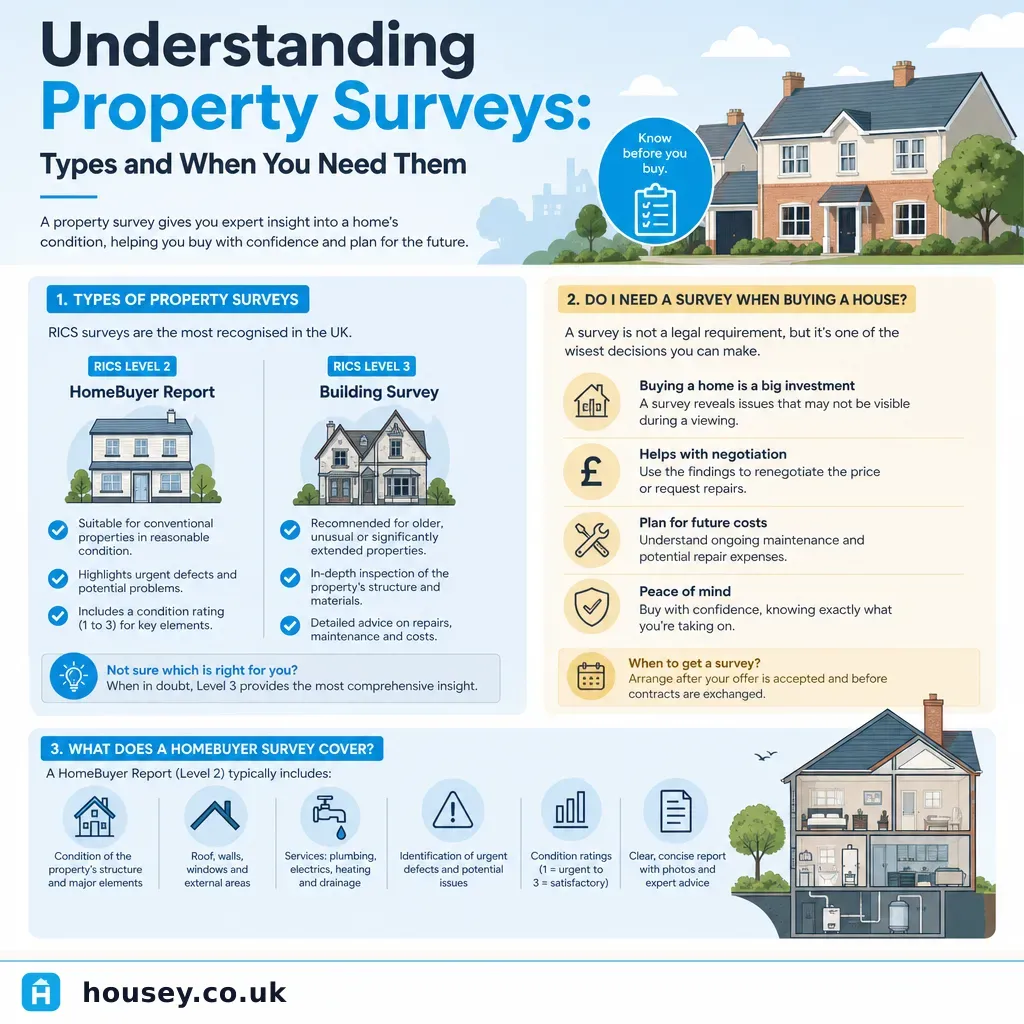
Understanding Property Surveys: Types and When You Need Them
Most buyers in England and Wales instruct a property survey between offer acceptance and exchange of contracts — a window when the right information can prevent costly surprises or support a price renegotiation. Yet the range of available survey types frequently creates genuine confusion about which product is appropriate and what it will actually cover. Scotland operates a different system, with the Home Report required at the point of listing, but the principles of understanding what a survey tells you apply across the UK.
Key points
- RICS unified its residential survey framework in 2021: the Level 1 Condition Report, Level 2 Home Survey, and Level 3 Building Survey replaced previous branding including the Homebuyer Report and Full Structural Survey.
- A RICS Level 3 Building Survey is strongly recommended for properties built before 1920, those with non-standard construction (timber frame, concrete panels, thatched roofs), and any property where defects are visible at viewing.
- Surveyors must hold RICS chartered status or be registered with the Residential Property Surveyors Association (RPSA); always verify credentials before instructing.
- A specific defect survey focuses on a single identified issue — such as cracking, damp, or roof condition — and is commonly commissioned after a general survey flags a concern requiring specialist investigation.
- A measured building survey produces accurate floor plans, sections, and elevations for architectural or planning use; it is a spatial record, not a condition inspection, and does not report on defects.
RICS survey levels compared
Survey type | Best for | Not ideal for | Typical output | Indicative cost (2024) |
|---|---|---|---|---|
RICS Level 1 — Condition Report | New-build, recently renovated, or very standard properties in good condition | Older, complex, or problem properties | Traffic-light condition ratings only | £250–£400 |
RICS Level 2 — Home Survey | Conventional homes in reasonable condition, typically post-1920 | Properties with visible defects, unusual construction, or significant alterations | Condition ratings, defects identified, repair advice | £400–£800 |
RICS Level 3 — Building Survey | Pre-1920 properties, non-standard construction, visible defects, major alterations | None — it is the most comprehensive general option | Detailed defect analysis, likely causes, repair options | £600–£1,500 |
Specific defect survey | Single identified concern (e.g. crack, damp, roof) | Whole-property condition assessment | Focused technical report on one issue | £250–£600 |
Measured building survey | Planning applications, architectural drawings, space planning | Condition or defect identification | Accurate floor plans, sections, elevations in CAD | £500–£2,000+ |
Indicative UK costs, last reviewed 2026-05-30. Costs vary by location, property size, and surveyor firm. Source: RICS, RPSA.
Which survey do you need?
- Choose a RICS Level 1 if the property is a new-build within its NHBC Buildmark warranty period, a recently converted flat, or a straightforward modern property with no visible concerns.
- Choose a RICS Level 2 if the property is a post-1920 brick or brick-and-block home in broadly standard condition — a 1930s semi, 1960s estate house, or 1990s build — with no obvious structural concerns or significant alterations.
- Choose a RICS Level 3 if the property is pre-1920 (particularly pre-1919 solid-wall construction), a listed building, a converted building (barn, church, or warehouse), shows any cracking, damp, or movement at viewing, or has had significant alterations including loft conversions, extensions, or internal wall removals.
- Commission a specific defect survey if a general survey has already flagged a concern — say, 'possible movement to the rear extension' — and you need a specialist opinion before deciding whether to proceed and at what revised price.
- Commission a measured building survey if you are planning to extend, convert, or alter the property and your architect or planning consultant needs accurate existing floor plans and elevations as a base for design drawings.
- Ask your surveyor directly if you remain unsure: a brief conversation about the property's age, type, and any visible concerns will usually confirm the right level.
What a survey does and does not cover
A common source of buyer disappointment is misunderstanding what a survey actually inspects. RICS Level 2 and Level 3 surveys are visual inspections — the surveyor does not lift floorboards, move furniture, test electrics, or open closed service ducts. They also do not include drainage surveys, specialist asbestos testing, or gas and electrical condition reports.
Typically within scope:
- Structural condition of walls, roof, floors, and foundations (visible elements only)
- Damp and moisture ingress
- Condition of windows, doors, and external joinery
- Chimney stacks and flashings
- Drainage (visual only, at inspection chambers if accessible)
- Signs of alteration and whether building regulations appear to have been followed
Typically requiring a separate specialist:
- Drainage CCTV survey (strongly advisable on pre-1970 properties)
- Electrical Installation Condition Report (EICR)
- Gas Safety Certificate (if not provided by the seller)
- Asbestos survey (if the property was built or significantly altered before 2000)
- Structural engineer's report (for diagnosed or suspected foundation movement)
Red flags that suggest stepping up to a higher survey level
If any of the following apply, consider instructing a Level 3 rather than a Level 2, or supplementing a general survey with a specific defect or specialist report:
- Diagonal or stepped cracking in external brickwork or blockwork
- Sloping or noticeably uneven floors
- Signs of past or current damp on internal walls or ceilings
- Obvious alterations with no building regulations completion certificate disclosed
- Bulging or bowing external walls
- A roof line that appears to sag or deflect between supports
- Missing leadwork or visible weathering to chimney stacks and flashings
- Any indication the property sits in an area with a history of mining, clay shrinkage, or subsidence
When to get professional help
A survey is itself professional help — but some findings prompt a further step:
- If your surveyor flags potential structural movement, instruct a structural engineer to provide an independent diagnosis before you exchange contracts
- If the report notes 'probable asbestos-containing materials', arrange a specialist asbestos survey before any works begin
- If you are buying a leasehold flat and the survey identifies building fabric concerns, ask your solicitor to investigate whether a major works programme is planned — this could result in a significant service charge demand shortly after purchase
How Housey can help
Housey connects you with RICS-qualified surveyors for RICS Level 2 surveys and RICS Level 3 surveys on all property types across the UK. Where a focused opinion is what you need, specific defect surveys are also available through the platform. If you require accurate plans for a planning application or renovation project, measured building surveys can be arranged with verified RICS-accredited practices.
Frequently asked questions
Can I rely on the mortgage valuation instead of commissioning a survey?
A mortgage valuation is carried out for the lender, not the buyer, and is not a structural inspection. It confirms the property provides adequate security for the loan but will not identify damp, roof defects, or structural movement in any detail. Most lenders explicitly state buyers should not rely on the valuation for their own purposes. Commissioning a separate survey before exchange is strongly advisable.
When in the buying process should I instruct a survey?
Instruct a survey after your offer has been accepted and both parties are proceeding, but before you exchange contracts. Ideally, do so before your solicitor completes all searches, so that any issues identified can be raised, investigated, or reflected in a price renegotiation before you are legally committed. Most surveyors can be booked within a few days of offer acceptance and return reports within 5–10 working days.
What happens if the survey reveals problems?
Survey findings do not automatically end a transaction. Common responses include renegotiating the asking price to reflect repair costs, requesting the seller addresses specific defects before exchange, proceeding on the basis of the surveyor's cost guidance, or — where problems are serious — withdrawing before exchange. Your surveyor can usually advise on the relative severity of findings and whether specialist follow-up reports are needed.
Is a property survey compulsory when buying in England and Wales?
No survey is legally required for a buyer in England and Wales. However, property defects can cost tens of thousands of pounds to remediate, and a survey is one of the most cost-effective ways to understand what you are buying before you are legally committed. Omitting a survey is a significant financial risk, particularly for older, extended, or visibly defective properties.
Sources and further reading
Useful next reads
 Surveys & Inspections
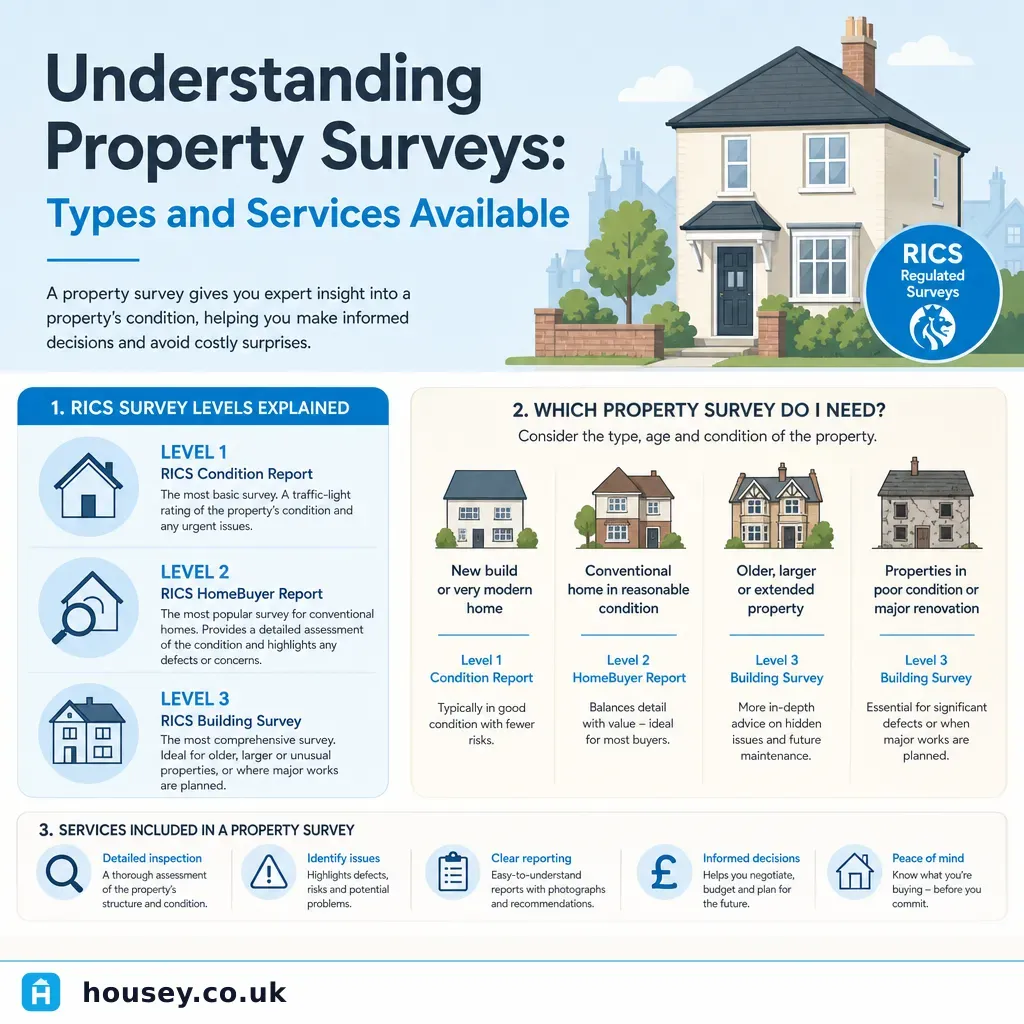
Understanding Property Surveys: Types and Services Available
UK property surveys follow three RICS-defined levels: Level 1 (Condition Report), Level 2 (Home Survey), and Level 3 (Building Survey).
 Surveys & Inspections
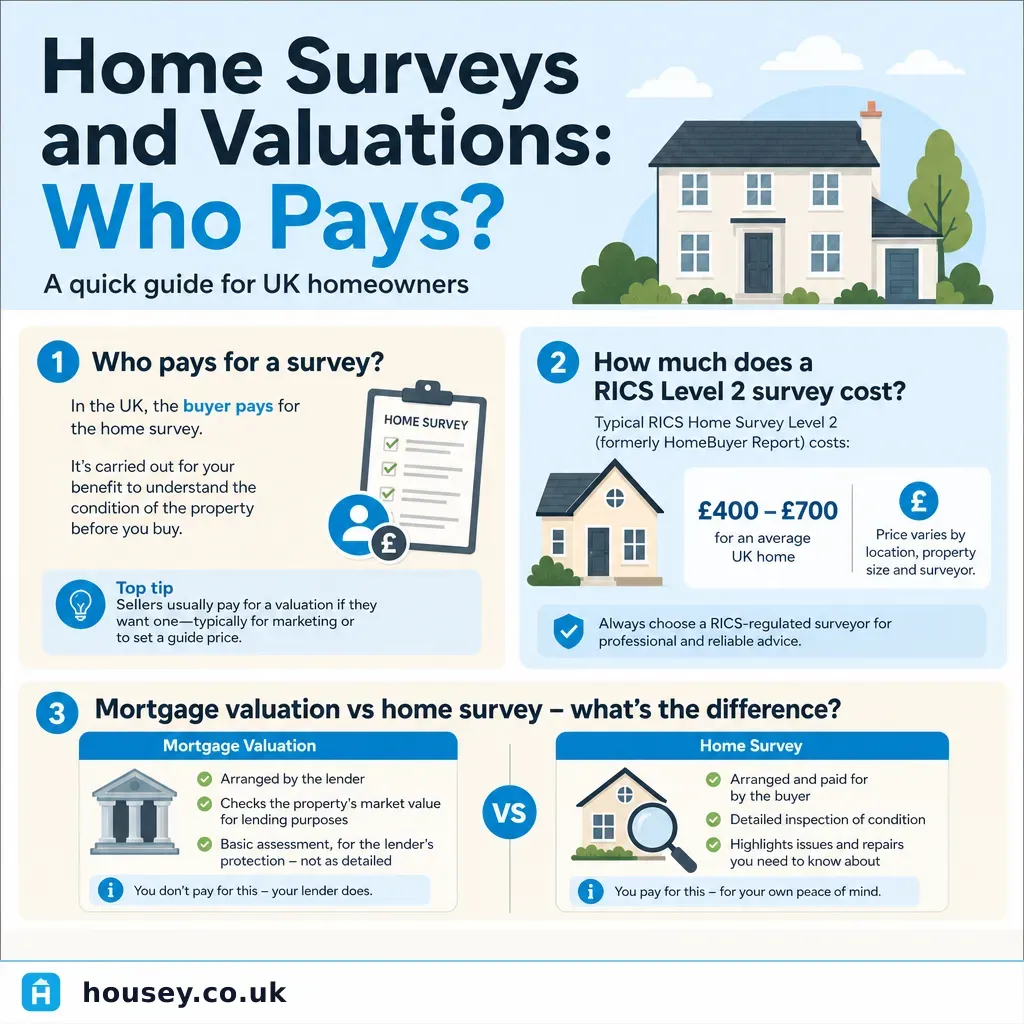
Home Surveys and Valuations: Who Pays?
In the UK, the buyer almost always pays for their own home survey.
 Surveys & Inspections
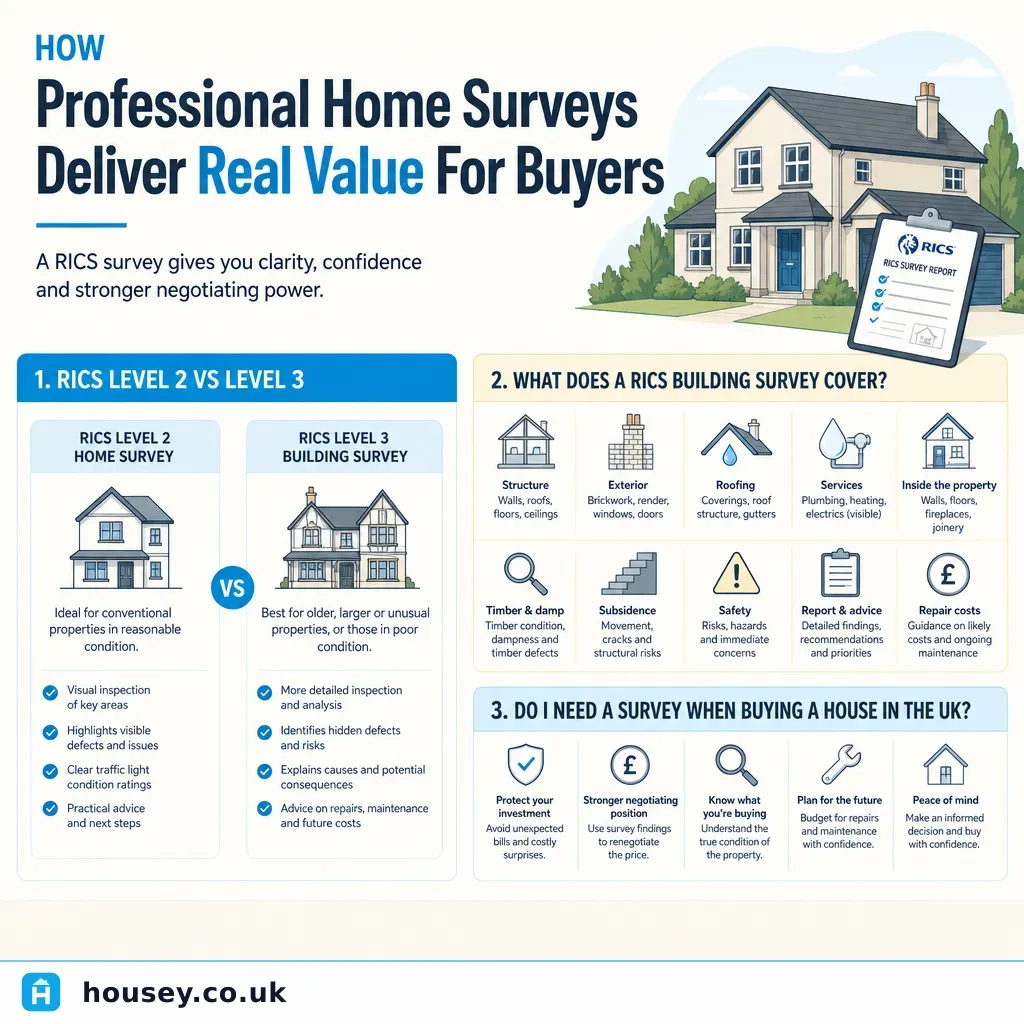
How Professional Home Surveys Deliver Real Value For Buyers
A professional home survey by a RICS-registered surveyor can identify defects, legal compliance gaps, and cost liabilities before exchange of contracts, giving buyers an evidence base for negotiation or withdrawal.
 Surveys & Inspections
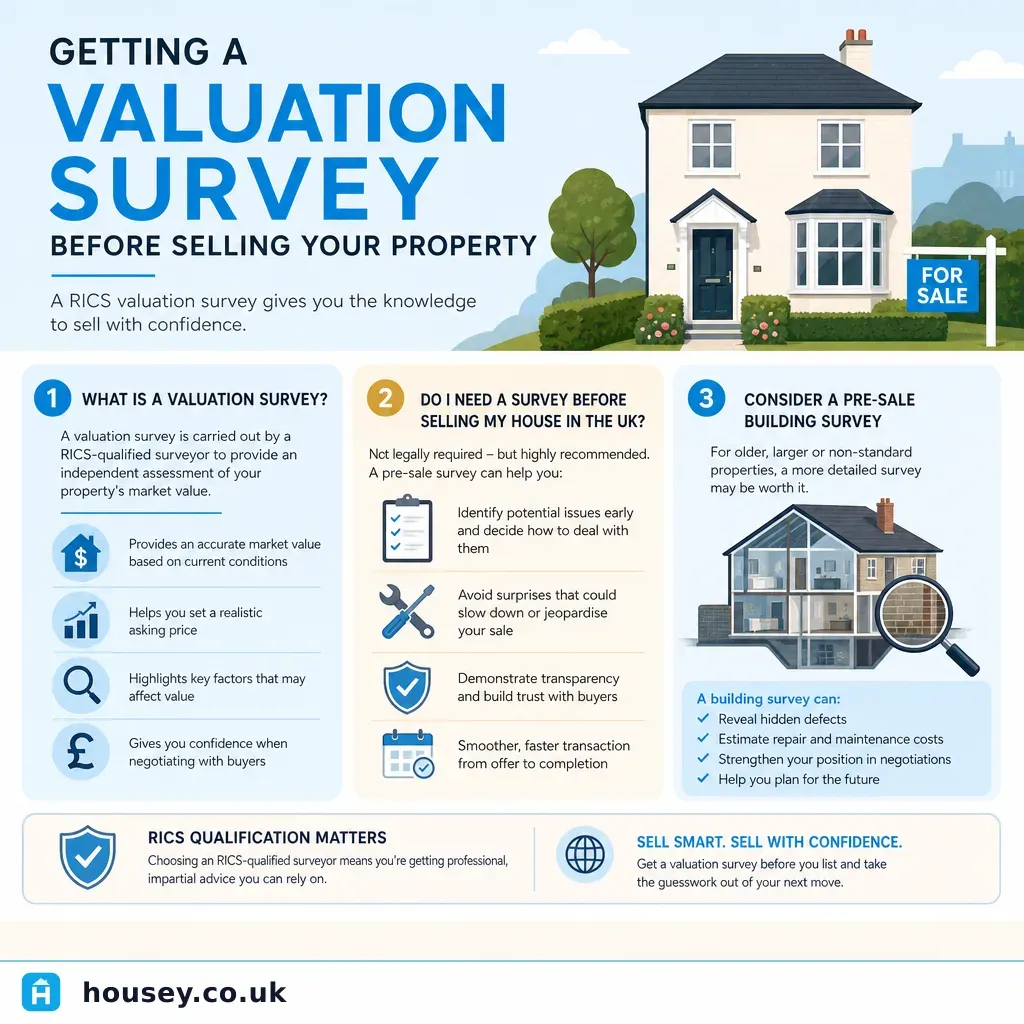
Getting a Valuation Survey Before Selling Your Property
Before selling, a free estate agent appraisal gives a market price guide, but only a RICS Red Book valuation carries formal professional standards and legal weight.
 Surveys & Inspections
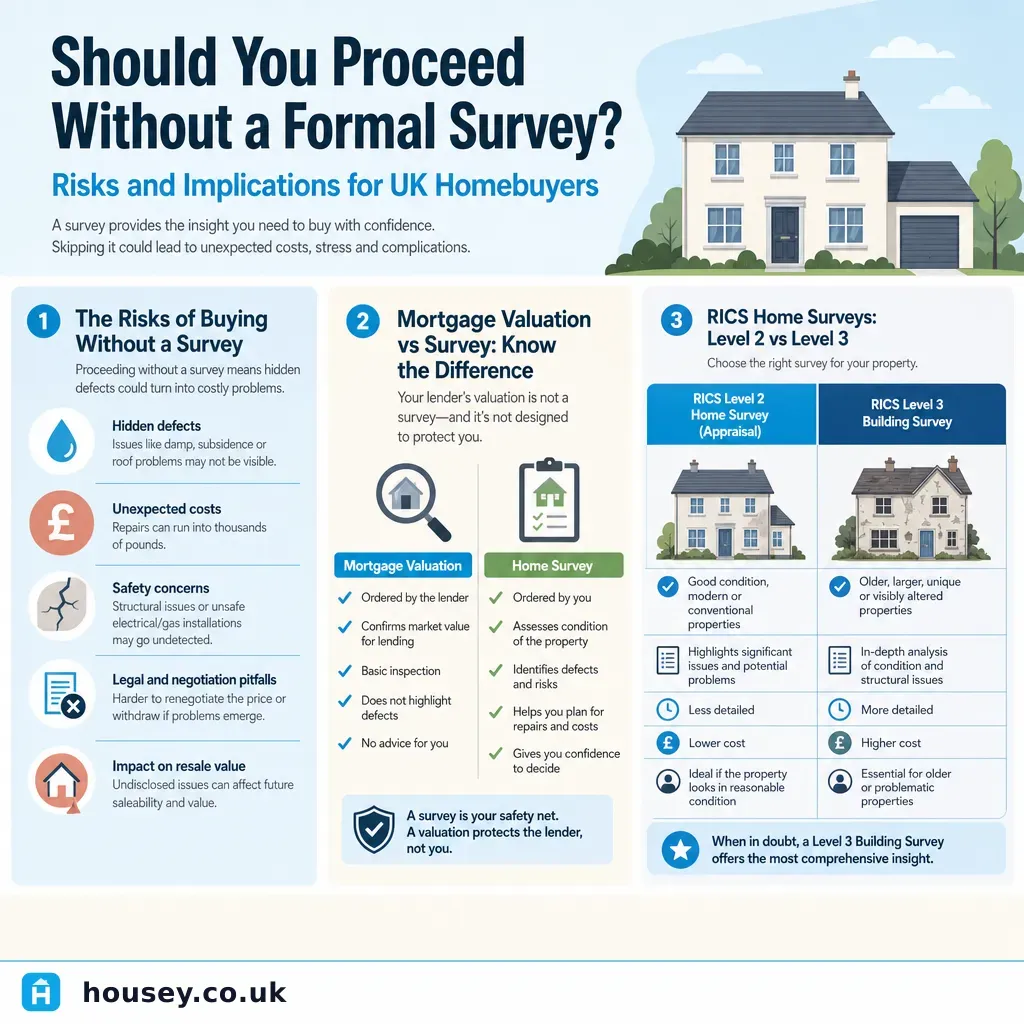
Should You Proceed Without a Formal Survey? Risks and Implications
In England and Wales there is no legal requirement to obtain a survey before exchange, but caveat emptor means any undisclosed defects become your problem the moment contracts are exchanged.