Building Without Planning Permission: Size Thresholds and Permitted Development
By Housey · Last reviewed 4th of May 2026
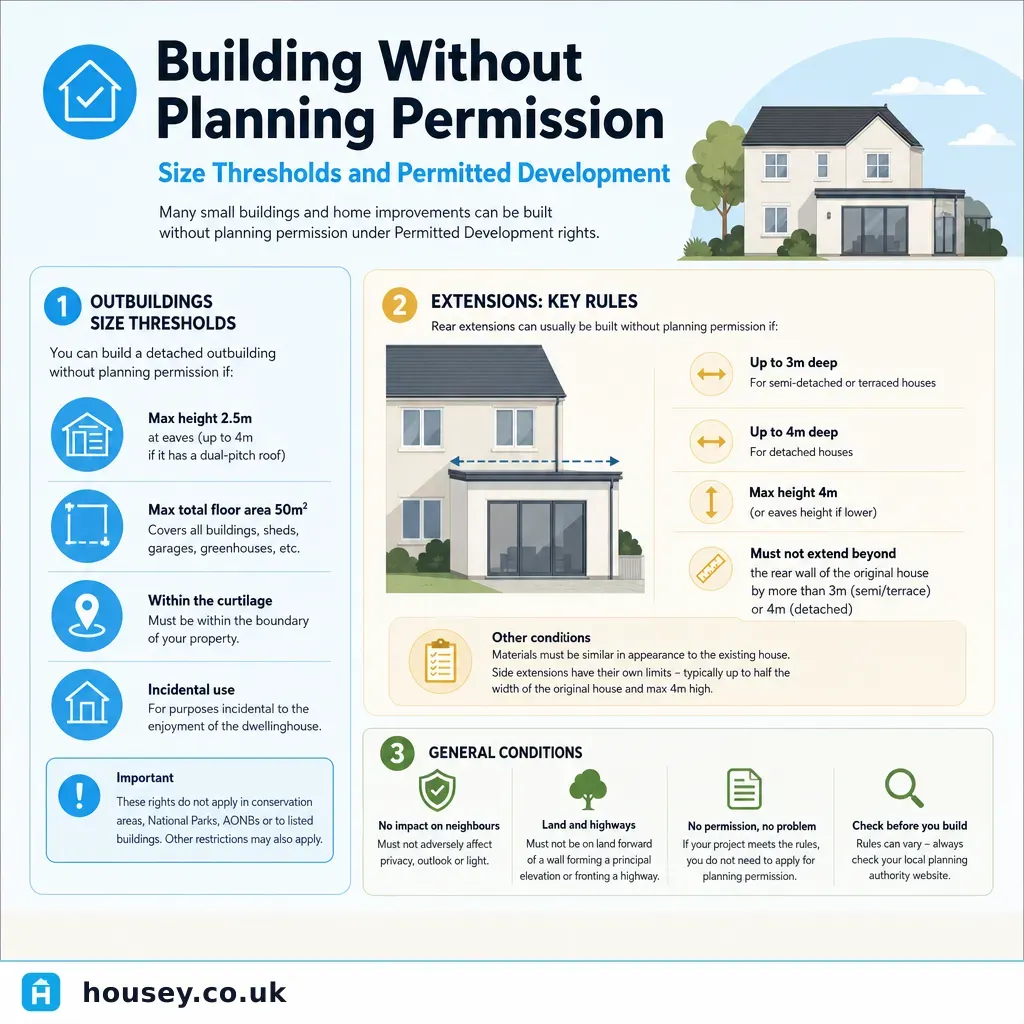
Building Without Planning Permission: Size Thresholds and Permitted Development
Many homeowners are surprised to learn that significant building work on a standard UK house can go ahead without a planning application, provided it falls within legally defined size thresholds. These permitted development rights are set out in national legislation and can allow everything from rear extensions to loft conversions and garden offices without any interaction with the local planning authority — but the thresholds are specific, the exceptions are numerous, and confusing planning rules with building regulations can lead to costly mistakes.
Key points
- Permitted development rights in England are primarily established by the Town and Country Planning (General Permitted Development) (England) Order 2015 (GPDO 2015), as amended.
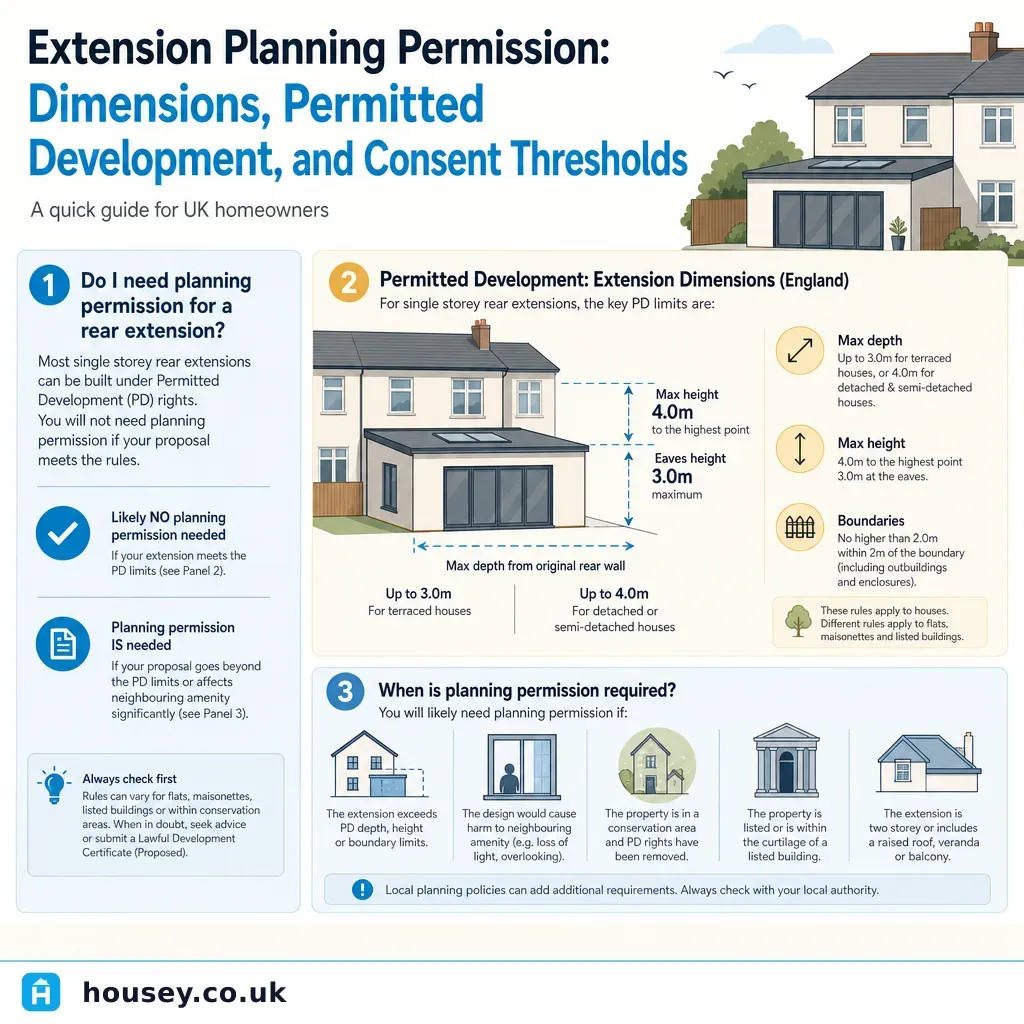
- Single-storey rear extensions can be built without prior approval up to 4m deep on a detached house, or 3m deep on any other house type; the Larger Home Extension scheme allows up to 8m or 6m respectively, subject to a 42-day neighbour consultation.
- Loft conversions can add up to 50 cubic metres of additional roof space on a detached house (40 cubic metres for semi-detached or terraced houses) under permitted development.
- Outbuildings and garden structures are permitted provided total outbuilding footprint does not exceed 50% of the original garden and height limits are respected.
- Permitted development rights do not apply to flats, maisonettes, or listed buildings, and can be removed by Article 4 Directions or by conditions attached to the original planning permission for a property.
What is permitted development?
Permitted development (PD) is a set of rights granted by Parliament that allows certain types of building work on houses to proceed without a planning application. The rights are established nationally by the GPDO 2015, but local planning authorities (LPAs) can restrict or remove them in specific areas through Article 4 Directions or via conditions attached to a property's planning history.
Permitted development applies to dwelling houses only. Flats, maisonettes, commercial buildings, and listed buildings are not covered by householder permitted development rights — any significant external works to these will typically require a planning application.
Key size thresholds by project type
Rear extensions (Class A)
House type | Without prior approval | With prior approval (Larger Home Extension scheme) |
|---|---|---|
Detached house | Up to 4m deep | Up to 8m deep |
Semi-detached or terraced house | Up to 3m deep | Up to 6m deep |
All rear extensions under permitted development must also be no taller than 4m (single-storey); must not extend beyond the side wall of the original house; must not be forward of the principal elevation; and should use materials of similar appearance to the existing house.
The Larger Home Extension scheme requires notification to the LPA and a 42-day neighbour consultation period. If no objection is upheld, work can proceed. This is a prior approval process, not a full planning application.
Side extensions (Class A)
Side extensions are permitted development only if they are single-storey, no wider than half the original house, and no more than 4m tall. Two-storey side extensions require full planning permission.
Loft conversions (Class B)
House type | Maximum additional volume under permitted development |
|---|---|
Detached house | 50 cubic metres |
Semi-detached or terraced house | 40 cubic metres |
The conversion must not protrude above the existing roof slope on the principal (front) elevation. Dormers on the rear can be permitted development; dormers on the front elevation facing a highway generally require planning permission.
Outbuildings and garden structures (Class E)
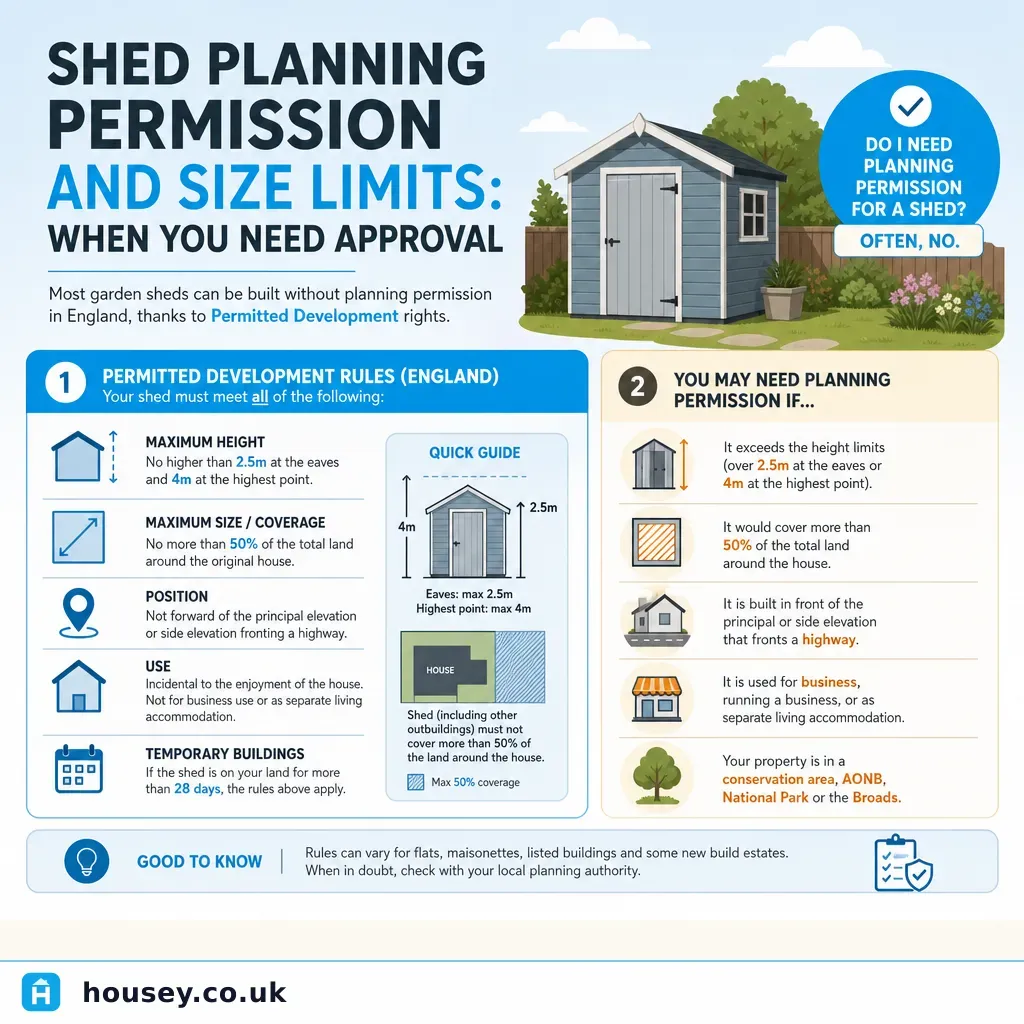
- Maximum eaves height of 2.5m if within 2m of any boundary; 4m (dual-pitched roof) or 3m (any other roof type) if more than 2m from any boundary.
- Total footprint of all outbuildings must not exceed 50% of the original garden area.
- Structures must be within the curtilage of the house and not forward of the principal elevation.
- Structures intended for human habitation require planning permission regardless of size.
Porches (Class D)
A porch may be added without planning permission if: the ground area does not exceed 3 square metres; it is no taller than 3m; and it is more than 2m from any highway boundary.
When does permitted development not apply?
Listed buildings: Works affecting the character of a listed building — inside or outside — require listed building consent in addition to any planning permission. Householder permitted development rights do not apply to listed buildings.
Flats and maisonettes: Householder permitted development rights apply to houses only. Any significant external works to flats or maisonettes typically require planning permission.
Article 4 Directions: An LPA can remove permitted development rights in a defined area using an Article 4 Direction. These are common in conservation areas, historic streets, and regeneration zones. Check your local council's planning portal before starting work.
Planning conditions on the property: The original planning permission for your home may include conditions removing permitted development rights — particularly common on new-build estates. Check the property's planning history on your council's planning search tool.
Conservation areas, AONB, National Parks, World Heritage Sites: These designated areas attract additional restrictions, particularly for side extensions, outbuildings in side gardens, and roof alterations visible from the road.
Building regulations: a separate requirement
Planning permission (or permitted development) determines whether you are allowed to build. Building regulations govern how the work must be carried out — covering structural integrity, fire safety, energy performance, drainage, and ventilation. These are two entirely separate systems, and permitted development status does not exempt you from building regulations.
Projects that are commonly permitted development but still typically require building regulations approval include:
- Extensions of any size
- Loft conversions
- Garage conversions to habitable space
- New electrical circuits
- Replacement windows and doors (unless installed by a FENSA-registered contractor)
Your local building control body or an approved inspector will issue a completion certificate once work passes inspection. Keep this documentation — it is important evidence for future property sales and mortgage applications.
Decision tree: do you need planning permission?
- Is your home a flat, maisonette, or listed building? → You will almost certainly need planning permission. Contact your LPA before starting.
- Does your property have an Article 4 Direction or conditions removing PD rights? → Check your council's planning portal. If yes, a planning application is likely required.
- Is your home in a conservation area, National Park, AONB, or World Heritage Site? → Permitted development is more restricted. Verify with your LPA before starting work.
- Is your project a single-storey rear extension within the depth limits? → Likely permitted development under Class A. Check all conditions in GPDO 2015.
- Is your project a loft conversion within the volume limits? → Likely permitted development under Class B. Verify front dormer position.
- Is your project an outbuilding within height and coverage limits? → Likely permitted development under Class E. Check boundary proximity.
- Is your project close to any threshold, or do you have any doubt? → A Certificate of Lawful Development provides formal certainty. A planning consultant can advise.
Red flags that suggest you need planning permission
- Your project involves adding more than one storey to the side of the house
- You live in a flat, maisonette, or purpose-built conversion
- The structure will be forward of the principal (front) elevation
- The extension or outbuilding would take total outbuilding coverage above 50% of the original garden
- You have received a letter from your local planning authority about the works
- Your property is in a conservation area and the works involve a side extension, front dormer, or visible roof alteration
- The building is intended for someone else to live in separately from the main house
- You are unsure whether previous extensions have already used up the permitted development allowance
Important limitations
This article covers permitted development rules in England only, as at May 2026. Scotland, Wales, and Northern Ireland each have separate legislation with different thresholds and rules. The GPDO 2015 is amended periodically — always verify against the current version on legislation.gov.uk. This guide is general information only and is not a substitute for professional planning advice or a formal pre-application enquiry with your local planning authority. The consequences of unlawful development can include enforcement notices, requirements to demolish or reinstate, and difficulties at the point of sale.
What to ask a qualified professional
If you are engaging a planning consultant or architect for a project near permitted development limits, consider asking:
- Does my property have any Article 4 Directions or conditions that restrict permitted development rights?
- Will my proposed works fall within permitted development, or do I need a planning application?
- Would a Certificate of Lawful Development (CLD) be appropriate for my project?
- Do I also need building regulations approval, and which building control body should I notify?
- How do the rules change if I am in a conservation area, AONB, or other designated area?
- What documentation will I need when I come to sell or remortgage?
When to get professional help
Seek advice from a qualified planning consultant or architect if:
- Your project is at or near a permitted development size threshold.
- You are unsure whether previous works have used up your PD allowance.
- Your property has a complex planning history, including prior conditions or enforcement history.
- You want a Certificate of Lawful Development for certainty before or after work.
- A neighbour or council officer has raised concerns about the works.
- Your project involves a listed building or falls in a conservation area, AONB, or National Park.
How Housey can help
Permitted development rules are nuanced, and working out whether your project qualifies — or obtaining formal confirmation — often benefits from professional input. Housey can connect you with qualified specialists through our planning consultancy service for planning assessments and Certificate of Lawful Development applications, and through our building control consultants service to ensure your works meet building regulations requirements.
Frequently asked questions
What is the difference between planning permission and permitted development?
Planning permission is a formal grant from your local planning authority approving a specific project. Permitted development is a national right granted by Parliament allowing certain works to proceed without a planning application, provided size and location criteria in the GPDO 2015 are met. Permitted development does not exempt you from building regulations, which apply separately to most structural works.
Can I build a two-storey extension under permitted development?
Two-storey rear extensions can be permitted development in England under Class A, provided specific conditions are met: the extension must be no closer than 7m to the rear boundary, no taller than the original house's eaves, and the roof pitch should match the existing house. Two-storey side extensions require full planning permission regardless of size.
Does permitted development apply in Wales, Scotland, or Northern Ireland?
No — each devolved nation has its own planning legislation. Wales uses the Town and Country Planning (General Permitted Development) Order 1995 as amended for Wales; Scotland has its own Scottish GPDO; Northern Ireland has the Planning (General Development) Order (Northern Ireland) 2015. Thresholds and conditions differ significantly, so always check the relevant national guidance.
What is a Certificate of Lawful Development and when do I need one?
A Certificate of Lawful Development (CLD) is a formal document from the local planning authority confirming that works are lawful under permitted development or that enforcement time limits have passed. It is not compulsory but is increasingly expected by buyers and mortgage lenders when a property has been extended or altered. Applications are made via the Planning Portal.
Do I need building regulations approval even if planning permission is not required?
Often, yes. Building regulations apply to most structural works — extensions, loft conversions, garage conversions to habitable space, and certain electrical and drainage works — regardless of whether planning permission is required. A completion certificate from building control is important evidence at the point of sale and may be required by mortgage lenders.
Sources and further reading
- Town and Country Planning (General Permitted Development) (England) Order 2015 — legislation.gov.uk
- Planning Portal: House extensions — Planning Portal
- GOV.UK: Planning permission — GOV.UK
- GOV.UK: Building regulations approval — GOV.UK
- Planning Portal: Lawful Development Certificate — Planning Portal
Useful next reads
 Planning & Pre-Build
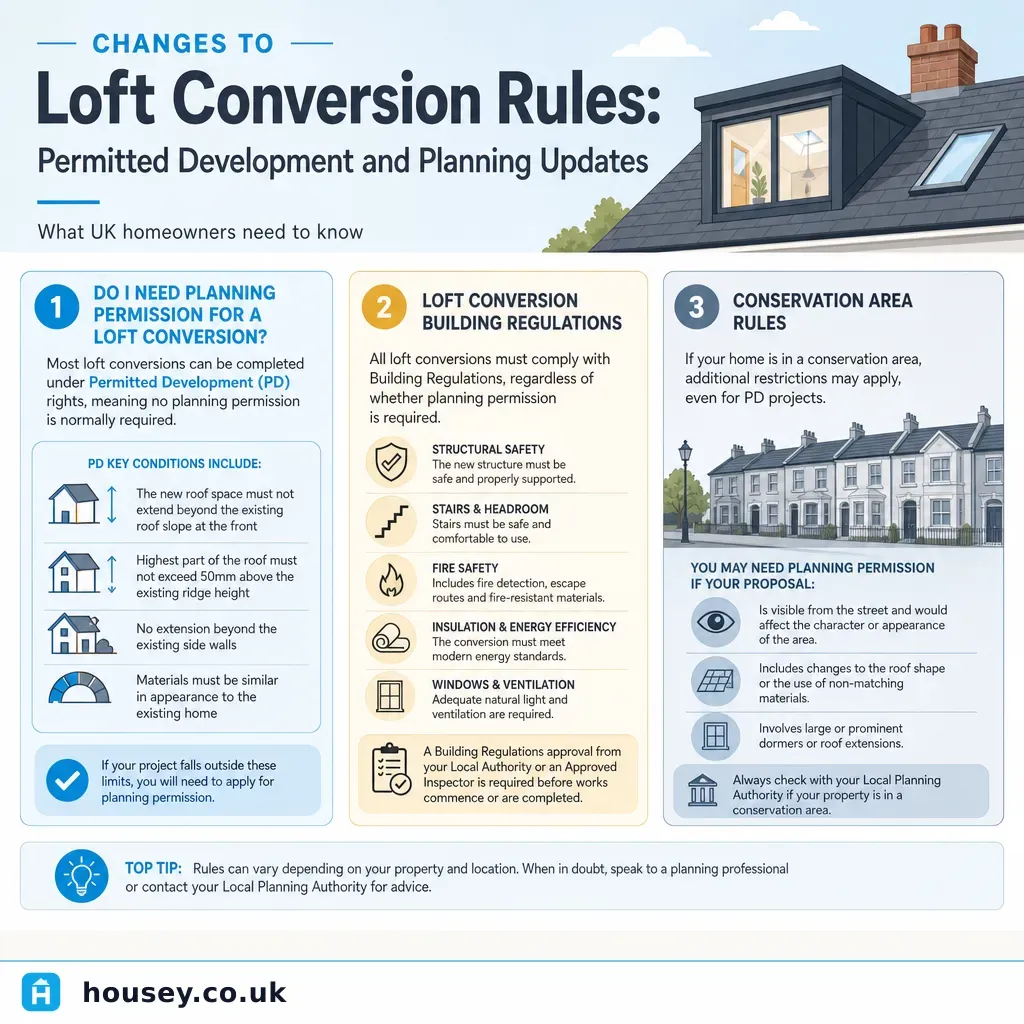
Changes to Loft Conversion Rules: Permitted Development and Planning Updates
In England, most loft conversions on standard houses qualify as Permitted Development under Class B of the GPDO 2015, allowing up to 40 cubic metres (terraced) or 50 cubic metres (detached or semi-detached) without a planning application — if conditions are met.
 Planning & Pre-Build
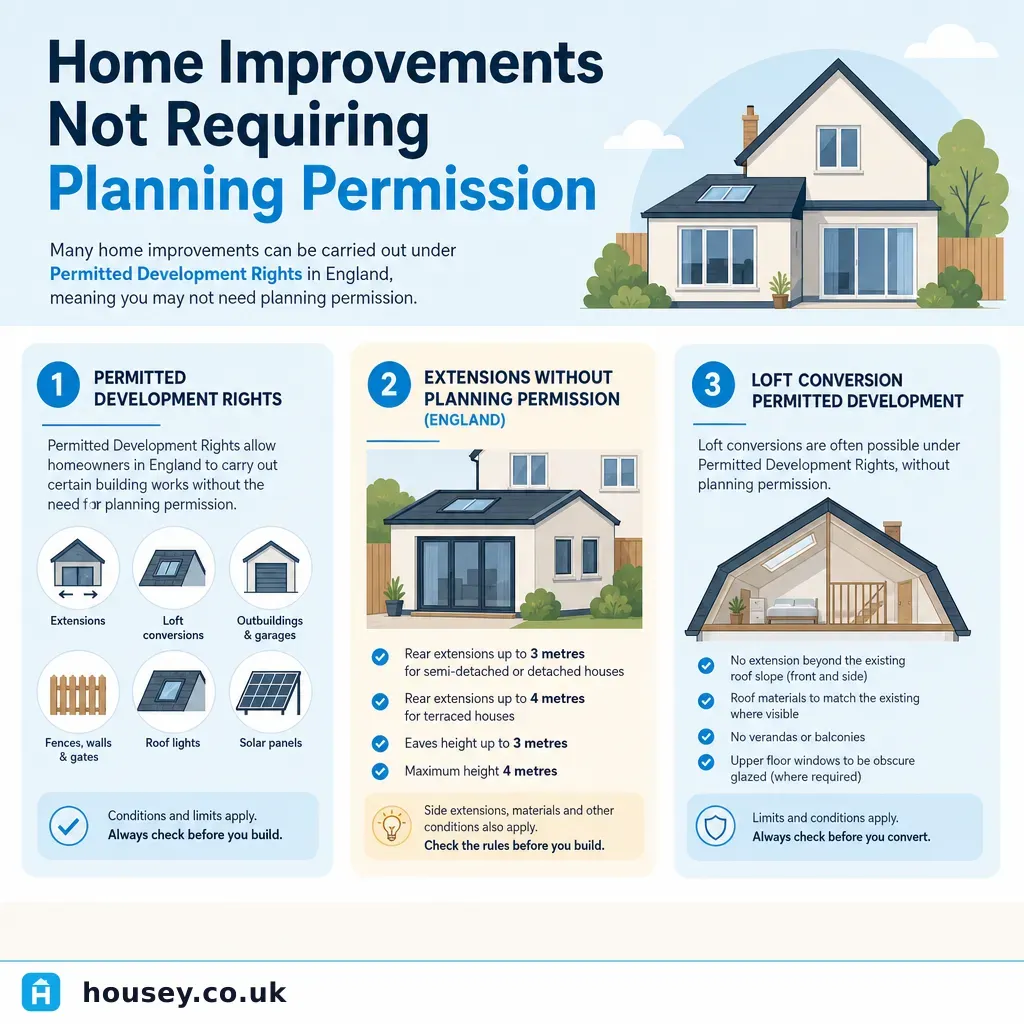
Home Improvements Not Requiring Planning Permission
Many common home improvements in England fall under Permitted Development Rights and do not require a planning application.
 Planning & Pre-Build
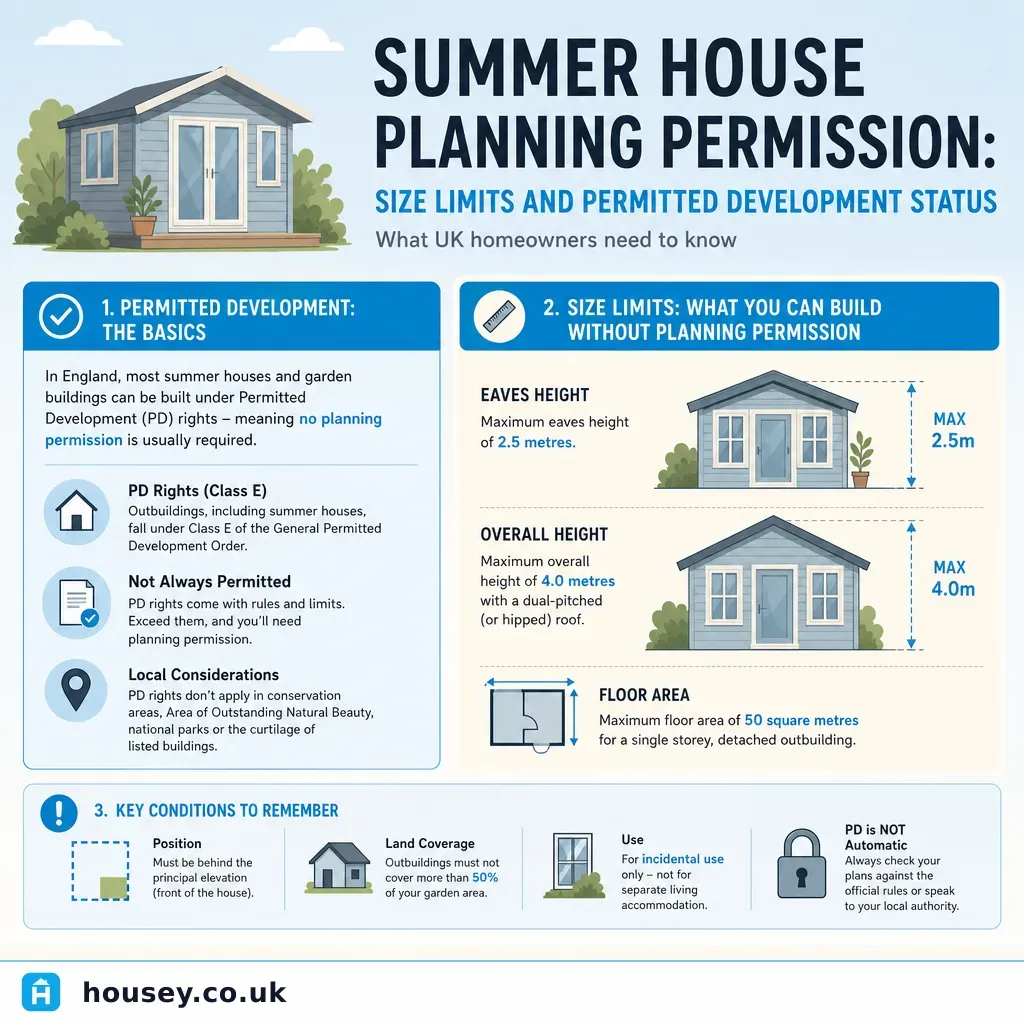
Summer House Planning Permission: Size Limits and Permitted Development Status
Most summer houses in England are permitted development if they are single-storey, sit behind the principal elevation, stay within height limits (2.
 Planning & Pre-Build
Extension Planning Permission: Dimensions, Permitted Development, and Consent Thresholds
Single-storey rear extensions up to 4m (detached) or 3m (other houses) are usually permitted development in England without planning permission.
 Planning & Pre-Build
Shed Planning Permission and Size Limits: When You Need Approval
Most garden sheds in England fall under Class E permitted development rights and do not need planning permission, provided they are single-storey, behind the principal elevation, within height limits for their boundary distance, and combined outbuilding coverage does not exceed 50% of the original curtilage.