Changes to Loft Conversion Rules: Permitted Development and Planning Updates
By Housey · Last reviewed 19th of May 2026
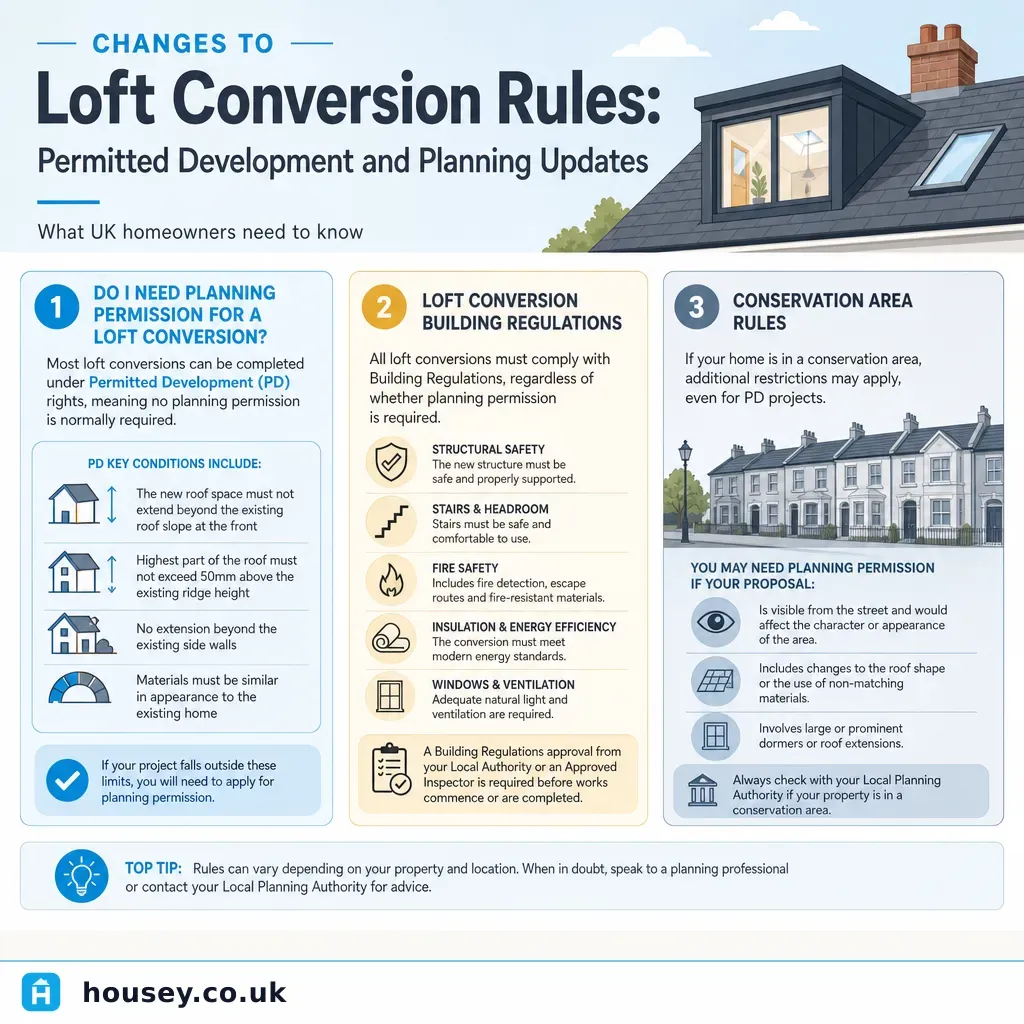
Changes to Loft Conversion Rules: Permitted Development and Planning Updates
Loft conversions remain one of the most popular ways to add a bedroom, office, or living space to a UK home without the cost and disruption of moving. The rules governing when you need planning permission — and when Permitted Development rights apply — have been subject to ongoing policy discussion as the government pursues its housing delivery targets. Whether you own a 1930s semi in a suburban street or a Victorian terrace in a conservation area, understanding the current rules and their practical limits is essential before instructing an architect or contractor.
Key points
- Under Schedule 2, Part 1, Class B of the Town and Country Planning (General Permitted Development) (England) Order 2015 (GPDO), homeowners can add up to 40 cubic metres of additional roof space for terraced houses, or 50 cubic metres for detached and semi-detached houses, without a full planning application.
- Permitted Development rights are removed or restricted for listed buildings, Conservation Areas, National Parks, Areas of Outstanding Natural Beauty (AONBs), and properties subject to an Article 4 Direction.
- Building regulations approval is required for all loft conversions regardless of planning status — covering structural integrity, fire safety (including protected escape routes), thermal performance (Part L), and staircase requirements.
- The government's Planning and Infrastructure Bill (introduced to Parliament in 2025) signals continued reform of the planning framework, with housing density in existing residential areas an explicit policy objective.
- Permitted Development rules are devolved: Class B of the GPDO applies in England only; Scotland, Wales, and Northern Ireland have separate planning regulations.
What the current rules allow: Permitted Development for loft conversions
Class B of the GPDO 2015 allows homeowners to enlarge a roof without a full planning application, subject to specific conditions. Class C covers rooflights and skylights, with fewer restrictions.
Class B conditions include:
- Volume limits: 40 cubic metres for terraced houses; 50 cubic metres for detached and semi-detached houses (cumulative — including any previous enlargements)
- The enlargement must not exceed the highest part of the existing roof
- No verandas, balconies, or raised platforms
- Side-facing windows must be obscure-glazed and non-opening below 1.7m from floor level
- Materials must be similar in appearance to the existing house
- The dormer must not extend beyond the existing roof slope on the principal elevation
These conditions mean that hip-to-gable conversions and rear dormers on most standard UK houses fall within Permitted Development. Front dormers that project beyond the existing roof slope on the principal elevation will require full planning permission in most circumstances.
Where Permitted Development does not apply
Even if your property type meets the criteria, Permitted Development rights may be unavailable in certain situations:
Situation | Planning position |
|---|---|
Listed building (any grade) | PD does not apply; Listed Building Consent required in addition to planning permission |
Conservation Area | Roof enlargements require full planning permission |
National Park or AONB | Reduced or removed PD rights; check with the relevant authority |
Article 4 Direction in place | LPA has removed PD rights; check local planning records |
Previous extensions have used the volume allowance | The 40/50 cu m limit is cumulative across all roof additions |
Flat or maisonette | Class B does not apply to flats or maisonettes |
Property subject to conditions removing PD rights | Check the original planning consent documents |
If your property falls into any of these categories, a full planning application will be required.
Building regulations: always required
One of the most commonly misunderstood points: building regulations approval is required even when the project qualifies as Permitted Development. The building control process covers:
- Structural integrity of the new floor, steel beams, and connections to the existing roof
- A protected escape route — typically a new staircase with fire-resisting doors and mains-wired interlinked smoke alarms
- Thermal insulation performance (Approved Document L)
- Ventilation of the new habitable space (Approved Document F)
- Staircase dimensions, handrails, and headroom (Approved Documents K and M)
- Electrical installations where new circuits are added (Approved Document P)
Building regulations approval is obtained through your local authority building control (LABC) or a Registered Building Inspector under the Building Safety Act 2022. Your architect, architectural technologist, or loft conversion contractor should manage this process, but the homeowner holds ultimate legal responsibility.
The policy context: ongoing planning reform
The government has signalled continued reform of the planning system as part of meeting its housing delivery targets. Key context as of early 2025:
- Planning and Infrastructure Bill (2025): introduced with provisions to rationalise the planning framework and review permitted development thresholds. Expanding upward extensions in existing residential areas is within the bill's stated objectives.
- NPPF revision (December 2024): the updated National Planning Policy Framework strengthens the presumption in favour of sustainable development and raises housing land supply requirements for local authorities.
- Prior approval routes: some roof extensions can already proceed via a prior approval process rather than full planning permission. The government may expand these routes, but as of the date of this article, no changes to core Class B volume limits have been enacted.
Important: Policy discussions and legislative proposals should not be relied upon as confirmation that works are currently permitted. Always confirm the planning position with your local planning authority (LPA) or a qualified planning consultant before committing to a design.
Decision guide: which planning route applies?
- Use Permitted Development if: your property is a house (not a flat), it is not listed, not in a Conservation Area, AONB, or National Park, no Article 4 Direction applies, the proposed volume is within the 40/50 cu m limit, no balcony is proposed, and any dormer does not project beyond the principal roof slope.
- Apply for full planning permission if: your property is a flat or maisonette, is listed, is in a Conservation Area, an Article 4 Direction removes PD rights, or the proposed works exceed volume limits.
- Consider a prior approval application if: your specific proposal may qualify under an existing prior approval category — check with your LPA or a planning consultant.
- Obtain a Lawful Development Certificate (LDC) if: you want written confirmation from the LPA that proposed works are Permitted Development. This is strongly recommended and is almost always requested by conveyancers on a future sale.
- Ask a planning consultant if: the property has a complex planning history, is in or near a protected area, or you are uncertain which category applies.
Important limitations
This article provides general information about Permitted Development and planning rules for loft conversions in England as of 2026-05-19. Planning law is complex and depends on individual property history, location, local planning policy, and the specific design proposed.
Nothing in this guide constitutes planning advice for a specific property. Rules can differ between local planning authorities, and national policy is subject to change through legislation and statutory instruments. Always consult your local planning authority or a qualified planning consultant before committing to a design, instructing contractors, or submitting a building regulations application.
When this becomes urgent
- You have started work without checking the planning position — stop work immediately and contact your LPA; retrospective applications are possible but carry no guarantee of approval, and enforcement action can require demolition.
- Your conveyancer has raised a compliance query about a loft conversion — you will need a Lawful Development Certificate and building regulations completion certificate before exchange.
- You have received a planning enforcement notice — seek professional planning advice immediately; strict time limits to respond apply.
- Your property's listed building or conservation area status was not confirmed before works began — speak to a specialist planning consultant.
What to ask a qualified professional
Before instructing an architect, architectural technologist, or loft conversion contractor:
- Can you confirm whether my property has Permitted Development rights for the proposed works, or whether planning permission is required?
- Will you apply for a Lawful Development Certificate (LDC) before works start?
- Who will manage the building regulations application — local authority building control or a Registered Building Inspector?
- What structural work is needed and will you engage a structural engineer?
- How will fire escape compliance be achieved — will existing staircase doors need replacing?
- Does the party wall need to be addressed if my property is terraced or semi-detached?
- Under what circumstances could the quoted price increase?
When to get professional help
A qualified professional is needed for any loft conversion, regardless of scale. Even a simple rooflight conversion requires building regulations approval. Where the planning position is unclear:
- A planning consultancy can confirm the correct route and handle applications to your LPA.
- Architectural technologists or architects can produce technical drawings for planning and building control.
- A structural engineer must size the new floor structure, steel beams, and connections to the existing roof.
- A party wall surveyor may be required if the works affect a shared wall in a terraced or semi-detached property.
How Housey can help
Housey connects you with vetted professionals across every stage of a loft conversion. Our network includes planning consultancy specialists who can confirm your Permitted Development position and handle LPA applications, architectural technologists for technical drawings, loft conversion companies who manage the full build process, and providers of building regulations drawings for building control submissions.
Frequently asked questions
Do I need planning permission for a loft conversion?
Not always. Most standard loft conversions on houses in England fall within Permitted Development rights under Class B of the GPDO 2015 — provided volume limits are met, no front dormer projects beyond the principal roof slope, materials match the existing house, and the property is not listed or in a protected area. Building regulations approval is always required regardless of planning status.
What is a Lawful Development Certificate and do I need one?
A Lawful Development Certificate (LDC) is a formal document from the LPA confirming that proposed works are lawful as Permitted Development. It is optional but strongly recommended: it protects against future policy changes and conveyancers will typically require it on any future sale. The application fee is typically around half the cost of a standard planning application.
Does a loft conversion add value to my home?
Generally yes — adding a useable bedroom with an ensuite is among the most value-additive improvements in most UK markets. Industry guidance suggests a bedroom addition can add 10–20% to property value depending on location and property type, though this is not guaranteed. A RICS valuation before and after provides the most reliable assessment for your specific property.
Do Permitted Development rules apply in Scotland, Wales, and Northern Ireland?
No. Planning is a devolved matter. The Class B rules in this article apply in England only. Scotland, Wales, and Northern Ireland each have their own planning regulations and Permitted Development equivalents. Always check with the relevant planning authority for your nation before planning any loft conversion works.
Sources and further reading
- Loft conversion — Planning Portal — Planning Portal
- Town and Country Planning (General Permitted Development) (England) Order 2015 — legislation.gov.uk
- Planning permission — GOV.UK — GOV.UK
- Planning and Infrastructure Bill — Parliament — UK Parliament
- National Planning Policy Framework (December 2024) — GOV.UK
Useful next reads
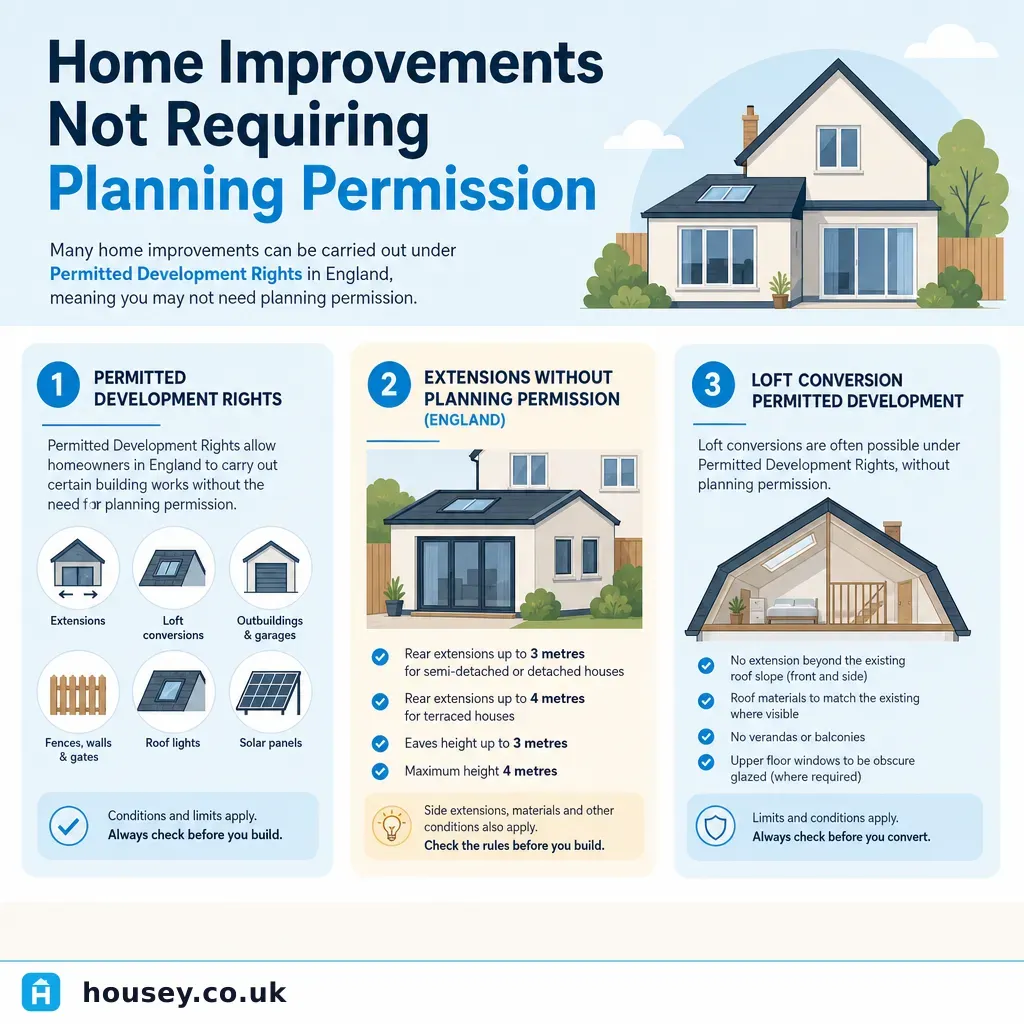 Planning & Pre-Build
Home Improvements Not Requiring Planning Permission
Many common home improvements in England fall under Permitted Development Rights and do not require a planning application.
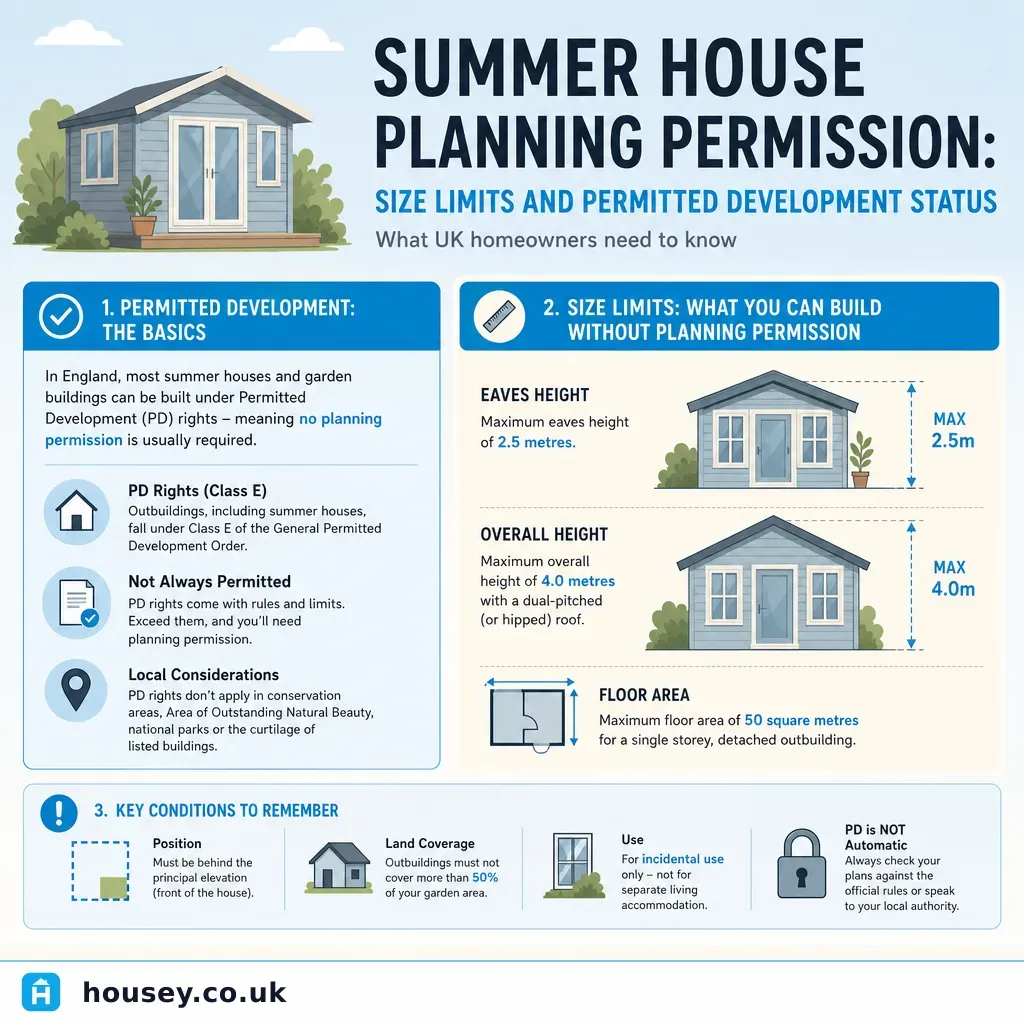 Planning & Pre-Build
Summer House Planning Permission: Size Limits and Permitted Development Status
Most summer houses in England are permitted development if they are single-storey, sit behind the principal elevation, stay within height limits (2.
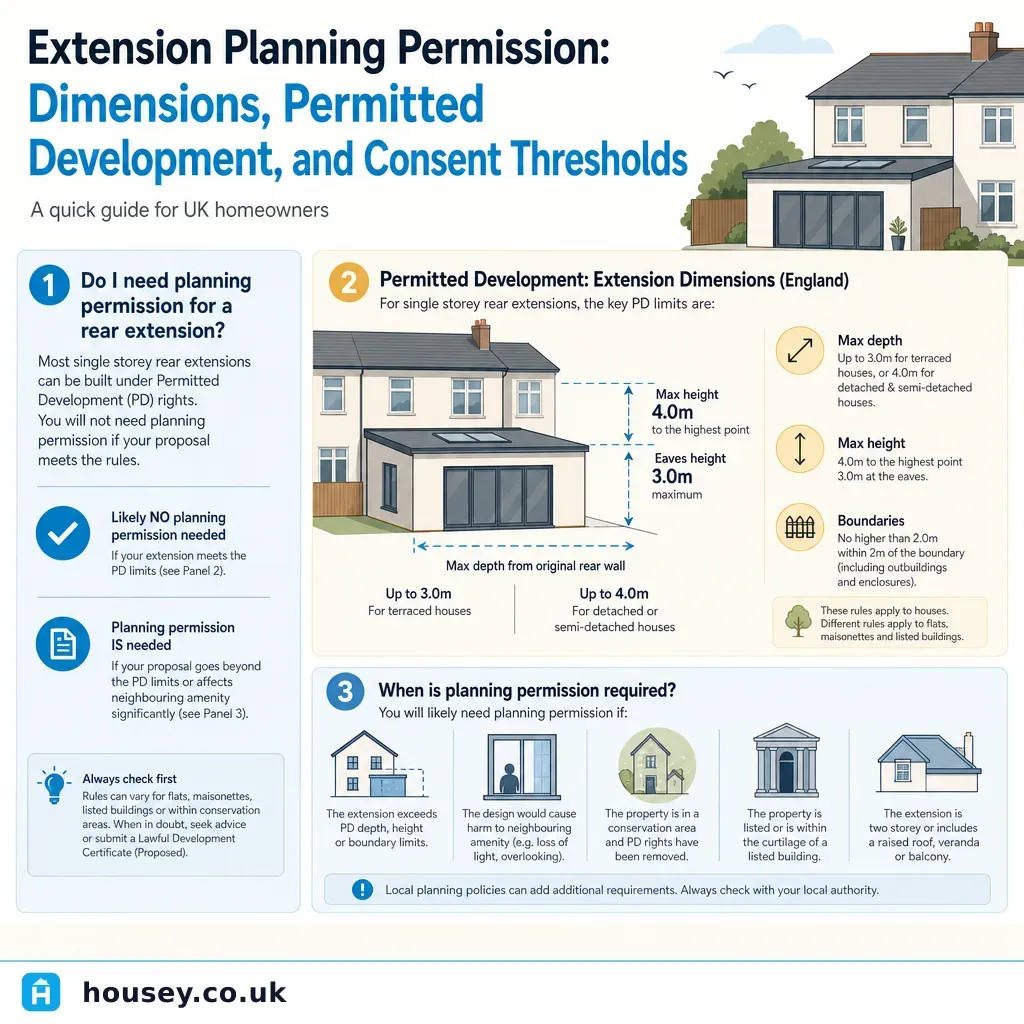 Planning & Pre-Build
Extension Planning Permission: Dimensions, Permitted Development, and Consent Thresholds
Single-storey rear extensions up to 4m (detached) or 3m (other houses) are usually permitted development in England without planning permission.
 Planning & Pre-Build
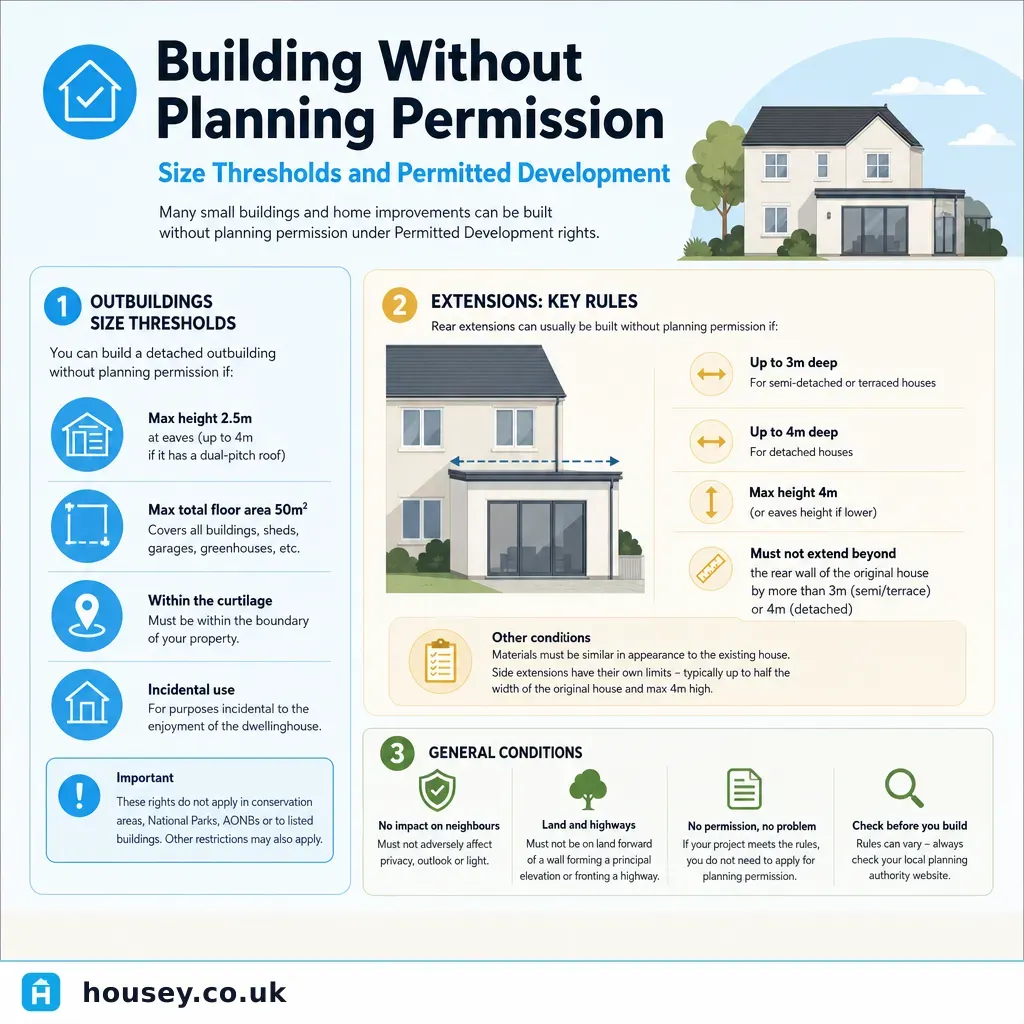
Building Without Planning Permission: Size Thresholds and Permitted Development
In England, most house extensions, loft conversions, and outbuildings can go ahead without planning permission under permitted development rights, provided size thresholds are met.
 Planning & Pre-Build
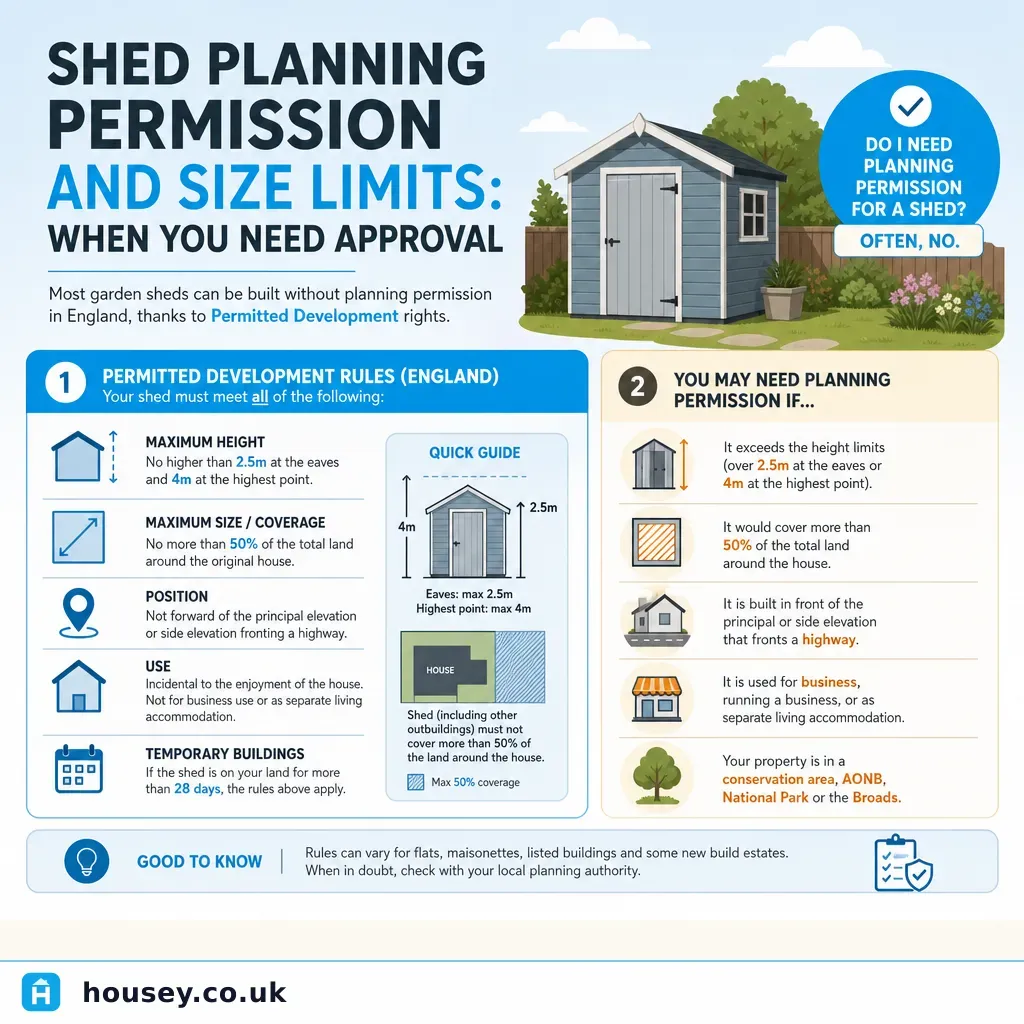
Shed Planning Permission and Size Limits: When You Need Approval
Most garden sheds in England fall under Class E permitted development rights and do not need planning permission, provided they are single-storey, behind the principal elevation, within height limits for their boundary distance, and combined outbuilding coverage does not exceed 50% of the original curtilage.