Extension Planning Permission: Dimensions, Permitted Development, and Consent Thresholds
By Housey · Last reviewed 4th of May 2026
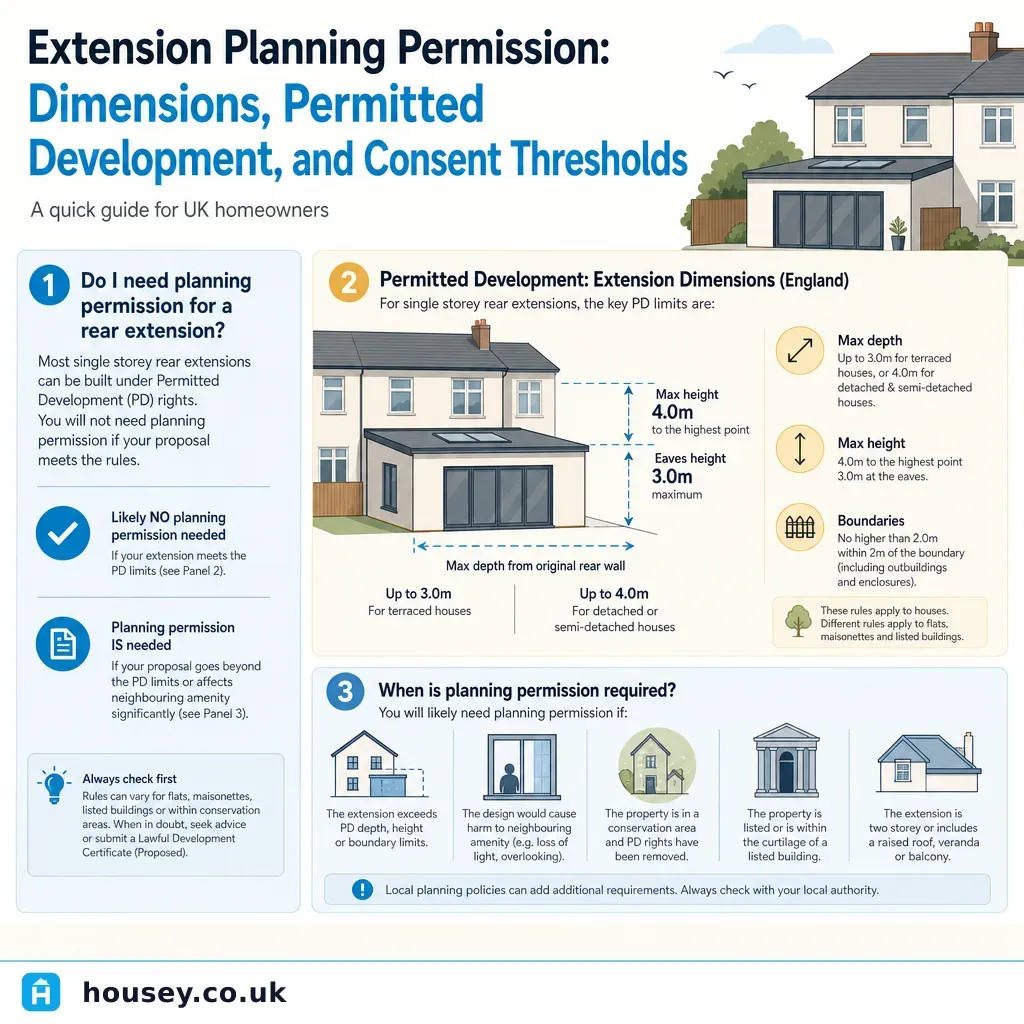
Extension Planning Permission: Dimensions, Permitted Development, and Consent Thresholds
Extending a home in England involves navigating two distinct regimes: Permitted Development (PD) rights, which allow certain extensions without a planning application, and full planning permission, which requires formal approval from the local planning authority (LPA). Getting the threshold wrong — building beyond PD limits without permission — can result in enforcement action, costly demolition orders, and complications at sale. In England, permitted development rules are set by national legislation but can be removed or restricted at a local level, making it important to verify your property's specific status before work begins.
Key points
- Under Schedule 2, Part 1, Class A of the Town and Country Planning (General Permitted Development) (England) Order 2015 (as amended), a single-storey rear extension can project up to 4 metres from the rear wall of a detached house, or 3 metres for any other house type, without planning permission.
- The Neighbour Consultation Scheme (Prior Approval Class A) allows single-storey rear extensions up to 8 metres (detached) or 6 metres (other houses), subject to a 42-day neighbour consultation process.
- Permitted Development rights do not apply to flats, maisonettes, listed buildings, or properties in Article 2(3) designated land, which includes conservation areas for certain types of work.
- Building Regulations approval is a separate legal requirement from planning permission and applies to almost all extensions regardless of PD status — covering structure (Part A), fire (Part B), energy efficiency (Part L), and drainage (Part H).
- PD thresholds are measured from the rear wall of the original dwelling as built, not from any previously added extensions — so an existing extension eats into your allowance.
What counts as Permitted Development for extensions?
Permitted Development rights are set by legislation, not council discretion. However, they can be removed by Article 4 Directions, by conditions attached to the original planning consent, or by the property being in certain designated areas.
PD dimension thresholds for England
Extension type | Max projection (standard PD) | Max projection (Prior Approval) | Max eaves/ridge height | Notes |
|---|---|---|---|---|
Single-storey rear — detached house | 4m | 8m | 4m eaves, 4m ridge | Prior Approval needs 42-day consultation |
Single-storey rear — other house types | 3m | 6m | 4m eaves, 4m ridge | As above |
Two-storey rear | 3m | Not available | No higher than existing ridge | Must be 7m or more from rear boundary |
Single-storey side | Half original width | Not available | 4m | Not permitted under PD in designated areas |
Two-storey side | Not permitted under PD | Not available | — | Always requires full planning permission |
Dimensions are measured from the rear wall of the original dwelling — the house as built, or as it stood on 1 July 1948 if built before that date.
When full planning permission is always required
Even if your proposed dimensions fall within PD thresholds, full planning permission is required when:
- The property is a flat, maisonette, or converted building.
- The property is a listed building (any grade).
- The property is in a conservation area and the extension would be on a side elevation visible from a highway, or would involve cladding an external wall.
- An Article 4 Direction has removed PD rights — common in some conservation areas and certain new housing estates.
- The extension involves a change of use of part of the building.
- The property is in Scotland, Wales, or Northern Ireland, where separate national legislation applies.
Prior Approval: the middle route
The Neighbour Consultation Scheme (Prior Approval Class A) allows larger single-storey rear extensions beyond standard PD limits, but requires the LPA to consult adjoining neighbours.
- Submit a Prior Approval application to your LPA — typically a simplified form with a site plan and elevations.
- Fee: approximately £120 as of April 2024 — check GOV.UK for current figures.
- Timeline: 42-day consultation period; if no objection from an adjoining owner is received, Prior Approval is not required and you can proceed.
- If an objection is received: the LPA assesses whether the extension would have an unacceptable impact on the amenity of adjoining properties.
Do I need Building Regulations approval?
Yes — almost always. Building Regulations are separate from and additional to planning permission and apply regardless of whether the extension is permitted development. Relevant approved documents include Part A (structure), Part B (fire safety), Part C (damp), Part F (ventilation), Part L (energy efficiency), Part P (electrical safety), and Part H (drainage).
A Completion Certificate from building control is evidence of compliance and is typically required by mortgage lenders and solicitors on sale. Options include your LPA's building control team (Full Plans or Building Notice route) or a Registered Building Inspector under the Building Safety Act 2022.
Decision tree: do I need planning permission?
- Is the property a flat, listed building, or subject to an Article 4 Direction? → Full planning permission required — speak to a planning consultant.
- Is the extension a two-storey side extension? → Full planning permission required.
- Is it a single-storey rear extension within 4m (detached) or 3m (other)? → Likely permitted development — but check for previous extensions and Article 4 Directions.
- Is it a single-storey rear extension between 4–8m (detached) or 3–6m (other)? → Prior Approval (Neighbour Consultation Scheme) required.
- Does the extension cover more than half the curtilage of the original dwelling? → Full planning permission likely required.
- Still unsure? → Instruct an architect or architectural technologist to advise on your planning position before committing to a design.
Important limitations
This article summarises general rules under the Town and Country Planning (General Permitted Development) (England) Order 2015 as amended, and applies to England only. Permitted Development rights can be removed or modified by Article 4 Directions, local plan conditions, or conditions on the original planning consent. Designations such as conservation area, National Park, Area of Outstanding Natural Beauty, and World Heritage Site impose additional restrictions. This is general information only — always verify your property's specific permitted development status with your LPA or a qualified planning professional before starting work.
What to ask a qualified professional
Before instructing an architect, architectural technologist, or planning consultant, ask:
- Is this property subject to any Article 4 Direction that removes or restricts PD rights?
- Has the original dwelling been extended previously, and how much PD allowance remains?
- Is the property in a conservation area, listed, or on any designated land?
- Will you confirm the planning route in writing before I proceed with detailed drawings?
- Will the drawings be designed to comply with Building Regulations, and who handles building control?
- If Prior Approval is needed, what is the likely process and timeline?
- Are there any party wall, covenant, or boundary considerations relevant to this extension?
When to get professional help
Seek professional advice before committing to any design if:
- You are unsure whether your property has PD restrictions from Article 4 or planning conditions.
- The proposed extension is close to any PD dimension threshold.
- The property is listed, in a conservation area, or in a designated landscape area.
- The extension shares a boundary with a neighbour — the Party Wall etc. Act 1996 may apply.
- You intend to sell within a few years — building control compliance and planning status directly affect conveyancing.
An architectural technologist or architect can confirm your planning position, prepare compliant drawings, and liaise with building control consultants.
How Housey can help
Whether you need to confirm your planning position, prepare drawings for a Prior Approval application, or submit a full householder application, Housey connects you with qualified professionals. Request quotes from a planning consultant to get clarity on your permitted development rights and the most appropriate consent route before work begins.
Frequently asked questions
Do permitted development rules apply in Wales, Scotland, and Northern Ireland?
No. Each nation has its own legislation. Wales operates under the Town and Country Planning (General Permitted Development) Order 1995 as amended in Wales. Scotland and Northern Ireland have separate statutory instruments. If your property is outside England, check with your national planning authority for the applicable permitted development rules before starting any works.
Can I extend my terraced house under Permitted Development?
Yes — a terraced house is treated as 'any other house type' for PD purposes, allowing a single-storey rear extension up to 3m under standard PD or up to 6m under Prior Approval. Side extensions must be single storey and no wider than half the original dwelling's width. Check for Article 4 Directions, which some councils apply to terraced frontages in conservation areas.
How long does a planning application for an extension take?
A standard householder planning application has an eight-week statutory determination period. A Prior Approval application for a larger home extension has a 42-day period. Pre-application discussions with the local planning authority can help clarify likely outcomes before a formal application is submitted, and are often available for a modest fee.
What happens if I build an extension without the correct consent?
The local planning authority can issue an enforcement notice requiring alteration or demolition. For operational development such as extensions, enforcement action can typically be taken up to four years after completion. Unauthorised works also create problems on sale — a buyer's solicitor will usually require a Lawful Development Certificate or indemnity insurance before exchange.
What is a Lawful Development Certificate?
A Lawful Development Certificate (LDC) confirms that a proposed or completed development is lawful. In England it costs around £120 (half the householder planning fee as of April 2024) and provides legal certainty for conveyancing. Many solicitors and mortgage lenders prefer an LDC over informal assurances that works fell within permitted development.
Sources and further reading
- Planning Portal: permitted development for householders — Planning Portal
- Town and Country Planning (General Permitted Development) (England) Order 2015 — legislation.gov.uk
- Technical guidance: permitted development rights for householders — GOV.UK
- Planning fees in England — GOV.UK
- Building regulations: approved documents index — GOV.UK
Useful next reads
 Planning & Pre-Build
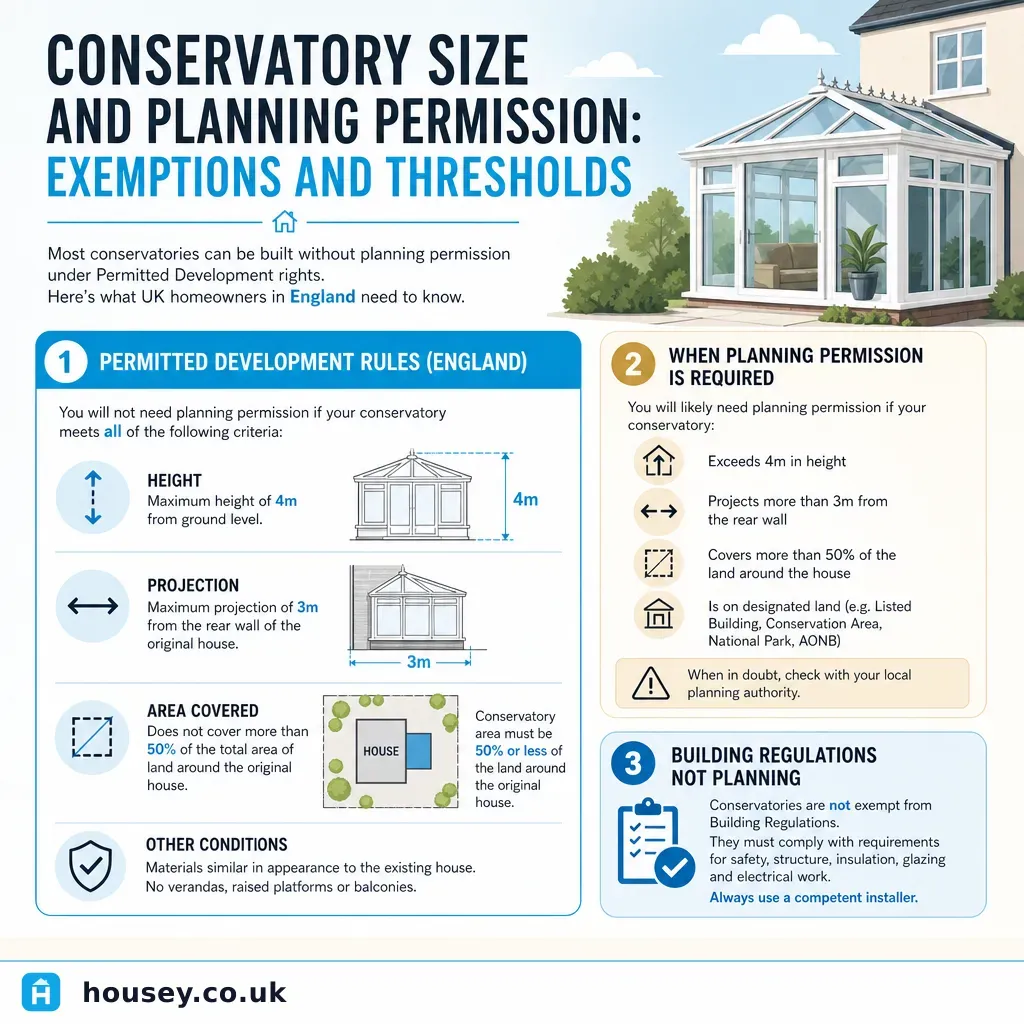
Conservatory Size and Planning Permission: Exemptions and Thresholds
In England, a rear conservatory is usually permitted development if it extends no more than 3 metres (semi-detached or terraced) or 4 metres (detached) beyond the original rear wall.
 Planning & Pre-Build
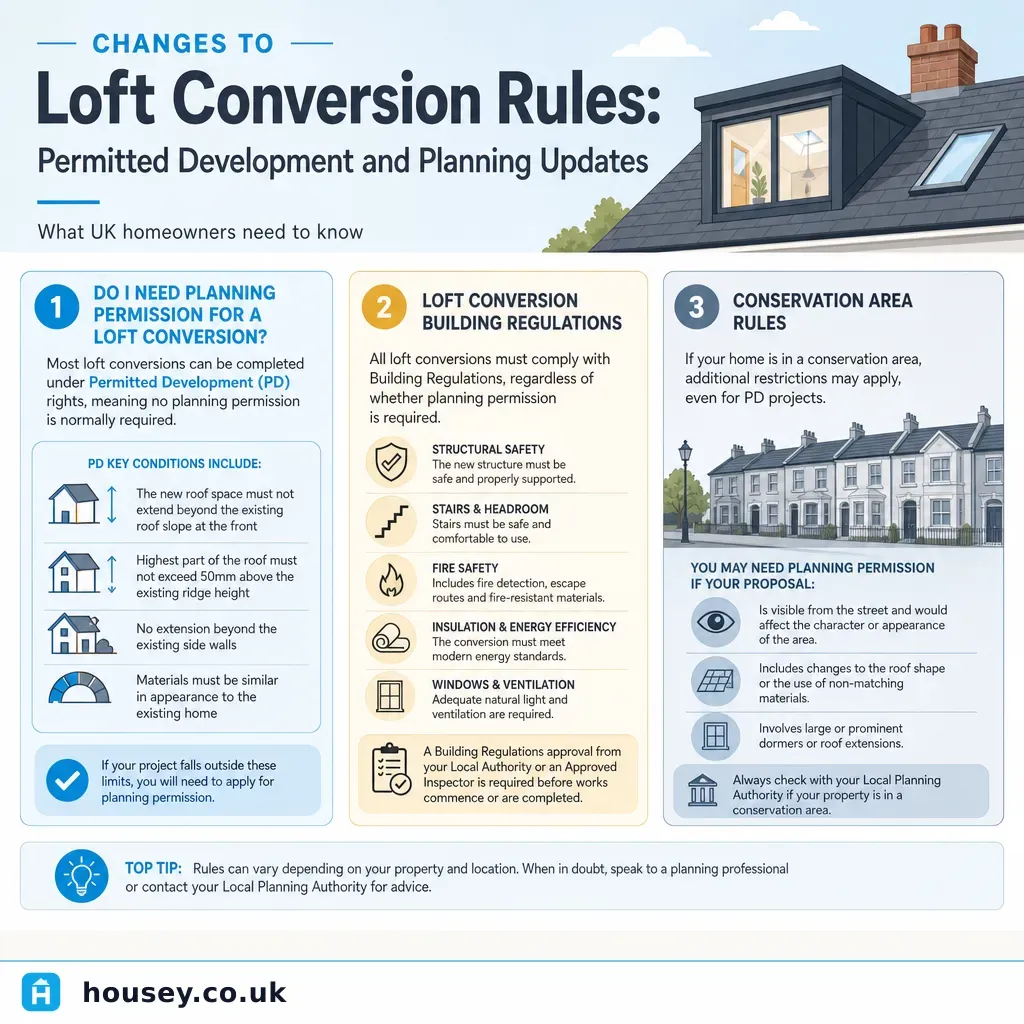
Changes to Loft Conversion Rules: Permitted Development and Planning Updates
In England, most loft conversions on standard houses qualify as Permitted Development under Class B of the GPDO 2015, allowing up to 40 cubic metres (terraced) or 50 cubic metres (detached or semi-detached) without a planning application — if conditions are met.
 Planning & Pre-Build
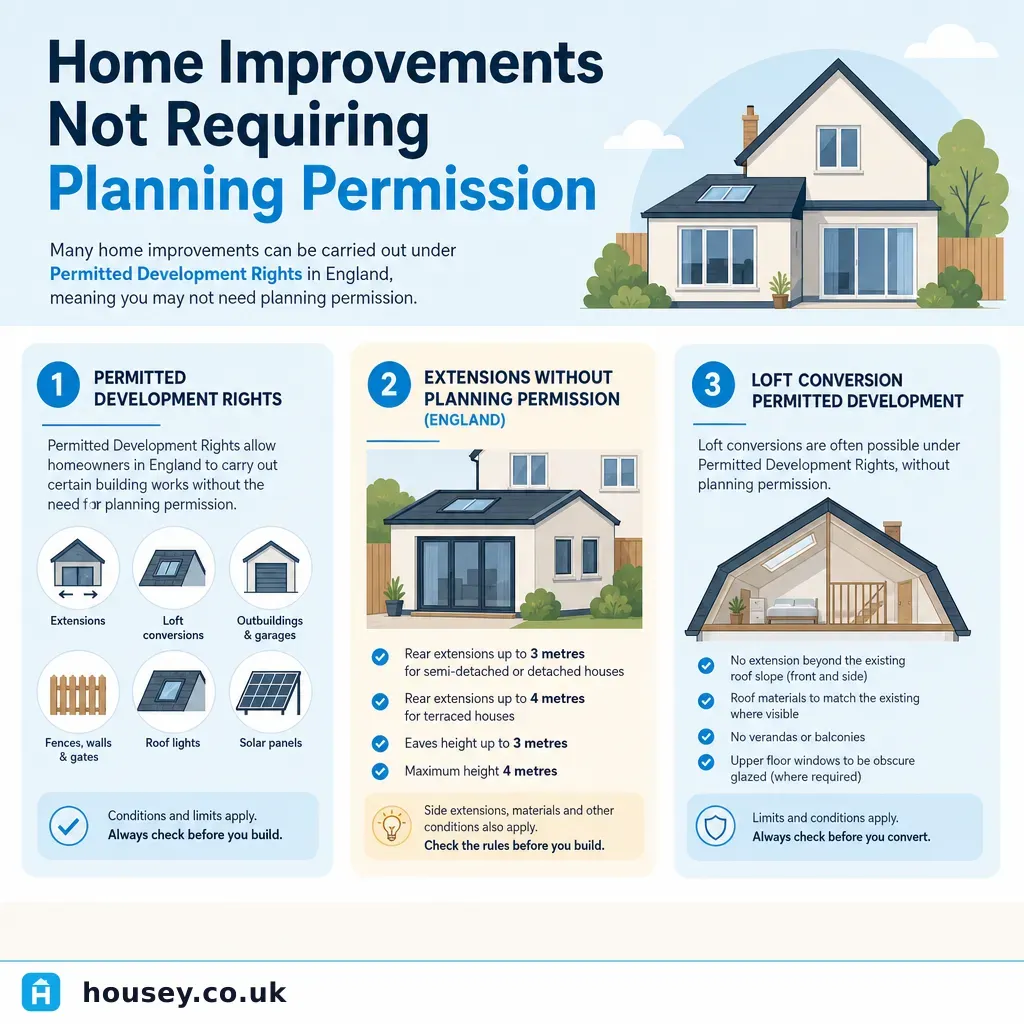
Home Improvements Not Requiring Planning Permission
Many common home improvements in England fall under Permitted Development Rights and do not require a planning application.
 Planning & Pre-Build
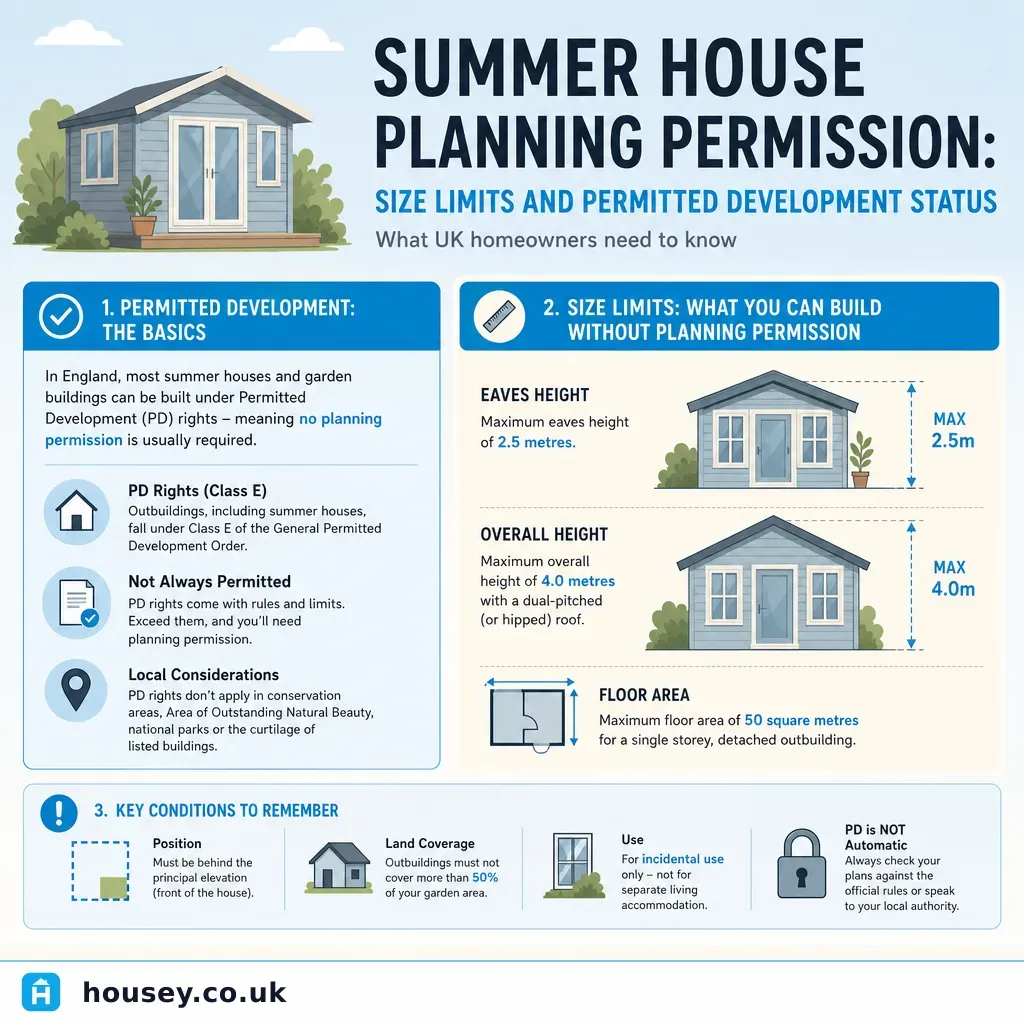
Summer House Planning Permission: Size Limits and Permitted Development Status
Most summer houses in England are permitted development if they are single-storey, sit behind the principal elevation, stay within height limits (2.
 Planning & Pre-Build
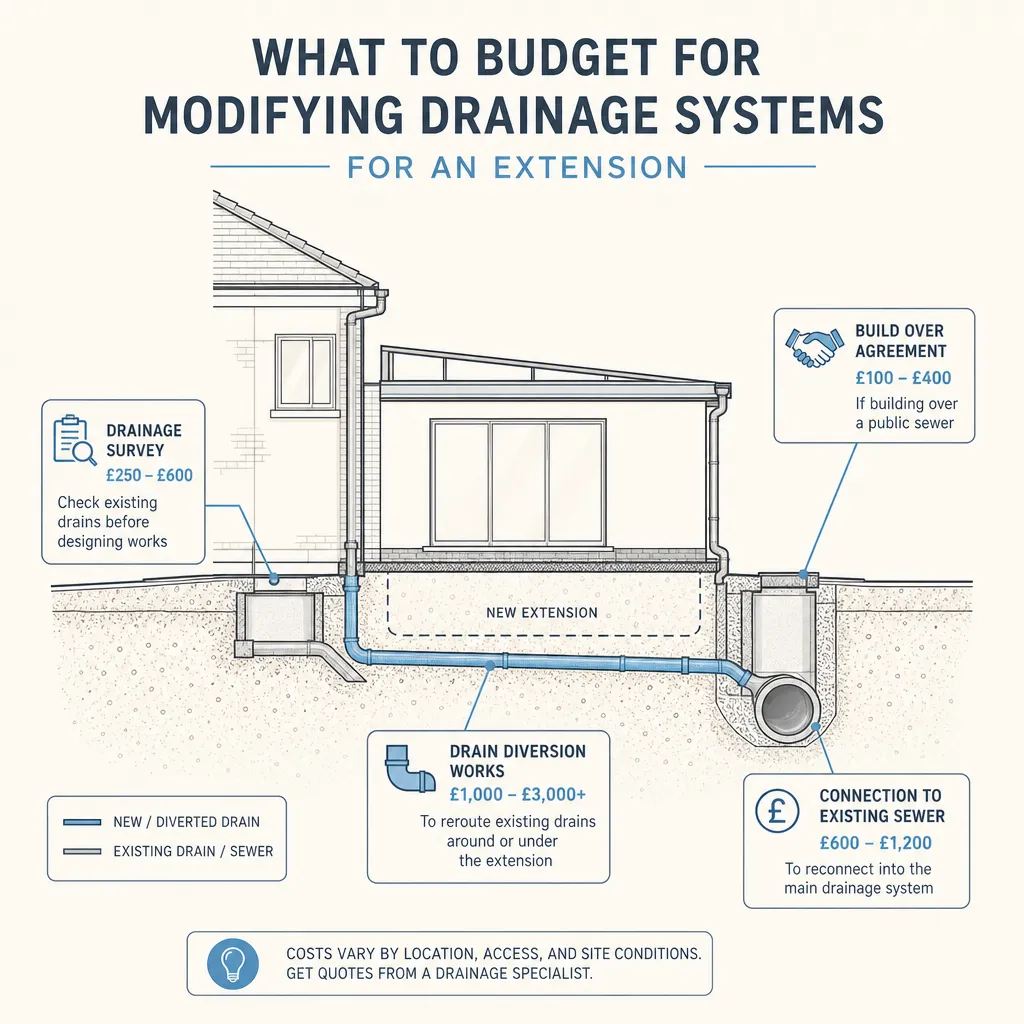
What to budget for modifying drainage systems for an extension
Modifying drainage for a house extension can cost from a few hundred pounds for a Build Over Agreement application to £40,000 or more for diverting a public sewer.