Shed Planning Permission and Size Limits: When You Need Approval
By Housey · Last reviewed 5th of May 2026
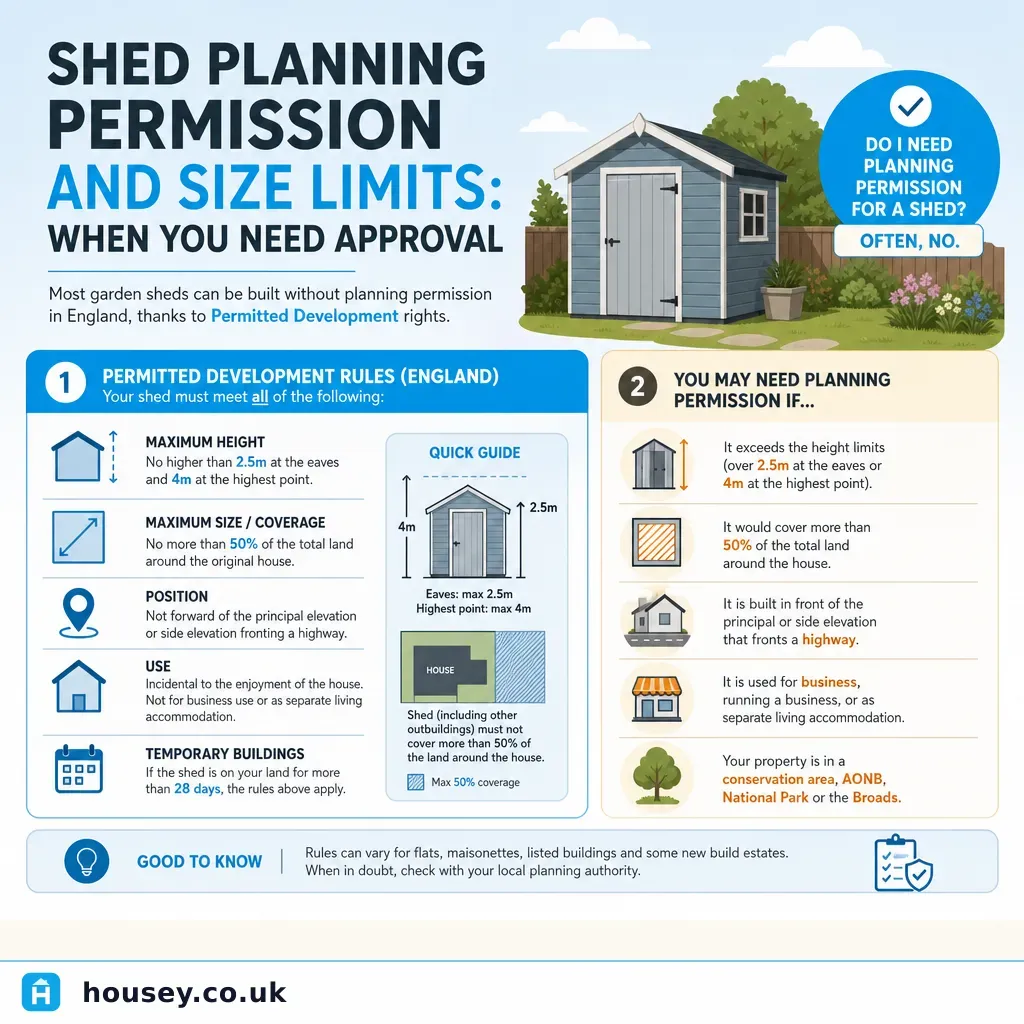
Shed Planning Permission and Size Limits: When You Need Approval
Most garden sheds go up without a planning application — and in many cases that is entirely lawful. But the permitted development rules that allow this carry precise height, size, and location conditions that are easy to miss, particularly for larger workshops, corner plots, or properties on new-build estates where permitted development rights may have been removed. Getting the detail right before you build avoids enforcement notices and complications at the point of sale.
Key points
- Sheds and garden outbuildings in England fall under Class E of Schedule 2 to the Town and Country Planning (General Permitted Development) (England) Order 2015 (GPDO 2015).
- The critical threshold is 2 metres from any boundary: a shed within 2 metres must not exceed 2.5 metres total height, including the roof ridge.
- All outbuildings combined must not cover more than 50% of the original curtilage of the dwelling, excluding the house footprint.
- Sheds on the land of a listed building do not benefit from Class E rights and require a planning application.
- A Lawful Development Certificate is not mandatory for compliant sheds but provides formal proof of lawfulness useful at sale or remortgage.
When a shed is permitted development
For a shed to be permitted development under Class E in England, all of the following must be satisfied simultaneously:
- It is within the curtilage of a dwelling house (not a flat or maisonette).
- It is single-storey.
- It is not forward of the principal elevation of the house.
- Eaves height does not exceed 2.5 metres.
- Overall height does not exceed 4 metres (dual-pitched roof) or 3 metres (any other roof).
- If within 2 metres of any boundary, overall height does not exceed 2.5 metres.
- Combined footprint of all outbuildings and extensions does not exceed 50% of the original curtilage.
- The shed is not used as self-contained living accommodation.
Failure on any single point means a planning application is normally required.
Height limits by boundary distance
Distance from any boundary | Maximum eaves height | Maximum overall height |
|---|---|---|
More than 2 metres, dual-pitched roof | 2.5m | 4m |
More than 2 metres, any other roof | 2.5m | 3m |
2 metres or less (any roof type) | 2.5m | 2.5m |
The 2-metre measurement runs from the outer wall of the shed to the legal boundary of your curtilage — which may not align exactly with a fence or hedge. If the boundary is unclear, a boundary survey should be obtained before building.
The 50% rule: a worked UK property scenario
The combined footprint of all outbuildings and extensions (measured on the ground, excluding the original house) must not exceed half the total curtilage of the original dwelling.
Example: A 1950s terraced house has a rear garden of 80 m². A lean-to extension already covers 12 m². The remaining permitted outbuilding allowance is 28 m² (40 m² minus 12 m²). A 3 m × 6 m shed (18 m²) falls within that limit; a 4 m × 8 m shed (32 m²) does not.
When you need planning permission
A full planning application will normally be required if:
- The shed is forward of the principal elevation.
- The shed exceeds height limits for its boundary distance.
- Combined outbuilding and extension coverage would exceed 50% of the original curtilage.
- The property is a listed building or within its curtilage.
- An Article 4 Direction has removed Class E rights in the area.
- You intend to use the shed as sleeping or living accommodation.
- The property is in Wales, Scotland, or Northern Ireland, where separate frameworks apply.
Permitted development: homeowner checklist
Before building without a planning application, confirm every point below:
Decision tree: does your shed need planning permission?
- Listed building, flat, or maisonette? → Yes: planning permission almost certainly required.
- Article 4 Direction applies? → Yes: check with the local planning authority before proceeding.
- Shed is forward of the principal elevation? → Yes: planning permission required.
- Within 2m of a boundary AND taller than 2.5m? → Yes: planning permission required.
- Taller than 4m (dual-pitched) or 3m (other roof)? → Yes: planning permission required.
- Combined coverage would exceed 50% of original curtilage? → Yes: planning permission required.
- All conditions satisfied? → Likely permitted development. Consider an LDC for written certainty.
What not to assume
"Small sheds are always exempt." Size is one factor, but boundary proximity matters equally. A compact but tall shed within 2 metres of a fence breaches the rules if total height exceeds 2.5 metres.
"Planning rules only apply to permanent structures." Permitted development rules apply regardless of whether a building has concrete foundations. A large prefabricated shed on timber bearers is still an outbuilding for planning purposes.
"I can convert the shed into an annexe later without permission." Using a shed as self-contained living accommodation moves it outside Class E. Even if the original structure was permitted development, the material change of use to residential accommodation will usually require planning permission.
"Conservation area restrictions only affect the front of the house." Under Class E, outbuildings to the side of a dwelling in a conservation area are not permitted development. Check with your local planning authority before siting a large shed to the side of your property in a conservation area.
Important limitations
This article is general guidance based on Class E of the GPDO 2015 as it applies in England. Local Article 4 Directions, planning conditions on individual properties, and site-specific circumstances may alter what is lawful on your land. This is not a substitute for professional planning advice or a formal Lawful Development Certificate from your local planning authority.
Separate legislation governs permitted development in Wales, Scotland, and Northern Ireland. If your property is outside England, do not rely on the rules above.
What to ask a qualified professional
- Is there an Article 4 Direction affecting Class E rights on my property?
- What planning conditions, if any, are attached to my property?
- How does the 50% curtilage calculation apply given existing extensions or outbuildings on my plot?
- Would an LDC be advisable, and what is the current process and fee?
- If permission is needed, what design or siting changes would make approval more likely?
When to get professional help
Most standard shed installations on unrestricted residential properties are straightforward to assess. Consider professional advice when:
- The property is listed, in a conservation area, AONB, or National Park.
- You plan to install a fixed electrical supply or use the shed as sleeping accommodation.
- You are close to the 50% curtilage limit and need a reliable calculation.
- Your local planning authority has raised concerns or issued an enforcement notice.
- You are buying or selling and need to confirm that an existing shed is lawful.
How Housey can help
If you are uncertain whether your shed falls within permitted development rights, or if your property has planning restrictions, Housey can connect you with qualified planning consultancy specialists who can review your circumstances, advise on Article 4 Directions, and assist with a Lawful Development Certificate application if needed.
Frequently asked questions
Does a garden shed need building regulations approval?
Most domestic sheds do not need building regulations approval. Sheds under 15 m² are generally exempt. Between 15 m² and 30 m², a shed may be exempt if not used as sleeping accommodation and sited at least 1 metre from any boundary or built from substantially non-combustible materials. Sheds over 30 m² require approval under the Building Regulations 2010, Schedule 2, Class 6. Any electrical installation must comply with Part P.
Do I need permission for a shed on a new-build estate?
Possibly. Many new-build properties have planning conditions that remove some or all permitted development rights. Check the original planning permission for your plot on your local planning authority's online portal using the application reference number from your title documents. If conditions restrict outbuildings, a planning application will be needed regardless of size.
Can I put a shed in my front garden?
No, under Class E permitted development rights. Outbuildings forward of the principal elevation are not permitted development and require a full planning application, regardless of the shed's dimensions. The location restriction takes precedence over the height and size rules.
How close to my boundary can I put a shed?
There is no minimum boundary distance under the GPDO 2015, but a shed within 2 metres of any boundary is restricted to a maximum overall height of 2.5 metres including the roof. Your property deeds may also contain restrictive covenants imposing additional distance or size requirements beyond the planning rules.
What is the difference between planning permission and a Lawful Development Certificate?
Planning permission is required when permitted development rights do not apply. A Lawful Development Certificate (LDC) is formal confirmation from your local planning authority that a development is lawful — typically because it meets permitted development criteria. An LDC is not legally required but provides written evidence useful for property sales and mortgage applications.
Sources and further reading
- Town and Country Planning (General Permitted Development) (England) Order 2015, Class E — legislation.gov.uk
- Outbuildings permitted development guidance — Planning Portal
- Apply for a Lawful Development Certificate — GOV.UK
- Building Regulations 2010, Schedule 2 — legislation.gov.uk
- Building regulations for outbuildings — Planning Portal
Useful next reads
 Planning & Pre-Build
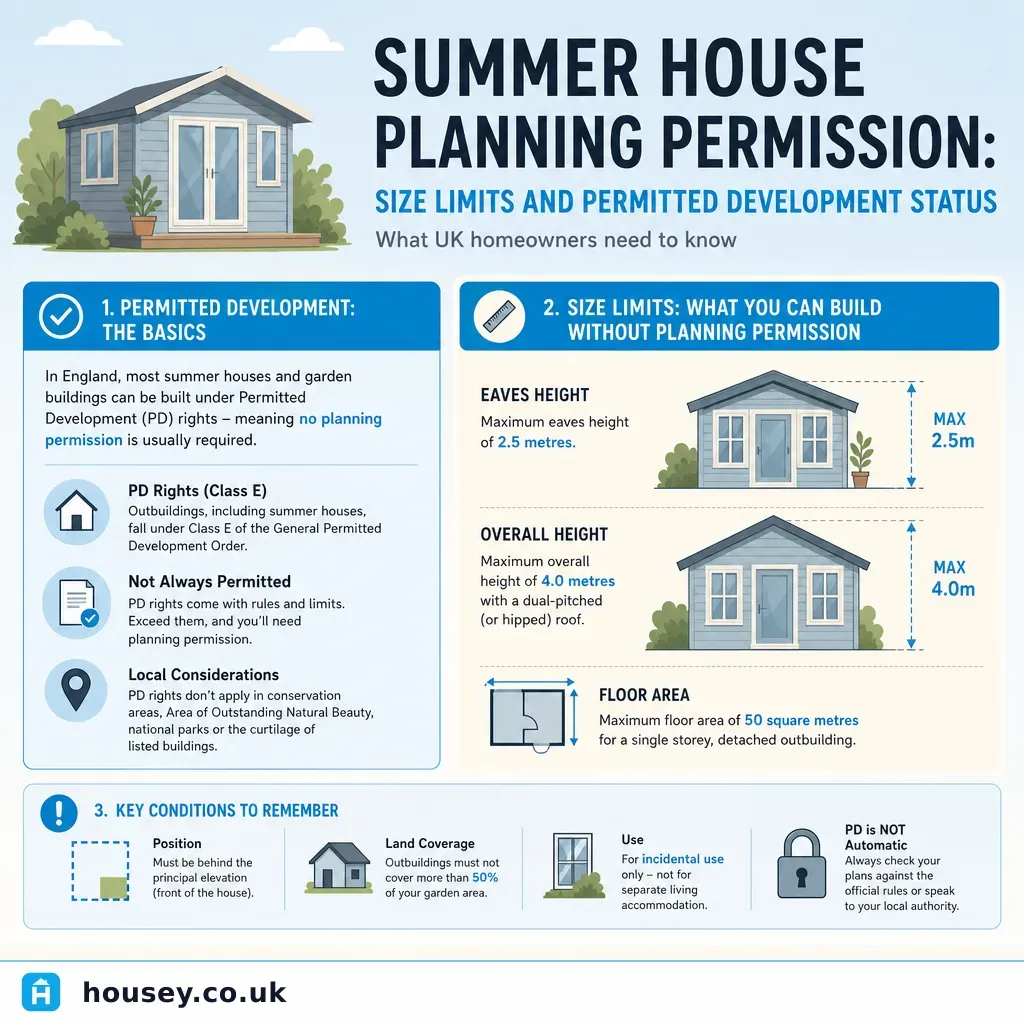
Summer House Planning Permission: Size Limits and Permitted Development Status
Most summer houses in England are permitted development if they are single-storey, sit behind the principal elevation, stay within height limits (2.
 Planning & Pre-Build
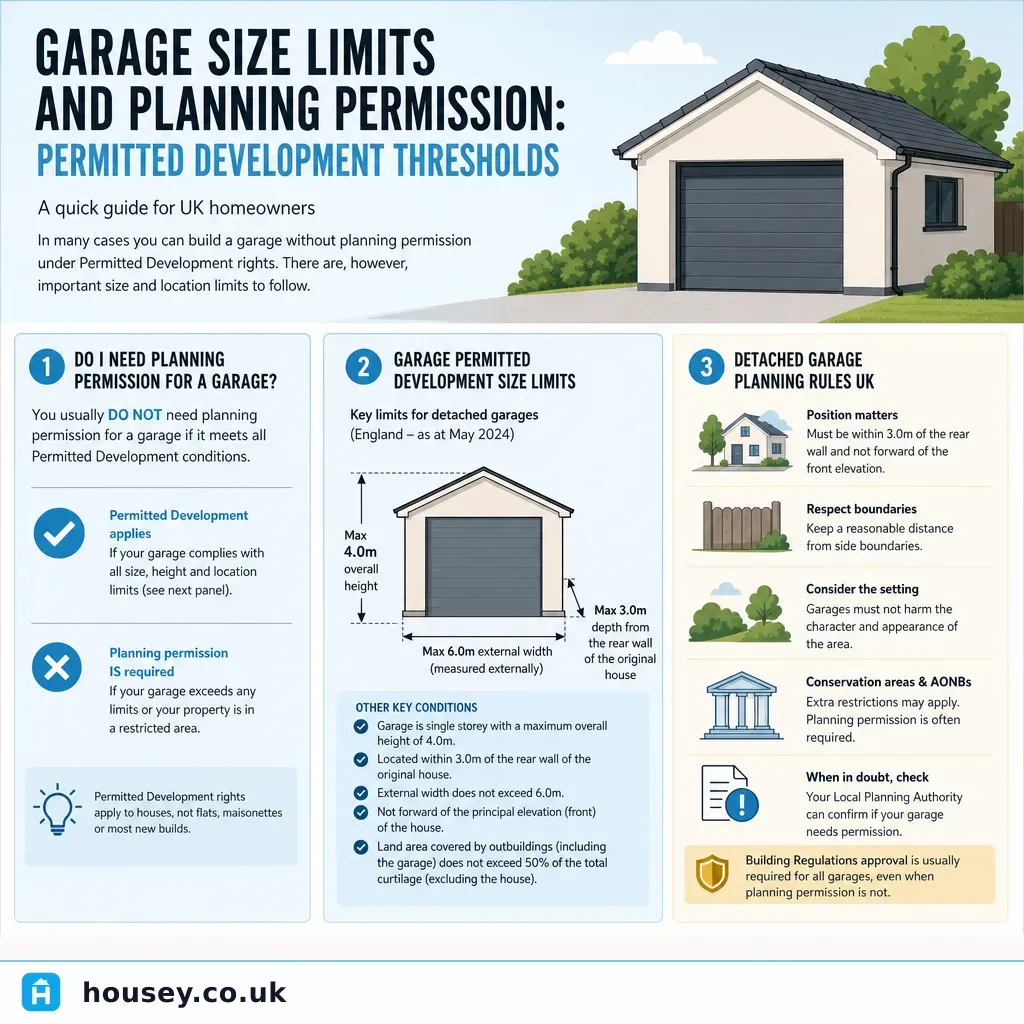
Garage Size Limits and Planning Permission: Permitted Development Thresholds
A detached garage is usually permitted development under Class E of the GPDO 2015 if it covers less than 50% of the curtilage and meets height limits.
 Planning & Pre-Build
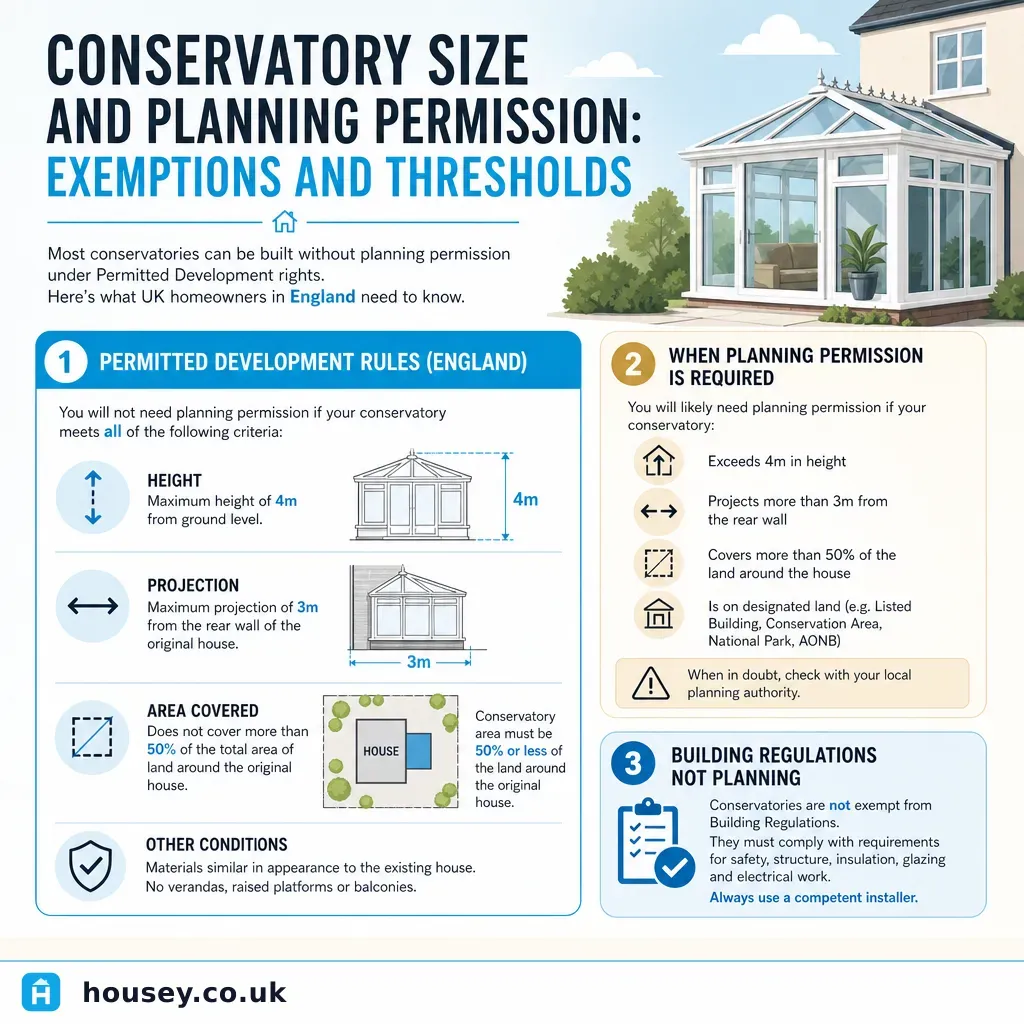
Conservatory Size and Planning Permission: Exemptions and Thresholds
In England, a rear conservatory is usually permitted development if it extends no more than 3 metres (semi-detached or terraced) or 4 metres (detached) beyond the original rear wall.
 Planning & Pre-Build
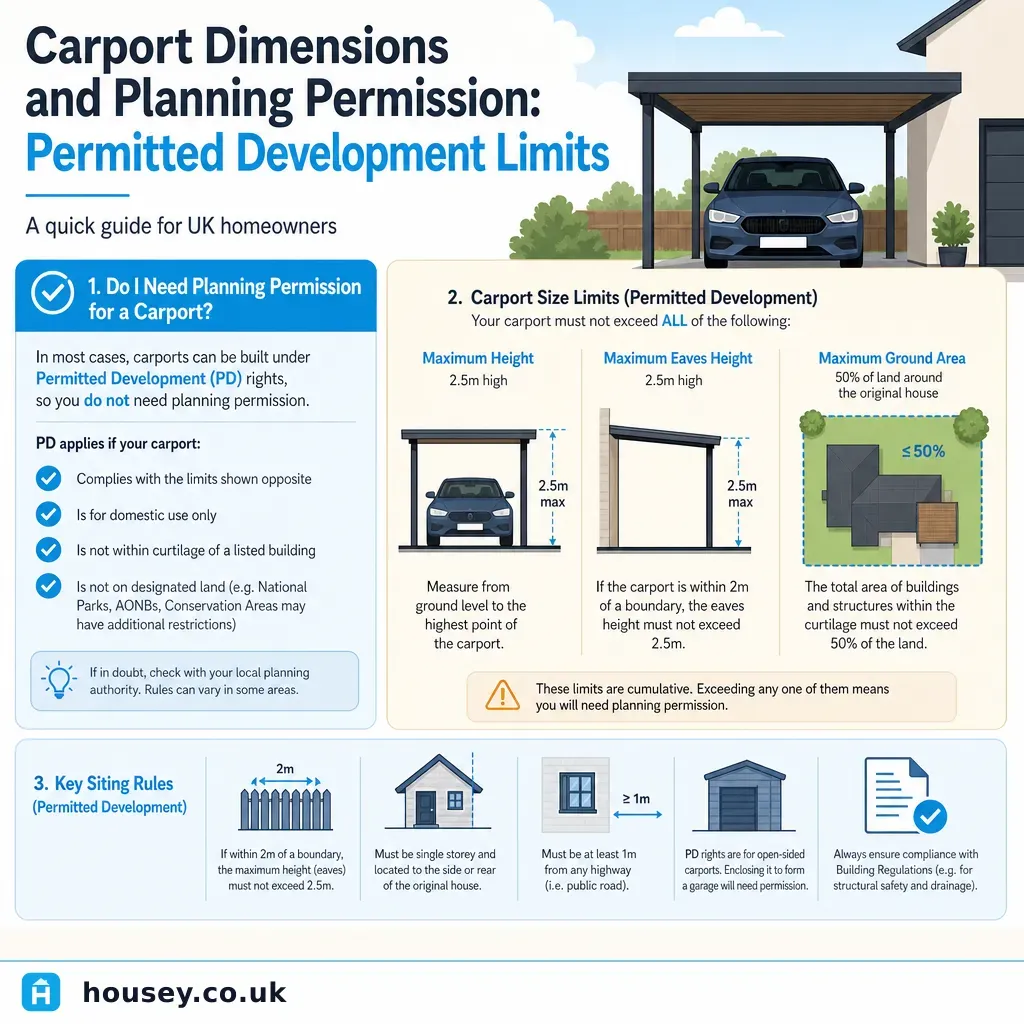
Carport Dimensions and Planning Permission: Permitted Development Limits
A carport may be built under permitted development (Class E, GPDO 2015) if it stays within 50% of the curtilage, does not exceed 2.
 Planning & Pre-Build
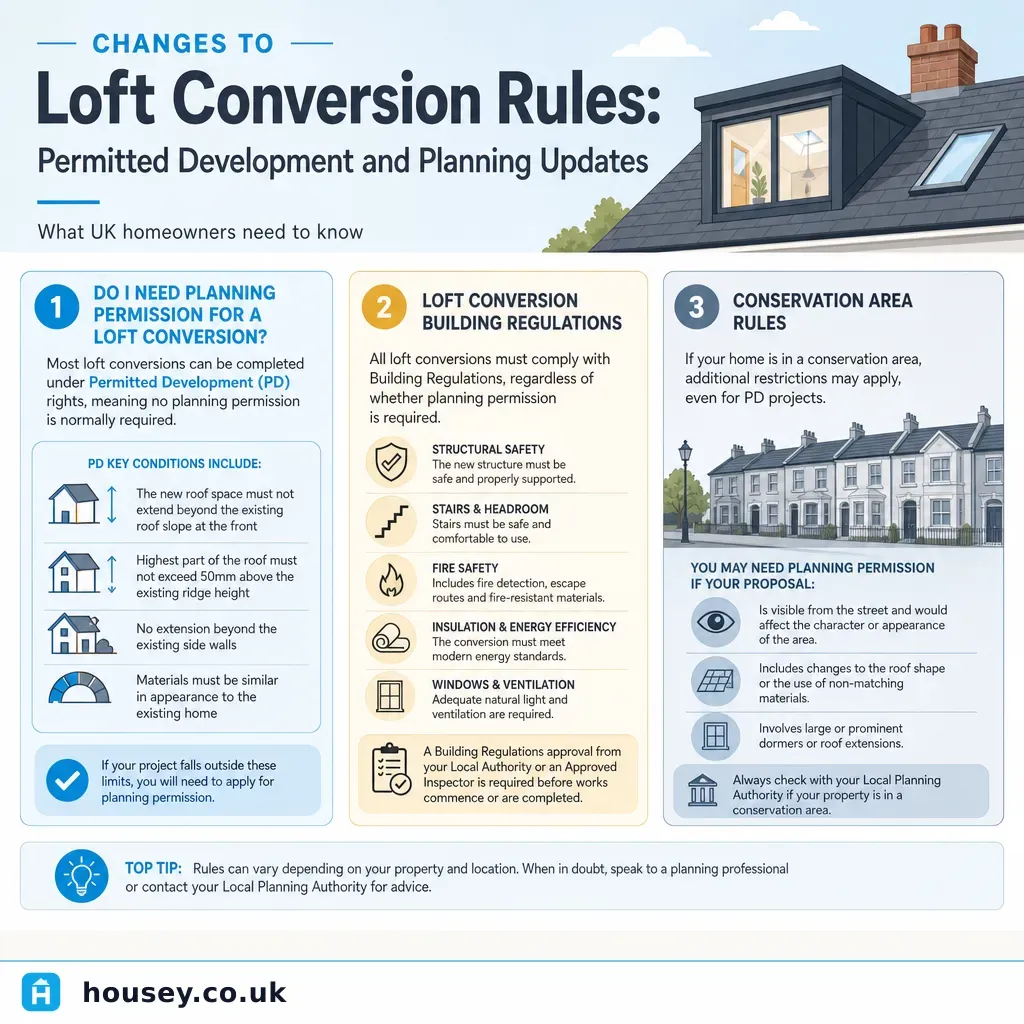
Changes to Loft Conversion Rules: Permitted Development and Planning Updates
In England, most loft conversions on standard houses qualify as Permitted Development under Class B of the GPDO 2015, allowing up to 40 cubic metres (terraced) or 50 cubic metres (detached or semi-detached) without a planning application — if conditions are met.