Home Improvements Not Requiring Planning Permission
By Housey · Last reviewed 11th of May 2026
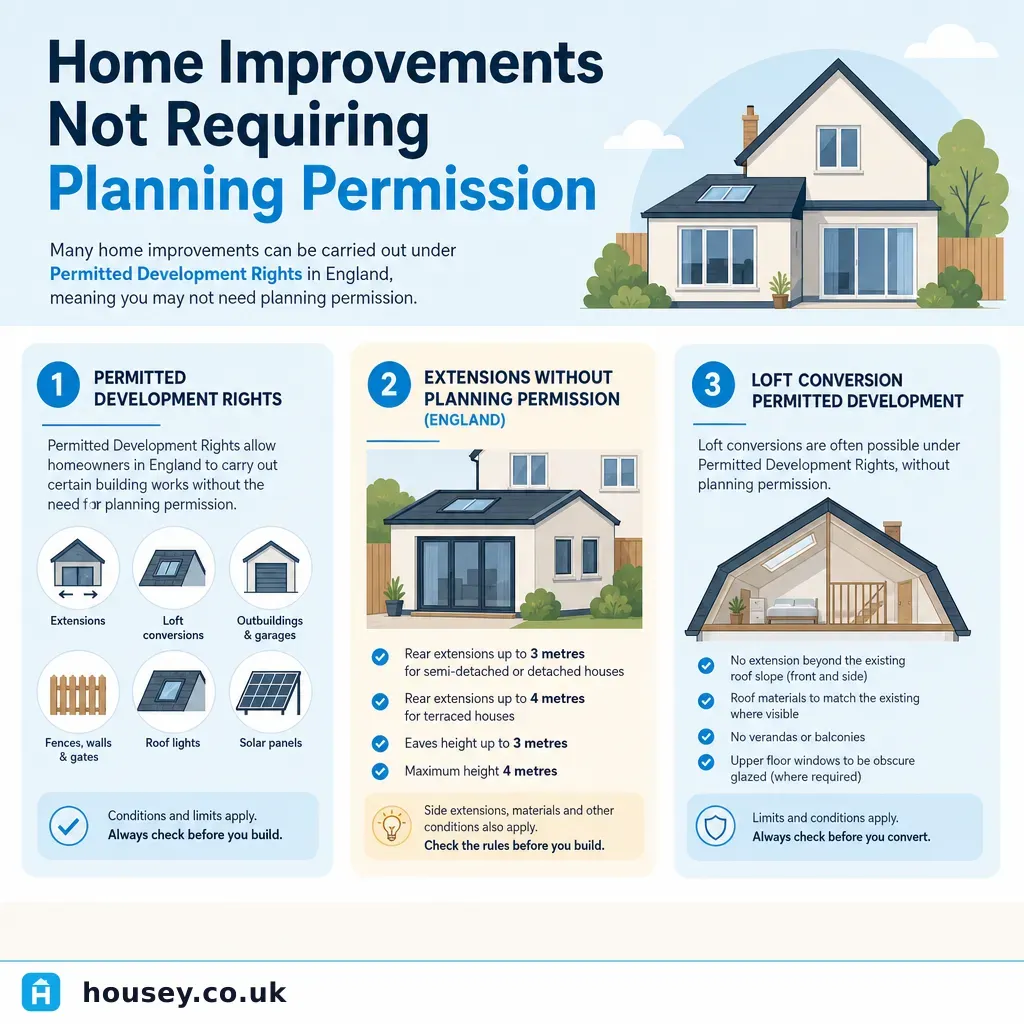
Home Improvements Not Requiring Planning Permission
Permitted Development Rights (PDRs) allow homeowners in England to carry out a wide range of improvements without applying for full planning permission. The rules are, however, more conditional than many people assume — the same extension that is permitted at a 1990s estate house may require consent at a listed property, a flat, or a home in a conservation area. Knowing which category your property falls into, and whether your PDRs remain intact, can protect you from enforcement risk and unnecessary delays before work begins.
Key points
- Permitted Development Rights are set out in the Town and Country Planning (General Permitted Development) (England) Order 2015 (the GPDO), as amended — the principal legislation governing what can be built without a planning application.
- PDRs do not apply to listed buildings, flats, or maisonettes, and are commonly removed or restricted in conservation areas, Article 4 Direction areas, and on some new-build estates via planning conditions.
- A single-storey rear extension can reach up to 4 metres from the original rear wall on a detached house (3 metres on a semi-detached or terraced house) under Class A permitted development.
- Most internal alterations — removing non-load-bearing walls, refitting kitchens and bathrooms, internal replastering — do not require planning permission, though many will trigger a separate Building Regulations approval process.
- A Lawful Development Certificate (LDC) from the local planning authority provides formal legal confirmation that a project falls within permitted development; this is strongly recommended before committing to significant works.
What permitted development means in practice
Permitted Development Rights are a form of pre-granted planning permission for specific categories of development described in the GPDO. If your proposed work falls within a permitted development class and your property's PDRs have not been removed or restricted, you can proceed without a planning application.
However, permitted development does not mean free from all consents. Building Regulations approval is required for structural work, extensions, loft conversions, new drainage, and electrical work — regardless of planning permission status. These two regimes are managed separately by different bodies.
Common improvements that usually don't need planning permission
Single-storey rear extensions
Under Class A permitted development (houses only):
- Detached houses: up to 4 metres from the original rear wall.
- Semi-detached and terraced houses: up to 3 metres from the original rear wall.
- The Larger Home Extension Scheme allows up to 8 metres (detached) or 6 metres (semi/terrace) via a prior approval and neighbour consultation route.
- Maximum height 4 metres; eaves height must not exceed 3 metres within 2 metres of a boundary.
Side extensions are more restricted — a single-storey side extension under Class A must not exceed half the width of the original house.
Loft conversions
Usually permitted development where:
- Volume added does not exceed 40 cubic metres (terraced houses) or 50 cubic metres (detached and semi-detached houses).
- Rear dormers are generally permitted in many situations; hip-to-gable changes and dormers facing a highway are more restricted.
- The roof does not exceed the height of the existing ridge.
Building Regulations are always required for loft conversions covering structural work, fire escape routes, and energy efficiency.
Outbuildings and garden structures
Outbuildings — sheds, garages, garden offices, summerhouses — are generally permitted development when:
- Located within the domestic curtilage and not forward of the principal elevation.
- Height does not exceed 4 metres (dual-pitched roof) or 3 metres (any other roof type).
- Total outbuilding floor area does not take built coverage beyond 50% of the original garden area.
- Not used as a separate self-contained dwelling.
Internal alterations
Most internal work does not require planning permission, including removal of non-load-bearing walls, refitting kitchens and bathrooms, replacing flooring, and internal redecoration. Building Regulations are typically required for structural alterations, changes to heating or drainage systems, new electrical circuits, and alterations affecting means of escape.
Replacement windows and doors
Replacing like-for-like windows and doors generally does not require planning permission for most houses (listed buildings are a significant exception). Replacement glazing must comply with Parts L and K of the Building Regulations — in practice achieved by using a FENSA- or CERTASS-registered installer, or by applying for a Building Regulations certificate separately.
Decision tree: do I need planning permission?
- Is the property a listed building? → Contact your local planning authority. Almost all external changes — and many internal ones — require Listed Building Consent regardless of PDRs.
- Is the property a flat or maisonette? → PDRs for extensions and loft conversions do not apply to flats; check with your local planning authority before proceeding.
- Is the property in a conservation area or subject to an Article 4 Direction? → Many permitted development classes are restricted or removed; confirm with your local planning authority before starting.
- Have the property's PDRs been removed by a planning condition? → Check the original planning permission for the house on your local authority's planning portal. New-build estates and certain previous consents frequently remove PDRs.
- If none of the above apply: verify the dimensional limits for your specific class of development in the GPDO and, ideally, apply for a Lawful Development Certificate before starting work.
Comparison: planning permission vs Building Regulations
Aspect | Planning permission | Building Regulations |
|---|---|---|
Purpose | Controls land use, external design, and impact on surroundings | Ensures structural safety, energy efficiency, fire safety, and drainage |
Who manages it | Local Planning Authority (LPA) | Building Control (LPA team or approved inspector) |
When required | Most external changes; change of use; PDR work does not require it | Structural work, extensions, loft conversions, heating and electrical changes |
Applies to permitted development? | No — that is the purpose of PDRs | Often yes; the two systems are entirely separate |
Consequence of non-compliance | Enforcement notice; may be required to demolish or undo works | Unsafe building; no completion certificate; complications on sale |
Red flags: when to pause and check
- You are planning a side extension or a front-facing dormer — these are more restricted under PDRs than rear extensions.
- The garden has been subdivided or sold off in the past — PDR calculations use the footprint as it stood on 1 July 1948 (or as built if later), and a reduced curtilage affects the permitted area.
- You are near the maximum dimension for your class of development — even 100 mm over the threshold means a full planning application is required.
- The property has had any previous extensions — cumulative additions count towards permitted development limits, not just the current project.
- The work involves a chimney, flue, or satellite dish visible from a highway in a conservation area.
- You plan to change the use of part of the building, such as converting a garage into a self-contained annexe with separate facilities, which may constitute a material change of use requiring consent.
Important limitations
This article provides general information about permitted development in England. Planning rules are complex and site-specific — the same project can be permitted development at one property and require full consent at a neighbouring one. Rules differ in Scotland, Wales, and Northern Ireland, which each have their own planning legislation and permitted development orders. Nothing in this guide constitutes planning advice for a specific property. Always verify with your local planning authority or a qualified planning consultant before committing to works.
What to ask a qualified professional
Before instructing a planning consultant or building control consultant, consider asking:
- Does my property have any Article 4 Directions, conditions removing PDRs, or other restrictions I should be aware of?
- Do my proposed works fall within the permitted development class I believe applies — and are all the conditions for that class satisfied?
- Is a Lawful Development Certificate appropriate here, and what evidence will I need to provide with the application?
- Does the project also require Building Regulations approval, and who should manage that separately?
- If the project falls just outside PD limits, is a pre-application enquiry to the local planning authority worth pursuing?
When to get professional help
Consult a qualified planning consultant or your local planning authority when:
- You are not certain whether your property's PDRs are intact — particularly on new builds, properties with prior extensions, or those in designated areas.
- The project is at or near the edge of any dimensional limit.
- You want formal legal certainty before beginning work or before a property sale — a Lawful Development Certificate is a material document in conveyancing.
- The project involves any change of use, even partial.
- The property is in a conservation area, Area of Outstanding Natural Beauty, National Park, or other designated area.
Engage a building control consultant at design stage for any structural alteration, extension, loft conversion, or internal change that triggers Building Regulations — even when planning permission is not required.
How Housey can help
Housey connects homeowners with experienced planning consultants who can confirm whether your project is permitted development, prepare a Lawful Development Certificate application if appropriate, and advise on any local restrictions. For projects that proceed to construction, vetted building control consultants can manage Building Regulations compliance from design stage through to completion certificate.
Frequently asked questions
Do I need a Lawful Development Certificate if my project is permitted development?
You are not legally required to obtain one, but it is strongly recommended for any significant works. A Lawful Development Certificate is a formal decision from your local planning authority confirming the work is lawful. Without one, you may face difficulties when selling, as buyers' solicitors routinely ask for planning compliance evidence for extensions, conversions, and outbuildings.
Does permitted development apply in Scotland, Wales, and Northern Ireland?
Scotland, Wales, and Northern Ireland each have their own planning legislation and permitted development orders with different rules and dimensional thresholds from those in England. The information in this article applies to England only. Check ePlanning Scotland, Planning Portal Wales, or the Northern Ireland Planning Portal for rules applicable in other nations.
Can I build a garden office without planning permission?
In most cases, a garden office falls within the permitted development rules for outbuildings (Class E in the GPDO), provided it is within the domestic curtilage, not in front of the main elevation, does not exceed the height limits, and the total outbuilding area stays within 50% of the original garden. Building Regulations may apply if the structure includes fixed electrical installations or is a substantial permanent construction.
What happens if I carry out works without planning permission when I needed it?
Your local planning authority can issue an enforcement notice requiring you to undo the works within a specified period. Under provisions in the Levelling-up and Regeneration Act 2023, the enforcement window is being extended to ten years for most operational development. Unpermitted works can also complicate the sale of your property and may need to be declared to your mortgage lender.
Sources and further reading
- Town and Country Planning (General Permitted Development) (England) Order 2015 — legislation.gov.uk
- Planning Portal — permitted development guidance — Planning Portal
- When you need building regulations approval — GOV.UK
- Lawful development certificates: guidance — GOV.UK Planning Practice Guidance
- Historic England — permitted development and listed buildings — Historic England
Useful next reads
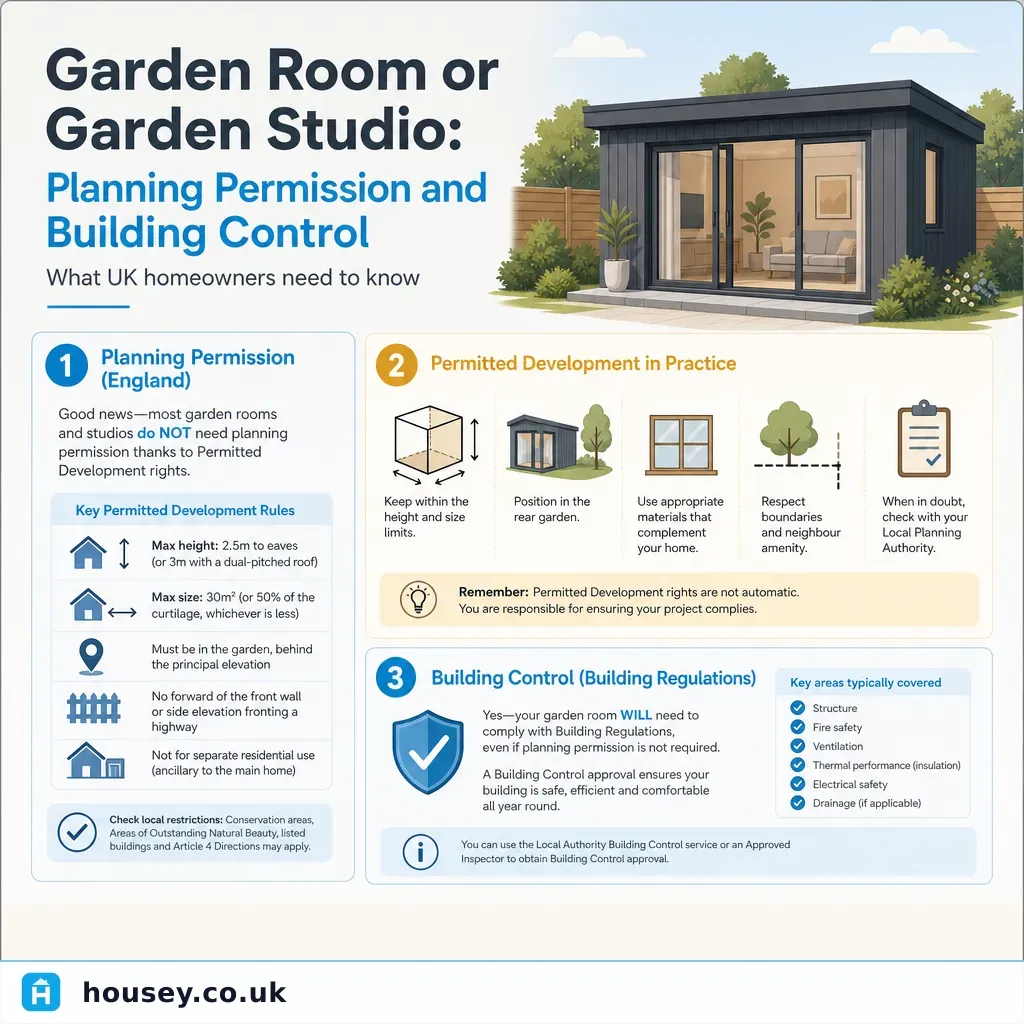 Planning & Pre-Build
Garden Room or Garden Studio: Planning Permission and Building Control
A garden room or studio often qualifies as permitted development in England, meaning no planning application is needed — provided it occupies no more than 50% of the total curtilage, sits within height limits, and is not used as a separate dwelling.
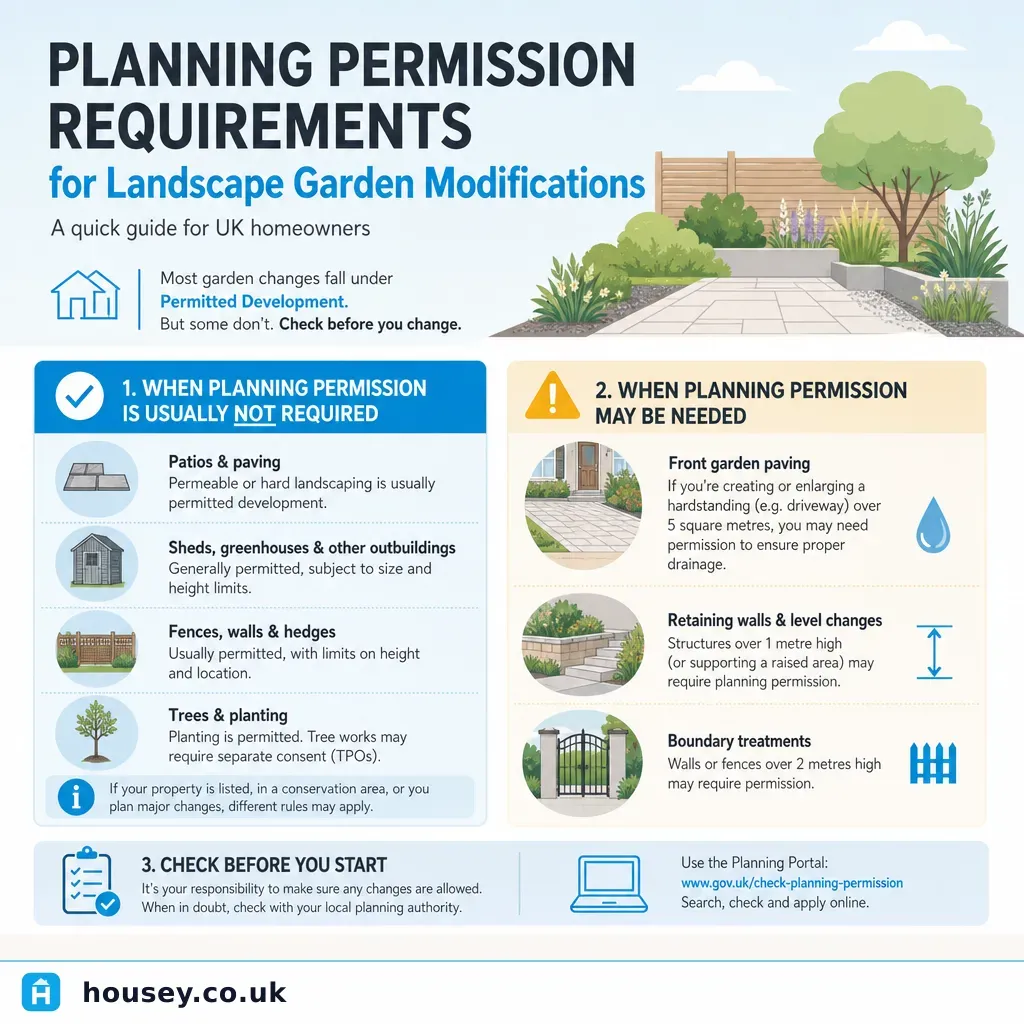 Planning & Pre-Build
Planning Permission Requirements for Landscape Garden Modifications
Most garden landscaping in England does not require planning permission.
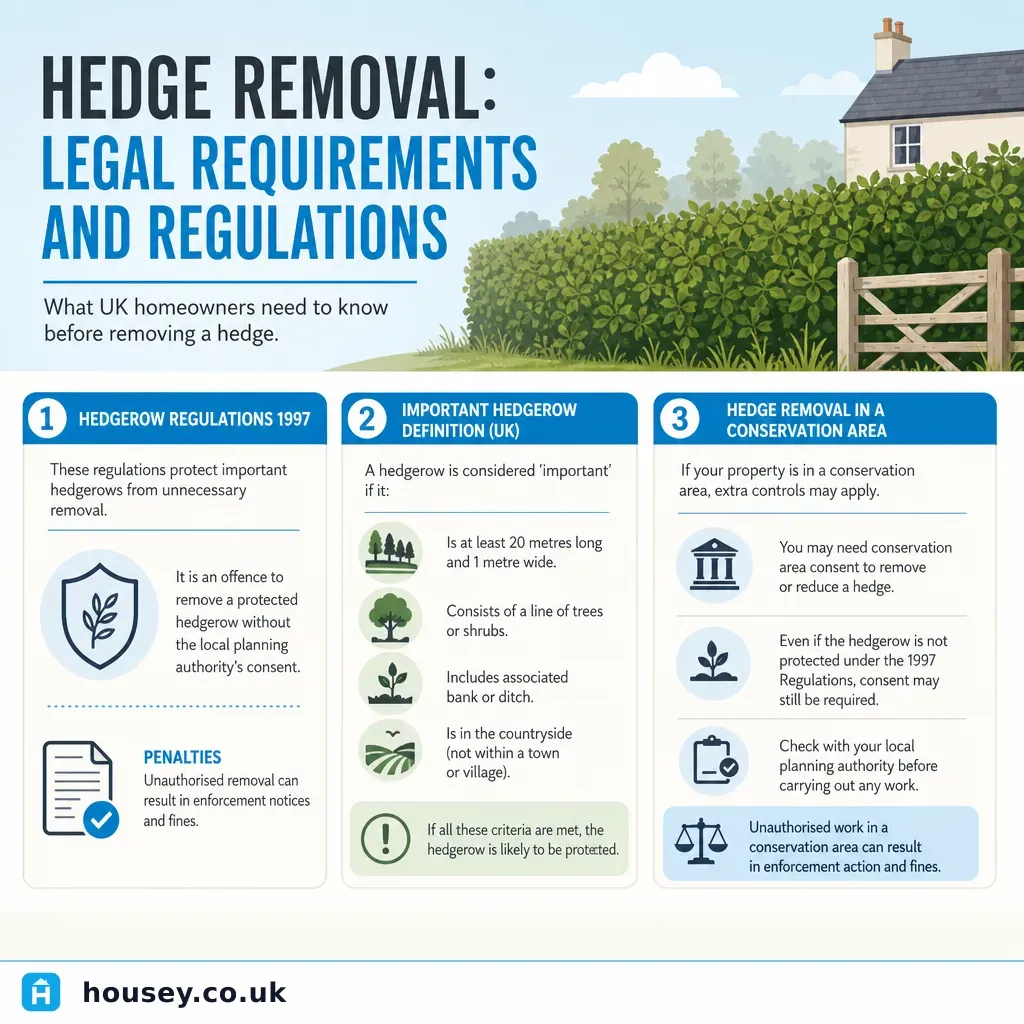 Planning & Pre-Build
Hedge Removal: Legal Requirements and Regulations
Whether you need permission to remove a hedge in the UK depends on its location, age, and what it contains.
 Planning & Pre-Build
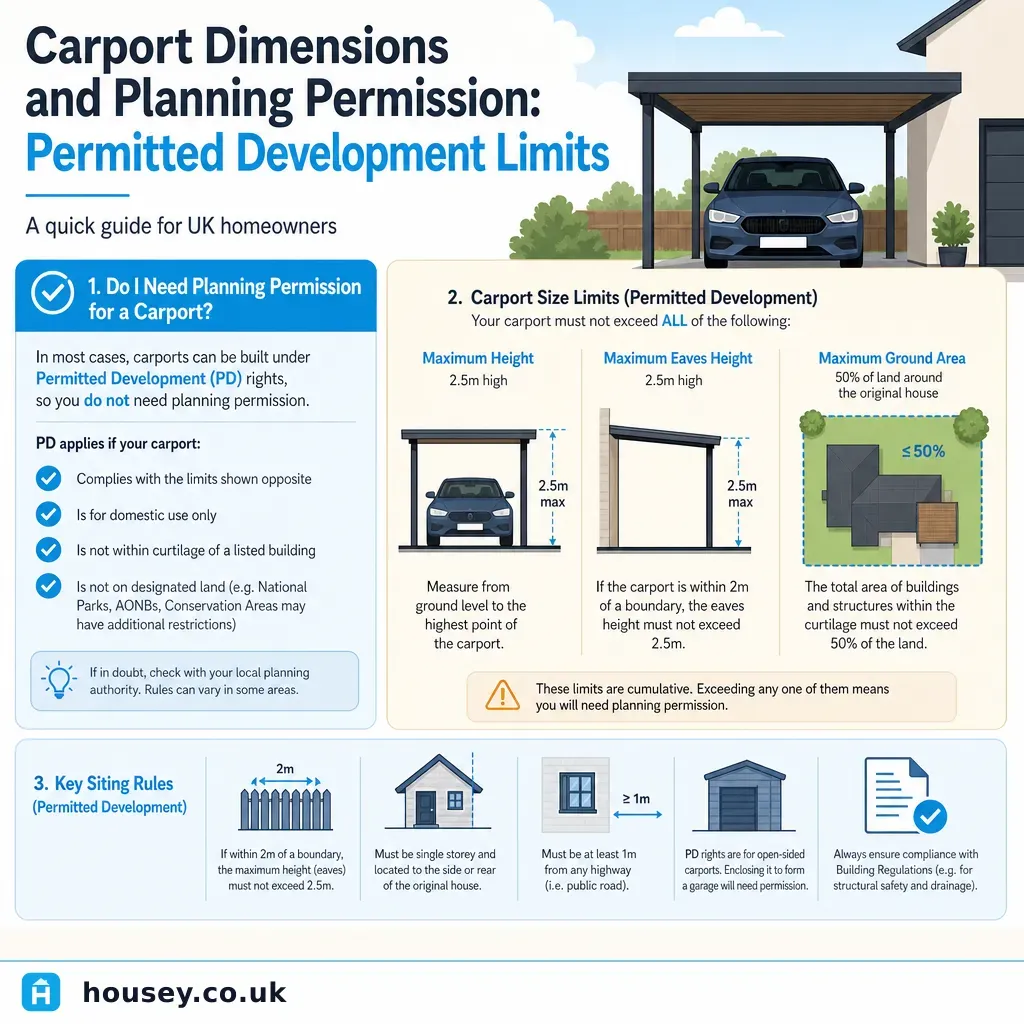
Carport Dimensions and Planning Permission: Permitted Development Limits
A carport may be built under permitted development (Class E, GPDO 2015) if it stays within 50% of the curtilage, does not exceed 2.
 Planning & Pre-Build
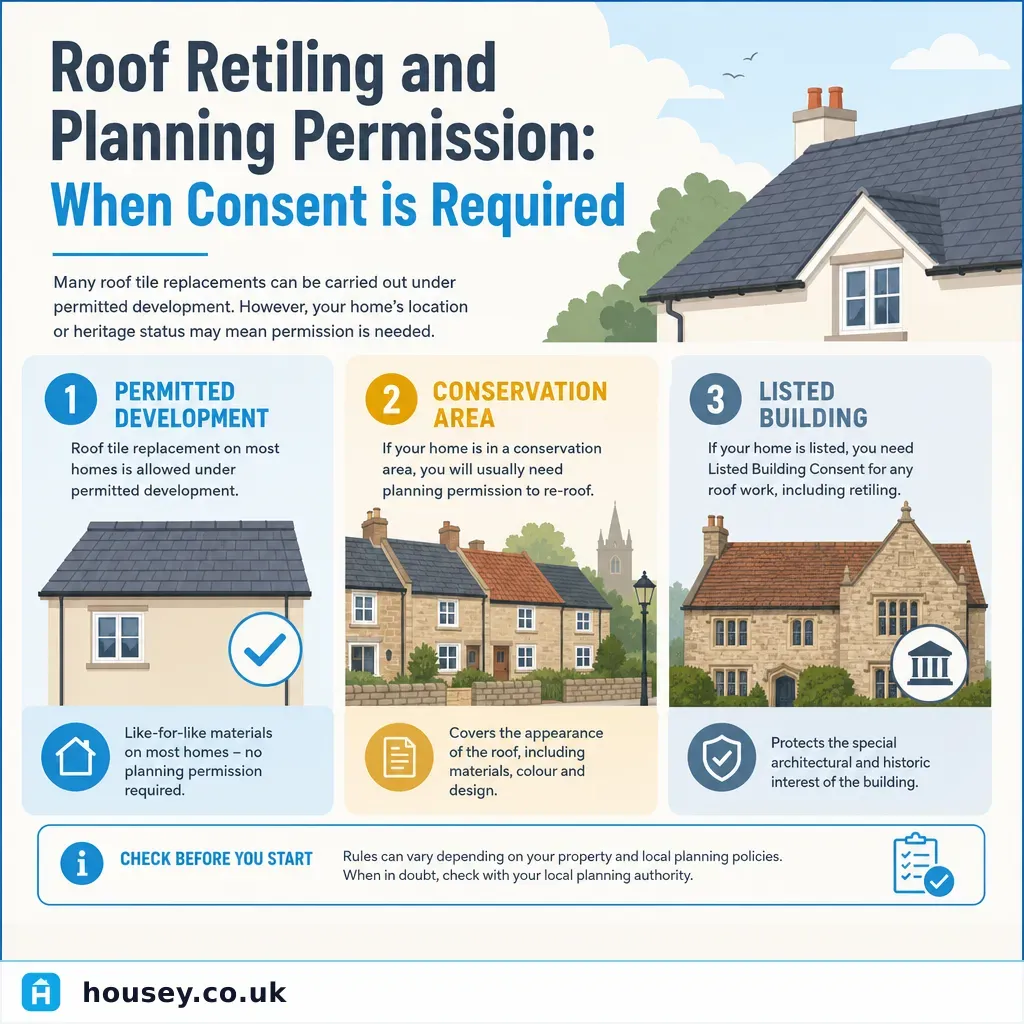
Roof Retiling and Planning Permission: When Consent is Required
Replacing roof tiles with materials of similar appearance is generally permitted development in England and does not need planning permission.