Built-In Shelving: Design and Installation Costs
By Housey · Last reviewed 9th of May 2026
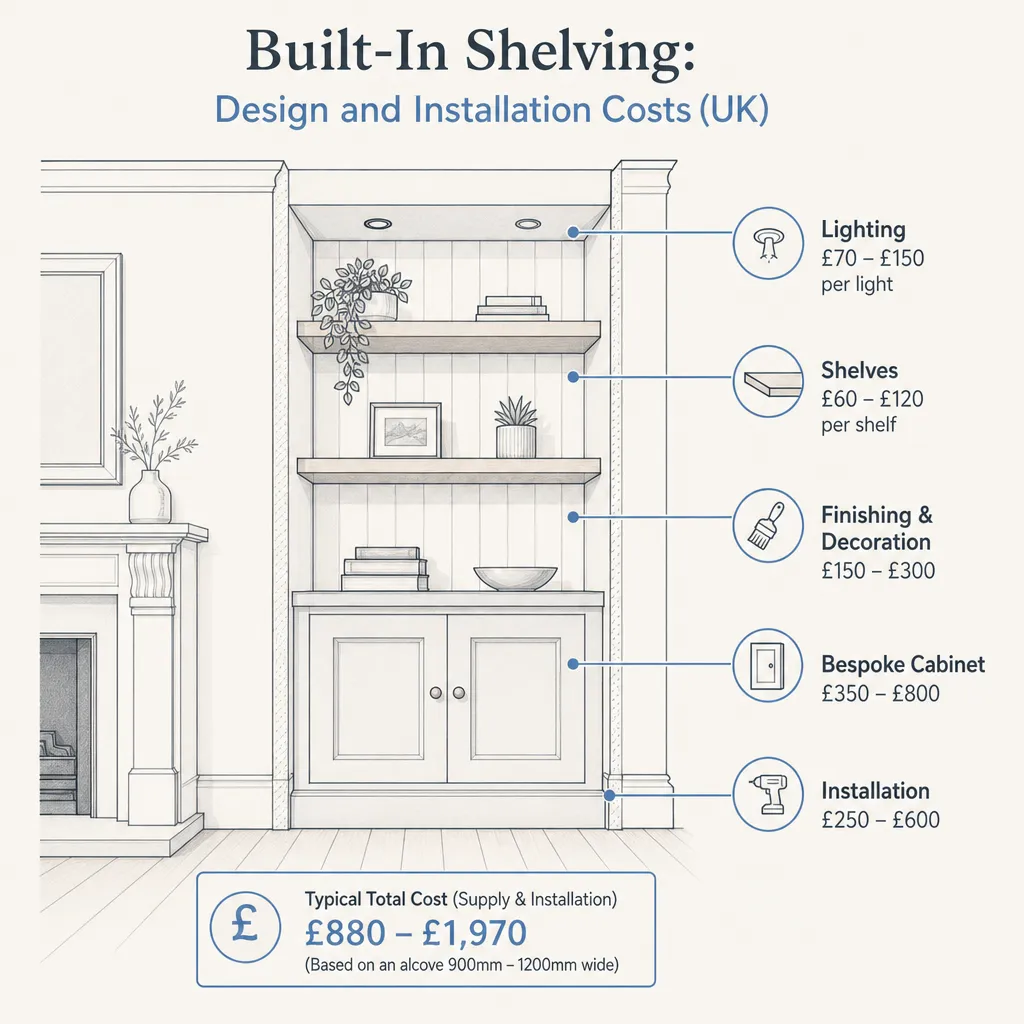
Built-In Shelving: Design and Installation Costs
Built-in shelving transforms awkward alcoves, chimney breasts, and bare walls into purpose-built storage that sits flush with the room's architecture. The question of cost typically arises during a living-room renovation, a property purchase where storage is limited, or when planning a home office. Getting the specification right before requesting quotes — material, finish, whether base cupboards are needed — makes a significant difference to both the price and the result.
Key points
- Indicative UK costs range from roughly £400 for a simple single-alcove MDF unit to £3,000+ for a pair of floor-to-ceiling painted alcoves with base cupboards; bespoke hardwood work costs substantially more (Indicative UK costs, last reviewed 2026-05-09; obtain at least three quotes as prices vary by region and specification).
- No planning permission or building regulations approval is required for most internal fitted shelving — it is classed as routine interior alteration.
- MDF (medium-density fibreboard) is the standard substrate for painted shelving; solid timber or hardwood-veneered plywood suits stained or natural finishes.
- A carpenter or joiner handles standard alcove and wall shelving; a cabinet maker or bespoke joinery firm is more appropriate for complex or high-end projects.
- Finishing costs — painting, priming, skirting reinstatement, and making good — often add 20–30% on top of the carpentry quote; confirm what is included before accepting a price.
What does built-in shelving cost in the UK?
Costs vary by material, complexity, region, and finish. The table below gives indicative ranges for common project types.
Project type | Typical material | Indicative cost range | Notes |
|---|---|---|---|
Single alcove, shelves only | MDF | £400–£900 | Basic painted finish; no base cupboard |
Single alcove with base cupboard and shelves | MDF | £700–£1,500 | Common living-room layout |
Pair of alcoves, base cupboards and shelves | MDF painted | £1,400–£3,000 | Symmetrical chimney-breast arrangement |
Floor-to-ceiling library or study wall | MDF or plywood | £2,000–£5,000+ | Larger footprint; may include ladder rail |
Bespoke hardwood or veneered joinery unit | Hardwood or ply | £3,000–£8,000+ | Cabinet maker; higher material and labour costs |
Bedroom alcove wardrobe with shelving | MDF or painted timber | £900–£2,500 | Depends on internal fittings and door style |
Indicative UK costs, last reviewed 2026-05-09. Prices vary by region, specification, and contractor. Obtain at least three written quotes.
Key cost drivers
- Material choice: MDF machines cleanly and takes paint well; plywood is stronger and holds fixings better; solid hardwood increases cost substantially.
- Number of shelves and adjustability: Fixed shelves are cheaper; adjustable-peg systems add a small amount of drilling time but allow future flexibility.
- Base cupboards and doors: Adding shaker-style or panelled base doors increases joinery time significantly.
- Wall condition: Uneven, solid, or dot-and-dab walls need more time to scribe and fit accurately.
- Finish and decoration: Some carpenters quote the joinery only, leaving painting to a decorator. Others include a primed or fully painted finish — check before accepting a price.
- Region: London and the South East typically command 20–40% higher rates than the Midlands or North.
Which professional do you need?
Project type | Right professional | What to check |
|---|---|---|
Standard MDF alcove shelving | Self-employed carpenter or joiner | Portfolio of comparable work; whether painting is included |
Built-in bedroom wardrobes | Carpenter or fitted-bedroom specialist | Board quality and hinge brands used |
High-end bespoke library or study | Cabinet maker or bespoke joinery firm | Timber sourcing, finishing process, lead times |
Shelving as part of a wider renovation | Design-and-build firm | Coordination with other trades; single point of contact |
Shelving within a new extension | Extension builder | Joinery in scope; coordination with the build programme |
MDF, solid timber, or plywood: which should you choose?
Each material suits different situations.
MDF is the standard choice for painted shelving. It machines cleanly, takes paint well, and is cost-effective. It is not suited to damp environments, very heavy loads without intermediate supports, or shelf spans greater than about 800 mm without either 25 mm thickness or a mid-rail stiffener.
Plywood (typically 18 mm birch-ply or hardwood-veneered ply) is dimensionally stable and holds fixings well. It can be left with a natural finish or painted. It is heavier to work with and costs more than MDF.
Solid hardwood (oak, ash, walnut, or similar) is used for stained or oiled natural-finish joinery. It moves seasonally with changes in humidity, so experienced cabinet makers allow for this in their designs. Costs are substantially higher than sheet materials.
Painted softwood (pine, planed-all-round timber) works for simpler shelves with traditional profiles, particularly in period properties where timber materials suit the aesthetic.
Adjustable versus fixed shelves
Fixed shelves are structurally simpler and marginally cheaper. They suit spaces where height requirements are known in advance — a dedicated display alcove or a shelf sized for vinyl records, for example.
Adjustable shelves use a shelf-pin system drilled into the cabinet sides. The extra drilling adds a small amount of time; the benefit is that spacing can be changed as storage needs evolve. Most alcove shelving built for books and general items uses an adjustable system.
Homeowner checklist: before you commission built-in shelving
Use this list before accepting a quote or instructing a carpenter.
What to ask before accepting a quote
- What substrate or board material will be used, and what thickness?
- Is painting, priming, and making good included, or quoted separately?
- Will skirting boards need to be cut back, and is that in the price?
- What is the estimated installation time, and will the room be usable during work?
- Is a site visit included in the quoting process, or is the price based on photos and dimensions only?
- How will the unit be fixed to the wall, and what plugs and fixings will be used?
- Is VAT included in the quoted price?
- What is the payment schedule?
When to get professional help
Built-in shelving is a lower-risk interior project in most cases. A few situations warrant careful professional input:
- Heavy loads: Shelving for a large book collection, heavy stone or ceramic objects, or a wall-mounted television requires the correct shelf thickness, span, and wall-fixing method. Undersupported shelves can fail without warning.
- Listed buildings and conservation areas: Most fitted shelving does not require consent, but in a listed building check with your local planning authority before any internal alteration that could affect historic fabric — original panelling, shutters, or fitted cupboards.
- Adjacent to concealed services: Ask the carpenter to check for electrical cables and pipes before drilling into walls, particularly for back-panel fixings.
- Alcoves on external walls: In older solid-wall properties, fixing a back panel against an uninsulated external wall may create a condensation risk. Consider a ventilation gap at the rear of the unit.
How Housey can help
If shelving forms part of a wider renovation or home redesign, a design-and-build firm for whole-room renovations can coordinate joinery alongside other trades and help manage the specification from the outset. For shelving within a new extension or larger refurbishment, extension builders offering joinery as part of a refurbishment can often quote across multiple elements of the project simultaneously.
Frequently asked questions
Do I need planning permission for built-in shelving?
No. Internal fitted shelving is classed as routine interior alteration and does not require planning permission or building regulations approval in England and Wales. Listed buildings are an exception — check with your local planning authority before carrying out internal alterations that might affect original historic fabric, such as original panelling, shutters, or fitted cupboards.
How long does it take to fit alcove shelving?
A single alcove with shelves and a base cupboard typically takes one to two days for a carpenter to build and install on site, depending on complexity and wall condition. Floor-to-ceiling library walls may take three to five days. Painting is a separate phase, usually carried out after the joinery is complete and any filler has cured.
Can I build alcove shelving myself?
Basic fixed MDF shelving is within the capability of a reasonably skilled DIYer with the right tools. Scribing accurately to uneven walls, cutting clean mitres, and achieving a high-quality painted finish requires practice. For a feature unit in a main living space, many homeowners find that the cost of professional carpentry is justified by the quality and longevity of the result.
What thickness should MDF shelves be?
For spans up to 600 mm with light to moderate loads, 18 mm MDF is generally adequate. For spans of 600–900 mm or heavier loads such as books or ceramics, use 25 mm MDF or 18 mm plywood with a solid timber lipping along the front edge to resist deflection. Always discuss loading requirements with your carpenter before specifying shelf thickness.
Will built-in shelving add value to my home?
Well-designed, well-fitted alcove shelving can appeal to buyers, particularly in living rooms and home offices. Poorly fitted or poorly specified units can detract from a property's presentation. Quality of finish and functional suitability for the room tend to matter more to buyers than the specific material used.
Sources and further reading
- Building regulations approval — when you need it — GOV.UK
- Listed buildings — advice on consent and alterations — Historic England
- Timber engineering and specification guidance — TRADA (Timber Research and Development Association)
Useful next reads
 Improvement & Build
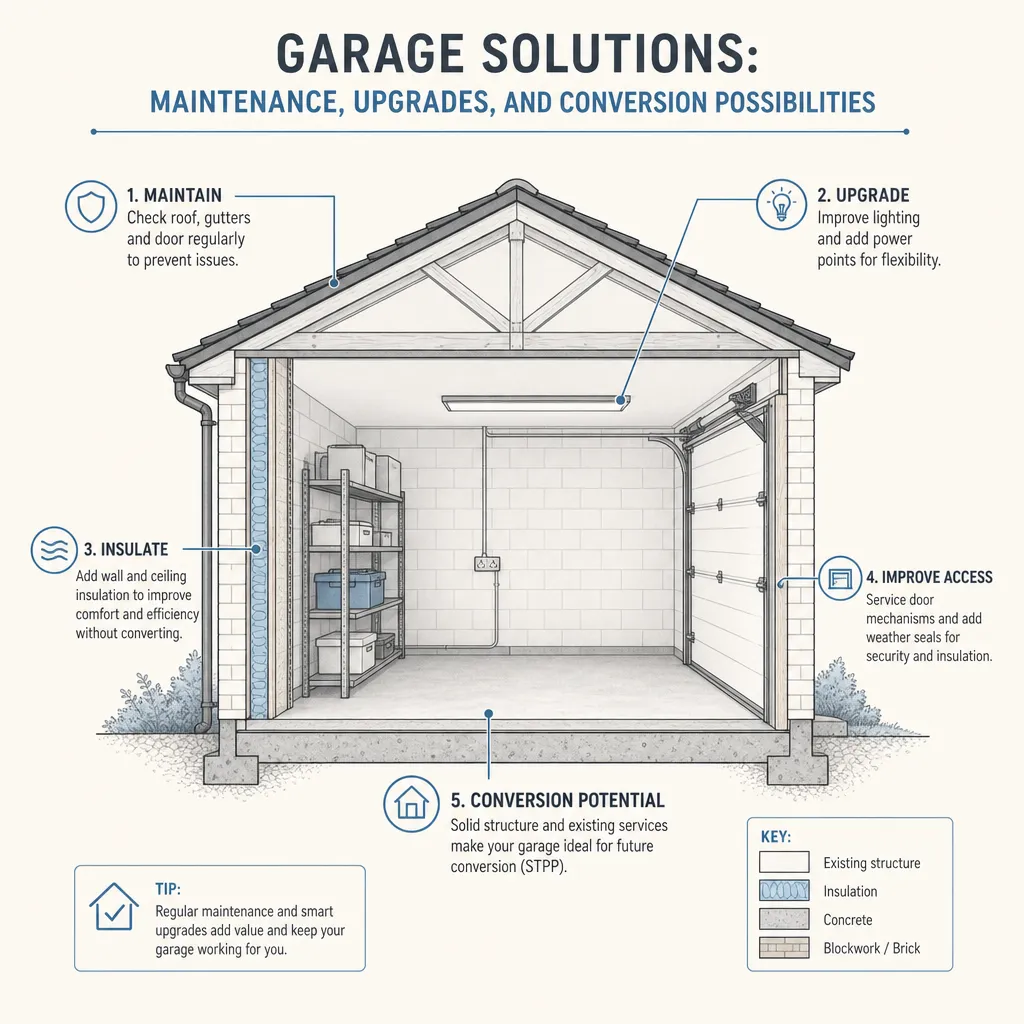
Garage Solutions: Maintenance, Upgrades, and Conversion Possibilities
Your garage can serve many functions — storage, workshop, hobby space, or a full habitable room conversion.
 Improvement & Build
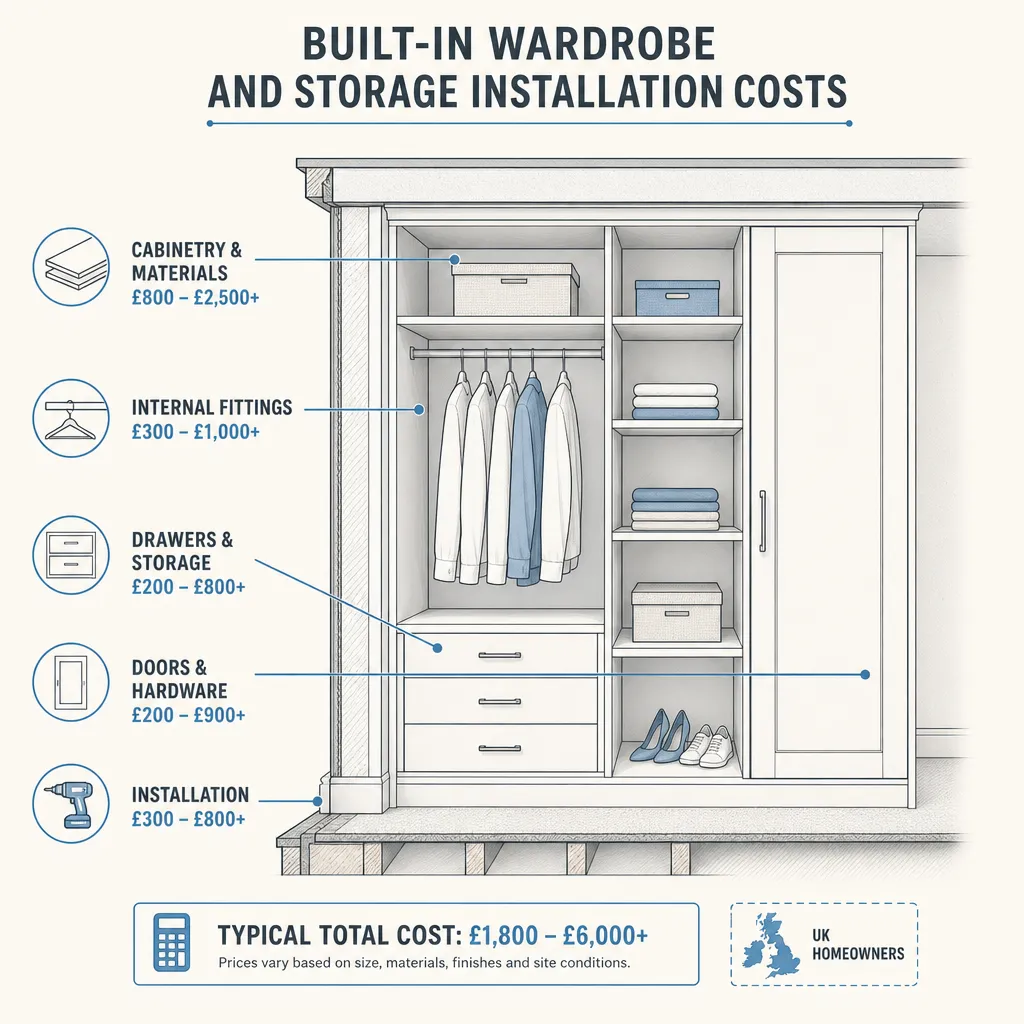
Built-In Wardrobe and Storage Installation Costs
Built-in wardrobe installation in the UK typically costs £800–£3,000 for a standard bedroom using fitted flatpack or semi-bespoke systems, and £2,500–£8,000 or more for fully bespoke carpentry.
 Improvement & Build
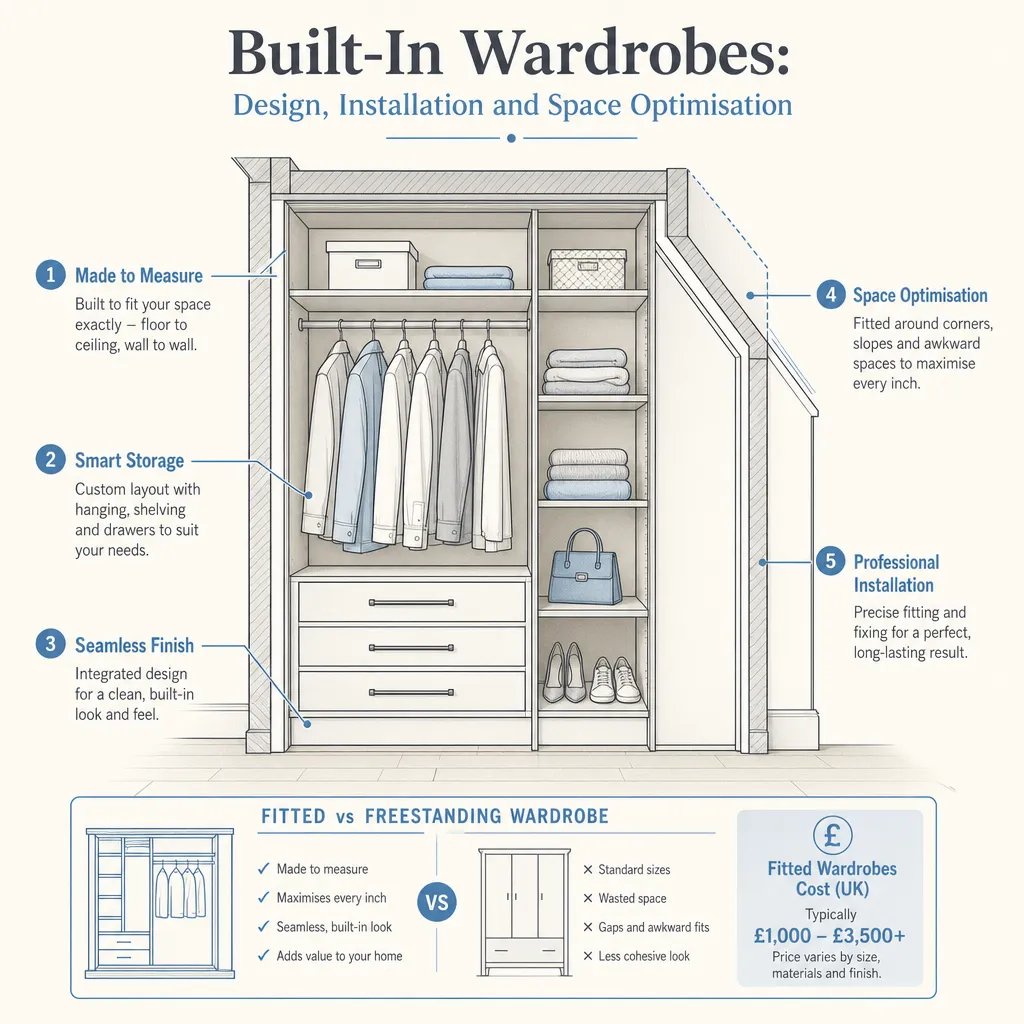
Built-In Wardrobes: Design, Installation and Space Optimisation
Built-in wardrobes are fixed storage units designed to span a wall, alcove, or recess, installed by a joiner or fitted-furniture company.
 Improvement & Build
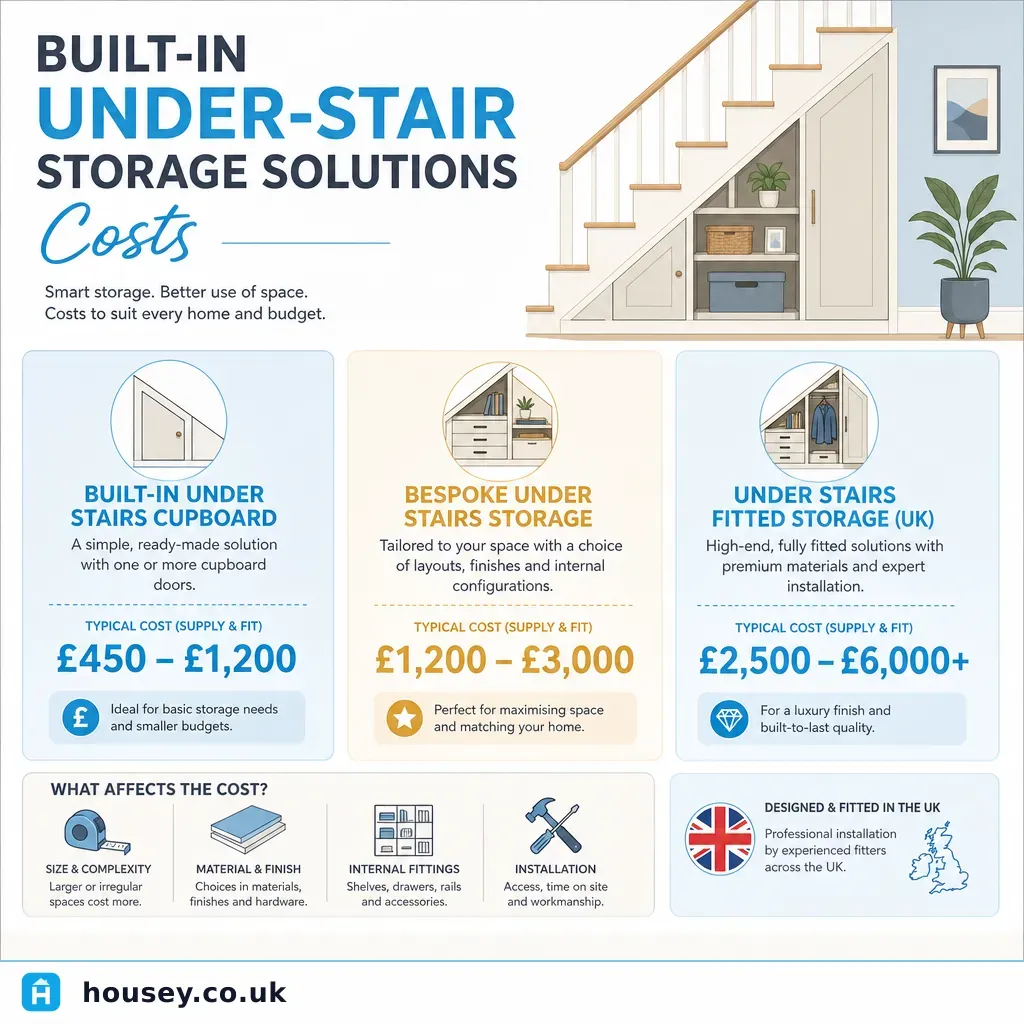
Built-In Under-Stair Storage Solutions Costs
Built-in under-stair storage in the UK typically costs £500–£1,500 for a basic fitted door and shelving unit, rising to £2,000–£5,000 or more for fully bespoke carpentry with drawers and a painted finish.
 Improvement & Build
Home Storage Solutions: Organisation Ideas for Every Room
Good home storage starts with measuring available space and understanding exactly what needs to be stored.