Built-In Under-Stair Storage Solutions Costs
By Housey · Last reviewed 11th of May 2026
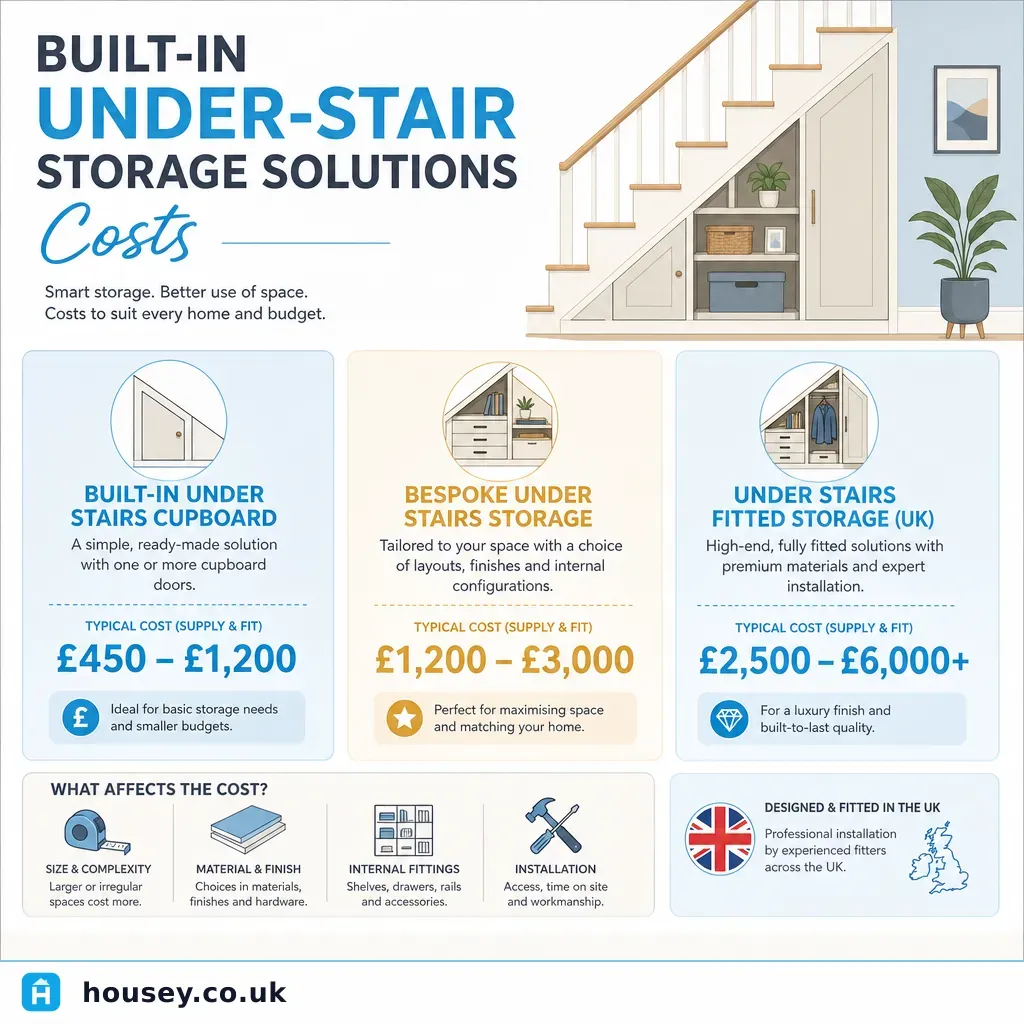
Built-In Under-Stair Storage Solutions Costs
The space beneath a staircase is one of the most persistently underused areas in a UK home, particularly in Victorian and Edwardian terraces and post-war semis where internal square footage is often at a premium. Homeowners typically start thinking about costs when planning a hallway refresh, when a growing family needs better-organised storage near the front door, or when a renovation creates the opportunity to commission the work properly. What drives the cost varies considerably — and the staircase shape matters far more than most people realise before they receive their first quote.
Key points
- Basic fitted under-stair storage — a framed door with fixed shelves — typically costs £500–£1,500 installed; fully bespoke carpentry with pull-out drawers and a painted finish can reach £2,000–£5,000 or more (Indicative UK costs, last reviewed 2026-05-11).
- The staircase type is the biggest single cost driver: a straight staircase with a clean triangular void is the simplest to work with; a quarter-turn or dog-leg staircase produces an irregular shape requiring significantly more complex cutting and framing.
- If the under-stair area is being enclosed as a cupboard, Building Regulations require adequate ventilation to prevent moisture build-up, particularly if the staircase runs adjacent to an external wall.
- Any electrical work inside the under-stair space — sockets or lighting — should be first-fixed by a registered electrician before joinery is fitted; budget an additional £100–£300 for this.
- For staircases that form a protected fire-escape route in converted flats or HMOs, fire regulations may apply and building control should be consulted before enclosing the space.
What types of under-stair storage are available?
Open shelving: Adjustable shelves fixed within the void, with no door. Suits utility storage — hoovers, coats, shoes — where accessibility matters more than appearance. The least expensive option and often the quickest to install.
Fitted door and shelving: A framed door with fixed or adjustable shelves behind. The most common upgrade, and one that can significantly tidy the appearance of a hallway in a Victorian terrace or 1930s semi.
Pull-out drawers or trolleys: Custom-made drawers on runners that maximise the triangular depth of the space by bringing items to the user rather than requiring reaching to the back. Higher cost due to precision joinery.
Full bespoke fitted unit: A purpose-built unit with a combination of drawers, shelves, pull-outs, hooks, and sometimes an integrated shoe bench. Painted or wrapped to match existing hallway joinery.
Home office conversion: A desk, shelving, and power points fitted under a straight staircase, typically enclosed by bi-fold or sliding doors. Popular in homes where a dedicated study room is not possible.
Indicative under-stair storage costs
Indicative UK costs, last reviewed 2026-05-11. Costs vary by staircase type, complexity, finish specification, and location. Obtain at least three quotes.
Solution type | Indicative cost range |
|---|---|
Open shelving (basic materials, standard fixing) | £150–£400 |
Fitted door and shelves (joiner-fitted) | £500–£1,500 |
Pull-out drawers (custom-made) | £1,000–£2,500 |
Fully bespoke painted carpentry (straight stair) | £2,000–£4,000 |
Fully bespoke under dog-leg or quarter-turn stair | £3,000–£6,000+ |
Home office conversion (joinery and electrics) | £2,500–£5,500 |
DIY flat-pack vs. bespoke carpentry
| Flat-pack or off-the-shelf | Bespoke joinery |
|---|---|---|
Cost | £100–£500 (materials only) | £1,000–£5,000+ (materials and labour) |
Fit quality | Good for rectangular shapes; poor for angled voids | Exact fit to the space, any shape |
Finish | Limited; usually white melamine | Painted, stained, or wrapped to match hallway |
Durability | MDF or particleboard; adequate for light use | Solid timber or birch ply; more durable long term |
Lead time | Immediate or 2–4 weeks (semi-custom) | 4–10 weeks fabrication time |
Best for | Budget projects; renters; simple rectangular voids | Owner-occupiers staying long term; complex shapes |
What factors affect the cost?
Staircase shape: A straight staircase with a clean triangular void is the simplest and least expensive to work with. Quarter-turn, dog-leg, or winder staircases produce irregular shapes requiring more cutting, framing, and fitting time.
Finish specification: An unprimed MDF carcass for the homeowner to paint themselves costs less than a spray-painted, fully primed and finished unit supplied ready to hang.
Pull-out components: Custom pull-out drawers on quality runners add approximately £150–£400 per drawer to the unit cost, due to the precision fitting required.
Electrics: Adding sockets or LED strip lighting requires a qualified electrician to first-fix cabling before joinery is installed. This typically adds £100–£300 to the overall project.
Material choice: MDF is the most common material for painted fitted storage. Birch plywood is stronger and more moisture-resistant. Solid hardwood is used for premium bespoke commissions.
Location: Labour rates in London and the South East typically run 15–25% higher than in other regions of the UK.
Homeowner checklist: before instructing a carpenter
When to get professional help
A local carpenter or joinery company is the right professional for most under-stair storage projects. Seek additional professional input if:
- Structural timbers form part of the stair construction — a carpenter or structural engineer should advise before any cutting or notching
- The staircase serves more than one dwelling, as in a converted flat or HMO — fire regulations may apply to enclosures around protected escape routes
- You want to install a gas appliance (such as a boiler) inside the under-stair cupboard — specific ventilation and Gas Safe Register requirements apply
How Housey can help
Housey helps homeowners find and compare bespoke carpenters and joinery specialists across the UK. Submit your under-stair storage project once to receive competitive quotes from vetted tradespeople in your area, with no obligation to proceed.
Frequently asked questions
Do I need planning permission for under-stair storage?
In virtually all cases, no. Internal joinery does not require planning permission. Building Regulations may apply if the work involves significant structural alterations or affects fire-protected escape routes in a flat or HMO. If you are unsure, check with your local building control team before work starts — this is particularly relevant in converted properties.
How long does it take to fit under-stair storage?
A simple fitted door and shelving unit typically takes one to two days. A fully bespoke unit — made in a joinery workshop and installed on site — usually requires half a day to a full day for installation, following a fabrication lead time of four to eight weeks. Any electrical first-fix adds a separate tradesperson visit before the joinery is fitted.
Can I add insulation to the under-stair area?
Yes. Many homeowners insulate the soffit and external-facing wall when fitting under-stair storage, which can reduce heat loss in ground-floor hallways adjacent to external walls. Insulation in new or refurbished spaces should comply with Building Regulations Part L. Speak to your carpenter or a building control officer about the right specification for your property.
What is the best material for under-stair storage?
MDF is the most common choice for painted fitted storage — dimensionally stable, easy to work, and takes a smooth paint finish well. Birch plywood is preferred where moisture is a concern, such as under a ground-floor stair with a cold external substrate, or where greater load capacity is needed. Solid timber is used in premium bespoke commissions. Ask your carpenter to recommend the right material for your staircase type and budget.
Sources and further reading
- Approved Document K: Stairs, Ladders and Ramps — GOV.UK
- Do I Need Planning Permission? Common Projects — Planning Portal
- Under Stairs Storage Cost Guide — Checkatrade (indicative cost reference, commercial source)
Useful next reads
 Improvement & Build
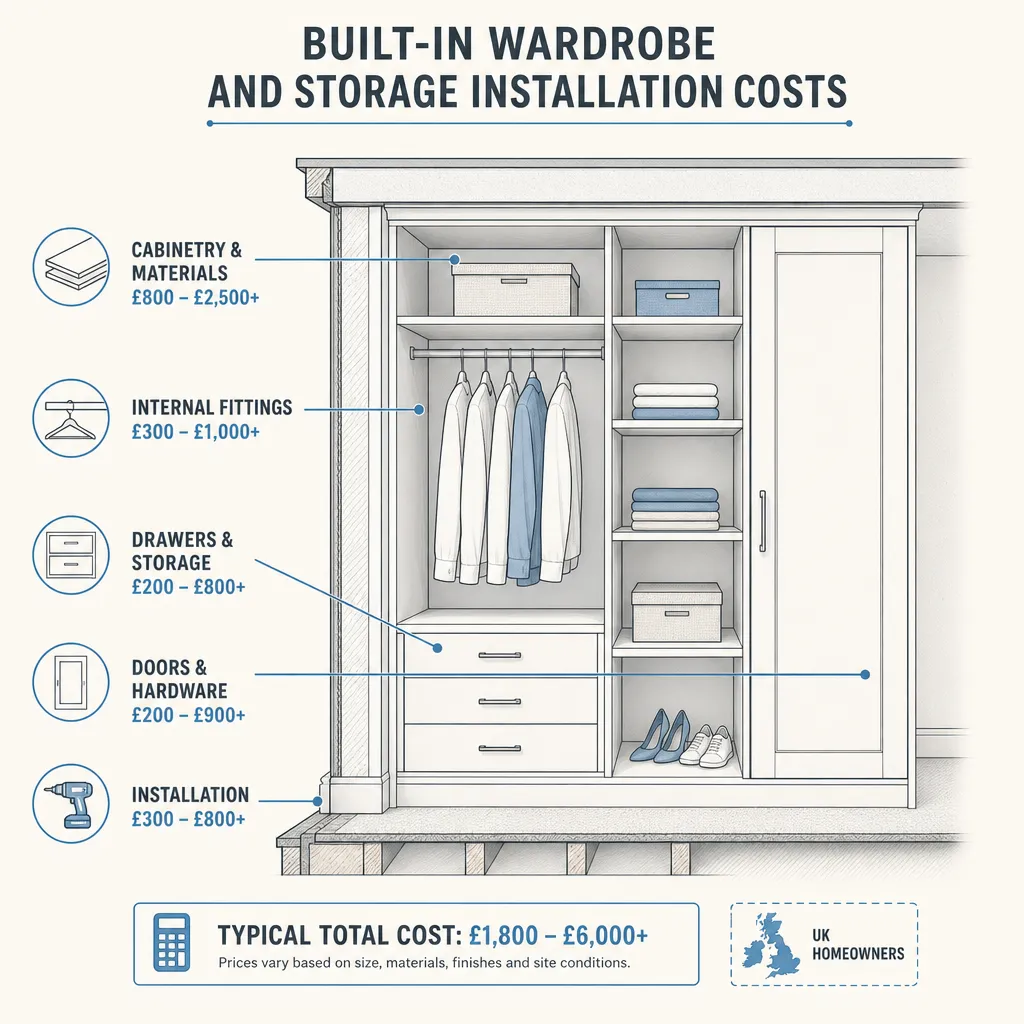
Built-In Wardrobe and Storage Installation Costs
Built-in wardrobe installation in the UK typically costs £800–£3,000 for a standard bedroom using fitted flatpack or semi-bespoke systems, and £2,500–£8,000 or more for fully bespoke carpentry.
 Improvement & Build
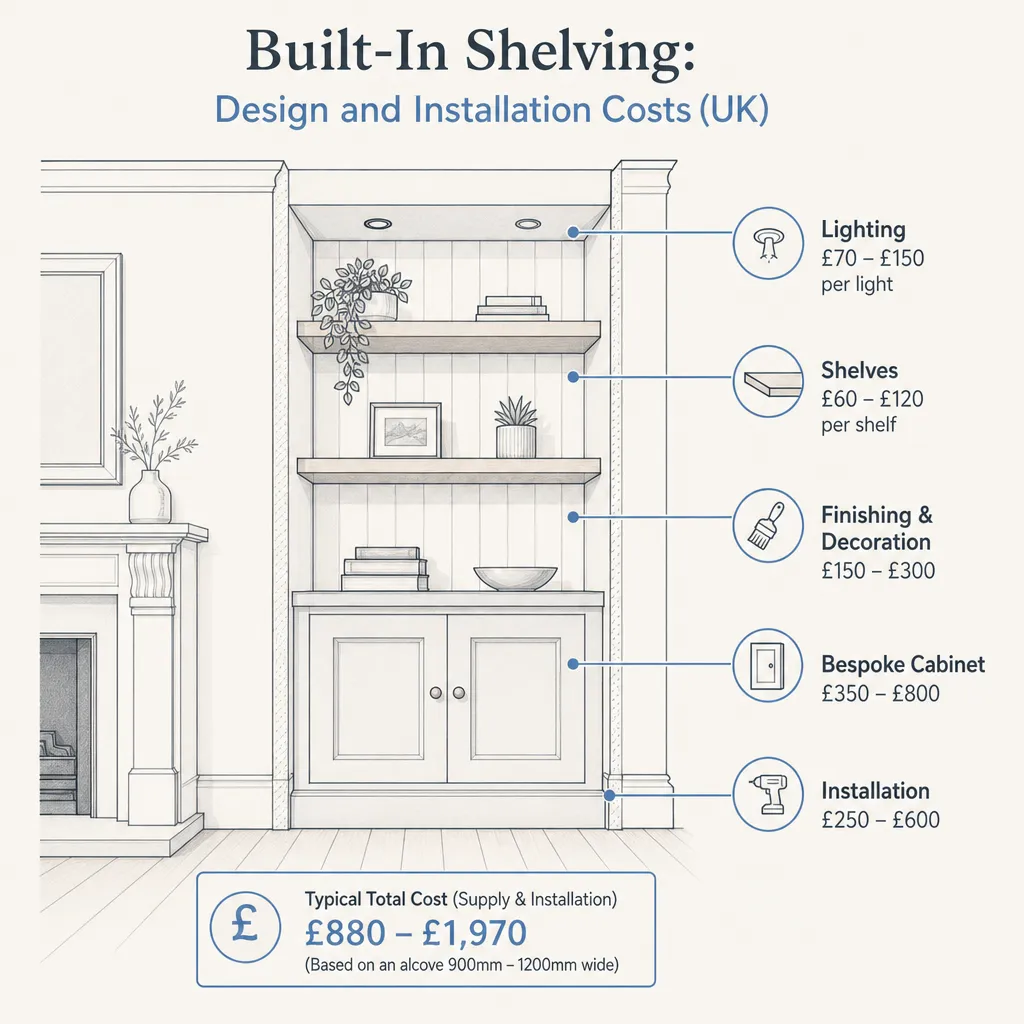
Built-In Shelving: Design and Installation Costs
Built-in shelving typically costs £400–£900 for a simple single-alcove MDF unit, rising to £1,400–£3,000 for a pair of painted alcoves with base cupboards.
 Improvement & Build
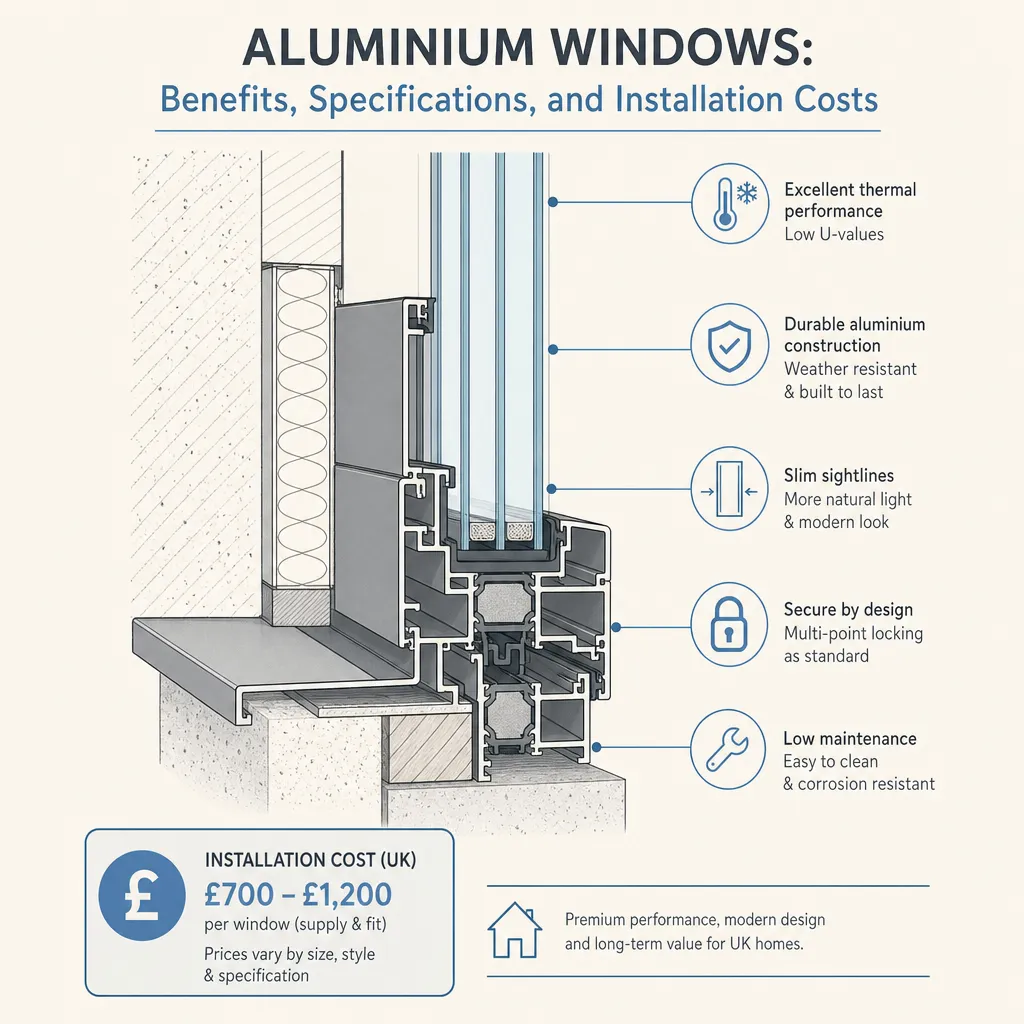
Aluminium Windows: Benefits, Specifications, and Installation Costs
Aluminium windows typically cost £600–£1,800 per window installed in the UK, depending on size and specification.
 Improvement & Build
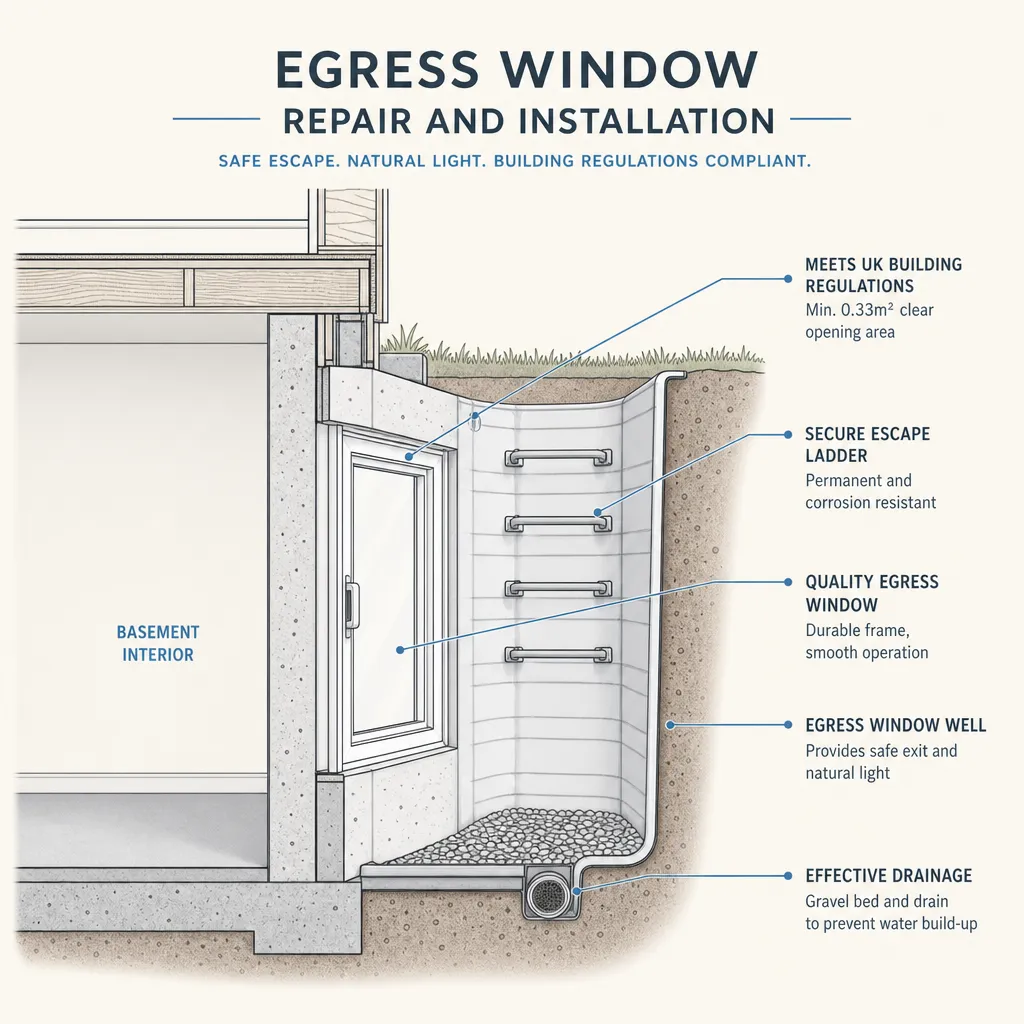
Egress Window Repair and Installation
An egress window is a window large enough to serve as an emergency escape route from a habitable room.
 Improvement & Build
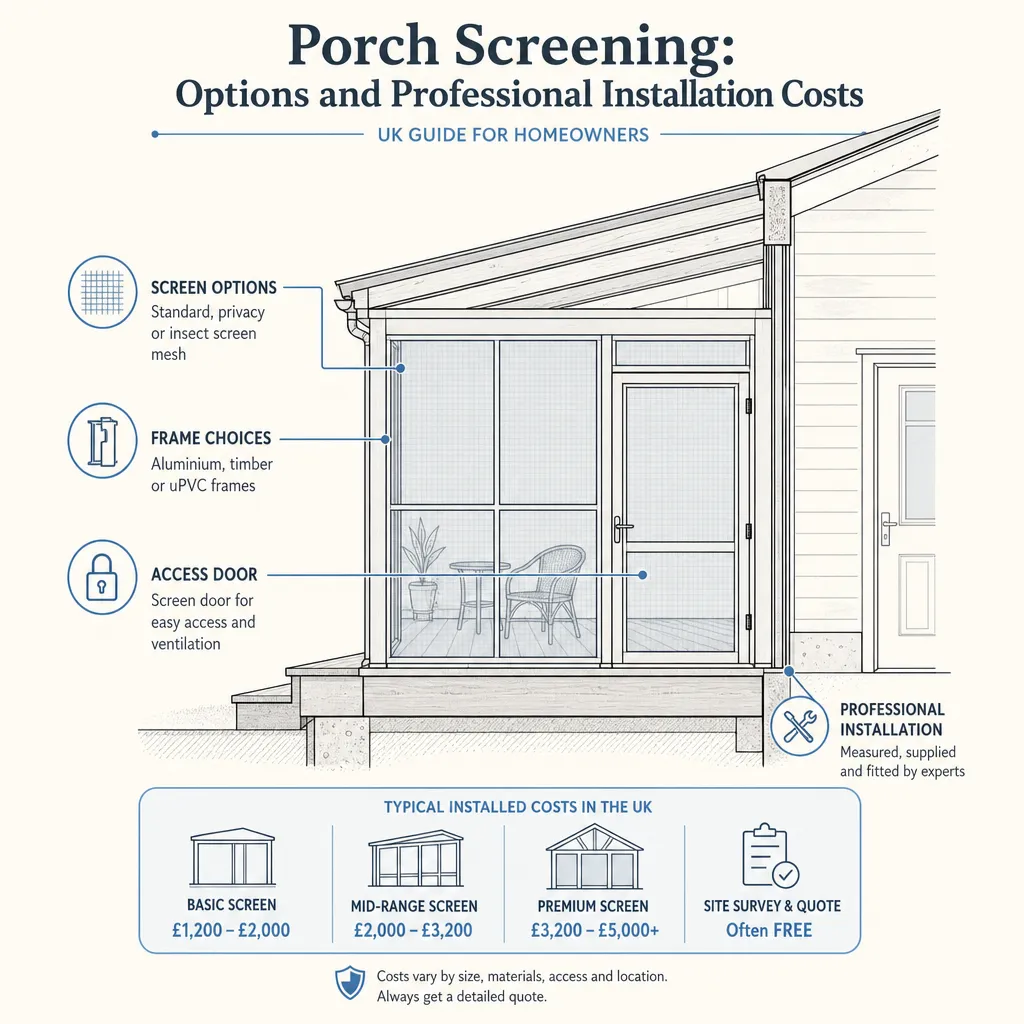
Porch Screening: Options and Professional Installation Costs
Porch screening ranges from simple insect mesh on a timber frame to bespoke aluminium-framed glazed enclosures.