Built-In Wardrobes: Design, Installation and Space Optimisation
By Housey · Last reviewed 19th of May 2026
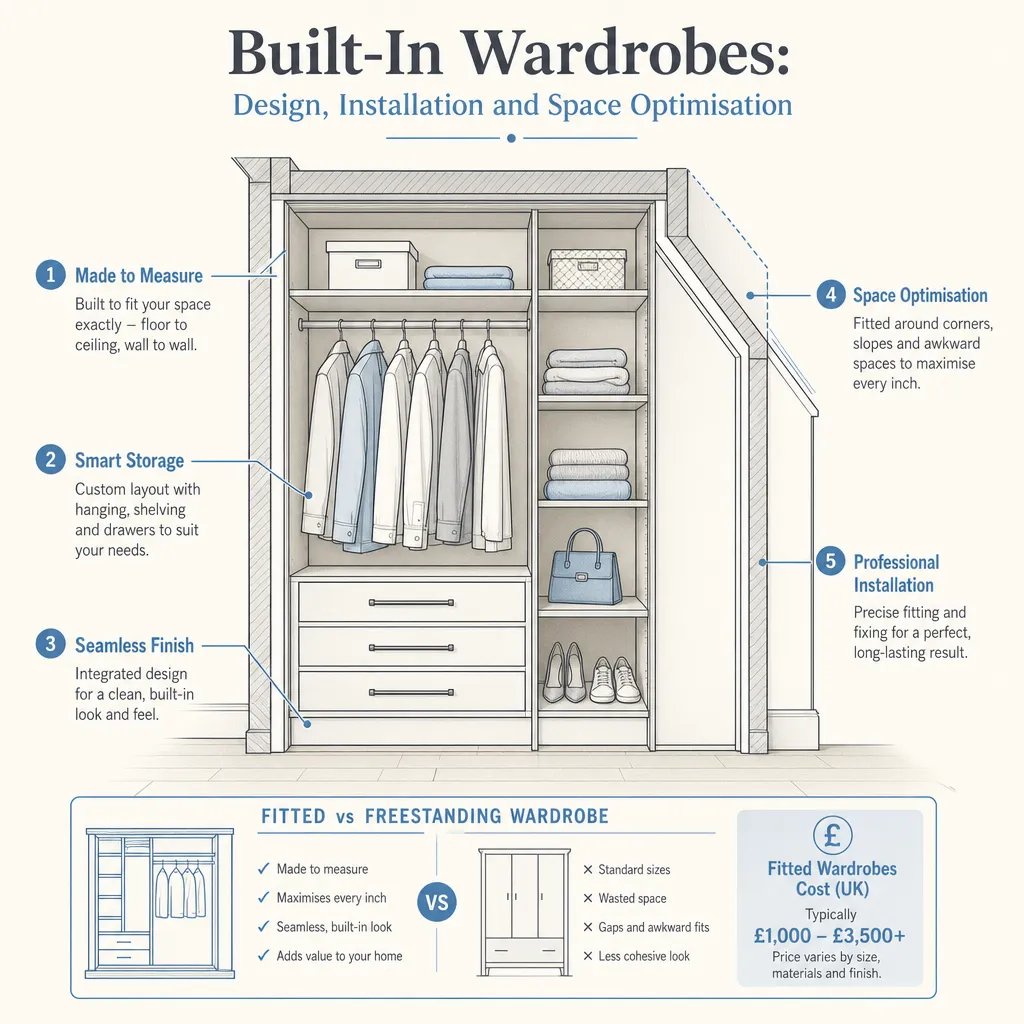
Built-In Wardrobes: Design, Installation and Space Optimisation
Bedroom storage is a persistent challenge in the UK housing stock, where rooms in Victorian terraces, 1930s semis, and post-war houses were rarely designed with built-in storage in mind. The decision to install fitted wardrobes arises at different moments — during a full bedroom renovation, after a loft conversion, or when freestanding furniture is no longer managing the load. Getting the design, specification, and installation right from the start saves both money and disruption, but the options available — from self-assembly flat-pack to fully bespoke joinery — span a wide range of cost and quality.
Key points
- Indicative costs range from £400–£1,000 for a self-assembled flat-pack system to £2,500–£6,000+ for bespoke joiner-built wardrobes (Indicative UK costs, last reviewed 2026-05-19).
- Standard hanging depth is 550–600mm for clothes on hangers; shallower carcasses of 350–400mm suit folded items, shoes, and linen storage.
- Sliding-door systems require no swing clearance and suit rooms under 3m wide; hinged doors provide unobstructed full-width access but need at least 600mm of clear floor space in front.
- Alcove installations beside chimney breasts frequently involve uneven walls and sloped or lowered ceilings, requiring scribing and packing that add to labour time and cost.
- No planning permission or building regulations approval is normally required for built-in wardrobes unless a structural wall is being altered as part of the project.
Flat-pack, fitted furniture, or bespoke joinery?
The market for built-in wardrobes in the UK divides broadly into three routes, each with different trade-offs on cost, lead time, and finish quality.
Approach | Typical cost per linear metre | Best for | Limitations |
|---|---|---|---|
Flat-pack (e.g. Ikea PAX-style systems) | £150–£300/m | Budget projects, simple rectangular rooms, DIY-confident owners | Standard depths only; unsuitable for significantly uneven walls, sloped ceilings, or complex alcoves |
Fitted-furniture company (e.g. regional specialists or national chains) | £600–£1,500/m | Mid-range budgets, standard layouts, sliding-door finishes | Semi-standard design vocabulary; quality and finish vary widely between suppliers |
Bespoke joiner-built | £900–£2,500/m | Complex spaces, period properties, high-quality finishes, unusual dimensions | Higher cost and lead time of 4–10 weeks; requires sourcing and vetting a competent joiner |
Indicative UK costs, last reviewed 2026-05-19. Most fitted wardrobe installations attract VAT at the standard 20% rate; check with your supplier.
A useful rule of thumb: if your walls are plumb, the ceiling is level, and the opening is a standard rectangular shape, a flat-pack or fitted-furniture route is usually sufficient. If you are working around a chimney breast, a sloped loft ceiling, or an irregular alcove, bespoke joinery typically produces a better result and makes more of the available internal volume.
Planning your layout and internal configuration
Before approaching any supplier, measure the available wall width, ceiling height, and floor-to-door clearance. Measure wall width at floor, mid-height, and ceiling level to check for any taper — in period properties, walls are rarely perfectly vertical. Record ceiling height precisely: most flat-pack systems are designed for ceilings of 2,010–2,400mm, while bespoke joinery can accommodate any height.
Internal configuration depends on what you need to store:
- Double hanging: requires a minimum of 900mm vertical clearance for jackets and coats; 1,000–1,100mm for full-length dresses.
- Single hanging with shelves above: suits shirts, folded knitwear, and accessories; more flexible for a mixed wardrobe.
- Drawers: typically 150–200mm per drawer; add cost if drawer packs are bespoke rather than modular inserts.
- Shoe racks and pull-outs: useful in shallower sections; allow 200–250mm depth per pair of shoes on angled racks.
Door styles, finishes, and hardware
Door choice significantly affects both the look and the practicality of a fitted wardrobe.
Sliding doors are popular in UK bedrooms where space is limited. They require a top track and typically need 50–75mm clearance between the door panel and internal shelf edges. Mirror-fronted sliding panels visually enlarge a room and are a standard option from most fitted-furniture companies.
Hinged doors provide unobstructed access to the full wardrobe width in a single motion and are more common in bespoke joinery projects and larger bedrooms. Soft-close hinges add a modest premium but extend door longevity considerably.
Finish options run from vinyl wrap and melamine-faced board (MFC) — standard in flat-pack systems — through to painted MDF, which is paintable to any colour and widely chosen in period properties, and solid timber. Painted MDF is the most popular bespoke finish because it matches existing woodwork and is straightforward to redecorate at a future date.
What to ask before accepting a quote
- What is included in the price — survey, supply, installation, and making good?
- What materials will the carcasses, doors, and internal fittings be made from?
- Will the fitter scribe to the floor and ceiling, or will gaps be left?
- What warranty is offered on materials and workmanship, and who do I contact if something fails?
- Is VAT included in the quoted price?
- What happens if dimensions change between survey and installation, for example due to plastering or other preparatory works?
- Will waste materials and packaging be removed from site at the end of the job?
When to get professional help
A competent joiner or specialist fitted-furniture installer handles most built-in wardrobe projects without additional professional involvement. However, seek further advice in these situations:
- The installation involves fixing to, cutting into, or notching a wall that may be structural — in older properties, internal walls are not always clearly non-load-bearing.
- There is evidence of damp, mould, or timber decay behind the wall where the wardrobe will be fixed; investigate this before covering the surface.
- The property is listed or in a conservation area, and the wardrobes may alter the character of the room or its historic fabric.
- You are working in an alcove built into a party wall — check whether drilling or bolting into that shared wall triggers any obligations under the Party Wall etc. Act 1996.
How Housey can help
Housey connects UK homeowners with vetted local joiners and specialist fitted-furniture installers who can survey, design, supply, and fit built-in wardrobes to your specification. Use our platform to request quotes from multiple professionals and compare pricing, experience, and reviews before committing to a supplier.
Frequently asked questions
Do built-in wardrobes add value to a UK property?
Well-fitted built-in wardrobes generally improve buyer appeal, particularly in smaller bedrooms where storage is a selling point. A neutral finish and practical layout tend to hold value better than heavily stylised or coloured designs. Poorly fitted units with visible gaps or low-quality materials can have the opposite effect on a buyer's impression.
Do I need planning permission to install built-in wardrobes?
No planning permission is required for internal fitted wardrobes in most UK homes. Building regulations approval is also not normally needed unless structural walls are being altered. If the property is listed or in a conservation area, check with your local planning authority before proceeding, as permitted development rights may be more restricted.
How long do fitted wardrobes last?
A well-made bespoke or mid-range fitted wardrobe should last 15–25 years with normal use. Flat-pack systems may need hardware replacement — hinges, drawer runners, and sliding-door tracks — after 8–12 years. The quality of materials and the standard of installation are the main factors affecting how long a unit performs reliably.
Can I fit built-in wardrobes in a rented property?
You will normally need written permission from your landlord before making fixed alterations to a rented property. Check your tenancy agreement carefully and obtain consent in writing before any work begins. Some landlords require that wardrobes are removed and the wall made good at the end of the tenancy.
Sources and further reading
- VAT for building and construction (Notice 708) — HMRC / GOV.UK
- Fitted wardrobes buying guide — Which?
- Find a vetted tradesperson — TrustMark
Useful next reads
 Improvement & Build
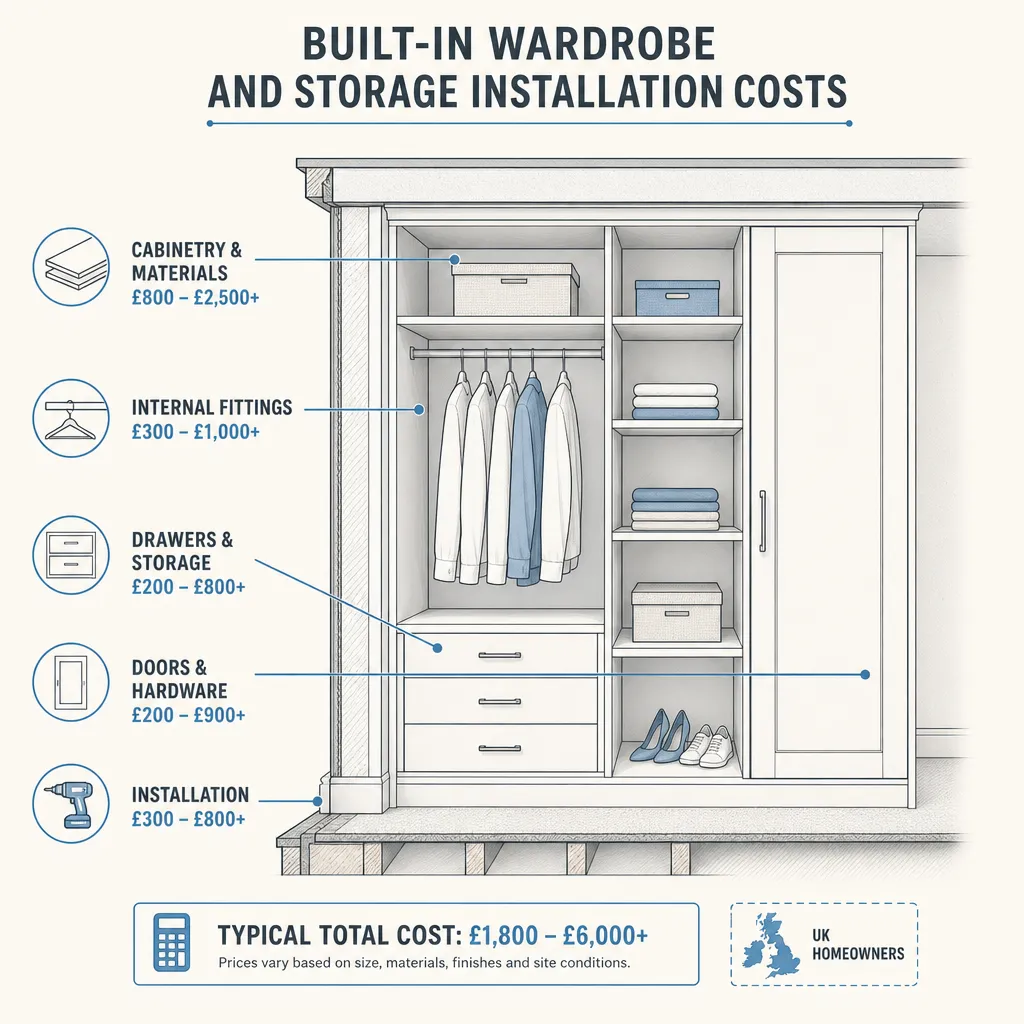
Built-In Wardrobe and Storage Installation Costs
Built-in wardrobe installation in the UK typically costs £800–£3,000 for a standard bedroom using fitted flatpack or semi-bespoke systems, and £2,500–£8,000 or more for fully bespoke carpentry.
 Improvement & Build
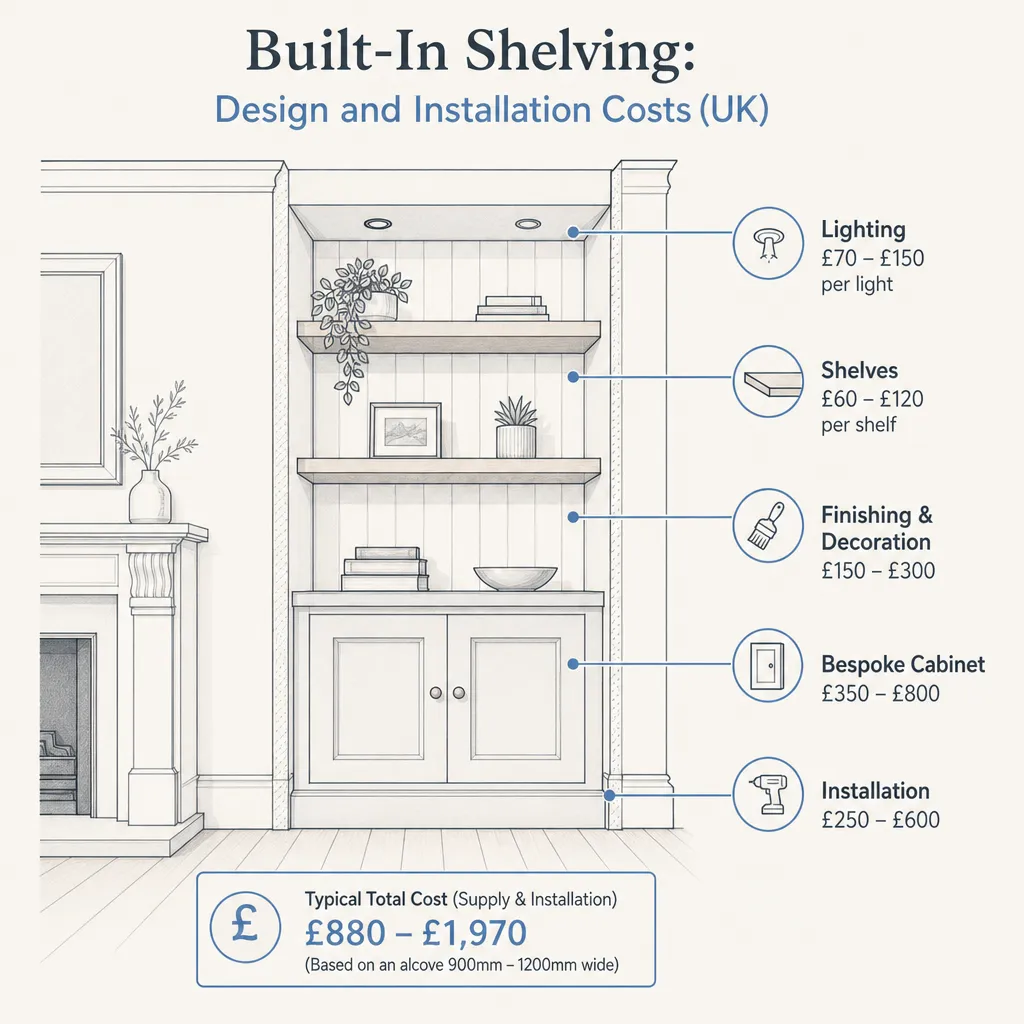
Built-In Shelving: Design and Installation Costs
Built-in shelving typically costs £400–£900 for a simple single-alcove MDF unit, rising to £1,400–£3,000 for a pair of painted alcoves with base cupboards.
 Improvement & Build
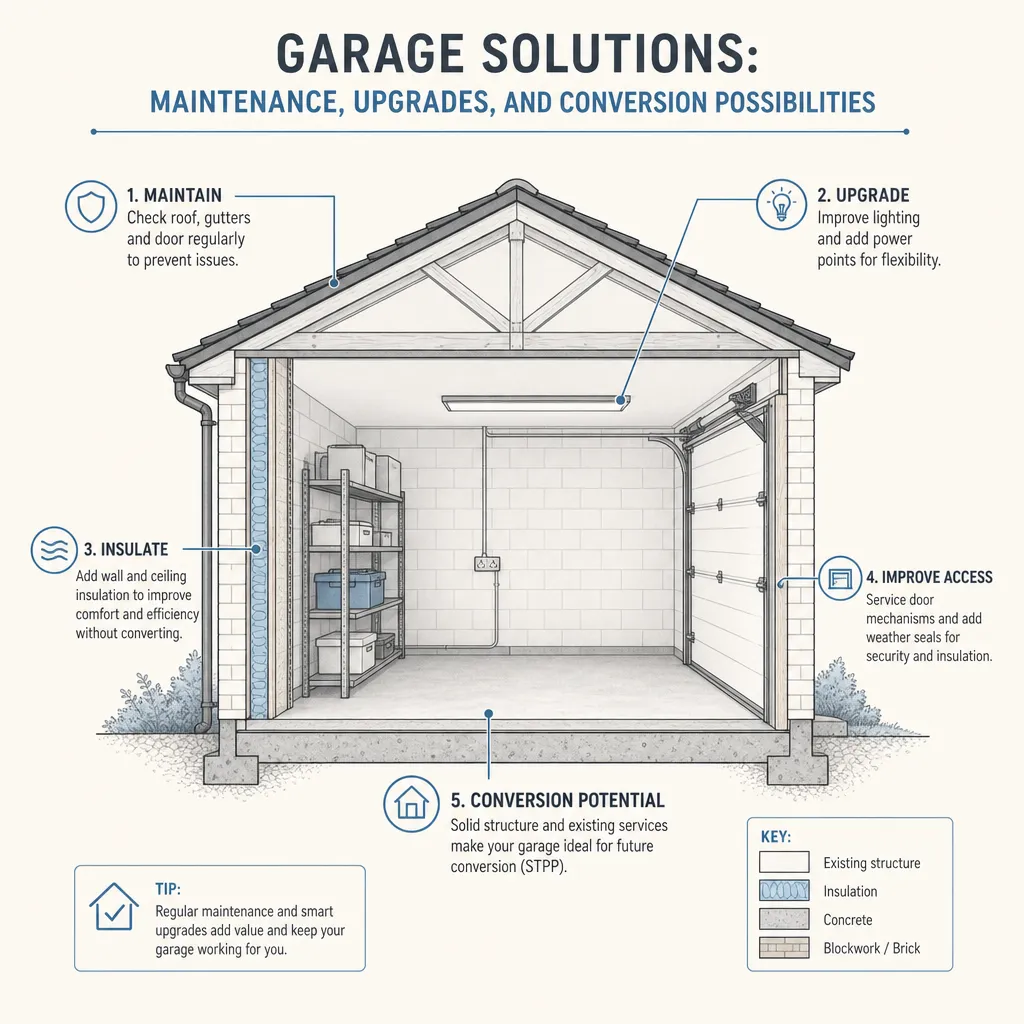
Garage Solutions: Maintenance, Upgrades, and Conversion Possibilities
Your garage can serve many functions — storage, workshop, hobby space, or a full habitable room conversion.
 Improvement & Build
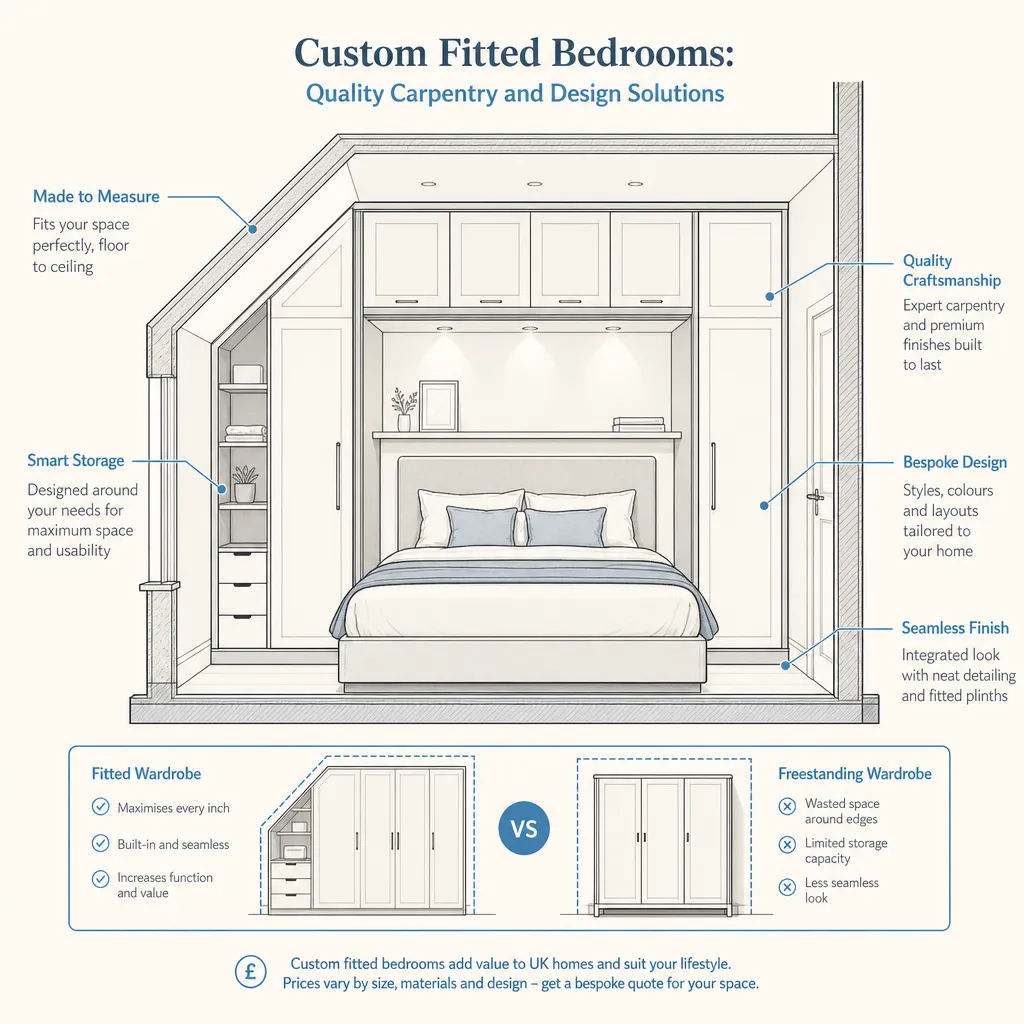
Custom Fitted Bedrooms: Quality Carpentry and Design Solutions
Custom fitted bedrooms are built to your exact room dimensions — by a specialist fitted-furniture company or an independent carpenter — to maximise storage in awkward spaces.
 Improvement & Build
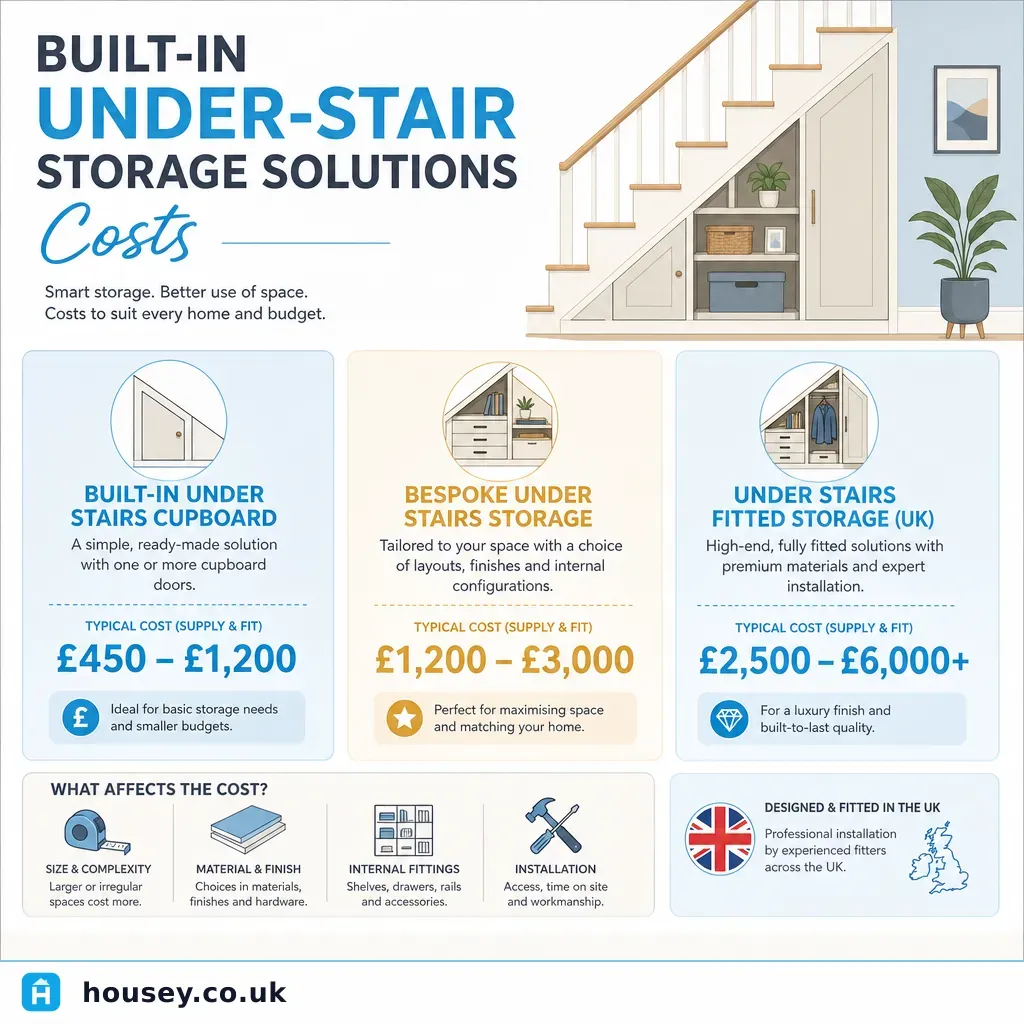
Built-In Under-Stair Storage Solutions Costs
Built-in under-stair storage in the UK typically costs £500–£1,500 for a basic fitted door and shelving unit, rising to £2,000–£5,000 or more for fully bespoke carpentry with drawers and a painted finish.