Aluminium Windows: Benefits, Specifications, and Installation Costs
By Housey · Last reviewed 5th of May 2026
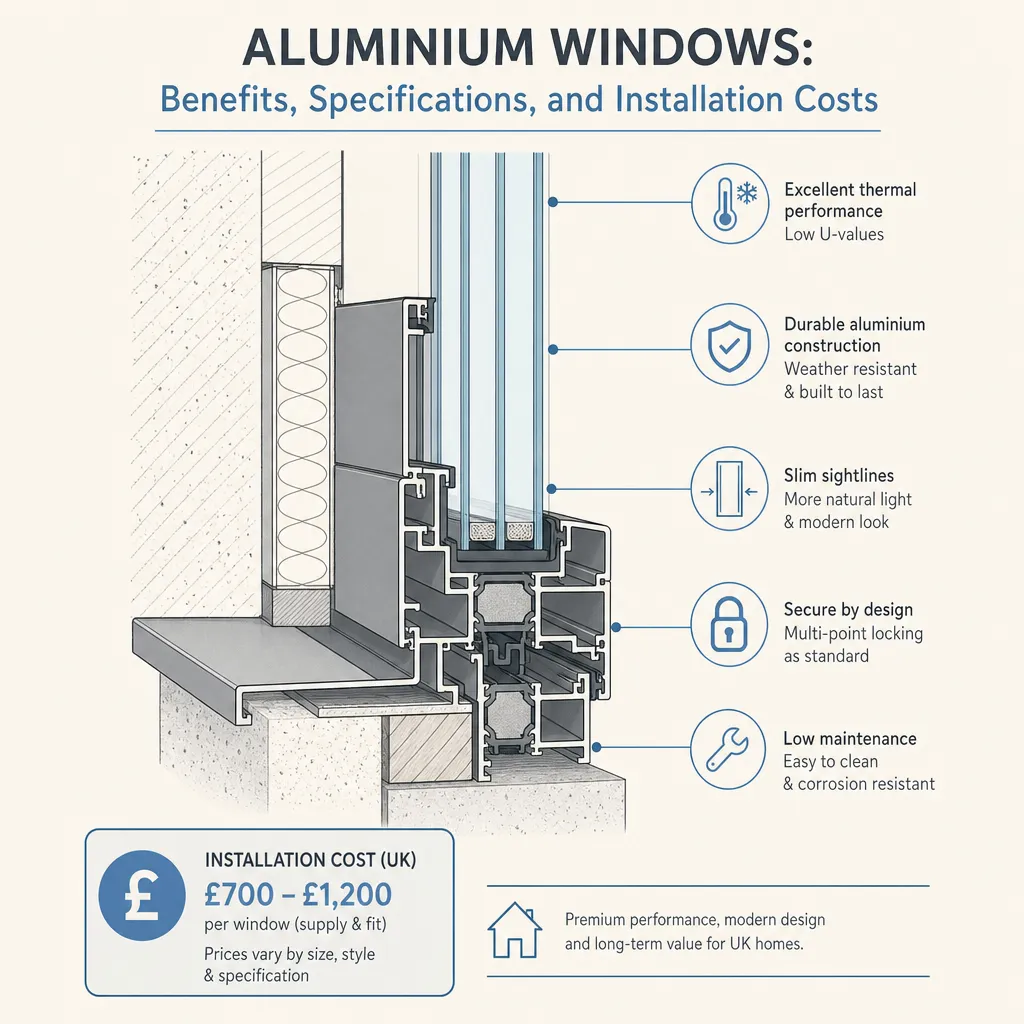
Aluminium Windows: Benefits, Specifications, and Installation Costs
Aluminium windows have shifted from a largely commercial product to a mainstream residential choice in the UK, driven by demand for contemporary aesthetics, slimmer profiles, and longer service life. The decision to specify aluminium typically arises when fitting windows to a new extension, when existing timber frames are failing, or when a homeowner wants a frame material that will outlast multiple sets of double-glazed units.
Key points
- Aluminium windows in the UK typically cost £600–£1,800+ per window installed, depending on size, configuration, glazing specification, and colour (indicative UK costs, last reviewed 2026-05-05).
- All replacement windows in England must achieve a minimum whole-window U-value of 1.4 W/m²K under Building Regulations Approved Document L (2022 edition); quality aluminium windows can reach 0.8 W/m²K with a thermal break and argon-filled glazing.
- Aluminium frames require a polyamide thermal break to prevent cold-bridging — without one, raw aluminium's thermal conductivity of approximately 205 W/m·K makes it a very poor insulator.
- Powder-coat finishes cover the full RAL colour palette and are typically guaranteed against fading for 25–30 years under a Qualicoat-certified specification.
- Installers replacing windows in existing England and Wales dwellings must be FENSA or CERTASS registered, or notify local building control before starting work.
What makes aluminium windows different from other frame materials?
Aluminium is a metal alloy with distinct physical properties that set it apart from UPVC or timber for window design.
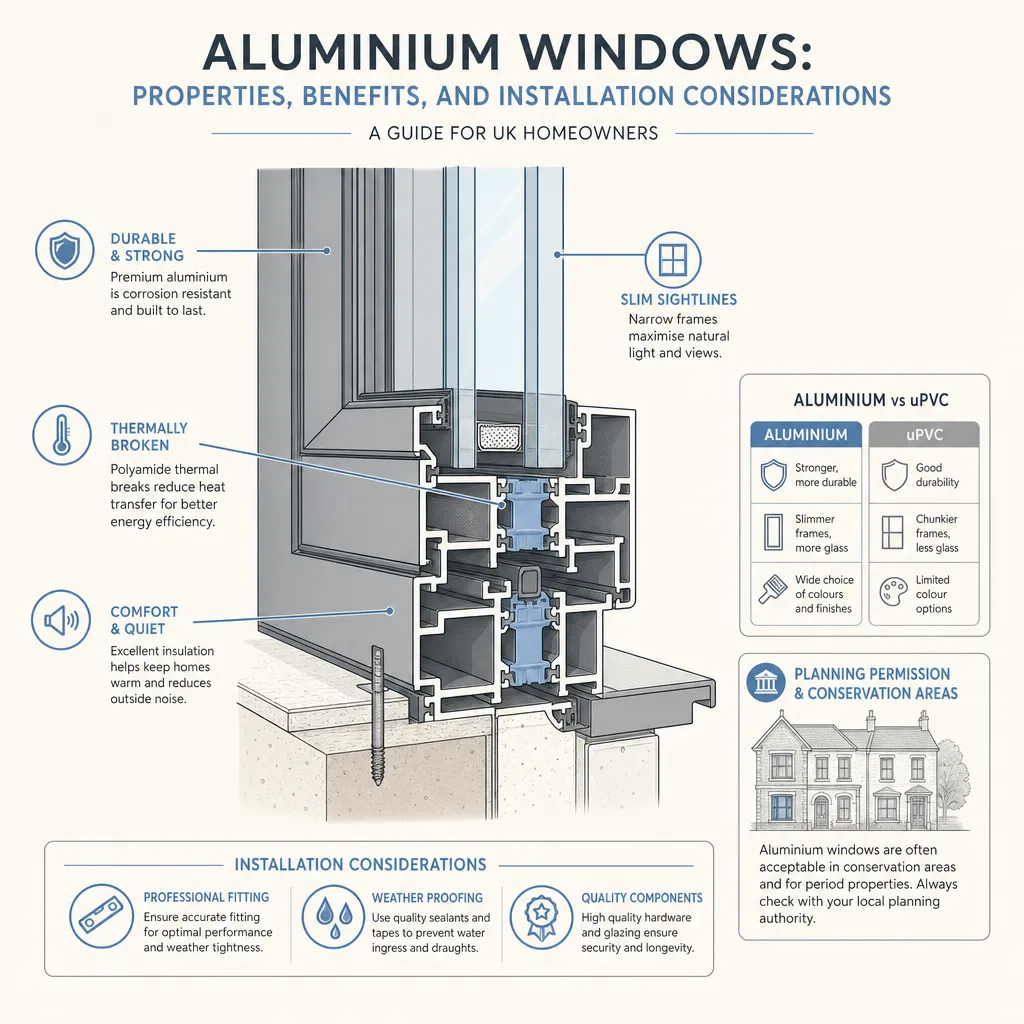
Strength-to-weight ratio: Aluminium is lightweight but structurally rigid, allowing manufacturers to produce slim frame profiles — typically 25–40 mm visible width for residential systems — without sacrificing weather resistance or load-bearing capacity. This is why aluminium is the material of choice for large-format glazing such as bifold doors and floor-to-ceiling panels.
Thermal conductivity: Raw aluminium conducts heat readily, which is a disadvantage for insulation. Modern aluminium windows address this with a polyamide thermal break — a continuous strip of reinforced polyamide (nylon) bonded between the inner and outer sections of the profile. This disrupts the thermal pathway and is essential for compliance with Part L and for preventing condensation on internal frame surfaces.
Powder-coat finishing: Aluminium is factory powder-coated after fabrication. The coating bonds electrostatically to the metal and is cured at high temperature, creating a hard, UV-resistant surface that does not need repainting. RAL 9016 (traffic white) and RAL 7016 (anthracite grey) are the most popular choices in the UK, but virtually any RAL or BS colour can be specified.
Recyclability: Aluminium is one of the most recyclable structural materials in common use. Recycling it uses approximately 5% of the energy required to produce virgin aluminium, giving it strong sustainability credentials over its full lifespan.
Thermal performance and Building Regulations compliance
Under Approved Document L (England, 2022 edition), replacement windows must achieve a whole-window U-value of 1.4 W/m²K or better. This is a whole-window figure — it combines the glazing unit, frame conductivity, and edge spacer effect together.
A well-specified aluminium window with a thermally broken frame, an argon-filled double-glazed unit, a warm-edge spacer bar, and a low-emissivity (low-e) coating on the internal pane can achieve a whole-window U-value of 1.0–1.4 W/m²K, comfortably meeting Part L.
Upgrading to a triple-glazed unit can bring the whole-window U-value to 0.8–1.0 W/m²K. Triple glazing adds weight and cost, and the structural opening and frame specification should be confirmed with your installer before ordering.
Scotland, Wales, and Northern Ireland operate their own building regulations with broadly similar energy performance requirements. Always confirm local requirements with your installer before work begins.
Aluminium window specifications: what to look for
Not all aluminium windows perform equally. The quality of the profile system significantly affects performance, longevity, and appearance.
Specification factor | What to look for | Why it matters |
|---|---|---|
Thermal break | Continuous polyamide, at least 24 mm wide | Wider break reduces conductivity further |
Glazing unit | Argon-filled, low-e coating, warm-edge spacer | Lowers U-value and reduces condensation risk |
Profile depth | 65–80 mm depth (residential) | Affects rigidity and glazing unit capacity |
Frame finish | Qualicoat-certified powder coat | Provides a durability guarantee on the finish |
Hardware | Multi-point locking, PAS 24 security testing | Meets the standard required by most home insurers |
Weather seals | EPDM rubber gaskets with dual drainage channels | Prevents draughts and water ingress |
Ask your installer which profile system they supply — for example, Smart Architectural Aluminium, Reynaers, or Schüco — and request the manufacturer's technical data sheet showing the certified U-value and any security accreditation.
Installation costs: what to budget
All figures are indicative UK costs, last reviewed 2026-05-05. Quotes vary by installer, region, property access, and specification.
Window type | Approximate installed cost range |
|---|---|
Standard casement window | £600–£1,000 |
Tilt-and-turn window | £700–£1,100 |
Fixed light (picture window) | £500–£900 |
Sliding sash window | £900–£1,600 |
Large-format or bespoke panel | £1,200–£1,800+ |
What affects the price:
- Size: Larger openings require more material and heavier sections.
- Opening configuration: Casement is typically the least expensive; tilt-and-turn and bifold configurations cost more.
- Glazing unit: Triple glazing generally adds £100–£300 per window over double-glazed equivalents.
- Colour: Bespoke RAL colours or dual-colour finishes — different inside and outside — add to fabrication cost.
- Access: Scaffolding for upper-storey windows increases the overall project cost.
- Structural work: If lintels or reveals need adjustment, budget separately for builder or structural engineer costs.
Homeowner checklist: before you commission aluminium windows
Use this list to prepare before requesting quotes and to verify what each installer is actually including in their price.
What to ask an aluminium window installer before committing
- Which profile system are you supplying, and can I see the technical data sheet with the certified U-value?
- What is the whole-window U-value — not just the glazing unit figure?
- Are you FENSA or CERTASS registered, and will I receive a compliance certificate on completion?
- Does the quote include VAT, old frame removal, and making good internal reveals?
- What is the fabrication lead time before installation can begin?
- What guarantee does the frame finish carry, and is it Qualicoat certified?
- Does the window meet PAS 24 security certification?
- What public liability and professional indemnity insurance do you hold?
When to get professional help
Window replacement is notifiable work under Building Regulations in England and Wales. A FENSA- or CERTASS-registered installer self-certifies compliance, so you receive a certificate confirming the work meets Part L — keep this with your property documents, as it will be required on sale.
Seek additional professional advice if:
- Your property is listed — listed building consent is required regardless of frame material, and a heritage consultant or conservation officer should advise on acceptable specifications before you order.
- Your home is in a conservation area with an Article 4 Direction — planning permission may be required even for like-for-like replacements.
- Window openings require structural alteration such as removing or widening lintels — a structural engineer should specify the correct lintel before work begins.
- You are replacing all windows as part of a broader energy-improvement programme — a retrofit assessor qualified under PAS 2035 can model the thermal impact and advise on sequencing improvements alongside ventilation measures.
How Housey can help
Housey connects UK homeowners with vetted, FENSA-registered window and door installers who can advise on aluminium window specifications, provide itemised written quotes, and handle Building Regulations self-certification. Describe your project to receive and compare quotes from local specialists.
Frequently asked questions
How long do aluminium windows last?
Aluminium windows are designed to last 45–60 years in typical UK conditions. The powder-coat finish is usually guaranteed for 25–30 years, and the frame itself is highly resistant to corrosion, UV damage, and structural distortion. This longevity makes the higher upfront cost more competitive when calculated over the window's full lifespan compared with UPVC replacements.
Do aluminium windows need painting or special maintenance?
No painting is required. Powder-coated aluminium needs only occasional washing with mild soapy water to maintain its appearance. Hinges, handles, and locking points should be lightly lubricated once a year. If the frame is scratched, localised touch-up paint in the correct RAL shade can be applied, and powder coating can be refreshed by a specialist if needed.
Are aluminium windows more secure than UPVC?
Security depends on locking hardware and installation quality rather than frame material alone. Both aluminium and UPVC windows can achieve PAS 24 security certification, which most home insurers and Secured by Design schemes require. Ask your installer whether the windows are PAS 24 certified before accepting a quote.
Will aluminium windows be acceptable in a conservation area?
This depends on your local planning authority and the conservation area's character appraisal. Some authorities accept slim-profile aluminium windows in a colour matching original timber frames, while others require timber or timber-look alternatives. Always consult your local planning authority or a planning consultant before ordering windows in a sensitive location.
Can aluminium windows reduce condensation?
Yes, if correctly specified. Condensation on the inside of frames occurs when surfaces drop below the dew point — a sign of cold-bridging through the frame. A quality polyamide thermal break and warm-edge glazing spacer significantly reduce cold surfaces and therefore lower the risk of condensation forming on frames and internal reveals.
Sources and further reading
- Building Regulations Approved Document L — Conservation of Fuel and Power — GOV.UK
- FENSA: competent person scheme for window and door installation — FENSA
- Windows in historic buildings — Historic England
- Double glazing and insulation guidance — Energy Saving Trust
- PAS 24: Enhanced security performance requirements for doorsets and windows in the UK — BSI
Useful next reads
 Improvement & Build
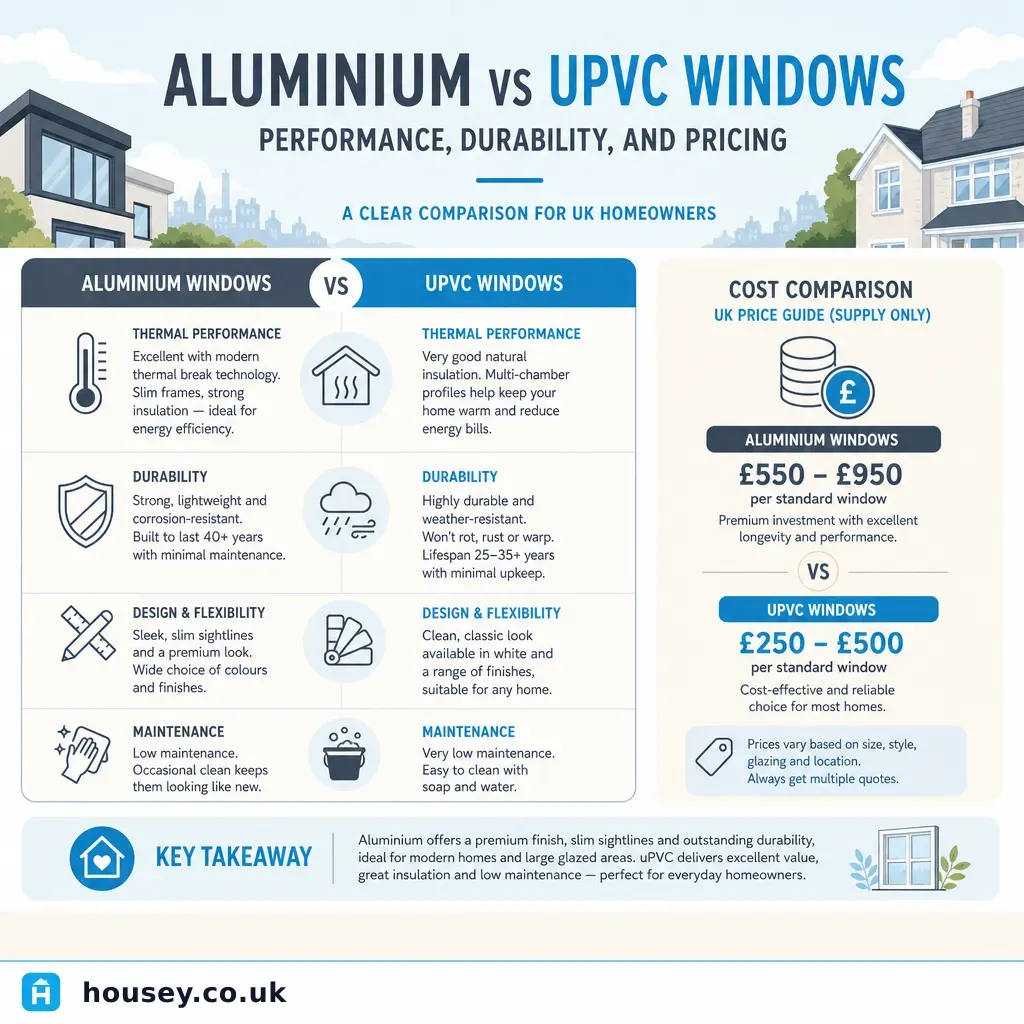
Aluminium vs UPVC Windows: Performance, Durability, and Pricing
Aluminium windows offer slimmer frames, greater longevity of 45 or more years, and a premium look, but typically cost roughly twice as much as UPVC.
 Improvement & Build
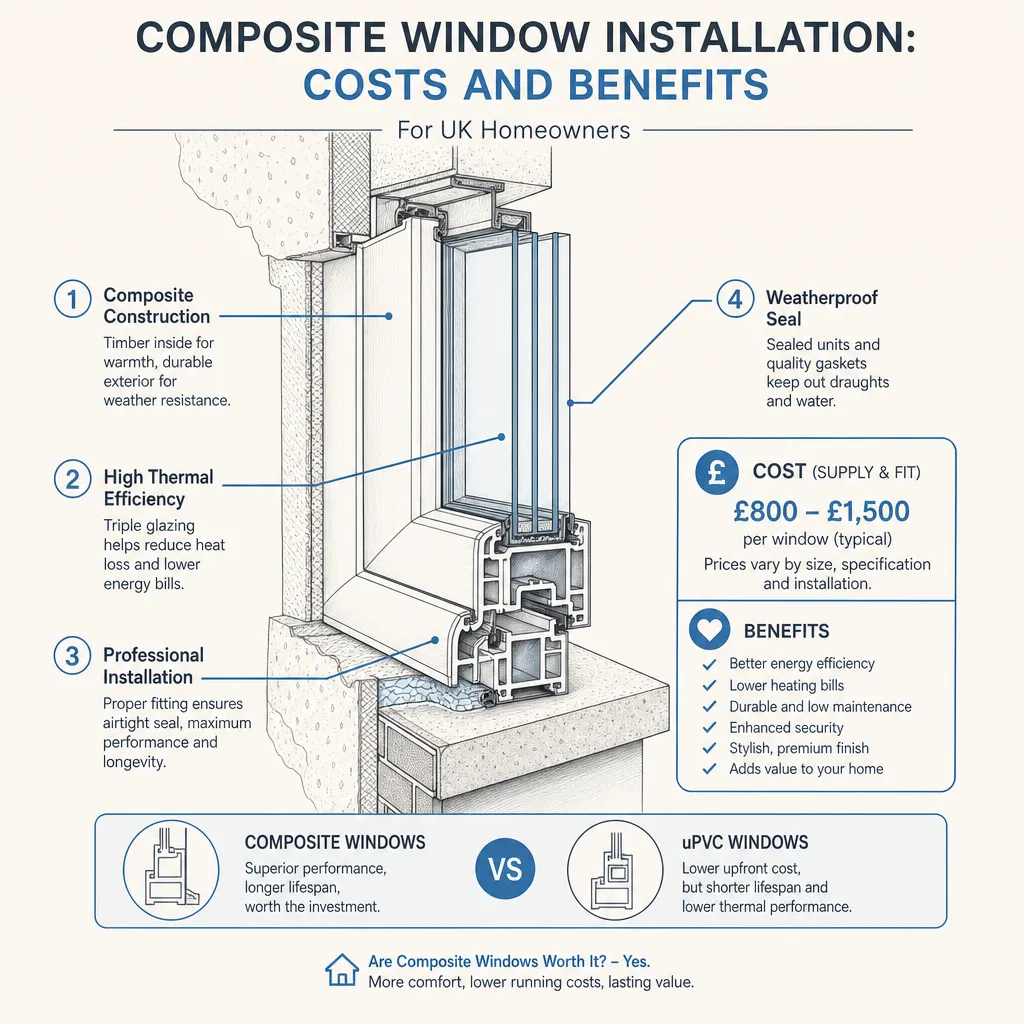
Composite Window Installation: Costs and Benefits
Composite windows combine two or more frame materials — typically a timber or aluminium core with a uPVC or aluminium outer casing — for better thermal performance and durability than standard uPVC.
 Improvement & Build
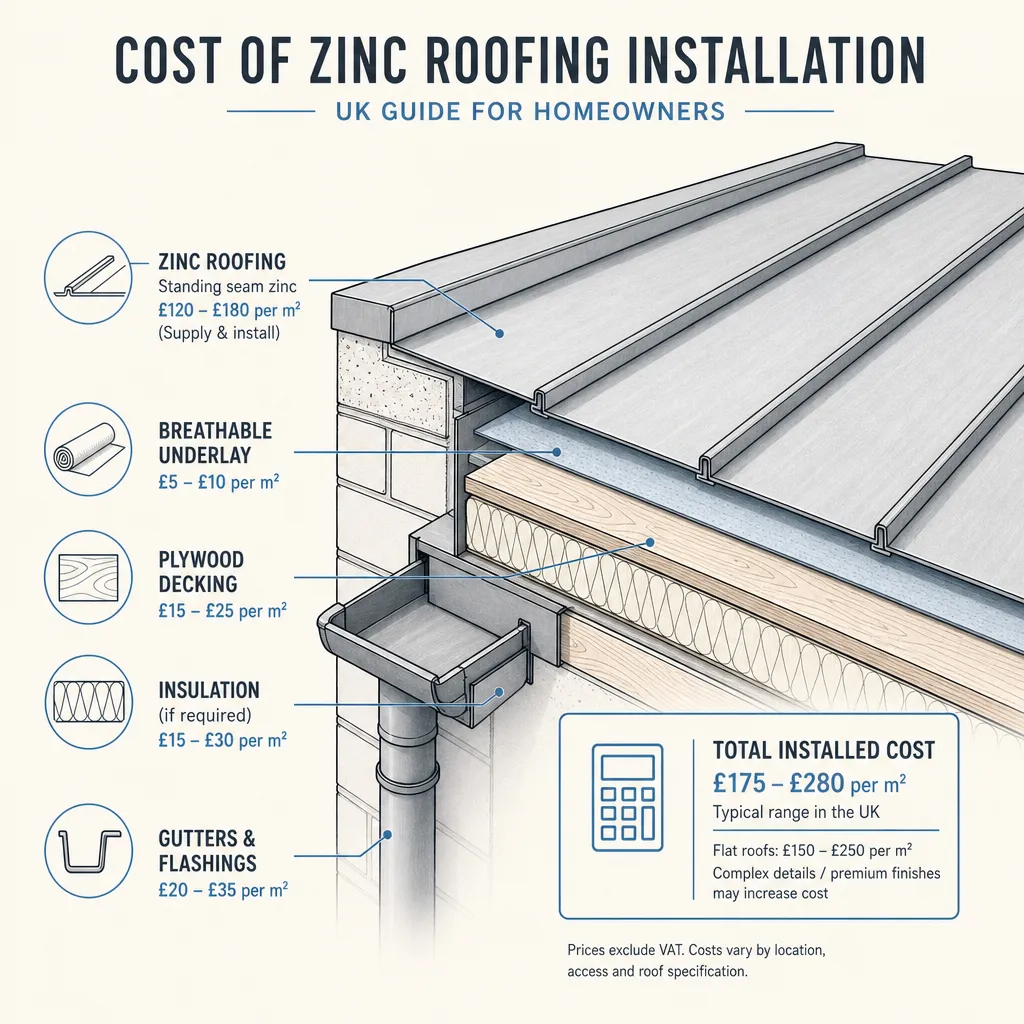
Cost of Zinc Roofing Installation
Zinc roofing typically costs £100–£200 per m² installed in the UK for standing seam systems, with flat roof applications ranging from £80–£160 per m².
 Improvement & Build
Aluminium Windows: Properties, Benefits, and Installation Considerations
Aluminium windows offer slim sightlines, long lifespan, and minimal maintenance.
 Improvement & Build
Liniar uPVC Windows: Performance, Durability, and Quality Assessment
Liniar uPVC window profiles are manufactured in the UK using multi-chambered, foamed frames.