Complete Guide to Budgeting and Planning a House Renovation
By Housey · Last reviewed 6th of May 2026

Complete Guide to Budgeting and Planning a House Renovation
House renovations rarely go exactly to plan — but the gap between expectation and reality narrows considerably when you start with a structured budget and a clear project sequence. Whether you are extending a 1930s semi, refurbishing a Victorian terrace, or tackling a whole-house project on a recently purchased property, the planning stage largely determines whether the work delivers lasting value or escalates unexpectedly. This guide covers setting a realistic budget, sequencing work correctly, navigating planning permission and building regulations, and choosing the right professionals.
Key points
- A contingency of 15–20% of total build cost is the standard industry recommendation; older properties with solid walls or original drainage warrant the upper end.
- Projects involving structural alterations, new habitable rooms, or significant changes to thermal performance will likely require Building Regulations approval under the Building Act 1984.
- Rear extensions over 4m deep on terraced or semi-detached houses often require planning permission; permitted development rights vary by property type, location, and planning history.
- Most residential renovation work attracts 20% VAT; converting a non-residential building to residential use may qualify for the reduced 5% rate.
- Instructing an architectural technologist before approaching contractors significantly improves quote accuracy and reduces scope creep.
Setting your renovation budget
Define scope before seeking costs. Estimating a project without a clear specification produces inconsistent quotes and a contingency figure that is meaningless.
A practical sequence:
- Agree what you want to achieve — more space, better layout, improved energy performance, or all three.
- Develop an outline specification with a designer covering materials, finishes, structural approach, and building services.
- Obtain at least three itemised quotes from contractors once drawings exist.
- Apply contingency on top of the quotes received, not as part of your target spend.
Indicative UK renovation cost ranges (last reviewed 2026-05-06):
Work type | Typical cost range | Key variables |
|---|---|---|
Single-storey rear extension | £1,800–£3,200 per m² | Glazing specification, structural complexity, finishes |
Loft conversion (dormer) | £35,000–£65,000 total | Beam requirement, access route, rooflight type |
Full kitchen refurbishment | £8,000–£25,000+ | Units, appliances, structural changes |
Bathroom refurbishment | £4,000–£12,000 | En-suite vs family, tile specification |
Full house rewire | £3,500–£8,000 | Floor area, circuit count, access ease |
Solid wall external insulation | £100–£200 per m² of wall | System type, render finish, number of storeys |
Sources: BCIS, Federation of Master Builders. Costs vary significantly by region and specification.
Planning permission and building regulations
These are two distinct processes that are regularly confused.
Planning permission relates to external appearance and land use; it is granted by your local planning authority (LPA). Many home improvements fall within permitted development rights and do not require permission — but those rights are removed by Article 4 Directions, do not apply to listed buildings, and carry specific size thresholds.
Building Regulations cover structural integrity, fire safety, thermal performance, drainage, ventilation, and electrical safety. They apply to most significant building works regardless of planning permission status. Since the Building Safety Act 2022, approval is granted by local authority building control or a registered building inspector.
Quick decision guide:
- Single-storey rear extension up to 4m deep (terraced or semi-detached), single storey → likely permitted development; Building Regulations still apply.
- Loft conversion to habitable space → Building Regulations required; planning permission may be needed for certain dormers.
- Works within a conservation area → planning permission likely required even for changes otherwise within permitted development.
- Replacement windows and doors → Building Regulations apply; use a FENSA-registered installer or notify building control.
- Change of use from commercial to residential → planning permission usually required; potential 5% VAT rate.
A building control consultant can clarify your Building Regulations obligations early in the design process, before contractor appointments are made.
Worked example: Victorian terrace renovation in Leeds
Property: Three-bedroom Victorian end-of-terrace, circa 1890s, solid brick walls, approximately 85m² original floor area.
Scope: Single-storey rear kitchen extension (18m²), full rewire, new central heating system, loft insulation upgrade, and kitchen refurbishment.
Project sequence: Appoint an architectural technologist for planning drawings and Building Regulations pack (4–6 weeks) → structural engineer sizes the new steel beam → planning application submitted (8-week determination) → Building Regulations application runs in parallel → groundworks and extension shell (6–8 weeks) → first fix electrics and plumbing (2–3 weeks) → plastering, screed, and drying time (3–4 weeks) → second fix, kitchen fitting, and sanitaryware (3–4 weeks) → decoration and external works (2–3 weeks).
Indicative total (2026 prices): £75,000–£100,000 including professional fees, planning, building control, and 20% VAT on labour and materials. Contingency of 15% added on top. Actual costs depend on contractor rates in your region, specification choices, ground conditions, and the condition of the existing structure. This scenario is illustrative.
Sequencing your project
Incorrect sequencing is one of the most costly renovation errors. Finishes that must be undone because an earlier stage was incomplete add time, materials, and call-out costs.
Homeowner renovation sequencing checklist:
Choosing your delivery approach
Approach | Best for | Key advantages | Key risks |
|---|---|---|---|
Main contractor (JCT contract) | Projects over £50,000; time-poor homeowners | Single point of accountability; programme managed | Higher markup on subcontractors; less direct trade control |
Self-managed subcontractors | Smaller phased projects; experienced homeowners | Lower cost; direct control over trade selection | Programme risk falls on you; gaps between trades extend timeline |
Professional project manager | Complex multi-trade projects | Independent oversight; reduces overruns | Additional fee of typically 5–15% of build cost |
An experienced project manager is particularly valuable on larger projects where multiple trades need coordinating and the homeowner has limited availability.
What to ask before accepting a quote
- What is included and excluded — specifically skips, scaffolding, structural engineer visits, and building control inspection fees?
- Who carries out the work — the firm or subcontractors — and what are their accreditations?
- What is the payment schedule, and is it milestone-linked rather than time-based?
- What contract form will be used? A JCT Homeowner Contract is recommended for domestic works.
- Is VAT included in the total price?
- What happens if unforeseen issues are found — unexpected rot, asbestos, or substandard existing structure?
- What are the main risks to the programme timeline?
When to get professional help
Any project involving structural alterations, load-bearing wall removals, new drainage connections, consumer-unit-level electrical work, or gas appliance installation must involve qualified and registered professionals. An architectural technologist at design stage and a structural engineer for beam and foundation work substantially reduce the risk of regulatory complications and cost overruns. A written contract — JCT or otherwise — protects both parties if disputes arise. For extension builders, always verify membership of the Federation of Master Builders or a comparable trade body before signing.
How Housey can help
Housey connects UK homeowners with vetted local professionals across the full renovation journey. Whether you need an architectural technologist for renovation drawings and planning applications, a building control consultant for your Building Regulations submission, extension builders for the construction phase, or a project manager to oversee the full programme, Housey can help you request quotes from relevant local providers.
Frequently asked questions
Do I need planning permission for a house renovation?
Not always. Many internal alterations and some external changes fall within permitted development rights and do not need planning permission. However, extensions above certain size thresholds, works to listed buildings or properties in conservation areas, and changes of use will usually require a planning application. Check with your local planning authority before starting work.
How much contingency should I add to a renovation budget?
The standard recommendation is 15–20% of total build cost, held separately from your main budget. Older properties — particularly solid-wall houses or those with previous works of uncertain quality — warrant the upper end. Do not treat contingency as a budget uplift; it exists for genuine unforeseen costs only.
Should I get drawings done before approaching contractors?
Yes, in almost all cases. Detailed drawings and a specification allow contractors to quote accurately on the same scope, making comparisons meaningful. Without drawings, quotes vary widely because each contractor prices different assumptions. An architectural technologist can produce drawings suitable for planning and Building Regulations at relatively modest cost.
Can I live in the property during a renovation?
It depends on scope and sequencing. Many homeowners live in during phased works where one part of the house stays habitable. Full rewires, major structural works, or loss of kitchen and bathroom can make temporary relocation practical. Budget for temporary accommodation if relevant — it is frequently overlooked in renovation cost planning.
What is a JCT Homeowner Contract?
The Joint Contracts Tribunal publishes a Homeowner Contract for domestic building works without a supervising professional. It sets out obligations for both parties, a milestone-linked payment schedule, and a dispute resolution process. Using a standard form contract is recommended for any project over approximately £5,000 and protects both homeowner and contractor.
Sources and further reading
- Planning permission: when you need it — GOV.UK
- Building regulations approval — GOV.UK
- JCT Homeowner Contracts — Joint Contracts Tribunal
- Buildings and construction: VAT Notice 708 — HMRC / GOV.UK
- Building Safety Act 2022 — legislation.gov.uk
- Federation of Master Builders — Federation of Master Builders
Useful next reads
 Improvement & Build
Evaluating And Planning Renovations For Properties Requiring Modernisation
Start by commissioning a condition survey — RICS Level 3 for pre-1919 properties — to identify structural defects, damp, and services issues before finalising a budget.
 Improvement & Build
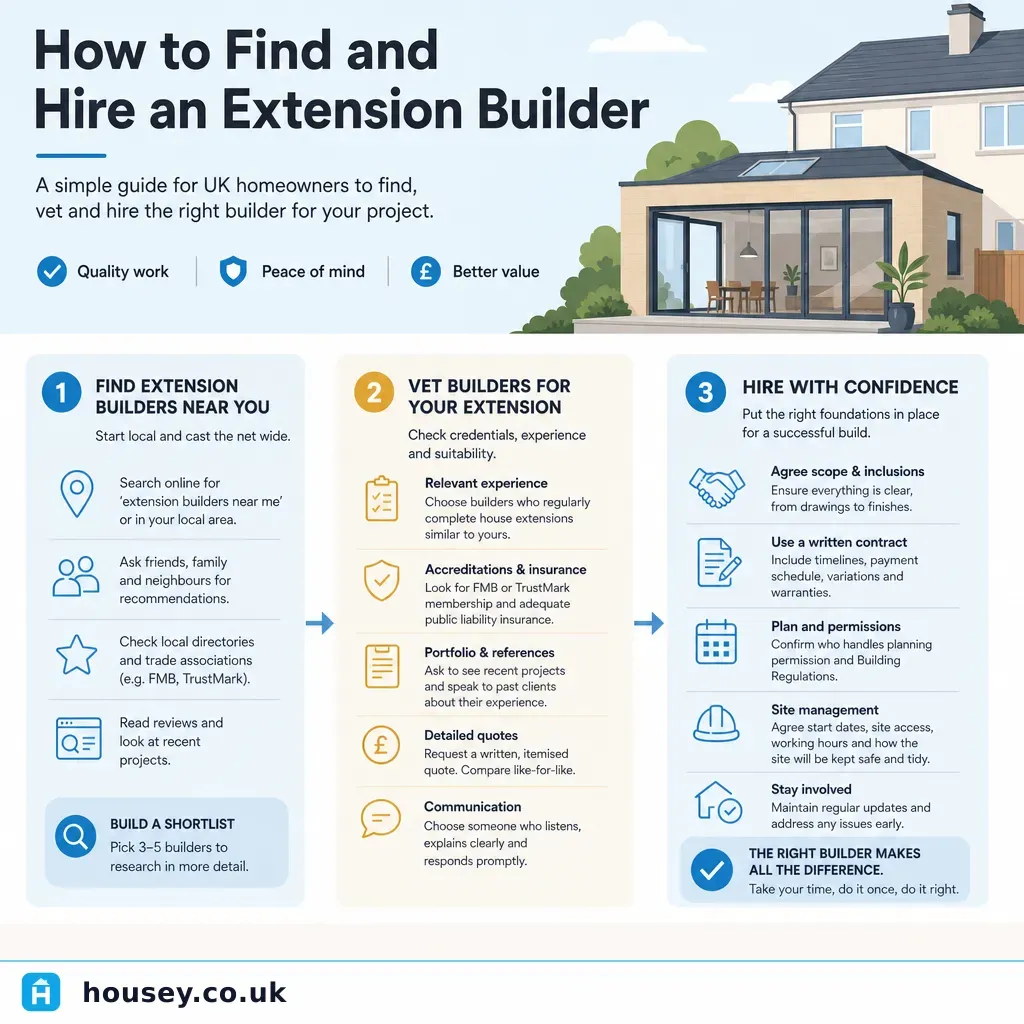
How to Find and Hire an Extension Builder
To hire a reliable extension builder, get at least three detailed written quotes from contractors with documented experience of similar projects.
 Improvement & Build
Who to Contact for Broken Door Handle Repair
For a broken door handle, a general handyperson can handle most internal timber door repairs, while a joiner or locksmith is better suited to external doors, particularly if the lock mechanism is affected.
 Improvement & Build
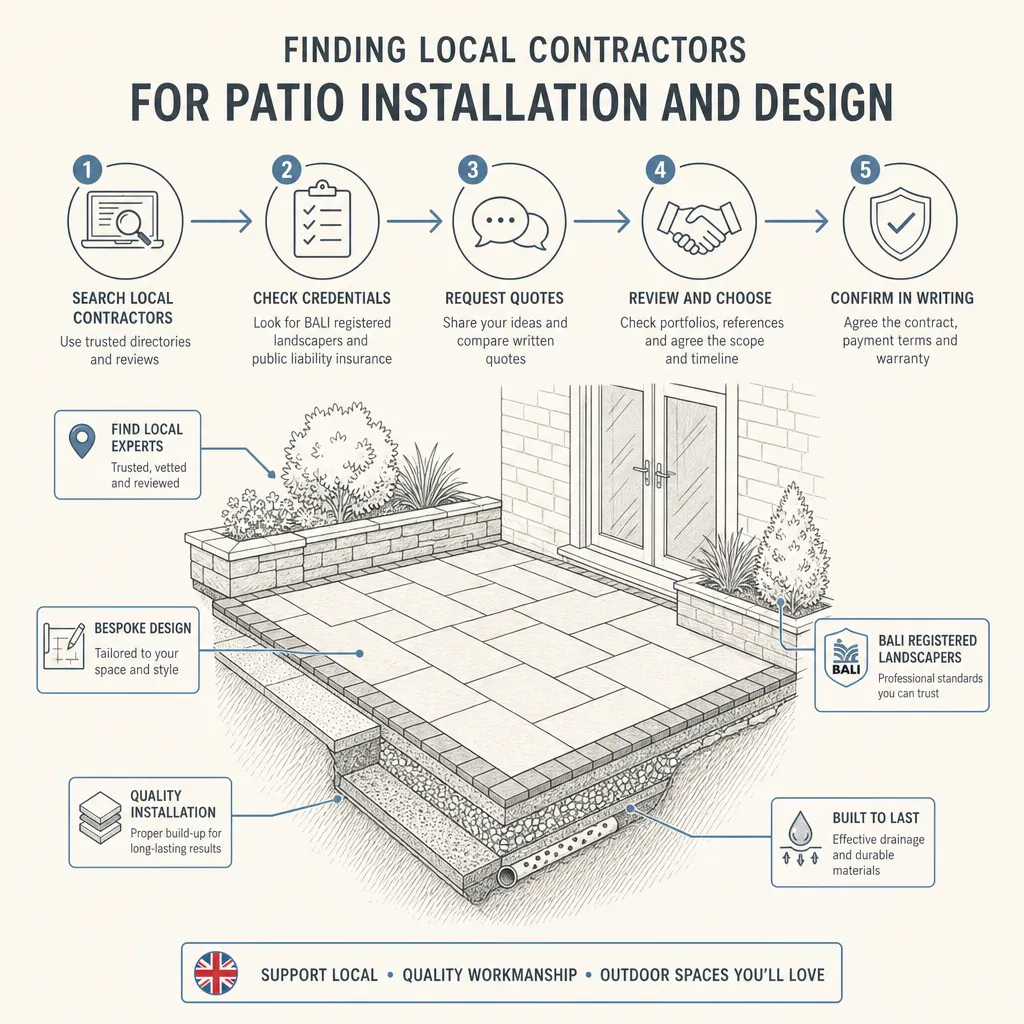
Finding Local Contractors for Patio Installation and Design
For most residential patios, a local landscaper or paving specialist manages the project from design to laying.
 Improvement & Build
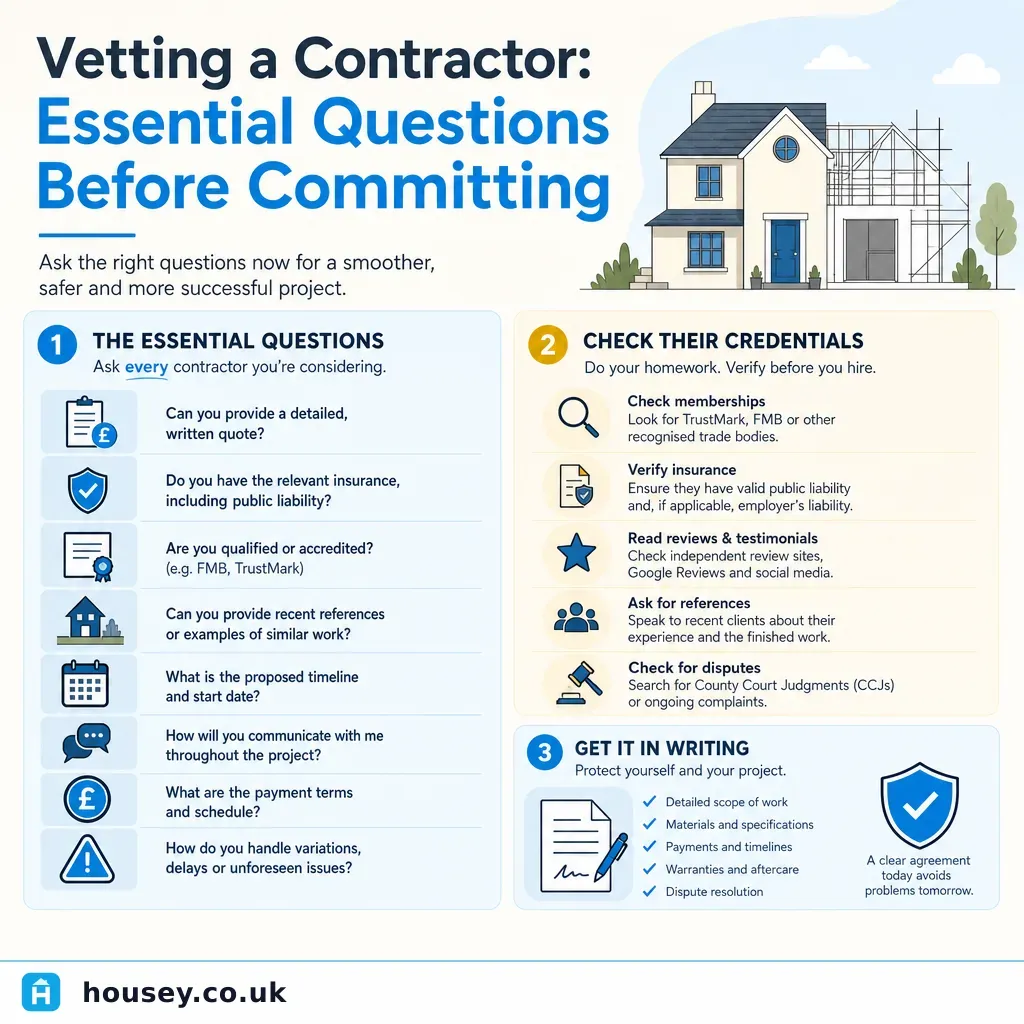
Vetting a Contractor: Essential Questions Before Committing
Vet a contractor by checking their full business name on Companies House, requesting current insurance certificates, verifying trade body membership directly with the association, and speaking to references from comparable recent jobs.