Vetting a Contractor: Essential Questions Before Committing
By Housey · Last reviewed 7th of May 2026
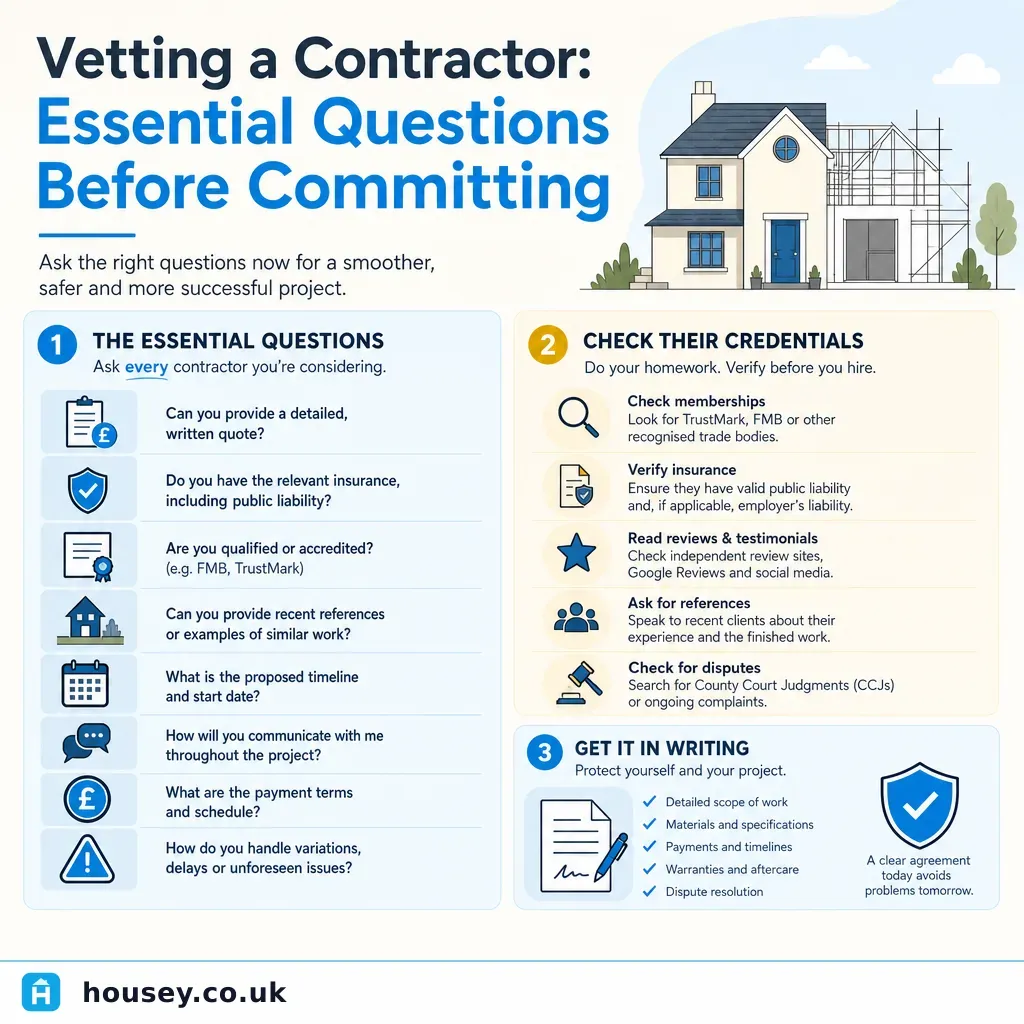
Vetting a Contractor: Essential Questions Before Committing
Most home improvement projects — extensions, loft conversions, reroofing, damp treatment — represent significant financial commitments, often running to tens or hundreds of thousands of pounds. Yet many UK homeowners approach contractor selection without a consistent framework, relying on a single recommendation or taking the lowest quote without scrutiny. Because the UK construction trades have no single mandatory licensing scheme, the due-diligence burden falls firmly on the person commissioning the work.
Key points
- The Consumer Rights Act 2015 requires that services are carried out with reasonable care and skill; if a contractor falls short, you have a legal right to require repeat performance or a price reduction — but only if you can demonstrate what was agreed, which is why a written contract is essential.
- Any contractor employing workers is legally required to hold employers' liability insurance of at least £5 million under the Employers' Liability (Compulsory Insurance) Act 1969; failure to hold this cover is a criminal offence.
- TrustMark is the government-endorsed quality scheme for home improvement trades; membership requires independent vetting, insurance checks, and a complaints process — a meaningfully higher bar than unverified online listings.
- Work involving building regulations — extensions, structural alterations, reroofing beyond certain thresholds, electrical installation — requires a building control application, either to the local authority or via an approved inspector; confirm who is responsible before work begins.
- The Federation of Master Builders (FMB) requires members to pass an independent inspection before joining and to carry appropriate insurance; the public member directory is searchable at fmb.org.uk.
Why the lowest quote is rarely the full picture
In competitive UK home improvement markets, price differences between quotes often reflect:
Reason for lower price | What it may mean for you |
|---|---|
Different scope of work | Scaffolding, skip hire, making good, or decoration omitted |
Lower-grade materials specified | Budget tiles, thinner insulation, standard rather than enhanced windows |
Cash-only terms with no VAT receipt | Weaker consumer rights, no paper trail, possible tax irregularity |
Underpriced to win the job | Risk of variations and additional charges once work begins |
Genuine operational efficiency | Possible, but verify through references and comparable completed jobs |
Always request itemised written quotes so you can compare like for like.
What qualifications and schemes to look for
Relevant accreditation varies by trade. This table covers common home improvement trades:
Trade | Key accreditation or scheme | Where to check |
|---|---|---|
General builder or extension contractor | FMB membership, TrustMark, CHAS | fmb.org.uk, trustmark.org.uk, chas.co.uk |
Electrician | NICEIC or NAPIT registration | niceic.com, napit.org.uk |
Gas engineer | Gas Safe Register (legally required) | gassaferegister.co.uk |
Roofer | NFRC membership, TrustMark | nfrc.co.uk, trustmark.org.uk |
Damp proofing specialist | PCA membership | pca.org.uk |
Loft or garage conversion contractor | FMB, TrustMark, building control records | trustmark.org.uk, fmb.org.uk |
Membership of a trade body does not guarantee quality, but it confirms the contractor has been independently vetted and must usually carry adequate insurance as a condition of membership.
The essential questions to ask every contractor
Put these questions to every contractor you are seriously considering before committing.
Business and legal basics
- What is the full registered business name, and if incorporated, the Companies House registration number and trading address?
- How long have you been trading, and can you provide references from three recent, similar jobs I can contact directly?
- Do you carry public liability insurance and employers' liability insurance? Can I see current certificates?
- Are you a member of any trade association or government-endorsed quality scheme, and can I verify your membership directly with that body?
Scope and contract
- Will you provide a written contract covering scope, materials specification, start and completion dates, payment milestones, and a process for agreed variations?
- Is your quote fixed price or day rate, and what circumstances would cause the price to change?
- What is your standard payment schedule? (FMB and RICS guidance suggests avoiding front-loading — typically no more than 10–25% upfront for smaller projects.)
- What happens if you discover additional problems once work has started?
Planning and building control
- Will this work require planning permission or building regulations approval?
- Who is responsible for making any required application — you or me?
- Will a building control completion certificate be issued and provided to me at the end of the project?
Subcontractors and site management
- Will all work be carried out by your own employees, or will you use subcontractors?
- If subcontractors are involved, are they covered under your insurance policy and will you remain contractually responsible for their work?
- Who will be the named site supervisor on a day-to-day basis?
Completion and warranties
- What workmanship guarantee or warranty will you provide in writing?
- Are the materials you are specifying covered by a manufacturer's warranty, and will you pass those documents to me at handover?
- Will you supply all building control sign-off documents, completion certificates, test reports, and warranties at practical completion?
Homeowner checklist: before signing anything
Red flags that should stop you from proceeding
- Requests for full payment upfront. Reputable contractors do not require 100% payment before starting. Stage payments tied to progress milestones are standard practice.
- No written contract offered. Verbal agreements are difficult and expensive to enforce if something goes wrong.
- Pressure tactics or time-limited quotes. Legitimate pricing is based on costs and market conditions, not manufactured urgency.
- Cannot produce current insurance certificates. If an uninsured worker is injured on your property, you may face a civil claim.
- No references from comparable, recent jobs. A contractor unable to name a single satisfied client from a similar project represents a significant risk.
- Unwillingness to discuss building control. Any reputable contractor carrying out regulated work should comfortably explain the building regulations process and who is responsible for applications.
- Cash-only terms. Cash transactions leave you with no paper trail and substantially weaker consumer rights if disputes arise.
What not to assume
- A personal recommendation alone is sufficient vetting. Recommendations are a useful starting point but do not confirm current insurance, financial stability, or capacity for your specific project type.
- Trade body membership guarantees quality. Schemes vary considerably in vetting rigour; check what the scheme actually requires and whether the membership is current and active — not lapsed.
- The cheapest quote will cost less overall. In UK construction, cost overruns and defect rectification regularly cost more than the saving on the original quote.
- A verbal agreement is practically enforceable. It may be in law, but proving what was agreed without written records is very difficult and expensive.
- The contractor is automatically responsible for planning permission. Unless explicitly agreed in writing, you as the homeowner remain legally responsible for making any required planning or building control application.
When to get professional help
Consider appointing an architect, project manager, or independent clerk of works if:
- Your project value exceeds approximately £50,000 or involves structural alterations.
- You are unable to be on site regularly to monitor progress and quality.
- Multiple trades need to be coordinated across a complex programme.
- The project involves listed building consent, complex planning conditions, or party wall matters.
- You have already experienced problems with a contractor and need an independent assessment of work already carried out.
An architect or project manager can review contractor quotes, administer the building contract, and manage sign-off — substantially reducing the risk of disputes.
How Housey can help
Housey helps UK homeowners find and compare contractors across a range of home improvement trades. Whether you need extension builders, roofers, loft conversion companies, or garage conversion specialists, you can request and compare quotes from vetted providers, review credentials, and make informed decisions in one place.
Frequently asked questions
Do I need a written contract for small building jobs?
Even for small jobs, a written agreement is strongly advisable. It should cover what work will be done, the agreed price, start date, and payment terms. The Consumer Rights Act 2015 provides some protection where no written contract exists, but proving what was agreed without a written record is significantly harder. For any job above £1,000, a written contract substantially reduces the risk of disputes and makes remedies clearer.
Is it safe to use an unregistered contractor?
It depends on the trade. For gas work, using a non-Gas Safe registered engineer is illegal and dangerous. For notifiable electrical work, building control certification is required regardless of who carries it out. For general building work there is no statutory registration requirement, but you lose the independent vetting, insurance assurance, and complaints process that trade body membership provides — and you have less recourse if things go wrong.
What should I do if a contractor carries out poor work?
Raise the issue formally in writing — email is sufficient — explaining the specific defects and requesting remedy within a reasonable timeframe. Under the Consumer Rights Act 2015, you are entitled to require the contractor to repeat or fix work not carried out with reasonable care and skill. If they refuse, the county court small claims track handles disputes up to £10,000. If the contractor is a trade body member, the body may offer mediation.
How many quotes should I get for home improvement work?
Three is the standard guidance for most domestic projects. It gives a meaningful range to assess the market rate and identify outliers — both unusually high and suspiciously low. For complex or high-value projects, four or five quotes may be worthwhile. Ensure all quotes are based on the same written specification; without a common spec, you are not comparing like for like and price differences become very difficult to interpret.
Sources and further reading
- Consumer Rights Act 2015 — services — legislation.gov.uk
- TrustMark: government-endorsed quality scheme for home improvements — TrustMark
- Federation of Master Builders: find a member builder — Federation of Master Builders
- Check company information on Companies House — Companies House
- Employers' Liability (Compulsory Insurance) Act 1969 — legislation.gov.uk
- Building regulations approval — GOV.UK
Useful next reads
 Improvement & Build
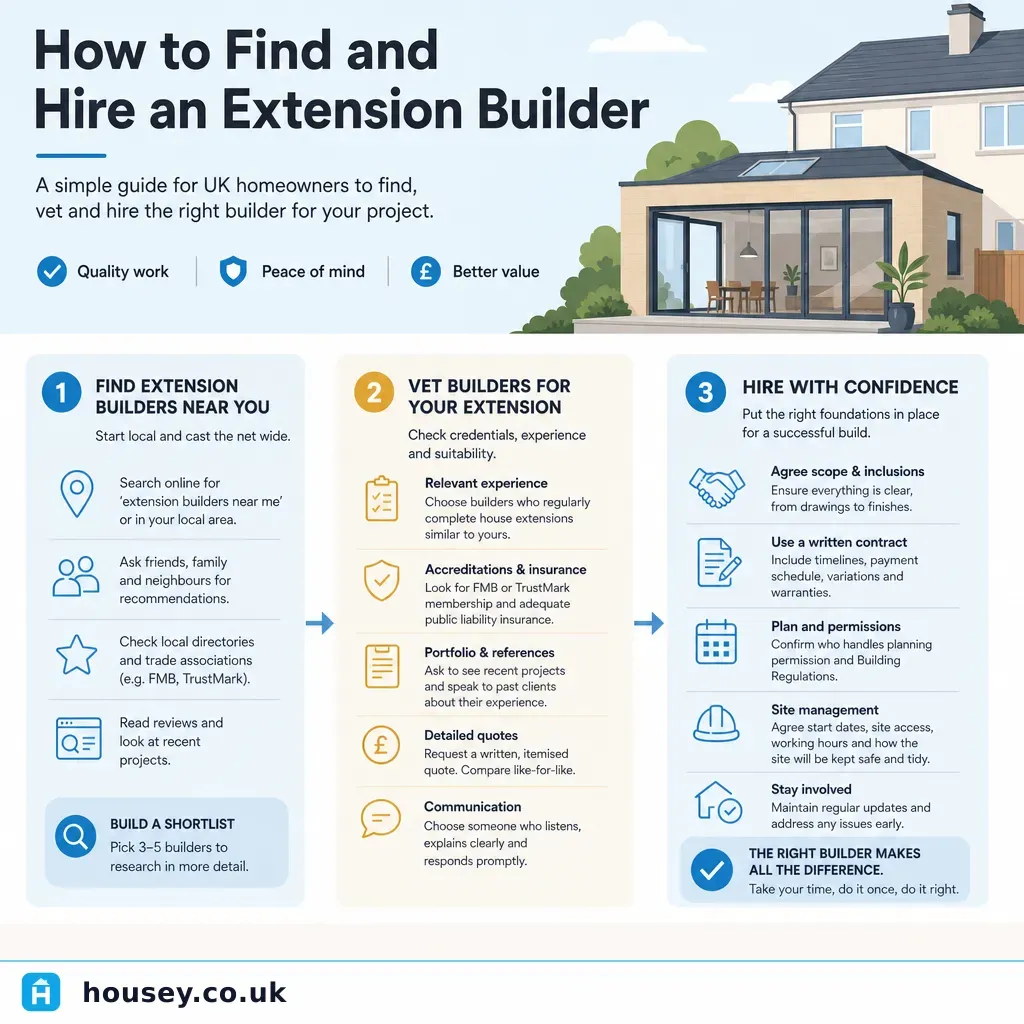
How to Find and Hire an Extension Builder
To hire a reliable extension builder, get at least three detailed written quotes from contractors with documented experience of similar projects.
 Improvement & Build
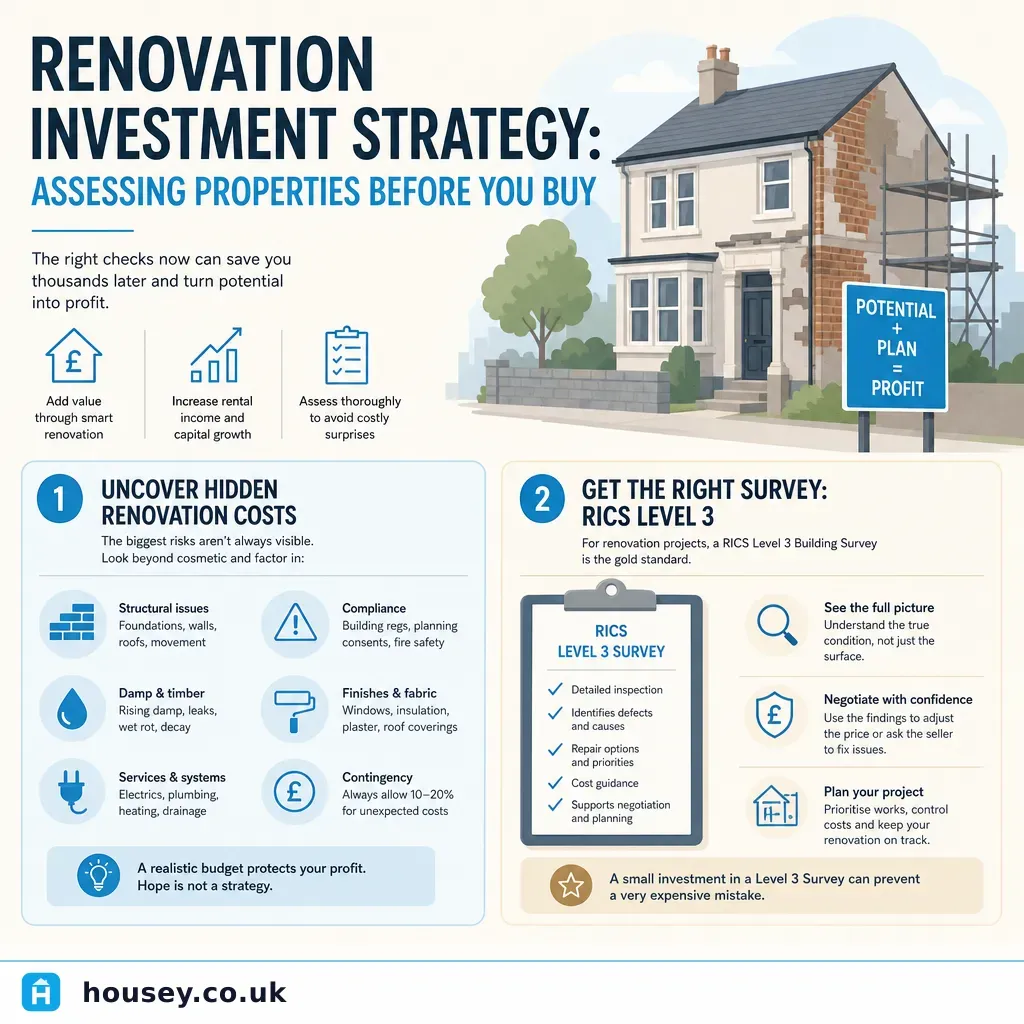
Renovation Investment Strategy: Assessing Properties Before You Buy
Renovation investment properties require more due diligence than a standard home purchase.
 Improvement & Build
Kitchen Extension Construction Costs and Budget
A single-storey kitchen extension in the UK typically costs £25,000–£60,000 for build work, rising to £80,000+ for a large rear extension in London or the South East.
 Improvement & Build
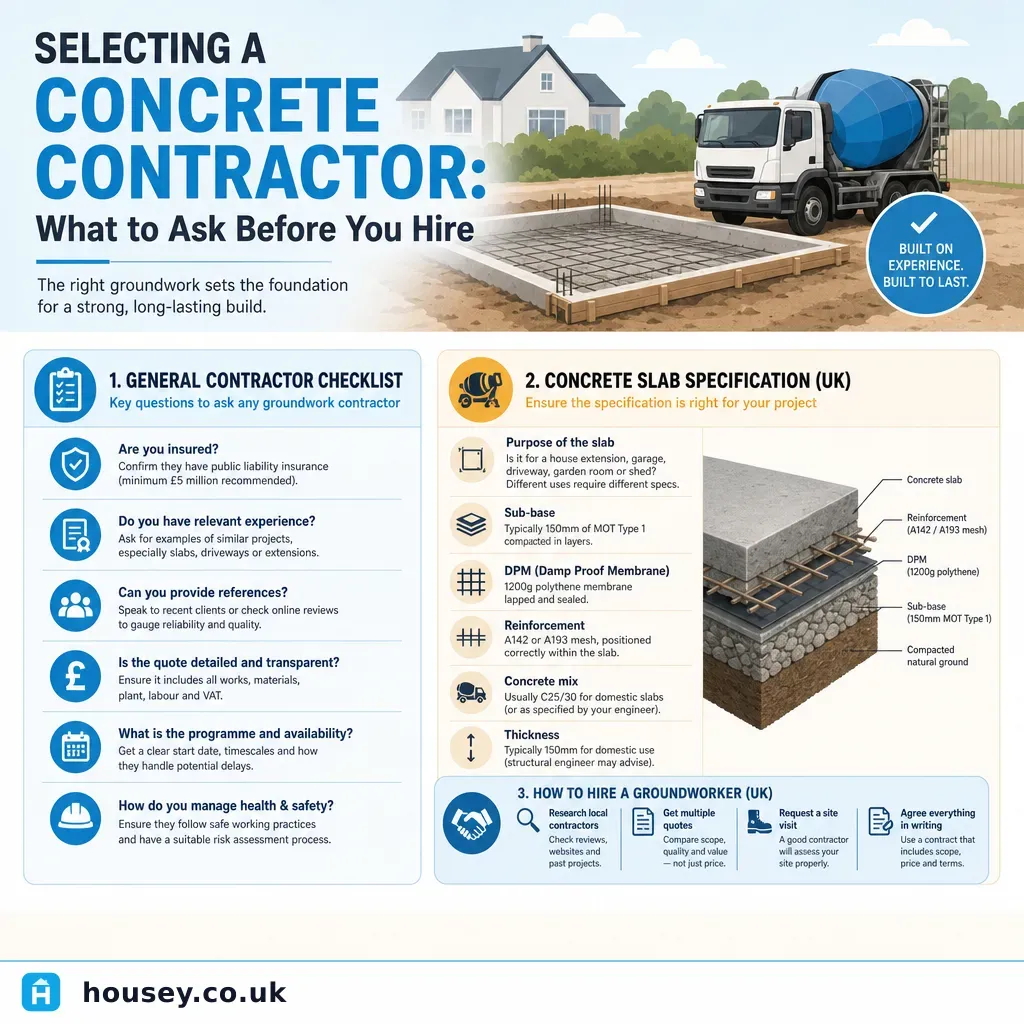
Selecting a Concrete Contractor: What to Ask Before You Hire
When choosing a concrete contractor, ask for proof of public liability insurance, a written specification stating the concrete mix to BS 8500, sub-base depth, and whether expansion joints are included.
 Improvement & Build
Selecting Renovation Contractors for Your Property Project
When selecting a renovation contractor, get at least three written, itemised quotes from contractors who have visited the site, verify membership of a recognised trade body such as the Federation of Master Builders, check references from comparable recent projects, and agree a detailed written contract before work starts.