Finding Local Contractors for Patio Installation and Design
By Housey · Last reviewed 18th of May 2026
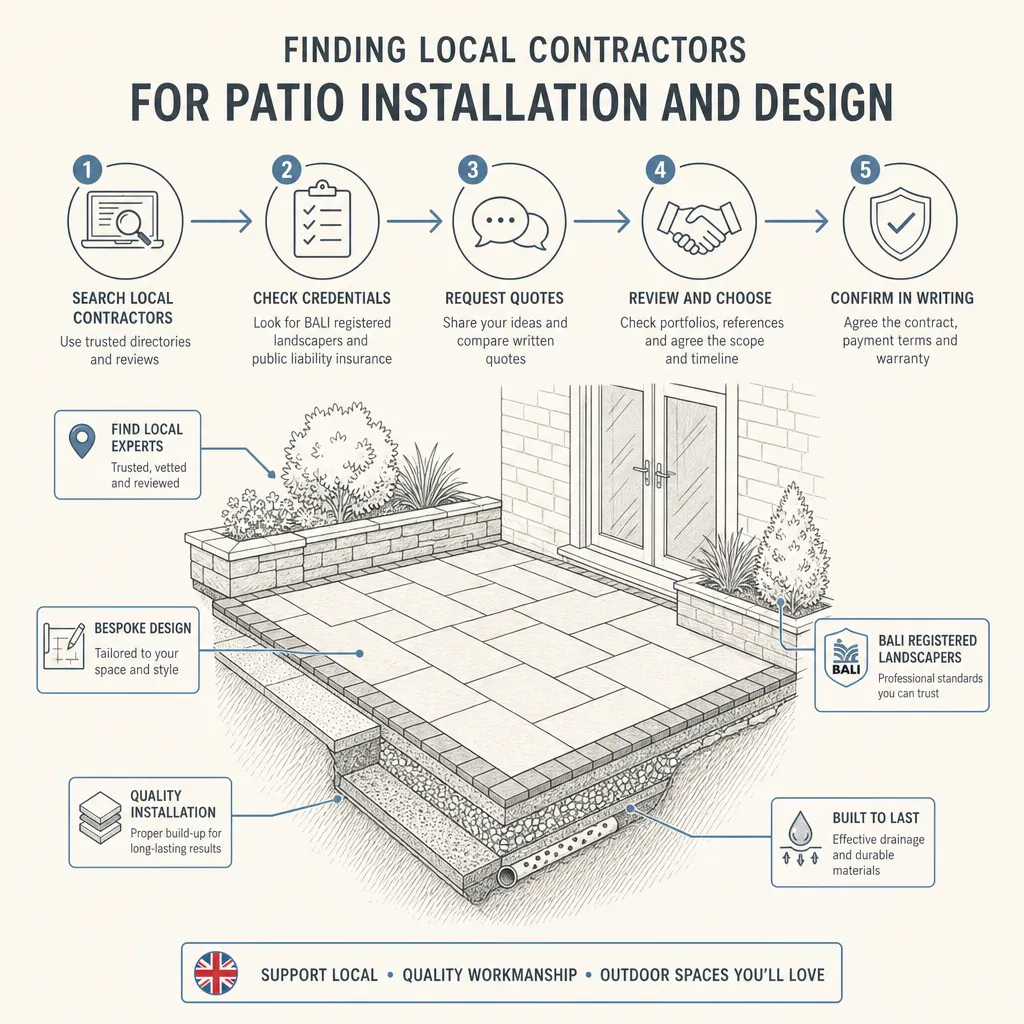
Finding Local Contractors for Patio Installation and Design
A new patio is one of the more achievable garden improvement projects, but choosing the wrong contractor can result in an uneven surface, poor drainage, and expensive remediation within a few seasons. The range of firms offering patio installation — from sole-trader landscapers to groundwork companies — varies widely in skills, materials knowledge, and reliability, making a structured approach to selecting and comparing contractors well worth the time.
Key points
- Hard surfaces over 5 m² that drain toward a public road or a neighbour's land must be permeable or drain to a lawful point under Approved Document H of the Building Regulations — planning permission is not generally required for back-garden patios under permitted development.
- Natural stone (Indian sandstone, slate, limestone) and porcelain are the most popular patio materials in UK gardens; porcelain requires specialist adhesive and wet-cut equipment that not all paving contractors possess.
- A groundworker typically handles excavation, sub-base preparation, and concrete or mortar bedding; a landscaper usually manages the full project including design, hard landscaping, and planting.
- There is no mandatory licence for patio installation in England, Wales, or Scotland — trade body membership (BALI or APL) and independently verified customer reviews are the main quality proxies.
- For cavity-wall or solid-wall properties, works within 3 metres of a drain or sewer may require notification to the water company before work begins.
Groundworker, landscaper, or paving specialist — which do you need?
Contractor type | Best for | Not ideal for | Typical output |
|---|---|---|---|
Groundworker | Excavation, sub-base, large paved areas, drainage runs | Design, planting, decorative finishing | Level formation and laid surface |
Landscaper | Full garden design, mixed hard and soft landscaping, design-led projects | Large commercial-scale excavation | Design drawings, hard landscaping, planting scheme |
Paving specialist | Single-trade paving, block paving, or porcelain projects | Drainage engineering, design, planting | Laid surface with edge restraints and pointing |
General builder | Small patios tied to a wider renovation or extension project | Specialist design or complex drainage requirements | Patio as part of a broader build |
For most residential patios, a landscaper who also manages groundworks is the practical choice. For sites requiring significant excavation, level changes, or drainage engineering, a groundworker or civils contractor may be more appropriate.
Where to find reputable local patio contractors
Trade association directories. The Association of Professional Landscapers (APL) and the British Association of Landscape Industries (BALI) maintain directories of vetted members. Both require members to meet technical and business standards. The Society of Garden Designers lists design-focused practitioners for more complex projects.
Checkatrade and Which? Trusted Traders. Both schemes verify identity, public liability insurance, and customer reviews. These are not professional qualifications but provide a vetting layer and complaints escalation mechanism.
Local recommendations. A contractor who has completed visible work nearby and can show you a finished project is one of the most reliable quality signals. Ask neighbours or local community groups for names before searching blind online.
Housey. Housey connects homeowners with local landscapers and groundworkers, allowing you to receive and compare quotes from verified local contractors in one place.
Homeowner checklist before hiring a patio contractor
What to ask before accepting a quote
- What excavation depth and sub-base specification are you quoting for? (For porcelain or natural stone, a compacted sub-base of 100–150 mm is typically required.)
- Are you quoting for a permeable or impermeable surface, and have you considered drainage implications for surfaces over 5 m²?
- Is skip hire, spoil removal, edging, pointing, and VAT included in the price?
- Who will carry out the installation — your own team or subcontractors?
- What workmanship warranty do you offer, and is it in writing?
- Do you carry current public liability insurance?
- Have you laid this specific material before, and can you provide local references?
- How will you protect existing planting, lawn, and structures during the work?
Materials comparison: what to know before choosing
Material | Durability | Maintenance | Indicative supply-and-lay cost | Notes |
|---|---|---|---|---|
Indian sandstone | Good (15–25 years) | Occasional sealing recommended | £50–£90/m² | Popular; quality varies widely — specify calibrated stone |
Porcelain | Excellent (25+ years) | Very low | £70–£120/m² | Needs specialist adhesive and cutting tools; check frost rating |
Concrete slab | Good | Low | £40–£70/m² | Very durable; less decorative than stone or porcelain |
Resin-bound gravel | Good (10–15 years) | Low | £60–£100/m² | Permeable — assists Approved Document H compliance |
Block paving | Very good | Moderate (weed and sand maintenance) | £50–£90/m² | Classic look; can be lifted for drainage access |
Indicative UK costs, last reviewed 2026-05-18. Prices vary by region, material supplier, site access, and project complexity. Always obtain itemised written quotes.
When to get professional help
For most standard residential patios, a competent landscaper or paving contractor is sufficient. Seek specialist input if:
- The patio is adjacent to a retaining wall or on sloped ground with significant level changes.
- Ground conditions are poor — filled ground or clay subsoil with high shrink-swell potential may require a deeper or reinforced sub-base.
- The works are within 3 metres of a drain or sewer — you may need to notify your water company before breaking ground.
- The property is listed, within a conservation area, or subject to Article 4 directions — additional consent may be required even for paving work.
- Surface water run-off is a concern near a shared or party boundary.
How Housey can help
Housey makes it straightforward to compare quotes from experienced local landscapers and groundworkers for patio installation and design. Submit your project details once and receive responses from verified local contractors.
Frequently asked questions
Does a patio need planning permission?
Most residential back-garden patios do not require planning permission under permitted development rights. However, if the new surface covers more than 5 m² and directs run-off towards a public highway or a neighbour's land, you may need to use a permeable surface or provide managed drainage. Check with your local planning authority for front gardens or properties in conservation areas.
How deep should the sub-base be for a patio?
For most domestic patios, a well-compacted sub-base of 100–150 mm beneath a bedding layer of mortar or adhesive is standard practice. Poor ground conditions or heavier use may require a deeper formation. Porcelain tiles must be laid on a full-bed adhesive rather than a traditional sand-and-cement mortar bed. Always confirm the specification in writing before work begins.
How long does a patio installation take?
A standard domestic patio of 20–40 m² typically takes 2–5 days from excavation to completion, depending on material, site access, and drainage requirements. Allow at least 24–72 hours curing time after laying before heavy use — mortar and adhesive-bed installations are sensitive to early loading and premature foot traffic.
How do I compare patio installation quotes effectively?
Compare quotes on a like-for-like basis: excavation depth, sub-base specification, bedding method, whether materials are included, VAT, spoil removal, edging, and pointing. A significantly cheaper quote often reflects a thinner sub-base or excluded items. Request an itemised written breakdown from each contractor before making a decision.
Sources and further reading
Useful next reads
 Improvement & Build
Who to Contact for Broken Door Handle Repair
For a broken door handle, a general handyperson can handle most internal timber door repairs, while a joiner or locksmith is better suited to external doors, particularly if the lock mechanism is affected.
 Improvement & Build
How to Find and Hire a Loft Conversion Company
To hire a loft conversion company, get at least three quotes from TrustMark-registered or FMB-member firms.
 Improvement & Build
Complete Guide to Budgeting and Planning a House Renovation
Budgeting a house renovation means defining the full scope before seeking quotes, adding a 15–20% contingency, and sequencing structural and building control stages first.
 Improvement & Build
Finding a Reliable Renovation Contractor: What to Look For
To find a reliable renovation contractor, verify FMB or TrustMark membership directly on the scheme website, obtain at least three itemised written quotes, and check public liability insurance documentation.
 Improvement & Build
Selecting uPVC Doors: A Buying and Installation Guide
When buying a uPVC door, confirm the doorset U-value meets Part L (currently 1.