Complete House Moving Checklist and Planning Guide
By Housey · Last reviewed 30th of May 2026

Complete House Moving Checklist and Planning Guide
Moving house in the UK involves coordinating solicitors, mortgage lenders, estate agents, removal firms, and utility providers across a process that typically spans 8–16 weeks. Delays and unexpected costs most often arise when notifications are sent too late, removal firms are not booked until the final fortnight, or completion-day logistics are not confirmed between all parties in advance. A clear timeline with defined tasks reduces each of these pressure points significantly.
Key points
- The average UK house move takes 12–14 weeks from offer acceptance to completion; the conveyancing process alone typically accounts for 8–12 of those weeks.
- Removal firms are commonly booked up several weeks in advance on popular completion days — particularly Fridays and end-of-month dates; the British Association of Removers recommends booking 6–8 weeks ahead.
- You must notify DVLA of a change of address for your driving licence and V5C vehicle registration certificate under the Road Vehicles (Registration and Licensing) Regulations 2002.
- Royal Mail's Redirection Service can forward post for 3, 6, or 12 months but does not replace individual notifications to banks, HMRC, pension providers, and the Electoral Roll.
- Buildings insurance for the new property should be in place from exchange of contracts — not just from completion — as the buyer bears the risk of the property from exchange.
Your house moving timeline and checklist
Work through each stage in sequence. Return to earlier stages if your completion date moves.
8 weeks before moving
6 weeks before moving
4 weeks before moving
2 weeks before moving
On moving day
Professional removal firm vs DIY: which suits your move?
Approach | Best for | Not ideal for | Key consideration |
|---|---|---|---|
Full-service removal firm | Families, long-distance moves, large homes, pianos, antiques | Short local moves with minimal furniture | Book 6–8 weeks ahead; verify BAR membership |
Self-drive van hire | Studio flats, small local moves, tight budgets | Long distances, heavy or fragile items | Confirm van size; check driving licence requirements |
Man-and-van service | Medium loads, flexible dates | Large family homes or high-value fragile items | Check goods-in-transit insurance and read reviews |
Part-load or freight service | Overseas moves or very long UK distances | Time-sensitive completions | Lead times can exceed those of a dedicated removal |
Which approach should you choose?
- Choose a full-service removal firm if you have a family home, are moving long-distance, or have specialist items (piano, gym equipment, large artwork).
- Choose van hire if you have a small load, are moving locally, and can manage the physical work yourself or with help.
- Choose man-and-van if you need flexibility on dates and have a medium-sized load with no specialist or high-value items.
- Ask your removal firm about storage if completion and possession dates do not align — most BAR-member firms can arrange short-notice storage.
What to ask your removal firm before confirming the booking
- Are you a member of the British Association of Removers (BAR) or hold equivalent professional accreditation?
- Is this quote based on a physical survey of the property or a phone or online estimate?
- Does the price include dismantling and reassembling furniture?
- Is VAT included in the quoted price?
- What is your protocol if legal completion is delayed on moving day?
- Do you offer storage if the chain collapses on or before completion?
- What does goods-in-transit insurance cover, and what are the per-item and total claim limits?
- Will the crew who survey the property be the same team carrying out the move?
Documents to keep accessible during the move
Keep these in a clearly labelled folder or bag that travels with you — not in the removal van:
- Completion statement and official copy of title register from your conveyancer
- Buildings and contents insurance policy documents for the new property
- Mortgage offer, if applicable
- Utility account numbers and contact details for providers at the new address
- FENSA certificates, boiler service records, and building regulations completion certificates for any notifiable works carried out
- Passports and birth certificates
- Keys for all doors, gates, sheds, and outbuildings — old and new address
When to get professional help
Most house moves are manageable with an early start and methodical planning. However:
- Chain delays mid-process: a BAR-member removal firm is better placed to hold your booking and offer flexible rescheduling if your solicitor calls to say completion has been delayed.
- Temporary storage required: if move-out and move-in dates differ, a specialist storage service removes the need to overcrowd the new property on day one.
- Large volume of unwanted items: arrange a house clearance before the removal team arrives so they are quoting and moving only what is actually coming with you.
- Large, fragile, or specialist items: confirm capability, staffing, and insurance limits with your removal firm before accepting a quote; some items require specialist contractors.
How Housey can help
Housey makes it straightforward to compare quotes for the key services you need around moving day. Find accredited firms for house removals and check availability for your completion date. Arrange a house clearance in advance to declutter before your removal team arrives. Or book flexible storage if you need an overlap between leaving your old property and settling into your new one.
Frequently asked questions
How far in advance should I book a removal firm?
Most removal firms and the British Association of Removers recommend booking at least 6–8 weeks before your target completion date. For popular dates — Fridays, end-of-month completions, and school-holiday periods — earlier booking is advisable as availability fills quickly. Confirm the booking in writing and note the firm's policy on postponement.
What happens if my completion date changes after I have booked removals?
Most professional removal firms will try to accommodate a date change subject to availability and their booking terms. BAR-member firms operate under a code of practice that includes provisions for postponement. Notify your firm as soon as the date is at risk, confirm any change in writing, and check whether any rescheduling fee applies.
Do I need to be present on moving day?
Someone responsible for the property — you or a trusted person — should be at both the old and new address during the move. This allows supervision of loading, handling of access or parking issues, and checking off items at delivery. Premature key handover can also cause delays if completion is still being processed by your solicitor.
What is the Royal Mail Redirection Service and how long should I use it?
Royal Mail's Redirection Service forwards post from your old address to your new one for 3, 6, or 12 months and is a useful safety net for correspondence from senders not yet updated. However, banks, HMRC, DVLA, and pension providers should always be notified directly — redirection does not guarantee all correspondence will be forwarded correctly or in time.
Sources and further reading
- GOV.UK: Tell DVLA you have changed address — DVLA / GOV.UK
- Royal Mail Redirection Service — Royal Mail
- British Association of Removers: find a member — BAR
- GOV.UK: Buying or selling your home — GOV.UK
- Citizens Advice: moving home — Citizens Advice
Useful next reads
 Buying & Moving
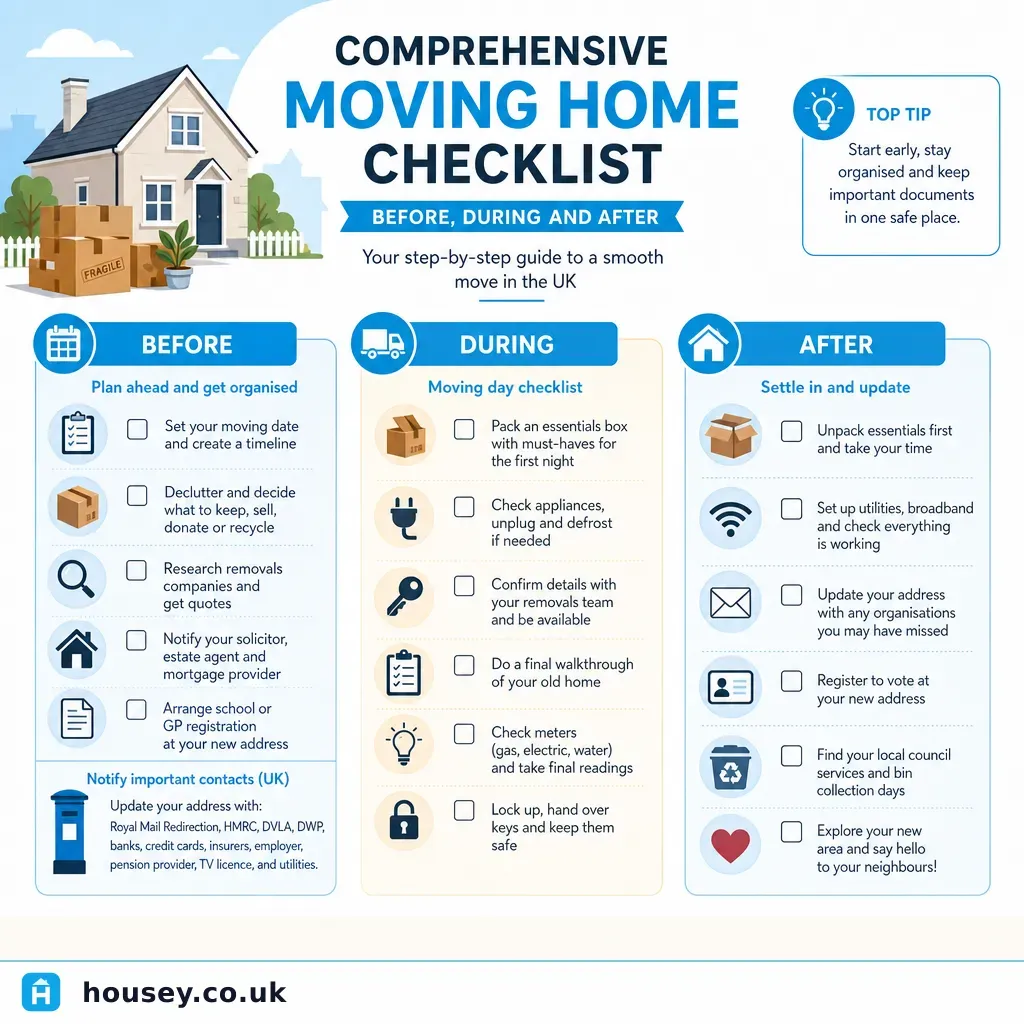
Comprehensive Moving Home Checklist: Before, During and After
Moving house in the UK involves tasks across roughly eight weeks: instructing a conveyancer and removal firm early, systematically notifying organisations of your new address, confirming buildings insurance from exchange, taking meter readings on completion day, and registering with the new council and utilities promptly.
 Buying & Moving
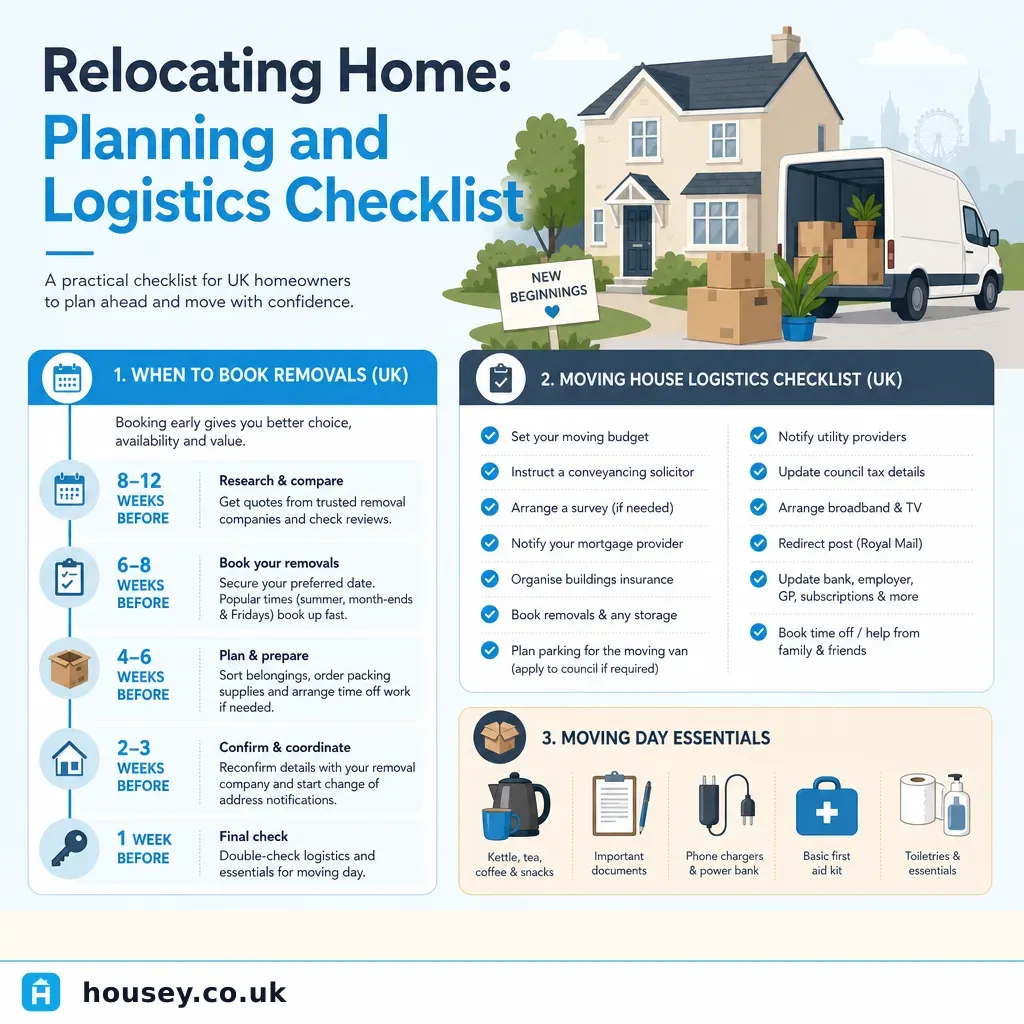
Relocating Home: Planning and Logistics Checklist
Successful home relocation in the UK typically requires 8–12 weeks of advance planning.
 Buying & Moving
Planning Your Home Removal: What to Expect from Professional Services
A professional removal company loads, transports, and unloads your household belongings between properties.
 Buying & Moving
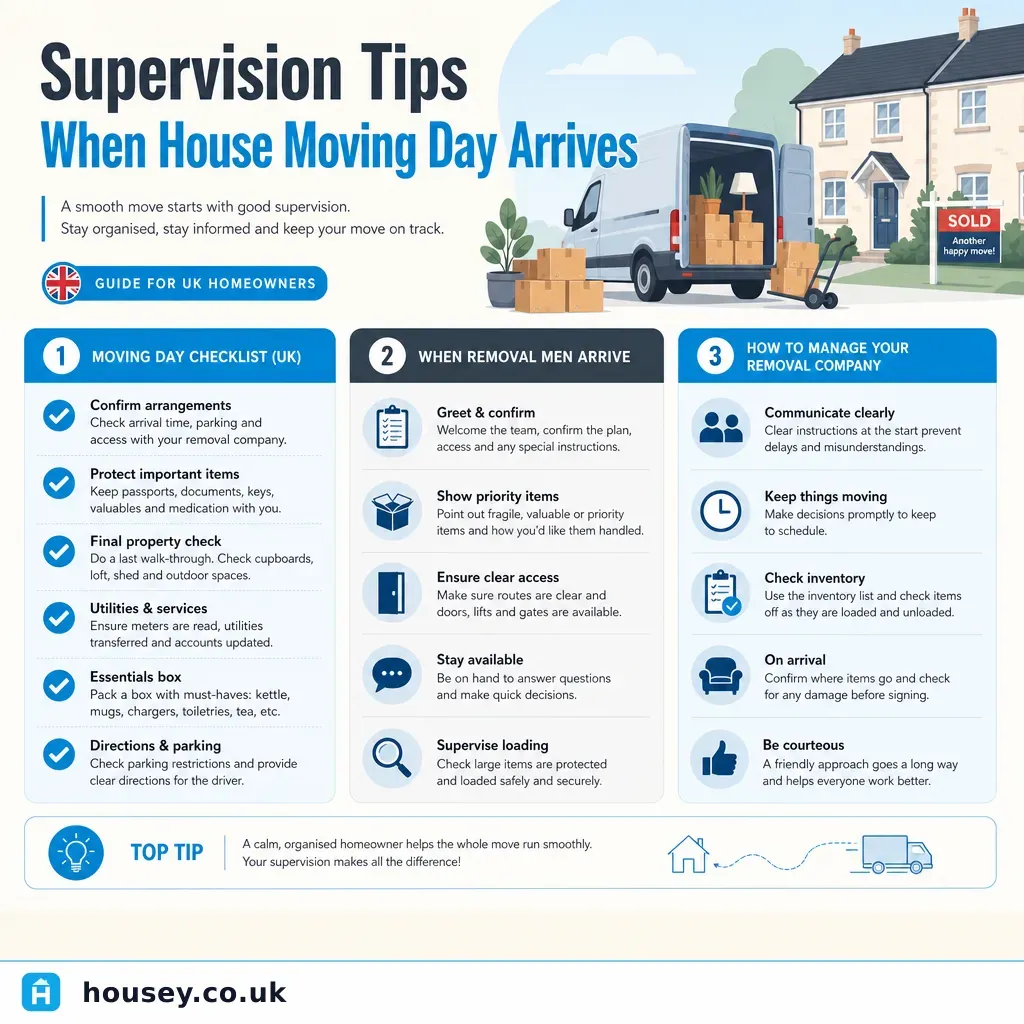
Supervision Tips When House Moving Day Arrives
On moving day, assign one person to supervise the removals crew throughout, walk through every room before the van leaves, and photograph any pre-existing damage to furniture and walls before loading begins.
 Buying & Moving
The Evolution and Development of the Removals Industry
The UK removals industry has transformed from Victorian horse-drawn furniture wagons into a specialist logistics sector with professional accreditation, containerised storage, international moves, and digital booking.