Comprehensive Moving Home Checklist: Before, During and After
By Housey · Last reviewed 30th of May 2026
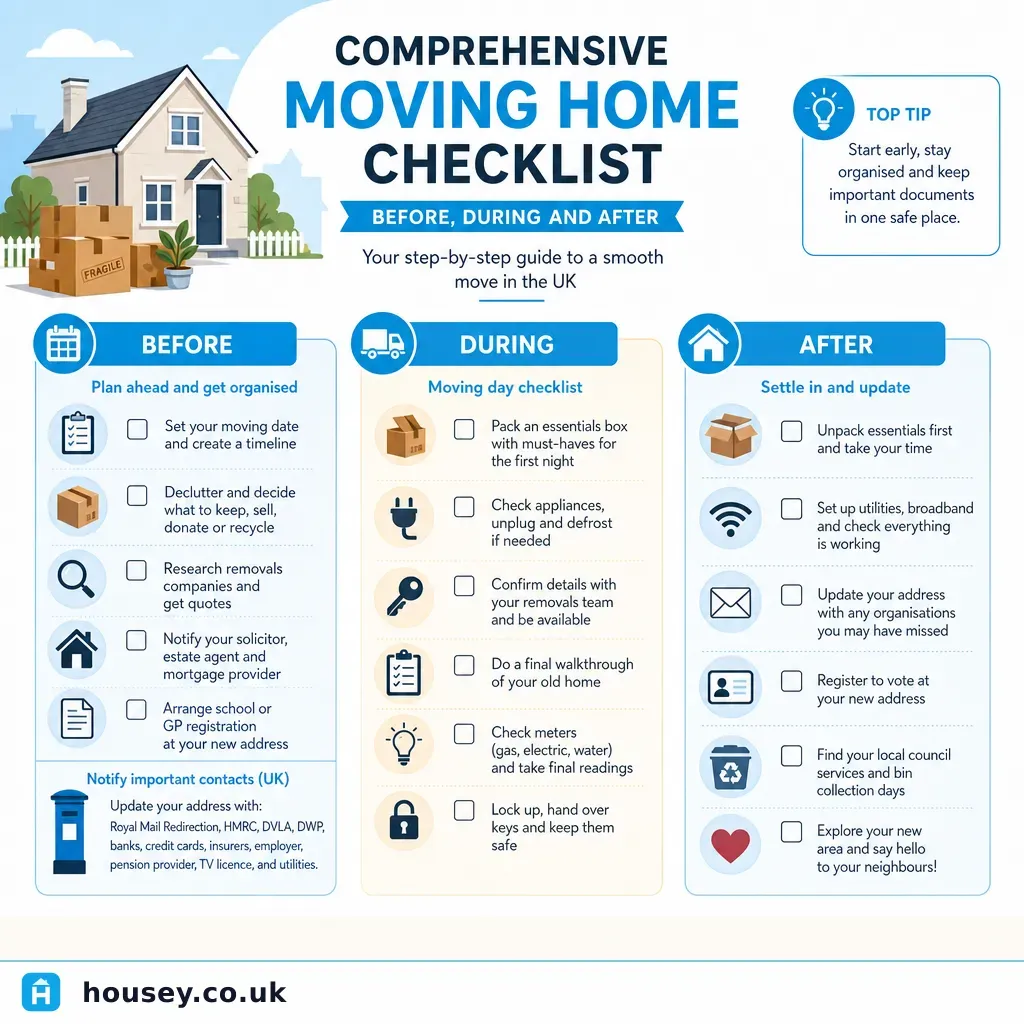
Comprehensive Moving Home Checklist: Before, During and After
Moving house in the UK involves dozens of inter-dependent tasks that run from the moment an offer is accepted to the week after you have unpacked. Miss a notification and you risk council tax charged at the wrong address, utility bills directed to the previous occupant, or HMRC correspondence lost in the post. The completion timeline — from exchange of contracts to key handover — can be as short as one week or as long as four, but most of the preparation work needs to begin well before exchange day itself.
Key points
- Exchange of contracts is the legally binding point in a residential sale in England, Wales, and Northern Ireland; the completion date is fixed at exchange and most moves complete within one to four weeks afterwards.
- Buildings insurance on a property you are buying should be in force from exchange of contracts, not completion — your legal liability for the building typically begins at the moment contracts are exchanged.
- DVLA rules require you to update your V5C vehicle logbook within 90 days of moving; your driving licence address should be updated when you next apply for a renewal.
- Council tax liability changes from the completion date — you must notify both your old and new local authority directly, as this responsibility sits with you and not your conveyancer.
- The Royal Mail redirection service (available for 3, 6, or 12 months) is a useful safety net but does not replace direct notification of key organisations; HMRC, DVLA, and most financial institutions send correspondence that redirection does not reliably cover.
Eight weeks before: instruct professionals early
This is the point to book your removal company and instruct your conveyancer. Reputable removal firms — particularly those that are members of the British Association of Removers (BAR) — fill up quickly in spring and summer. A Friday completion in July may already be unavailable if you leave the booking until two weeks before.
If you are selling, ensure a RICS home survey has been promptly instructed by your buyer. Survey delays are among the most common causes of late exchange in UK residential chains. For the legal side, conveyancing should begin as soon as an offer is accepted — delays in instructing a solicitor or licensed conveyancer typically slow every subsequent step.
What to ask before accepting a removal quote
- What is included and excluded — packing materials, disassembly and reassembly of furniture, specialist items such as pianos or antiques?
- Are your belongings covered by the firm's goods-in-transit insurance, and to what value per item?
- Is the firm a member of the British Association of Removers (BAR) or another recognised trade body?
- What happens if completion is delayed at the last minute — is there a storage or holding charge, and on what terms?
- Is VAT included in the quoted price?
- Will a surveyor visit your property to assess volume, or is the quote based on a video or online survey?
- What is the process for fragile, high-value, or specially insured items?
Four to six weeks before: notify key organisations
Work through notifications systematically, starting with financially and legally sensitive accounts:
Financial and legal
Utilities and home services
Local authority and government
Personal and professional
One to two weeks before: practical preparations
- Confirm the completion date with your conveyancer and check the chain is still intact.
- Clarify who holds the keys and when release is authorised — typically on confirmed receipt of completion funds.
- Confirm buildings insurance is active from exchange of contracts if you are buying.
- Confirm the removal firm's arrival time and arrange parking permits at both addresses if required.
- Pack an essentials bag containing overnight items, phone chargers, important documents, medications, and a kettle — keep this in the car, not the van.
- Take meter readings at your current property and photograph them as a timestamped record.
Moving day checklist
After moving: a worked UK property scenario
A first-time buyer completing on a 1930s semi-detached in the East Midlands:
- 9:00 am — Solicitor confirms funds received; estate agent releases keys.
- 9:30 am — Buyer takes meter readings and photographs the consumer unit, stop tap location, and any pre-existing marks or damage.
- 10:00 am — Removal van arrives and begins unloading.
- 12:00 pm — Buyer reports final meter readings to the old address supplier and opens an account for the new address.
- Day 2 — Registers for council tax with the new local authority online.
- Day 3 — Updates DVLA records, bank accounts, and HMRC Self Assessment address.
- Day 5 — Sets up Royal Mail redirection; first redirected envelope arrives the following morning.
- Week 2 — Registers with a local GP surgery and updates electoral roll registration.
When to get professional help
Contact a professional if:
- Your conveyancer has flagged a title defect, restrictive covenant, or missing completion document — do not exchange contracts without full legal clarity.
- You discover significant undisclosed defects after completion — contact your solicitor promptly, as a misrepresentation or misdescription claim may be available and time limits apply.
- A removal firm has caused substantial damage to your belongings — check their insurance cover, BAR membership, and written claims procedure before signing anything.
- Utility accounts cannot be transferred due to metering disputes or billing errors — escalate to the supplier's formal complaints team and, if unresolved, to the Energy Ombudsman.
How Housey can help
Housey connects you with trusted professionals across every stage of a UK move. Whether you need house removals, conveyancing solicitors, or property photography and floorplans to help market your current home, submit one request and compare quotes from vetted local providers.
Frequently asked questions
When should I book a removal firm?
As soon as you have an agreed completion date — ideally eight weeks before, or earlier during peak seasons such as spring and summer. Fridays and end-of-month dates are the busiest and fill fastest. Leaving it to fewer than four weeks before completion significantly limits your choice of reputable firm, particularly at popular times of year.
What is the most efficient way to notify everyone of my new address?
Work through a prioritised checklist starting with financially and legally sensitive contacts — HMRC, banks, and insurers. Set up Royal Mail redirection as a safety net, but do not rely on it alone: HMRC, DVLA, and many financial institutions send correspondence that redirection does not reliably cover, so direct notification remains essential for all key organisations.
Do I need to be at the old property on completion day?
Not legally, but it is strongly advisable. Being present — or having a trusted person there — allows you to take final meter readings, carry out a last walkthrough, check nothing has been left behind, and return keys promptly. If you are a tenant, your landlord will require the property to be vacated and keys returned by an agreed time.
What happens if completion is delayed on moving day?
If funds do not clear by the agreed time, completion may not take place that day and your conveyancer will keep you updated. If the removal van is already loaded or in transit, you may incur storage and overnight holding charges — ask your removal firm about this policy before moving day. This risk is one reason many buyers and sellers avoid exchanging and completing on the same day.
Sources and further reading
- Buying or selling your home — GOV.UK — GOV.UK
- Council tax: moving home — GOV.UK — GOV.UK
- Change your address on your driving licence — DVLA — GOV.UK / DVLA
- Royal Mail address redirection — Royal Mail
- British Association of Removers — BAR
- Energy Ombudsman — Ombudsman Services
Useful next reads
 Buying & Moving
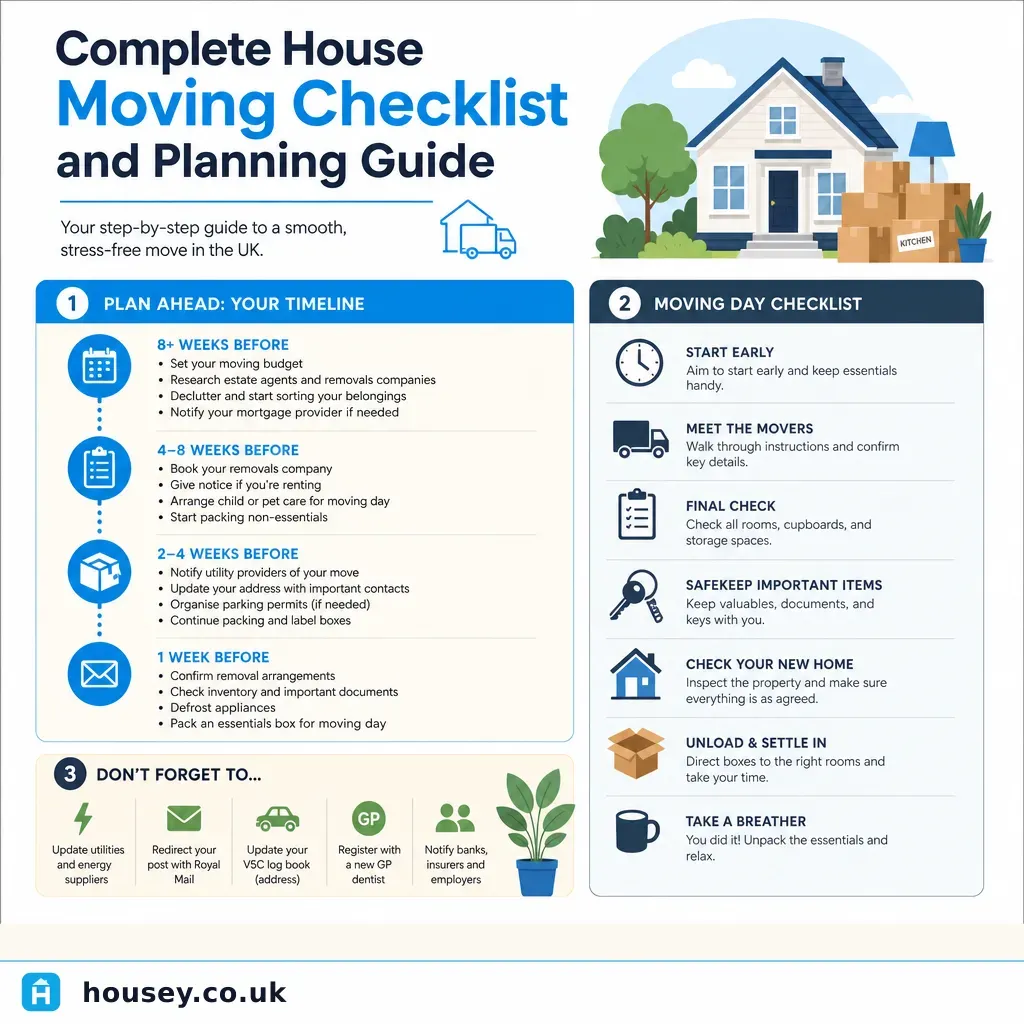
Complete House Moving Checklist and Planning Guide
A successful UK house move requires planning across 8 or more weeks: booking a removal firm early, decluttering before packing, notifying DVLA, HMRC, and utility providers, and confirming completion day logistics in advance.
 Buying & Moving
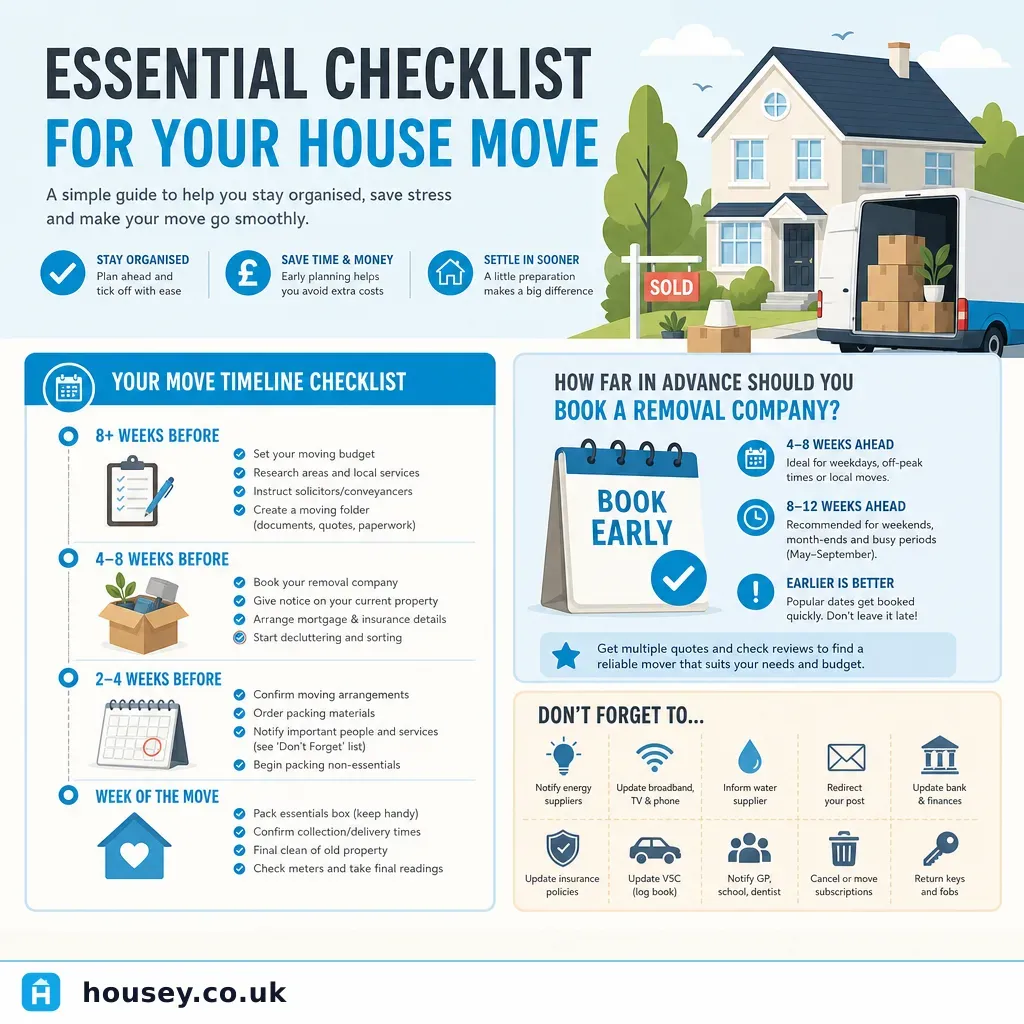
Essential Checklist for Your House Move
A successful UK house move relies on a staged checklist covering eight to twelve weeks before moving day through to two weeks after arrival.
 Buying & Moving
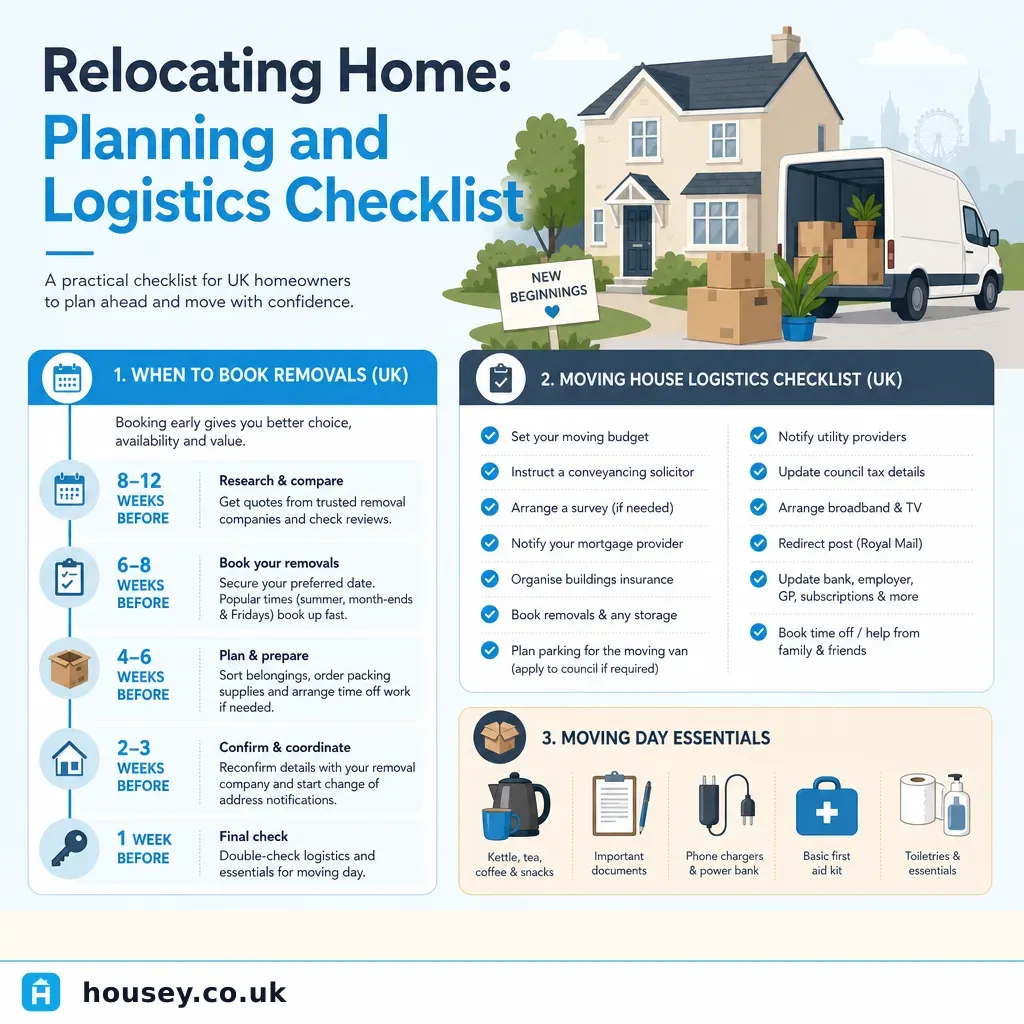
Relocating Home: Planning and Logistics Checklist
Successful home relocation in the UK typically requires 8–12 weeks of advance planning.
 Buying & Moving
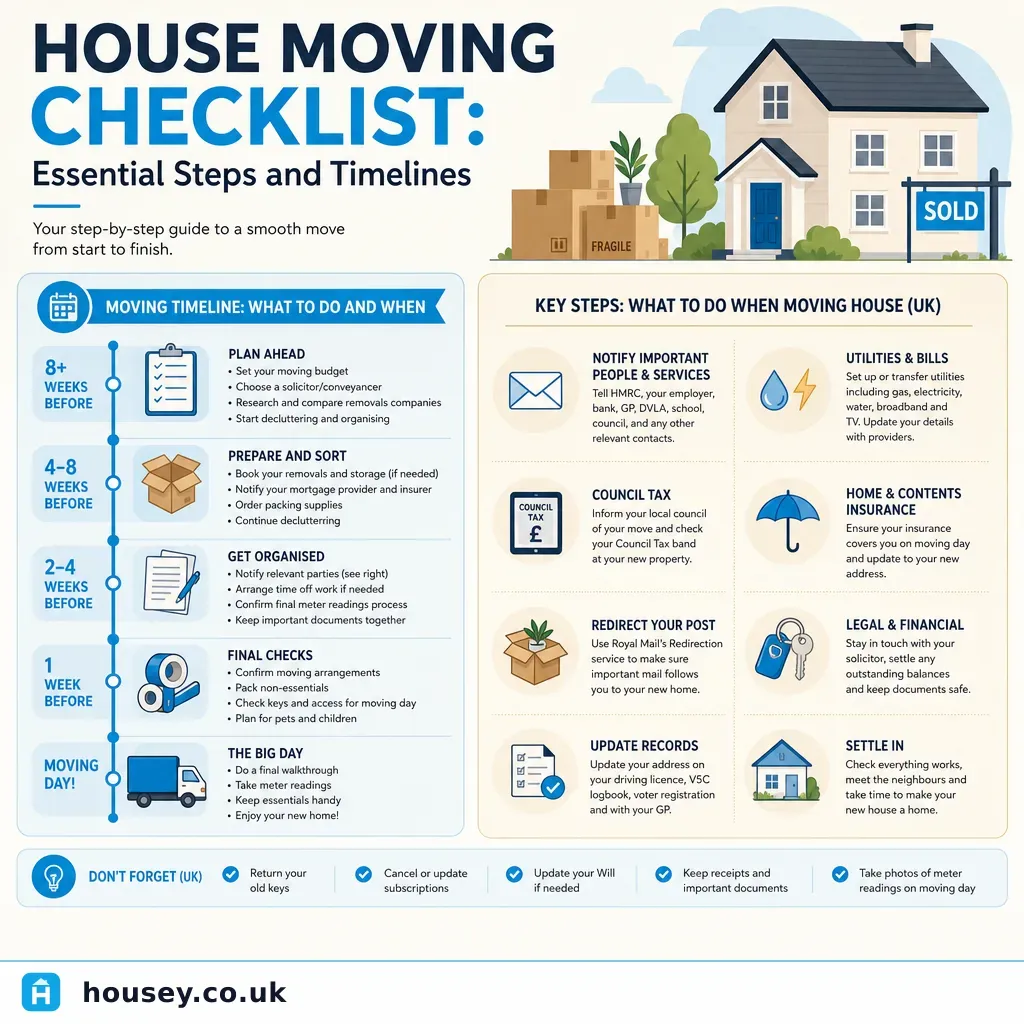
House Moving Checklist: Essential Steps and Timelines
A UK house move typically spans 8–12 weeks of preparation: book removals 4–6 weeks out, notify the DVLA, HMRC, and utilities as exchange approaches, take meter readings on moving day, and update Council Tax and the electoral register on arrival.
 Buying & Moving
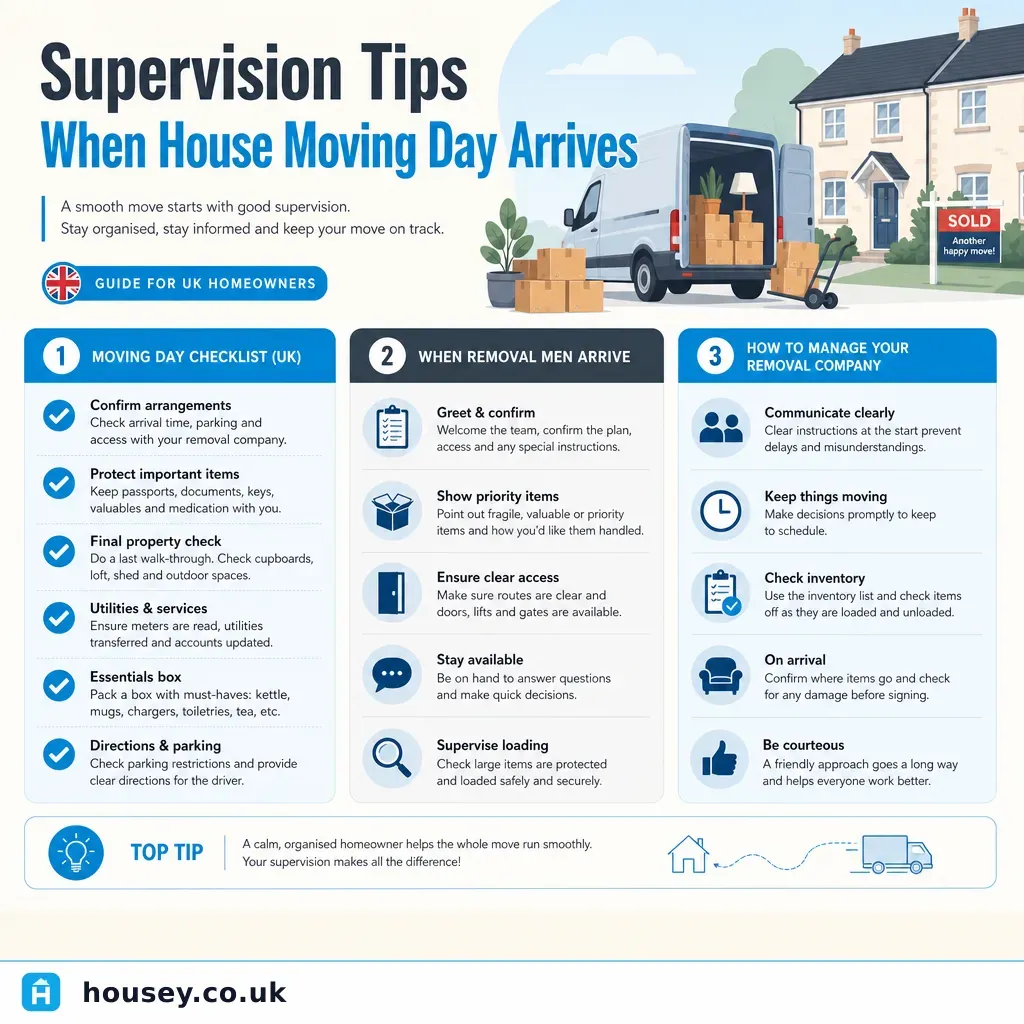
Supervision Tips When House Moving Day Arrives
On moving day, assign one person to supervise the removals crew throughout, walk through every room before the van leaves, and photograph any pre-existing damage to furniture and walls before loading begins.