Supervision Tips When House Moving Day Arrives
By Housey · Last reviewed 1st of June 2026
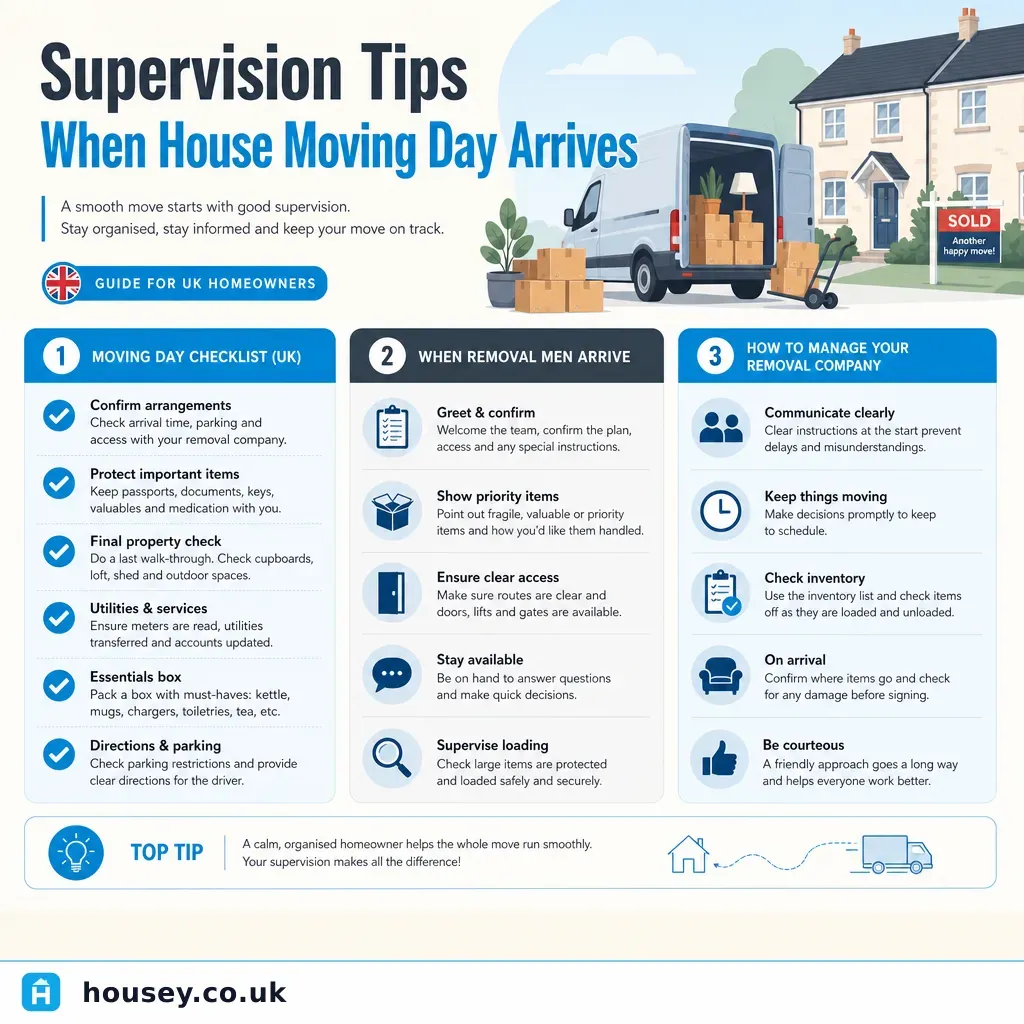
Supervision Tips When House Moving Day Arrives
Moving day is the culmination of weeks of planning, and how you manage the hours between the removal van arriving and the keys being handed over has a direct bearing on what arrives intact, what gets missed, and how smoothly the day unfolds. Whether you are shifting a one-bedroom flat or a four-bedroom Victorian terrace, a little structured supervision prevents the chaotic free-for-all that leads to scratched floors, missing boxes, and utility disputes.
Key points
- Parking suspensions for removal lorries typically require 5–14 days' notice to your local council; check your local authority's website for the application process and any fees.
- Under the Consumer Rights Act 2015, your removal company must carry out the service with reasonable care and skill — document any pre-existing damage before loading begins.
- Take meter readings (gas, electricity, water) at both properties on moving day and photograph them with a timestamp; energy suppliers require these to close and open accounts accurately.
- High-value items — passports, financial documents, jewellery, laptops — should travel with you in your personal vehicle, not in the removal van.
- Most removal contracts exclude cover for items you pack yourself; check your policy wording before the day.
Before the removal crew arrives
The hour before the van pulls up is your best opportunity to set the tone for the whole day. Walk through every room with a supervisor's eye and resolve anything that could cause confusion or delay once the crew are on the clock.
Checklist: before the crew starts loading
- Confirm parking access is clear; display any council suspension notices if you applied for a bay suspension.
- Remove or secure pets and children from working areas.
- Walk every room and photograph pre-existing marks on walls, floors, door frames, and furniture corners — use your phone's timestamp feature.
- Identify items the crew must not touch: plants, anything you are transporting yourself, and items being left for the buyers.
- Confirm with the crew lead the loading priority — fragile items should go in last and come out first.
- Sign the condition report and inventory before any loading starts.
Who should be in charge on the day
Assigning a single point of contact — ideally the person who booked the removal company — prevents conflicting instructions reaching the crew. If two adults are present, decide in advance who directs the crew at the origin property and who receives them at the destination.
Decision tree: who supervises what
- Have one person at the loading address until the van is packed and every room has been walked through and confirmed empty.
- Have the same or a second person at the destination address from the point you take possession of the keys.
- If the properties are far apart, coordinate by phone at the point of departure and again on arrival.
- If there are multiple van runs, the supervisor at the origin should sign off each load against the inventory before the van leaves.
- Contact the removal company's office (not just the crew) if anything is damaged, missing, or the timeline slips significantly.
Managing the loading process
A professional removal crew will have their own system, but your role as supervisor is to stay organised and present throughout.
- Confirm room labels match the boxes. Each box should be marked with its destination room. Misrouted boxes on arrival are one of the most common causes of unpacking confusion.
- Watch for rushed handling of fragile items. If a crew member is moving quickly with a box marked fragile, a calm word is appropriate — you are paying for care.
- Keep a master inventory list. Many removal companies provide a numbered inventory; tick off items as they go into the van. If yours does not, prepare a simple numbered list the evening before.
- Lock rooms as they are cleared. Once a room is empty and checked, close and lock the door to prevent items being left behind and to reduce the risk of confusion.
At the destination property
Before the van is unloaded, do a brief walkthrough of the new property.
- Note any damage already present before your furniture arrives — photograph it immediately with a timestamp.
- Confirm where each room's items should be placed and brief the crew before unloading begins, not midway through.
- Check that utilities are live: water stopcock open, electricity and gas supply on.
- Take meter readings immediately on entry, before anything else, and photograph them.
Red flags on moving day
Watch out for these signs that something has gone wrong or may go wrong:
- The crew are unfamiliar with the inventory. A professional team should have your job sheet and know what is expected.
- The van is significantly smaller than quoted. This usually means multiple runs or items being left behind — clarify before loading starts.
- No written inventory or condition report is offered. Ask for one before loading begins; a reputable firm will provide it.
- You are asked to sign a completion certificate before the van is fully unloaded. Do not sign until everything is inside and you have completed a room-by-room walkthrough.
- Damage is discovered after the crew has left. Photograph it immediately and notify the company in writing within 24 hours to preserve your rights under the Consumer Rights Act 2015.
When to get professional help
For most domestic moves, a professional removal company handles the physical work and your role is supervisory. However, consider specialist involvement when:
- You have antiques, fine art, pianos, or unusually large or heavy items requiring specialist packing and lifting equipment.
- You are moving internationally, which involves customs documentation and different insurance requirements.
- Your removal company causes damage and disputes your claim — the British Association of Removers (BAR) operates an Alternative Dispute Resolution scheme for member companies, offering a route to resolution without going to court.
How Housey can help
Housey connects homeowners with vetted house removals companies across the UK. Submit one request and receive quotes from local, checked removal firms, making it straightforward to compare services, insurance cover, and pricing before you commit.
Frequently asked questions
What should I do if the removal crew damages furniture or walls?
Photograph the damage immediately and note it on any completion paperwork before signing. Notify the removal company in writing — email creates a clear trail — within 24 hours. Check whether the damage falls under their liability policy or your own home contents insurance. If the company is a British Association of Removers member, their Alternative Dispute Resolution scheme offers a route without going to court.
Do I need to be present the entire time on moving day?
It is strongly advisable for at least one responsible adult to be present throughout loading and unloading. If you cannot be there for part of the day, appoint a trusted person who knows what is being moved and where it should go, and give them a copy of the inventory and the removal company's contact details.
Should I tip the removal crew?
Tipping is not expected but is a common courtesy for a good job. If the crew have been careful, efficient, and helpful, a small cash tip per person — typically £5–£20 depending on the size of the move — is appreciated but entirely optional.
How early should I arrive at the new property?
Aim to be at the destination address before the removal van arrives. This lets you do a brief pre-arrival walkthrough to note any pre-existing damage, take meter readings with a timestamp, and brief the crew on room placement before unloading begins.
Sources and further reading
- Consumer Rights Act 2015 — legislation.gov.uk
- British Association of Removers — Consumer Advice — British Association of Removers
- Problems with a service — Citizens Advice
Useful next reads
 Buying & Moving
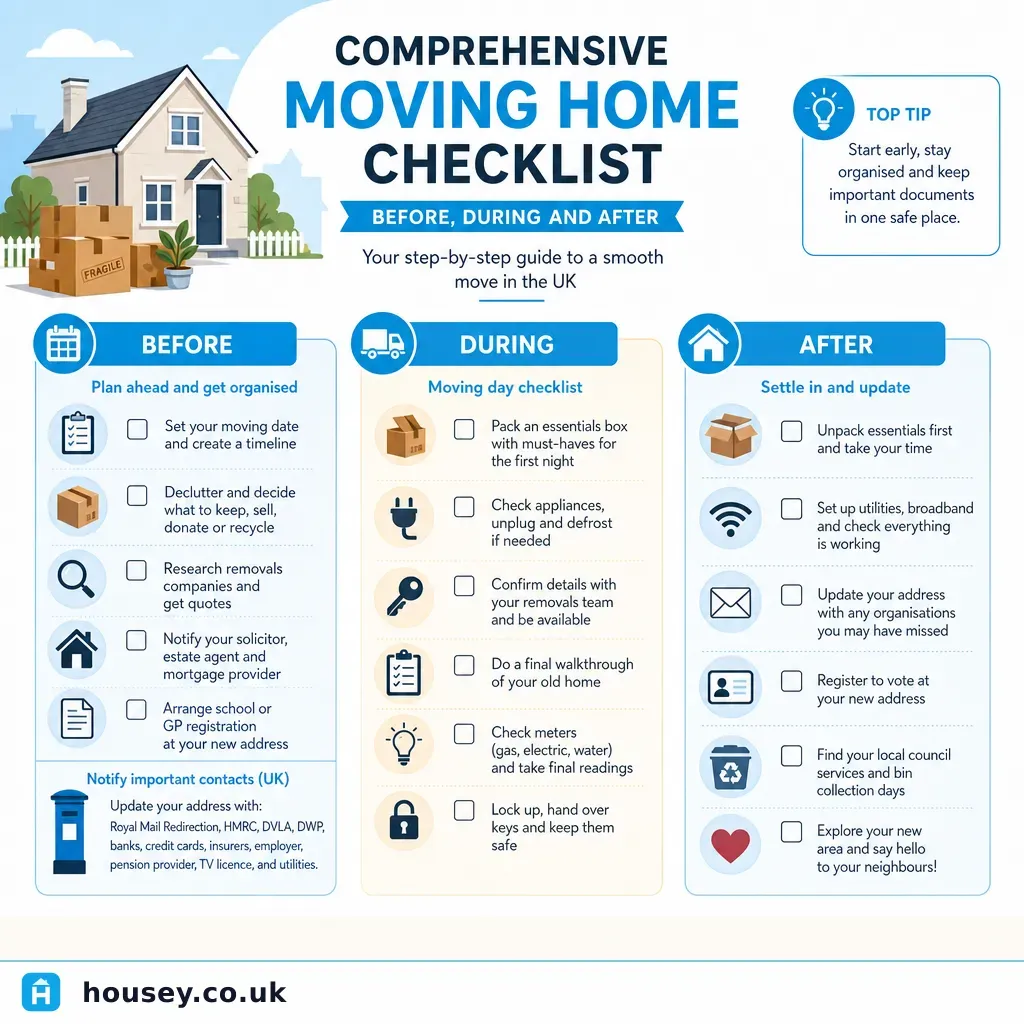
Comprehensive Moving Home Checklist: Before, During and After
Moving house in the UK involves tasks across roughly eight weeks: instructing a conveyancer and removal firm early, systematically notifying organisations of your new address, confirming buildings insurance from exchange, taking meter readings on completion day, and registering with the new council and utilities promptly.
 Buying & Moving
Complete House Moving Checklist and Planning Guide
A successful UK house move requires planning across 8 or more weeks: booking a removal firm early, decluttering before packing, notifying DVLA, HMRC, and utility providers, and confirming completion day logistics in advance.
 Buying & Moving
Moving Day Logistics: A Guide to a Successful Home Relocation
On moving day, wait for your solicitor to confirm completion before collecting keys — there is no fixed handover time and most UK completions happen between 11am and 2pm.
 Buying & Moving
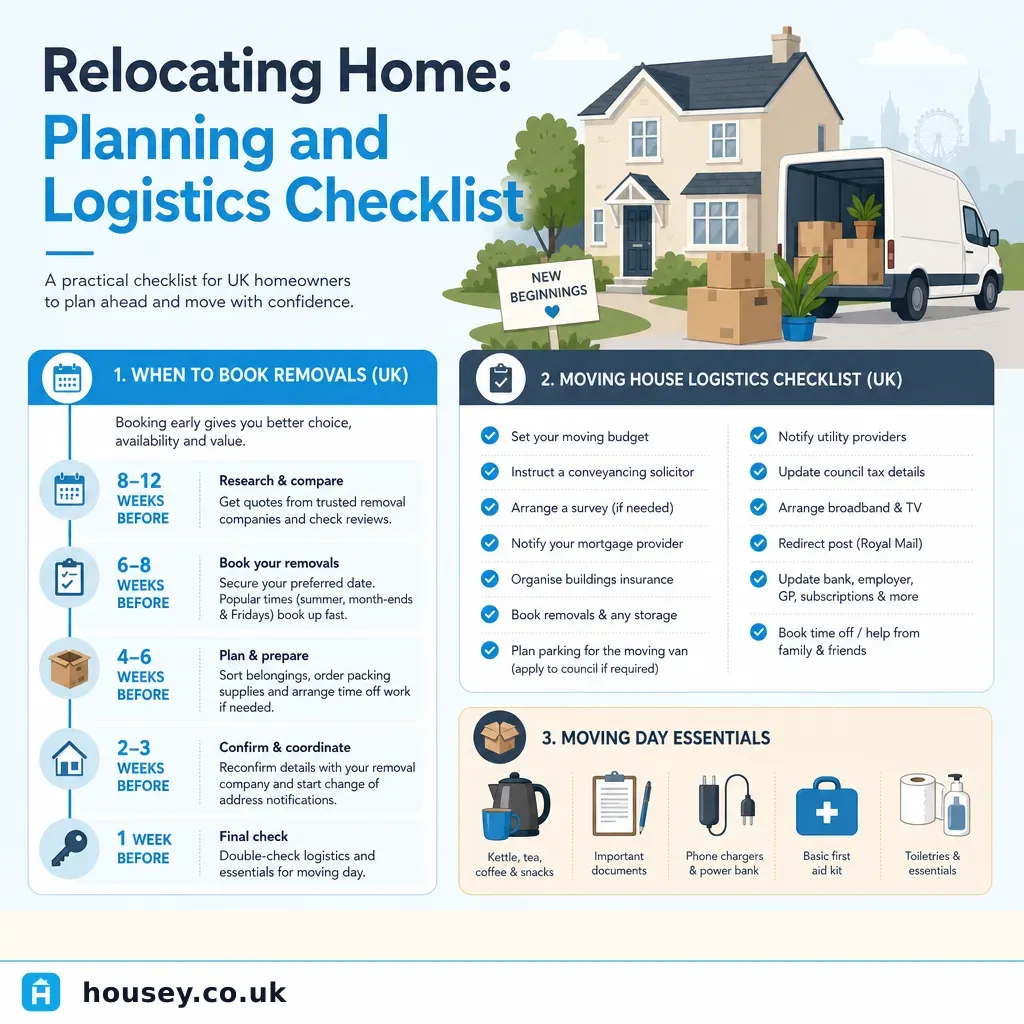
Relocating Home: Planning and Logistics Checklist
Successful home relocation in the UK typically requires 8–12 weeks of advance planning.
 Buying & Moving
Essential decluttering and preparation before house moves
Decluttering before a house move reduces removal costs, improves property photographs, and simplifies unpacking.