The Evolution and Development of the Removals Industry
By Housey · Last reviewed 30th of May 2026

The Evolution and Development of the Removals Industry
When a household in the UK plans a move, the choice of removals firm rarely prompts much historical reflection. Yet the companies handling furniture, boxes, and belongings today are the product of more than 150 years of industrial and social change — from Victorian horse-drawn vans navigating cobbled streets to GPS-tracked lorries and video-survey booking systems. Understanding how the industry evolved helps homeowners know what to expect from a modern professional service, and how to distinguish firms that have genuinely kept pace with change from those that have not.
Key points
- The British Association of Removers (BAR), founded in 1900, remains the principal UK trade body for the removals industry, operating an Advance Payment Guarantee scheme that protects consumers if a member firm becomes insolvent before a move is completed.
- Removal firms operating vehicles over 3.5 tonnes gross vehicle weight must hold a Goods Vehicle Operator's Licence, administered by the Traffic Commissioner under the Goods Vehicles (Licensing of Operators) Act 1995.
- International removals require compliance with HMRC customs procedures and, post-Brexit, additional documentation — including detailed household goods inventories — for moves into EU member states.
- Modern removals firms may hold TrustMark registration or Which? Trusted Trader status, providing additional consumer protection and access to independent dispute resolution.
- Containerised storage became widely available in the 1990s and is now a standard service offering, particularly useful when a property chain collapses or completion dates do not align.
The origins of the UK removals industry
Before the motor vehicle, household moves were managed with horse-drawn furniture vans — heavy, slow, and limited to short distances. Victorian and Edwardian households typically used local carriers or employed domestic staff for moves within a town or city. The concept of a specialist remover emerged in the latter half of the 19th century, particularly in growing industrial cities where a rising professional class moved more frequently between rented and owned accommodation.
The railways played a supporting role: large or heavy goods — pianos, billiard tables, and substantial furniture — were occasionally transported by rail, with local carriers handling collection and delivery at each end. This early multi-modal approach foreshadowed the international removal services that emerged decades later.
The motorised revolution and post-war expansion
Affordable motorised vans in the 1920s and 1930s transformed the industry. Purpose-built removal vehicles could handle longer distances, heavier loads, and more fragile contents than horse-drawn predecessors. The widespread adoption of motor transport also enabled the first national pricing structures, as firms could compare costs across journeys of any length.
After the Second World War, a sustained expansion in owner-occupied housing — driven by new housing estates, mortgage availability, and council house sales across suburban Britain — created a substantial and growing market for domestic removals. Firms began to standardise packing materials, develop trained crews, and offer storage for customers caught in property chains, a problem that has never fully gone away.
Professional standards and trade body growth
The founding of BAR in 1900 marked the beginning of organised professional standards in the UK removals industry. BAR's Code of Practice, approved by the Chartered Trading Standards Institute (CTSI), has evolved over more than a century to include requirements around written estimates, goods-in-transit insurance, cancellation rights, and complaint handling.
The Transport Act 1968 and later the Goods Vehicles (Licensing of Operators) Act 1995 imposed formal operator licensing requirements on commercial haulage, including removal firms. These frameworks raised baseline safety and reliability standards across the industry, though smaller operators have always worked alongside BAR members in the wider market.
Franchise models arrived in the 1980s and 1990s. National brands expanded their geographic reach through regional franchise arrangements, allowing customers to make a single booking with a nationally recognised firm while relying on local knowledge at origin and destination.
How the industry compares today: choosing the right service
Service type | Best for | Not ideal for | Typical operator | Key accreditation to look for |
|---|---|---|---|---|
Full-service (pack, move, unpack) | Families, long-distance, time-pressured moves | Budget-conscious single movers | BAR member firm | BAR, TrustMark |
Self-pack, driver-only | Moderate budgets; confident packers | Antiques, fragile or high-value items | BAR member or licensed firm | Goods Vehicle O-licence |
Man-and-van service | Small moves, students, single rooms | Long-distance, large households | Self-employed; no standard body | Check reviews; verify insurance |
Container or storage removals | Part-moves; chain delay; temporary relocation | Urgent same-day moves | Storage firm with removals capability | Self Storage Association; BAR |
International removals | Overseas relocation | Domestic-only moves | FIDI Accredited International Mover | FIDI, BAR International |
The digital era and consumer-facing changes
The internet transformed how UK homeowners find and compare removal firms. Price-comparison platforms, review aggregators, and direct-booking apps have shifted market power significantly toward consumers since the early 2000s.
Modern professional removal firms typically offer:
- Video or app-based inventory surveys, replacing the in-home visit for preliminary quotes
- Real-time vehicle tracking, particularly on long-distance and international moves
- Digital inventory and damage claim management
- Specialist packaging for art, wine, pianos, and antiques, including climate-controlled vehicles for sensitive items
- Integration with storage platforms for customers whose chain collapses at short notice
A worked UK scenario: A household in Manchester selling a three-bedroom 1930s semi and buying in Edinburgh would typically engage a BAR member firm offering a video survey, a fixed-price written estimate, a packing service for fragile items, and overnight container storage if completion dates fall on different days. The BAR Advance Payment Guarantee would protect any deposit paid to the firm if it encountered financial difficulties before moving day.
What to ask before booking a removals firm
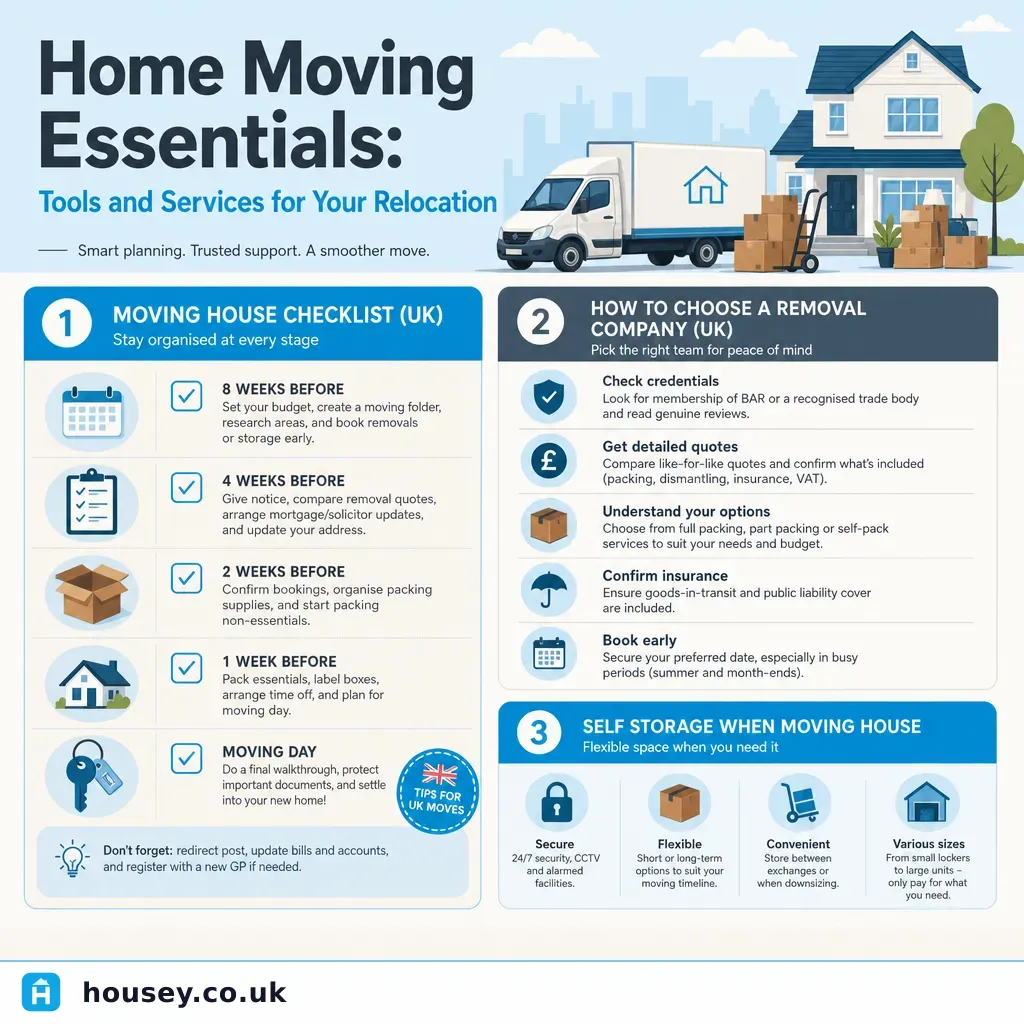
- Are you a member of BAR or another recognised trade body, and is your Code of Practice CTSI-approved?
- Do you hold a current Goods Vehicle Operator's Licence for vehicles over 3.5 tonnes?
- What goods-in-transit and public liability insurance do you carry, and what are the claim limits per item?
- Is your estimate fixed-price or variable, and what circumstances could change it?
- How do you handle delays on completion day — what storage options are available, and are rescheduling charges applied?
- Will the same crew carry out both the pre-move survey and the move itself?
- What is your claims process if items are damaged or go missing in transit?
When to get professional help
Most household moves benefit from engaging a fully accredited professional firm rather than self-organising or using an informal operator. In particular, seek a BAR member or equivalent accredited firm if:
- You are moving antiques, artwork, specialist instruments, or a wine collection requiring climate control.
- The move involves a long distance — particularly between England and Scotland, Wales, or Northern Ireland — or an international destination.
- Your property chain is at risk of collapse and you need flexible storage arrangements at short notice.
- You have a fixed completion date with financial penalties for delays.
- You require customs documentation for an international move post-Brexit.
How Housey can help
Housey makes it straightforward to compare quotes from vetted house removals firms across the UK. Whether you are moving a one-bedroom flat across town or a family home from London to Edinburgh, finding the right removals partner through a transparent quote process makes a meaningful difference on moving day.
Frequently asked questions
What does BAR membership actually guarantee?
BAR membership requires firms to adhere to a Chartered Trading Standards Institute-approved Code of Practice, hold adequate goods-in-transit insurance, and participate in the BAR Advance Payment Guarantee scheme. If a BAR member becomes insolvent after taking your deposit, you can reclaim that deposit — protection that informal or unaccredited operators do not typically provide.
How far in advance should I book a removals firm?
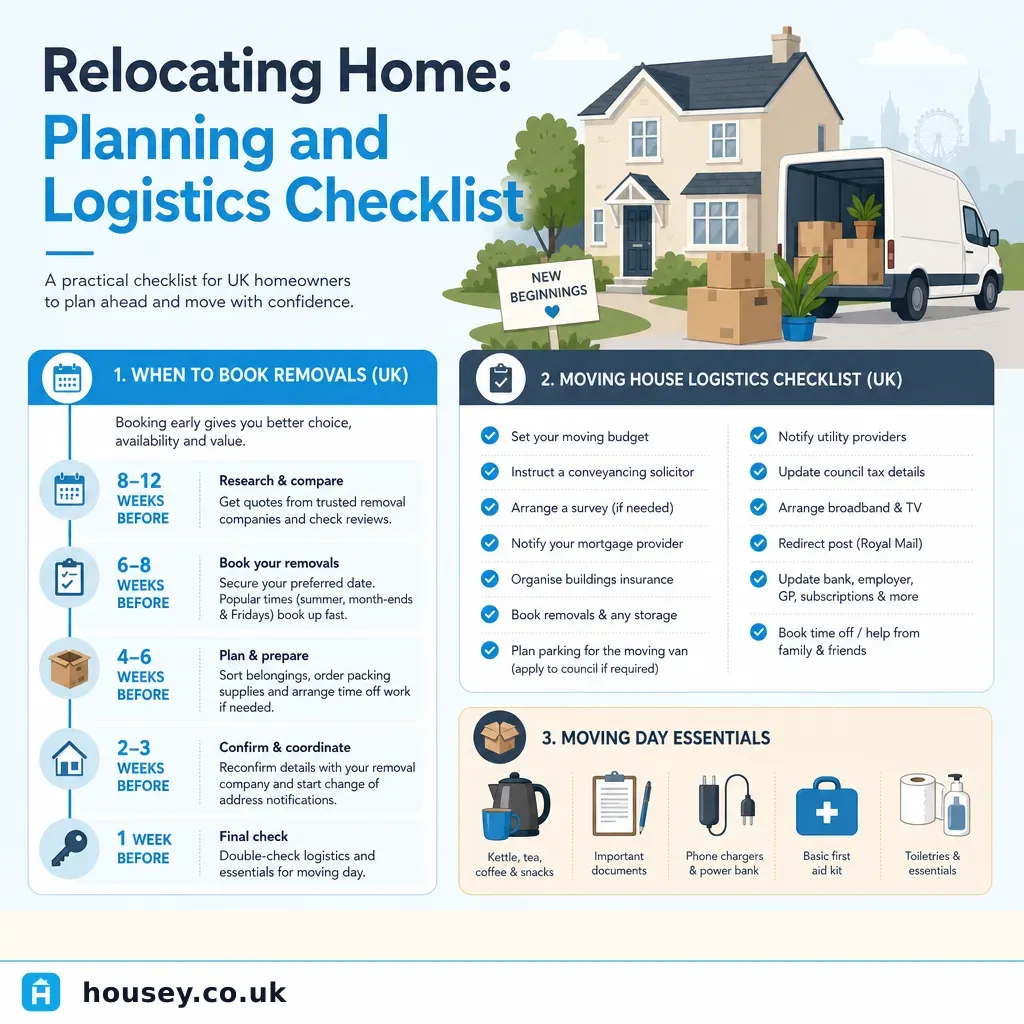
For a straightforward domestic move, 4–6 weeks is usually adequate. At peak periods — June to September and school holiday windows — popular BAR member firms may be booked 8–12 weeks ahead. If your completion date is uncertain, discuss provisional booking options and associated deposit terms with the firm before committing.
Are removals services subject to VAT?
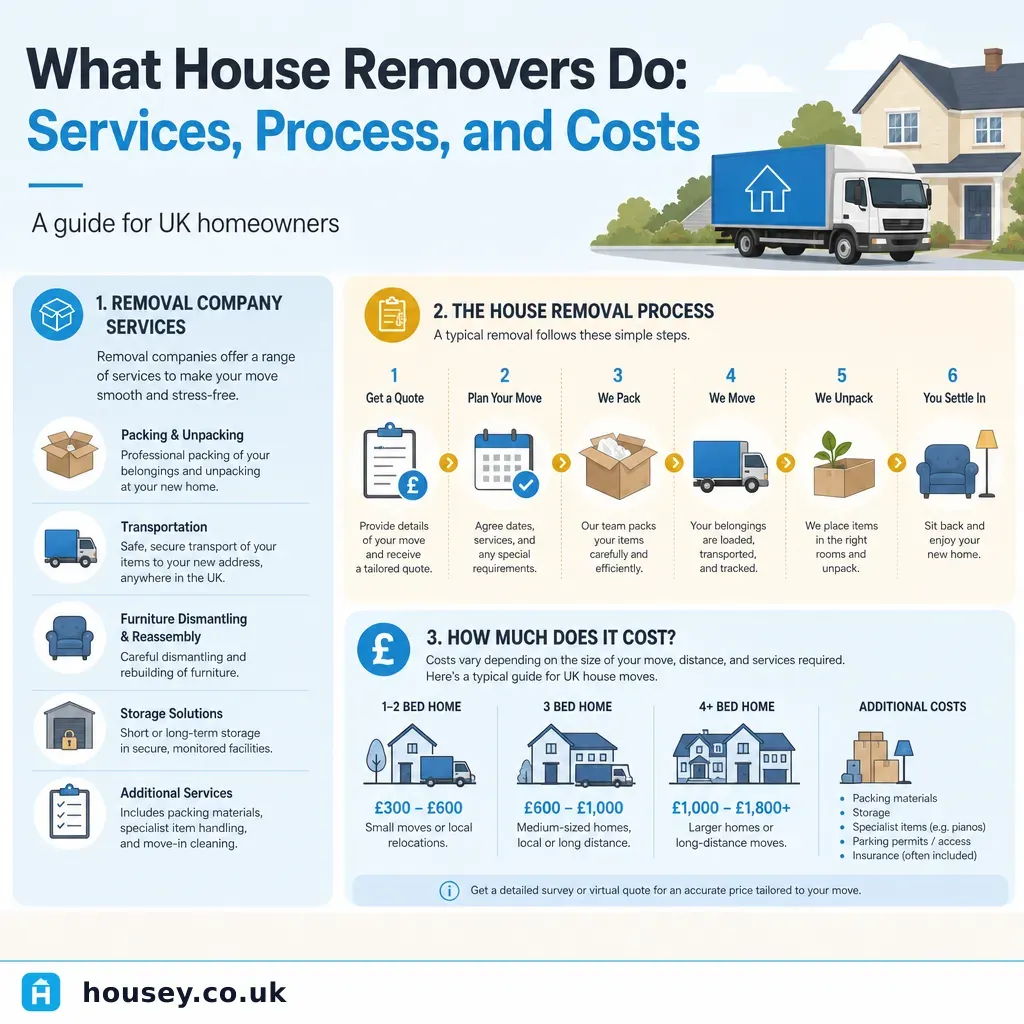
Yes. Professional removals services are subject to VAT at the standard rate of 20%. Always confirm whether a written estimate includes VAT or states the net figure only, as this can create a significant price difference between quotes that appear similar at first glance.
Do removals companies pack for you?
Most full-service BAR member firms offer a packing service using professional materials, quoted separately from the move itself. If you choose to self-pack, the firm's goods-in-transit insurance may apply different conditions to owner-packed boxes compared with items packed by the removal crew — clarify this before deciding.
Sources and further reading
- British Association of Removers: consumer guidance — British Association of Removers (BAR)
- Goods vehicle operator licensing — GOV.UK
- TrustMark: find a government-endorsed quality scheme member — TrustMark
- Which? guide to removal firms — Which?
Useful next reads
 Buying & Moving
Relocating Home: Planning and Logistics Checklist
Successful home relocation in the UK typically requires 8–12 weeks of advance planning.
 Buying & Moving
Planning Your Home Removal: What to Expect from Professional Services
A professional removal company loads, transports, and unloads your household belongings between properties.
 Buying & Moving
Home Moving Essentials: Tools and Services for Your Relocation
Moving house in the UK involves far more than hiring a removal van.
 Buying & Moving
Complete House Moving Checklist and Planning Guide
A successful UK house move requires planning across 8 or more weeks: booking a removal firm early, decluttering before packing, notifying DVLA, HMRC, and utility providers, and confirming completion day logistics in advance.
 Buying & Moving
What House Removers Do: Services, Process, and Costs
House removers load, transport, and unload your belongings between properties.