Conservatory Size and Planning Permission: Exemptions and Thresholds
By Housey · Last reviewed 4th of May 2026
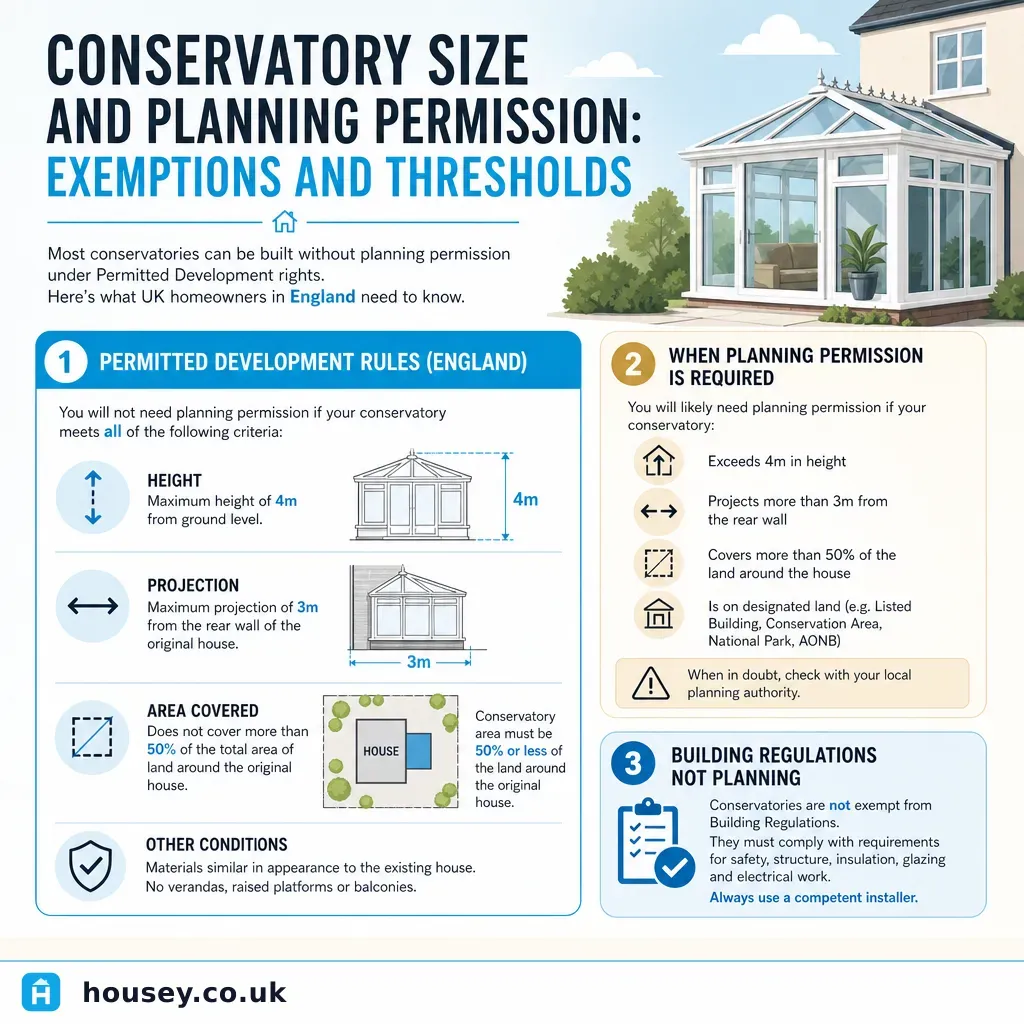
Conservatory Size and Planning Permission: Exemptions and Thresholds
Conservatories occupy an unusual position in UK planning and building law: they benefit from the same permitted development rights as other single-storey extensions and, if constructed to specific standards, a dedicated exemption from most building regulations requirements. Both sets of rules have precise size thresholds and conditions that, if missed, can result in enforcement action, complications during conveyancing, or a structure that fails to meet thermal performance standards. Understanding both sets of limits before you commission a design will save time, money, and potential legal complications later.
Key points
- In England, conservatories are treated as single-storey extensions under Class A, Schedule 2, Part 1 of the Town and Country Planning (General Permitted Development) Order 2015 (GPDO 2015) — there is no separate planning category for conservatories.
- The standard permitted development depth for a single-storey rear extension is 3 metres for a terraced or semi-detached house, or 4 metres for a detached house.
- Under the Neighbour Consultation Scheme (prior approval), these depths can increase to 6 metres (terraced or semi-detached) or 8 metres (detached), subject to LPA notification and neighbour consultation.
- A conservatory is exempt from most building regulations — including Part L energy efficiency requirements — only if it is at ground level, under 30m², thermally separated from the house by external-quality doors and windows, has a translucent roof covering at least 75% of its area, and has its own independent heating system.
- Conservatories on listed buildings always require listed building consent; in conservation areas, side conservatories require a planning application regardless of size.
How planning law treats conservatories
For planning purposes, a conservatory is an extension to the dwelling. In England, it falls under Class A of Schedule 2, Part 1 of the GPDO 2015 — the same class as any other single-storey rear or side extension. A conservatory can be built as permitted development — without submitting a planning application — provided it stays within Class A size limits and conditions. If it exceeds those limits, a full planning application is required.
Wales, Scotland, and Northern Ireland operate under separate planning systems and have different permitted development rules. This article covers England only.
Permitted development size thresholds
The following limits apply to a single-storey rear conservatory to remain permitted development in England:
Condition | Detached house | Terraced or semi-detached |
|---|---|---|
Maximum depth (standard permitted development) | 4 metres | 3 metres |
Maximum depth (Neighbour Consultation Scheme) | 8 metres | 6 metres |
Maximum eaves height | Must not exceed eaves of original house | Must not exceed eaves of original house |
Maximum overall height | 4 metres | 4 metres |
Maximum side width | No more than half the width of the original house | No more than half the width of the original house |
Forward of principal elevation | Not permitted development | Not permitted development |
Neighbour Consultation Scheme: To build beyond the standard depths up to the higher limits, you must submit a prior approval application to your local planning authority before starting. The LPA consults neighbouring properties and must respond within 42 days. Prior approval must be received before construction begins; this is a mandatory step, not the same as full planning permission.
When a planning application is required
A planning application is always needed if:
- The conservatory would be forward of the principal elevation facing a highway.
- The depth exceeds the Neighbour Consultation Scheme limits (8m for detached, 6m for terraced or semi-detached).
- The height would exceed the eaves of the original house.
- The property is listed — listed building consent is required for any external alteration.
- The conservatory extends to the side of the property in a conservation area.
- An Article 4 Direction has removed permitted development rights for your area or estate.
- The property is a flat or maisonette — Class A permitted development rights apply to houses only.
The building regulations exemption for conservatories
A conservatory that qualifies as permitted development does not automatically avoid building regulations. Under Schedule 2, Part 14 of the Building Regulations 2010, a conservatory is exempt from most building regulations requirements if all of the following conditions are satisfied:
- It is at ground floor level only.
- The floor area does not exceed 30 square metres.
- It is thermally separated from the dwelling — the wall, door, or window between the house and conservatory must meet the same energy efficiency standards as an external element.
- The roof is at least 75% translucent glazing (glass or polycarbonate panels).
- The walls are at least 50% glazed.
- The conservatory has its own heating system that is independent from, and separately controlled to, the main house heating.
If any of these conditions are not met — for example, if a solid insulated roof is installed or the thermal separation is removed — full building regulations apply, including compliance with Part L (energy efficiency), Part A (structure), and Part F (ventilation).
Planning and building regulations: comparison
Scenario | Planning application needed? | Building regulations needed? |
|---|---|---|
Rear glass conservatory, 3m deep, semi-detached, thermally separated, under 30m² | No | No (Schedule 2 exemption applies) |
Rear conservatory, 5m deep, detached, prior approval obtained, all conditions met | No (with prior approval) | No |
Conservatory with solid tiled roof (orangery) | Check — may still be within PD size limits | Yes — not a conservatory for building regs purposes |
Conservatory with no thermal separation | Check PD size limits | Yes — full building regs required |
Conservatory over 30 square metres | Check PD size limits | Yes — Schedule 2 exemption does not apply |
Side conservatory in a conservation area | Yes — planning permission required | Depends on design |
Conservatory attached to a listed building | Yes — listed building consent required | Yes |
Decision tree: planning permission, building regulations — or both?
- No planning application needed if the conservatory is to the rear, within the standard depth limits for your house type, does not exceed eaves height, and the property is not a listed building or in a conservation area with a side position.
- Notify your LPA (Neighbour Consultation Scheme) if you want to exceed 3m or 4m depth but stay within 6m or 8m — prior approval must be received before work starts.
- Apply for full planning permission if the conservatory exceeds NCS limits, is forward of the house, extends to the side in a conservation area, or the property is listed.
- No building regulations needed if all six Schedule 2 exemption conditions above are met.
- Building regulations approval required if any exemption condition is not met — contact a building control consultant to confirm which Parts apply and how to obtain approval.
- Seek a planning consultant if there is uncertainty about Article 4 Directions, designated land status, or the property's planning history.
Conservatory vs orangery: the distinction that matters for building regulations
The Schedule 2 building regulations exemption applies specifically to structures that are predominantly glazed and thermally separated from the house. If you:
- Install a solid insulated roof (for example, a lightweight tiled roof replacement),
- Remove or omit the thermal separation between the conservatory and the house interior,
- Or build an orangery with solid parapet walls where the glazed proportion falls below the 50% threshold,
…the structure is treated as a habitable extension and full building regulations apply. This distinction is frequently misunderstood — particularly where homeowners wish to upgrade an existing polycarbonate-roofed conservatory to a solid roof. That change removes the exemption and triggers building regulations compliance for the whole structure.
Homeowner checklist before commissioning a conservatory
Important limitations
This article describes the general position in England under national permitted development rules and building regulations as of the last review date. Individual circumstances vary considerably: local planning policies, the site history of the property, planning conditions from previous permissions, and the specific design all affect what is lawful and what requires formal approval. Planning and building regulations are amended periodically. This article is general information only and is not a substitute for professional planning or building control advice applied to your specific property and circumstances.
What to ask a qualified professional
Before instructing a conservatory supplier or builder, consider putting these questions to a planning consultant, architect, or building control body:
- Is my property subject to an Article 4 Direction that removes permitted development rights?
- Does my property have any planning conditions from previous works that restrict further extensions?
- Is the property listed, or in a conservation area, National Park, or AONB?
- Will the proposed design meet the Schedule 2 building regulations exemption — and can you confirm this in writing?
- If building regulations approval is required, which Parts apply and how do I obtain formal approval?
- Should I apply for a Lawful Development Certificate before or after the conservatory is built?
- If the roof is later converted to a solid roof, what approvals will be needed at that stage?
When to get professional help
Most rear conservatories on standard residential properties can be built as permitted development without a planning application, and without full building regulations if the design meets the Schedule 2 exemption conditions. Seek professional advice if:
- You are unsure whether your property is in a designated area or subject to an Article 4 Direction.
- The property is listed.
- You want a solid or insulated roof (orangery) — building regulations will apply.
- You intend to remove the thermal separation between the conservatory and the house interior.
- The conservatory floor area will exceed 30 square metres.
- A solicitor has raised questions about the planning or building regulations status of an existing conservatory during conveyancing.
How Housey can help
Whether you need clarity on permitted development status, a Lawful Development Certificate, or building regulations approval for a conservatory or orangery, Housey connects you with qualified professionals. Request quotes from planning consultancy specialists for planning advice, find a qualified architect to design a compliant structure, or connect with building control consultants for building regulations sign-off.
Frequently asked questions
Do I need planning permission for a conservatory on a terraced house?
Not necessarily. A rear conservatory on a terraced house can be permitted development if it extends no more than 3 metres beyond the original rear wall — or up to 6 metres under the Neighbour Consultation Scheme with prior approval — does not exceed 4 metres in height, and meets all other Class A conditions. A side conservatory in a conservation area always requires a planning application.
What happens if I convert my conservatory to a solid roof?
Replacing a translucent conservatory roof with a solid insulated roof means the structure no longer qualifies for the Schedule 2 building regulations exemption. Full building regulations approval is usually needed, particularly for Part L (energy efficiency) and Part A (structure). Whether a planning application is also needed depends on whether the alteration changes the overall size or height of the structure. Check with a building control body and a planning consultant before proceeding.
Does my conservatory count towards the 50% curtilage rule?
Yes. All extensions and outbuildings — including conservatories — count towards the rule that no more than 50% of the original curtilage may be covered. If you have existing extensions, a garage, or outbuildings, their footprints are added to the conservatory footprint when assessing the limit. The original curtilage is the land around the house as it stood in 1948 or when first built, whichever is the later date.
Can I use the Neighbour Consultation Scheme for a conservatory?
Yes, provided the conservatory is a single-storey rear extension. The scheme allows detached houses to extend up to 8 metres, and terraced or semi-detached houses up to 6 metres, beyond the original rear wall. You must notify the local planning authority before starting work, and the LPA will consult adjoining neighbours. Prior approval must be received before construction begins.
What is the building regulations exemption and how do I confirm it applies?
The exemption under Schedule 2, Part 14 of the Building Regulations 2010 means a conservatory meeting all six conditions — ground level, under 30m², thermally separated, 75% translucent roof, 50% glazed walls, independent heating — does not need full building regulations approval for most Parts. To confirm the exemption applies to your specific design, seek written confirmation from a building control body or building control consultant before work starts.
Sources and further reading
- Town and Country Planning (General Permitted Development) (England) Order 2015 — legislation.gov.uk
- Permitted development rights for householders: technical guidance — Ministry of Housing, Communities and Local Government
- Building Regulations 2010, Schedule 2 (Exempt buildings and work) — legislation.gov.uk
- Conservatories — Planning Portal — Planning Portal
- Approved Document L: Conservation of fuel and power — GOV.UK
Useful next reads
 Planning & Pre-Build
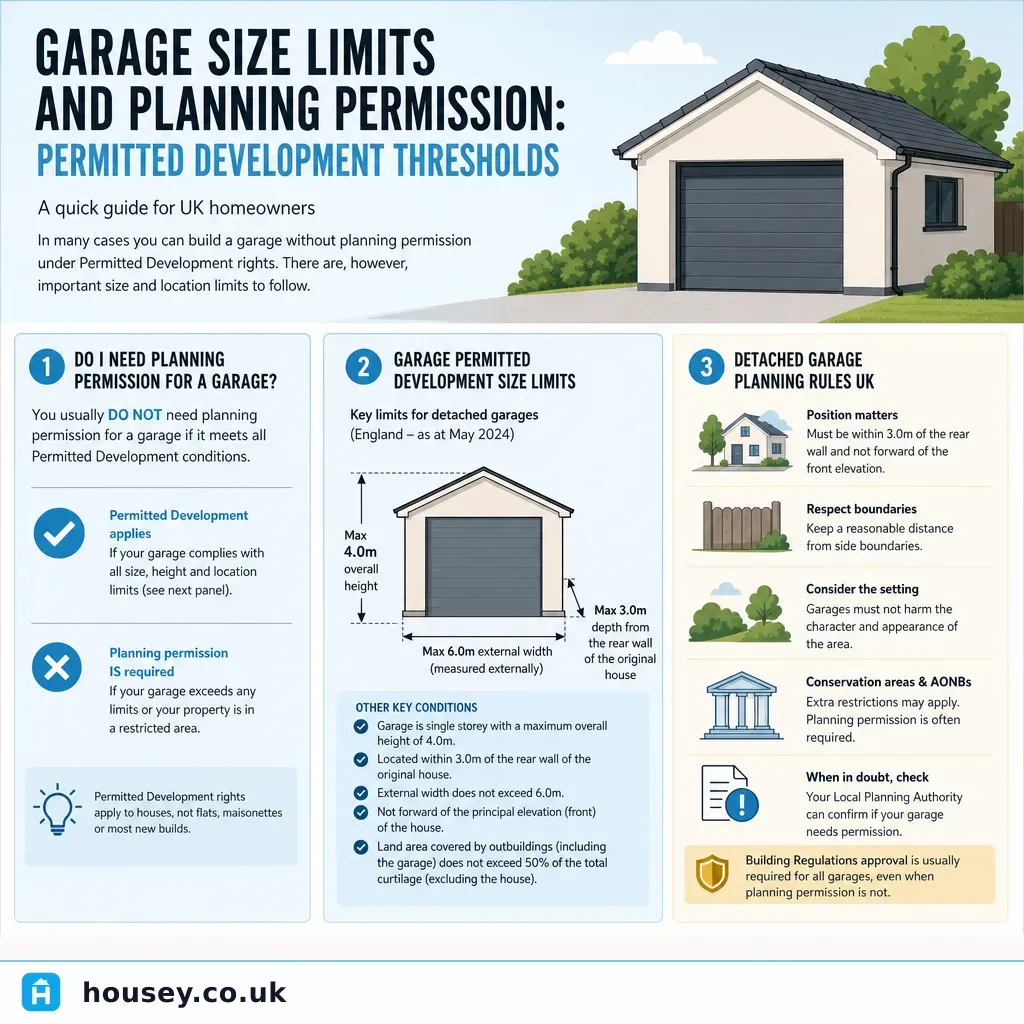
Garage Size Limits and Planning Permission: Permitted Development Thresholds
A detached garage is usually permitted development under Class E of the GPDO 2015 if it covers less than 50% of the curtilage and meets height limits.
 Planning & Pre-Build
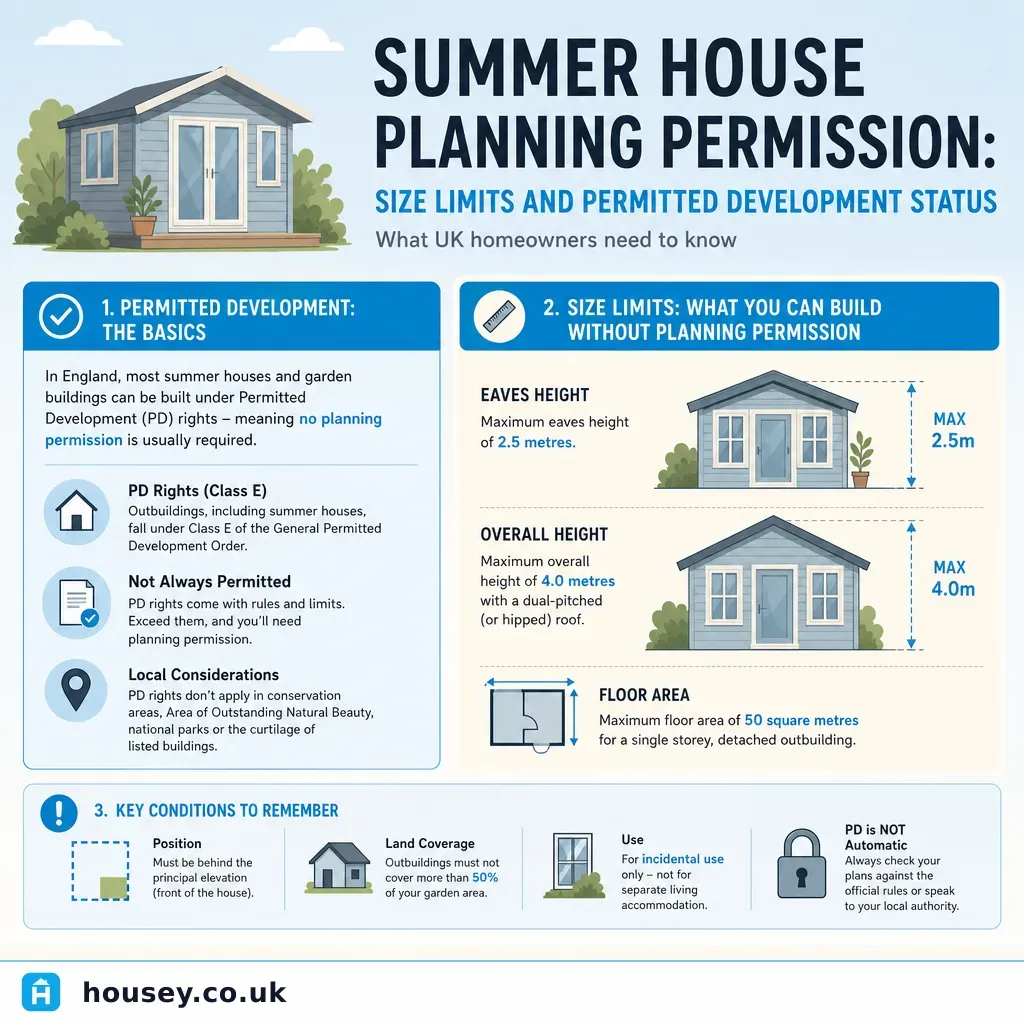
Summer House Planning Permission: Size Limits and Permitted Development Status
Most summer houses in England are permitted development if they are single-storey, sit behind the principal elevation, stay within height limits (2.
 Planning & Pre-Build
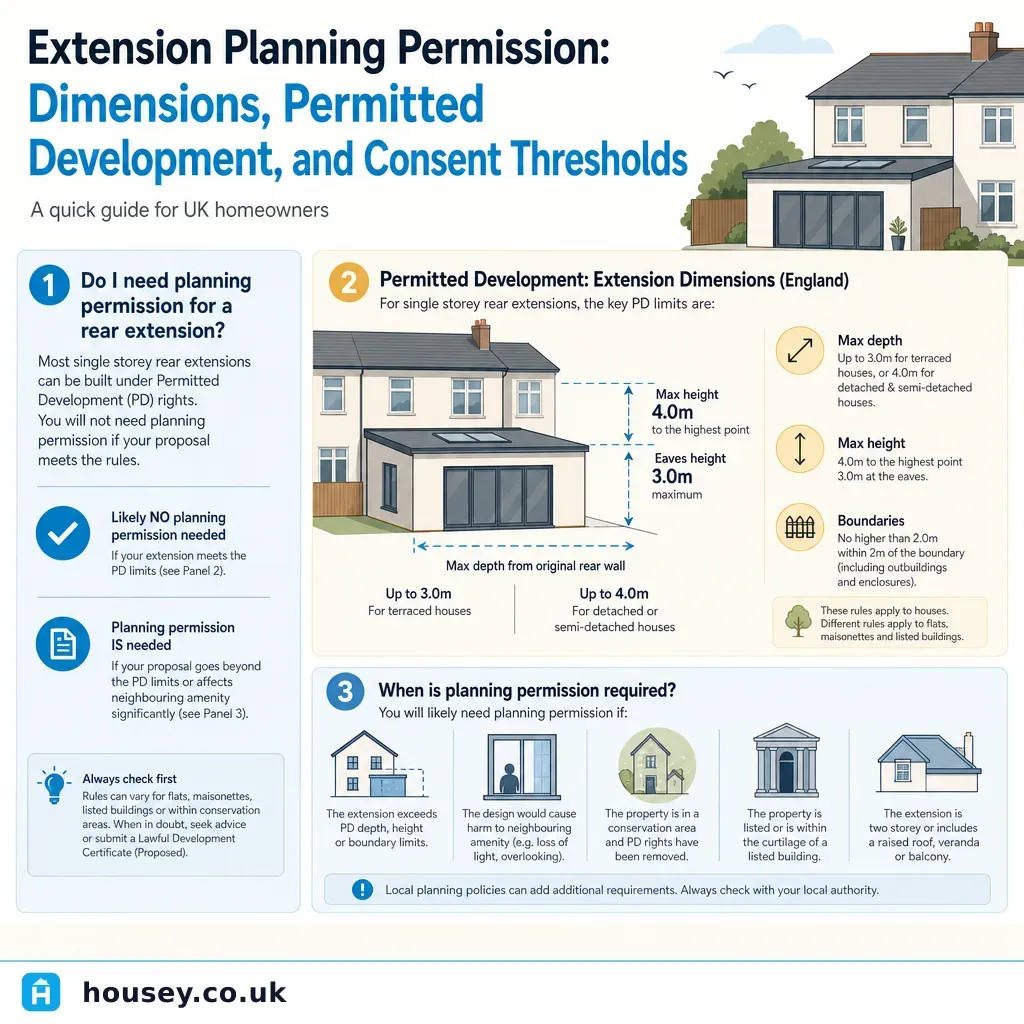
Extension Planning Permission: Dimensions, Permitted Development, and Consent Thresholds
Single-storey rear extensions up to 4m (detached) or 3m (other houses) are usually permitted development in England without planning permission.
 Planning & Pre-Build
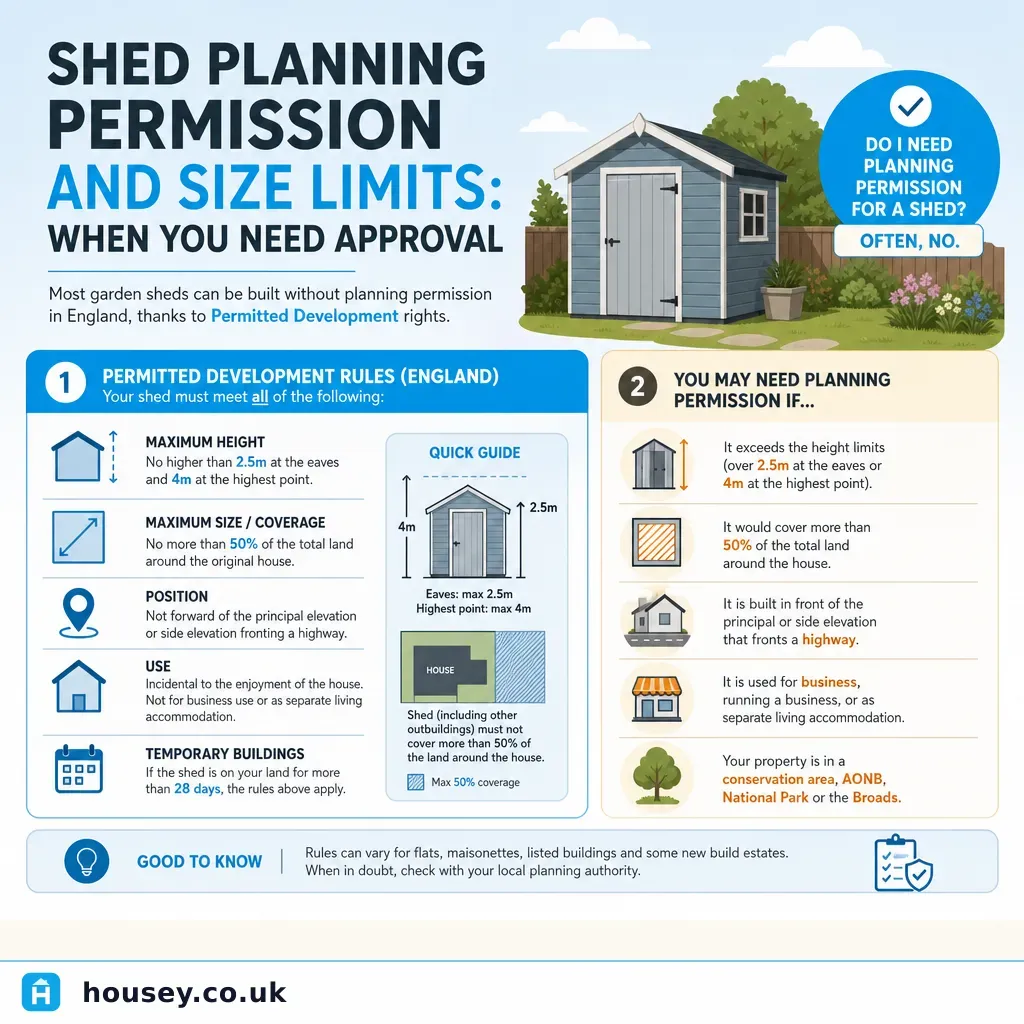
Shed Planning Permission and Size Limits: When You Need Approval
Most garden sheds in England fall under Class E permitted development rights and do not need planning permission, provided they are single-storey, behind the principal elevation, within height limits for their boundary distance, and combined outbuilding coverage does not exceed 50% of the original curtilage.
 Planning & Pre-Build
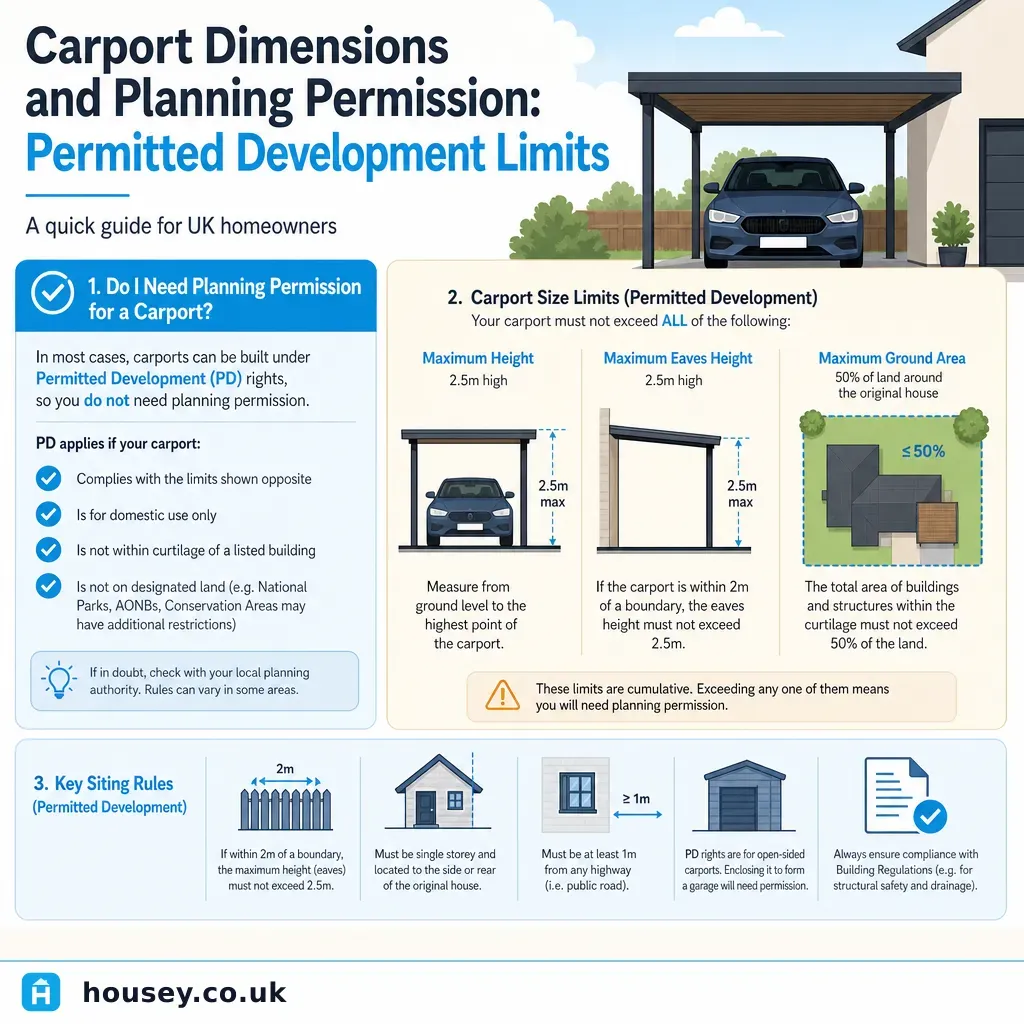
Carport Dimensions and Planning Permission: Permitted Development Limits
A carport may be built under permitted development (Class E, GPDO 2015) if it stays within 50% of the curtilage, does not exceed 2.