Garage Size Limits and Planning Permission: Permitted Development Thresholds
By Housey · Last reviewed 5th of May 2026
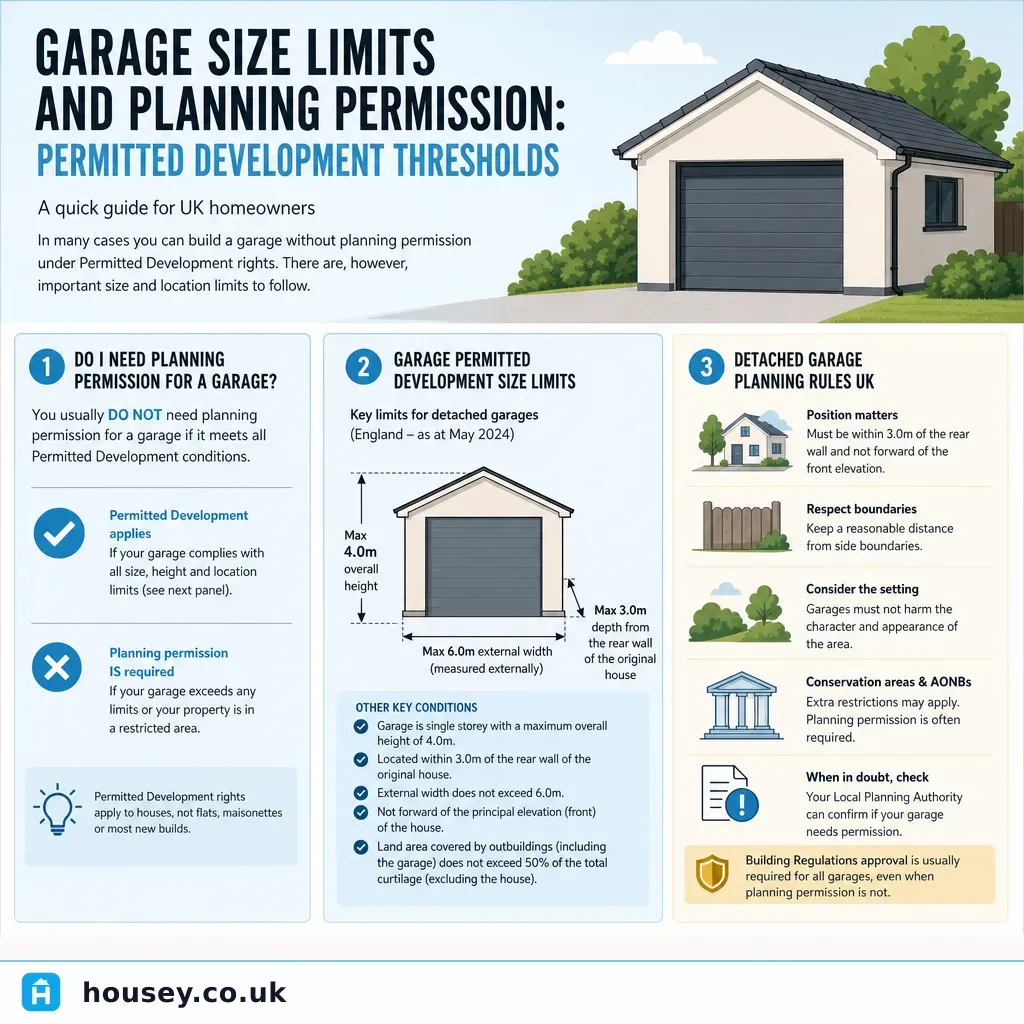
Garage Size Limits and Planning Permission: Permitted Development Thresholds
Whether you are planning a new detached garage or a garage attached to the side of your home, the planning rules differ significantly depending on how the structure relates to the house. Assuming all garages follow the same rules is one of the most common planning mistakes homeowners make — detached and attached garages are governed by separate permitted development classes under the Town and Country Planning (General Permitted Development) (England) Order 2015 (the GPDO), with very different size thresholds.
Key points
- Detached garages are treated as outbuildings under Class E of the GPDO 2015; the combined footprint of all outbuildings and extensions must not exceed 50% of the original curtilage.
- Attached and side garages are treated as home extensions under Class A of the GPDO 2015 and must comply with extension size limits, not outbuilding limits.
- A side-attached garage must not exceed half the width of the original house and must remain within the original roof height.
- Under the neighbour consultation scheme, a rear-attached single-storey garage may extend up to 8m depth (detached house) or 6m depth (semi-detached or terraced) with prior approval from the LPA.
- Permitted development rights do not apply to flats, maisonettes, or listed buildings; additional restrictions apply on designated land including conservation areas, AONBs, and National Parks.
Detached versus attached garages: different planning rules apply
The first question to settle is whether the proposed garage will be free-standing or attached to the house. This determines which permitted development class — and which size limits — govern the project.
Garage type | Applicable GPDO class | Key size limit |
|---|---|---|
Free-standing detached garage | Class E (outbuildings) | Eaves max 2.5m; total max 4m dual-pitch or 3m other; max 50% of curtilage |
Attached to rear of house | Class A (rear extension) | Max 4m depth standard PD; up to 8m or 6m under consultation scheme |
Attached to side of house | Class A (side extension) | Max width = 50% of original house width; max 4m height |
Integral within existing envelope | Usually not development | Internal alterations to an existing integral garage typically require no planning permission |
Permitted development size limits for detached garages
Under Class E of the GPDO 2015, a free-standing garage may be permitted development in England provided:
- It is not forward of the principal elevation of the house.
- The eaves height does not exceed 2.5m.
- The overall height does not exceed 4m (dual-pitch roof) or 3m (any other roof type).
- If within 2m of any boundary, the total height does not exceed 2.5m.
- The combined footprint of all outbuildings and extensions does not exceed 50% of the original curtilage.
- It is not intended for use as a separate dwelling.
- The property is not a flat, maisonette, or listed building.
On designated land, outbuildings to the side of the house are not permitted development regardless of size.
Permitted development limits for attached and side garages
An attached garage — one that shares a wall with the house — is treated as a home extension under Class A of the GPDO. The applicable limits depend on position.
Rear-attached single-storey garage:
- Standard permitted development: up to 4m depth (detached house) or 3m depth (semi-detached or terraced). Maximum 4m height.
- Neighbour consultation scheme (prior approval required): up to 8m depth (detached) or 6m (semi-detached or terraced). Neighbours are notified and the LPA considers objections within 42 days.
Side-attached single-storey garage:
- Must not exceed half the width of the original house.
- Maximum 4m height.
- On designated land: side extensions are not permitted development.
Decision tree: which planning rules apply to your garage?
- Is the garage free-standing? Yes: apply Class E (outbuildings) limits. No: continue.
- Will the garage be attached to the rear? Yes: apply Class A rear extension limits (4m standard; up to 8m or 6m under consultation scheme). No: continue.
- Will the garage be attached to the side? Yes: apply Class A side extension limits (max 50% of original house width). Check designated land status.
- Is the property a flat, maisonette, or listed building? Yes: planning permission required regardless of size.
- Is there an Article 4 Direction in your area? Yes: planning permission required. Confirm with your LPA.
When full planning permission is needed for a garage
A planning application will be required if:
- The garage is forward of the principal elevation.
- A detached garage pushes the combined outbuilding and extension footprint beyond 50% of the curtilage.
- Height thresholds are exceeded.
- A side-attached garage exceeds half the width of the original house.
- The property is listed, a flat, or a maisonette.
- The property is in a conservation area and the garage is to the side.
- A local Article 4 Direction removes permitted development rights.
- The garage will be used for a habitable room, office, or any purpose beyond vehicle storage.
Building regulations for garages
Planning permission and building regulations approval are separate. A detached garage that qualifies as permitted development may still require building regulations approval if it exceeds 30m² in floor area, is attached to or shares a wall with the house, or is within 1m of a boundary and not built from non-combustible materials.
A detached garage of up to 30m² that is at least 1m from any boundary — or built from non-combustible materials — is generally exempt under Class 6, Schedule 2 of the Building Regulations 2010.
If a future conversion to living space is possible, speak to a building control consultant at the design stage. The conversion itself will almost certainly require building regulations approval to meet current thermal, fire-safety, and ventilation standards.
Important limitations
This article provides general information about permitted development rules in England as of 2026. Rules differ in Scotland, Wales, and Northern Ireland. Local Article 4 Directions, conditions attached to previous planning permissions, and the precise planning history of a property can all alter what is and is not permitted development. This guide is not a substitute for professional planning advice or a formal pre-application enquiry with your local planning authority.
What to ask a qualified professional
Before instructing a planning consultant or submitting a planning application:
- Does my property have any Article 4 Directions restricting permitted development rights?
- Do conditions on previous planning permissions limit extensions or outbuildings on this site?
- Will the garage require building regulations approval, and to what standard?
- If using the neighbour consultation scheme, what is the prior approval process and typical LPA timescale?
- Will a side garage require notification under the Party Wall etc. Act 1996?
- Is a Lawful Development Certificate advisable before I start work?
When to get professional help
Seek advice from a qualified planning consultancy professional if the property is listed, in a conservation area, AONB, or National Park; if you are unsure whether prior extensions have consumed the permitted development allowance; if a side garage is close to the 50% width limit; or if you want a Lawful Development Certificate before committing to the build. A Lawful Development Certificate from your LPA confirms in writing that the garage is permitted development and protects you on resale.
How Housey can help
If your garage project sits near the edge of permitted development thresholds — or you want certainty before committing to a build — Housey can connect you with experienced planning consultancy professionals who can assess your situation and manage any required prior approval or planning application. For building regulations questions, building control consultants can advise from the design stage.
Frequently asked questions
How large can a detached garage be without planning permission?
There is no single fixed maximum footprint. The limit is 50% of the original curtilage, combined across all existing outbuildings and extensions. A larger plot allows a larger garage, but the eaves height (maximum 2.5m) and overall height (maximum 4m for a dual-pitch roof, 3m for other roof types) always apply regardless of plot size.
Does a side garage always need planning permission?
Not always. A side-attached garage may be permitted development if it does not exceed half the width of the original house and meets the applicable height limits. However, on designated land — including conservation areas, AONBs, and National Parks — side extensions are not permitted development and a full planning application will be required.
Do I need building regulations approval for a garage as well as planning permission?
Yes, these are separate requirements. Planning permission governs whether a structure can be built; building regulations govern how it must be built. A garage may need building regulations approval even where it is permitted development — for example, if it exceeds 30m², is attached to the house, or is within 1m of a boundary and not constructed from non-combustible materials.
Can I convert my permitted development garage into a habitable room later?
Yes, but a conversion will almost always require building regulations approval. The structure must meet current insulation, ventilation, fire-safety, and structural standards at the time of conversion. If the property is in a conservation area or is listed, planning permission for the change of use may also be needed. Check with your LPA and a building control body before starting.
What is the neighbour consultation scheme for a larger rear garage?
Under Class A of the GPDO, a single-storey rear-attached garage can exceed standard depth limits — up to 8m for detached houses or 6m for semi-detached and terraced — if the homeowner notifies the LPA and neighbours are given 42 days to comment. The LPA then decides whether the impact is acceptable. Formal prior approval must be granted before work begins.
Sources and further reading
- Permitted development rights for householders: technical guidance — GOV.UK
- Extensions — Planning Portal
- Outbuildings and garages — Planning Portal
- Town and Country Planning (General Permitted Development) (England) Order 2015 — legislation.gov.uk
- Building Regulations 2010 — legislation.gov.uk
Useful next reads
 Planning & Pre-Build
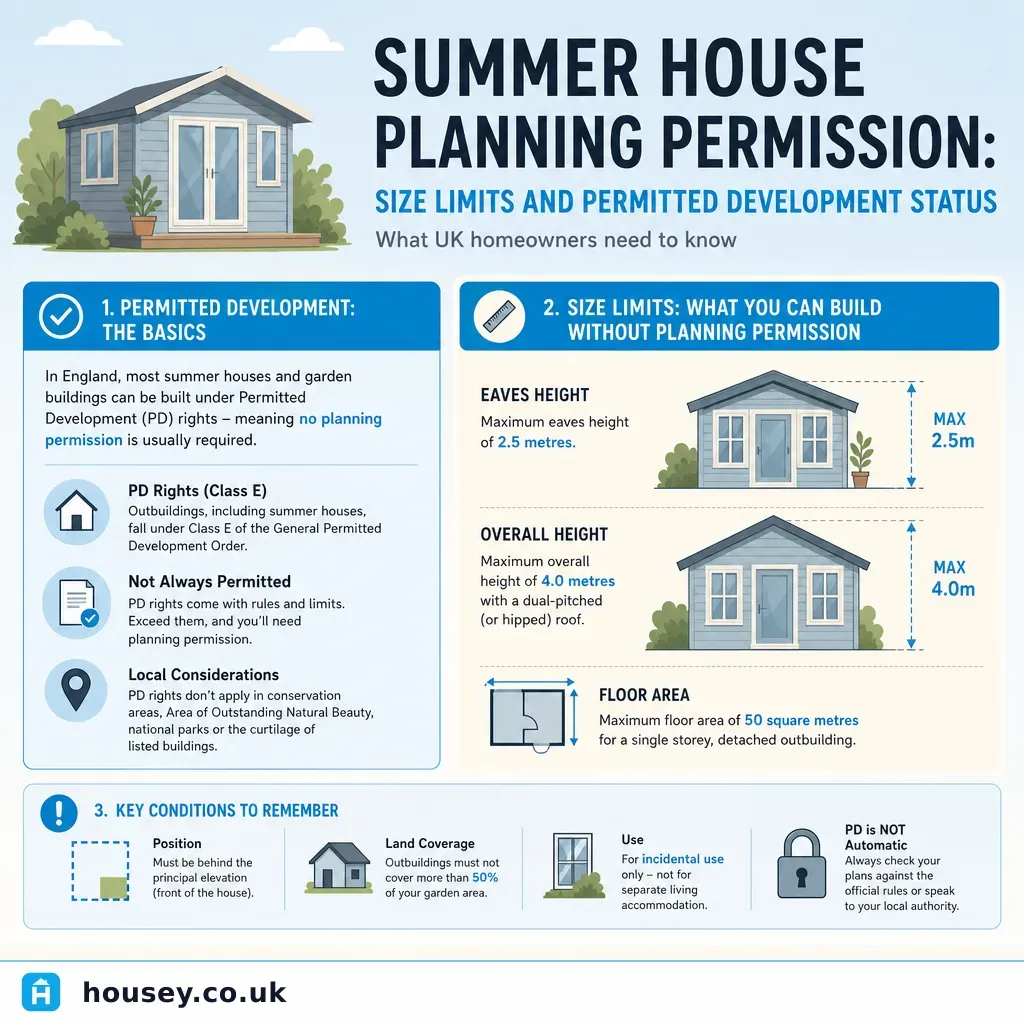
Summer House Planning Permission: Size Limits and Permitted Development Status
Most summer houses in England are permitted development if they are single-storey, sit behind the principal elevation, stay within height limits (2.
 Planning & Pre-Build
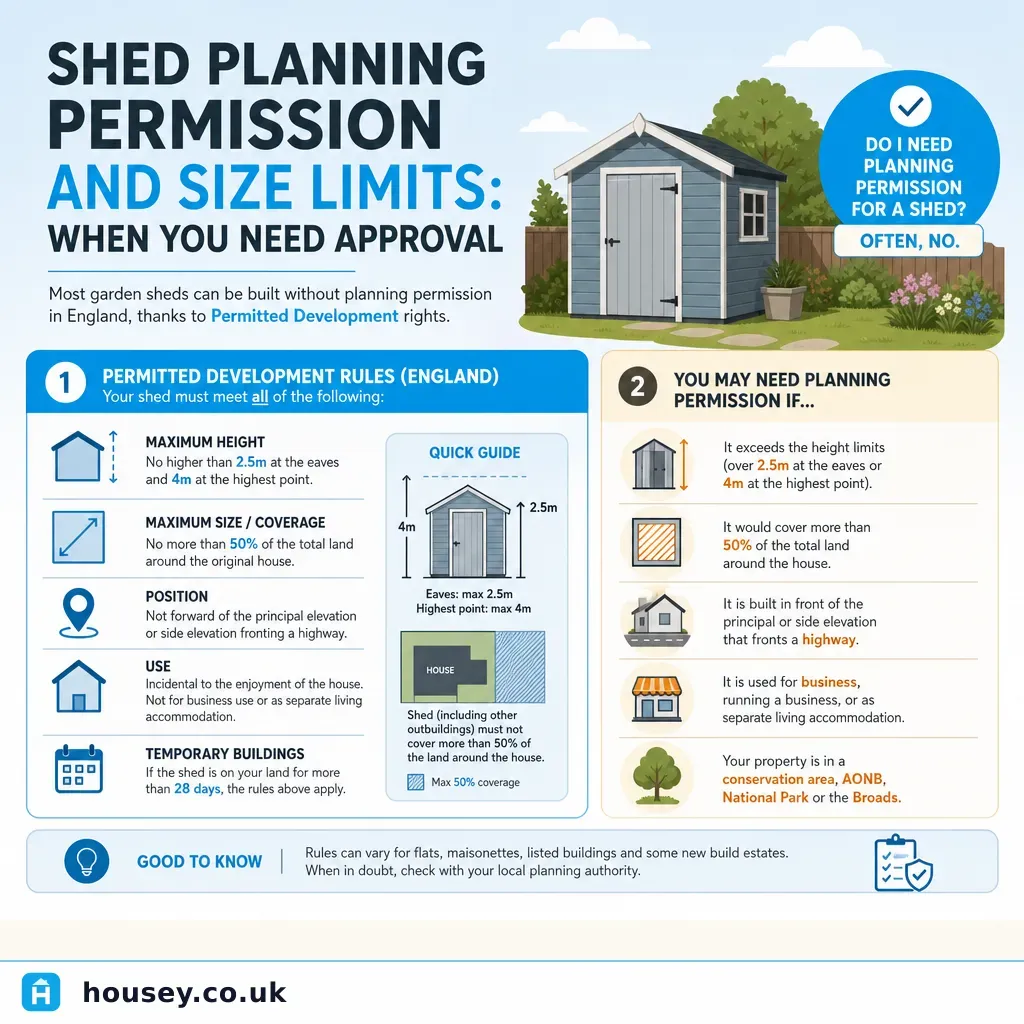
Shed Planning Permission and Size Limits: When You Need Approval
Most garden sheds in England fall under Class E permitted development rights and do not need planning permission, provided they are single-storey, behind the principal elevation, within height limits for their boundary distance, and combined outbuilding coverage does not exceed 50% of the original curtilage.
 Planning & Pre-Build
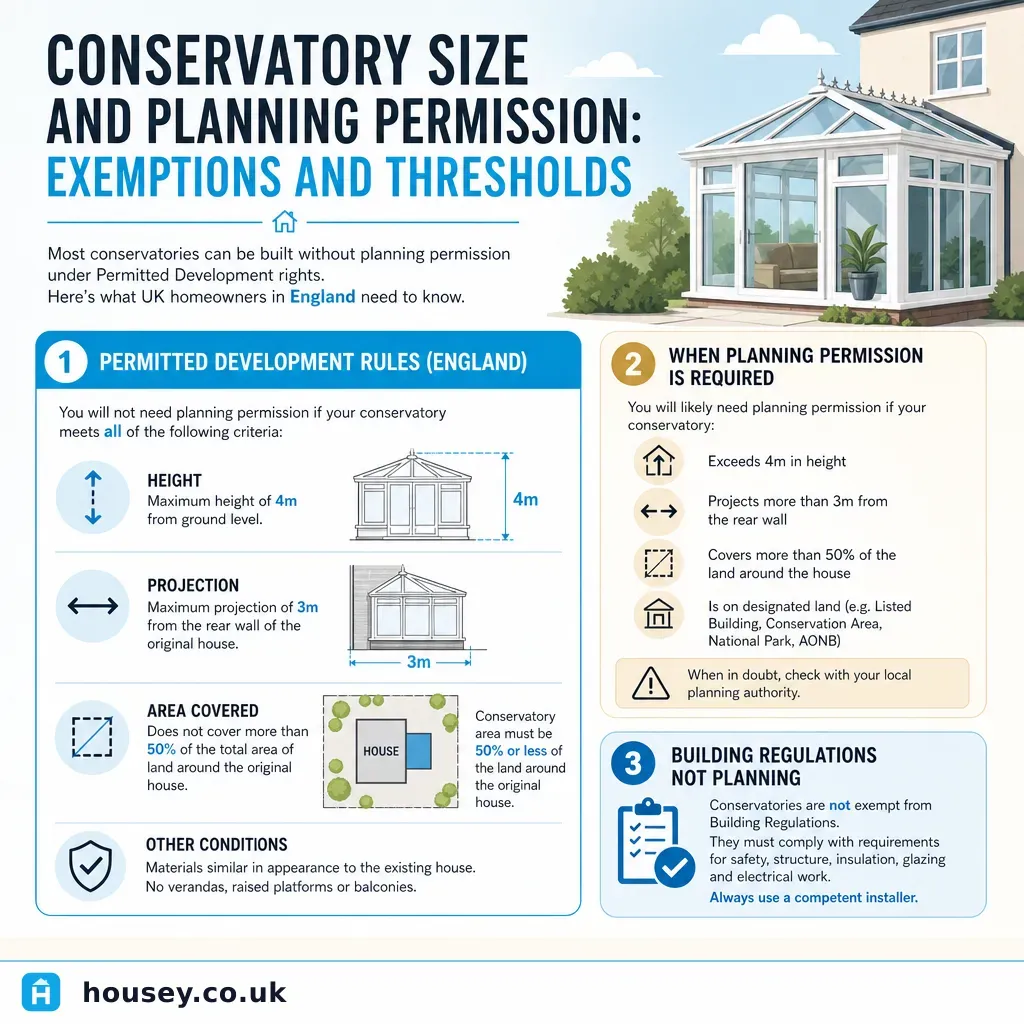
Conservatory Size and Planning Permission: Exemptions and Thresholds
In England, a rear conservatory is usually permitted development if it extends no more than 3 metres (semi-detached or terraced) or 4 metres (detached) beyond the original rear wall.
 Planning & Pre-Build
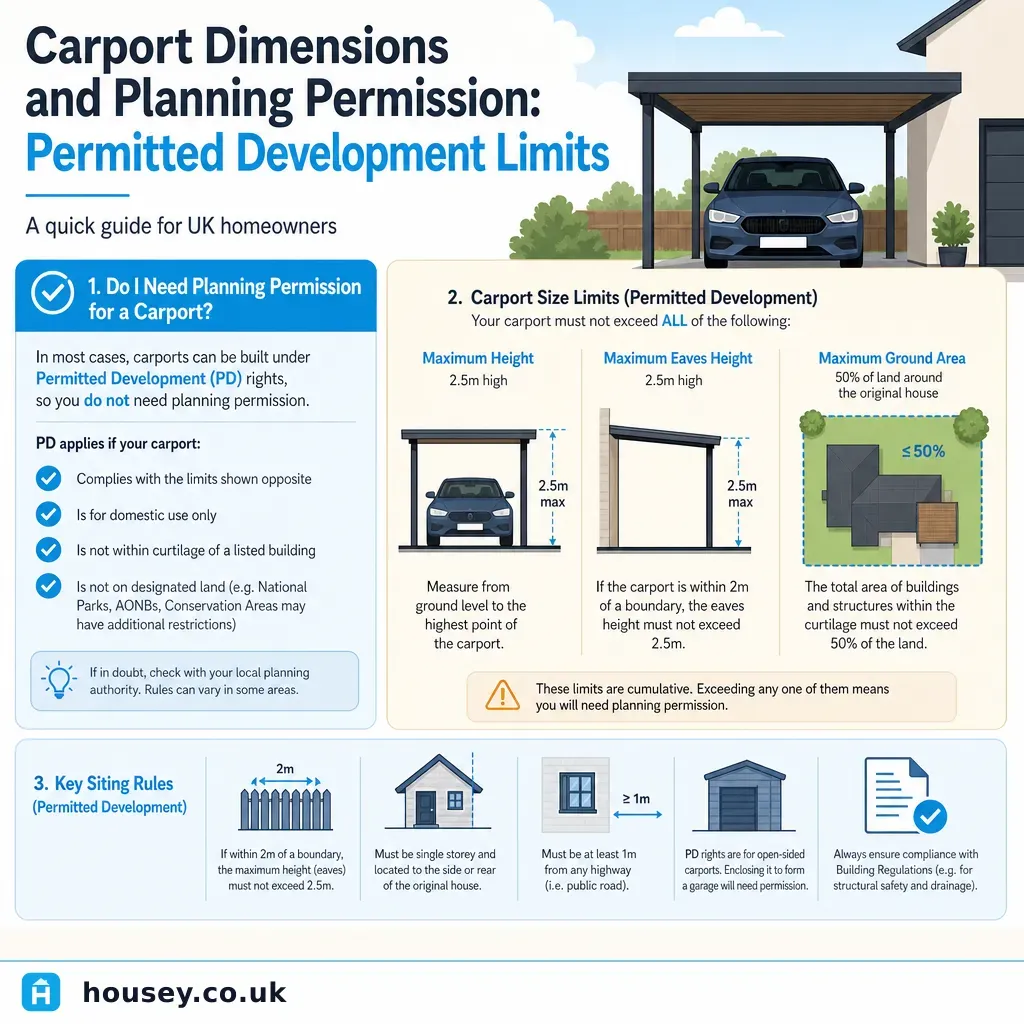
Carport Dimensions and Planning Permission: Permitted Development Limits
A carport may be built under permitted development (Class E, GPDO 2015) if it stays within 50% of the curtilage, does not exceed 2.
 Planning & Pre-Build
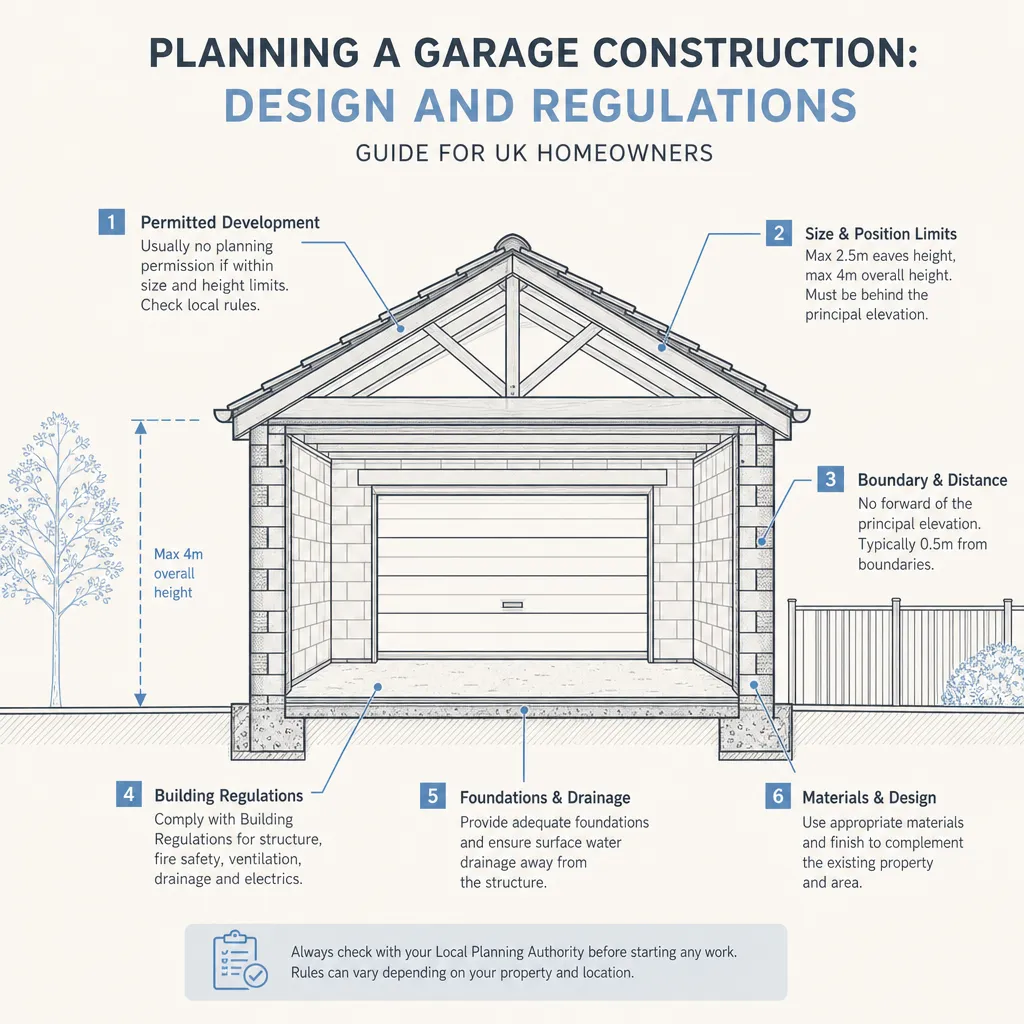
Planning A Garage Construction: Design And Regulations
Most detached single-storey garages in England qualify for permitted development, meaning no planning permission is required, provided they meet height, size, and siting rules.