Carport Dimensions and Planning Permission: Permitted Development Limits
By Housey · Last reviewed 5th of May 2026
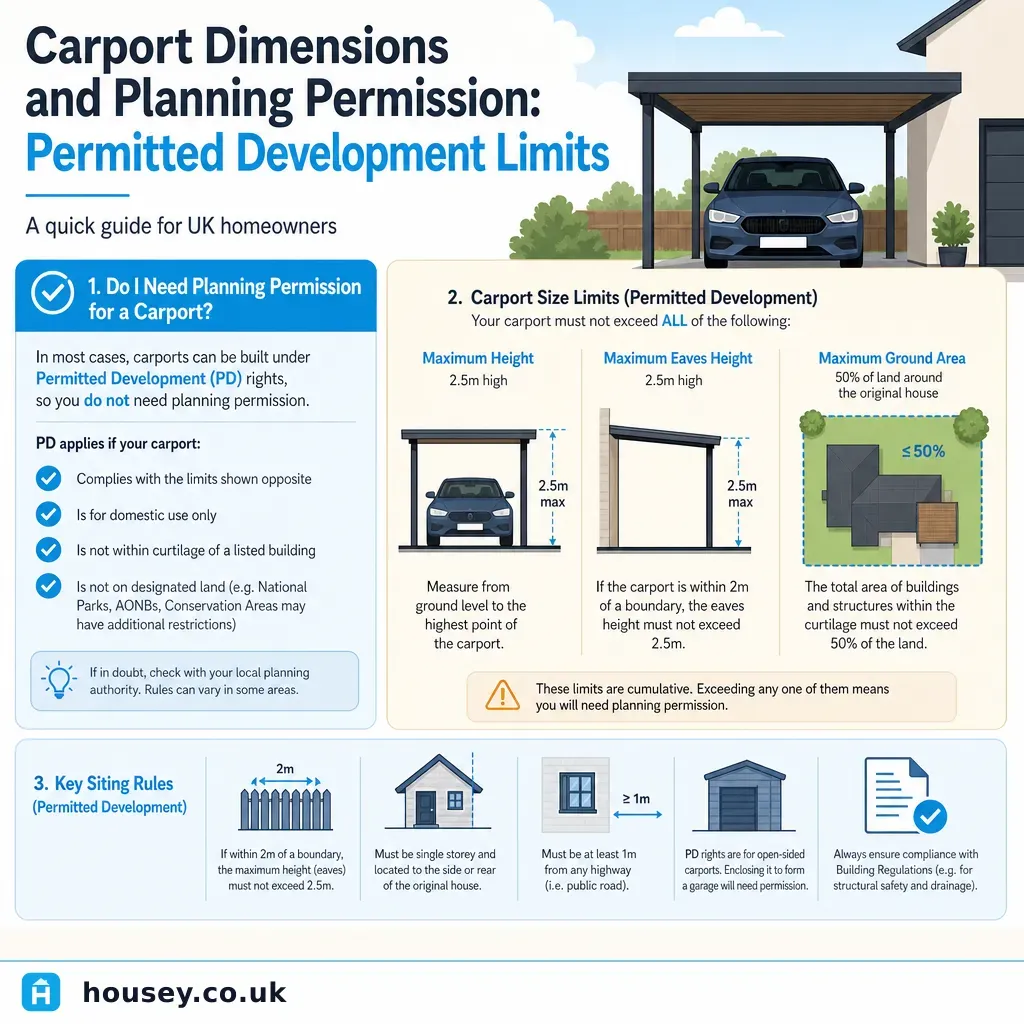
Carport Dimensions and Planning Permission: Permitted Development Limits
For many homeowners, the question of whether a carport needs planning permission arises only after a builder has been instructed or a quote accepted. In England, most carports fall under the Town and Country Planning (General Permitted Development) (England) Order 2015 (the GPDO), but whether a specific carport is permitted development depends on its size, position, and the type of land the property sits on. Getting this wrong can lead to an enforcement notice requiring demolition.
Key points
- Under Class E, Schedule 2, Part 1 of the GPDO 2015, free-standing carports are treated as outbuildings and may be built without a planning application if specific conditions are met.
- The combined footprint of all outbuildings and extensions must not exceed 50% of the curtilage, measured excluding the original house footprint.
- Maximum eaves height is 2.5m; maximum overall height is 4m for a dual-pitch roof or 3m for any other roof type.
- A carport within 2m of any boundary must not exceed 2.5m in total height.
- On designated land — conservation areas, AONBs, National Parks, World Heritage Sites — outbuildings to the side of a dwellinghouse are not permitted development.
What counts as a carport for planning purposes
A free-standing carport is treated as an outbuilding for planning purposes, regardless of whether it has walls on all sides. If the carport is structurally attached to the house, Class A (home extension) rules may apply instead, with different size thresholds.
A carport is not automatically exempt simply because it is open-sided. The relevant question is whether the structure constitutes "development" under the Town and Country Planning Act 1990. Most carports of typical residential scale meet the definition of a building for planning purposes, so the permitted development conditions in Class E will apply.
Permitted development size limits for carports
Under Class E of the GPDO 2015, a carport in the curtilage of a dwellinghouse in England may be permitted development if all of the following are met:
Condition | Limit |
|---|---|
Position | Not forward of the principal elevation; not to the side on designated land |
Maximum eaves height | 2.5m |
Maximum overall height — dual-pitch roof | 4m |
Maximum overall height — any other roof | 3m |
Height if within 2m of a boundary | 2.5m total height |
Combined outbuilding and extension coverage | No more than 50% of the curtilage (excluding original house footprint) |
Use | Must not be used as a separate dwelling |
The 50% curtilage rule is cumulative — it covers all outbuildings, sheds, and extensions already on the site. If a large extension already exists, the remaining permitted development footprint may be smaller than expected.
When a carport requires full planning permission
Full planning permission will be required if:
- The carport would be forward of the principal elevation.
- It would be to the side of the house on designated land.
- The combined outbuilding and extension footprint would exceed 50% of the curtilage.
- Height limits are exceeded.
- The property is a flat, maisonette, or listed building — no Class E rights apply.
- The carport is intended for use as a separate dwelling, office, or commercial space.
- A local Article 4 Direction has removed permitted development rights.
Decision tree: do you need planning permission for your carport?
- Is the carport forward of the principal elevation? Yes: planning permission required. No: continue.
- Is the property a flat, maisonette, or listed building? Yes: planning permission required. No: continue.
- Is the property on designated land and is the carport to the side? Yes: planning permission required. No: continue.
- Will combined outbuilding and extension coverage exceed 50% of the curtilage? Yes: planning permission required. No: continue.
- Will any height limit be exceeded? Yes: planning permission required. No: likely permitted development — confirm with your LPA or apply for a Lawful Development Certificate.
Building regulations and carports
Planning permission and building regulations are separate. Under Class 6, Schedule 2 of the Building Regulations 2010, a detached carport is generally exempt if it is no more than 30m² in floor area and is at least 1m from any boundary or constructed from non-combustible materials.
If you plan to enclose the carport later, building regulations approval will almost certainly be required at that stage, covering thermal performance, structure, and fire safety. Speak to a building control consultant at the design stage if a future conversion is possible.
Rules for Scotland, Wales, and Northern Ireland
The GPDO 2015 applies in England only. Scotland, Wales, and Northern Ireland operate separate permitted development orders with different thresholds and designated-land rules. Check with the relevant national planning authority or a local planning consultancy professional if your property is outside England.
Important limitations
This article provides general information about permitted development rules in England as of 2026. Rules can vary based on a property's planning history, conditions attached to previous permissions, local Article 4 Directions, and precise positioning. This is not a substitute for professional planning advice or a pre-application enquiry with your local planning authority.
What to ask a qualified professional
Before instructing a planning consultant or submitting a pre-application enquiry:
- Does my property have any Article 4 Directions that restrict permitted development rights?
- Have previous planning permissions attached conditions that limit outbuildings on this site?
- Will the carport require building regulations approval, and to what specification?
- Does proximity to the boundary raise any Party Wall etc. Act 1996 obligations?
- Is a Lawful Development Certificate advisable before work starts?
When to get professional help
Seek advice from a qualified planning consultancy professional if the property is listed, in a conservation area, AONB, or National Park; if you are unsure whether existing structures have used up the permitted development allowance; or if you want formal written confirmation of lawfulness before spending money on the build. A Lawful Development Certificate from your LPA provides that confirmation and protects you on resale.
How Housey can help
If your carport falls outside straightforward permitted development — or you want certainty before starting — Housey can connect you with experienced planning consultancy professionals who can assess your situation and manage any required application. For building regulations questions, building control consultants can advise from the design stage.
Frequently asked questions
Does a carport need planning permission if it is attached to the house?
An attached carport is likely treated as a home extension under Class A of the GPDO 2015 rather than an outbuilding under Class E. Different size limits apply, including restrictions on side extensions, which must not exceed half the width of the original dwelling. Use the Planning Portal's interactive house guide to identify which class governs your project.
Can I build a carport at the front of my house?
A carport positioned forward of the principal elevation is not permitted development in England and will require a full planning application. The restriction applies even if only part of the carport projects forward of the front wall. Check the precise position against the principal elevation before starting any work.
Does a carport in a conservation area need planning permission?
In a conservation area, outbuildings to the side of the house are not permitted development. A carport at the rear may still qualify provided all other conditions — height, coverage, and eaves limits — are met. If any doubt exists, seek pre-application advice from your local planning authority or a qualified planning consultant.
Do I need building regulations approval for a carport?
A detached carport under 30m² is generally exempt from building regulations if it is at least 1m from any boundary or is built from non-combustible materials. Attached carports, or any carport that may later be enclosed, are more likely to require approval. Confirm the position with a building control body before starting work.
Sources and further reading
- Permitted development rights for householders: technical guidance — GOV.UK
- Outbuildings — Planning Portal
- Town and Country Planning (General Permitted Development) (England) Order 2015 — legislation.gov.uk
- Building Regulations 2010, Schedule 2 — legislation.gov.uk
Useful next reads
 Planning & Pre-Build
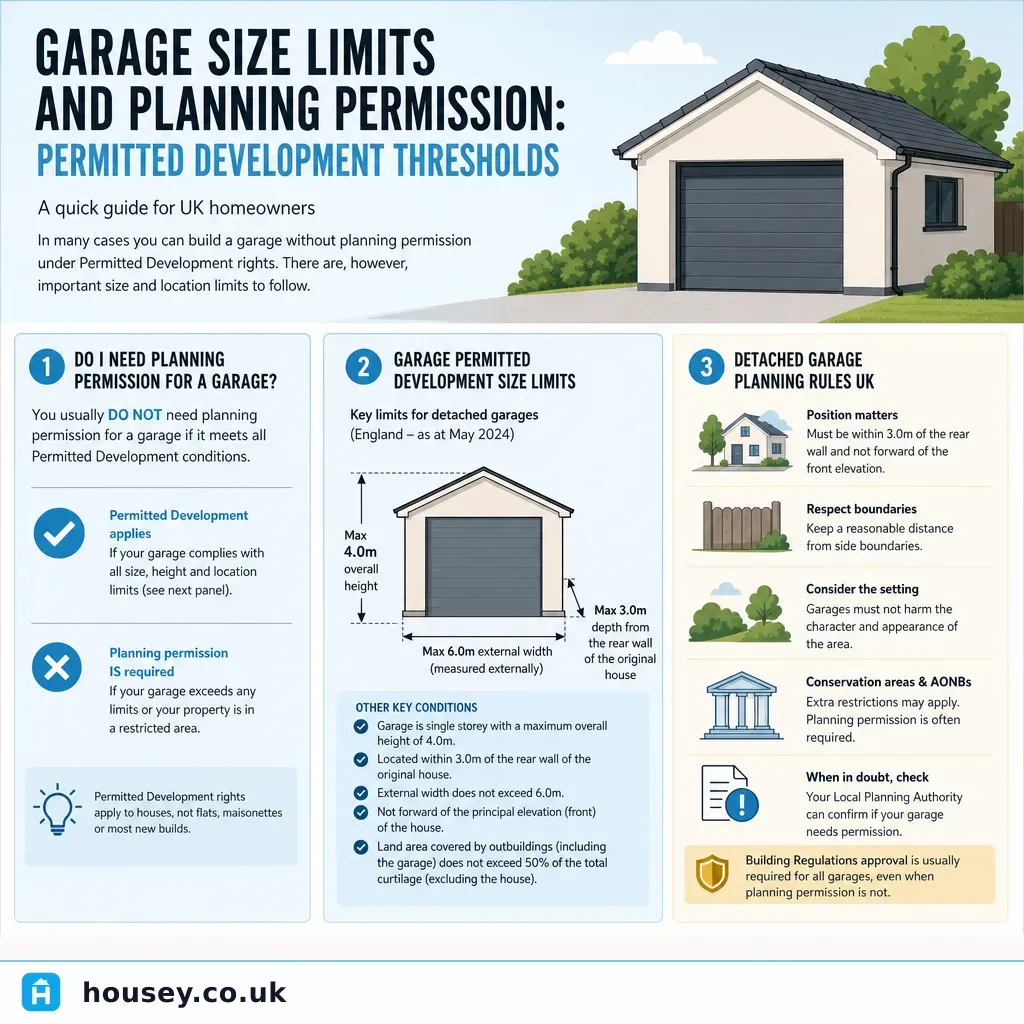
Garage Size Limits and Planning Permission: Permitted Development Thresholds
A detached garage is usually permitted development under Class E of the GPDO 2015 if it covers less than 50% of the curtilage and meets height limits.
 Planning & Pre-Build
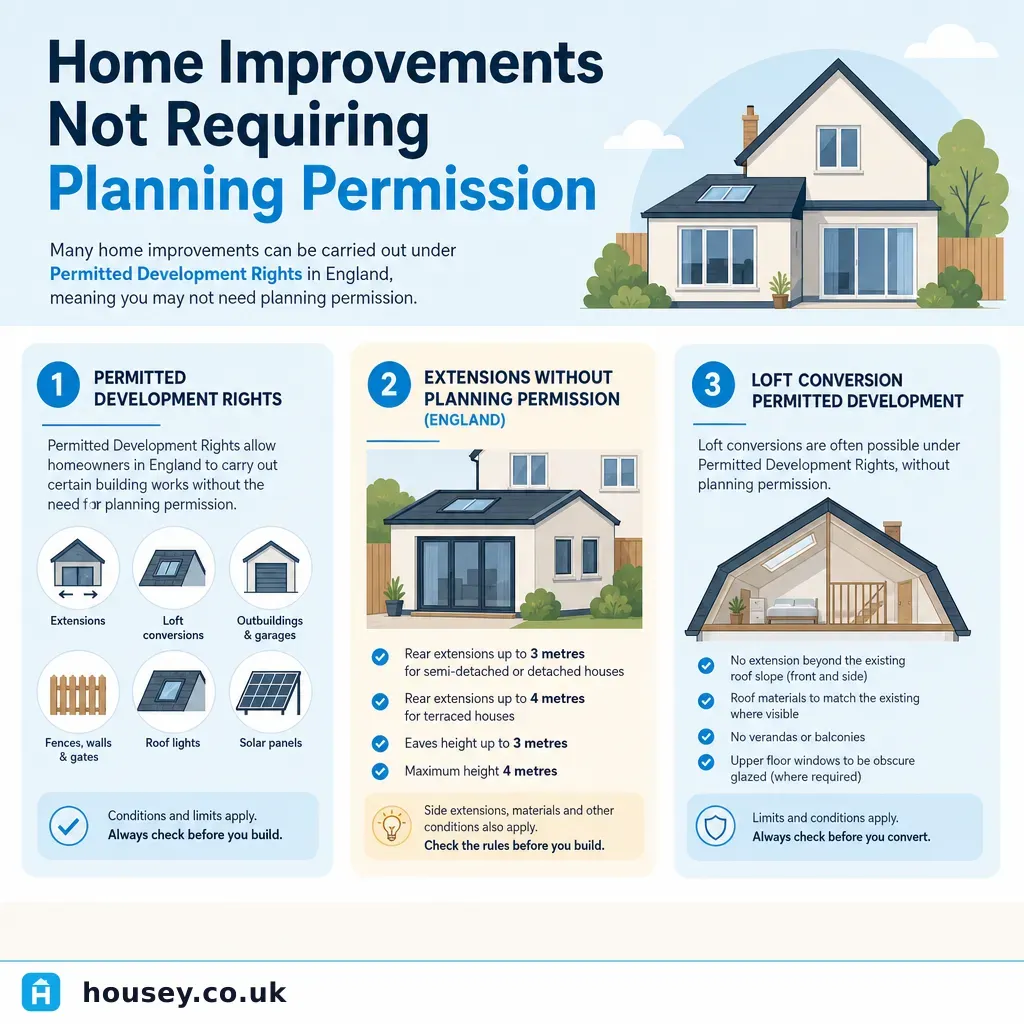
Home Improvements Not Requiring Planning Permission
Many common home improvements in England fall under Permitted Development Rights and do not require a planning application.
 Planning & Pre-Build
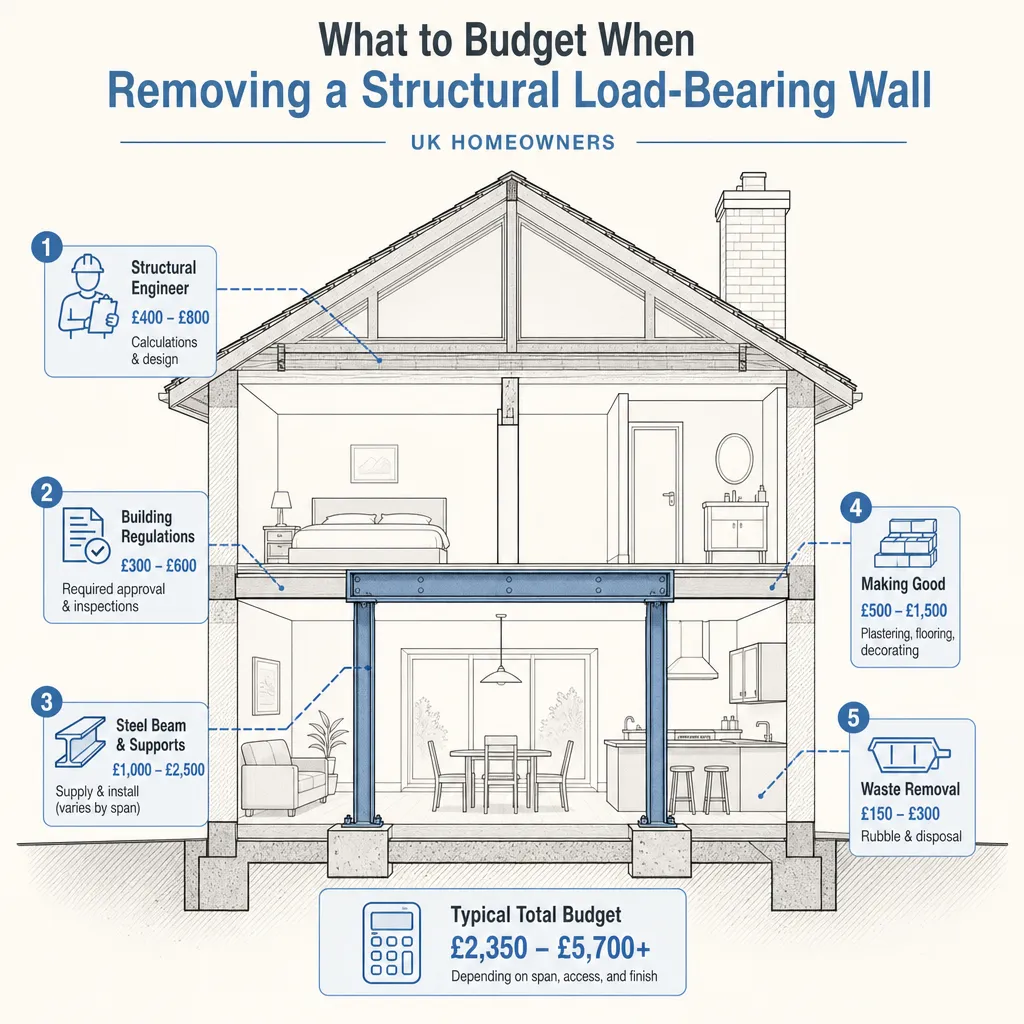
What to Budget When Removing a Structural Load-Bearing Wall
Removing a load-bearing wall in a typical UK home costs £2,500–£8,000 or more in total, covering a structural engineer's calculations, Building Regulations approval, the steel beam, builder's labour, and replastering.
 Planning & Pre-Build
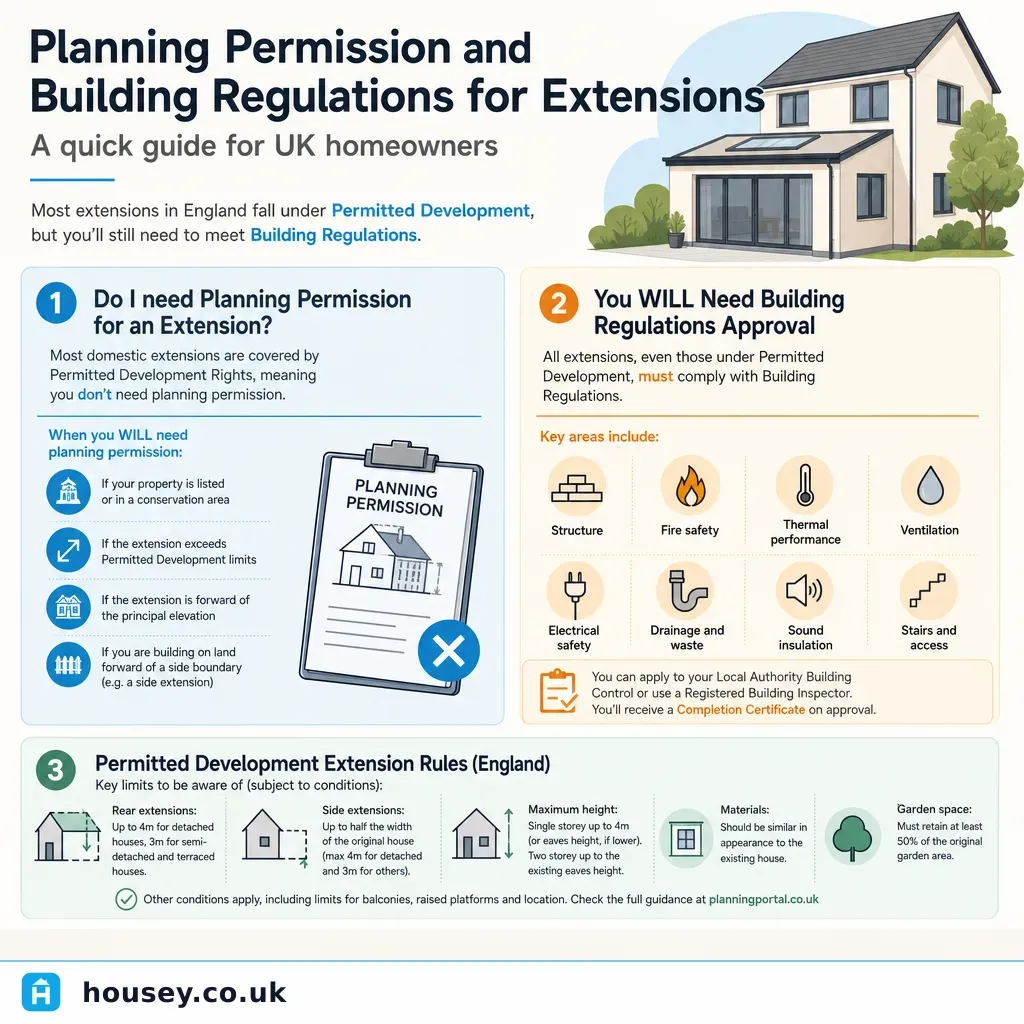
Planning Permission and Building Regulations for Extensions
UK home extensions usually require both planning permission and Building Regulations approval, though most smaller rear extensions qualify as Permitted Development under the GPDO 2015 and need no planning application.
 Planning & Pre-Build
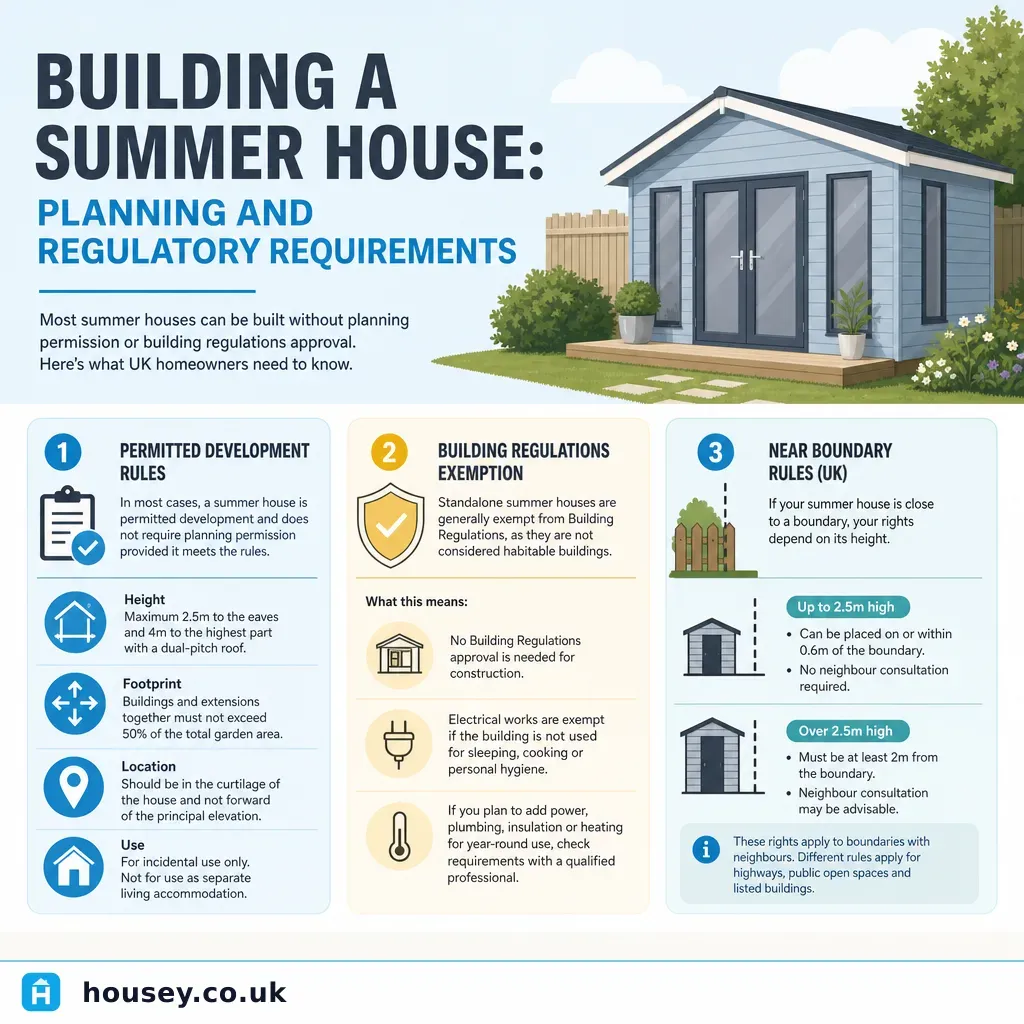
Building a Summer House: Planning and Regulatory Requirements
Most garden summer houses in England fall under Class E permitted development and need no planning permission, provided they are single-storey, within height limits, and not used for sleeping.