Converting Historic Buildings: Planning and Professional Support
By Housey · Last reviewed 19th of May 2026
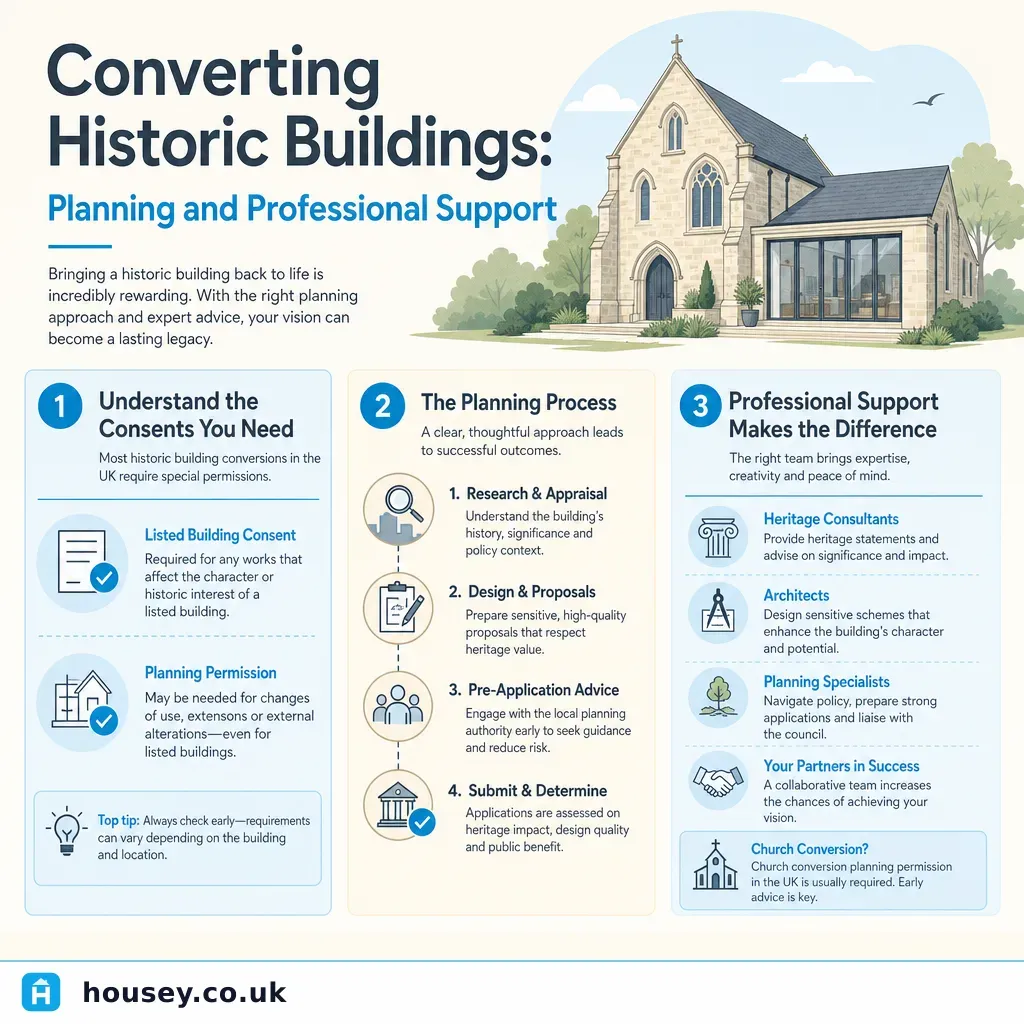
Converting Historic Buildings: Planning and Professional Support
Few renovation projects carry as much regulatory complexity — or creative reward — as converting a historic building for residential or commercial use. Former churches, mills, barns, and institutional buildings attract buyers who want character and space that new development cannot replicate, but the planning and consent framework governing listed structures and conservation areas is demanding and sometimes unforgiving. Unauthorised works on a listed building are a criminal offence under the Planning (Listed Buildings and Conservation Areas) Act 1990, and that legal exposure begins the moment work starts without consent.
Key points
- Listed Building Consent (LBC) must be obtained from the local planning authority (LPA) before carrying out any works that affect the character of a listed building — internally or externally.
- Buildings in England are listed at Grade I (exceptional interest), Grade II* (particularly important), or Grade II (nationally important); equivalent designation systems operate in Scotland, Wales, and Northern Ireland.
- Planning permission and Listed Building Consent are two separate applications — you usually need both for a conversion that changes the building's use.
- Permitted development rights are significantly restricted or removed entirely for listed buildings; you cannot assume any works are permitted development without checking with the LPA.
- Unauthorised alterations to a listed building are a criminal offence with no statutory time limit for prosecution, and enforcement can require the physical reinstatement of removed historic fabric.
Understanding listed building status
A listing covers the entire structure, not just the facade. It typically includes any object or structure fixed to the building, and any object or structure within the curtilage that has formed part of the land since before 1 July 1948. Grade II listings account for approximately 91% of all listed buildings in England.
You can check whether a property is listed on the National Heritage List for England (NHLE), maintained by Historic England. Scotland, Wales, and Northern Ireland operate their own registers via Historic Environment Scotland, Cadw, and the Historic Environment Division respectively.
Conservation area designation adds a further layer of control. Even where a building is not itself listed, conservation area status restricts certain permitted development rights and requires planning permission for demolition.
Which professional do you need?
Role | When required | Qualification or accreditation |
|---|---|---|
Heritage or conservation architect | Concept design and consent applications for listed buildings | RIBA; AABC conservation accreditation desirable |
Heritage consultant | Policy advice, heritage impact assessments, designation queries | IHBC (Institute of Historic Building Conservation) |
Structural engineer | Assessing structural condition of historic fabric before works | IStructE or ICE |
Heritage planning consultant | Complex consent strategies, pre-application discussions, appeals | RTPI |
Building control body or approved inspector | Building Regulations compliance for the conversion | UKAS-accredited or local authority building control |
Licensed ecologist | Bats and nesting birds — common in churches, barns, and mills | CIEEM; protected species surveys required where relevant |
Asbestos surveyor | Pre-1980 structures routinely contain asbestos | UKAS-accredited; P402 qualification for management surveys |
Planning and consent: what you need before you start
A historic building conversion typically requires:
- Planning permission for change of use (for example, from a former church to a dwelling).
- Listed Building Consent for any works affecting the building's character, if the building is listed.
- Building Regulations approval — typically via a Full Plans application — for structural, fire safety, energy efficiency, and ventilation compliance.
- Protected species surveys (particularly for bats and nesting birds), which must be timed around seasonal survey windows.
- Pre-application advice from the LPA — strongly recommended and sometimes essential for complex or sensitive sites.
Pre-application discussions with the LPA conservation officer are not a bureaucratic formality. They shape what the authority will and will not accept, and they can prevent months of wasted design work.
Decision tree: which consents apply to your conversion?
- Is the building listed? If yes, you need Listed Building Consent for any works affecting its character, and planning permission for change of use. Both applications are required — they cannot be combined into one.
- Is the building in a conservation area? If yes, permitted development rights may be restricted; check with the LPA before proceeding. Demolition in a conservation area requires planning permission.
- Could the building support bats or nesting birds? If yes, or if uncertain, a protected species survey by a licensed ecologist is required before planning is submitted. Bat surveys follow Natural England guidelines and are seasonal — allow adequate time in your programme.
- Does the building pre-date 1980? If yes, commission an asbestos management survey before any intrusive investigation or demolition works begin.
- Does the conversion involve structural alteration? If yes, a structural engineer should assess the existing fabric before any design work is finalised.
Building Regulations and historic fabric
Building Regulations apply to conversion works regardless of listed status, but they must be applied sensitively in heritage contexts. Approved Document L (energy efficiency) acknowledges that applying standard U-value targets to solid-stone or traditional-lime-constructed buildings can cause moisture damage and long-term harm to historic fabric.
Common areas where heritage and Building Regulations requirements create tension:
- Insulation: Standard cavity or internal insulation can trap moisture behind historic masonry. A building physicist or specialist assessor may be needed to agree a moisture-safe approach with the building control body.
- Fire safety: Timber floors and roof structures require careful fire compartmentation strategies that do not destroy historic character or remove original fabric.
- Ventilation: Converting large volumes — a nave, mill floor, or barn — requires careful mechanical ventilation design to achieve adequate air changes without harming the structure.
- Structural adaptation: Opening up floors for new staircases or installing mezzanines in listed structures requires detailed structural appraisal, agreed with building control in advance.
Important limitations
This article provides general information about the planning and consent framework for historic building conversions in England. Rules and requirements vary significantly depending on the grade of listing, the LPA's local conservation policies, the building's location, the nature of proposed works, and the presence of protected species. Nothing in this article constitutes planning, legal, or structural advice. A qualified heritage professional and planning consultant should be engaged before any application is made or any works instructed.
What to ask a qualified professional
Before instructing a heritage architect, consultant, or planning adviser, ask:
- What is the listing grade, and what does it specifically protect?
- Has the LPA provided pre-application advice on this type of conversion at this site?
- What heritage impact assessment is likely to be required with the application?
- Are there known bat or protected species issues on this site or nearby?
- What building control route do you recommend — local authority or private approved inspector?
- How do we resolve the tension between Part L energy standards and moisture risk in the historic fabric?
- What is a realistic timeline from pre-application advice to a consent decision, including any ecology survey seasons?
- Have you worked on conversions approved by this specific LPA?
When to get professional help
Engage a heritage professional and planning consultant before committing fully to purchasing a historic building for conversion. The right team can advise on consent risk before you are financially committed. Red flags that make early professional involvement critical:
- The building is Grade I or Grade II* listed (far stricter scrutiny and lower consent rates for significant alteration)
- The proposed use is substantially different from the original, such as a residential conversion of a former industrial or agricultural structure
- Protected species surveys have not been carried out and survey seasons are approaching
- The LPA has a history of conservation-led refusals on nearby or similar buildings
- Structural surveys have revealed significant movement, settlement, or deterioration of historic fabric
How Housey can help
Our heritage and conservation consultants can advise on consent strategy, heritage impact assessments, and pre-application discussions with your local planning authority. For the technical compliance side of your project, our building regulations drawings service and building control consultants can guide your conversion through compliance — even where heritage constraints require a bespoke, sensitivity-led approach.
Frequently asked questions
Do I always need Listed Building Consent for internal works?
Yes, if the works affect the building's character. Routine like-for-like redecoration is unlikely to require LBC, but removing historic features, installing new services, or altering internal walls almost certainly does. When in doubt, contact your local planning authority's conservation officer before starting. Proceeding without consent is a criminal offence with no statutory time limit for prosecution.
How long does it take to get planning permission for a historic building conversion?
Straightforward applications for lower-grade listed buildings in supportive LPAs can be decided within 8–13 weeks. Complex projects — Grade I or II* listed, contentious uses, or ecology issues — can take 6–18 months, including pre-application discussions and protected species survey seasons. Build a realistic consent timeline into your programme and budget from the outset.
Can I appeal if Listed Building Consent is refused?
Yes. You can appeal to the Planning Inspectorate (England and Wales) against a refusal of LBC. Appeals are assessed on the same policy basis as the original application. Understanding specifically why the LPA refused — and whether a revised scheme could address those grounds — is essential before committing to an appeal. A heritage planning consultant can advise on prospects.
Is it possible to get building regulations exemptions for listed buildings?
Building Regulations apply to conversion works regardless of listed status. However, where compliance with a specific requirement would be unreasonable given the listed status — for instance, standard insulation that would trap moisture behind historic masonry — the building control body may accept a compensatory approach. This must be agreed in writing before works begin, not assumed.
Sources and further reading
- Planning (Listed Buildings and Conservation Areas) Act 1990 — legislation.gov.uk
- National Heritage List for England — Historic England
- Building Regulations Approved Document L — GOV.UK
- Planning Practice Guidance: when is permission required — GOV.UK
- Bat surveys and mitigation for development projects — Natural England / GOV.UK
- Institute of Historic Building Conservation — IHBC
Useful next reads
 Planning & Pre-Build
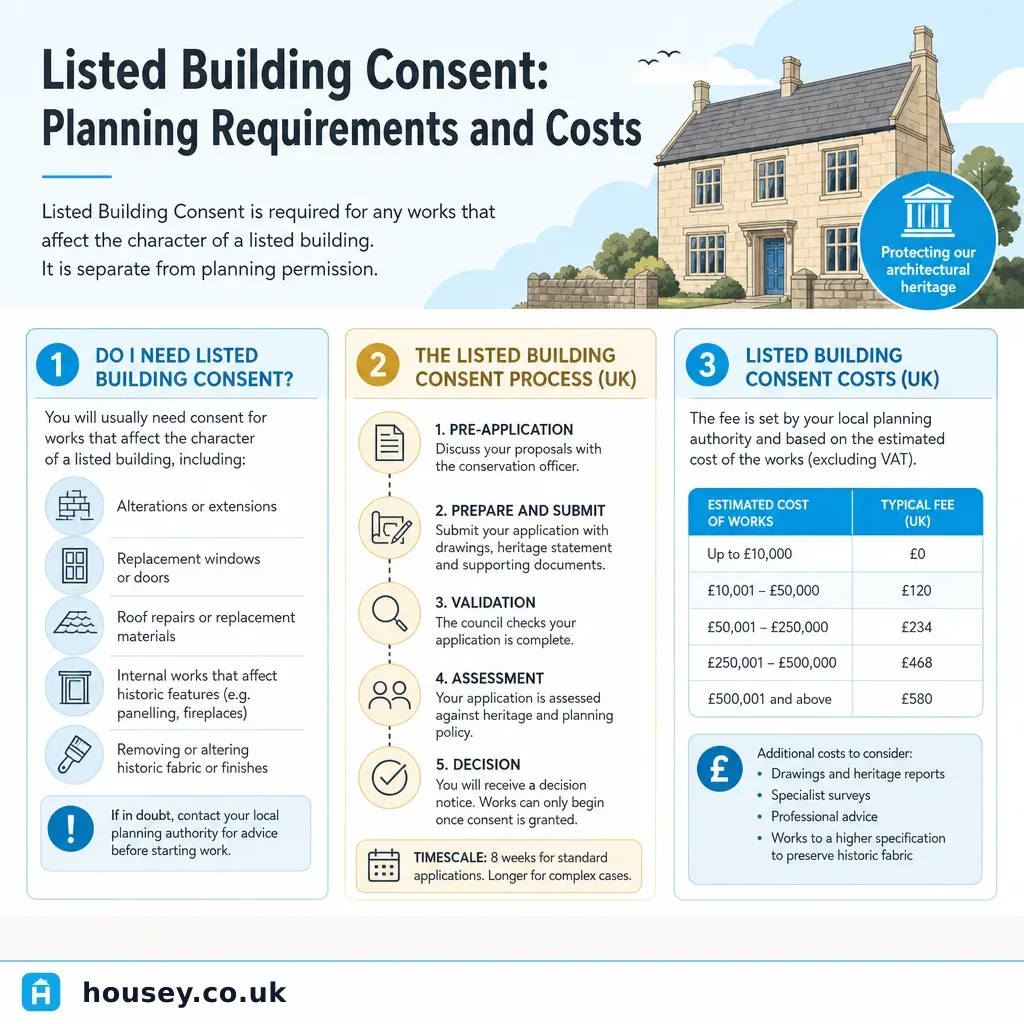
Listed Building Consent: Planning Requirements and Costs
Listed Building Consent is required for any works that affect the character of a listed building as a building of special architectural or historic interest — including internal alterations.
 Planning & Pre-Build
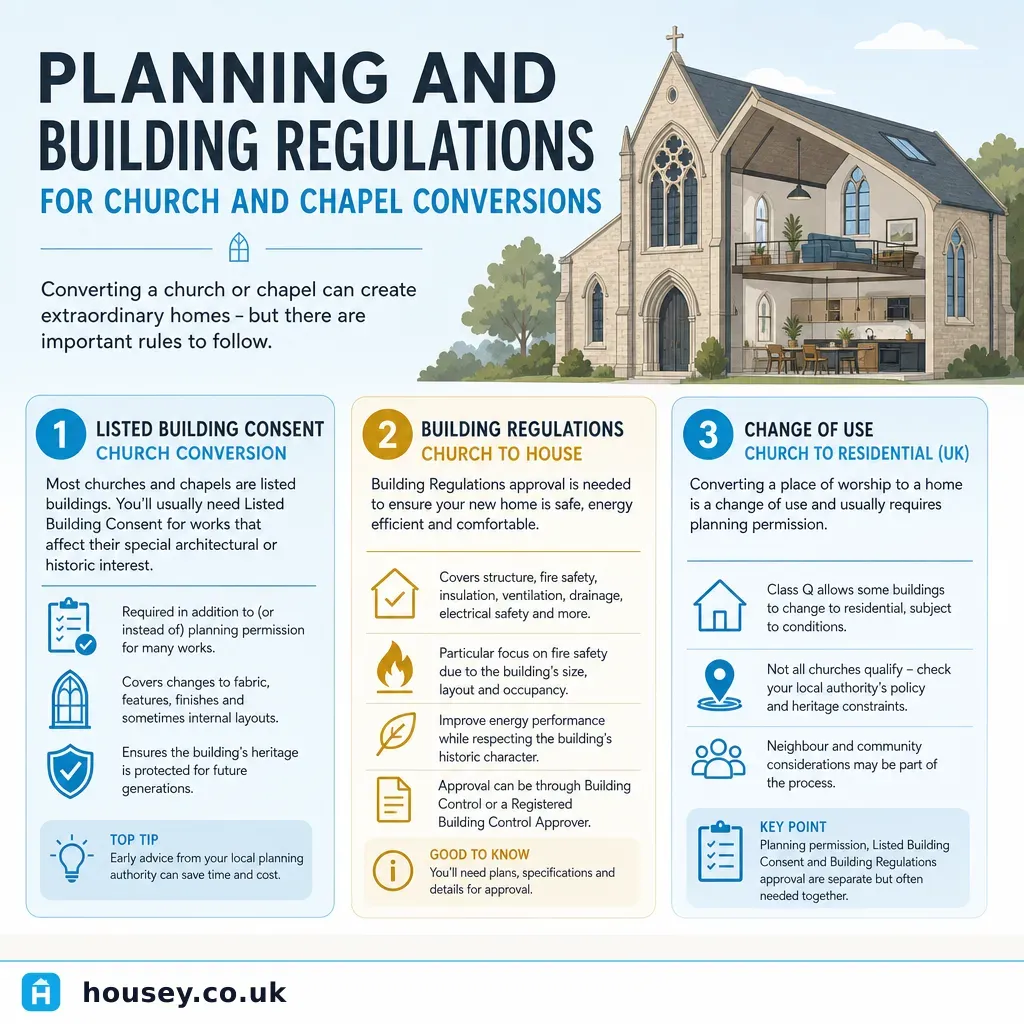
Planning and Building Regulations for Church and Chapel Conversions
Converting a church or chapel to residential use requires planning permission for change of use from Class F1 to Class C3, and listed building consent if the building is listed.
 Planning & Pre-Build
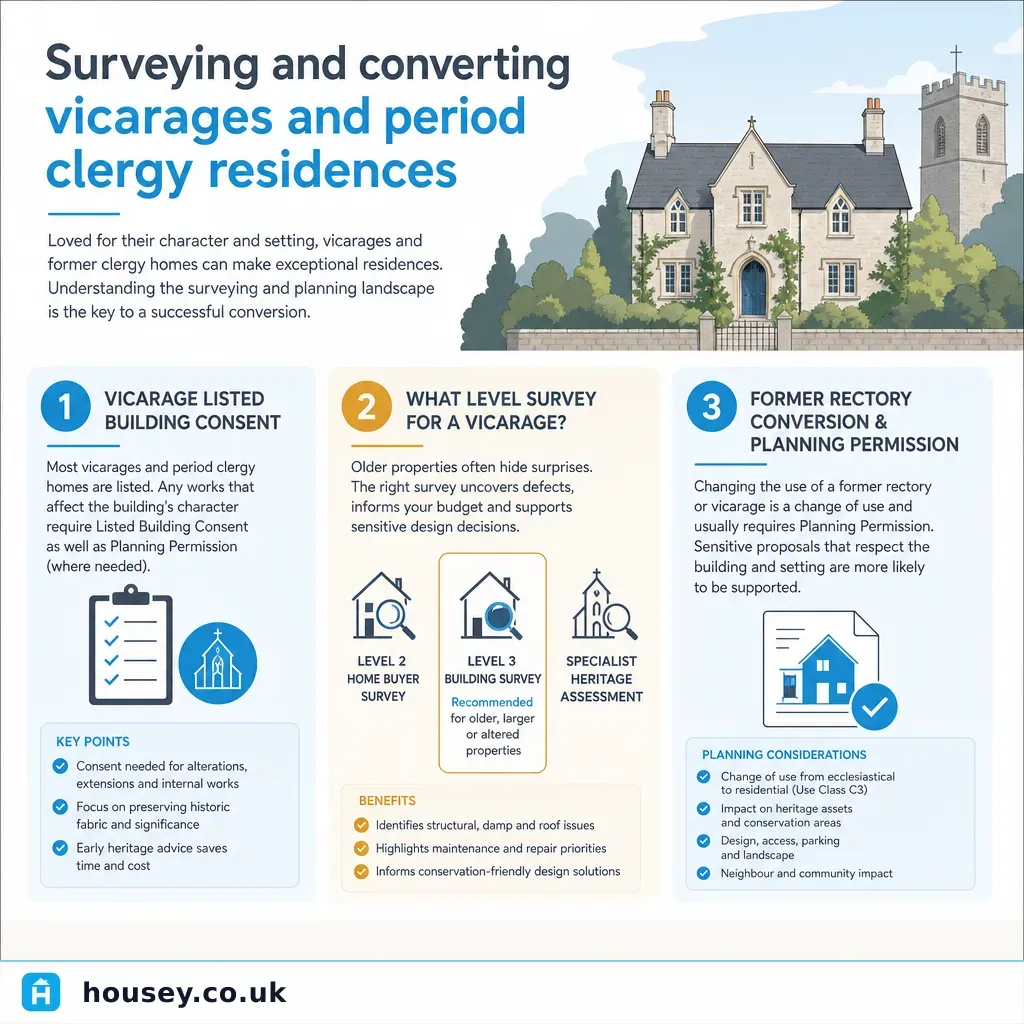
Surveying and converting vicarages and period clergy residences
Former vicarages are often listed buildings subject to full planning and Listed Building Consent rules once sold privately.
 Planning & Pre-Build
Heritage Property: Preserving Historic Homes and Conservation Standards
Listed buildings in the UK require Listed Building Consent for most works — internal and external — that affect their special architectural or historic interest.
 Planning & Pre-Build
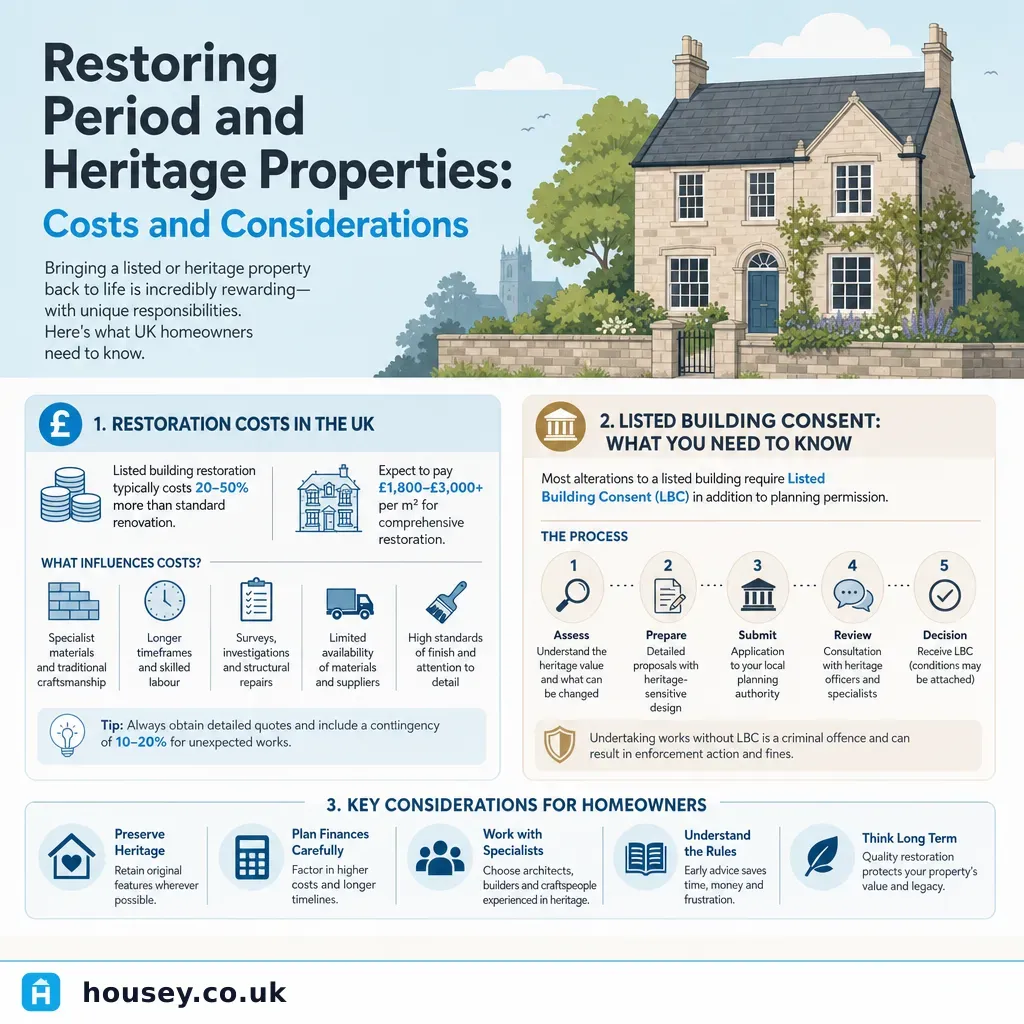
Restoring Period and Heritage Properties: Costs and Considerations
Restoring a period or heritage property requires listed building consent for most alterations, use of traditional materials such as lime mortar, and specialist contractors.