Surveying and converting vicarages and period clergy residences
By Housey · Last reviewed 30th of May 2026
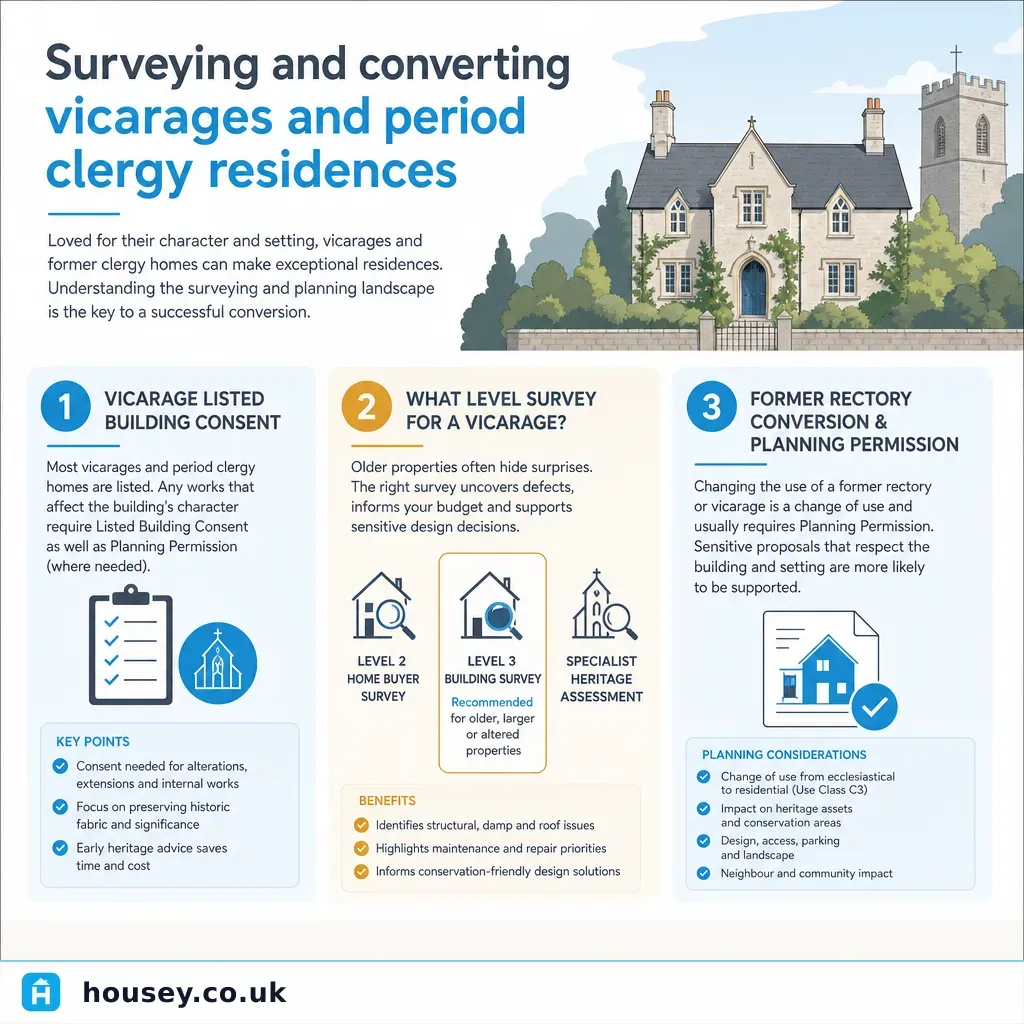
Surveying and converting vicarages and period clergy residences
Vicarages, rectories, and other period clergy residences occupy a distinctive niche in the English property market. Sold in growing numbers by dioceses since the 1970s, they typically combine generous room sizes, extensive grounds, and real architectural character alongside construction challenges, conservation obligations, and maintenance costs that differ markedly from a standard residential purchase. Understanding the legal and physical implications before exchange is essential — these are properties whose history and planning status are rarely straightforward.
Key points
- Many vicarages sold by the Church of England are listed (Grade I, II*, or Grade II), meaning any material alterations require Listed Building Consent (LBC) from the local planning authority regardless of who owns the property.
- Once a former ecclesiastical building passes into private ownership, the Ecclesiastical Exemption from listed building controls ceases to apply; full heritage planning law under the Planning (Listed Buildings and Conservation Areas) Act 1990 governs the building from the date of transfer.
- A RICS Level 3 Building Survey is the minimum recommended survey for a Victorian or Edwardian vicarage, given traditional construction complexity, the potential for hidden defects, and the elevated cost of like-for-like repairs using heritage-appropriate materials.
- Measured building surveys to RICS standards are typically required before any conversion drawings are prepared, to establish verified floor areas, ceiling heights, and structural configuration.
- Conversion of a vicarage to multiple flats usually requires both planning permission and — where the building is listed — Listed Building Consent; permitted development rights are frequently restricted or removed by Article 4 Directions in conservation areas.
Are vicarages usually listed buildings?
Many, but not all, former clergy residences are listed. Victorian Gothic vicarages designed by architects such as William Butterfield or George Edmund Street are frequently Grade II* or Grade I listed. More modest late-Victorian and Edwardian examples are often Grade II. Some twentieth-century vicarages are unlisted but may sit within a conservation area, which still limits external alterations.
Before proceeding beyond an initial viewing, check the National Heritage List for England published by Historic England. The listing record confirms the designation, describes the significance, and sometimes identifies fixtures and fittings that are themselves protected. Your solicitor should verify whether any Article 4 Directions or planning conditions attach to the property.
Ecclesiastical Exemption — what changes at sale
In some cases, ecclesiastical buildings in active religious use may benefit from the Ecclesiastical Exemption, which can affect how alterations are governed while the building remains in church ownership and use. Once any property — including a former vicarage — is sold into private ownership, any potential exemption ceases to apply entirely. The new owner is subject to full Listed Building Consent requirements under the Planning (Listed Buildings and Conservation Areas) Act 1990, including for internal works that affect the character of the building.
What survey do you need before buying a vicarage?
Survey type | Best for | Not ideal for | Key output |
|---|---|---|---|
RICS Level 3 Building Survey | Victorian and Edwardian vicarages, listed buildings, properties with visible defects or past alterations | Modern post-1980 buildings in good condition | Detailed condition report; recommended further investigations |
Structural engineer's report | Where cracks, movement, or subsidence are suspected | General pre-purchase condition assessment | Engineering diagnosis and remediation options |
Measured building survey | Before preparing conversion drawings or planning applications | General pre-purchase due diligence only | Verified floor plans, elevations, and sections to RICS standard |
Asbestos survey (Type 2 Management) | Pre-1999 buildings where intrusive works are planned | Stable, undisturbed buildings not being altered | Register of asbestos-containing materials, condition, and management recommendations |
For most pre-1914 vicarages, you will need at minimum a RICS Level 3 survey before exchange and a measured building survey before any planning application is submitted. If the Level 3 survey flags suspected structural movement, commission a separate structural engineer's inspection before exchanging.
Common defects in Victorian and Edwardian vicarages
Period vicarages were built to impress as much as to shelter, which means tall chimneys, bay windows, large single-glazed sash windows, and expansive roofs — all of which present significant maintenance challenges.
Roof and rainwater goods: Valley gutters, parapet gutters, and decorative lead flashings are common failure points. Repair or replacement to match historic detailing can be expensive and, on a listed building, may require consent and the use of traditional materials such as natural slate and cast-iron guttering.
Damp and ventilation: Solid-wall construction — brick or stone without a cavity — is typical. Breathable lime mortars and plasters that manage moisture movement are frequently replaced with cement, which traps moisture and causes spalling brickwork. Incorrect renders or waterproof coatings are a particular red flag.
Timber and floors: Beetle activity in roof timbers and suspended timber floors is common in properties that have been infrequently heated or left vacant. A Level 3 survey should probe accessible timbers and flag further specialist investigation where activity is suspected.
Services: Rewiring, central heating, and modern plumbing may have been installed to varying standards across many decades. An Electrical Installation Condition Report (EICR) and an inspection by a Gas Safe-registered engineer of any gas appliances are standard pre-purchase checks.
Outbuildings and grounds: Former coach houses, stables, or walled gardens included in the curtilage may themselves be listed. Boundary maintenance obligations and rights of way — particularly over former churchyard paths — should be established through your solicitor.
Planning and Listed Building Consent for conversion works
Conversion of a former vicarage to continued residential use as a single dwelling is generally the simplest planning scenario. Subdivision into flats, extension, or change of use requires a planning application, and any works affecting the character of a listed building require a separate Listed Building Consent application.
What consent do you need?
- Choose no application if you are occupying as a single dwelling with no alterations — but confirm with your local planning authority if you have any uncertainty.
- Seek Listed Building Consent if the building is listed and you plan any internal or external alteration affecting historic fabric, including decorative changes.
- Apply for planning permission if you are extending, subdividing, or changing the use of the building.
- Apply for both planning permission and LBC if the building is listed and you are subdividing, extending significantly, or changing use.
- Engage a heritage consultant before submitting any application — pre-application discussions with the conservation officer can prevent costly refusals and delays.
- Check with your local planning authority before starting any works; pre-application advice services are available at most councils and can prevent enforcement action.
A heritage and conservation consultant can prepare a Heritage Impact Assessment demonstrating how proposed works respond to the building's significance — this document is often required for listed building consent applications and substantially strengthens the case.
Important limitations
This article provides general information about the planning, survey, and conversion considerations relevant to vicarages and former clergy residences in England. Heritage planning law is detailed and fact-specific: the scope of a listing, the significance of particular features, and the policies of individual local planning authorities all vary. Nothing in this article constitutes planning advice, legal advice, or a structural assessment. A qualified heritage consultant, conservation architect, or planning consultant should assess your specific property and proposal before any works are instructed or planning applications submitted.
What to ask a qualified professional
Before instructing a surveyor, heritage consultant, or conservation architect for a vicarage purchase or conversion:
- Is this building listed, and if so at what grade? Are any outbuildings or curtilage structures also listed or otherwise protected?
- Does the property sit within a conservation area, and are there Article 4 Directions that restrict permitted development rights?
- What level of survey is appropriate given the age, construction, and visible condition of this specific building?
- What defects are typically present in buildings of this type and age, and what is the likely order of cost for remediation to heritage standards?
- What consents will be required for my proposed works, and what does the local planning authority's heritage policy say about this type of conversion?
- Will I need a Heritage Impact Assessment, and what will it need to demonstrate about significance and harm?
- What materials and methods are acceptable to the conservation officer for repair and alteration works on a building of this type?
When to get professional help
A heritage or conservation specialist should be involved from the outset — ideally before making an offer — if the property is listed or within a conservation area. Do not rely on a standard homebuyer's survey alone for a Victorian or Edwardian vicarage.
Seek urgent professional advice if:
- Cracks are visible in external walls, particularly stepped cracks through brickwork or separation at corners.
- The roof shows signs of sagging, lead failure, or missing slates.
- There is a persistent smell of damp or visible tide marks suggesting past water ingress.
- The vendor cannot produce Faculty consents or building regulation certificates for past works.
- You are uncertain whether alterations already carried out had the necessary Listed Building Consent.
- The listing record describes fixtures, fittings, or interiors as part of the listing — and these appear to be missing or altered.
How Housey can help
Housey connects homeowners and buyers with experienced heritage and conservation consultants who understand listed building consent, significance assessments, and working constructively with conservation officers. If you need verified drawings before submitting a planning application, our measured building survey specialists provide accurate floor plans and elevations to RICS standards. For compliance during conversion works, building control consultants can guide you through the building regulation approval process.
Frequently asked questions
Do I need Listed Building Consent to redecorate inside a listed vicarage?
Routine decorating with equivalent materials — painting over previously painted plaster, for example — is unlikely to need Listed Building Consent. However, stripping paint from historic joinery, removing or altering plasterwork, or making any structural change does require consent. If in doubt, seek pre-application advice from your local planning authority's conservation officer before instructing any contractor.
Can I install double glazing in a listed vicarage?
Replacing historic single-glazed sash windows with double glazing is one of the most commonly refused listed building consent applications. Secondary glazing — a discreet inner frame fitted behind the original sashes — is generally more acceptable to conservation officers and can meaningfully improve thermal performance without removing historic fabric. Discuss the options with a heritage consultant before making any application.
How long does a Listed Building Consent application take?
The statutory determination period is 8 weeks from validation, though complex or contentious applications may take longer. Pre-application engagement with the conservation officer can significantly improve the chances of first-time approval. Some local planning authorities have waiting times for pre-application advice; factor this into your programme.
Is a vicarage conversion eligible for VAT relief?
Certain conversion works on residential buildings that have been empty for two or more years may qualify for the reduced rate of VAT (5%) or zero-rating in some circumstances. The rules are detailed and depend on the specific nature of works and the building's history. Consult a tax adviser or refer to HMRC's VAT Notice 708 for current guidance.
Sources and further reading
- National Heritage List for England — Historic England
- Planning (Listed Buildings and Conservation Areas) Act 1990 — legislation.gov.uk
- Owning a listed building — Historic England
- RICS Home Survey Standard — RICS
- Ecclesiastical exemption: listed buildings — GOV.UK
- VAT Notice 708: buildings and construction — HMRC / GOV.UK
Useful next reads
 Planning & Pre-Build
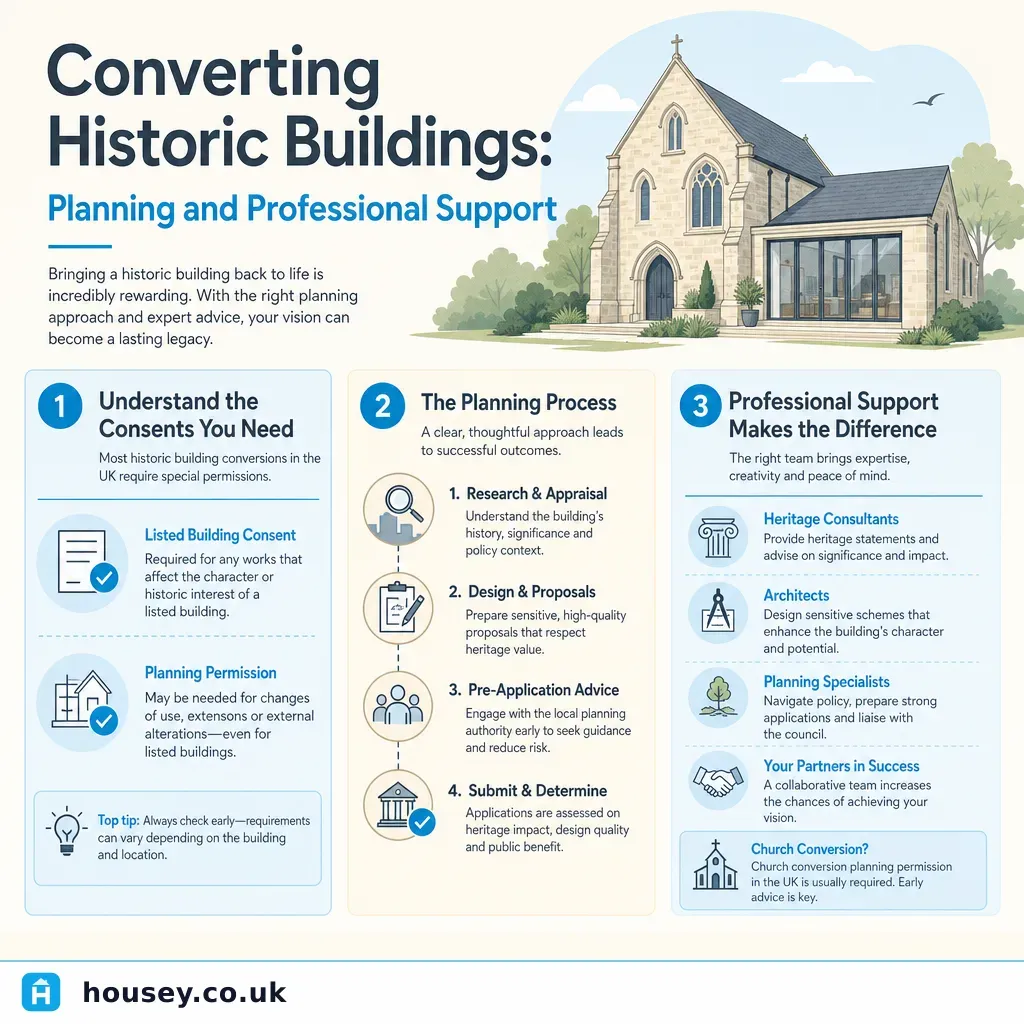
Converting Historic Buildings: Planning and Professional Support
Converting a historic or listed building in the UK requires Listed Building Consent in addition to planning permission, both granted by the local planning authority.
 Planning & Pre-Build
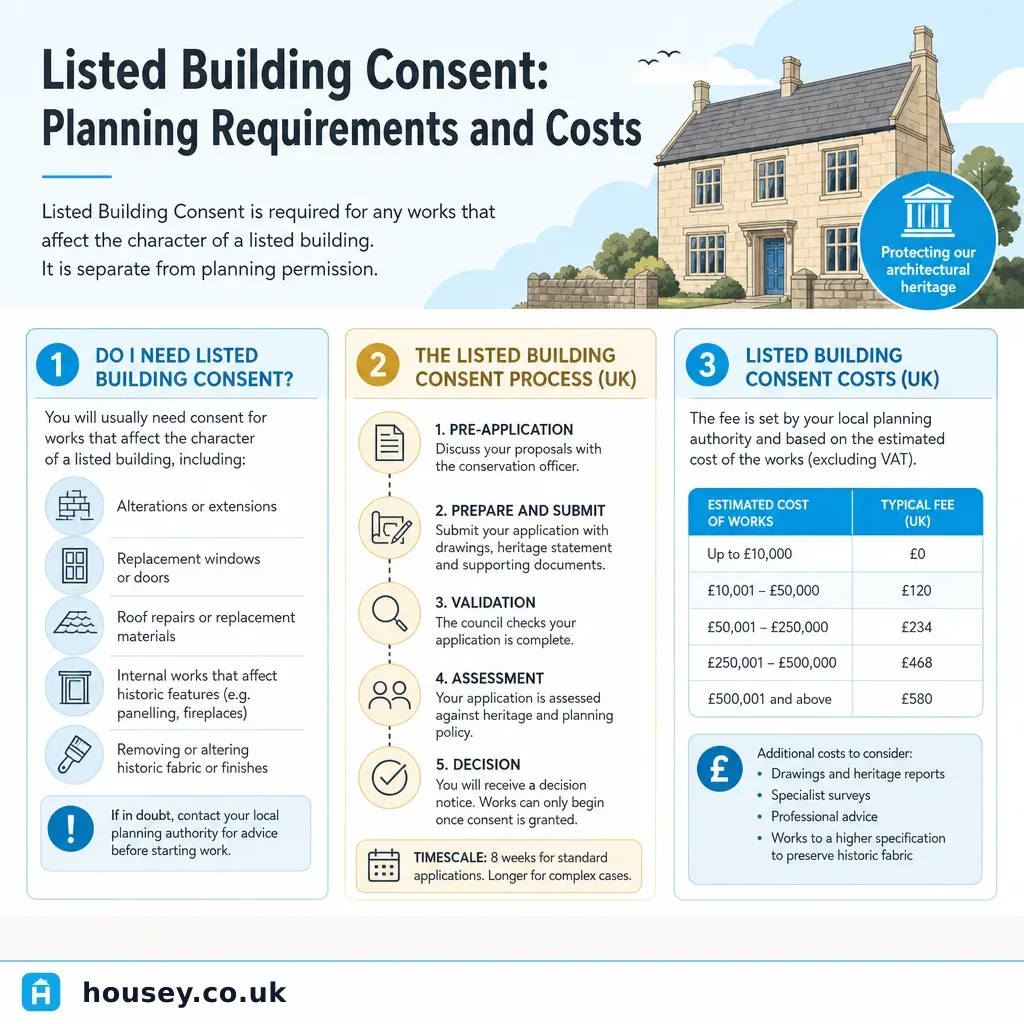
Listed Building Consent: Planning Requirements and Costs
Listed Building Consent is required for any works that affect the character of a listed building as a building of special architectural or historic interest — including internal alterations.
 Planning & Pre-Build
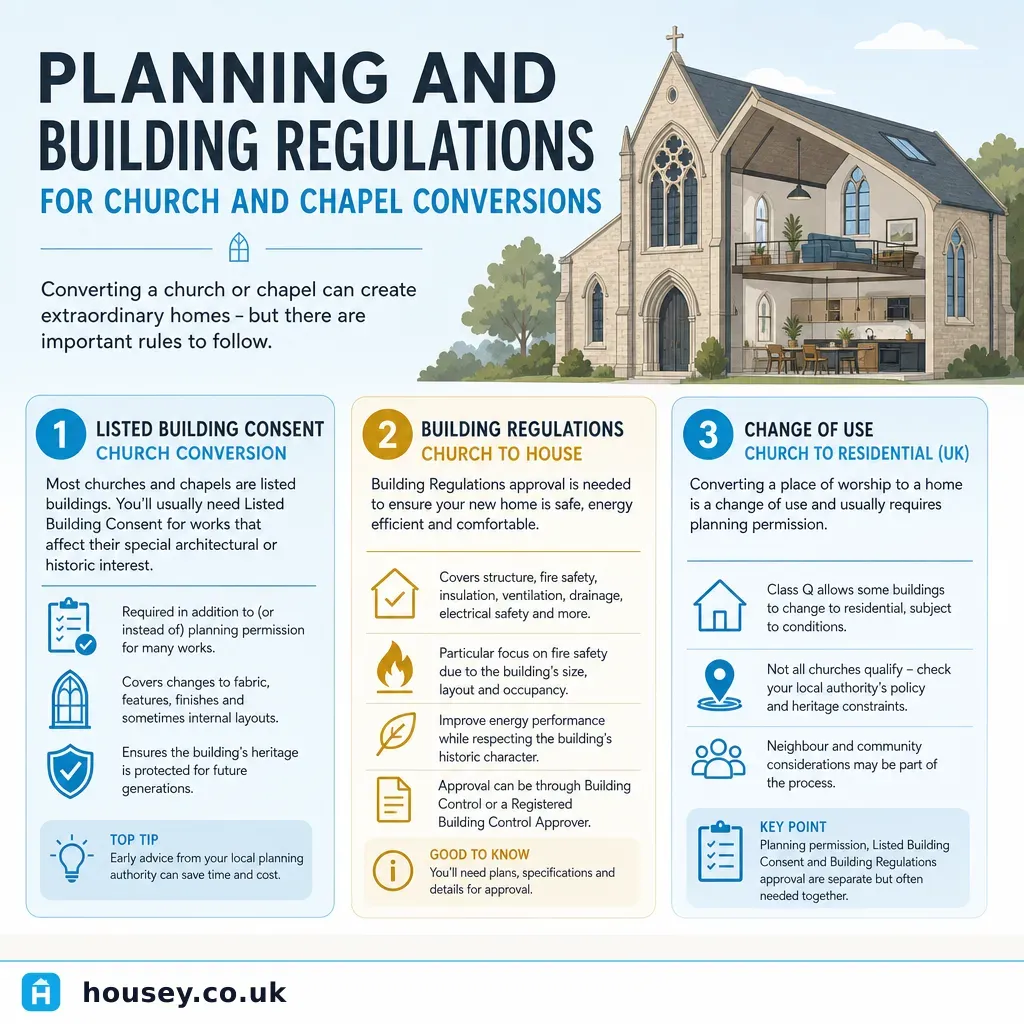
Planning and Building Regulations for Church and Chapel Conversions
Converting a church or chapel to residential use requires planning permission for change of use from Class F1 to Class C3, and listed building consent if the building is listed.
 Planning & Pre-Build
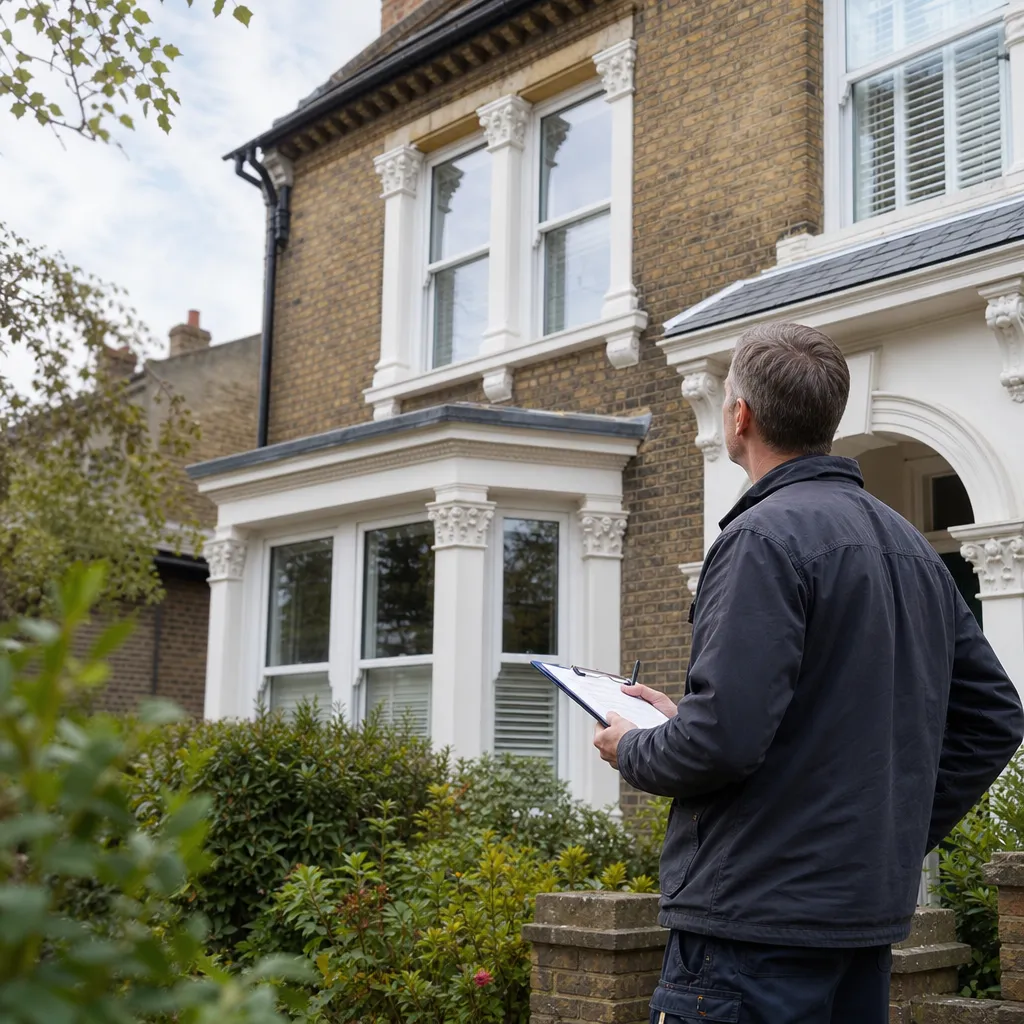
Heritage Property: Preserving Historic Homes and Conservation Standards
Listed buildings in the UK require Listed Building Consent for most works — internal and external — that affect their special architectural or historic interest.
 Planning & Pre-Build
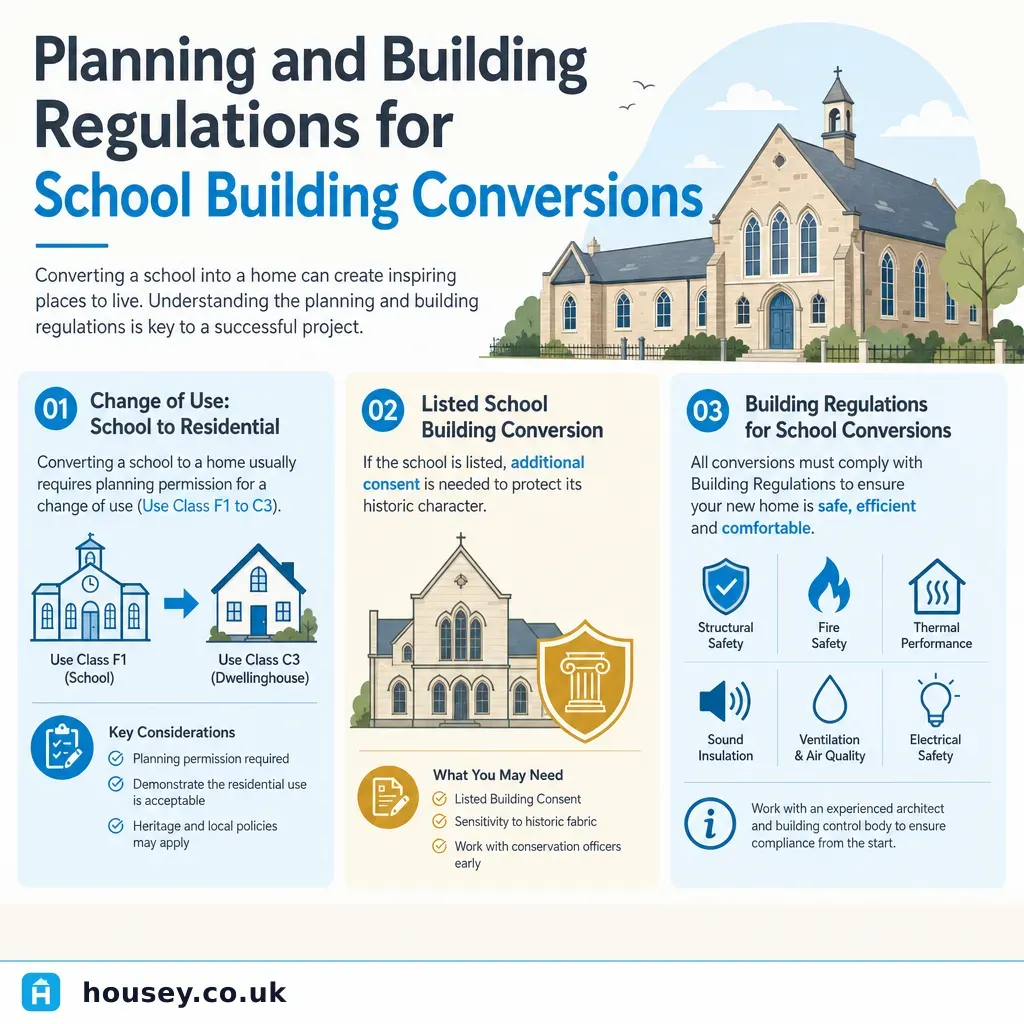
Planning and Building Regulations for School Building Conversions
Converting a school to residential use in England requires full planning permission — there is no permitted development right for this change of use.