Listed Building Consent: Planning Requirements and Costs
By Housey · Last reviewed 7th of May 2026
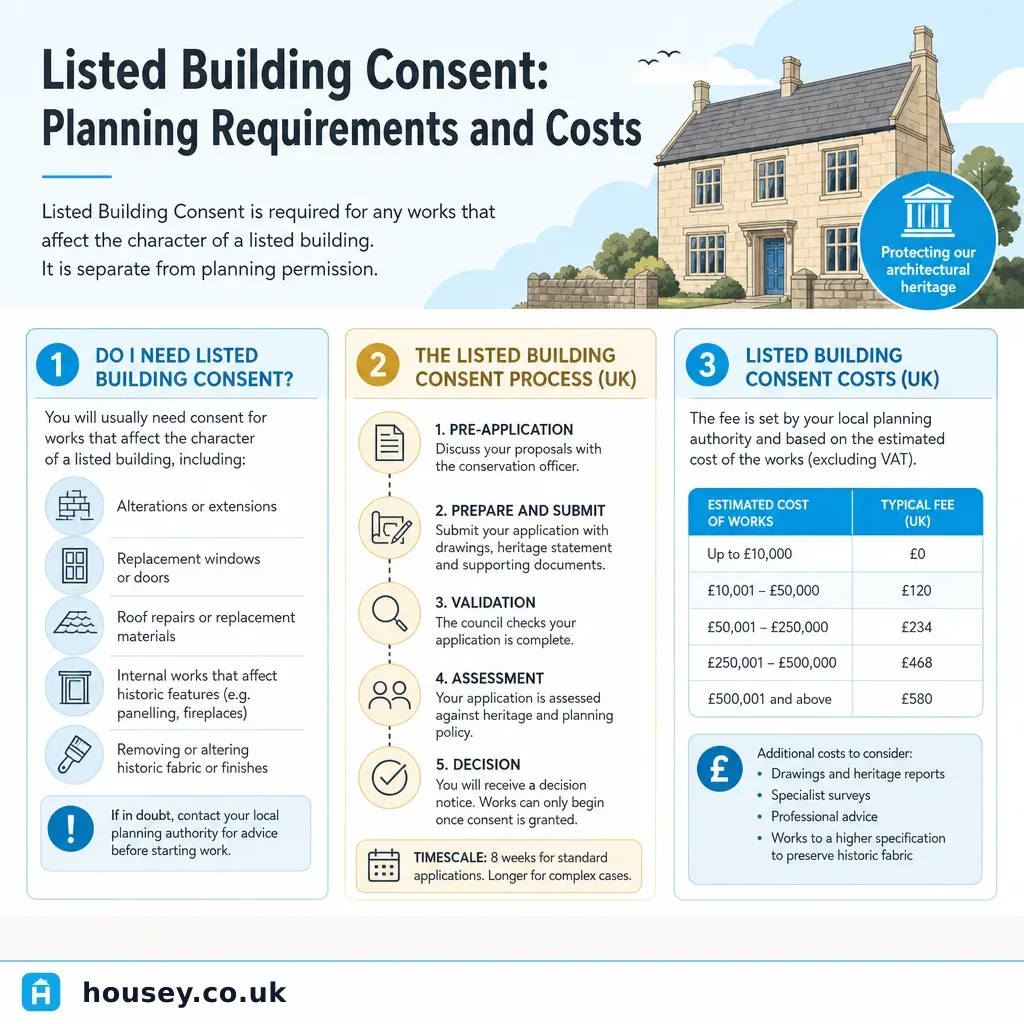
Listed Building Consent: Planning Requirements and Costs
The UK has around 500,000 listed building entries, and a significant number are privately owned family homes. Owners face an additional layer of regulatory scrutiny that most homeowners never encounter — governed by a separate legal regime from everyday planning permission. Whether you are planning a kitchen renovation, replacing windows, or re-pointing external stonework, understanding when Listed Building Consent (LBC) is required is essential before any work begins.
Key points
- Listed Building Consent is a legal requirement separate from planning permission, governed by the Planning (Listed Buildings and Conservation Areas) Act 1990; carrying out works without consent is a criminal offence under section 9 of that Act, with no time limit for prosecution.
- LBC is required for any works that would affect the character of a listed building as a building of special architectural or historic interest — this includes internal alterations, not just external changes.
- England has approximately 500,000 listed building entries in three grades: Grade I (2%), Grade II* (6%), and Grade II (92%), according to Historic England.
- Applications for Listed Building Consent in England and Wales carry no application fee; however, professional fees for heritage statements and drawings typically range from £1,500 to £8,000+ depending on complexity (Indicative UK costs, last reviewed 2026-05-07).
- Historic England is a statutory consultee on all Grade I and Grade II* applications and must be notified before consent is granted.
What is Listed Building Consent?
Listed Building Consent (LBC) is a formal approval from your Local Planning Authority (LPA) required before carrying out works to a listed building that would affect its character as a building of special architectural or historic interest. It is entirely distinct from planning permission, though both may be needed for the same project.
The legal basis is the Planning (Listed Buildings and Conservation Areas) Act 1990. The threshold — works affecting "the character of a listed building as a building of special architectural or historic interest" — is deliberately broad and is interpreted case by case by conservation officers at the LPA.
A listing covers the entire building and its curtilage: internal alterations, external changes, structures within the curtilage pre-dating 1 July 1948, and curtilage-listed boundary walls and outbuildings.
When do you need Listed Building Consent?
Do you need LBC? — decision tree
- Is the building listed? Check the Historic England National Heritage List for England (NHLE), Cadw (Wales), Historic Environment Scotland, or NIEA (Northern Ireland). If no → standard planning rules apply.
- Are the works routine maintenance using matching materials and traditional methods? If yes → LBC is generally not required. If unsure → ask the LPA conservation officer before starting.
- Is it an internal alteration affecting historic fabric, fittings, or spatial character? If yes → LBC is almost certainly required.
- Is it an external change visible from outside? May also require planning permission as a separate application.
- Is it full or partial demolition? LBC is required; full demolition consent is rarely granted.
- Still unsure? Request a pre-application enquiry from the LPA or consult a heritage consultant before any work starts.
Common works: does LBC apply?
Type of work | LBC likely required? | Notes |
|---|---|---|
Replacing original windows with UPVC | Yes | Likely refused; like-for-like timber replacement usually preferred |
Installing central heating or new wiring | Usually yes | Depends on extent of fixings and damage to historic fabric |
Removing internal walls or partitions | Yes | Even non-original partitions may require LBC |
Re-roofing with matching materials | Usually no | Confirm with conservation officer if any structural change involved |
Inserting a new door opening | Yes | Structural and character impact |
Repointing with matching lime mortar | Usually no | Cement mortar on a lime-built wall may require LBC and cause harm |
Painting previously unpainted masonry | Yes | Can be irreversible and affect character significantly |
Adding insulation behind plasterwork | Yes | Risk of obscuring or damaging historic fabric |
Garden landscaping within curtilage | Possibly | If affecting curtilage-listed structures or below-ground archaeology |
How to apply and what does it cost?
The application process
Applications in England are submitted via the Planning Portal to your LPA. The typical steps are:
- Pre-application discussion with the LPA conservation officer — strongly recommended; often free or low-cost and can save significant professional fees.
- Heritage Statement explaining the building's significance, the proposed works, and why they are appropriate.
- Drawings — existing and proposed floor plans and elevations from an architect, architectural technologist, or heritage specialist.
- Specialist reports if needed: bat survey (for roof works), structural assessment, or materials analysis.
- Submission via the Planning Portal — no application fee in England and Wales.
- Determination within 8 weeks (standard) or 13 weeks (major). Historic England is formally notified of all Grade I and Grade II* applications.
- Conditions — consent often includes pre-commencement requirements such as sample material approvals.
Professional fees (indicative, last reviewed 2026-05-07)
Service | Indicative fee range |
|---|---|
Pre-application consultation (LPA) | Free to ~£250 |
Heritage Statement / Design and Access Statement | £1,500–£4,000 |
Architect or technologist drawings | £1,500–£5,000+ |
Heritage consultant project management | £2,000–£8,000+ |
Bat survey (if required for roof works) | £500–£2,000 |
Structural engineer's assessment | £800–£3,000 |
Indicative UK costs, last reviewed 2026-05-07. Professional fees vary by property complexity, region, and scope. Always obtain at least three quotations.
The cost of getting it wrong
Carrying out works without LBC is a criminal offence under section 9 of the 1990 Act. Unlike most planning enforcement, there is no time limit for prosecution. You may also be required to reverse the works entirely at your own expense.
Important limitations
This article provides general information about the Listed Building Consent process in England and Wales only. Rules differ in Scotland (Historic Environment Scotland), Northern Ireland (NIEA), and Wales (Cadw). What requires consent — and what is likely to be approved — depends on the specific building's grade, the LPA's local conservation policies, the assigned conservation officer's views, and the reversibility of the proposed works. This article is not a substitute for professional advice. Do not begin any works on a listed building before confirming the consent position with your LPA or a qualified heritage professional.
What to ask a qualified professional
Before instructing a heritage consultant, planning consultant, or conservation architect:
- Have you worked on Listed Building Consent applications in this local authority before?
- What is your view on whether this specific work requires LBC?
- What pre-application strategy do you recommend with this LPA?
- What supporting documents and specialist reports will be required?
- What is your track record with similar applications — consented, refused, or appealed?
- Who at your practice will handle the application, and what is their heritage qualification (e.g., IHBC membership, RICS, ARB)?
- Are your fees fixed or hourly, and what is included?
- If consent is refused, what are the realistic options?
When to get professional help
Seek specialist advice before any works on a listed building — not after. Immediate professional input is needed if:
- You have already carried out works that may require LBC — enforcement risk is serious and unlimited in time; seek legal advice immediately.
- You are purchasing a listed building — instruct a solicitor and RICS surveyor with listed building experience and check the enforcement history before exchange.
- Your LBC application has been refused and you are considering an appeal to the Planning Inspectorate.
- The proposed works are structural, affect the roof structure, or involve removal of historic fabric.
- The LPA conservation officer is unresponsive — a heritage consultant can liaise and maintain a written record of pre-application discussions.
How Housey can help
Housey connects you with qualified professionals who understand the listed building consent process. Heritage and conservation consultants can advise on significance, pre-application strategy, and Heritage Statements, while planning consultants experienced in listed building work can manage your application from submission through to determination.
Frequently asked questions
Do I need planning permission as well as Listed Building Consent?
Sometimes. LBC and planning permission are separate applications and both may be needed for the same project — for example, building an extension to a listed building. Planning permission addresses land use and development; LBC addresses impact on the building's special interest. Check with your LPA conservation officer which applications are required before instructing an agent.
Can I get retrospective Listed Building Consent?
Technically yes, but there is no guarantee of consent and you remain liable to prosecution regardless. Carrying out works without LBC is a criminal offence under section 9 of the Planning (Listed Buildings and Conservation Areas) Act 1990, with no time limit for enforcement. If unauthorised works have already taken place, seek legal advice before making any application.
How long does Listed Building Consent last?
Consent is typically valid for three years from the date of the decision notice, within which the authorised works must be started. Conditions attached — such as sample material approvals or method statements — must be discharged as specified. If you are unlikely to start within three years, discuss a fresh application or extension of time with your planning consultant.
Does listed building status affect internal alterations?
Yes. Unlike planning permission, LBC covers internal works affecting the building's character. Removing original fireplaces, panelling, staircases, doors, or historic flooring — even if not visible from outside — usually requires LBC. This surprises many owners who assume the consent only covers the exterior appearance of the building.
Can a listed building owner be forced to carry out repairs?
Yes. Under section 48 of the Planning (Listed Buildings and Conservation Areas) Act 1990, an LPA can issue an Urgent Works Notice requiring essential works to prevent a listed building from deteriorating. For unoccupied buildings, the LPA may carry out the works and recover costs from the owner. Keeping a listed building in good repair is both a legal and practical obligation.
Sources and further reading
- Planning (Listed Buildings and Conservation Areas) Act 1990 — legislation.gov.uk
- Historic England — Advice on Listed Buildings and Consents — Historic England
- National Heritage List for England (NHLE) — Historic England
- Planning Portal — Listed Buildings — Planning Portal
- Historic England Good Practice Advice Note 2: Managing Significance in Decision-Taking — Historic England
Useful next reads
 Planning & Pre-Build
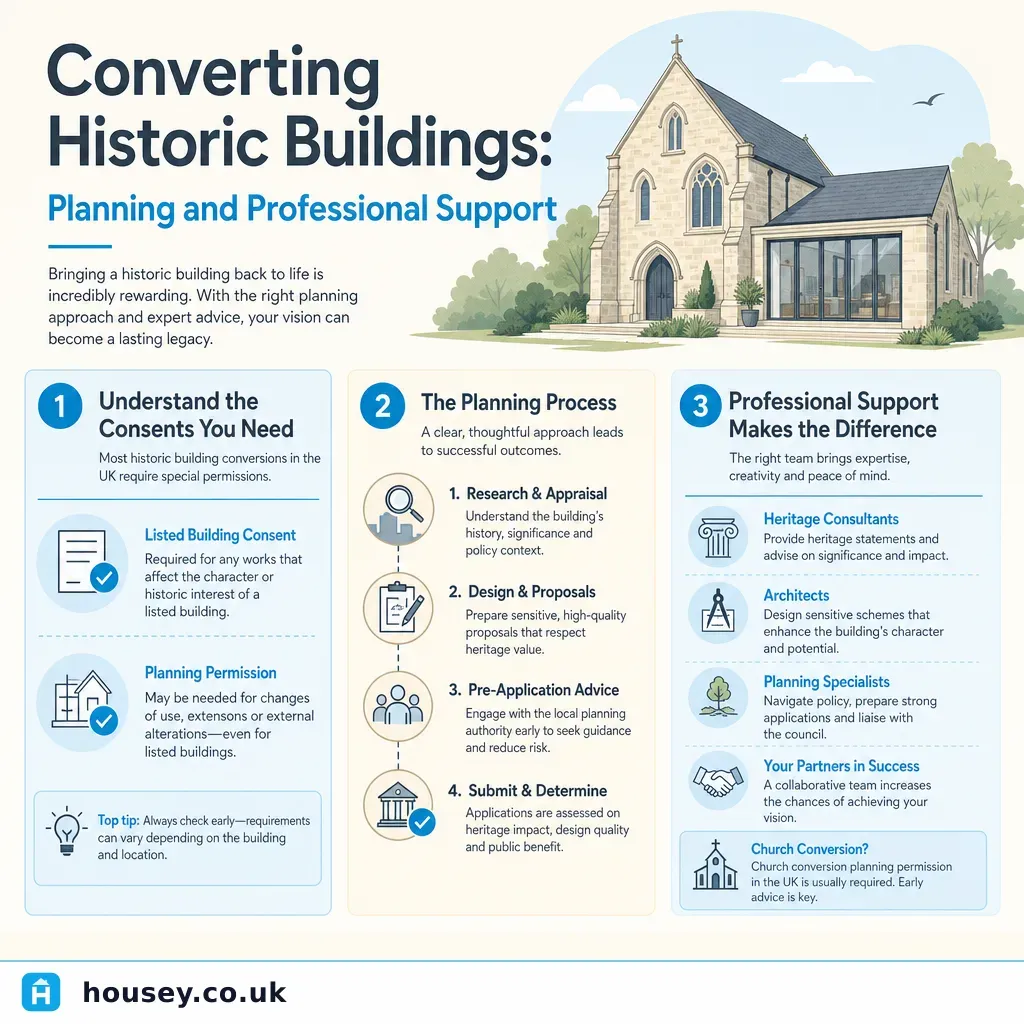
Converting Historic Buildings: Planning and Professional Support
Converting a historic or listed building in the UK requires Listed Building Consent in addition to planning permission, both granted by the local planning authority.
 Planning & Pre-Build
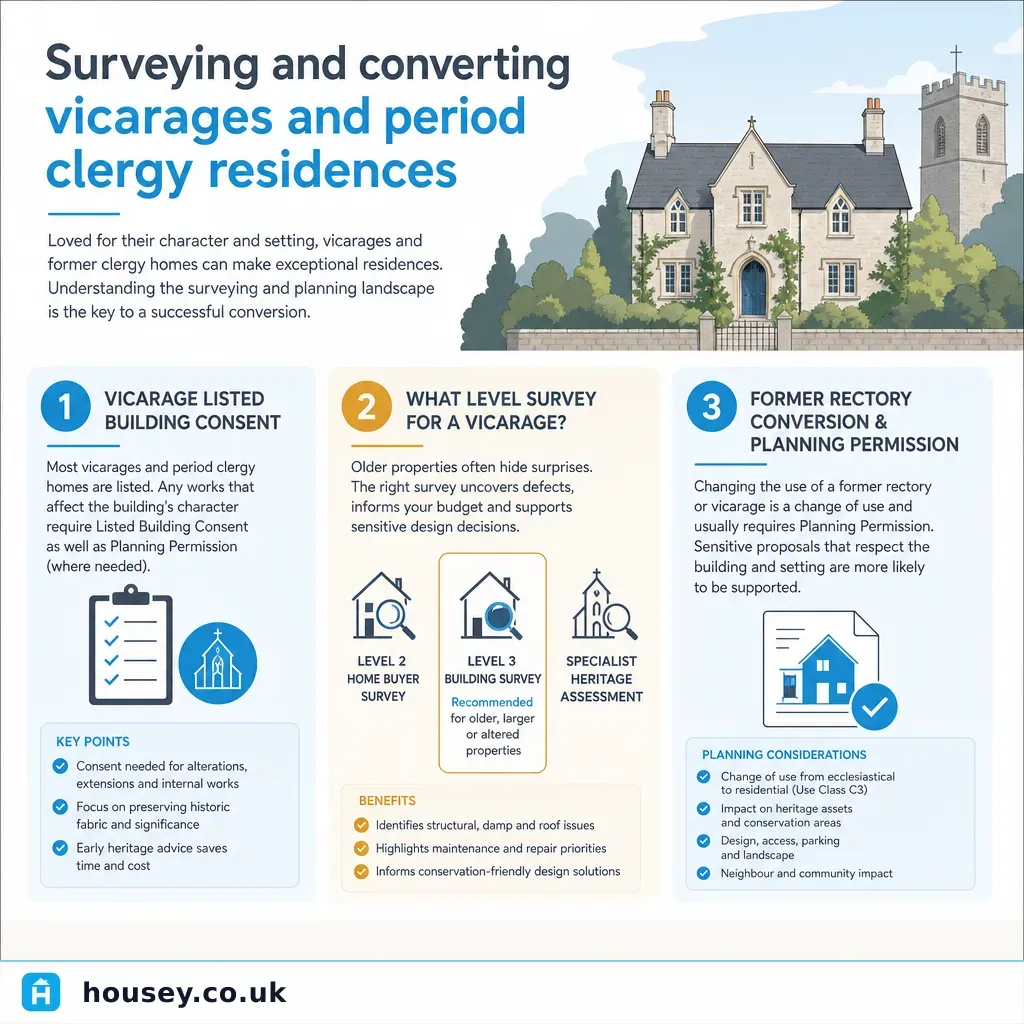
Surveying and converting vicarages and period clergy residences
Former vicarages are often listed buildings subject to full planning and Listed Building Consent rules once sold privately.
 Planning & Pre-Build
Heritage Property: Preserving Historic Homes and Conservation Standards
Listed buildings in the UK require Listed Building Consent for most works — internal and external — that affect their special architectural or historic interest.
 Planning & Pre-Build
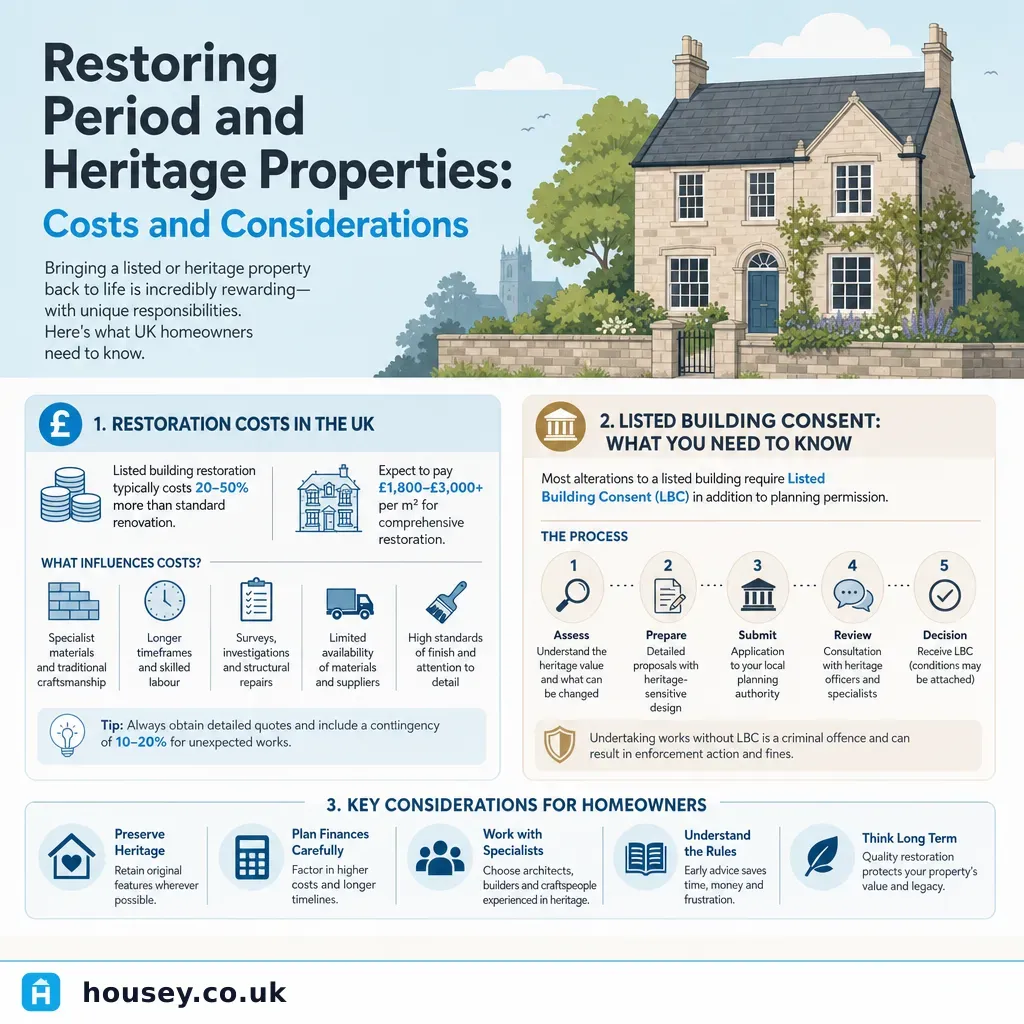
Restoring Period and Heritage Properties: Costs and Considerations
Restoring a period or heritage property requires listed building consent for most alterations, use of traditional materials such as lime mortar, and specialist contractors.
 Planning & Pre-Build
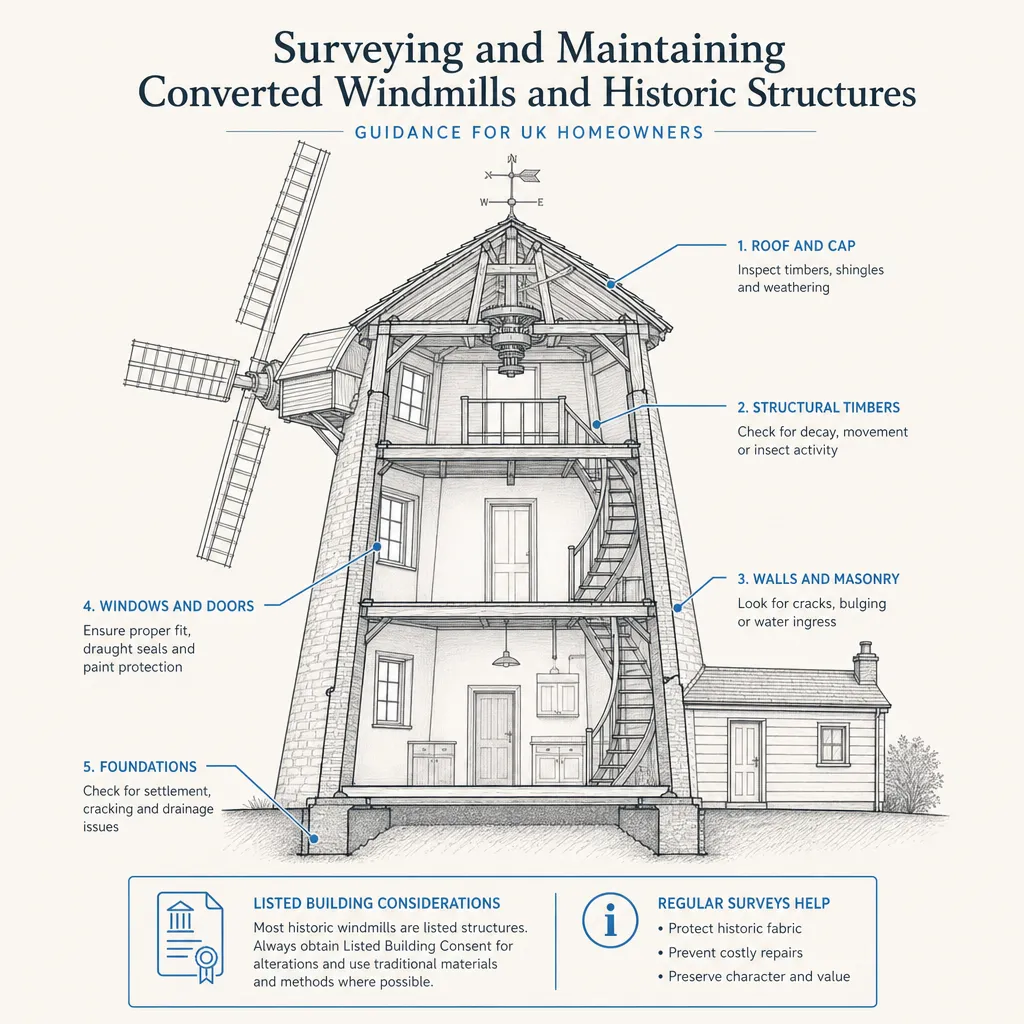
Surveying and Maintaining Converted Windmills and Historic Structures
Converted windmills and other historic structures typically require a specialist heritage building survey, not a standard RICS inspection.