Conveyancers vs Solicitors: Understanding the Professional Difference
By Housey · Last reviewed 25th of May 2026
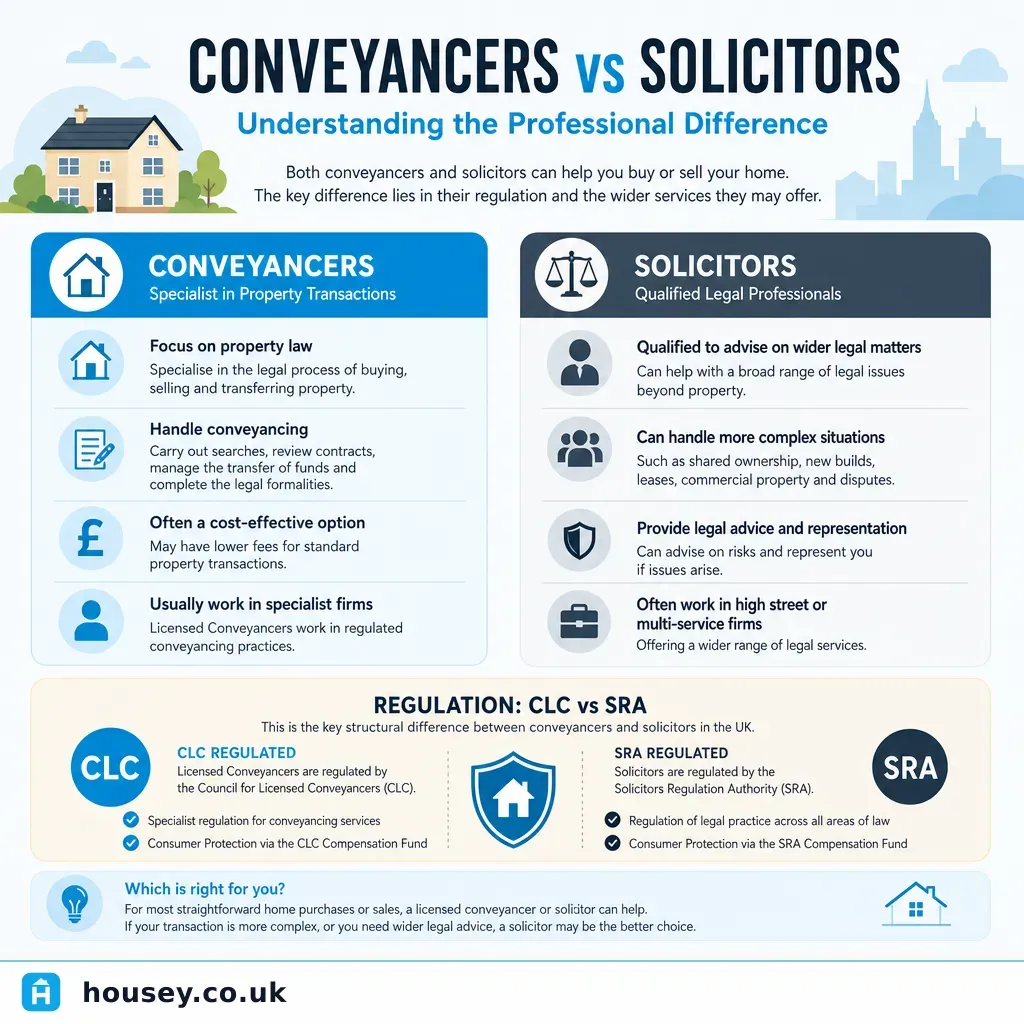
Conveyancers vs Solicitors: Understanding the Professional Difference
Choosing a legal professional for a property transaction seems straightforward until you notice some firms advertised as solicitors and others as licensed conveyancers — sometimes at different price points, with different recommendations from estate agents or mortgage brokers. Both professions are regulated and legally qualified to handle residential conveyancing in England and Wales, but they differ in their training, the regulatory body that oversees them, and the scope of work they can take on. Understanding those differences helps buyers and sellers choose the right professional and ask better questions before instructing.
Key points
- Licensed conveyancers are regulated by the Council for Licensed Conveyancers (CLC), established under the Administration of Justice Act 1985 as a specialist regulator for property law practitioners.
- Solicitors are regulated by the Solicitors Regulation Authority (SRA) and qualify via the Solicitors Qualifying Examination (SQE) or the older Legal Practice Course (LPC), both of which cover multiple areas of law.
- Licensed conveyancers cannot advise on matters outside property law — they cannot handle family law, probate, or contested boundary litigation without additional specialist licences.
- Your mortgage lender maintains an approved panel; a professional not on your lender's panel may require the lender to appoint separate representation, potentially at additional cost to you.
- Both CLC and SRA member firms must hold professional indemnity insurance and maintain client money in a segregated account protected by their regulator's Compensation Fund.
What is a licensed conveyancer?
A licensed conveyancer is a property law specialist. The profession was created by the Administration of Justice Act 1985, which established the CLC as the specialist regulator for conveyancing and probate practitioners. Training focuses on conveyancing and land law. A licensed conveyancer cannot advise on matters outside property law — if a transaction raises family law issues, a will dispute, or a landlord and tenant matter, they must refer you to a solicitor.
The CLC requires all licensed conveyancers to hold professional indemnity insurance and maintain client money in a segregated client account. If a licensed conveyancer firm fails or commits dishonesty, the CLC Compensation Fund provides a backstop for consumer losses.
What is a conveyancing solicitor?
A solicitor is a qualified lawyer regulated by the SRA. Solicitors complete the SQE or the older LPC route, both of which cover multiple areas of law. Many solicitors choose to specialise in residential property, but their broader qualification means they can, in principle, advise on connected issues within the same firm — for example, advising on a cohabitation agreement alongside a purchase, or handling probate where a property forms part of an estate.
The SRA Accounts Rules govern client money handling; the SRA Compensation Fund provides protection if a regulated firm fails or acts dishonestly.
Comparison table: licensed conveyancer vs conveyancing solicitor
| Licensed Conveyancer | Conveyancing Solicitor |
|---|---|---|
Regulator | Council for Licensed Conveyancers (CLC) | Solicitors Regulation Authority (SRA) |
Qualification focus | Property and land law only | Broad law training; may specialise in property |
Can advise on family law? | No | Yes, if the firm has the relevant specialism |
Can advise on probate? | Only with a separate probate practitioner licence | Yes |
Typical work handled | Freehold and leasehold residential transactions | Residential, leasehold, commercial, and complex transactions |
Fees for standard transactions | Often (not always) lower | Varies widely by firm size and location |
Client money protection | CLC Compensation Fund | SRA Compensation Fund |
Suitable for standard purchase or sale | Yes | Yes |
Suitable for divorce-linked transaction | No — refer to a family solicitor | Yes, with family law expertise in the firm |
Suitable for commercial conveyancing | Not usually | Yes |
Fees vary by firm, region, and transaction complexity. Always obtain written, itemised quotes before instructing. Indicative UK costs, last reviewed 2026-05-25.
Which professional should you choose?
Decision tree
- Choose a licensed conveyancer if: your transaction is a standard residential purchase, sale, or remortgage with no connected legal complexities, and you want a specialist focused entirely on the conveyancing process.
- Choose a conveyancing solicitor if: your transaction involves divorce proceedings, a disputed estate, cohabitation arrangements, a shared ownership scheme, or you may need legal advice beyond property law from the same firm.
- Ask a solicitor with a family law specialism if: property ownership is affected by a divorce, a court order, or contested beneficial interests between separating parties.
- Check your mortgage lender's approved panel before instructing: a firm not on your lender's panel may result in the lender appointing its own solicitor, and you could face dual representation fees.
- Ask any firm whether a qualified professional will handle your matter directly, or whether work will be delegated to unqualified staff — this applies equally to both professions.
Online and hybrid conveyancing firms
Many online and hybrid firms employ both licensed conveyancers and solicitors. The professional title of the individual handling your case matters less than the firm's regulatory status (CLC or SRA), its lender panel membership, client money protections, and its communication model. Automated online portals can work well for straightforward transactions; complex or time-sensitive purchases may benefit from a firm with a named, qualified fee-earner and a direct telephone line.
Lender panel membership
Your mortgage lender maintains an approved panel of conveyancers and solicitors it will work with. Both licensed conveyancers and solicitors can appear on lender panels, but not all firms do. If your chosen firm is not on your lender's panel, your lender may appoint their own solicitor — and you may be charged for both representations. Confirm panel membership before instructing, particularly with smaller or newer firms.
What to ask before instructing a conveyancer or solicitor
- Are you regulated by the CLC or the SRA?
- Are you on my mortgage lender's approved conveyancing panel?
- Will a qualified professional handle my matter day-to-day, or will it be delegated to a paralegal or assistant?
- Is your fee fixed, and what disbursements and search fees are charged on top?
- Does the quoted figure include VAT?
- What is your process for keeping me updated throughout the transaction?
- Do you have experience with my type of transaction — leasehold, new-build, shared ownership, or Help to Buy?
- What happens to fees if the transaction falls through before exchange?
Important limitations
This article provides general information about the two types of regulated professional who handle residential conveyancing in England and Wales. It does not constitute legal advice. The suitability of a licensed conveyancer or a solicitor for your specific transaction depends on its complexity, any connected legal matters, and the individual firm's experience and capacity. Scotland and Northern Ireland have separate legal systems and different professional frameworks. A regulated professional should advise on your individual transaction.
What to ask a qualified professional
- Does my transaction involve complications that fall outside standard residential conveyancing?
- Would you recommend I also instruct a specialist in family law, probate, or another area alongside the conveyancing?
- If you are a licensed conveyancer and an issue arises outside your scope, how will that be handled and to whom would you refer me?
- Do you have experience with this type of property — for example, a short lease, a listed building, or a property with a complex title history?
When to get professional help
Always instruct a regulated professional for property conveyancing. Attempting to act without a qualified conveyancer or solicitor carries serious legal and financial risks. Seek additional specialist legal advice if:
- Property ownership is disputed or linked to divorce or separation proceedings.
- The property forms part of an estate being administered following a death.
- There are unresolved boundary disputes or adverse possession claims.
- The transaction involves a trust, a company, shared ownership, or a Help to Buy equity loan redemption.
How Housey can help
Housey helps buyers and sellers find regulated conveyancing professionals for residential transactions across England and Wales. Compare CLC- and SRA-regulated firms, request quotes, and review credentials through the Housey platform before instructing.
Frequently asked questions
Is a licensed conveyancer as good as a solicitor for buying a house?
For a standard residential purchase or sale in England and Wales, a licensed conveyancer is fully qualified to handle the transaction. Both professions are regulated, must hold professional indemnity insurance, and are subject to client money protection rules. The distinction matters most when your transaction involves connected legal complexities beyond the property transfer itself.
Can a licensed conveyancer handle a leasehold purchase?
Yes. Licensed conveyancers routinely handle leasehold purchases, including reviewing the lease, requesting leasehold information packs, and advising on ground rent and service charge obligations. For very complex leases, or where lease terms require renegotiation or extension proceedings, specialist solicitor advice may also be needed alongside the conveyancing.
What happens if my conveyancer makes a mistake?
All CLC- and SRA-regulated professionals must hold professional indemnity insurance. If a regulated firm causes financial loss through negligence, you can make a claim against their insurer. Both the CLC and SRA also maintain compensation funds as a backstop in cases involving dishonesty or firm insolvency.
Do conveyancers and solicitors charge the same fees?
Not necessarily. Licensed conveyancers often — though not always — charge slightly lower fees for routine residential transactions. Solicitors' fees vary widely by firm size, location, and specialism. Always obtain at least two or three written quotes and check exactly what is included, including disbursements and VAT, before instructing.
Can I switch conveyancer mid-transaction?
Yes, though doing so causes delays and may incur additional costs. Your new firm must request the file from your previous firm, which takes time. If you are unhappy with the service you are receiving, raise concerns directly first — many issues can be resolved without the disruption of switching partway through a live transaction.
Sources and further reading
- Consumer information: homebuyers and sellers — Council for Licensed Conveyancers
- Choosing a solicitor — Solicitors Regulation Authority
- Find a solicitor — The Law Society
- Buying or owning a home — GOV.UK
Useful next reads
 Buying & Moving
Managing Delays with Removal Companies: Rights and Resolution
If a removal company is late, your rights depend on your contract and whether the company is BAR-registered.
 Buying & Moving
Understanding Leasehold Property: Rights and Responsibilities
Leasehold means you own a time-limited interest in a property while the freeholder owns the land and building.
 Buying & Moving
The Complete Property Buying Guide: From Search to Purchase
Buying a property in England and Wales typically takes 3–6 months from accepted offer to completion.
 Buying & Moving
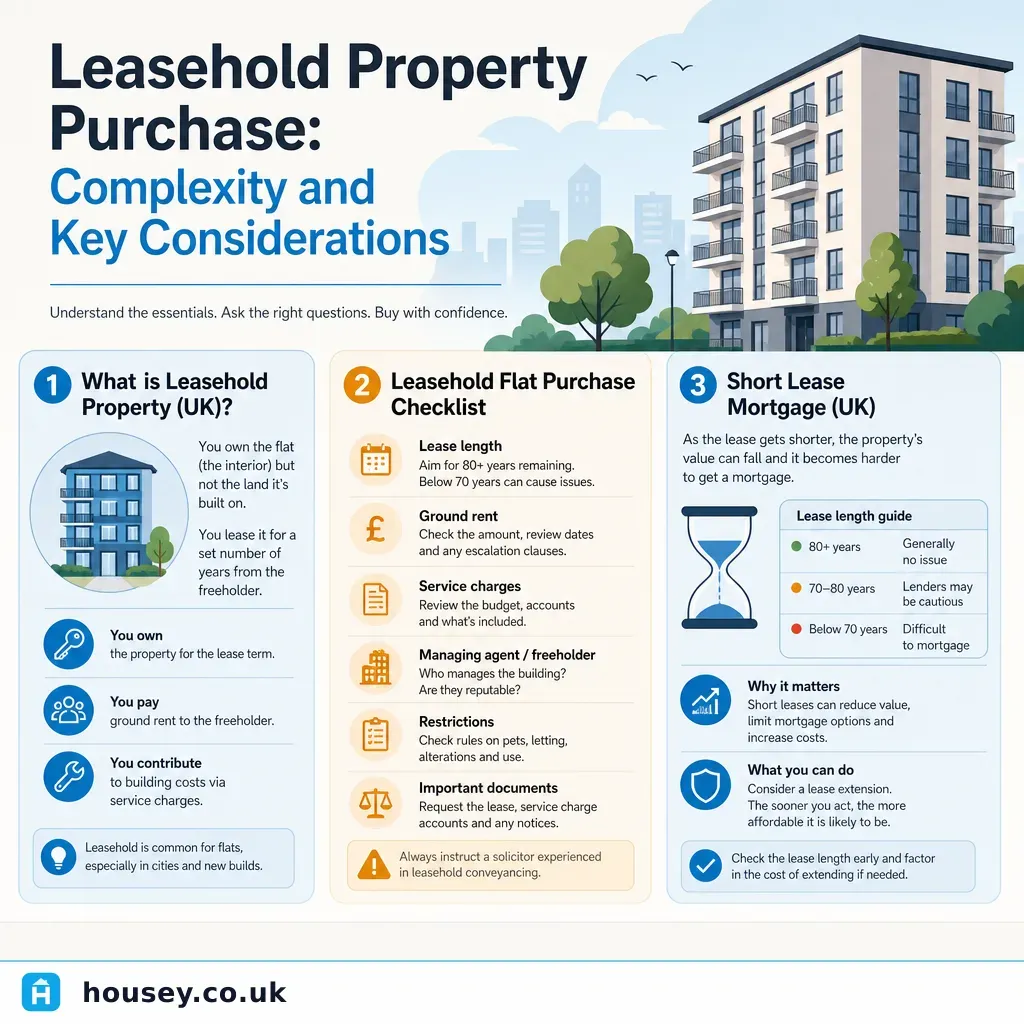
Leasehold Property Purchase: Complexity and Key Considerations
Buying a leasehold property means purchasing the right to occupy for a fixed term rather than owning the land outright.
 Buying & Moving
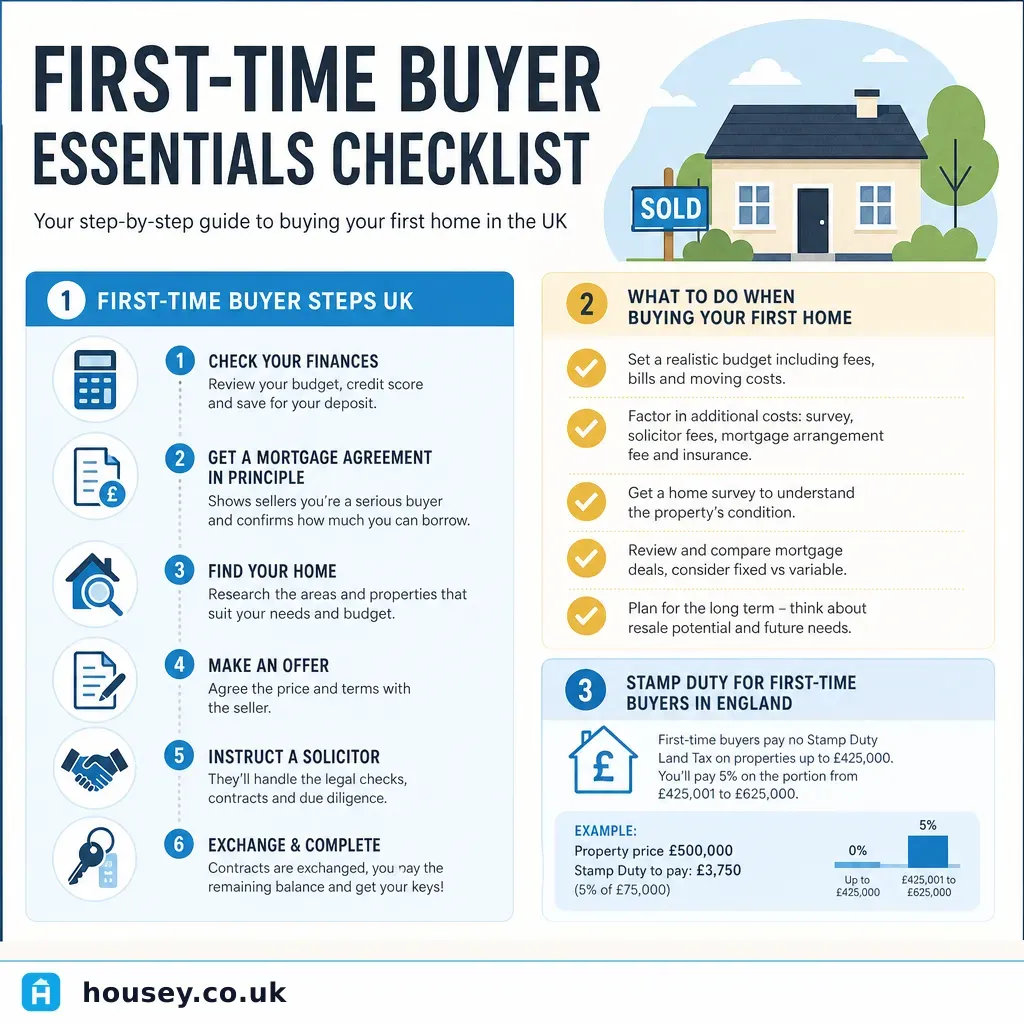
First-Time Buyer Essentials Checklist
Buying your first home involves obtaining a mortgage in principle, making an offer, instructing a solicitor, arranging a survey, and exchanging contracts before completion.