First-Time Buyer Essentials Checklist
By Housey · Last reviewed 11th of May 2026
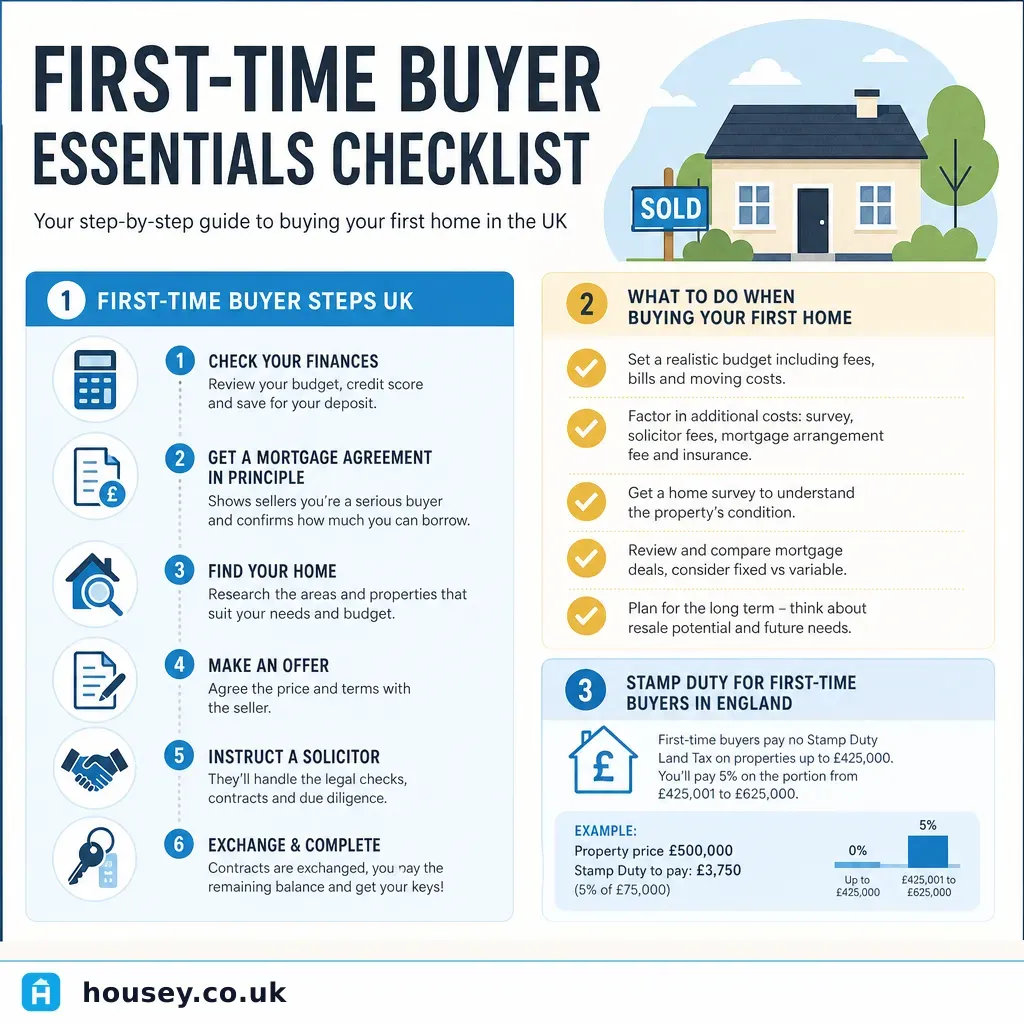
First-Time Buyer Essentials Checklist
Buying your first home in the UK involves a sequence of legal, financial, and practical stages that are rarely explained in a clear, ordered way. Decisions made early — about mortgage products, surveys, and legal representation — can significantly affect both cost and outcome later in the process. The risks of being caught out by delays, unexpected costs, or complications that could have been anticipated are real, and they fall harder on first-time buyers who have no prior experience of the process. This guide covers the key steps for buyers in England and Wales; the process differs in Scotland and Northern Ireland.
Key points
- First-time buyers in England and Northern Ireland currently pay no Stamp Duty Land Tax (SDLT) on the first £425,000 of a purchase price on properties costing up to £625,000 — check GOV.UK for current thresholds, as these are subject to change at each Budget.
- Exchange of contracts is the legally binding point in the conveyancing process; withdrawing after exchange typically means forfeiting your deposit.
- Buildings insurance must be in force from exchange of contracts, not from completion — the period between exchange and completion is one in which you are legally responsible for the property.
- A RICS Level 2 Home Survey is typically appropriate for post-1900 homes in reasonable condition; a RICS Level 3 Building Survey gives greater detail and is recommended for older, larger, or visibly defective properties.
- A lender's mortgage valuation confirms only that the property is adequate security for the loan; it is not a condition survey and does not check for defects.
The first-time buyer process: an overview
The process from deposit saving to completion typically moves through these stages in England and Wales:
- Save a deposit — most residential mortgages require at least 5–10% of the purchase price; a larger deposit usually secures a lower loan-to-value ratio and a better interest rate.
- Obtain a mortgage in principle — also called an Agreement in Principle (AIP) or Decision in Principle (DIP); a provisional confirmation from a lender of the sum they may be willing to lend, subject to full application. Estate agents frequently request this before accepting offers.
- Find a property and make an offer — offers are not legally binding at this stage in England and Wales; either party can withdraw without financial penalty until exchange of contracts.
- Instruct a solicitor or licensed conveyancer — do this promptly after offer acceptance to begin searches and review the contract pack from the seller's solicitor.
- Arrange a survey — separate from the lender's valuation; the level you choose depends on the property's age, construction, and apparent condition.
- Submit a full mortgage application — the lender commissions a valuation and assesses your financial circumstances in detail.
- Searches and enquiries — your solicitor conducts local authority, drainage, environmental, and other searches; raises enquiries with the seller's solicitor on any unclear points.
- Exchange of contracts — the legally binding point; deposit (typically 10%) transferred to the seller's solicitor; completion date agreed.
- Completion — remaining funds transferred; keys released; you are now the legal owner.
Document preparation checklist
Gather these documents before approaching a lender or solicitor to avoid delays:
- Proof of identity: passport or current UK driving licence
- Proof of address: utility bill or bank statement dated within the last three months
- Proof of income (employed): last three months' payslips and your latest P60
- Proof of income (self-employed): two to three years' HMRC SA302 tax calculations and corresponding tax year overviews
- Bank statements: last three months, showing salary credits and regular outgoings
- Deposit evidence: savings account statements showing the accumulation of funds; if any part is gifted, a signed gift letter from the donor confirming the money is not a loan
- Details of existing commitments: credit cards, personal loans, car finance, student loan balance
- Employment details: contract type, start date, employer name and address
Which survey level do you need?
Survey type | Best for | Not ideal for | Typical output |
|---|---|---|---|
RICS Level 1 Condition Report | New-build or near-new conventional homes in good condition | Older, altered, or defective properties | Traffic-light condition ratings; no repair advice |
RICS Level 2 Home Survey | Post-1900 conventional homes in reasonable condition | Older, unusual, significantly altered, or visibly defective homes | Condition ratings, defect advice, maintenance notes |
RICS Level 3 Building Survey | Older, larger, listed, or defective properties; unusual construction | Straightforward newer homes where the cost may not be justified | Detailed construction analysis, cost estimates for repairs |
Specific defect survey | One identified concern — for example, suspected movement or damp | General unknown risk across the whole building | Specialist diagnosis of that single issue |
Lender's mortgage valuation | Confirming minimum security value for the lender | NOT a condition survey — does not check for defects | Valuation figure only |
For most first-time buyers purchasing a 1970s–1990s estate house in reasonable condition, a RICS Level 2 Home Survey is appropriate. For a Victorian or Edwardian terrace, a flat in an older converted building, or any property with visible signs of defect, consider a RICS Level 3 Building Survey.
What your solicitor will check
Your conveyancing solicitor will:
- Review the title register and title plan held at HM Land Registry (or register the title if it is currently unregistered)
- Review the Property Information Form and Fittings and Contents Form supplied by the seller
- Raise and review enquiries with the seller's solicitor on any points that are unclear
- Check planning permissions and building regulations completion certificates for any alterations or extensions at the property
- Conduct searches: local authority, drainage and water, environmental, and others as advised by the search provider
- Review the Energy Performance Certificate (EPC) — a valid EPC with a rating of A–G must exist for most residential sales in England and Wales
- Report to you and to your mortgage lender before recommending exchange
If you are buying a leasehold flat, pay close attention to: remaining lease length (below 80 years significantly affects mortgage eligibility and future sale value), annual service charges and most recent accounts, ground rent terms, and any major works planned or recently completed by the freeholder.
Red flags to watch for
Certain findings during the buying process warrant extra care before proceeding:
- Missing building regulations completion certificates for extensions, loft conversions, or significant alterations — their absence may indicate unpermitted work that becomes your legal liability on purchase.
- A short lease on a leasehold property — below 80 years remaining makes lease extension significantly more expensive and can affect mortgage availability with most lenders.
- EPC rating of F or G — signals potentially high running costs and likely need for energy-efficiency investment before or after purchase.
- Survey findings referencing structural movement, active damp, or Japanese knotweed — each may require specialist investigation before exchange.
- Slow or inconsistent communication from the seller's solicitor — can indicate title complications, chain difficulties, or undisclosed issues with the property.
- A seller unwilling to reduce the agreed price after a survey identifies material defects — consider whether the purchase price still reflects the property's actual condition.
Important limitations
This checklist is general information for first-time buyers in England and Wales. Property law, tax thresholds, and mortgage regulation differ in Scotland (where the conveyancing process uses missives rather than exchange of contracts) and in Northern Ireland. SDLT thresholds, Help to Buy schemes, and Lifetime ISA rules change with government policy — always verify current figures on GOV.UK before making financial decisions. Nothing in this article constitutes legal or financial advice. You must instruct a qualified solicitor or licensed conveyancer and seek independent mortgage advice from an FCA-authorised adviser.
What to ask a qualified professional
Before instructing a solicitor:
- Are you a member of the Law Society's Conveyancing Quality Scheme (CQS)?
- What are your total fees, and what is included and excluded — searches, Land Registry fees, bank transfer charges, VAT?
- How will you communicate with me during the process, and who is my day-to-day contact?
Before committing to a mortgage product:
- What is the total cost over the initial fixed-rate period and over the full mortgage term?
- What early repayment charges apply if I want to remortgage before the fixed-rate period ends?
- Am I eligible for any government-backed schemes such as a Lifetime ISA bonus or a mortgage guarantee?
Before proceeding after a survey:
- Does the surveyor recommend any specialist investigations before exchange of contracts?
- Should I seek to renegotiate the purchase price in light of the findings?
- What is the estimated cost and urgency of repairs flagged as required or recommended?
When to get professional help
You will need qualified professional input at almost every stage of a property purchase. Seek immediate professional advice if:
- A survey finding references structural movement, asbestos, Japanese knotweed, or significant flooding risk.
- Your solicitor identifies a leasehold complication: a lease under 80 years, onerous ground rent terms, or disputed service charges.
- There is a discrepancy between the title register and the physical boundaries of the property as you understand them.
- Building regulations compliance is uncertain for alterations or extensions already present at the property.
How Housey can help
Housey connects first-time buyers with the professionals they need at each stage. Book a RICS Home Survey to understand the condition of your intended purchase, arrange a valuation survey for an independent assessment of the property's value, confirm the property has a valid Energy Performance Certificate, and find qualified conveyancing support to manage the legal process from offer to completion.
Frequently asked questions
How long does the buying process take in England?
From offer acceptance to completion, the process typically takes 8–16 weeks in straightforward cases. Complex chains, leasehold complications, slow local authority searches, or outstanding planning queries can extend this considerably. Instructing a solicitor promptly after offer acceptance and responding quickly to information requests from your solicitor and lender helps avoid unnecessary delays.
Do I need a survey if I am getting a mortgage?
The lender's mortgage valuation is not a survey. It confirms only that the property is worth enough to secure the lender's loan — it does not check the condition of the building. Commissioning a separate RICS Home Survey is strongly advisable for most purchases, regardless of property age or apparent condition. Survey findings may also give you grounds to renegotiate the purchase price.
What is a Lifetime ISA and can I use it towards a first home?
A Lifetime ISA (LISA) allows UK residents aged 18–39 to save up to £4,000 per year and receive a 25% government bonus — up to £1,000 annually — which can be applied to a first home purchase on properties priced at £450,000 or under. Eligibility rules are set by HMRC. Check GOV.UK for current criteria before opening or using a LISA, as rules may change.
What searches does my solicitor carry out?
Standard conveyancing searches typically include a local authority search (covering planning permissions, road adoption, and enforcement notices), a drainage and water search, and an environmental search (flooding, contamination, subsidence risk). Your solicitor may recommend additional searches depending on the property's location or history, and should explain each search, what it covers, and its cost before ordering.
Sources and further reading
- GOV.UK — Stamp Duty Land Tax for first-time buyers — GOV.UK / HMRC
- HM Land Registry — buying and selling property — HM Land Registry
- RICS — consumer guide to home surveys — RICS
- Citizens Advice — buying a home — Citizens Advice
- GOV.UK — Lifetime ISA — GOV.UK / HMRC
- Law Society — Conveyancing Quality Scheme — The Law Society
Useful next reads
 Buying & Moving
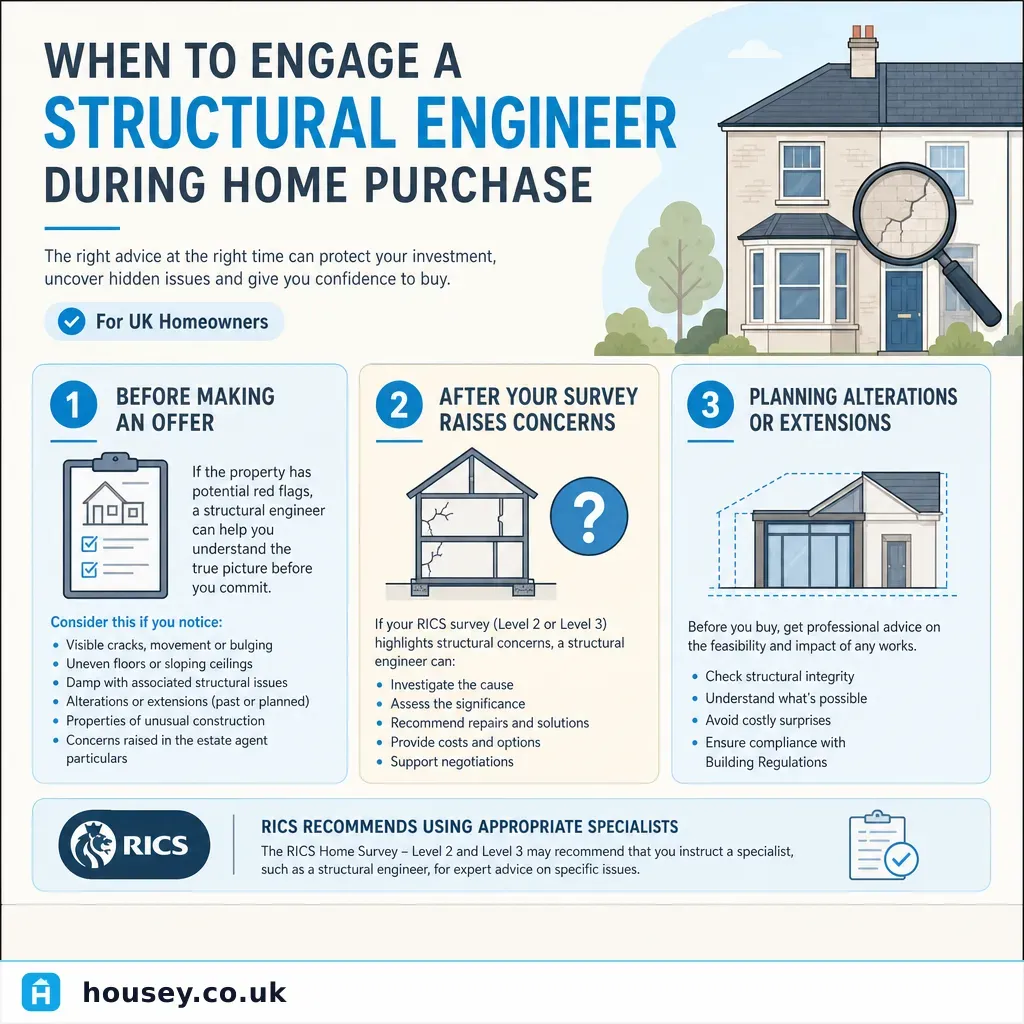
When to Engage a Structural Engineer During Home Purchase
Instruct a structural engineer before exchange if your RICS survey flags movement, cracking rated condition 3, or suspected subsidence.
 Buying & Moving
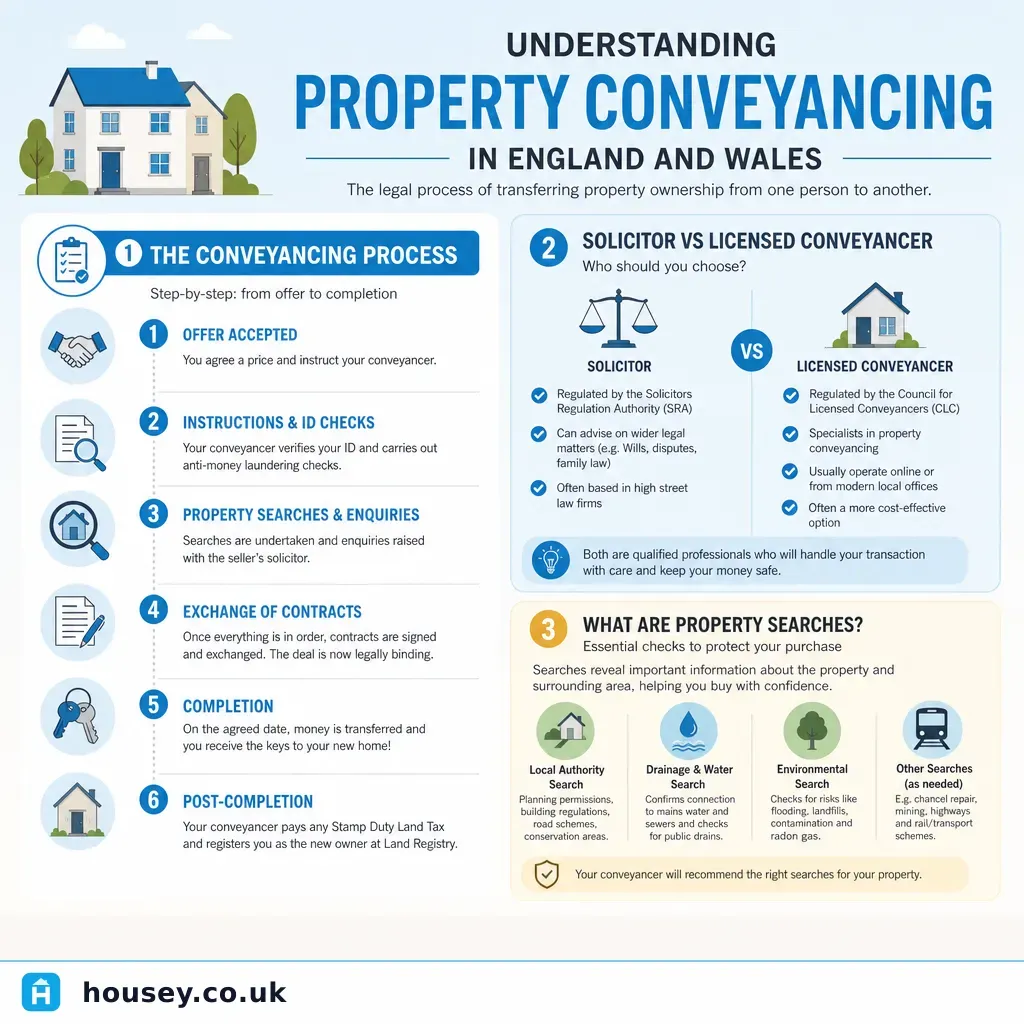
Understanding Property Conveyancing in England and Wales
Conveyancing is the legal process of transferring property ownership in England and Wales.
 Buying & Moving
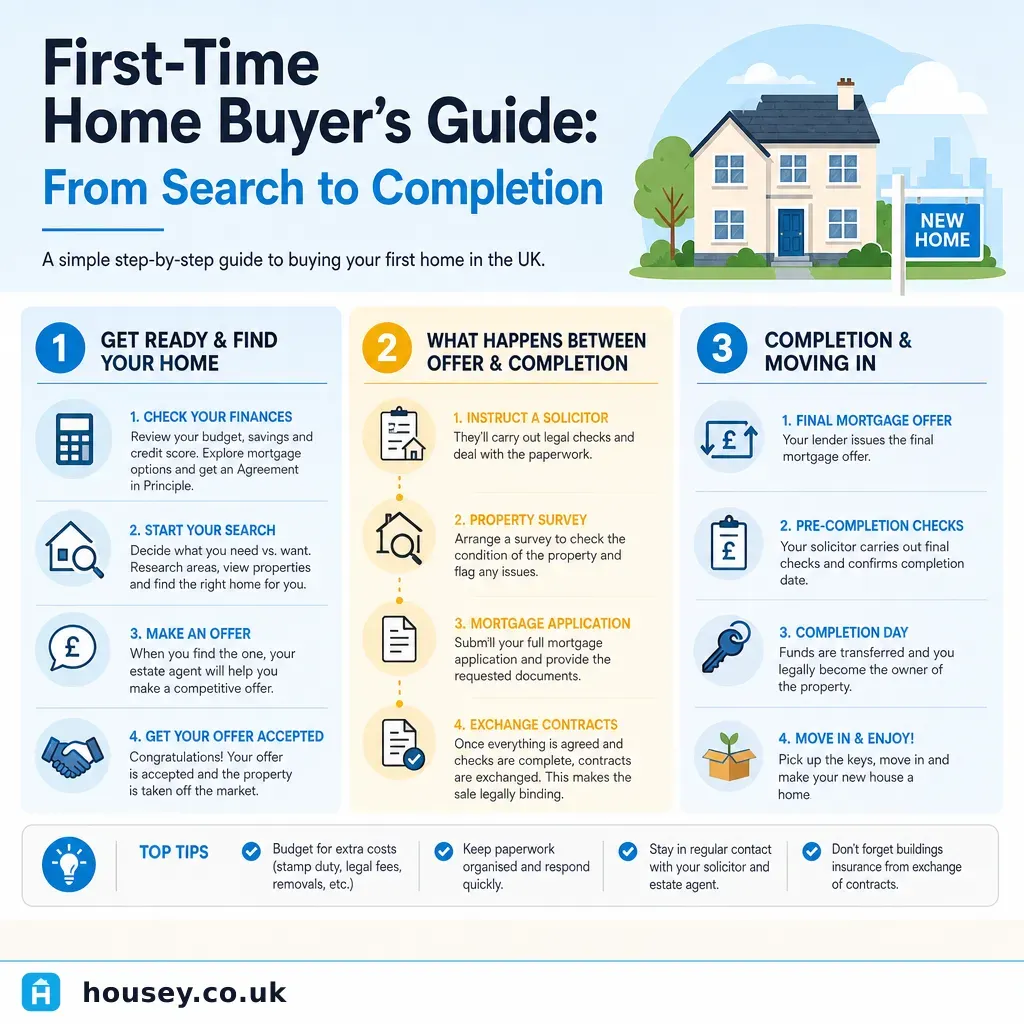
First-Time Home Buyer's Guide: From Search to Completion
Buying your first home in the UK typically takes 3–6 months from offer acceptance to completion.
 Buying & Moving
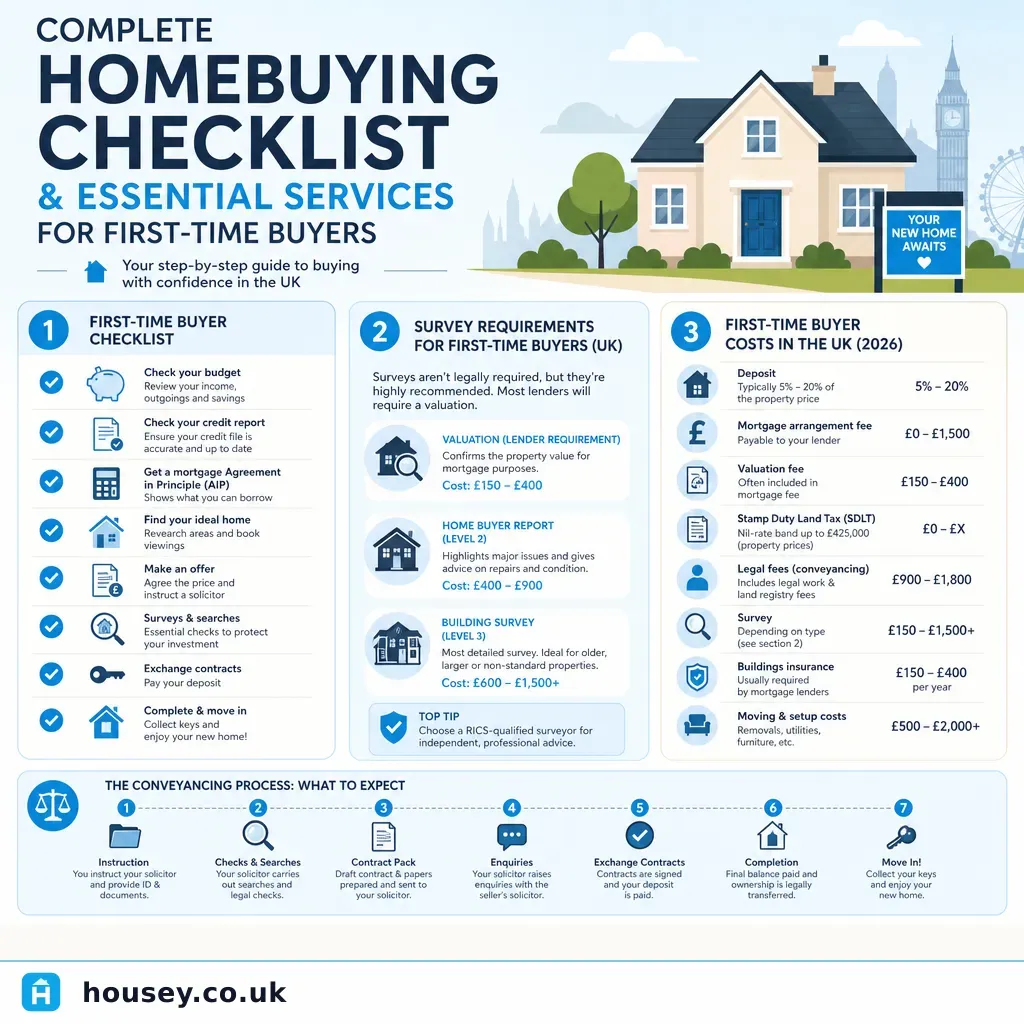
Complete Homebuying Checklist and Essential Services for First-Time Buyers
First-time buyers in the UK should commission an independent RICS Home Survey before exchange — a mortgage lender's valuation does not protect you.
 Buying & Moving
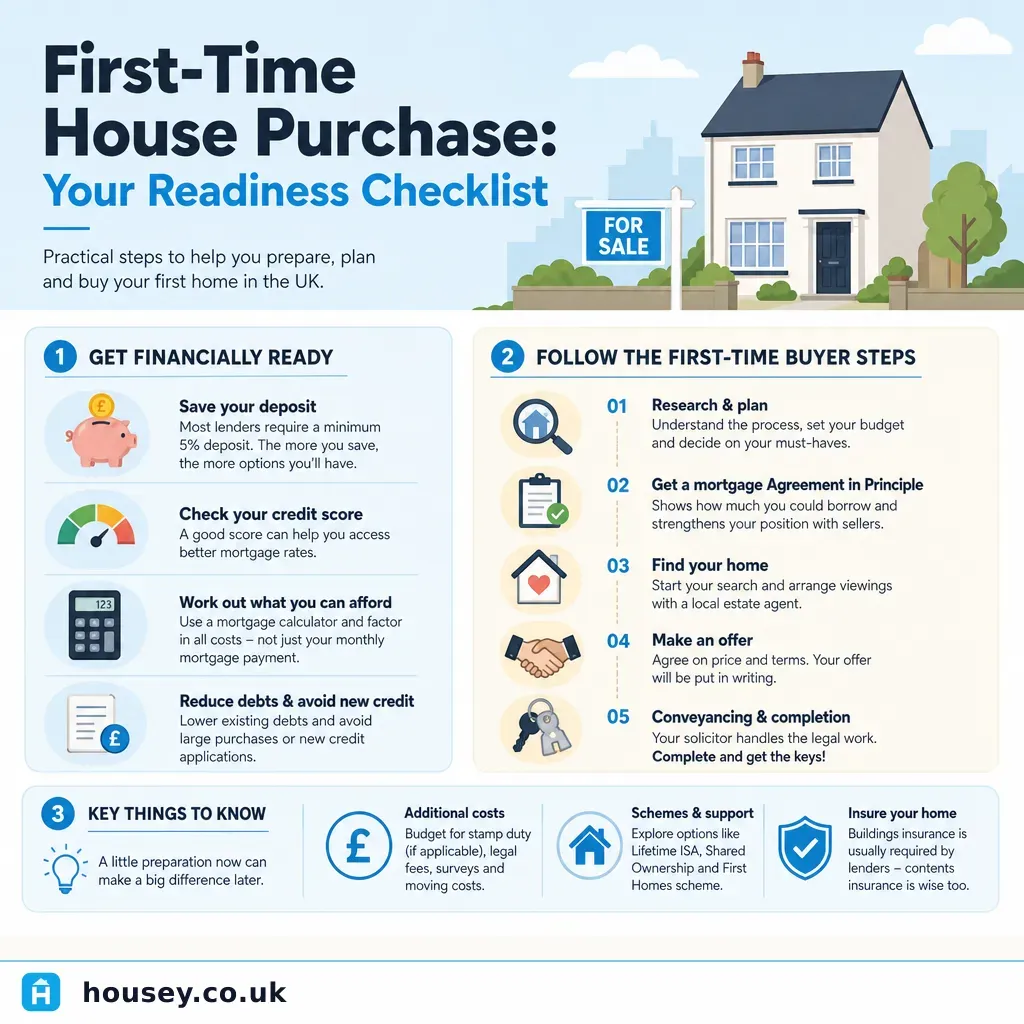
First-Time House Purchase: Your Readiness Checklist
Before making your first offer, have a mortgage agreement in principle, a deposit plus buying costs saved (allow 2–3% of the purchase price beyond the deposit itself), and a conveyancer ready to instruct.