The Complete Property Buying Guide: From Search to Purchase
By Housey · Last reviewed 18th of May 2026
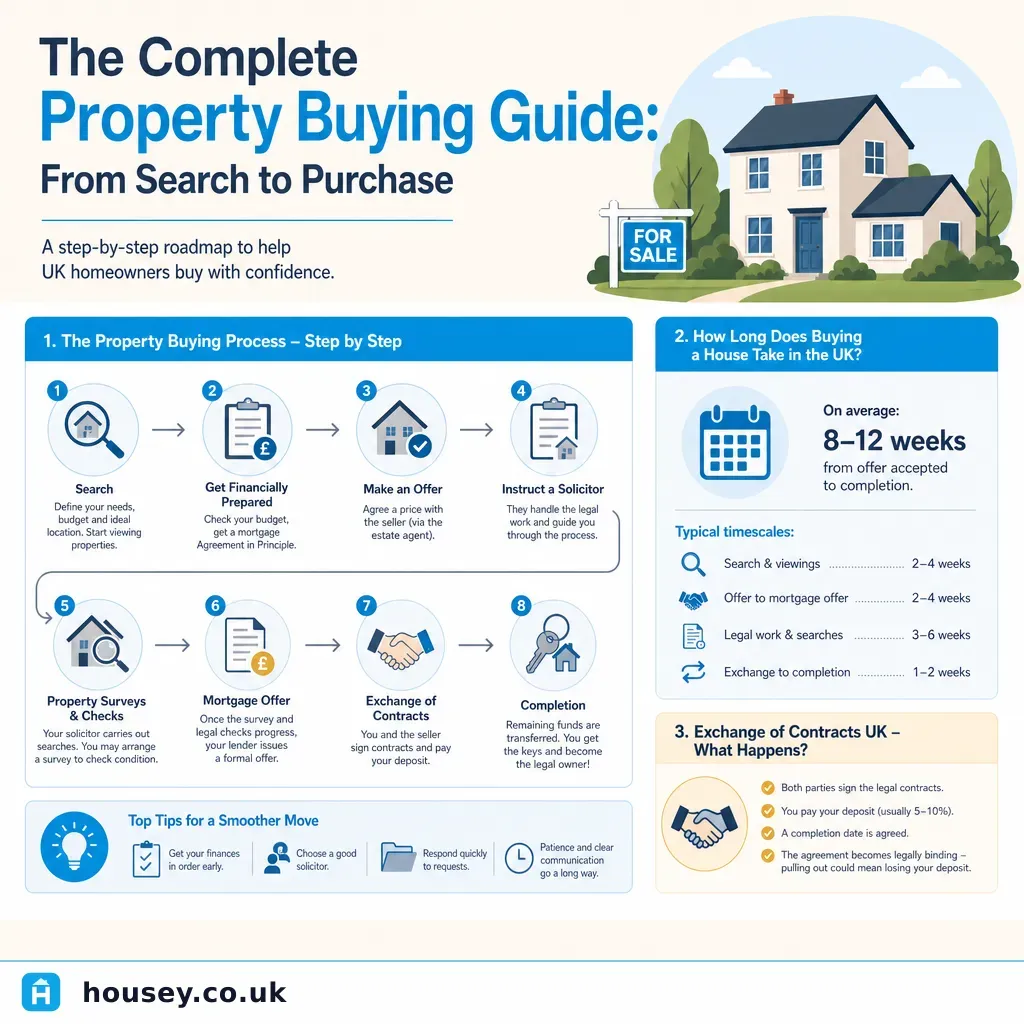
The Complete Property Buying Guide: From Search to Purchase
Buying a property in the UK involves more legal, financial, and procedural steps than almost any other transaction most people will make. Understanding how each stage connects to the next — what can go wrong, which professionals to instruct, and when to instruct them — helps you move faster, protect your deposit, and avoid the most common and costly mistakes. This guide covers the process for England and Wales; Scotland and Northern Ireland operate under different legal systems and are noted where significant differences apply.
Key points
- In England and Wales, a sale only becomes legally binding at exchange of contracts — either party can withdraw before then, often without financial penalty, unless a formal exclusivity agreement is in place.
- Conveyancing typically takes 8–16 weeks from instruction to exchange, depending on chain complexity, title issues, and local authority search turnaround times.
- From 1 April 2025, the Stamp Duty Land Tax (SDLT) first-time buyer threshold reverted to £300,000 (from the temporary £425,000); standard tiered residential rates apply above that figure.
- A mortgage lender's valuation is not a structural survey — it confirms the property is worth the purchase price to the lender, not whether the building is in good condition.
- Scotland operates under Scots law: offers are made through a solicitor, and the binding missive system can create legal commitment earlier in the transaction than in England and Wales.
How the property buying process works in England and Wales
Stage 1: Preparation — before you view
Before viewing properties seriously, establish your financial position. Check your credit file with the main agencies (Experian, Equifax, TransUnion) and correct any errors. Calculate your maximum budget including purchase costs — not just the deposit.
Budget items to calculate before searching:
- Deposit (minimum 5% for most lenders; 15–25% typically attracts better mortgage rates)
- Stamp Duty Land Tax — use the HMRC calculator for your purchase price and buyer status
- Conveyancing fees (indicative: £1,000–£2,500 including searches and Land Registry fee)
- Survey (indicative: £300–£1,500 depending on level and property size)
- Mortgage arrangement fee, if applicable
- Removal costs
- Building insurance (required by most lenders from the date of exchange)
Indicative UK costs, last reviewed 2026-05-18. Costs vary significantly by property price, location, and provider — obtain individual quotes for each.
Obtain a mortgage Agreement in Principle (AIP) before making offers. Estate agents often ask to see one before accepting.
Stage 2: Searching and viewing
Use the major property portals (Rightmove, Zoopla, OnTheMarket) and registered estate agents — NAEA Propertymark members follow a code of practice. During viewings, note:
- Damp patches, staining, or a persistent musty smell
- Cracks in walls, particularly diagonal cracks through brickwork
- Evidence of past flooding (tide marks, recent low-level replastering)
- Loft access to check insulation and roof structure
- Boiler age and whether it has an up-to-date Gas Safe service record
- Age of the consumer unit (fuse box) and whether it has modern MCBs
- EPC rating and what it means for running costs and future upgrade obligations
Stage 3: Making an offer
Offers are made verbally or in writing to the estate agent and are not legally binding in England and Wales. Once an offer is accepted:
- Inform your mortgage lender to proceed with the full application
- Instruct a conveyancer immediately — do not wait for the survey results
- Book your RICS survey
Stage 4: Conveyancing — 8–16 weeks
Your conveyancer will request and review the seller's property information forms (TA6 for general information, TA10 for fittings and contents, TA7 if leasehold), carry out local authority, drainage, and environmental searches, review the title register and title plan at HM Land Registry, raise enquiries with the seller's solicitor, report to you on findings, and coordinate exchange and completion once all parties are ready.
Stage 5: Survey — book as soon as the offer is accepted
Commission a RICS survey independently of the mortgage valuation. The right level depends on the property:
Survey level | What it covers | Best for | Not ideal for |
|---|---|---|---|
RICS Level 1 (Condition Report) | Traffic-light condition ratings; no repair advice | Modern, conventional properties in good condition | Older, altered, or visibly defective properties |
RICS Level 2 (Home Survey) | Material defects, maintenance advice, repair recommendations | Most mainstream properties including older homes in reasonable condition | Properties with significant structural concerns |
RICS Level 3 (Building Survey) | Full structural analysis; detailed defects; repair options; cost guidance | Victorian, Edwardian, unusual, or visibly defective properties | Straightforward modern new-builds |
Valuation survey | Market value opinion | When a formal valuation is required for mortgage or legal purposes | Replacing a condition survey |
New-build snagging | Inspection for defects before legal completion | Newly built properties under developer warranty | Second-hand properties |
Stage 6: Exchange of contracts
At exchange, both parties sign identical contracts and the buyer pays the deposit (usually 10% of the purchase price, though this can be negotiated). The sale becomes legally binding. If the buyer withdraws after exchange without valid grounds, they forfeit the deposit. If the seller withdraws, they may be liable for the buyer's wasted costs.
Stage 7: Completion
Completion happens on the agreed date (often 1–4 weeks after exchange). Mortgage funds are released, the purchase price is transferred to the seller's solicitor, and keys are handed over. Your conveyancer registers the transfer of ownership at HM Land Registry.
Worked example: buying a 1960s semi-detached house in the Midlands
Scenario: first-time buyer purchasing a 1960s semi-detached house in Coventry for £230,000 with a 10% deposit.
Cost item | Amount | Notes |
|---|---|---|
Purchase price | £230,000 | — |
Deposit (10%) | £23,000 | Paid at exchange |
SDLT (first-time buyer, from April 2025) | £0 | Below £300,000 threshold |
Mortgage amount | £207,000 | — |
Conveyancing fees (indicative) | £1,400 | Including searches and Land Registry fee |
RICS Level 2 survey (indicative) | £500 | Varies by provider and property size |
Mortgage arrangement fee (indicative) | £999 | Can often be added to loan |
Removal costs (indicative) | £800 | Local move |
Total upfront costs (approximate) | £26,700 | Plus ongoing mortgage payments |
All figures indicative, last reviewed 2026-05-18. Obtain individual quotes from solicitors, surveyors, and removal companies for accurate costs.
Document preparation list
Gather these documents before instructing a conveyancer or applying for a mortgage:
Which survey or purchase route do you need?
- Choose a RICS Level 1 survey if the property is a modern new-build or recently completed conventional home with no visible defects.
- Choose a RICS Level 2 survey if the property is a mainstream house or flat — including older properties in reasonable condition with no significant concerns flagged during viewings.
- Choose a RICS Level 3 survey if the property is Victorian or Edwardian, has had significant alterations, shows signs of damp or cracking, or is of unusual construction.
- Commission a new-build snagging survey if buying a newly built home before or shortly after legal completion — developers are not always prompt at addressing defects identified after keys are handed over.
- Instruct a structural engineer (in addition to or instead of a general survey) if there are visible signs of subsidence, stepped cracking through brickwork, or differential settlement.
- Check with your conveyancer before proceeding if the property is leasehold with fewer than 80 years on the lease, has an unregistered title, or involves shared ownership — the legal complexity differs substantially from a standard freehold purchase.
- Review the flood risk map (Environment Agency, GOV.UK) early in the process if the property is near a river, coast, or low-lying ground — flood risk affects insurance cost and mortgage availability.
Important limitations
This article describes the typical property purchase process in England and Wales. Scotland operates under Scots law, where offers are made through solicitors and the missive system creates binding obligations at a different point in the transaction. Wales follows the same conveyancing law as England but has its own Land Transaction Tax (LTT) rather than SDLT. Northern Ireland has a separate property law system. Nothing in this article constitutes legal, financial, or tax advice. Rules, thresholds, and scheme availability change — always instruct a qualified conveyancer or solicitor and take independent financial advice before committing to a purchase.
What to ask a qualified professional
Ask your conveyancer or solicitor:
- Are there any title defects, restrictive covenants, or rights of way that could affect the property's use or future saleability?
- What do the local authority, drainage, and environmental search results show — and are there any issues I should investigate further?
- If leasehold: what is the remaining lease term, and are there any planned major works, service charge disputes, or ground rent review clauses?
- Are there any indemnity insurance policies in place, and why have they been taken out?
Ask your RICS surveyor:
- What survey level do you recommend for this specific property, and what was your reasoning?
- Did the survey identify any defects requiring specialist investigation before I exchange contracts?
- Are there any issues that are likely to affect the mortgage lender's valuation?
Ask your mortgage broker:
- Are there any conditions attached to the mortgage offer that I need to satisfy before exchange?
- How does the lender treat gifted deposits, bonus income, or self-employed earnings?
- What happens if the property valuation comes in below the purchase price?
When to get professional help
Professional help is required throughout the purchase process — conveyancing and mortgage advice are not optional. Seek additional specialist input in these circumstances:
- Structural concerns — if the survey identifies movement, subsidence, or significant cracking, a structural engineer may be needed before you decide whether to proceed.
- Listed buildings — any alterations require Listed Building Consent; commission a specialist building survey and confirm planning history with your conveyancer.
- Flood risk — properties in high flood-risk zones may face higher insurance premiums or limited mortgage availability; check the Environment Agency flood map early.
- Auction purchases — instruct a solicitor to review the legal pack before bidding; exchange takes place on the fall of the hammer and completion is typically required within 28 days.
- Shared ownership — the legal structure differs from a standard purchase; ensure your solicitor has experience with shared ownership transactions.
How Housey can help
Housey connects you with professionals at every stage of the property buying process. Compare quotes for conveyancing from qualified solicitors and licensed conveyancers, or choose the right survey from a RICS Level 1 survey for modern homes through to a RICS Level 3 survey for older or complex properties. If you need a formal valuation survey, an Energy Performance Certificate to understand running costs, or a new-build snagging survey before you complete on a new development, Housey can connect you with accredited providers near you.
Frequently asked questions
How long does it take to buy a property in England?
The average purchase in England takes 3–6 months from offer accepted to completion, though simpler chain-free transactions can complete in 8–10 weeks. Complex chains, slow local authority search turnaround times, or title issues can extend this significantly. Scotland can be faster due to the legally binding missive system, but timescales still depend on the specific transaction.
Can the seller pull out after my offer is accepted?
Yes. In England and Wales, neither party is legally committed until contracts are exchanged. The seller can accept a higher offer (gazumping) or withdraw for any reason before exchange. This is why moving quickly to instruct your conveyancer and commission a survey reduces the window of risk. Scotland's missive system creates a binding commitment earlier in the process.
What happens if the survey reveals problems?
You can proceed as planned, negotiate a price reduction or repair credit, require the seller to carry out specific works before completion, or withdraw from the purchase — all before exchange. The survey report is a negotiation tool, not just an information source. Your conveyancer can help you frame any renegotiation request professionally based on the surveyor's findings.
Do I need a solicitor or can I do my own conveyancing?
DIY conveyancing is legal only for cash buyers and is rarely advisable. If you have a mortgage, your lender will require a qualified conveyancer. The risks of missing title defects, incorrect Land Registry registration, or failing anti-money laundering checks are significant. A licensed conveyancer or solicitor regulated by the CLC or SRA respectively is required for all mortgaged purchases.
What is gazumping and how can I reduce the risk?
Gazumping occurs when a seller accepts a higher offer from another buyer after having accepted yours, but before exchange. There is no legal remedy in England and Wales. To reduce the risk: instruct your solicitor immediately, commission your survey promptly, ask the seller to take the property off the market, and consider an exclusivity agreement — your solicitor can advise on whether this is appropriate.
Sources and further reading
- Stamp Duty Land Tax — GOV.UK
- Registering land or property with HM Land Registry — HM Land Registry / GOV.UK
- RICS Home Survey Standard — RICS
- Buying a home: before you start — Citizens Advice
- Flood map for planning — Environment Agency / GOV.UK
Useful next reads
 Buying & Moving
Property Terminology and Listing Definitions: Buyer's Reference Guide
UK property listings and conveyancing documents use specific terms that affect buying decisions.
 Buying & Moving
Conveyancing Glossary: Key Terms and Definitions for Property Buyers
Conveyancing involves specific legal terms that appear throughout a UK property purchase.
 Buying & Moving
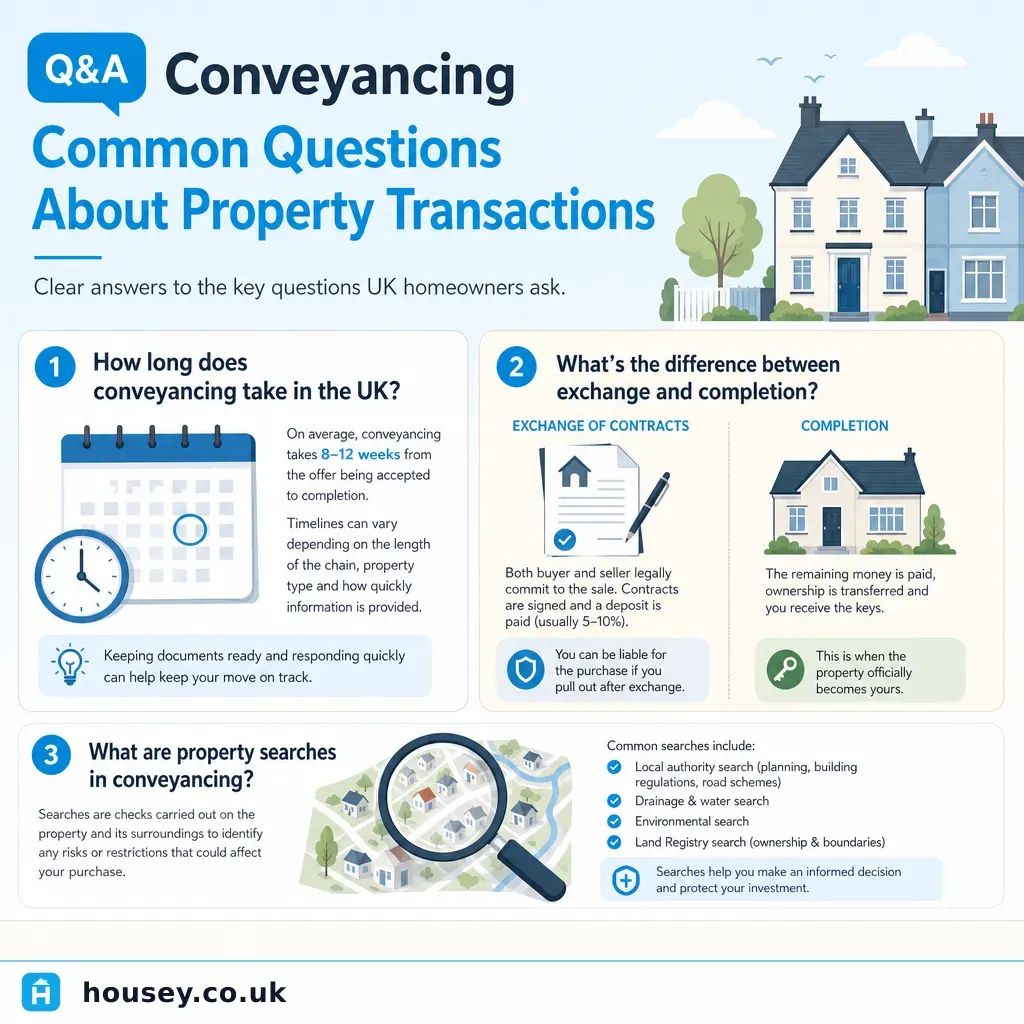
Conveyancing Q&A: Common Questions About Property Transactions
Conveyancing is the legal transfer of property ownership, typically taking 12 to 16 weeks in England and Wales.
 Buying & Moving
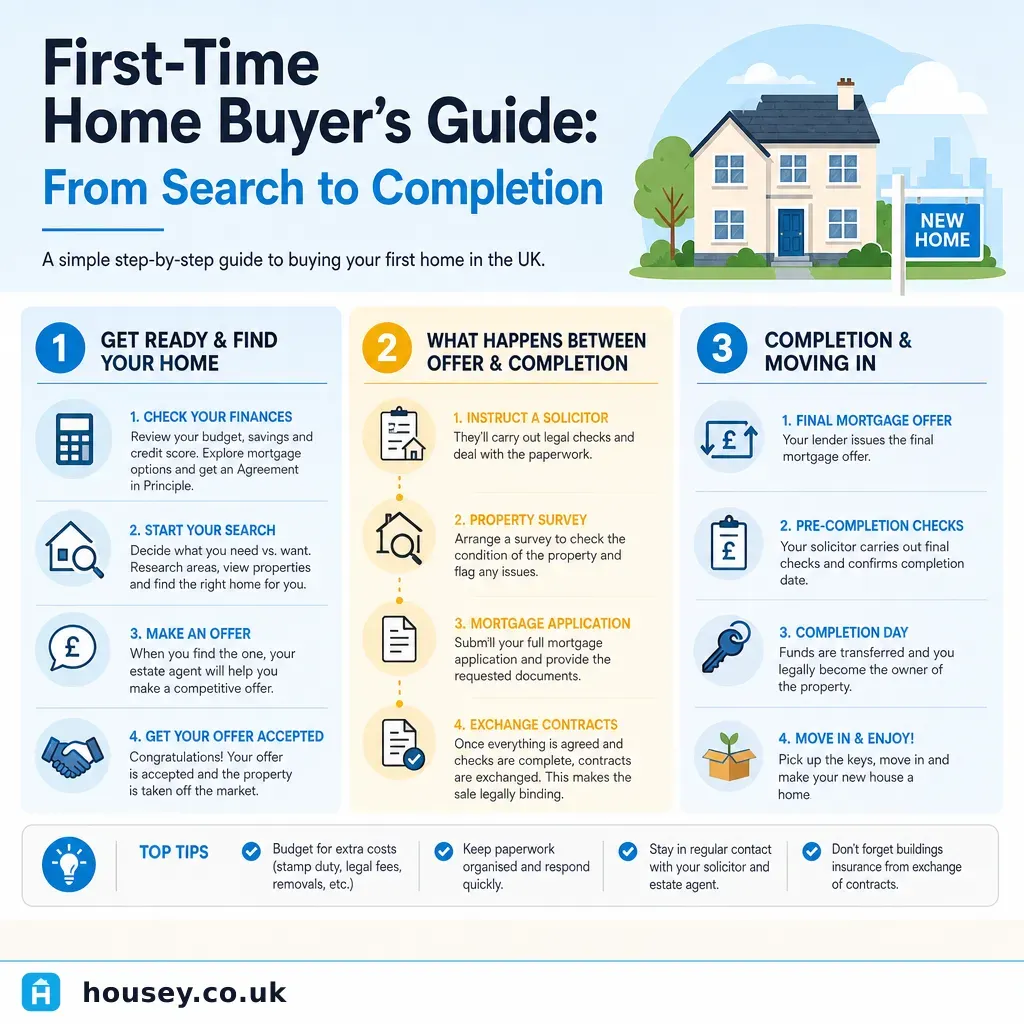
First-Time Home Buyer's Guide: From Search to Completion
Buying your first home in the UK typically takes 3–6 months from offer acceptance to completion.
 Buying & Moving
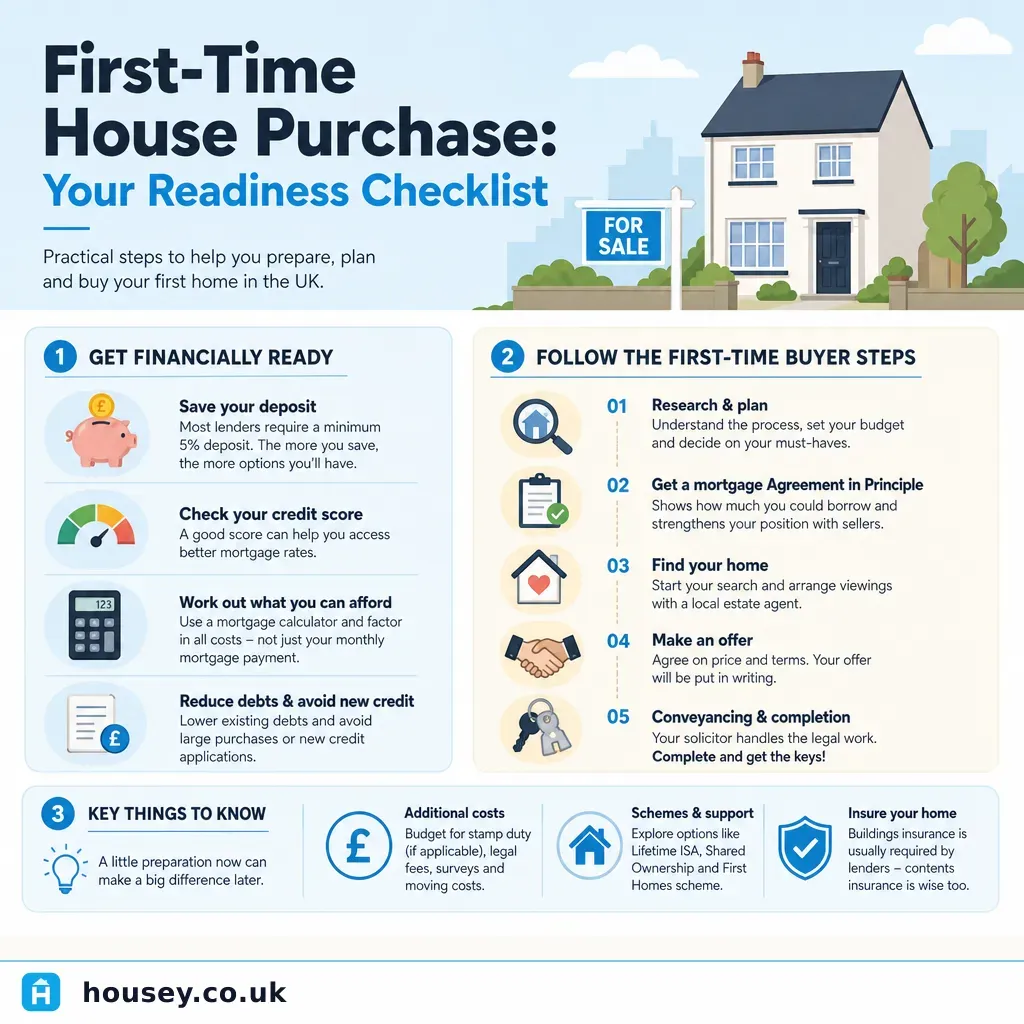
First-Time House Purchase: Your Readiness Checklist
Before making your first offer, have a mortgage agreement in principle, a deposit plus buying costs saved (allow 2–3% of the purchase price beyond the deposit itself), and a conveyancer ready to instruct.