Leasehold Property Purchase: Complexity and Key Considerations
By Housey · Last reviewed 25th of May 2026
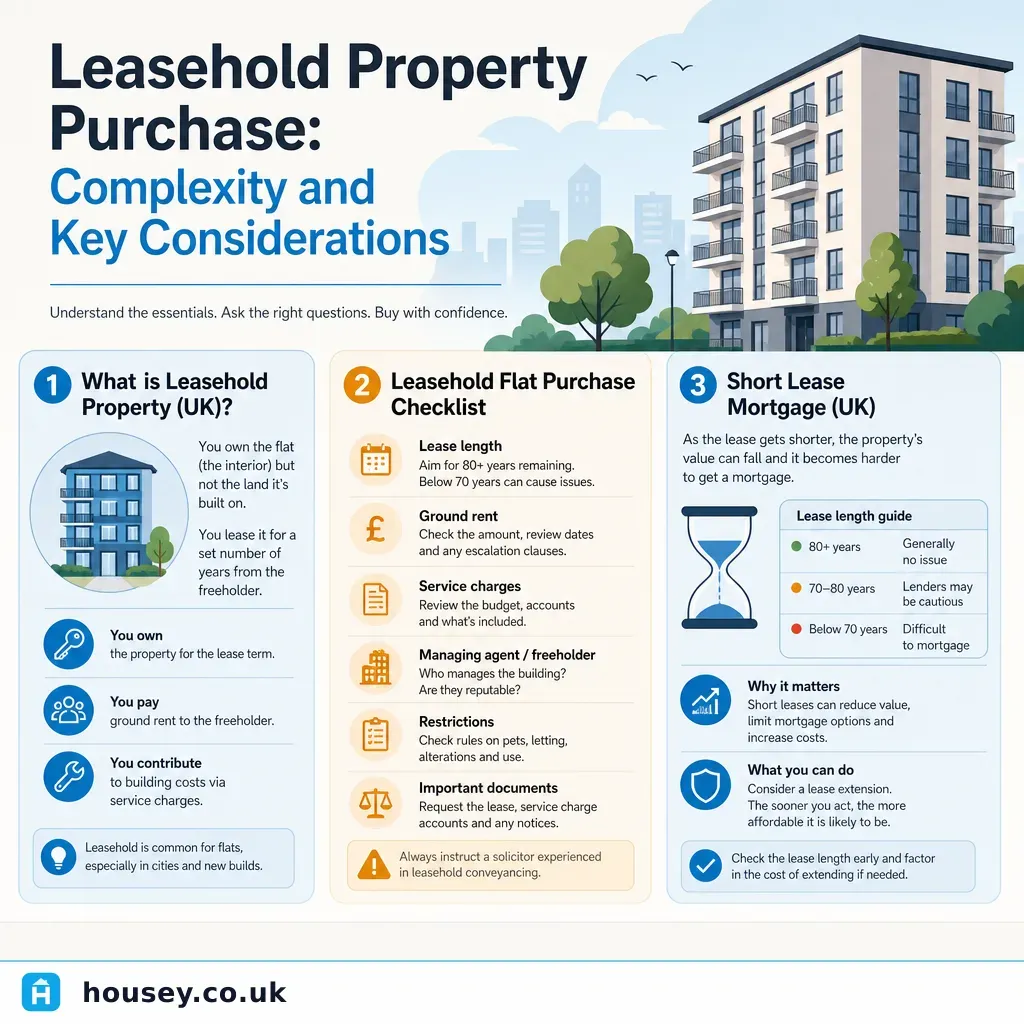
Leasehold Property Purchase: Complexity and Key Considerations
Leasehold purchases account for the majority of flat sales in England and Wales and a significant share of new-build transactions. For buyers moving from freehold experience, or buying their first flat, the additional layers of legal obligation and ongoing cost can come as a surprise. Unlike freehold ownership, leasehold property comes with a defined remaining term, a third party holding management responsibilities, and a set of covenants that govern how you use, alter, and sublet your home.
Key points
- Leases with fewer than 80 years remaining trigger a marriage value uplift in statutory lease extension calculations under the Leasehold Reform, Housing and Urban Development Act 1993, substantially increasing the premium payable.
- The Leasehold Reform (Ground Rent) Act 2022 banned above-peppercorn ground rents for new residential leases granted from 30 June 2022; pre-2022 leases retain their original ground rent terms.
- The Leasehold and Freehold Reform Act 2024 introduced further statutory rights for leaseholders — check with your conveyancer which provisions are in force at the time of your purchase.
- Service charges are not nationally capped; leaseholders can challenge unreasonable charges at the First-tier Tribunal (Property Chamber) under section 19 of the Landlord and Tenant Act 1985.
- A management pack ordered from the freeholder or managing agent typically costs £200–£500 and discloses service charge history, reserve fund position, and any Section 20 consultation notices for planned major works.
What leasehold means in practice
When you buy a leasehold property, you purchase the right to occupy the property for the remaining years of a fixed lease term — commonly originally granted for 99, 125, or 999 years. The land, and usually the main structure of the building, is owned by the freeholder, often also called the landlord.
This differs fundamentally from freehold ownership. As a leaseholder you are bound by the covenants in your lease — rules about alterations, subletting, pets, and use of communal areas — and are usually obliged to pay ground rent (on older leases), service charges, and building insurance arranged by the freeholder. These obligations continue for the life of the lease and affect both your day-to-day ownership costs and the property's future resale value.
Leasehold vs freehold: how they compare
Feature | Leasehold | Freehold |
|---|---|---|
What you own | Right to occupy for a fixed remaining term | Property and land outright |
Ground rent | May apply on pre-2022 leases | Not applicable |
Service charges | Usually payable to freeholder or managing agent | Not applicable |
Building management | Freeholder or managing agent controls | Your responsibility |
Alterations | Usually require landlord's licence to alter | Your decision |
Lease extension | Statutory right available; has a cost | Not required |
Typical property types | Flats, some new-build houses | Houses, bungalows |
Lease length: why the remaining term matters
Lenders and valuers assess the remaining lease term at the time you buy — not the original granted term. The implications change significantly as the lease shortens:
- 90 years or more remaining: Generally acceptable to most high-street lenders with no special conditions.
- 80–90 years: Approaching the critical threshold; factor lease extension costs into your offer before committing.
- Below 80 years: Marriage value becomes payable in a statutory lease extension, significantly increasing the premium. Many lenders apply restrictions or decline entirely.
- Below 70 years: Very few lenders will lend at standard terms; most buyers must negotiate a simultaneous lease extension as a condition of purchase.
You acquire the statutory right to extend a lease by 90 years (at a peppercorn ground rent) under the Leasehold Reform, Housing and Urban Development Act 1993 after two years of ownership. A seller can assign this right to you at the point of sale, avoiding the two-year wait — ask your conveyancer to investigate this if the remaining term is below 90 years.
Ground rent: old and new rules
The Leasehold Reform (Ground Rent) Act 2022 banned ground rents above a peppercorn for new residential leases in England and Wales granted from 30 June 2022. For leases granted before that date, the original ground rent terms remain in force and are binding on buyers.
Red flags to watch for in older lease ground rent clauses:
- Ground rent that doubles every 10 or 25 years (sometimes called doubling ground rents)
- Ground rent linked to the Retail Price Index or periodic property value reviews
- Ground rent above £250 per year (£1,000 in Greater London) — these historically triggered the Housing Act 1988 Assured Tenancy definition, creating potential grounds for possession
- Any ground rent above a peppercorn on a lease dated after 30 June 2022 — if this appears on a post-2022 lease, seek immediate legal advice as it may indicate a drafting error with serious consequences
Service charges and major works
Service charges cover maintenance, building insurance, communal utilities, management fees, and other shared costs. They vary enormously — from a few hundred pounds per year in a small self-managed block to several thousand pounds in a large managed development with lifts, concierge, and extensive communal areas.
Key things to check before exchange:
- Current annual service charge amount and the last three years of accounts
- Whether a Section 20 consultation has been issued for planned major works — roof, cladding, lifts, or windows can result in significant one-off bills
- Reserve or sinking fund balance — a well-managed building holds meaningful reserves relative to its age and condition
- Whether the managing agent is a member of a recognised body such as ARMA (Association of Residential Managing Agents)
- Any arrears owed by other leaseholders, which can affect communal repairs and services
Under section 19 of the Landlord and Tenant Act 1985, service charges must be reasonable. Leaseholders can apply to the First-tier Tribunal (Property Chamber) for a determination if charges appear excessive.
The management pack: what it contains
Your conveyancer will request a management pack from the freeholder or managing agent. It typically includes:
- Latest service charge accounts and the annual budget
- Reserve or sinking fund balance and recent contributions
- Ground rent confirmation and payment history
- Any Section 20 consultation notices for planned major works
- Building insurance schedule and current cover level
- Details of any ongoing disputes or tribunal applications
- Three years of service charge history
Management packs can take 4–6 weeks to arrive from some managing agents. Ordering early avoids delays to your exchange timeline — late receipt of the pack is a common reason for slippage in leasehold transactions.
Leasehold purchase checklist
Work through these points before exchanging contracts on any leasehold property:
What not to assume
- "The lease is 125 years" does not mean 125 years remain. Calculate from the date the lease was originally granted; a 125-year lease granted in 1975 has approximately 74 years left.
- "Ground rent is only £150 a year" is not automatically safe. Check the escalation clause — a doubling every 10 years compounds rapidly and will cause serious mortgage and resale problems within a decade.
- "The managing agent is well known" does not confirm good management. Ask your conveyancer to check for any First-tier Tribunal decisions and review Companies House status for the management company.
- "The building looks well maintained" does not mean no large bills are coming. A Section 20 notice for roof replacement, cladding remediation, or lift overhaul could arrive shortly after you exchange contracts.
Important limitations
This article covers leasehold property purchase in England and Wales. Scotland uses a different system — most Scottish flats are owned under tenement ownership rather than leasehold. Northern Ireland has its own leasehold framework. Leasehold reform legislation is developing rapidly; the Leasehold and Freehold Reform Act 2024 has provisions being brought into force over time and the position may have changed since this article was last reviewed. Always obtain current legal advice from a qualified conveyancer before exchange.
What to ask a qualified professional
Before exchanging contracts on a leasehold property:
- What is the remaining lease term, and does it meet my lender's minimum requirements?
- Is there a ground rent clause that escalates, and does it create any Housing Act 1988 risk?
- Has the management pack been received and reviewed in full — are there any concerns about charges, reserves, or planned works?
- Are any Section 20 notices outstanding or imminent that could result in a large service charge demand?
- What are the estimated costs of a lease extension, and can the seller assign their statutory right to me?
- Is the reserve fund adequate for the building's age and apparent condition?
- Is there any share of freehold or right to manage, and what are the practical implications?
When to get professional help
Instruct a conveyancer as early as possible in any leasehold purchase — ideally before making a formal offer, so you understand the headline lease position from the outset. Seek additional specialist advice if:
- The remaining lease term is below 80 years.
- The ground rent has a doubling clause or exceeds £250 per year (£1,000 in Greater London).
- The management pack reveals large planned works or an underfunded reserve.
- There is an active dispute between leaseholders and the freeholder at the First-tier Tribunal.
- You are purchasing a new-build leasehold house rather than a flat — consider whether freehold purchase rights are available or preferable.
The Leasehold Advisory Service (LEASE) offers free, impartial guidance on lease extension rights and process.
How Housey can help
Housey connects buyers with conveyancers experienced in leasehold transactions. Use our conveyancing service to compare regulated solicitors who will review lease terms, scrutinise the management pack, and advise on any ground rent or service charge concerns before exchange. If the remaining lease term means you need to factor in an extension, our lease extension valuations service connects you with RICS-registered valuers who can estimate the likely premium so you can negotiate from an informed position.
Frequently asked questions
What lease length should I look for when buying a leasehold property?
Most mortgage lenders require a minimum of 70–85 years remaining at the time of application, though individual lender requirements vary. As a practical rule, 90 years or more avoids the marriage value complication and gives you flexibility before you need to extend. If the lease is below 80 years, obtain a lease extension cost estimate before making your offer and factor it into the price you are willing to pay.
What is a management pack and why does it matter?
A management pack is a bundle of documents from the freeholder or managing agent covering service charge history, reserve fund balance, insurance, ground rent, and any planned major works or tribunal disputes. Your conveyancer uses it to identify financial and legal risks before exchange. Without a completed management pack, most conveyancers will not advise proceeding to exchange of contracts.
Can ground rent affect my ability to get a mortgage on a leasehold?
Yes. Ground rent clauses that cause rent to double at frequent intervals, or that result in a ground rent above £250 per year (£1,000 in Greater London), have historically caused mortgage lenders to decline. Modern lenders scrutinise ground rent terms carefully. Where a problematic clause exists, a deed of variation may be required before a lender will proceed — this takes time and requires freeholder cooperation.
What are service charges and can I dispute them?
Service charges are contributions from leaseholders towards the cost of maintaining and managing the building and communal areas. Under section 19 of the Landlord and Tenant Act 1985 they must be reasonable. If you believe charges are excessive, you can apply to the First-tier Tribunal (Property Chamber) for a determination. There is no national cap on service charges, but the tribunal can order a reduction if charges are found unreasonable.
Sources and further reading
- Leasehold Reform (Ground Rent) Act 2022 — legislation.gov.uk
- Leasehold and Freehold Reform Act 2024 — legislation.gov.uk
- Leasehold property — GOV.UK
- Lease extension: a guide for tenants — LEASE (Leasehold Advisory Service)
- Landlord and Tenant Act 1985 — legislation.gov.uk
Useful next reads
 Buying & Moving
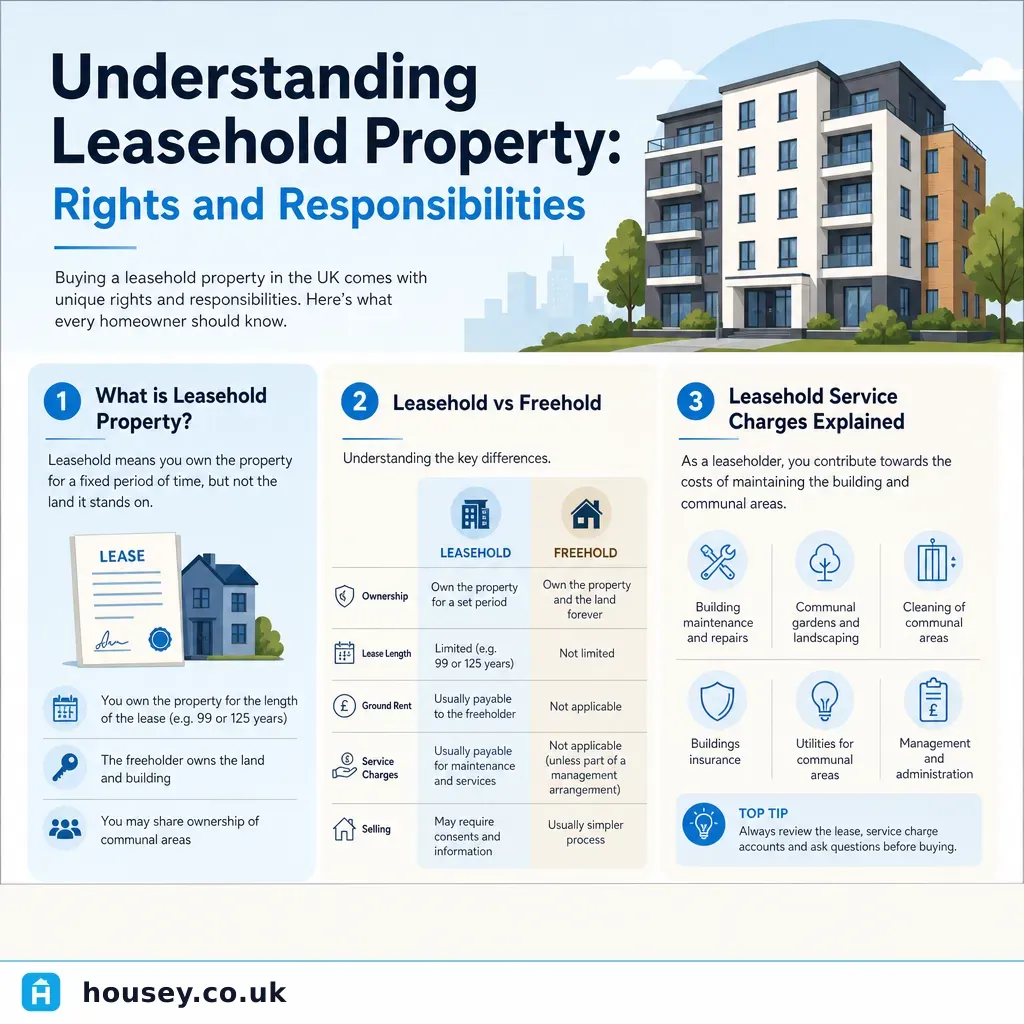
Understanding Leasehold Property: Rights and Responsibilities
Leasehold means you own a time-limited interest in a property while the freeholder owns the land and building.
 Buying & Moving
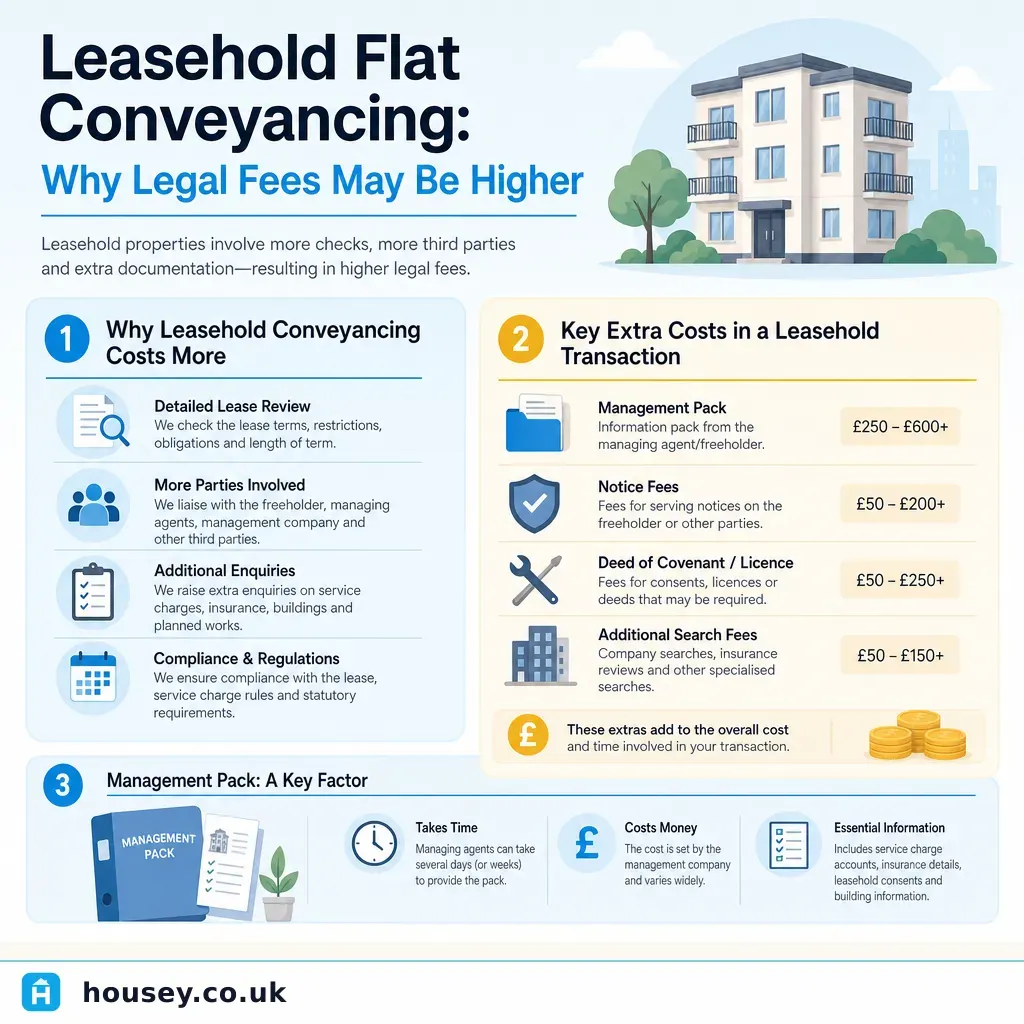
Leasehold Flat Conveyancing: Why Legal Fees May Be Higher
Leasehold flat conveyancing typically costs more than freehold because solicitors must review the lease, check service charge accounts, obtain a management information pack, and handle freeholder consents and notice fees.
 Buying & Moving
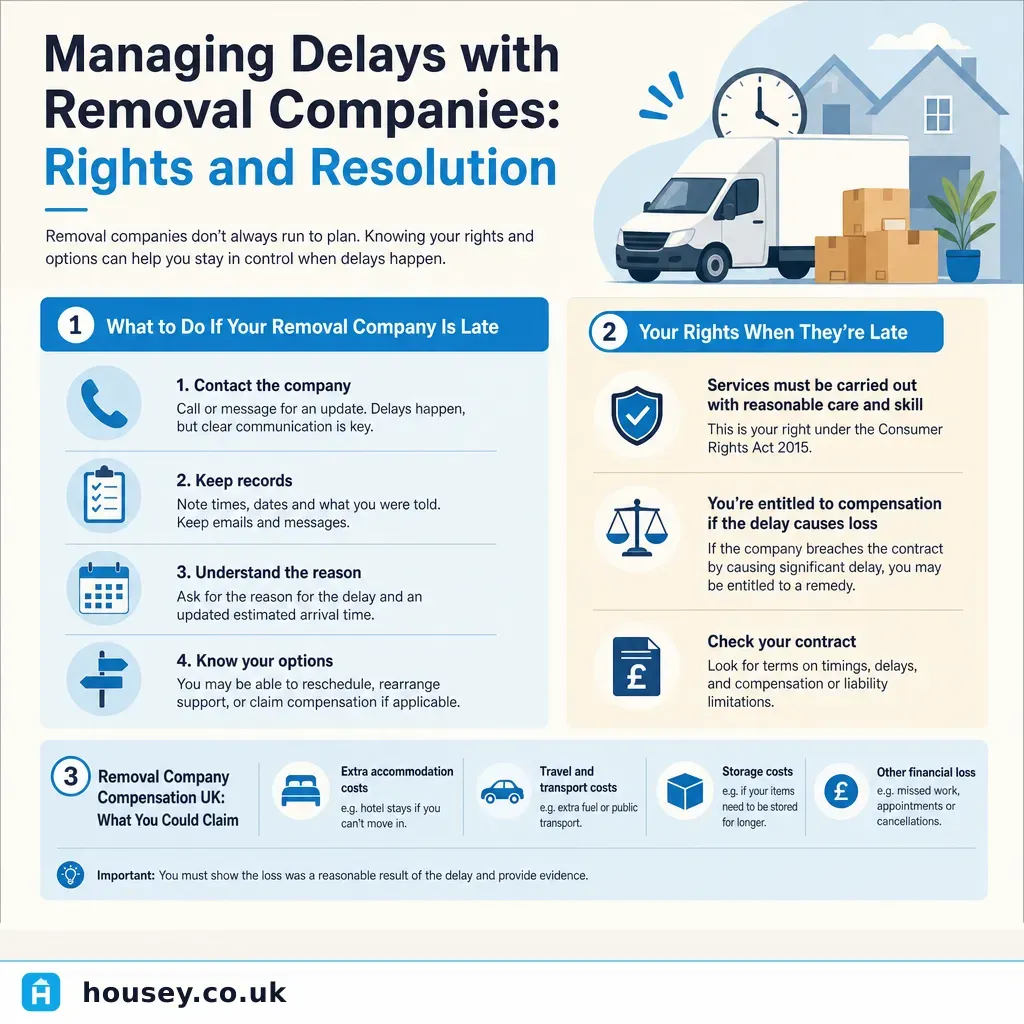
Managing Delays with Removal Companies: Rights and Resolution
If a removal company is late, your rights depend on your contract and whether the company is BAR-registered.
 Buying & Moving
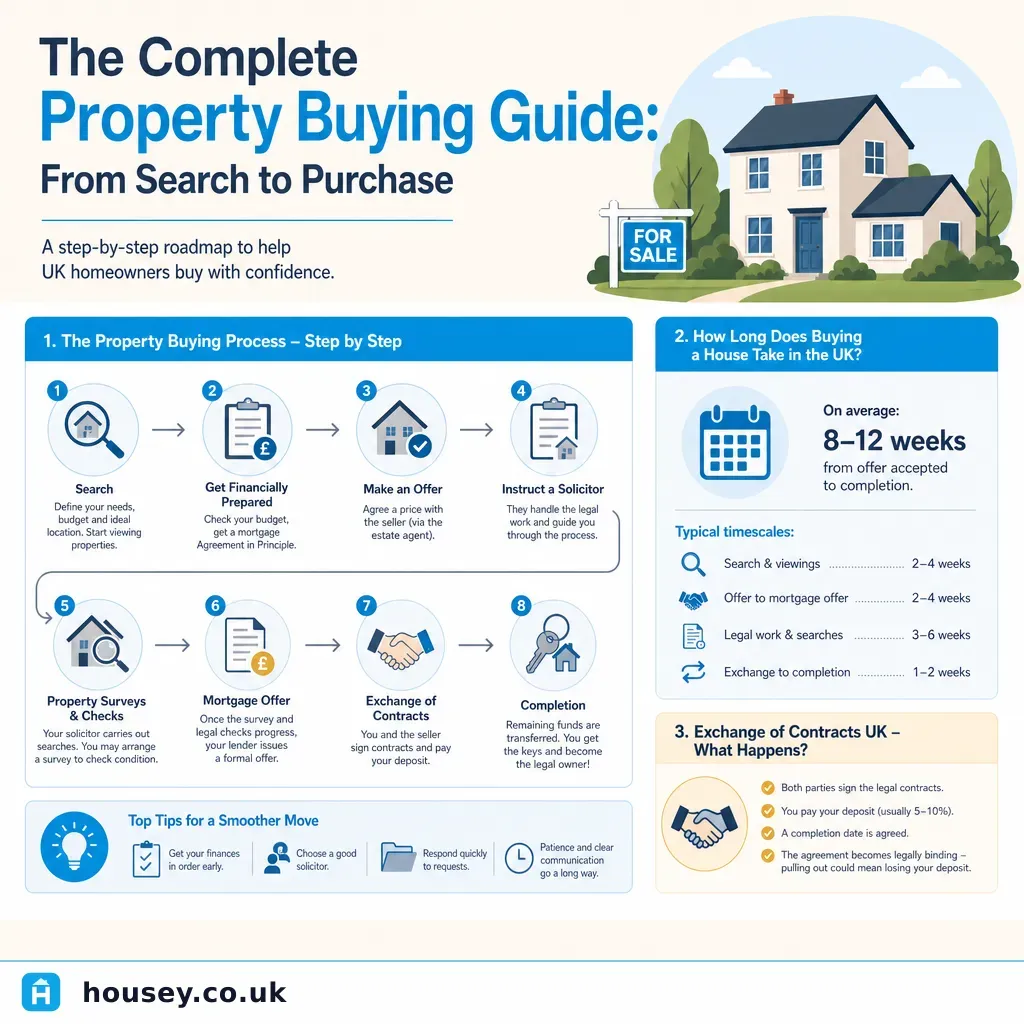
The Complete Property Buying Guide: From Search to Purchase
Buying a property in England and Wales typically takes 3–6 months from accepted offer to completion.
 Buying & Moving
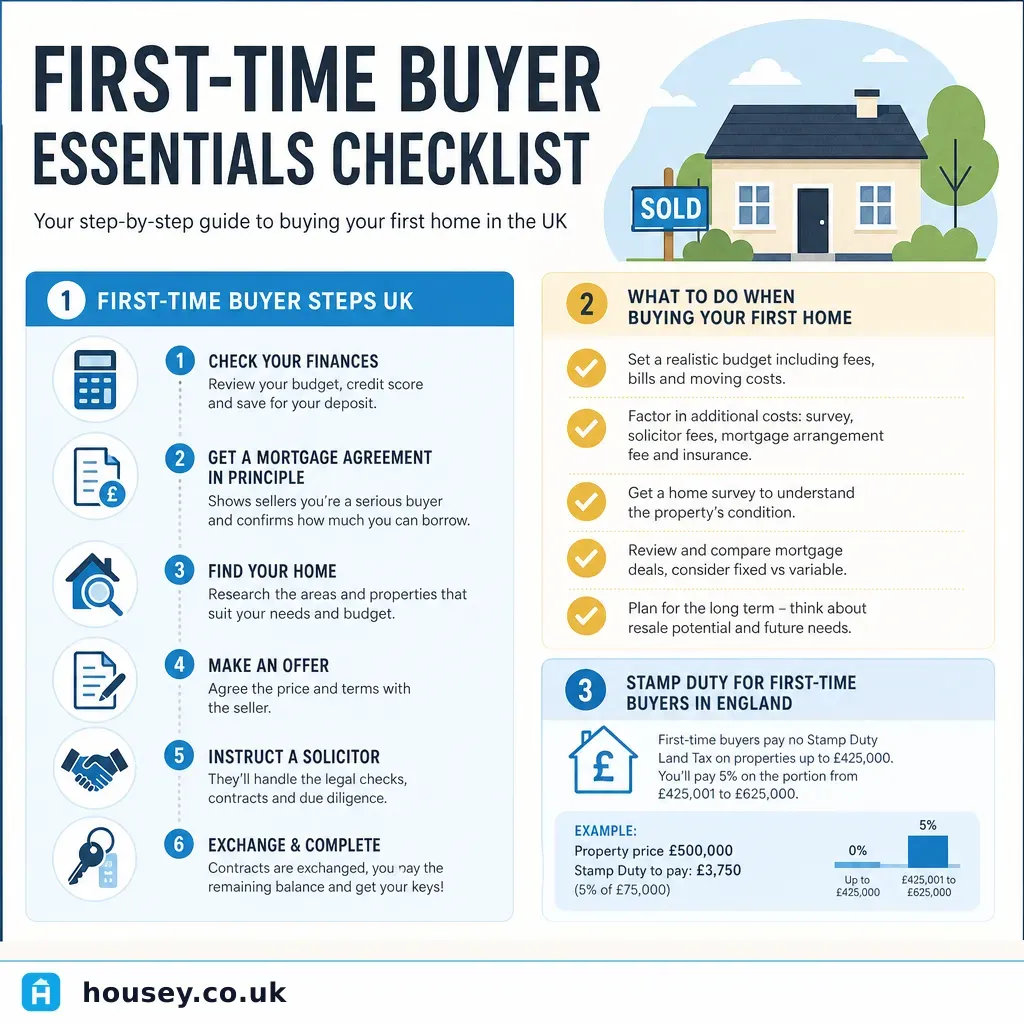
First-Time Buyer Essentials Checklist
Buying your first home involves obtaining a mortgage in principle, making an offer, instructing a solicitor, arranging a survey, and exchanging contracts before completion.