Cost Estimation for Building Projects: Budget Planning and Professional Advice
By Housey · Last reviewed 19th of May 2026
Cost Estimation for Building Projects: Budget Planning and Professional Advice
Accurate cost estimation is one of the most important steps in any building project — yet it is often treated as an afterthought until a contractor's quote arrives. Whether you are planning a single-storey extension on a 1930s semi, a full renovation of a Victorian terrace, or a self-build, getting the numbers right before committing to design fees and planning applications can prevent projects from stalling mid-build. UK homeowners typically encounter the question of costs at their first design meeting, but the most effective budgeting starts much earlier.
Key points
- RICS publishes the New Rules of Measurement (NRM) — the industry standard for preparing cost estimates, used by quantity surveyors and cost consultants across the UK.
- Build costs are typically benchmarked per square metre of gross internal area (GIA), but preliminary estimates based on floor area alone can be misleading without adjusting for specification, location, and complexity.
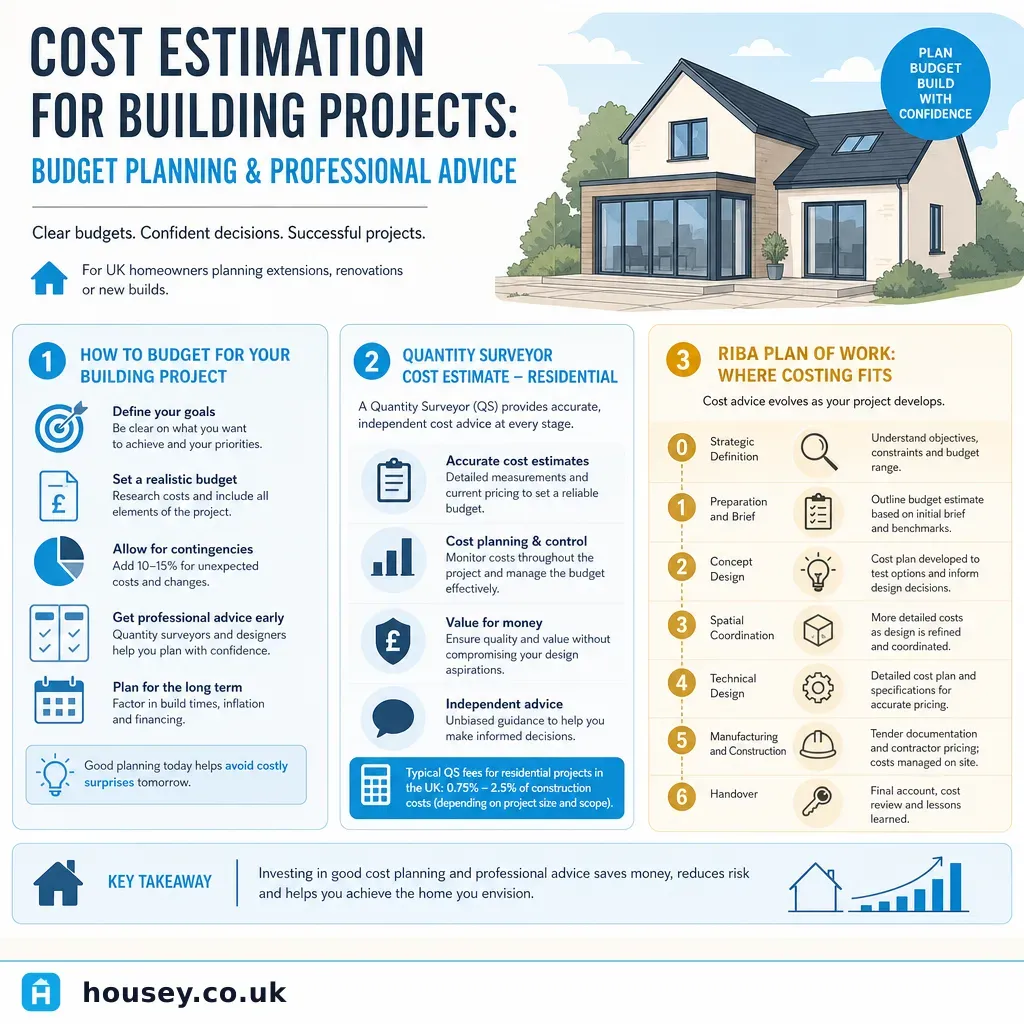
- Under the RIBA Plan of Work 2020, formal cost plans are produced at Stages 2 (concept design), 3 (spatial coordination), and 4 (technical design), each becoming progressively more accurate as design detail increases.
- VAT is charged at 20% on most building works; new builds qualify for 0% relief and some conversions for 5%, as set out in HMRC VAT Notice 708.
- Standard contingency allowances are 10–15% for straightforward refurbishment and 15–20% for older, complex, or unknown-condition properties.
What does build cost estimation involve?
A build cost estimate is a structured forecast of the likely total expenditure on a construction project. A comprehensive estimate covers professional fees (architect, structural engineer, quantity surveyor), statutory costs (planning application fees, Building Control fees), VAT, site preparation, materials, labour, fixtures and fittings, and a contingency allowance — not just the contractor's build price.
At the earliest stage — before detailed design begins — an order-of-magnitude estimate is produced using benchmarked rates per square metre, adjusted for location, construction type, and specification level. As design develops, this is refined into a formal cost plan with elemental breakdowns (substructure, superstructure, finishes, services), and eventually into a fully priced document for comparison against contractor tenders.
The distinction matters because an early £/m² estimate can differ from a final tender price by 20–30% or more, particularly on older properties where unknowns — soil conditions, hidden services, structural condition — are resolved only during detailed survey and design work.
What drives build costs in the UK?
Several factors determine how much a project will cost, and many vary significantly across the UK:
- Location: Labour and material costs in London and the South East can be 20–40% higher than in many parts of northern England, Wales, or Scotland.
- Specification level: A basic contractor-grade finish and a high-end bespoke specification can differ by a factor of two or more for the same floor area.
- Construction type: Timber frame, masonry cavity wall, steel frame, and insulated concrete formwork (ICF) all carry different cost profiles.
- Site access and ground conditions: Restricted access, sloped ground, or poor load-bearing capacity significantly increases preliminary costs.
- Property age and condition: Pre-1919 solid-wall properties often carry hidden structural, damp, or services-related costs that standard estimates do not capture.
- Planning and design complexity: Conservation area or listed building constraints typically require additional specialist input and more expensive materials.
Indicative UK build costs by project type
The table below shows indicative construction costs only, excluding professional fees, VAT, and contingency. Treat these as a starting point for feasibility — always obtain a professional cost plan before making financial commitments.
Project type | Indicative range (£/m² GIA) | Key cost drivers |
|---|---|---|
Basic internal refurbishment | £400–£800 | Kitchen, bathroom, decoration; no structural changes |
Mid-range renovation with structural changes | £800–£1,500 | Reconfiguration, new services runs, structural alterations |
Single-storey rear extension | £1,500–£2,500 | Foundations, glazing specification, kitchen or utility fit-out |
Two-storey extension | £1,400–£2,200 | Structural complexity, additional bedrooms and bathrooms |
Loft conversion (dormer) | £1,200–£2,000 | Roof structure, staircase, insulation to Building Regulations Part L |
High-specification new build | £2,000–£3,500+ | Bespoke design, method of construction, London cost uplift |
Indicative UK costs, last reviewed 2026-05-19. Regional variation is significant — always obtain itemised quotes. Source: RICS/BCIS building cost benchmarks.
Which professional should you use?
The right professional depends on the stage and scale of your project:
- Quantity surveyor (QS) / cost consultant: Provides formal cost plans, manages tender processes, and monitors costs during construction. Accredited QSs hold RICS membership. Essential on projects above £100,000 or where lender sign-off is required.
- Architect with cost advisory experience: Many architects provide early cost guidance at concept stage — useful for smaller projects, but a QS brings dedicated cost-management expertise.
- Project manager: Can coordinate cost advice across the design team on larger or more complex projects.
- Main contractor's estimator: Provides a specific tender price but is not independent — not a substitute for impartial cost advice.
For most residential extensions and renovations, an independent cost plan from a RICS-accredited professional at RIBA Stage 2 is the most reliable way to test affordability before committing to full design and planning fees.
Homeowner checklist: preparing for a cost estimation appointment
Before your first meeting with a cost consultant or quantity surveyor, have the following ready:
When to get professional help
Early professional cost advice is advisable for any project beyond basic cosmetic work. Seek specialist input if:
- The project involves structural alterations, foundations, or underpinning
- You are applying for planning permission and need to assess financial viability
- A self-build or custom-build mortgage requires QS cost certification
- The project is in a conservation area, on a listed building, or in a flood risk zone
- You have received a contractor quote that seems unexpectedly high or low
- There is disagreement within the design team about what is achievable within budget
If a contractor's tender is significantly below your cost plan estimate, do not assume it is a bargain — gaps often indicate scope ambiguity, missing preliminary costs, or an inadequate contingency allowance.
How Housey can help
Housey connects you with RICS-accredited professionals who offer a build cost estimating service for UK residential and self-build projects. Submit your project details to connect with a RICS-accredited cost consultant or quantity surveyor in your area.
Frequently asked questions
When should I get a cost estimate for my building project?
Ideally at RIBA Stage 2 (concept design) at the latest, so you can check affordability before spending on detailed drawings or applying for planning permission. An early order-of-magnitude estimate at Stage 1 can also help test whether a project is viable at all. Getting professional cost advice before detailed design helps avoid abortive fees.
What is the difference between a quantity surveyor and a cost consultant?
In practice the terms are often used interchangeably on residential projects. A quantity surveyor (QS) traditionally prepares bills of quantities and advises on contract procurement. A cost consultant focuses on cost planning, benchmarking, and value management across all project stages. Both roles can be filled by a RICS-accredited professional.
How accurate is an early build cost estimate?
Early order-of-magnitude estimates (RIBA Stage 1) are typically accurate to ±25–30%. A detailed cost plan at Stage 3 (spatial coordination) can narrow this to ±10–15%, and a priced bill of quantities after tender reduces uncertainty further. Contingency allowances at each stage reflect the remaining uncertainty in the design.
Does VAT apply to building works in the UK?
Most building work is subject to 20% VAT. However, new builds qualify for zero-rating under HMRC VAT Notice 708, and some conversions — for example, converting a non-residential building to residential use — may qualify for the reduced 5% rate. Always confirm VAT treatment with your contractor and accountant before finalising your budget.
Sources and further reading
- RICS New Rules of Measurement (NRM) — RICS
- RIBA Plan of Work 2020 — RIBA
- VAT Notice 708: buildings and construction — GOV.UK
- BCIS Building Cost Information Service — RICS/BCIS
Useful next reads
 Planning & Pre-Build
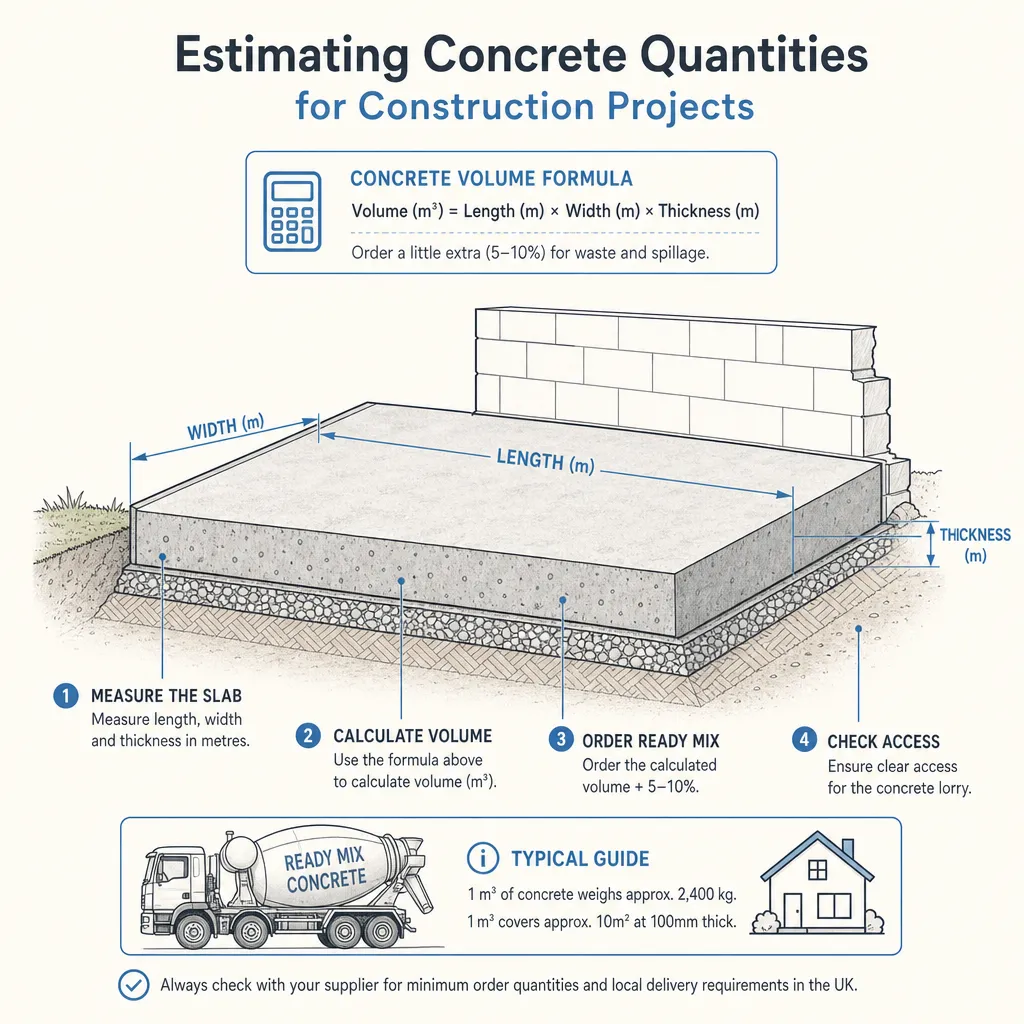
Estimating Concrete Quantities for Construction Projects
To estimate concrete quantities, calculate the volume in cubic metres (length × width × depth), then add a 5–10% wastage allowance.
 Planning & Pre-Build
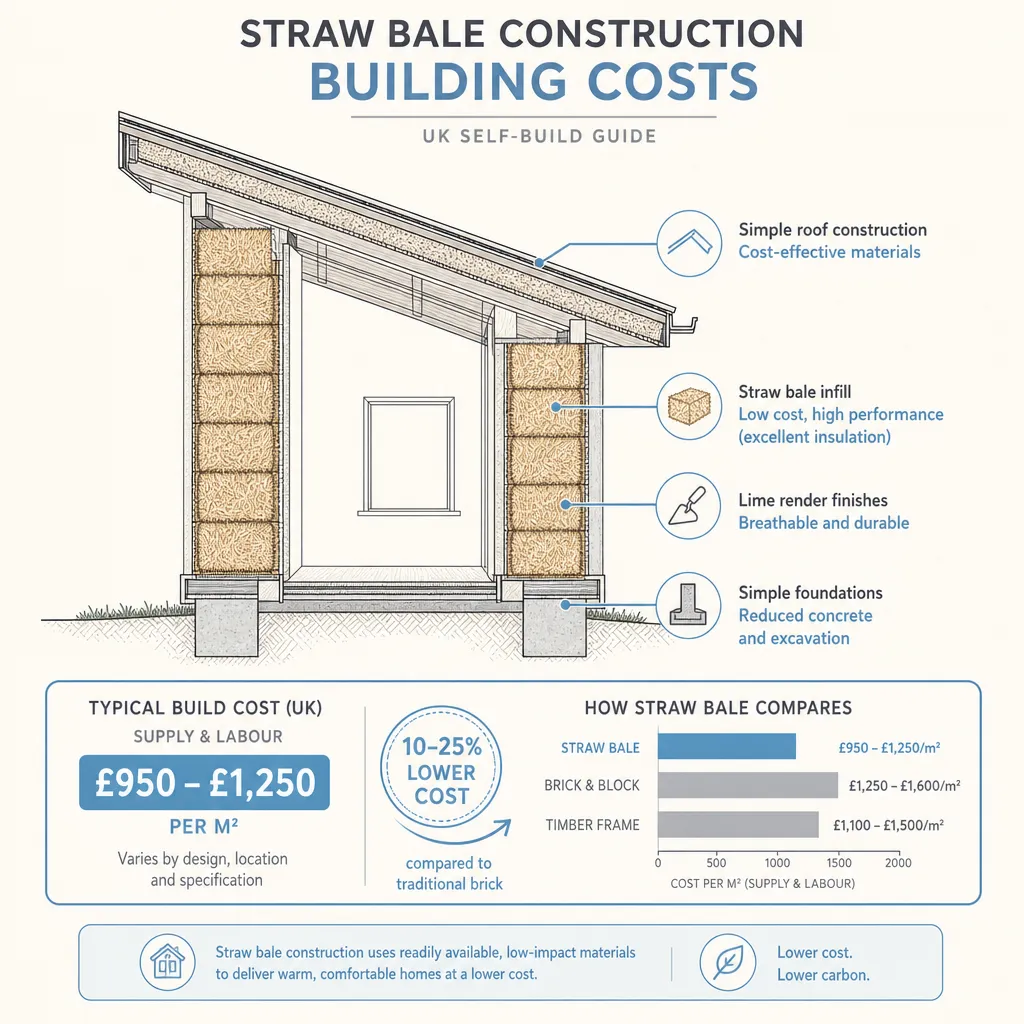
Straw Bale Construction Building Costs
Straw bale construction in the UK typically costs £1,500–£2,500 per square metre for a fully contracted self-build, though costs vary by design, render specification, and contractor experience.
 Planning & Pre-Build
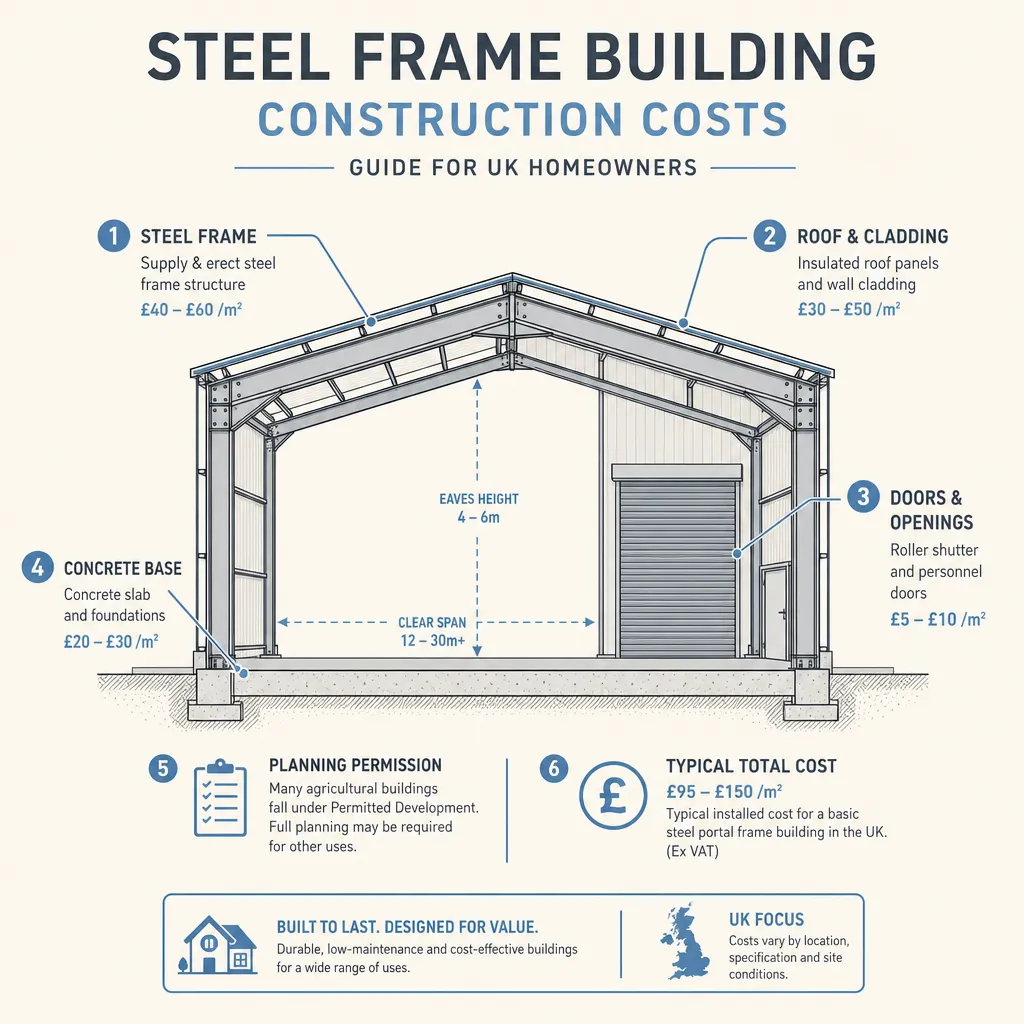
Steel Frame Building Construction Costs
Steel frame buildings in the UK cost from around £400 to over £1,200 per square metre of floor area, depending on building type, size, cladding, insulation, and fit-out level.
 Planning & Pre-Build
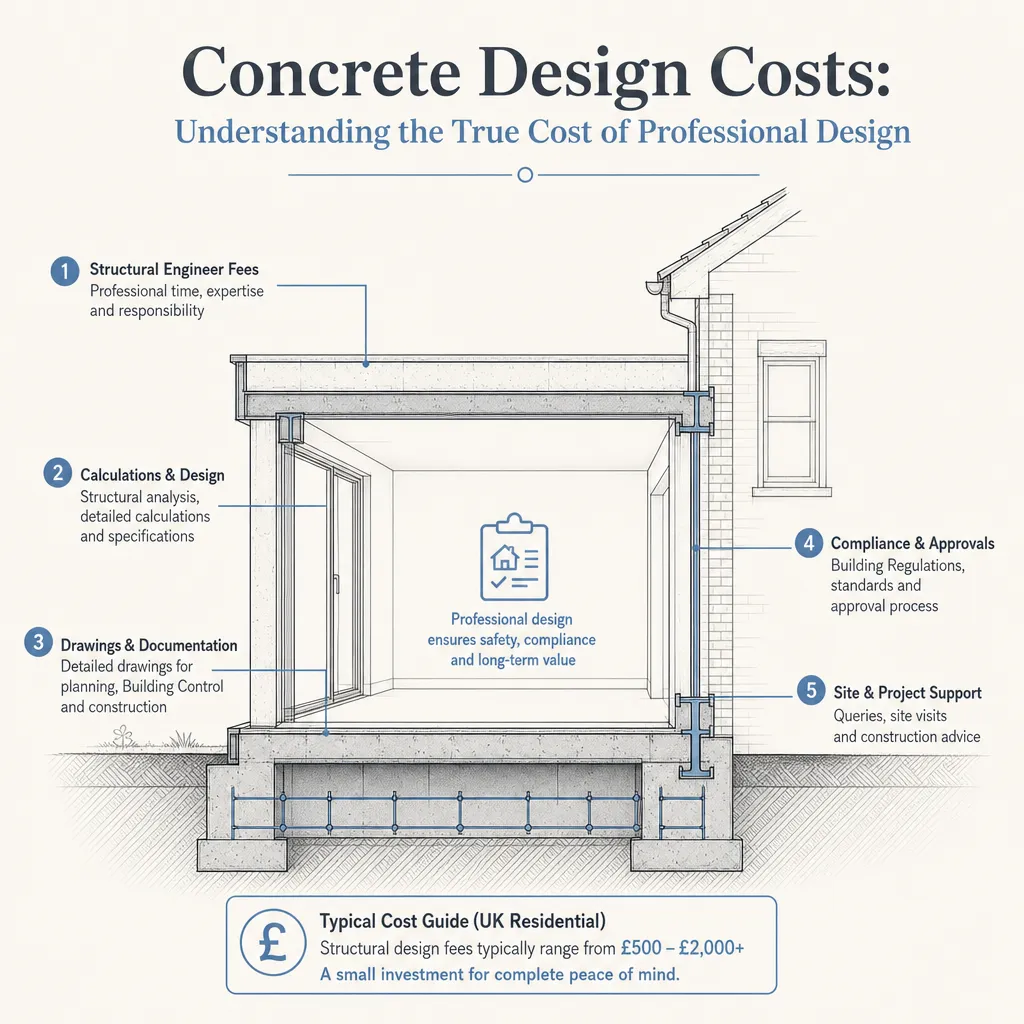
Concrete Design Costs: Understanding the True Cost of Professional Design
Professional design fees in the UK typically range from 5–12% of construction cost, or £500–£5,000+ as a fixed fee depending on scope and complexity.
 Planning & Pre-Build
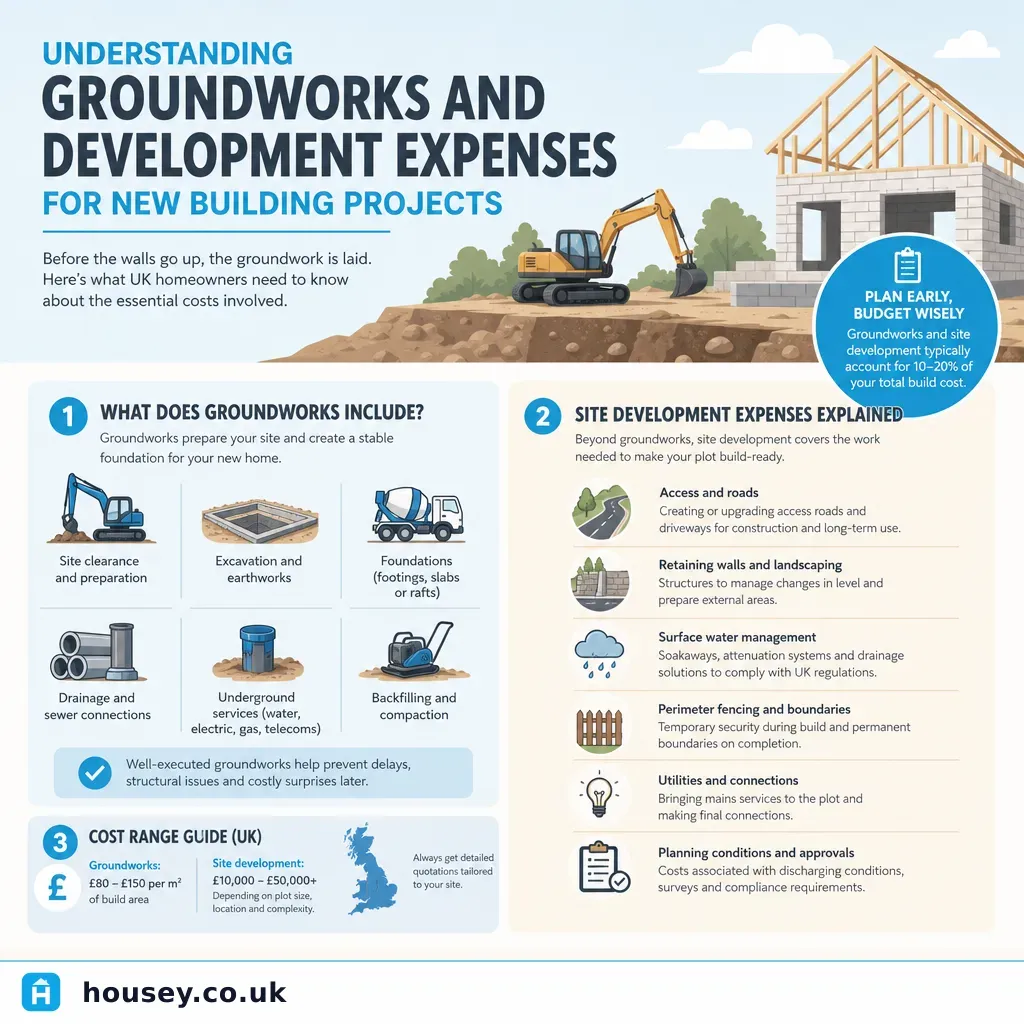
Understanding Groundworks and Development Expenses for New Building Projects
Groundworks cover all below-ground site preparation — excavation, drainage, foundations, and service connections — that must be completed before superstructure construction begins.