Straw Bale Construction Building Costs
By Housey · Last reviewed 11th of May 2026
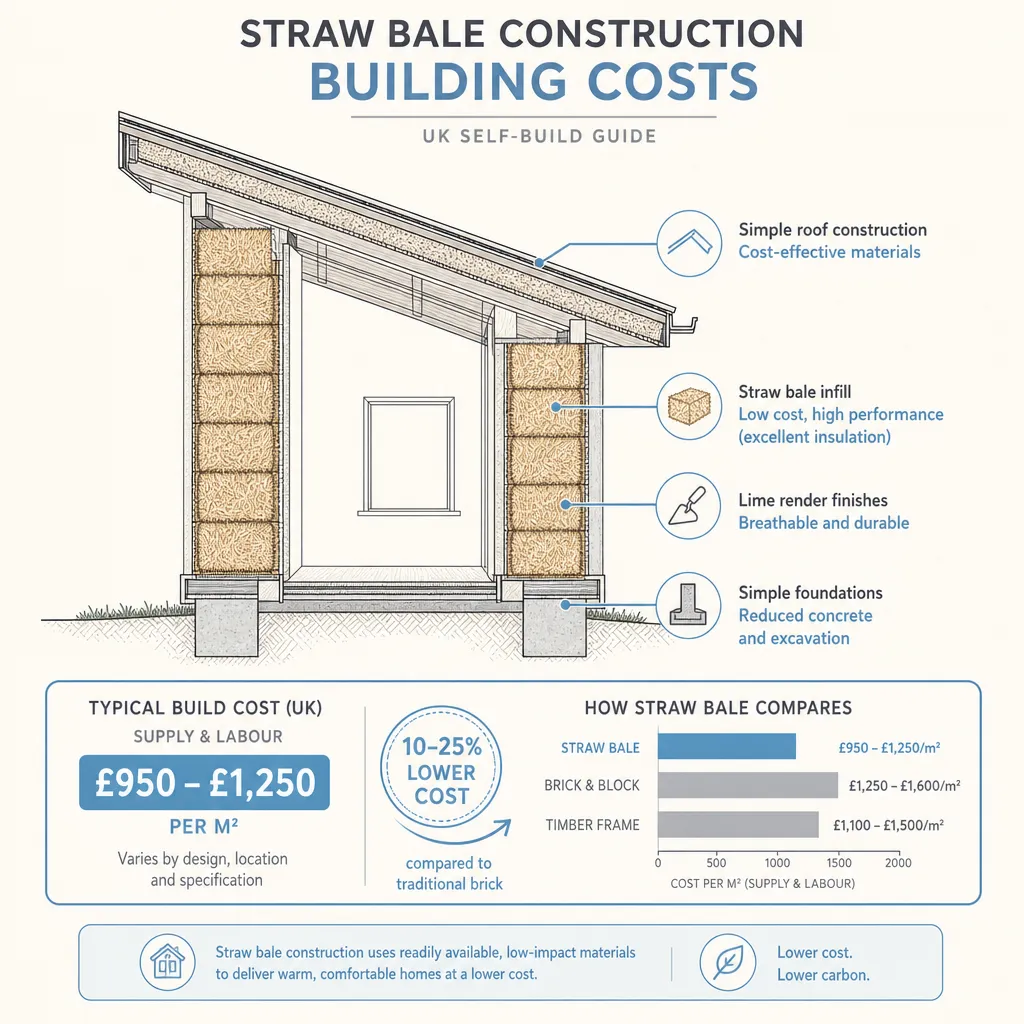
Straw Bale Construction Building Costs
Straw bale construction has moved steadily from the fringes of eco-self-build into a recognised method that UK building control departments deal with more routinely than a decade ago. Homeowners and self-builders typically face the same questions at the same moment: when comparing straw bale to timber frame or brick-and-block, trying to establish whether the 'cheaper material' headlines translate into a cheaper finished home, or when a mortgage lender or insurer flags the construction type. The reality involves a wider set of cost variables than most initial research suggests, and the regulatory path — planning permission, building control sign-off — is non-trivial for first-time self-builders.
Key points
- Straw bale construction requires full Building Regulations approval as a non-standard construction method; building control bodies will typically require engineered structural designs and thermal performance data before granting approval.
- Lime render over straw bale is critical to both weatherproofing and structural integrity; a three-coat lime system typically costs £80–£150 per m² of wall area and is often the single largest variable in the overall build cost.
- Part L (Conservation of Fuel and Power) applies to new straw bale homes; straw bale walls can achieve U-values below 0.13 W/m²K, comfortably exceeding the Part L threshold of 0.18 W/m²K for external walls in new dwellings.
- Planning permission is required for all new dwellings in the UK; permitted development rights do not apply to new residential buildings, and some local planning authorities may request additional information on non-standard materials.
- Specialist straw bale contractors are concentrated in certain regions; in areas with limited local experience, professional fees and subcontract costs tend to be higher than national averages.
What does straw bale construction cost in the UK?
Straw bale construction is not universally cheaper than conventional methods. The structural straw itself is inexpensive — bales typically cost £2–£5 each, and a modest two-bedroom home might use 200–400 bales — but materials are only one part of the total build cost. Labour, specialist render, structural engineering, building control fees, architectural design, and groundworks together determine the overall figure.
Indicative UK costs, last reviewed 2026-05-11. Individual quotes will vary; always obtain at least three contractor quotes.
Specification | Indicative cost per m² (GIA) |
|---|---|
Owner-builder with significant self-build labour | £700–£1,200 |
Hybrid self-build (contractor-led structural, owner labour on finishes) | £1,100–£1,700 |
Fully contracted turnkey straw bale build | £1,500–£2,500 |
These ranges overlap significantly with timber frame self-builds (typically £1,200–£2,200 per m² fully contracted) once specialist render and professional fees are factored in. The saving on raw straw is often absorbed by the render system, structural engineer fees for non-standard building control approval, and the additional time taken in the design and inspection process.
What drives the cost up or down?
Straw specification and sourcing
Agricultural wheat or barley straw is the standard material. Bale costs are modest, but sourcing certified, dry, low-moisture straw within reasonable distance of the site affects haulage costs. Straw moisture content above 20% increases mould risk — testing is advisable, and some contractors include moisture testing in their specification as standard.
Render and weatherproofing
Lime render is the standard external finish for both load-bearing and infill straw bale walls. A breathable lime render is essential; cement render must not be used, as it traps moisture and can cause bale degradation over time. The render specification is frequently the item that most surprises self-builders on first cost review.
Structural system: load-bearing vs timber-framed infill
Load-bearing straw bale: The straw bales themselves carry the structural load of the roof. This is the traditional approach and can reduce timber costs, but requires more careful structural design and building control approval.
Timber-frame infill: A conventional timber frame carries the structural load; straw bales fill the cavity as insulation. This is often easier to get through building control and is more familiar to mainstream contractors, which can reduce labour costs.
The choice of structural system affects both structural engineer fees and contractor availability significantly.
Foundation design
Straw bale walls are sensitive to ground moisture. A well-detailed foundation with a raised floor slab or plinth — keeping bales at least 225 mm above finished ground level — is standard practice. Ground investigation, drainage detailing, and damp-proof design all require careful specification by a qualified professional before build commences.
Professional fees
For a straw bale self-build of approximately 100 m² GIA, indicative professional fees are:
Indicative UK costs, last reviewed 2026-05-11. Fees vary by region, project complexity, and professional experience with straw bale construction.
Professional | Indicative fee range |
|---|---|
Architect (design through planning and building control) | £10,000–£25,000+ |
Structural engineer (non-standard construction calculations) | £2,000–£6,000+ |
Building control (private approved inspector or local authority) | £1,500–£4,000 |
Straw bale vs conventional construction: a comparison
Factor | Straw bale | Timber frame | Brick and block |
|---|---|---|---|
Material cost (structure and insulation) | Low | Low–medium | Medium |
Labour (specialist render required) | Higher than standard | Standard | Standard |
Thermal performance | Excellent (U-value ≤0.13 W/m²K) | Good (depends on insulation spec) | Variable (depends on build-up) |
Building control complexity | Higher (non-standard method) | Standard | Standard |
Contractor availability (UK) | Limited | Widespread | Widespread |
Mortgage and insurance | Can be harder to arrange | Straightforward | Straightforward |
Indicative turnkey cost per m² | £1,500–£2,500 | £1,200–£2,200 | £1,400–£2,400 |
Indicative UK costs, last reviewed 2026-05-11.
Planning permission for straw bale homes
All new dwellings in England require planning permission — permitted development rights do not cover new residential buildings. Straw bale is not a planning refusal trigger in itself; the planning system in England is generally material-neutral for residential design. However, in conservation areas, National Parks, or Areas of Outstanding Natural Beauty (AONBs), external finishes such as lime render colour and texture may be subject to additional conditions.
A pre-application consultation with your local planning authority — typically costing £200–£600 — can surface any materials-related concerns before a full application is submitted.
Building regulations for straw bale construction
Straw bale construction must satisfy all relevant parts of the Building Regulations in England. Similar requirements apply in Scotland (Building (Scotland) Regulations), Wales, and Northern Ireland. The key approved documents are:
- Part A (Structure): Structural calculations are required; a structural engineer experienced in non-standard construction should provide these.
- Part C (Site preparation and resistance to moisture): Detailing to prevent ground moisture reaching the bales is critical and must be specified by a qualified designer.
- Part L (Conservation of fuel and power): New dwellings must meet the SAP (Standard Assessment Procedure) energy target; straw bale typically performs well here due to its high thermal mass and low U-value.
- Part F (Ventilation): Highly insulated straw bale homes will usually require mechanical ventilation with heat recovery (MVHR) to maintain adequate air quality without moisture build-up.
Both local authority building control (LABC) and registered private approved inspectors can manage the inspection process. Some self-builders prefer private approved inspectors for straw bale projects as they may have more direct experience with non-standard methods.
Checklist: before you get straw bale construction quotes
Important limitations
This article provides general cost guidance for straw bale construction in the UK based on publicly available information and recognised industry sources. Individual project costs will vary significantly based on site conditions, local authority requirements, contractor availability, specification choices, and market conditions. Straw bale construction is a non-standard method; building regulations compliance and structural adequacy must be assessed by qualified professionals with direct experience of this construction type. Nothing in this article constitutes structural, planning, or legal advice.
What to ask a qualified professional
Before instructing an architect or structural engineer for a straw bale project, ask:
- Do you have previous experience with straw bale or other non-standard sustainable construction in the UK, and can you provide project references with building control sign-off?
- What structural system would you recommend for this site, and what are the building control implications?
- How will you approach the building control pre-submission process, and have you worked with this building control body before?
- What are the critical moisture and ventilation details for this specification?
- Will your fee include liaison with building control through to the final certificate?
- What are the most common cost overruns on straw bale projects, and how will you manage them in your contract?
When to get professional help
Straw bale construction requires professional input at every stage. Seek professional help immediately if:
- A contractor offers to build a straw bale home without providing a structural engineer's calculations for building control submission.
- You are sourcing bales without moisture testing.
- A lender or insurer has raised concerns about the construction type and you are unsure how to respond.
- Ground investigation reveals high groundwater levels or unstable ground — these conditions materially affect foundation and moisture-protection design and must be assessed by a qualified geotechnical or structural engineer before any design is finalised.
How Housey can help
Finding professionals with straw bale experience can be the hardest part of the project. Housey connects self-builders with architects experienced in sustainable and alternative construction and structural engineers for non-standard construction who can manage the building control process from design through to final certificate. Compare quotes and credentials before committing to any professional.
Frequently asked questions
Is straw bale construction legal in the UK?
Yes. Straw bale construction is legal throughout the UK and can receive full building regulations approval when designed and built to the relevant standards. It must comply with all applicable parts of the Building Regulations, including structural (Part A), thermal (Part L), and ventilation (Part F) requirements. Building control bodies in England, Scotland, Wales, and Northern Ireland are all capable of approving straw bale projects, though some may require more detailed documentation than for conventional methods.
Can I get a mortgage on a straw bale house?
Mortgages for straw bale homes can be harder to arrange than for conventional construction. Most high-street lenders classify straw bale as non-standard construction and may decline to lend. Specialist self-build lenders and some building societies are more likely to consider applications. An independent mortgage broker with self-build experience is advisable. Some lenders require a structural warranty from a recognised provider before releasing funds.
How long does a straw bale house last?
When properly designed, built, and maintained — particularly with correct moisture management and a breathable lime render — straw bale structures can last well over a century. The oldest known straw bale buildings in the UK and USA are over 100 years old. The key risk is moisture: a compromised render or inadequate ground-level detail can lead to bale degradation. Correct specification and regular maintenance of the render are essential.
Do I need planning permission for a straw bale house?
Yes. All new dwellings in England (and equivalent legislation in Scotland, Wales, and Northern Ireland) require full planning permission. Permitted development rights do not apply to new residential buildings. The fact that the construction is straw bale does not in itself affect the planning decision, but external finishes — typically lime render — must be specified in the application and may be subject to conditions in sensitive locations such as conservation areas.
Sources and further reading
- Planning Portal — planning permission guidance — Planning Portal
- Building Regulations Approved Documents — GOV.UK
- AECB — Association for Environment Conscious Building — AECB
- Local Authority Building Control — LABC
- HSE — construction health and safety — Health and Safety Executive
Useful next reads
 Planning & Pre-Build
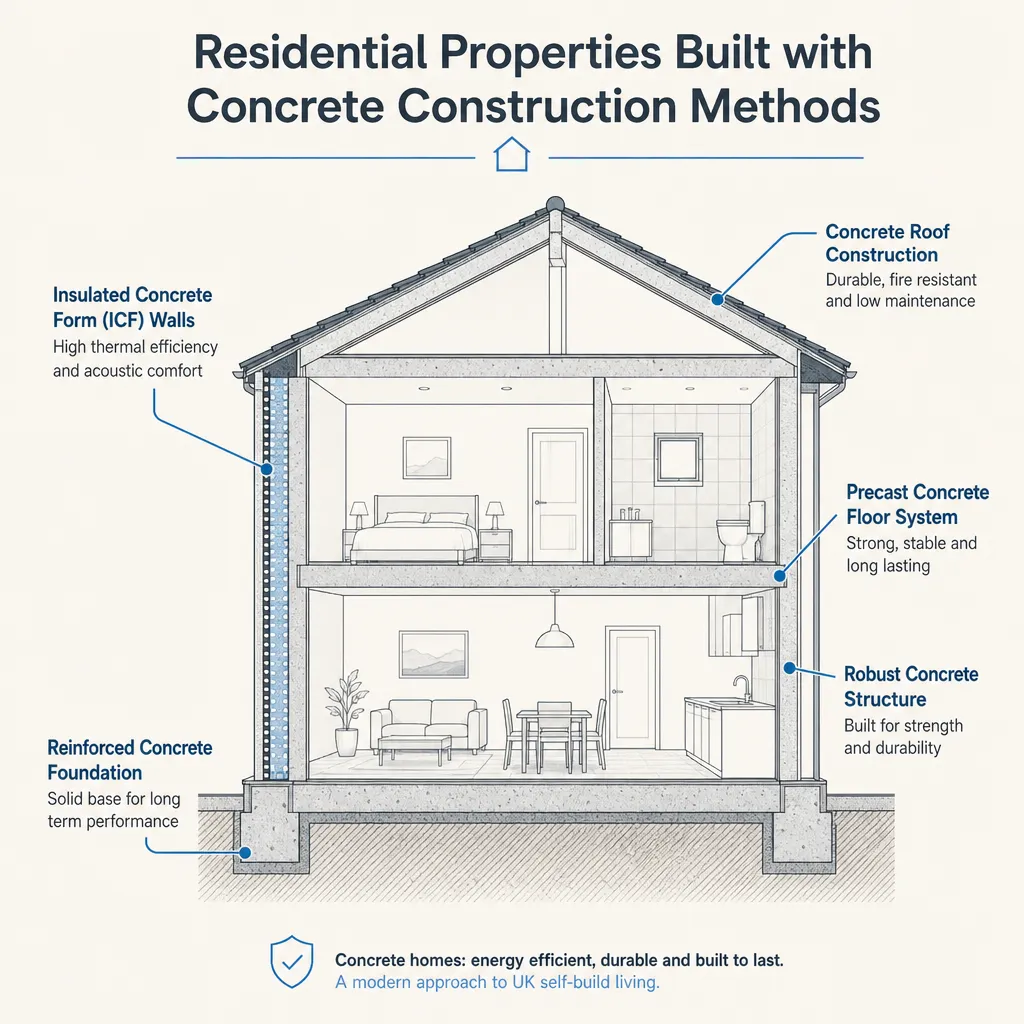
Residential Properties Built with Concrete Construction Methods
UK homes are built using several concrete methods: in-situ cast concrete, precast panel systems, insulating concrete formwork (ICF), and older non-traditional types such as Wimpey No-Fines and Laing Easiform.
 Planning & Pre-Build
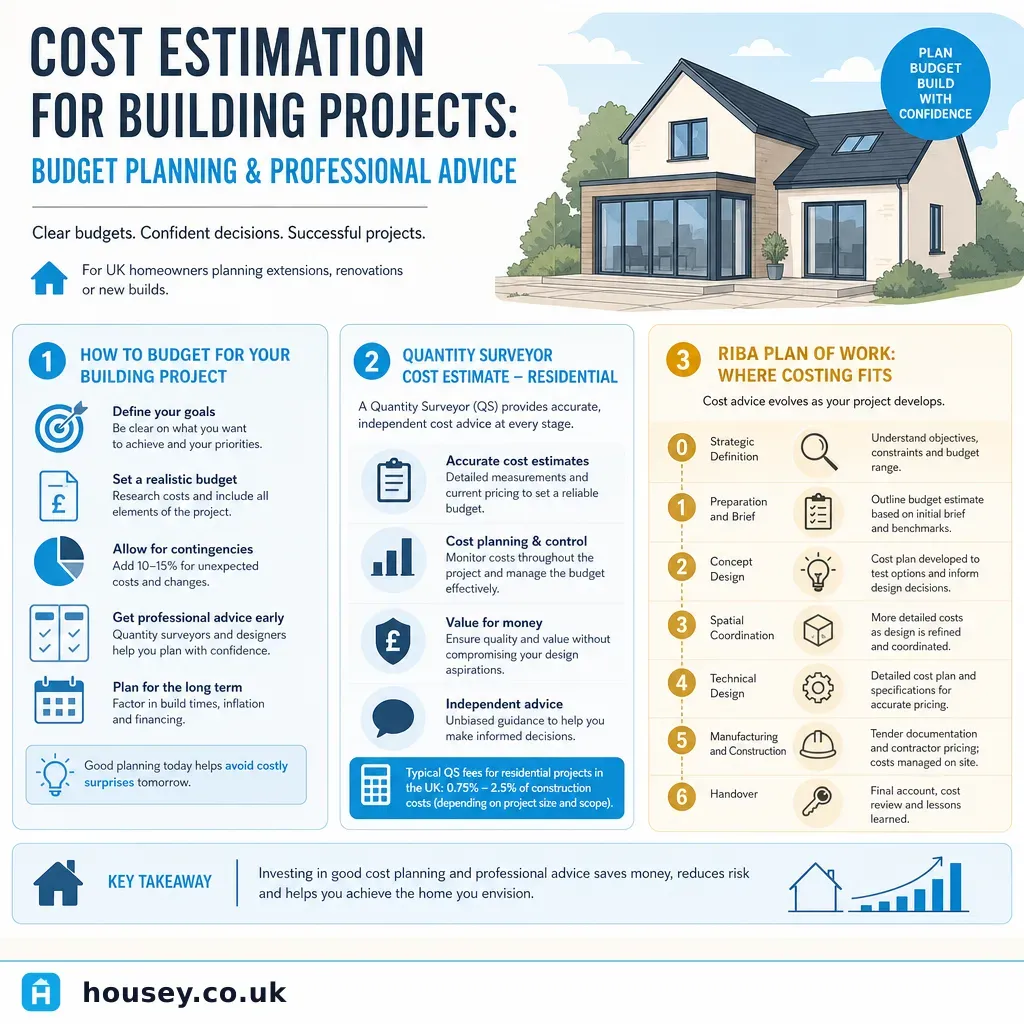
Cost Estimation for Building Projects: Budget Planning and Professional Advice
Build cost estimation involves calculating likely expenditure across design, materials, labour, fees, and contingency before committing to a project.
 Planning & Pre-Build
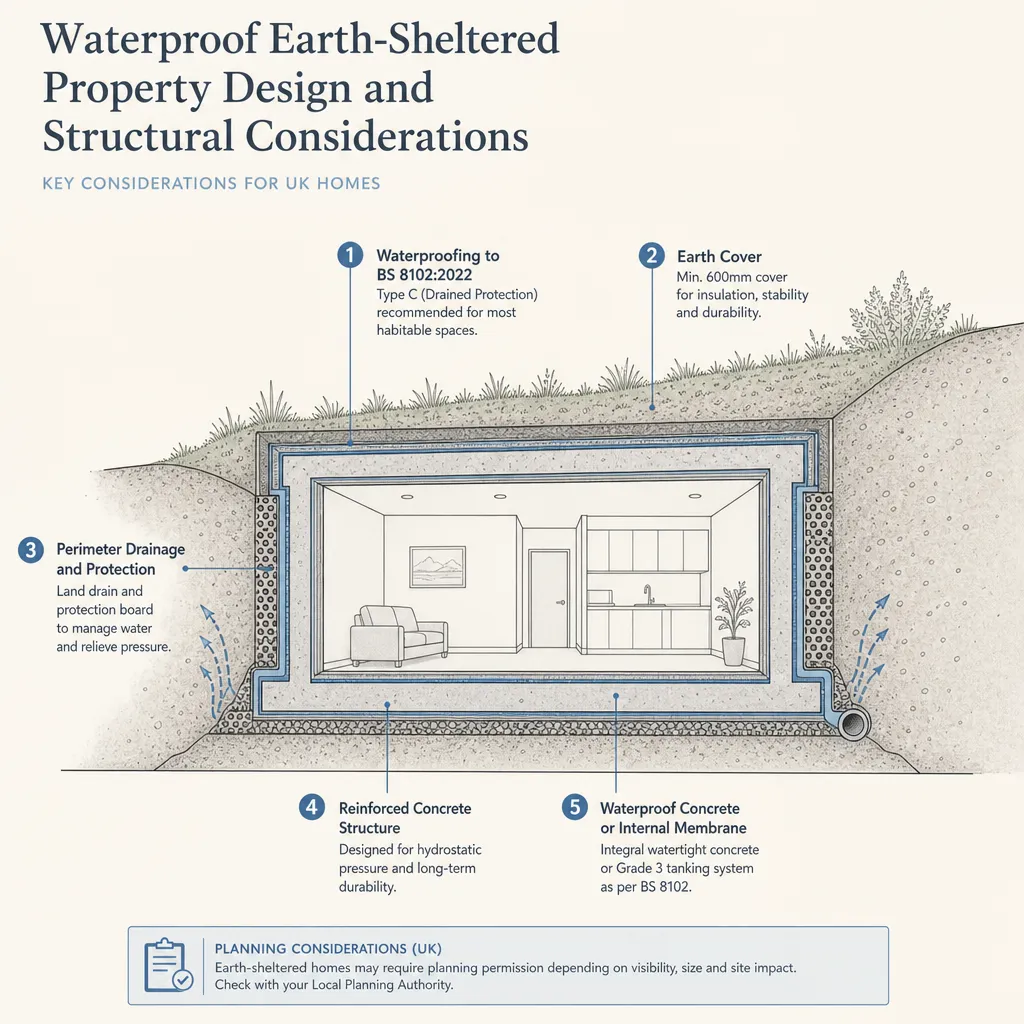
Waterproof Earth-Sheltered Property Design and Structural Considerations
Earth-sheltered homes in the UK require specialist structural design to manage lateral soil pressure and hydrostatic loads, along with a waterproofing strategy compliant with BS 8102:2022.
 Planning & Pre-Build
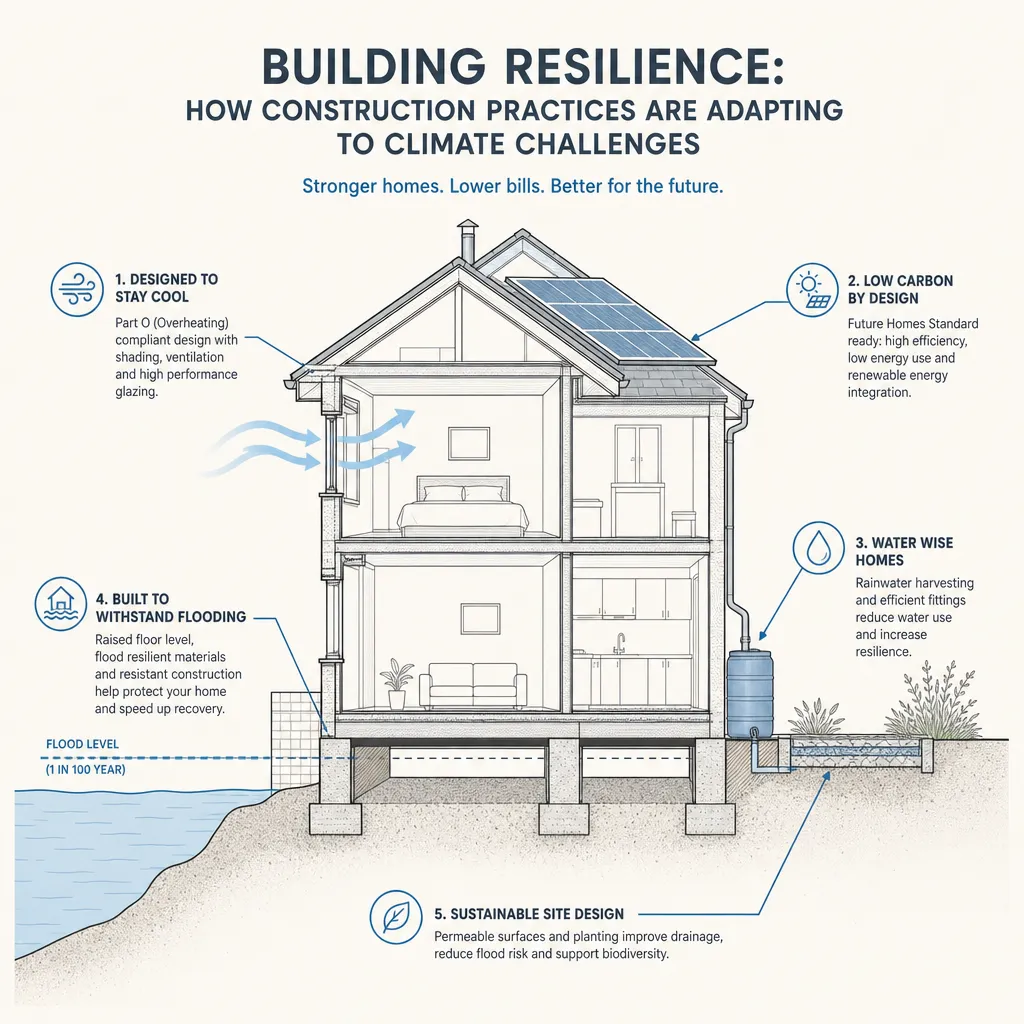
Building Resilience: How Construction Practices Are Adapting to Climate Challenges
UK construction is adapting to climate change through updated Building Regulations.
 Planning & Pre-Build
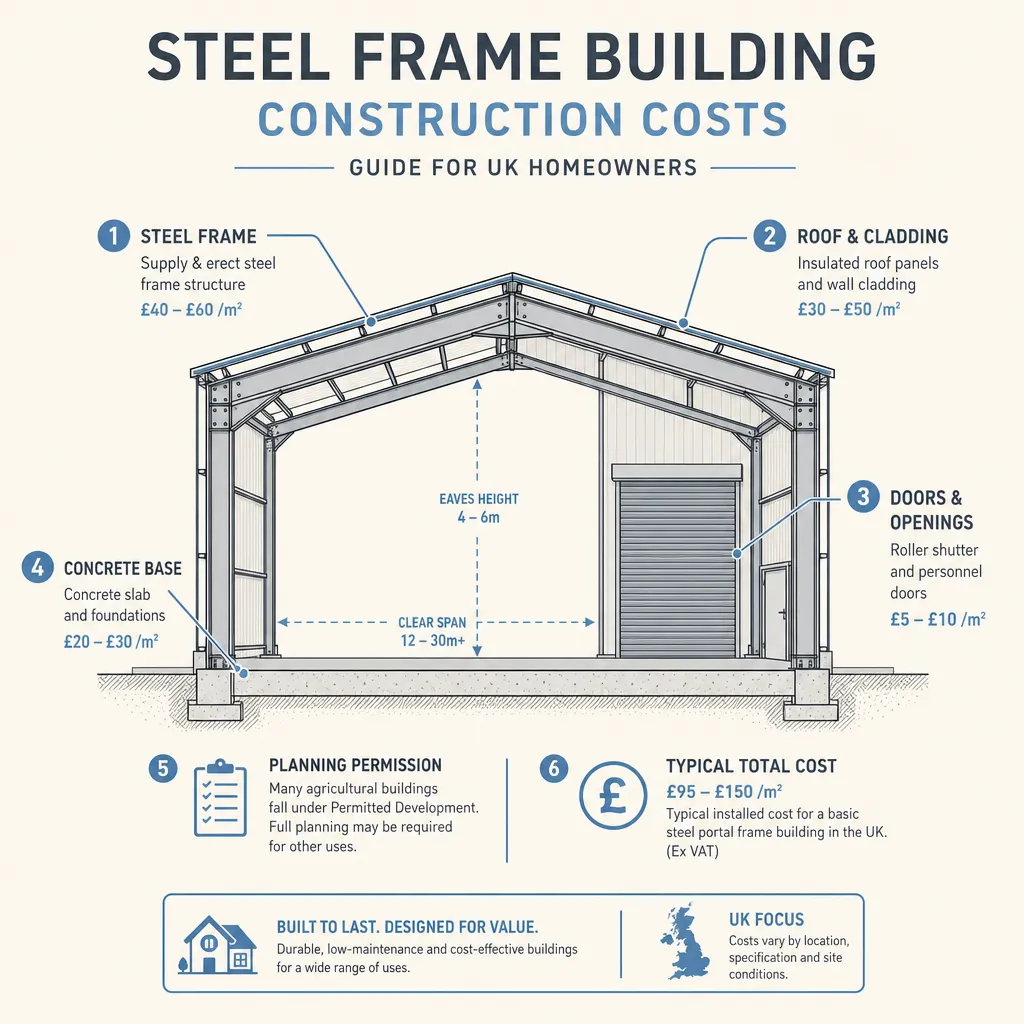
Steel Frame Building Construction Costs
Steel frame buildings in the UK cost from around £400 to over £1,200 per square metre of floor area, depending on building type, size, cladding, insulation, and fit-out level.