Understanding Groundworks and Development Expenses for New Building Projects
By Housey · Last reviewed 1st of June 2026
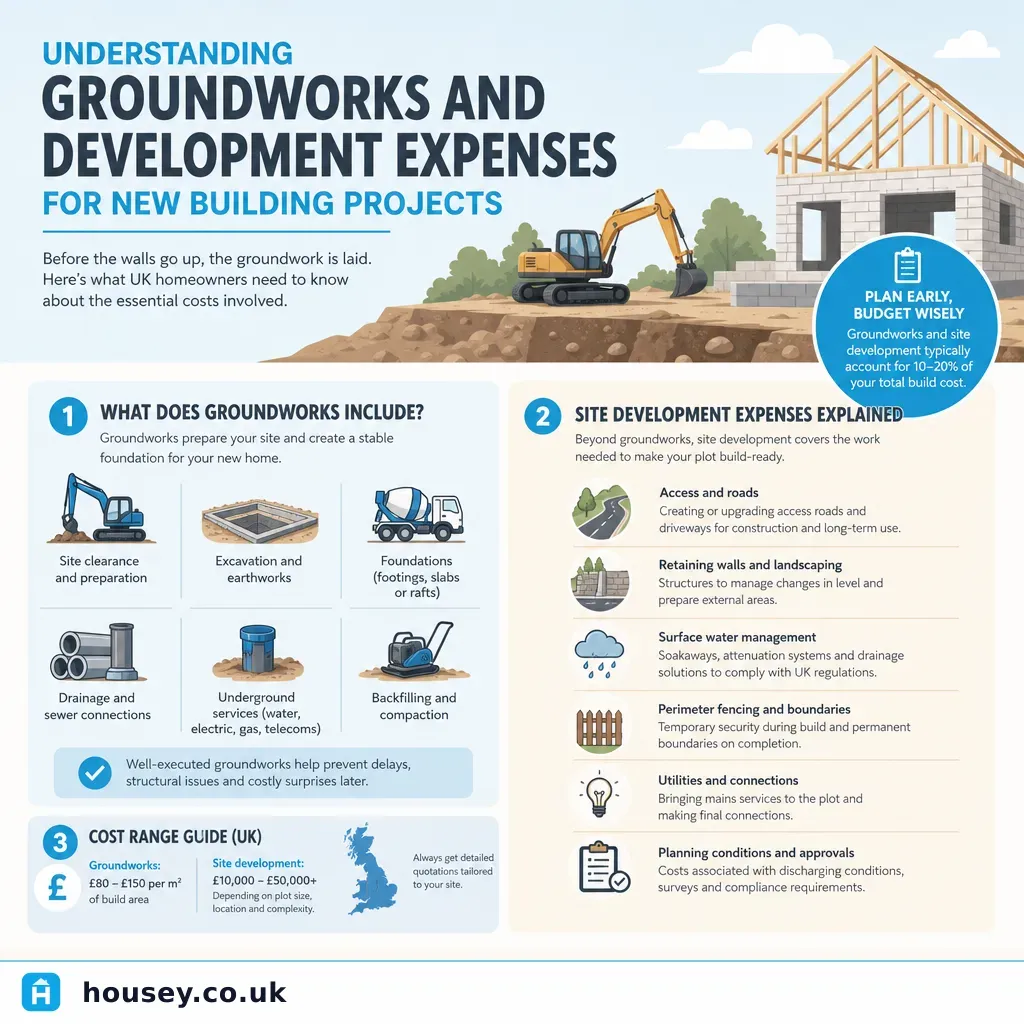
Understanding Groundworks and Development Expenses for New Building Projects
Groundworks are the hidden foundation of any new build — the excavation, drainage, foundations, and site preparation that rarely feature in architectural renders but routinely account for 10–15% of total construction costs. Misunderstanding or under-budgeting this phase is one of the most common reasons UK self-build and developer projects overrun before a single wall is erected, and cost overruns at this stage are difficult to recover later in the programme.
Key points
- Groundworks typically represent 10–15% of total construction cost on a UK new-build project, but can rise substantially on sites with poor ground conditions, contamination, a high water table, or steep gradients.
- A geotechnical investigation (soil survey) should be commissioned before site purchase or at the earliest stage of planning — without it, foundation design cannot be finalised and groundworks budgets are estimates with wide uncertainty.
- Building Regulations Approved Document A requires foundations to be designed for site-specific ground conditions; the choice between strip, trench fill, raft, and pile foundations carries very different cost implications.
- Brownfield and former industrial sites may require a Phase 1 environmental desk study and, if risks are identified, a Phase 2 intrusive investigation as a planning condition — remediation can add tens of thousands of pounds.
- The Community Infrastructure Levy (CIL) and Section 106 planning obligations may form part of your overall development costs; confirm with the local planning authority before finalising your budget.
What groundworks include
Groundworks covers all preparatory below-ground and ground-level civil engineering work that must be completed before superstructure construction can begin. The scope varies significantly by site, but typically includes:
Site clearance and preparation
- Vegetation clearance, topsoil strip, and disposal off-site
- Demolition of existing structures where applicable
- Site levelling and bulk earthworks
Ground investigation
- Trial pits, boreholes, or dynamic probing to determine soil type and bearing capacity
- Laboratory testing of soil samples
- Contamination screening for gases, chemicals, or hydrocarbons
Drainage and services
- Foul water drainage layout — connection to adopted sewer or private treatment plant
- Surface water drainage — soakaways, attenuation tanks, or SuDS (Sustainable Drainage Systems)
- Service trenches for gas, water, electricity, and telecoms
Foundations
- Excavation and concrete pour for strip, trench fill, raft, or pile foundations
- Hardcore blinding and damp-proof membrane below the ground-floor slab
Ground-floor slab
- Insulated slab to meet Part L U-value requirements (0.13 W/m²K for new residential dwellings under the 2022 Part L update for England)
- Screed where specified by the structural or architectural engineer
Indicative UK groundworks costs
Indicative UK costs, last reviewed 2026-06-01. Costs vary significantly by region, ground conditions, site access, and scope. Always obtain at least three itemised quotes from experienced contractors.
Groundworks element | Indicative cost range | Key variables |
|---|---|---|
Site clearance (small plot) | £2,000–£8,000 | Vegetation volume, skip and disposal costs, access |
Geotechnical investigation (soil survey) | £1,500–£5,000 | Number of boreholes, lab tests, report complexity |
Phase 1 environmental desk study | £800–£2,000 | Site history and proximity to industrial land |
Phase 2 intrusive investigation | £3,000–£15,000+ | Contamination type and extent |
Strip foundations (3-bed house footprint) | £8,000–£20,000 | Depth, concrete volume, reinforcement |
Trench fill foundations | £10,000–£25,000 | Depth to bearing stratum |
Raft foundation | £12,000–£30,000 | Reinforcement specification, slab thickness |
Pile foundations | £15,000–£50,000+ | Number and type of piles, pile cap design |
Drainage installation (foul and surface water) | £5,000–£15,000 | Length of runs, connection point, SuDS requirement |
Insulated ground-floor slab | £6,000–£18,000 | Floor area, insulation specification, screed |
Services connections (water, electricity) | £3,000–£15,000 | Distance to mains, utility provider charges |
What drives groundworks costs up?
Several site-specific factors can push groundworks costs well above initial estimates.
Poor ground conditions Clay-heavy soils shrink and swell seasonally, creating heave risk; sandy or made-ground sites may have inadequate bearing capacity. Either condition may require deeper or engineered foundations. A geotechnical investigation is the only reliable way to quantify this risk before committing to a budget or a fixed-price contract.
High water table Sites with a shallow water table require groundwater management during excavation — pumping, sheet piling, or dewatering systems — adding cost and time to the programme.
Contaminated land Brownfield sites, former petrol stations, and land adjacent to industrial uses may require Phase 2 investigation and remediation. Costs range from around £5,000 for localised removal to hundreds of thousands of pounds for widespread hydrocarbon or chemical contamination.
Steep gradients or poor access Sloped sites require cut-and-fill earthworks or retaining structures. Poor road access limits plant size and increases material movement costs.
Proximity to trees Tree root zones affect foundation design due to clay shrinkage and heave risk. NHBC Chapter 4.2 sets minimum distances between tree species and foundation depths. A tree survey and arborist's report may be required as a planning condition.
Services diversions Existing gas, water, or electricity mains crossing the site may need diverting — utility companies charge significant fees for this work, with lead times that can delay the overall programme.
Worked example: a self-build on a sloped brownfield plot
A self-builder purchases a 0.1-hectare former garden plot in Birmingham that slopes approximately 1.8 metres across the proposed footprint of a 150m² four-bedroom house. A Phase 1 desk study reveals a former underground fuel tank on an adjacent site, triggering a Phase 2 intrusive investigation. The resulting groundworks scope includes:
Item | Cost |
|---|---|
Topsoil strip and disposal | £3,500 |
Phase 1 environmental desk study | £1,200 |
Phase 2 investigation (tank verification) | £6,800 |
Contamination clearance certificate (tank removed, clean result) | £4,200 |
Cut-and-fill earthworks for sloped site | £9,500 |
Trench fill foundations (deeper than standard — clay subsoil) | £22,000 |
Foul drainage to main sewer 28 m away | £4,800 |
SuDS attenuation tank (required as planning condition) | £7,200 |
Insulated ground-floor slab | £11,000 |
Services connections | £5,500 |
Total groundworks | ~£75,700 |
The self-builder's initial estimate before ground investigation was £45,000 — a gap of over £30,000. This illustrates why early investigation and a 10–20% contingency specifically allocated to groundworks are essential on any site with uncertainty about soil conditions or site history.
How to structure your groundworks budget
Groundworks budget checklist
Before finalising your groundworks budget, confirm you have accounted for:
What to ask when getting groundworks quotes
- What site investigation data is your quote based on? Quotes produced without a geotechnical report carry significant unquantified risk — the price can change substantially once ground conditions are confirmed.
- What is included in excavation — does disposal of contaminated or non-contaminated spoil carry additional cost?
- Who is responsible for the drainage design: a civil engineer, or is the groundworker working to an engineer's drawing supplied by you?
- What Building Regulations drawings are being worked to, and who is the appointed building control body — a local authority inspector or an approved inspector?
- Is VAT included? Standard-rated construction supplies attract 20% VAT for most self-builders, though eligible new builds may qualify under HMRC's VAT431NB reclaim scheme.
- What is the assumed foundation type, and what happens to the price if ground conditions encountered during excavation require a change?
- What are the programme milestones, what causes delay, and what are the contractual consequences if the ground investigation data is incomplete?
When to get professional help
Groundworks are not a DIY undertaking — they involve structural design, regulatory compliance, and decisions that affect the safety and longevity of the entire building. Involve qualified professionals at these points:
- Before site purchase: a civil engineer or geotechnical specialist can identify ground risks early enough to affect the purchase price negotiation or inform planning conditions.
- Before finalising a build contract: a build cost estimator or quantity surveyor can sense-check groundworks quotes against the design drawings and identify gaps in scope.
- If ground conditions change during excavation: unexpected made ground, voids, groundwater, or contamination should trigger an immediate halt and professional reassessment before work continues.
- If the site is in a flood risk zone: a drainage engineer should confirm that the surface water drainage design meets Environment Agency requirements and any planning conditions.
How Housey can help
Housey connects self-builders and developers with the specialists needed at every stage of the pre-build phase. Find groundworkers for excavation and foundation construction, civil engineers for drainage design and earthworks, and geotechnical investigation specialists to understand your ground conditions before committing to a budget. For an independent sense-check of your overall scheme costs, our build cost estimating service can help you identify budget gaps before contracts are signed.
Frequently asked questions
Do I need a geotechnical survey before planning?
You do not always need a geotechnical survey before submitting a planning application, but it is advisable for brownfield sites, sites with known contamination risk, or unusual topography. Many local planning authorities require a Phase 1 desk study as a pre-application or planning condition. Foundation design — which determines your groundworks cost accurately — cannot be finalised without ground investigation data.
What is the difference between groundworks and civil engineering?
Groundworks typically refers to below-ground construction work on a building plot — excavation, foundations, drainage, and slabs. Civil engineering is a broader discipline covering design and delivery of infrastructure including roads, drainage networks, retaining walls, and earthworks. On residential projects, a civil engineer usually designs the drainage and earthworks that groundworkers then construct on site.
Can I reclaim VAT on groundworks for a self-build?
Eligible self-builders can reclaim VAT paid on most materials and services for a new dwelling using HMRC's VAT431NB scheme. The claim must be submitted within 3 months of completion. Some groundworks services may attract VAT at different rates depending on scope — consult an accountant familiar with construction VAT before assuming full reclaim eligibility on your project.
How long do groundworks take?
Duration depends on scope, ground conditions, and site access. For a typical three-to-four-bedroom new build on a straightforward site, allow 4–10 weeks from mobilisation to slab completion. Sites requiring piling, dewatering, or contamination remediation can take 3–6 months or more, and this must be factored into your overall programme and finance arrangement.
What is SuDS and do I need it for a new build?
SuDS (Sustainable Drainage Systems) manage surface water runoff by mimicking natural drainage — using soakaways, swales, permeable paving, or attenuation tanks to slow discharge to sewers or watercourses. Most new residential developments in England require SuDS under the National Planning Policy Framework and Building Regulations Approved Document H. Your drainage designer or civil engineer will advise on the appropriate solution for your site.
Sources and further reading
- Building Regulations Approved Document A (Structure) — GOV.UK
- Building Regulations Approved Document H (Drainage and waste disposal) — GOV.UK
- Building Regulations Approved Document L (Conservation of fuel and power) — GOV.UK
- NHBC Standards Chapter 4.2 — Building near trees — NHBC
- National Planning Policy Framework — GOV.UK
- HMRC VAT Notice 431NB: VAT refunds for DIY house builders — HMRC
- Environment Agency: Flood risk guidance — GOV.UK
Useful next reads
 Planning & Pre-Build
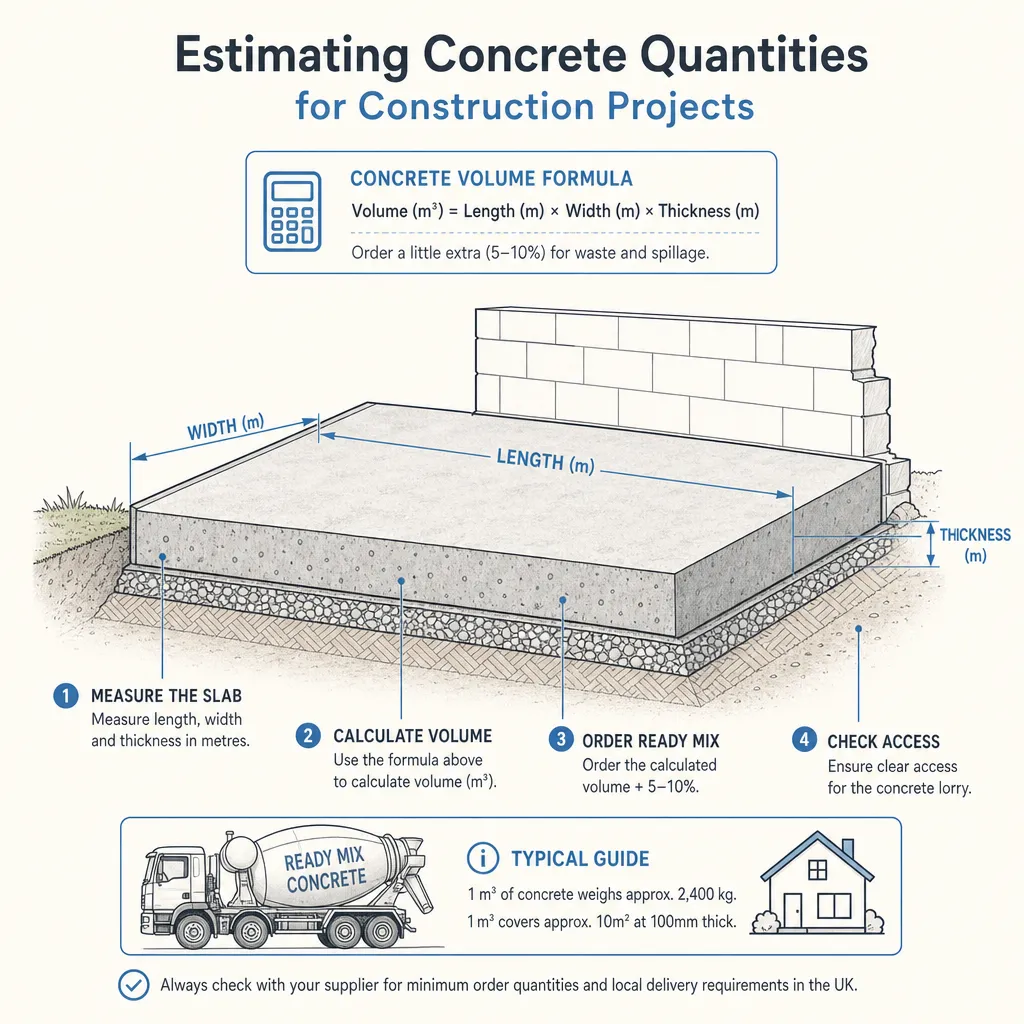
Estimating Concrete Quantities for Construction Projects
To estimate concrete quantities, calculate the volume in cubic metres (length × width × depth), then add a 5–10% wastage allowance.
 Planning & Pre-Build
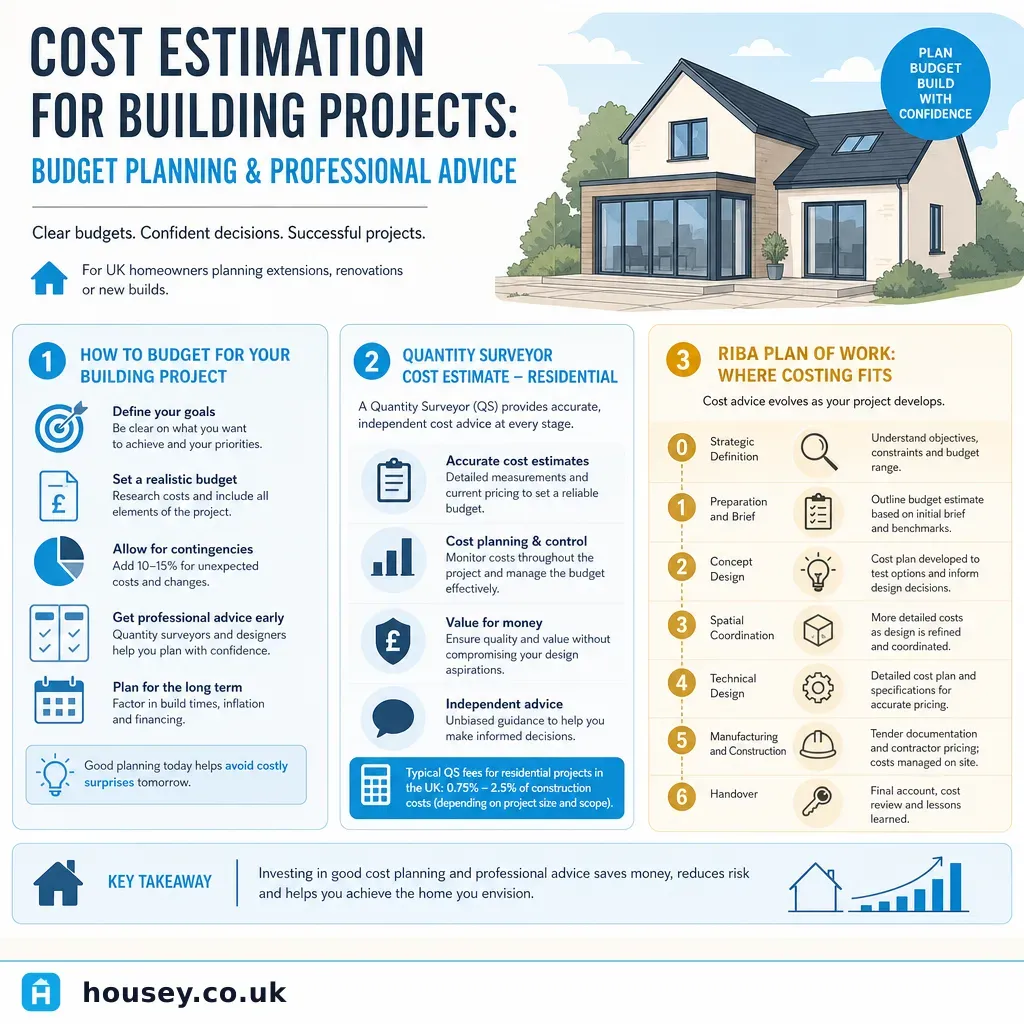
Cost Estimation for Building Projects: Budget Planning and Professional Advice
Build cost estimation involves calculating likely expenditure across design, materials, labour, fees, and contingency before committing to a project.
 Planning & Pre-Build
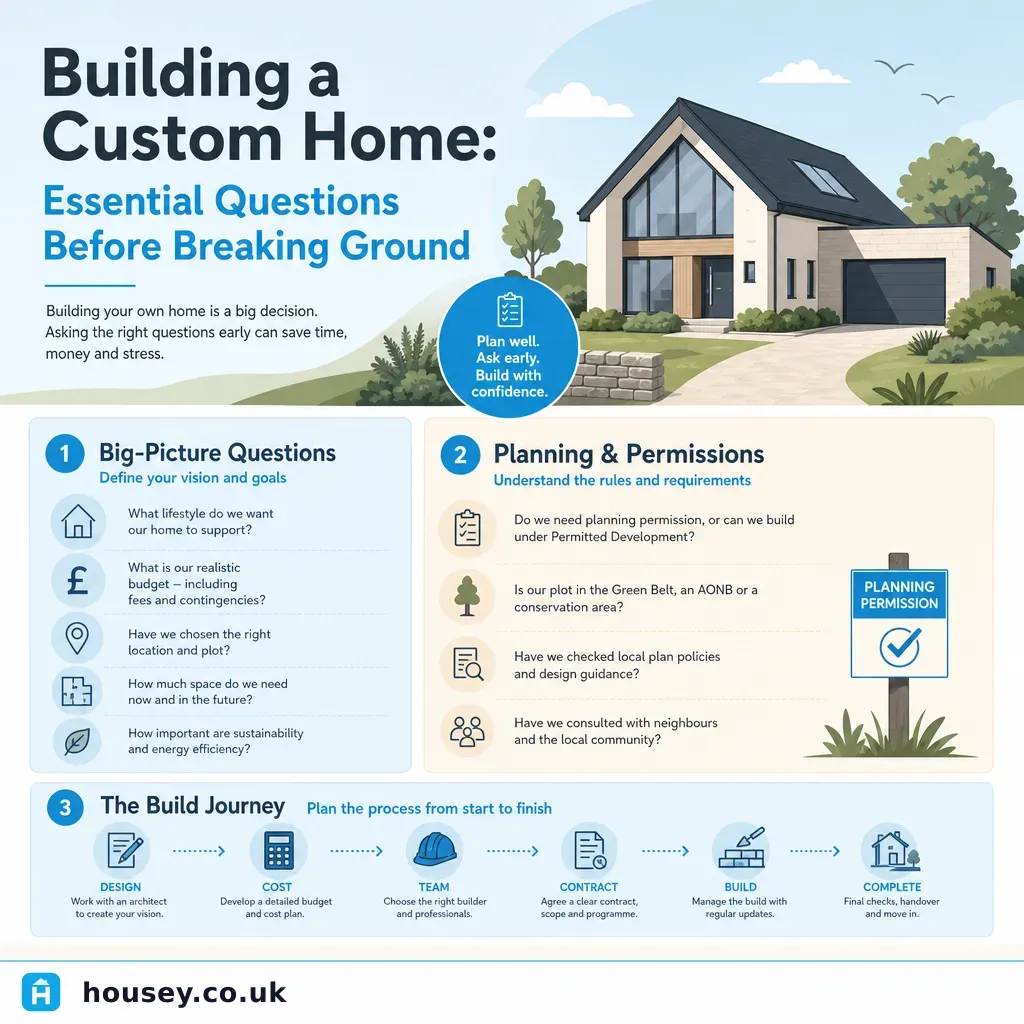
Building a Custom Home: Essential Questions Before Breaking Ground
Building a custom home in the UK requires planning permission, separate Building Regulations approval, and a professional team typically including an architect or architectural technologist, structural engineer, and building control body.
 Planning & Pre-Build
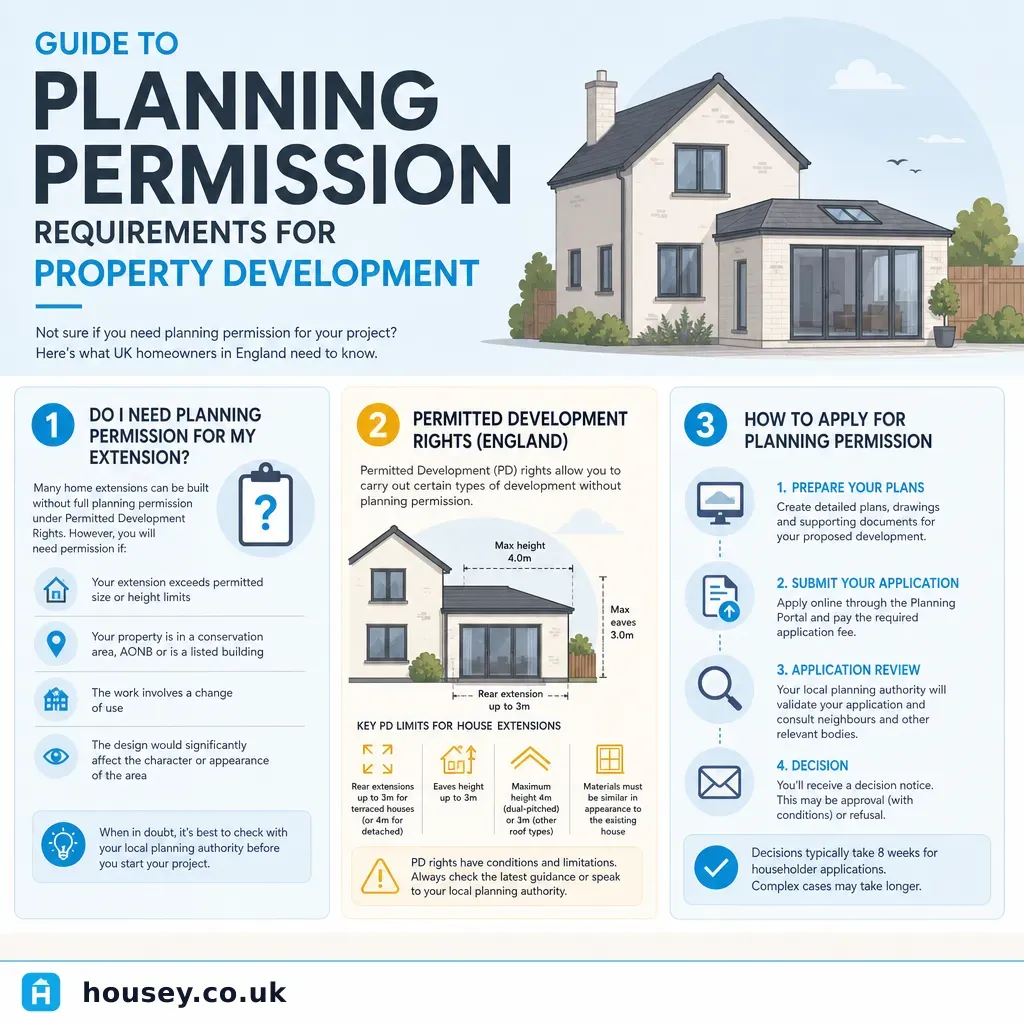
Guide to Planning Permission Requirements for Property Development
Most home improvements in England fall within permitted development rights and do not need a planning application.
 Planning & Pre-Build
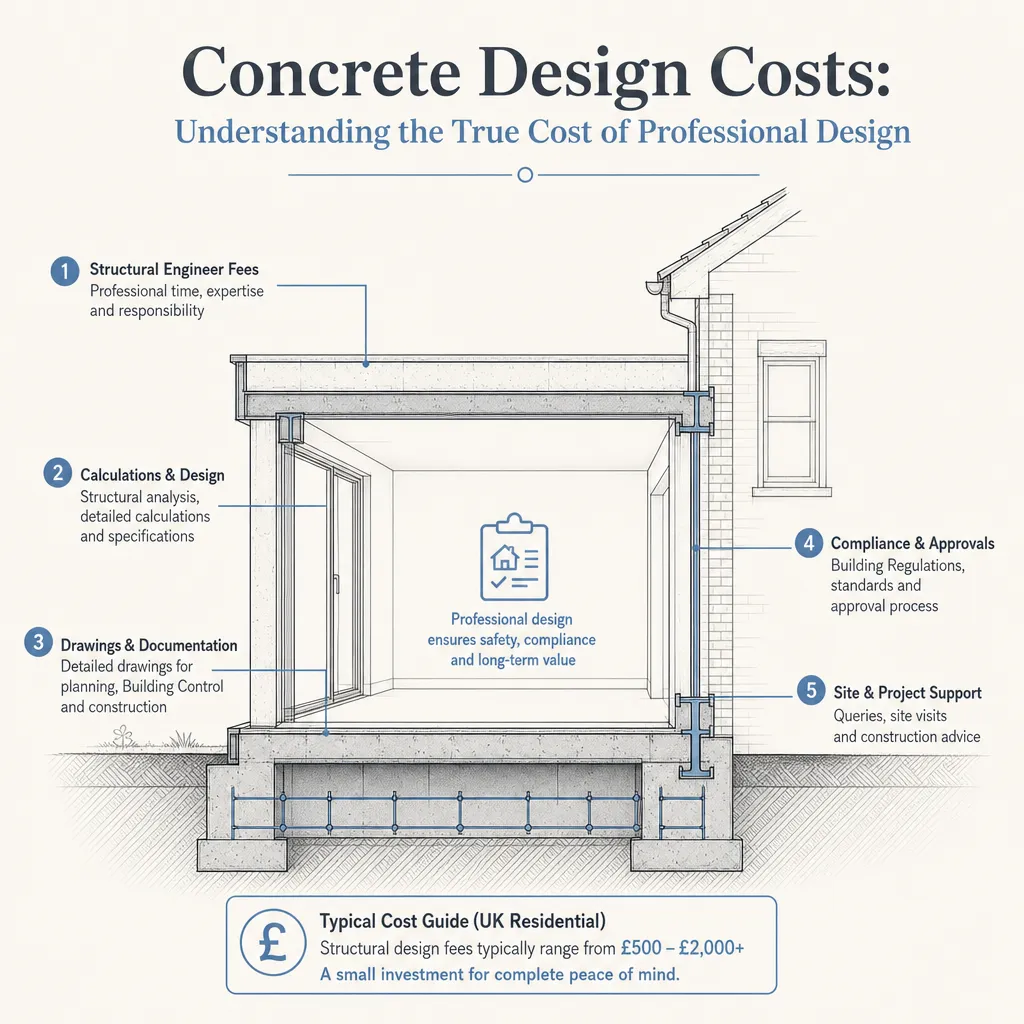
Concrete Design Costs: Understanding the True Cost of Professional Design
Professional design fees in the UK typically range from 5–12% of construction cost, or £500–£5,000+ as a fixed fee depending on scope and complexity.