Driveway Paving and Installation Cost Estimates
By Housey · Last reviewed 6th of May 2026
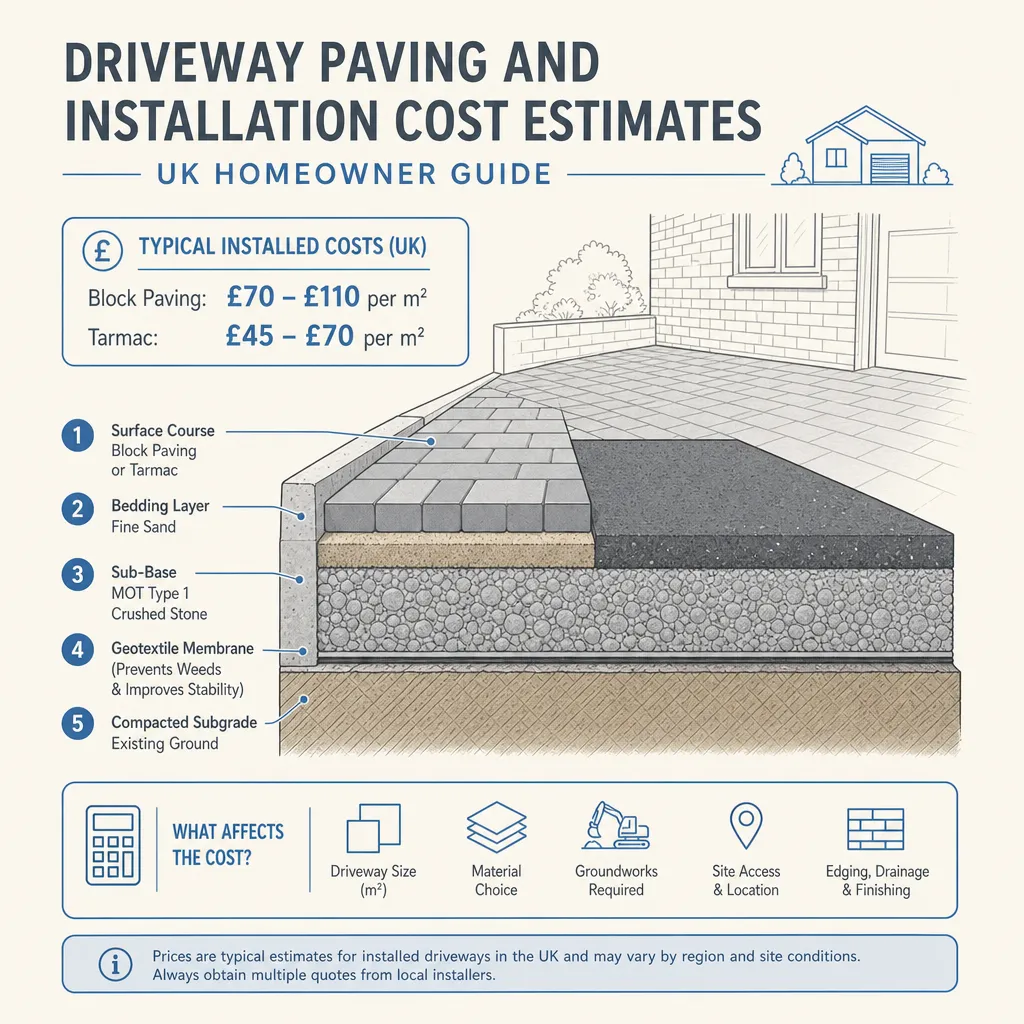
Driveway Paving and Installation Cost Estimates
New driveway projects arise when a property's existing surface has deteriorated beyond repair, when a homeowner wants to convert a front garden to hardstanding, or when a new build has no surfacing at all. The decision involves material choice, drainage compliance, potential planning requirements, and a wide range of contractor quotes — getting the groundwork right determines whether the surface lasts 10 years or 30.
Key points
- Indicative UK installation costs range from around £15/m² for gravel to £120/m² or more for block paving (Indicative UK costs, last reviewed 2026-05-06).
- Any new front garden driveway over 5m² must use a permeable surface or drain to a lawn or border — otherwise planning permission is required under Planning Portal guidance.
- A standard 40–50m² driveway project typically includes excavation, sub-base preparation, edging, and laying — these elements add significantly to the headline cost per square metre.
- Tarmac and asphalt are among the fastest surfaces to install (often one to two days); block paving typically takes three to five days for the same area.
- Resin-bound surfaces should be installed by a TrustMark or similarly accredited contractor to qualify as SuDS-compliant permeable surfacing for planning purposes.
What does driveway installation cost in the UK?
Installation cost depends heavily on the material chosen, the size of the driveway, existing ground conditions, and how much excavation is needed. The figures below are indicative only — always get at least three written quotes for your specific site.
Material | Indicative cost per m² | Typical lifespan | Key characteristic |
|---|---|---|---|
Gravel (loose) | £15–£40 | 10–15 years | Cheapest; may need edging and periodic raking |
Tarmac / asphalt | £25–£60 | 20–30 years | Fast to install; can be resurfaced later |
Concrete | £50–£100 | 25–40 years | Durable; cracking can be hard to repair invisibly |
Block paving | £50–£120 | 20–30+ years | High kerb appeal; individual blocks replaceable |
Resin-bound | £50–£100 | 15–25 years | Permeable; smooth finish; slip-resistant |
Pattern imprinted concrete | £60–£120 | 20–30 years | Decorative; sealing required periodically |
Indicative UK costs, last reviewed 2026-05-06. Prices exclude VAT unless stated. Source: Checkatrade national cost data and Rated People trade pricing guides.
For a typical 40m² front driveway, total project costs (including excavation, sub-base, edging, and surfacing) commonly range from:
- Gravel: £800–£2,000
- Tarmac: £1,200–£3,000
- Block paving: £2,500–£6,000
- Resin-bound: £2,200–£5,000
These are indicative ranges. Properties with poor access, significant existing materials to remove, soft ground, or drainage complications will cost more.
What drives driveway installation costs?
Understanding cost drivers helps you compare quotes on a like-for-like basis.
Excavation depth and sub-base
Most driveway surfaces need a compacted sub-base of MOT Type 1 aggregate to a depth of 100–150mm, plus the surface course. If the ground is soft, has tree roots nearby, or has poor drainage, deeper excavation may be needed.
Size and shape
A simple rectangular driveway costs less per square metre than one with curves, tight access, or multiple levels.
Edging and drainage
Block paving needs soldier-course edging restraints; most surfaces benefit from a channel drain at the foot of a slope. Some sites require drainage channels connected to a soakaway or highway drain — these add to the project cost.
Access and vehicle type
Driveways intended for heavy vehicles may need a deeper sub-base or thicker surface course to prevent rutting.
Existing surface removal
Breaking out and disposing of an existing concrete or tarmac drive adds approximately £5–£20/m² to the project cost.
Planning permission and permeable surfacing
Planning Portal guidance on driveways sets out that householders in England do not need planning permission if:
- The total new hardstanding is 5m² or less, or
- The surface used is permeable (e.g. gravel, permeable block paving, resin-bound), or
- Water drains to a permeable area such as a lawn or border.
If none of these conditions are met — for example, a plain concrete or standard asphalt driveway covering the full front garden — a householder planning application is required from the local planning authority (LPA).
Rules differ in Scotland, Wales, and Northern Ireland. Always check with your LPA before starting work, particularly if the property is in a conservation area or is listed.
Which driveway material should you choose?
- Choose gravel if budget is the primary concern, drainage is straightforward, and you are comfortable with occasional maintenance.
- Choose tarmac or asphalt if you want a durable, low-maintenance surface at moderate cost that can be resurfaced in future without full replacement.
- Choose block paving if kerb appeal and long-term appearance matter, and you are willing to invest more upfront — individual blocks can be lifted and replaced if drainage work is needed later.
- Choose resin-bound if you want a clean, modern finish that is genuinely permeable and requires minimal maintenance.
- Choose concrete if permanence and low surface maintenance are priorities and you accept the higher difficulty of invisible crack repair.
- Ask a drainage specialist if the site has significant slope, known ground instability, or existing drainage problems before finalising your material choice.
Worked UK property scenario
A homeowner in a 1960s semi-detached in the East Midlands wants to replace a deteriorating gravel access with a new block-paved driveway for two cars, approximately 45m². The existing gravel is removed, the sub-base laid to 150mm depth, edging restraints installed, and block paving laid in a herringbone pattern with a channel drain at the front.
Indicative quote breakdown:
- Excavation and removal: £450
- MOT Type 1 sub-base material and laying: £900
- Edging restraints: £200
- Channel drain and connection to soakaway: £350
- Block paving supply and laying (45m²): £3,150
- Total indicative cost: approx. £5,050 + VAT
This is illustrative only. In this example, three quotes ranged from £4,200 to £6,100, reflecting differences in block paving specification and contractor day rates.
What to ask before accepting a quote
- Is VAT included in the quoted price?
- What depth sub-base is specified, and what material (MOT Type 1)?
- How will drainage be handled — is a channel drain or soakaway included?
- What is the block or surface material specification (manufacturer, grade)?
- Who removes and disposes of the existing surface?
- Will the contractor handle any necessary planning permission application?
- What warranty applies to the completed work?
- Does the contractor hold public liability insurance and a registered waste carrier licence?
When to get professional help
Most driveway installation is straightforward work for an experienced contractor. However, speak to a structural engineer, drainage consultant, or specialist before proceeding if:
- The ground is visibly unstable, has caused previous surfaces to sink, or has known tree root activity nearby.
- The driveway slope directs water towards the house or the public pavement.
- The site has previously been used for a garage or outbuilding and may contain unknown drainage or foundations beneath.
- The property is listed or in a conservation area, where different planning restrictions may apply.
- You are unsure whether your proposed surface material meets local SuDS or drainage requirements.
How Housey can help
If you are ready to compare prices for a new driveway, Housey can connect you with vetted driveway installers in your area. Describe your project and receive up to four written quotes to compare on materials, drainage approach, and total cost.
Frequently asked questions
Do I need planning permission for a new driveway?
In England, planning permission is not required for a front garden driveway if the surface is permeable — such as gravel, permeable block paving, or resin-bound — or if rainwater drains to a lawn or border. A non-permeable surface covering more than 5m² typically needs a householder planning application. Rules differ in Scotland, Wales, and Northern Ireland, so check with your local planning authority before starting.
How long does driveway installation take?
Gravel driveways can be completed in a day. Tarmac typically takes one to two days for a standard two-car area. Block paving generally takes three to five days, including time for sub-base compaction. Resin-bound surfaces need dry weather and curing time — allow two to three days minimum. Timelines increase significantly if site conditions require additional excavation or drainage work.
Can I install a driveway myself?
Laying gravel is practical for a capable DIYer. Tarmac, block paving, and resin-bound surfaces require specialist equipment and skill for a durable result. Poor sub-base compaction is the most common cause of early driveway failure — a problem that is expensive to fix after the fact. For any surface where longevity and appearance matter, a professional contractor usually provides better long-term value.
How do I know if a driveway contractor is reputable?
Look for membership of the Association of Paving Contractors or a comparable accreditation scheme. Ask for references from recent local jobs. Confirm they carry public liability insurance and hold a registered waste carrier licence for removing excavated material. Be cautious of contractors who quote verbally only, ask for large upfront cash payments, or cannot provide evidence of previous work.
What is the most durable driveway material?
Concrete typically lasts 25–40 years if well-constructed, though cracks are difficult to repair invisibly. Block paving lasts 20–30 years and individual blocks can be replaced if drainage work is needed later. Tarmac lasts 20–30 years with periodic sealing. The durability of any surface ultimately depends on the quality and depth of sub-base preparation more than the surface material itself.
Sources and further reading
- Driveways — planning permission guidance — Planning Portal
- Association of Paving Contractors — Association of Paving Contractors
- Driveway cost guide — Checkatrade
- CIRIA SuDS Manual C753 — CIRIA
Useful next reads
 Improvement & Build
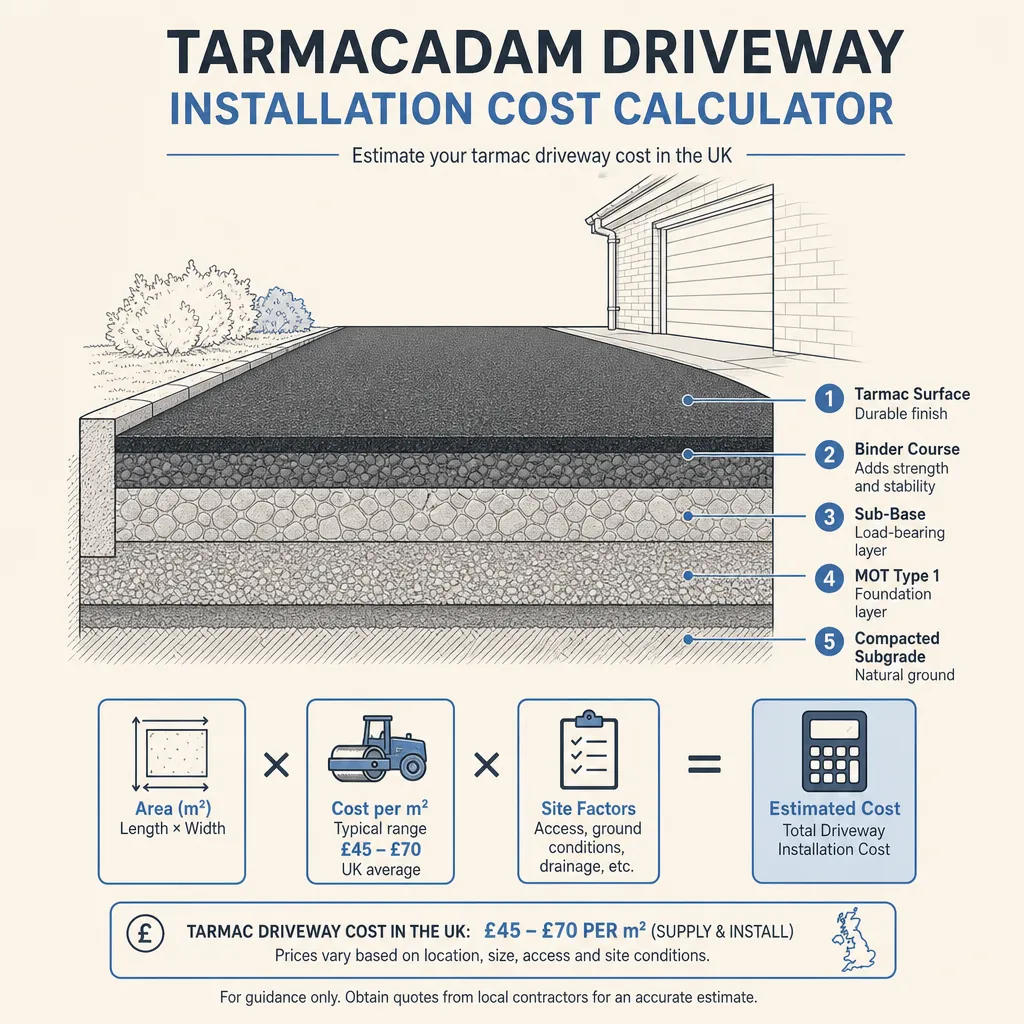
Tarmacadam Driveway Installation Cost Calculator
Tarmacadam driveway installation costs approximately £50–£100 per sq m in the UK for a full new installation, or £20–£50 per sq m for resurfacing over a sound existing base.
 Improvement & Build
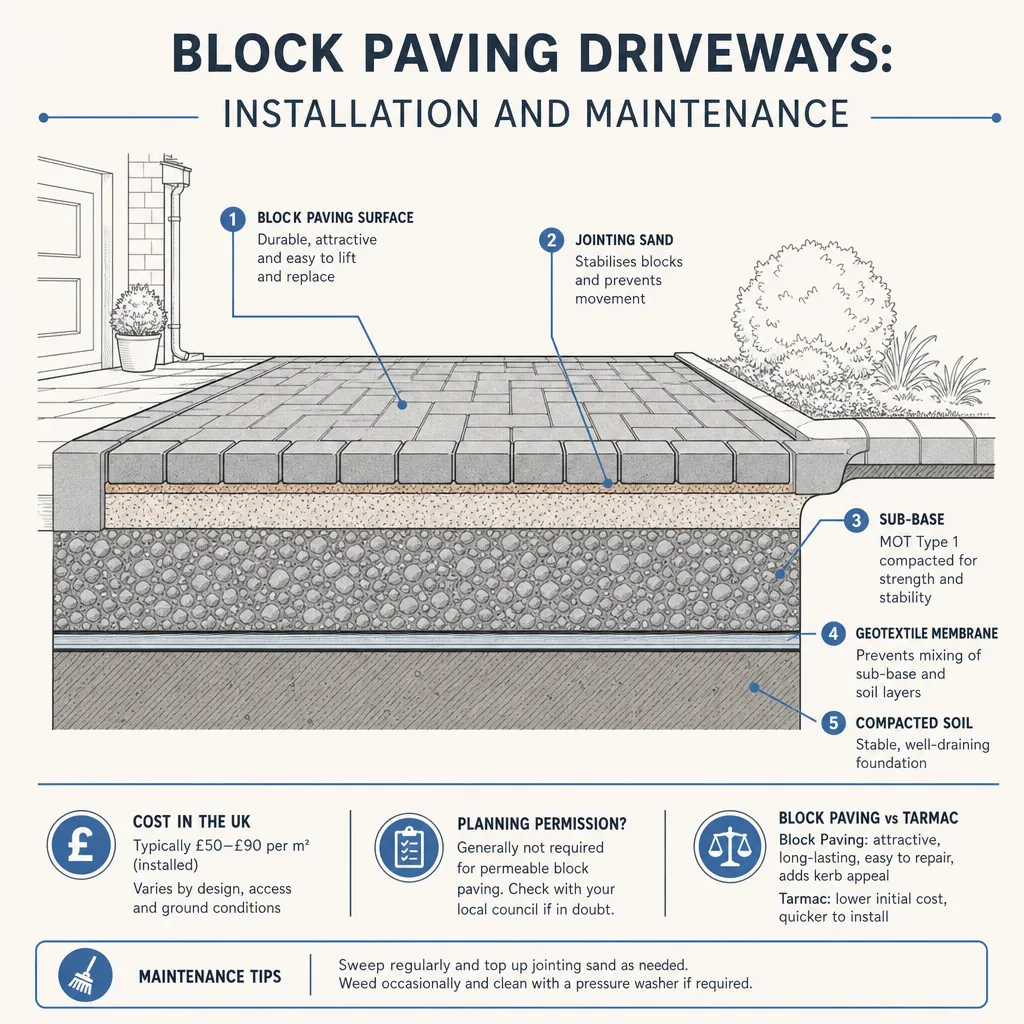
Block Paving Driveways: Installation and Maintenance
Block paving driveways typically cost £50–£120 per m² installed and last 20–30 years with good maintenance.
 Improvement & Build
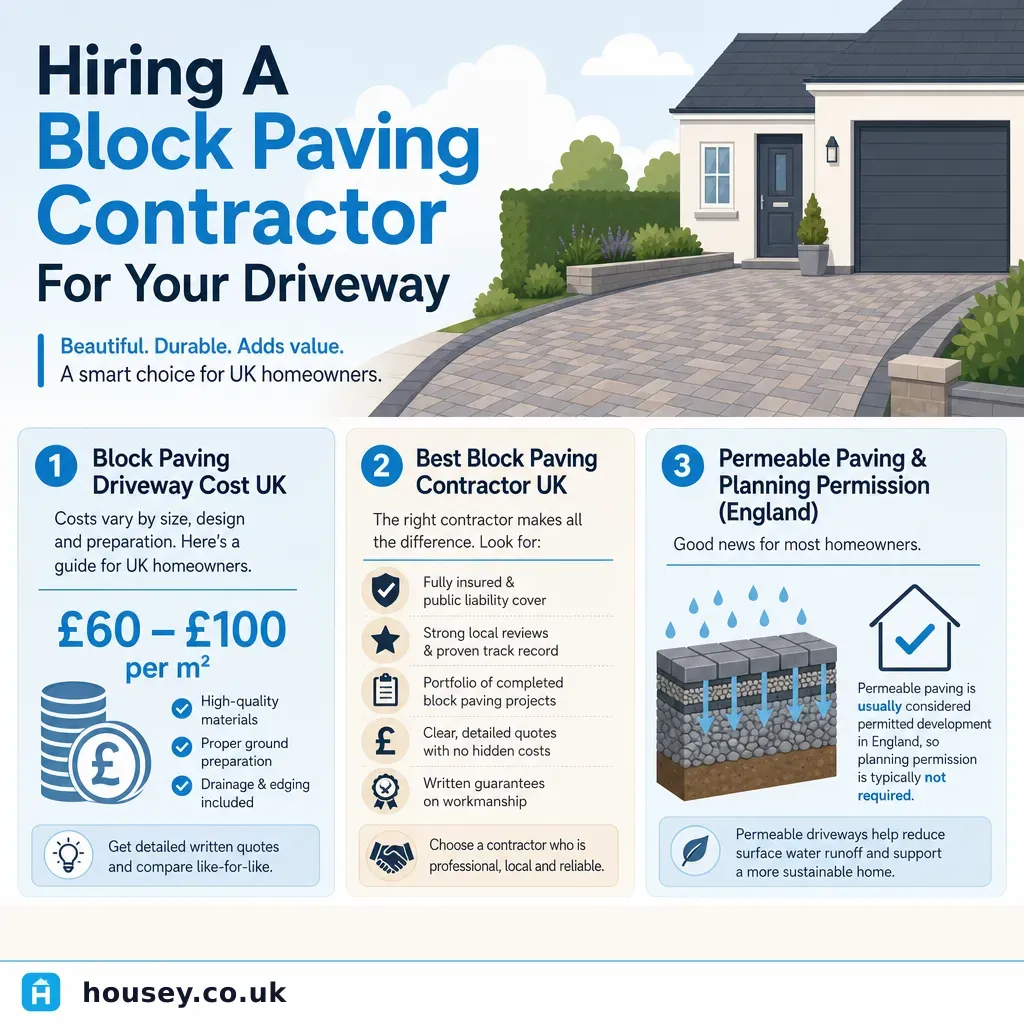
Hiring A Block Paving Contractor For Your Driveway
Block paving driveways are installed by specialist driveway or hard landscaping contractors.
 Improvement & Build
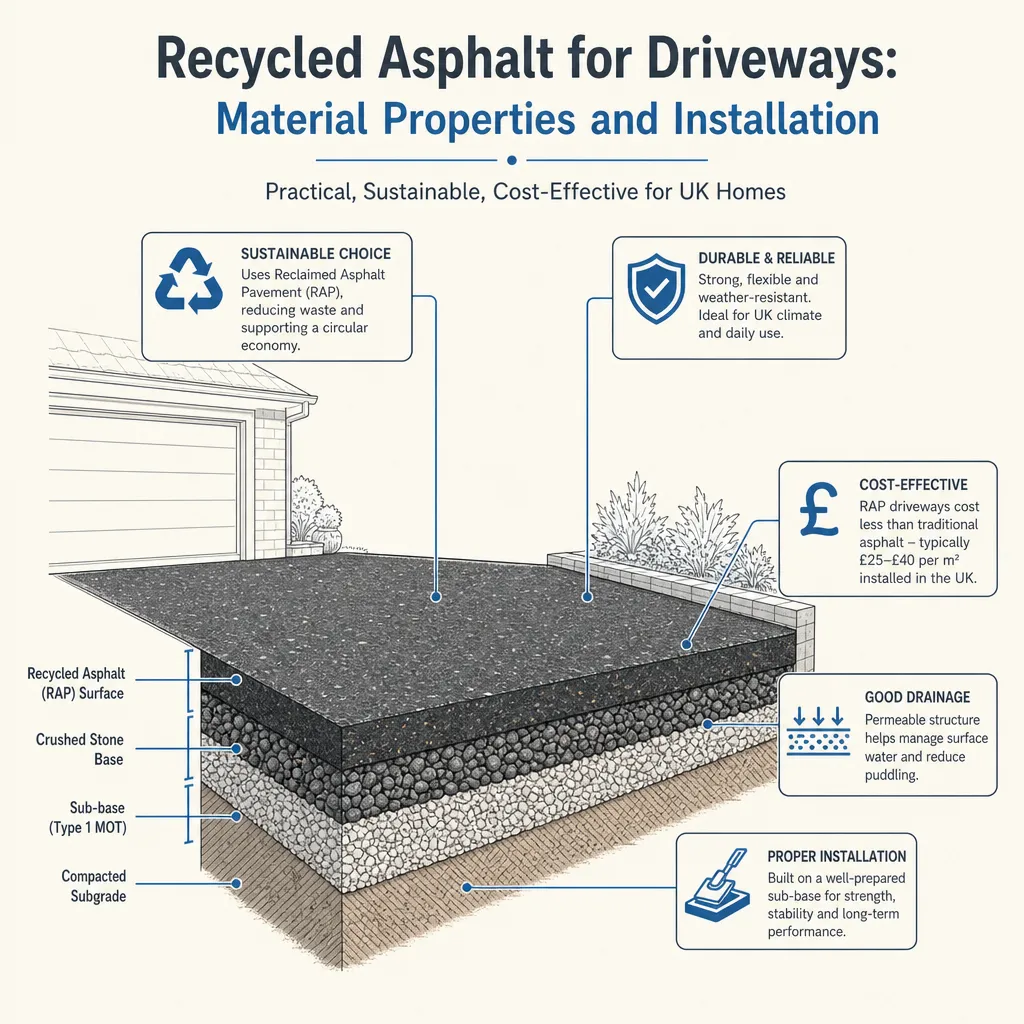
Recycled Asphalt for Driveways: Material Properties and Installation
Recycled asphalt (RAP) uses reclaimed road material and costs less than virgin asphalt, making it a budget-friendly option for UK driveways.
 Improvement & Build
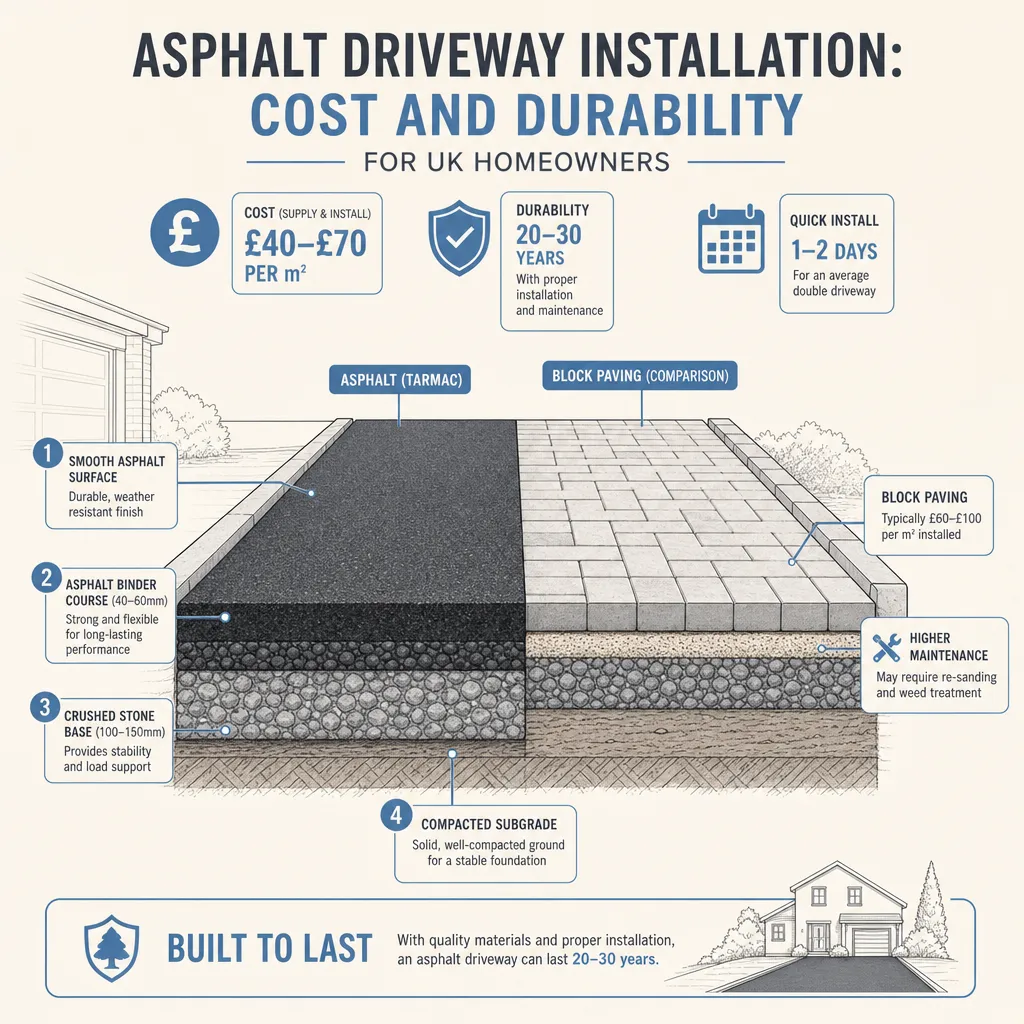
Asphalt Driveway Installation: Cost and Durability
Asphalt driveway installation in the UK typically costs £40–£80 per square metre.