Hiring A Block Paving Contractor For Your Driveway
By Housey · Last reviewed 31st of May 2026
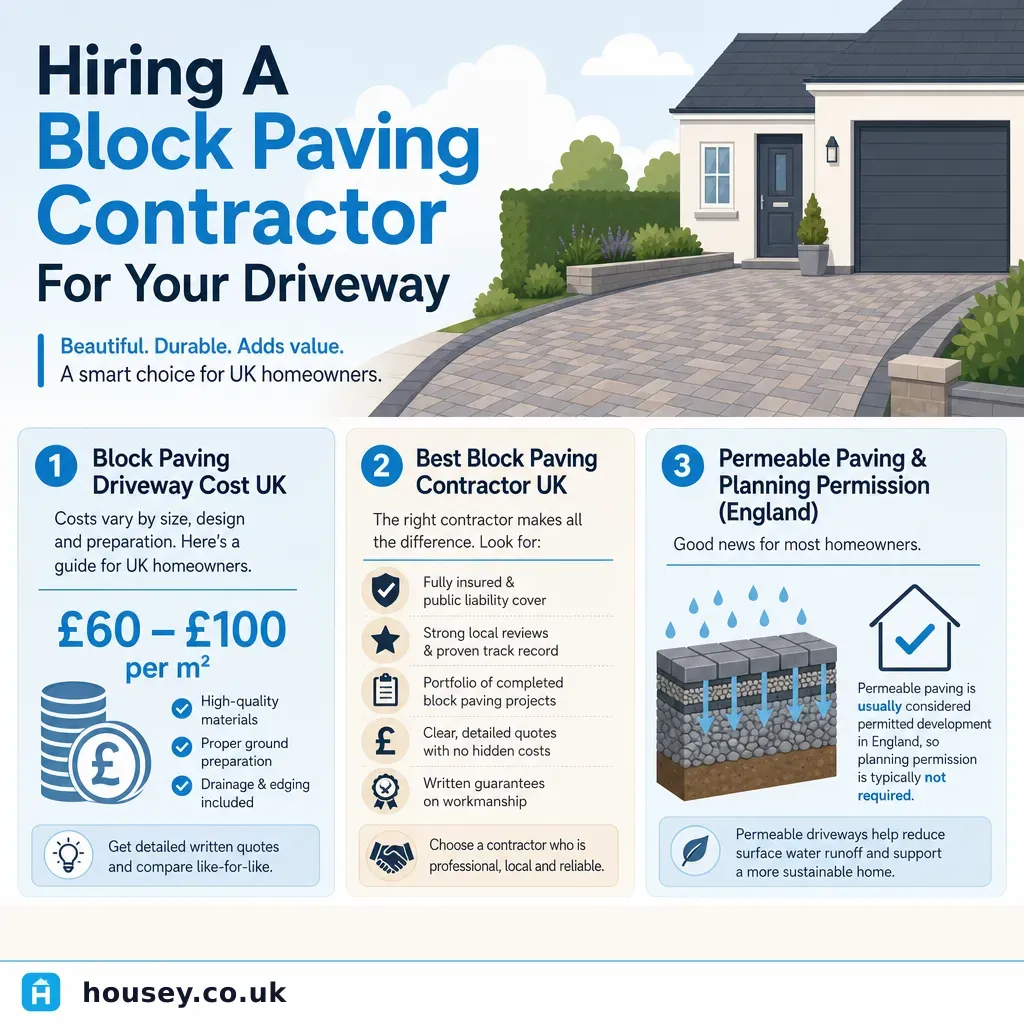
Hiring A Block Paving Contractor For Your Driveway
A new block paving driveway is a significant investment that affects your property's kerbside appeal, surface drainage, and long-term maintenance needs. Choosing the wrong contractor — or misunderstanding the planning rules that apply to front-garden hard-standing in England — can result in premature subsidence, poor drainage, or a surface that falls foul of local authority requirements. Getting the groundwork right, in every sense, is what separates a driveway that lasts 25 years from one that starts to fail within five.
Key points
- In England, replacing a front garden with an impermeable hard surface of more than 5m² requires planning permission unless a permeable surface is used or water drains to a lawn or border, under the Town and Country Planning (General Permitted Development) (England) Order 2015.
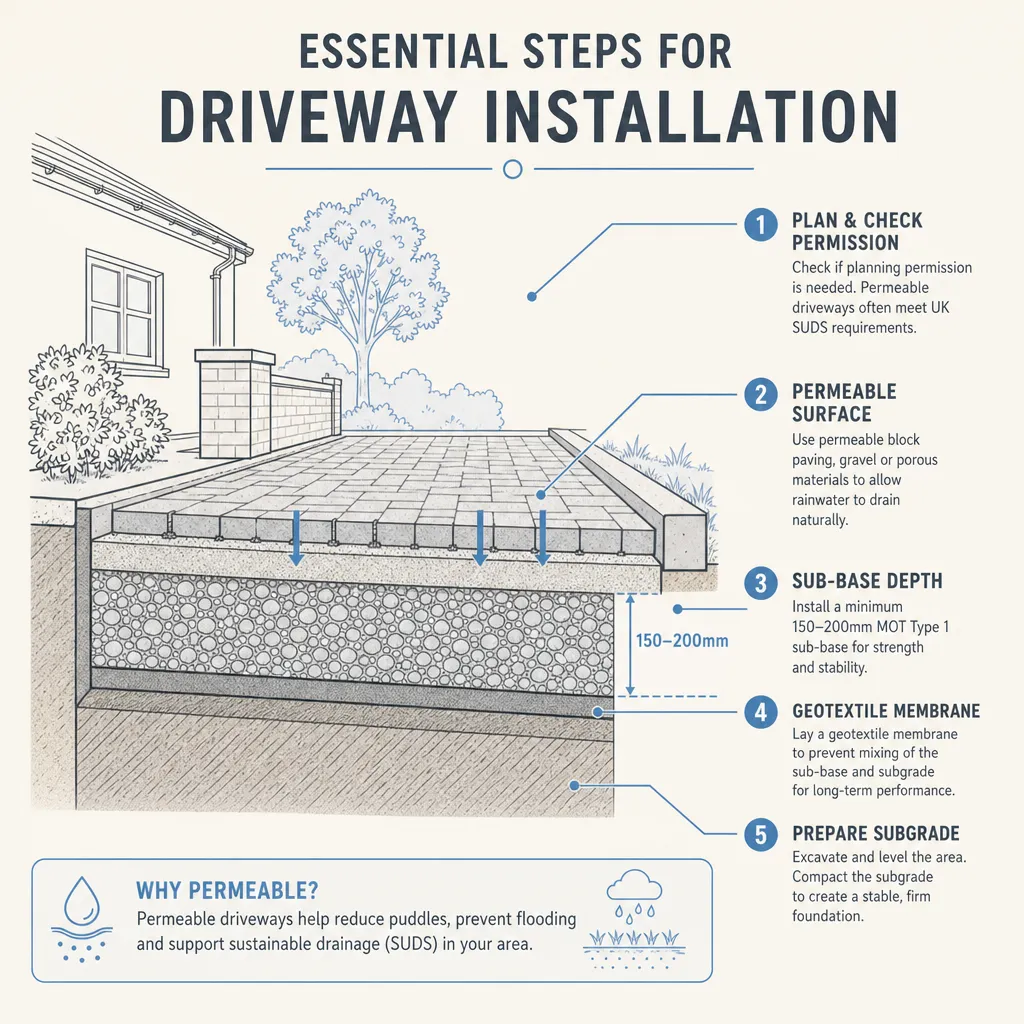
- The recommended minimum sub-base for a residential block paving driveway is 150–200mm of compacted MOT Type 1 granular material, plus a 40–50mm sharp sand bedding layer before blocks are laid.
- Any alteration to a dropped kerb (vehicle crossover) on a public highway requires separate consent from the local highway authority — this is distinct from and in addition to any planning permission for the driveway surface itself.
- Reputable driveway contractors should offer a minimum five-year workmanship guarantee on laying and edging in writing; block manufacturers often provide separate product warranties of 10 to 25 years.
- There is no single mandatory licence for driveway contractors in England — assessing references, insurance, and trade body membership is therefore essential before appointing.
Surface options: how block paving compares
Surface type | Best for | Approximate installed cost | Planning (front garden over 5m²) | Drainage |
|---|---|---|---|---|
Standard concrete block paving | Classic look, durability, pattern flexibility | £70–£130/m² | Permission needed if impermeable | Impermeable unless permeable blocks and sub-base specified |
Permeable block paving | Where planning is a concern; sustainability goals | £80–£150/m² | Usually no permission needed | Excellent — water infiltrates through surface |
Resin-bound gravel | Modern finish, low maintenance | £70–£120/m² | Usually no permission needed | Permeable if correctly installed |
Tarmac or asphalt | Budget-conscious, fast to install | £40–£80/m² | Permission needed if impermeable | Impermeable without drainage channels |
Loose gravel | Budget option, minimal preparation | £15–£40/m² | Usually no permission needed | Permeable |
Indicative UK costs, last reviewed 2026-05-31. Prices vary by region, block specification, groundworks depth, and site access.
Planning permission: what you need to know
The rules for front-garden hard-standing changed in England in 2008 following concerns about urban flooding from impermeable surfaces, and those rules are carried into the GPDO 2015.
- Impermeable surfaces over 5m² in a front garden require planning permission in England.
- Permeable surfaces — permeable block paving with open joints and a permeable sub-base, resin-bound gravel, or loose gravel — generally satisfy the drainage requirement and do not need permission.
- Rear and side driveways are generally not subject to this specific rule, though other permitted development limits may apply.
- Conservation areas and listed buildings may carry additional restrictions regardless of drainage — check with your local planning authority.
- Scotland, Wales, and Northern Ireland operate separate planning regimes; always check with the relevant authority before work begins.
Always confirm the planning position with your local planning authority before accepting any quote for a front garden using an impermeable surface.
Pre-appointment checklist: how to assess block paving contractors
There is no single mandatory licence for driveway contractors in England, so quality varies considerably. Before requesting quotes:
- Check recent, verifiable reviews on Google, Checkatrade, or Trustatrader — look for references to sub-base depth, drainage, and edging quality, not just the finished appearance.
- Ask whether the contractor is a member of the British Association of Landscape Industries (BALI) or the Association of Professional Landscapers (APL) — both provide a dispute resolution route.
- Request the contractor's public liability insurance certificate (minimum £2 million cover) before any work is agreed.
- Confirm that the contractor will provide a written, itemised quote rather than a verbal price per square metre.
- Ask whether the contractor can advise on or manage any dropped kerb application with the local highway authority if a new vehicle access point is needed.
Decision guide: matching the scope to the right specialist
- Choose a specialist driveway or hard landscaping contractor for block paving, tarmac, or resin — these materials require specialist groundworks knowledge that a general gardener or labourer will not have.
- Choose a BALI or APL member if quality assurance and access to a formal dispute resolution process are priorities.
- Specify a permeable surface if your driveway covers more than 5m² at the front of your property and you want to avoid a planning application.
- Engage a drainage engineer first if your garden or street has known flooding or drainage problems — a driveway contractor alone may lack the expertise to resolve underlying issues.
- Contact the local highway authority early if a new or altered dropped kerb is needed — this consent must be secured before any contractor works at the highway boundary.
What to ask before accepting a quote
Before committing to any contractor, ask:
- What is included — excavation depth, sub-base material and depth, sand bedding, blocks, edging restraints, and disposal of excavated material?
- What brand and specification of block are you proposing, and what is the manufacturer's product warranty period?
- Will the surface be permeable or impermeable, and has the planning position been confirmed for this front garden?
- What workmanship guarantee do you provide, and is it in writing?
- Is VAT included in the quoted price?
- How long will the work take, and how will access to my property be managed during the works?
- What could change the final price — for example, discovering poor ground conditions, buried rubble, or unexpected drainage complications?
- Will you advise on or manage a dropped kerb application with the highway authority if one is required?
When to get professional help
Block paving installation is a well-established trade, but seek broader professional advice if:
- Your driveway sits above drainage infrastructure such as an inspection chamber or soakaway — a drainage specialist should assess the impact before work begins.
- The property is listed or in a conservation area — planning restrictions beyond the standard front-garden rule may apply.
- Ground conditions are unstable, such as soft ground, areas prone to flooding, or made-up ground over demolition material — an engineer's view on appropriate foundation depth may be warranted.
- A neighbouring property has drainage rights over your land — formalising these before laying can prevent disputes later.
How Housey can help
Housey connects you with vetted driveway installers who can quote for block paving, permeable surfaces, and associated groundworks. Describe your project and receive structured quotes from local contractors, including guidance on any planning or highway authority steps that apply to your situation.
Frequently asked questions
Do I need planning permission for a block paving driveway in England?
In England, you need planning permission if you are installing an impermeable hard surface over 5m² in a front garden. Permeable block paving with open joints and a permeable sub-base is typically exempt, as are resin-bound gravel and loose gravel surfaces. Rear and side driveways are generally not subject to this specific rule. Confirm with your local planning authority before work begins.
How long does a block paving driveway last?
A well-installed block paving driveway with an adequate sub-base and correctly fixed edging restraints should last 20 to 30 years or more. Individual blocks can be lifted and replaced if damaged. The most common cause of early failure is an inadequate sub-base depth or edging that allows blocks to migrate under vehicle loading over time.
What is the difference between permeable and standard block paving?
Standard block paving uses blocks on compacted sand over an impermeable sub-base, so water runs off the surface. Permeable block paving uses open-jointed blocks over a permeable granular sub-base, allowing rainwater to percolate through the surface and into the ground below, reducing surface run-off and the risk of localised flooding.
How much does a block paving driveway cost in the UK?
Indicative UK costs, last reviewed 2026-05-31: standard block paving typically ranges from £70–£130 per m² installed. A double driveway of 40–50m² might cost £2,800–£6,500 or more. Always obtain at least three written, itemised quotes — cheap quotes often exclude essential groundworks and edging, which dramatically affects quality and longevity.
Sources and further reading
- When is planning permission required? — GOV.UK
- British Association of Landscape Industries — BALI
- Driveways and dropped kerbs — Planning Portal
- Sustainable drainage (SuDS) guidance — CIRIA
Useful next reads
 Improvement & Build
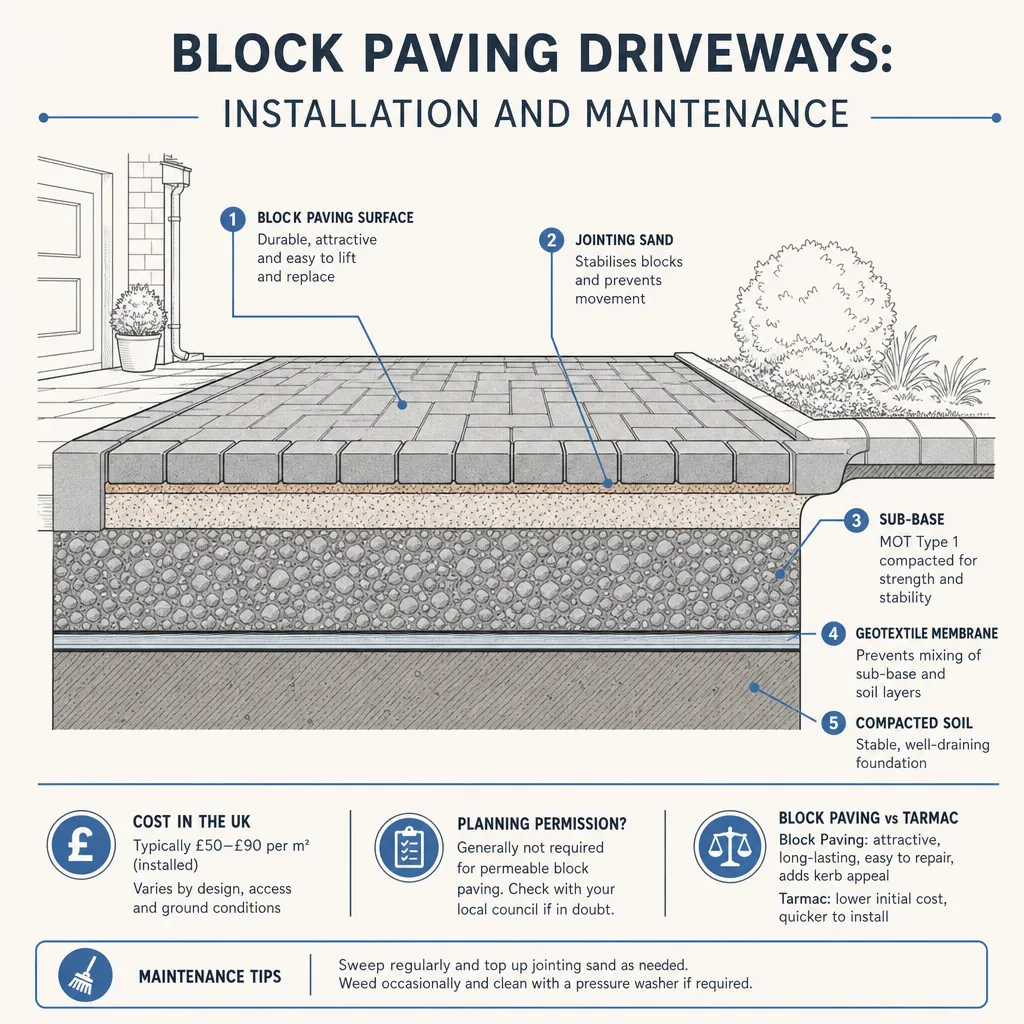
Block Paving Driveways: Installation and Maintenance
Block paving driveways typically cost £50–£120 per m² installed and last 20–30 years with good maintenance.
 Improvement & Build
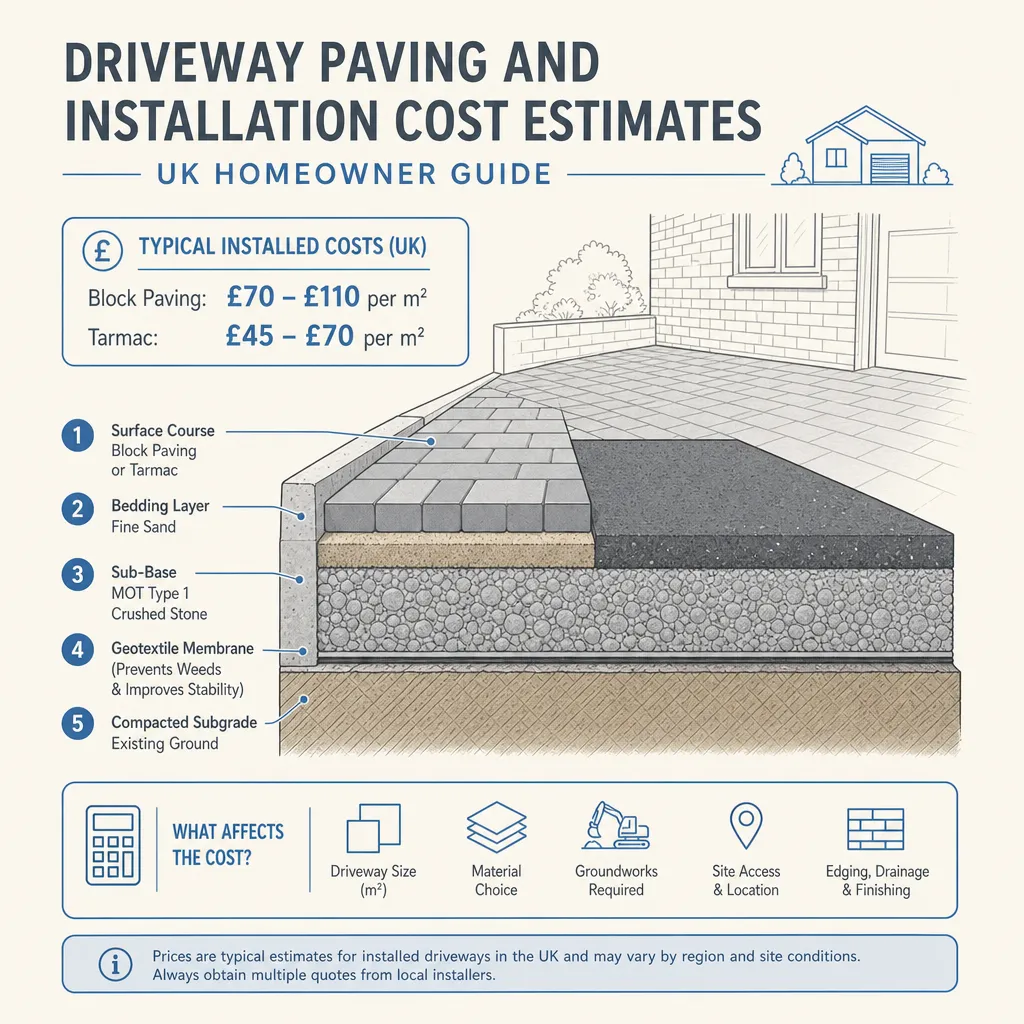
Driveway Paving and Installation Cost Estimates
Installing a new driveway in the UK typically costs £25–£120 per square metre depending on material.
 Improvement & Build
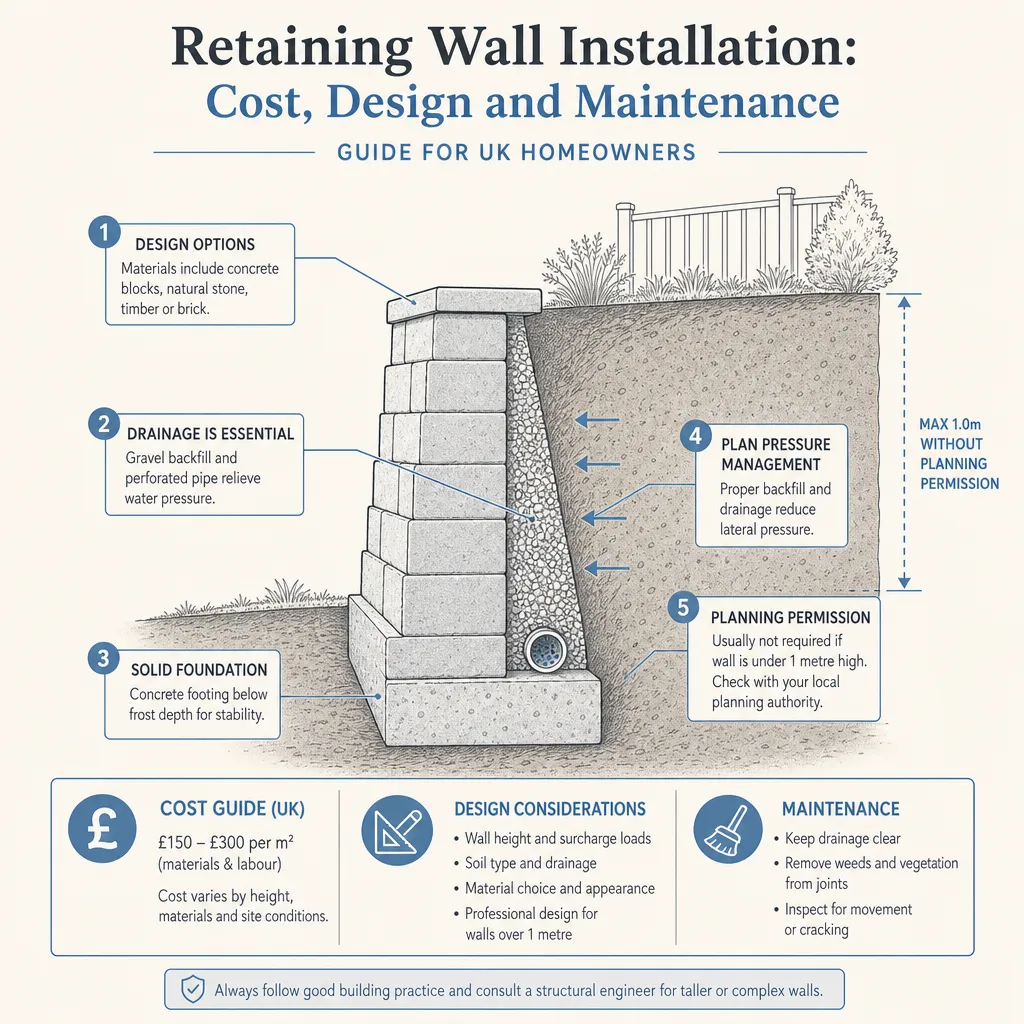
Retaining Wall Installation: Cost, Design and Maintenance
A retaining wall holds back soil on a sloped or banked site.
 Improvement & Build
Seasonal Garden Transformations and Outdoor Design Ideas
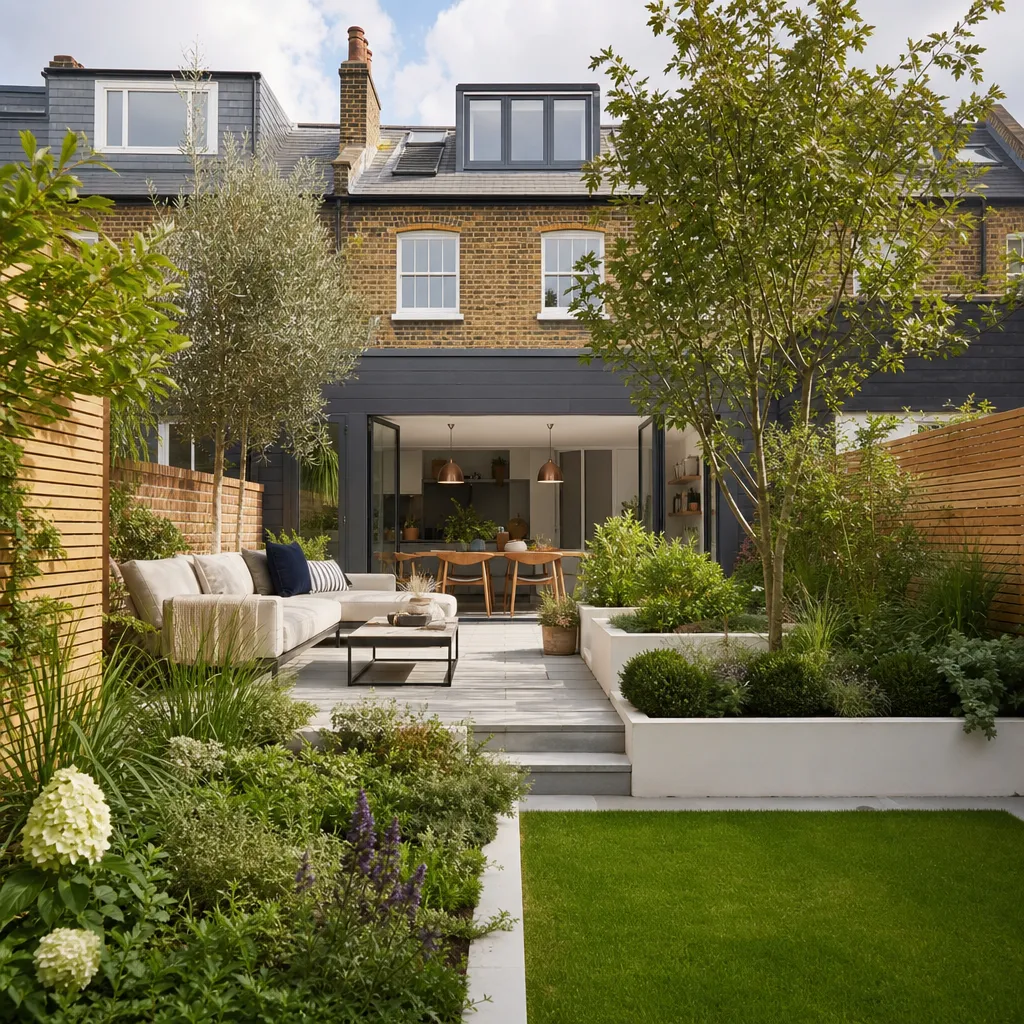
A successful garden transformation in the UK works with the seasons rather than against them — establishing structure and hard landscaping in autumn or winter, planting in spring, and enjoying the results through summer.
 Improvement & Build
Essential Steps for Driveway Installation
Installing a driveway in England requires planning permission only when using an impermeable surface (standard tarmac, concrete, or block paving) on a front garden area over 5 m².