Block Paving Driveways: Installation and Maintenance
By Housey · Last reviewed 6th of May 2026
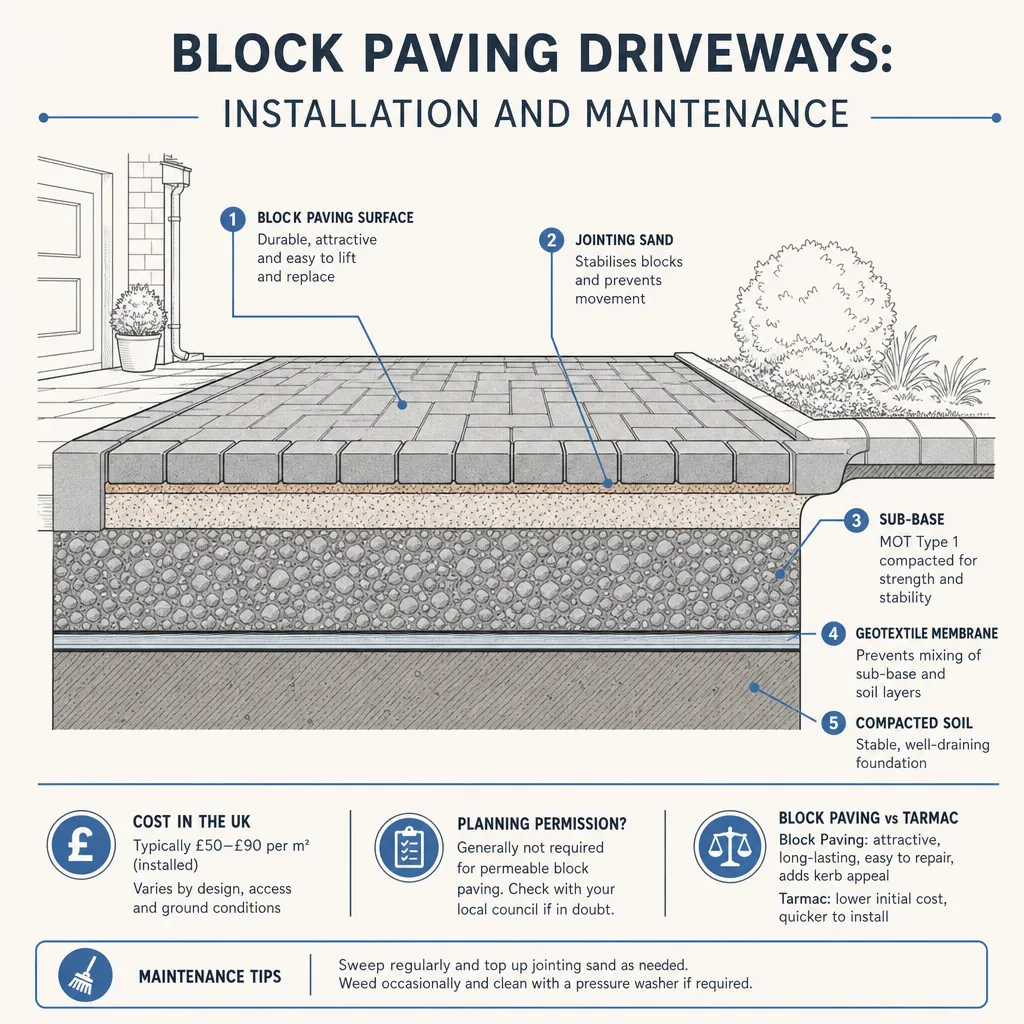
Block Paving Driveways: Installation and Maintenance
A new driveway is one of the most visible and practical improvements a UK homeowner can make, and block paving remains one of the most popular surface choices — offering design flexibility, good longevity when properly laid, and the practical advantage of being re-openable if underground works are ever needed. The question typically arises when replacing a worn tarmac or concrete surface, creating new off-street parking, or refreshing kerb appeal before a sale.
Key points
- Front garden driveways over 5 m² using impermeable block paving require planning permission in England unless water drains to a lawn, planted border, or soakaway — a rule introduced by the 2008 amendment to permitted development rights for hard surfaces.
- Permeable or porous block paving, or impermeable paving routing drainage to a planted area or soakaway, is exempt from this planning requirement in England.
- Typical installed costs range from £50–£120 per m², depending on specification, sub-base requirements, and regional labour rates. (Indicative UK costs, last reviewed 2026-05-06.)
- A well-installed driveway with a minimum 150 mm compacted MOT Type 1 sub-base can last 20–30 years with routine maintenance.
- A dropped kerb (vehicle crossover) requires a separate highway authority application under the Highways Act 1980 — it is not part of the planning permission process.
Does block paving need planning permission?
The 2008 update to permitted development rights in England made drainage — not surface material alone — the deciding factor.
No planning permission needed if:
- The surface is permeable or porous (water passes through the block or joints directly into the ground).
- OR the surface is impermeable but drainage routes to a lawn, planted border, or purpose-built soakaway.
Planning permission required if:
- The driveway exceeds 5 m², uses impermeable surfacing, AND water drains to the public highway or a combined sewer drain.
Rules differ in Wales, Scotland, and Northern Ireland. Listed buildings, conservation areas, and Article 4 direction areas may impose further restrictions. Check with your local planning authority before starting work.
Decision tree: do you need planning permission?
- Driveway 5 m² or under? → No planning permission needed.
- Surface permeable (water drains through block or joints)? → No planning permission needed.
- Drainage routes to planted border or soakaway? → No planning permission needed.
- Impermeable surface draining to highway or combined drain? → Planning permission required — contact your local planning authority.
- Listed building, conservation area, or Article 4 direction? → Check with your local planning authority regardless of surface type.
- Wales, Scotland, or Northern Ireland? → Different rules apply — check with your planning authority.
Block paving versus other driveway surfaces
Surface | Installed cost per m² | Typical lifespan | Planning (impermeable) | Repairability |
|---|---|---|---|---|
Block paving | £50–£120 | 20–30 years | May require PP | High — individual blocks replaceable |
Tarmac | £25–£60 | 15–25 years | May require PP | Moderate — patches visible |
Resin-bound | £40–£90 | 15–25 years | Usually PP-exempt (permeable) | Low — patches visible |
Concrete | £30–£70 | 25–40 years | May require PP | Low — cracks visible |
Gravel | £15–£35 | 10–20 years | Usually PP-exempt (permeable) | High — top up as needed |
Indicative UK costs, last reviewed 2026-05-06. PP = planning permission. Prices vary by region, sub-base condition, and total area.
What does a block paving installation involve?
A professionally installed driveway involves several distinct stages:
- Site clearance and excavation — existing surface removed; ground excavated to 200–300 mm total depth for a residential driveway.
- Sub-base preparation — minimum 150 mm of compacted MOT Type 1 crushed aggregate laid and mechanically compacted. This is the most critical stage; inadequate compaction causes sinking and rocking blocks.
- Edge restraints — haunched concrete edging or proprietary kerb blocks installed around the perimeter before laying begins, preventing the paving spreading outward under load.
- Bedding sand — a 25–50 mm layer of sharp sand (not building sand) screeded level.
- Block laying — blocks placed in the chosen pattern; herringbone at 45° or 90° is recommended for driveways for structural stability.
- Compaction and jointing — vibrating plate compactor passed over the surface; kiln-dried jointing sand swept in and compacted repeatedly until joints are fully filled.
Dropped kerbs: a separate process
If vehicles need to cross the pavement or verge to reach a new driveway, a vehicle crossover (dropped kerb) must be approved by the local highway authority. This is entirely separate from planning permission:
- Applications go to the highway authority, not the planning department.
- Application fees are typically £100–£500; construction costs are additional and must be carried out by the authority or their approved contractor — not your driveway installer.
- Carrying out a crossover without approval is an offence under the Highways Act 1980.
- Allow 4–12 weeks for the application and construction process.
Block paving maintenance checklist
Regular maintenance significantly extends the life of a block paved driveway:
- Annually: Sweep clear of leaves, soil, and debris. Pressure-wash any moss or algae using a low-pressure wide-fan setting — high pressure displaces jointing sand.
- Every 3–5 years (or when joints appear hollow): Re-apply kiln-dried jointing sand. Sweep in, compact with a plate or tamper, and repeat until joints are visibly filled.
- As needed: Treat persistent weeds with a patio weedkiller suitable for use near drains; remove larger weeds by hand before roots disturb the bedding layer.
- Immediately: Re-lay any rocking or sunken blocks — individual blocks can be lifted, bedding sand re-levelled, and the block relaid and re-jointed. Ignoring rocking blocks accelerates sub-base deterioration.
- Sealant (optional): Extends joint life and protects colour but is not essential. Some products permanently darken the surface — test on a small area first.
Red flags: signs of poor installation
- Blocks rocking or sinking within 12 months — indicates inadequate sub-base depth or compaction at installation.
- Joints opening rapidly — building sand used instead of kiln-dried, or insufficient plate compaction during the jointing stage.
- Blocks cracking under normal vehicle loads — bedding layer over 50 mm, blocks below the 60 mm minimum thickness for driveways, or an unstable sub-base.
- Water pooling on the surface — insufficient cross-fall; a minimum 1:60 gradient away from the property is standard practice.
- White bloom on new concrete blocks — efflorescence; common on new material and usually fades naturally within 12–18 months, not a structural defect.
When to get professional help
A reputable driveway installer handles most block paving projects, but seek specialist input in these situations:
- Significant sinkage in the existing surface — the cause may be a failing drain or tree root damage rather than simple compaction failure. A CCTV drain inspection may be needed before re-laying.
- Trees near the excavation area — trees subject to a Tree Preservation Order (TPO) or within a conservation area must not have roots disturbed. Check with your local authority before any digging.
- Proximity to existing drain runs — locate drain positions before excavation begins; accidental damage to a drain is costly and may require Building Regulations notification.
- Significant level changes — retaining walls over approximately 600 mm high may warrant structural engineering input.
How Housey can help
Housey makes it straightforward to find and compare quotes from vetted driveway installers across the UK. Submit your project details once and receive quotes from local professionals, so you can compare price, specification, and credentials before committing.
Frequently asked questions
How much does a block paving driveway cost in the UK?
Installed costs typically range from £50–£120 per m², so a 40 m² driveway might cost £2,000–£4,800 before groundworks extras. Costs vary by region — London and the South East are generally higher — along with block specification, sub-base depth, and whether a dropped kerb is needed. Always request itemised quotes and confirm whether VAT is included. (Indicative UK costs, last reviewed 2026-05-06.)
How long does block paving installation take?
Most standard domestic driveways take 2–5 days to install once materials are on site. Allow additional time if extensive groundworks are needed. If a dropped kerb application is also required, the highway authority process typically takes 4–12 weeks and must run separately from the driveway installation itself.
Can I lay block paving myself?
Physical laying of blocks is achievable for a competent DIYer on a small area, but sub-base preparation — excavation, compaction, and achieving correct drainage falls — requires a vibrating plate compactor and sound technical knowledge. Poor sub-base work causes early failure. For a driveway bearing vehicle loads, professional installation is strongly advisable.
Will block paving add value to my home?
Off-street parking with a well-maintained driveway is generally considered to improve value and saleability in the UK, particularly in urban areas where street parking is limited. Actual impact depends on local comparable sales and buyer demand. A driveway that improves drainage and kerb appeal tends to be viewed positively by buyers and valuers.
What is the best block paving pattern for a driveway?
Herringbone (at 45° or 90°) is the most structurally stable pattern for driveways because the interlocking angled arrangement resists block creep under vehicle turning loads. Stretcher bond and basketweave patterns are less stable under vehicular use and are better suited to pedestrian areas, paths, and patios.
Sources and further reading
- Driveways: do you need planning permission? — Planning Portal
- Town and Country Planning (General Permitted Development) (England) Order 2015 — legislation.gov.uk
- Highways Act 1980 — legislation.gov.uk
- Sustainable drainage systems (SuDS) guidance — GOV.UK
Useful next reads
 Improvement & Build
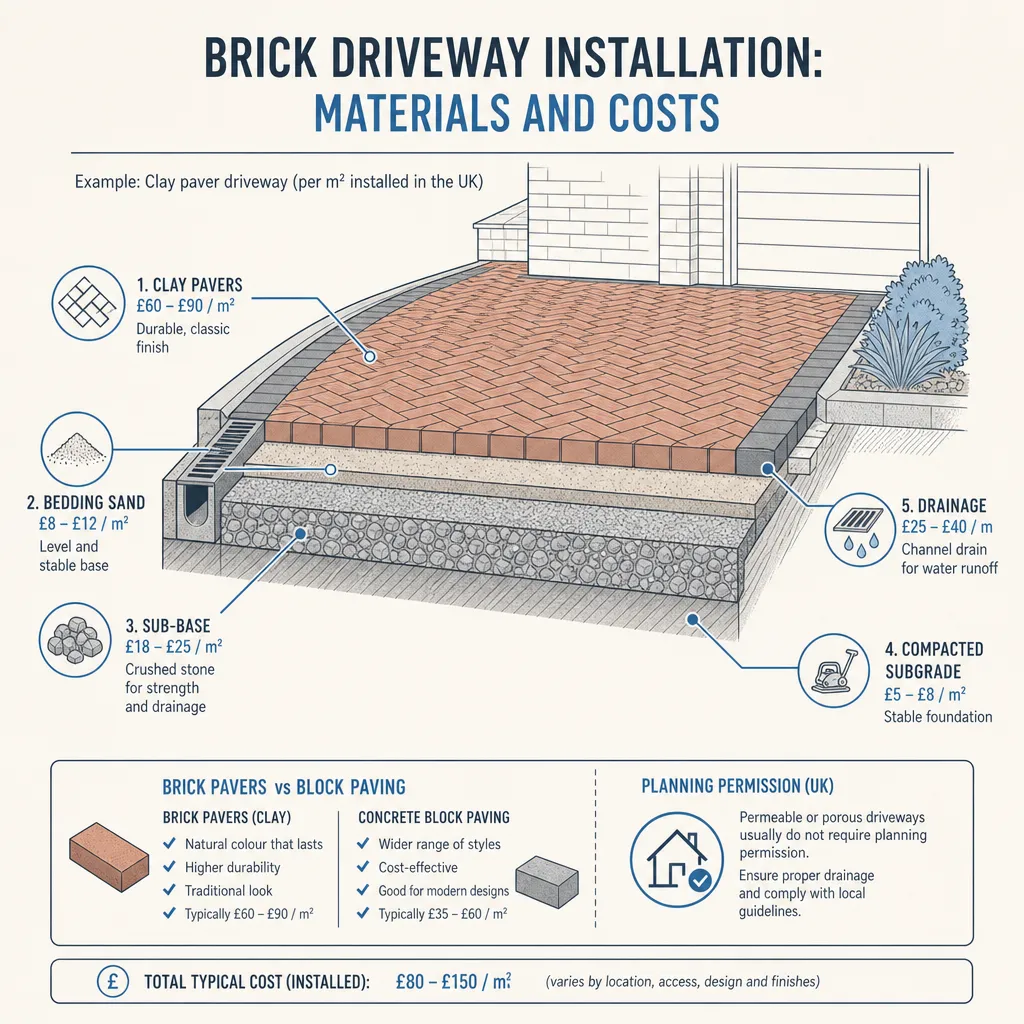
Brick Driveway Installation: Materials and Costs
A brick or clay paver driveway typically costs £90–£150 per square metre installed in the UK, depending on material grade, sub-base requirements, and regional labour rates.
 Improvement & Build
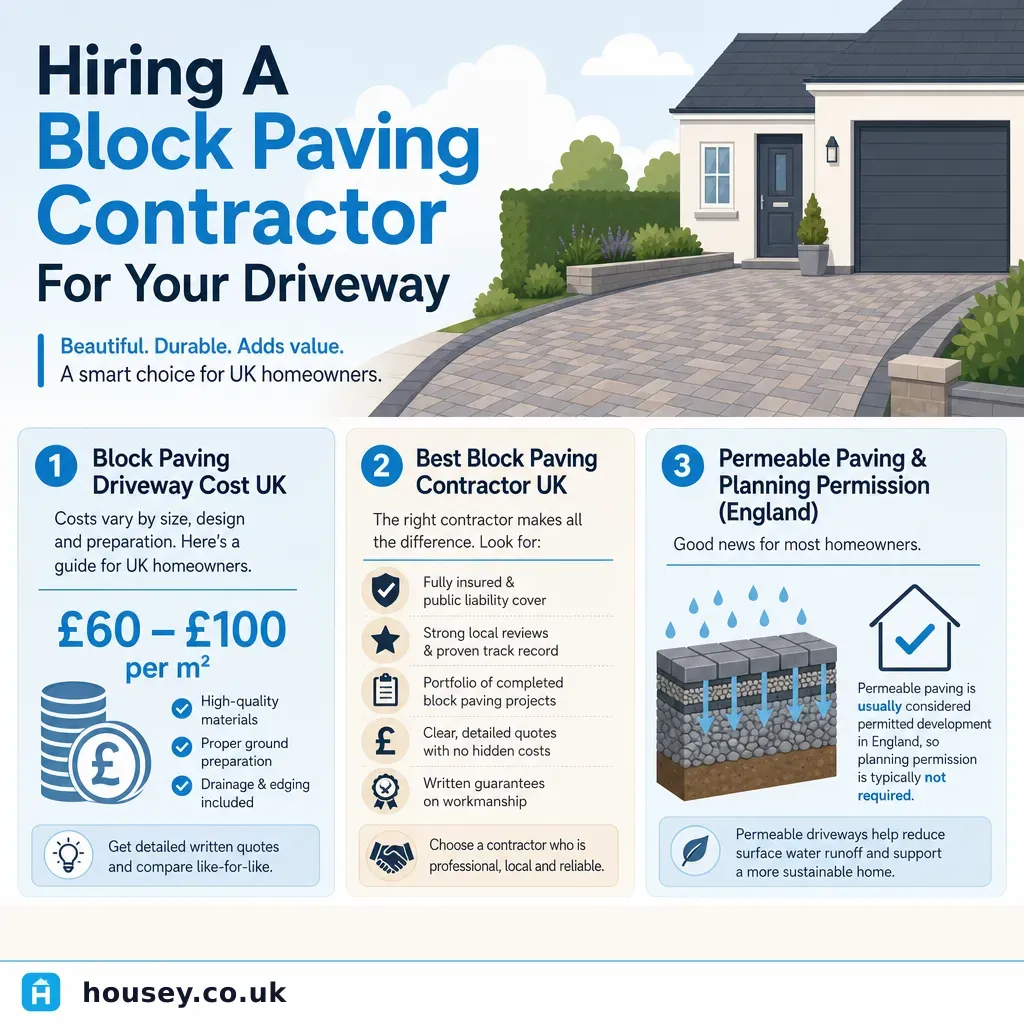
Hiring A Block Paving Contractor For Your Driveway
Block paving driveways are installed by specialist driveway or hard landscaping contractors.
 Improvement & Build
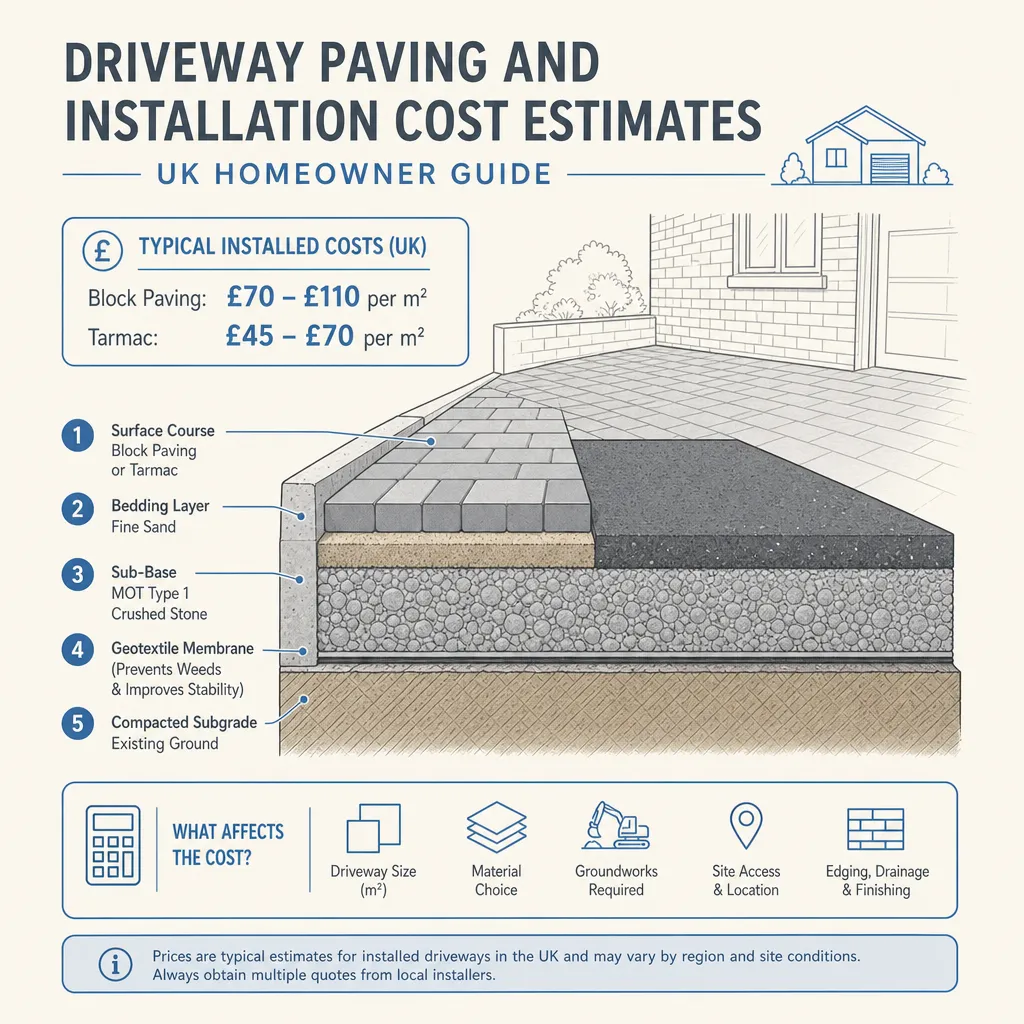
Driveway Paving and Installation Cost Estimates
Installing a new driveway in the UK typically costs £25–£120 per square metre depending on material.
 Improvement & Build
Professional Garden and Driveway Design: Landscape Transformation Services
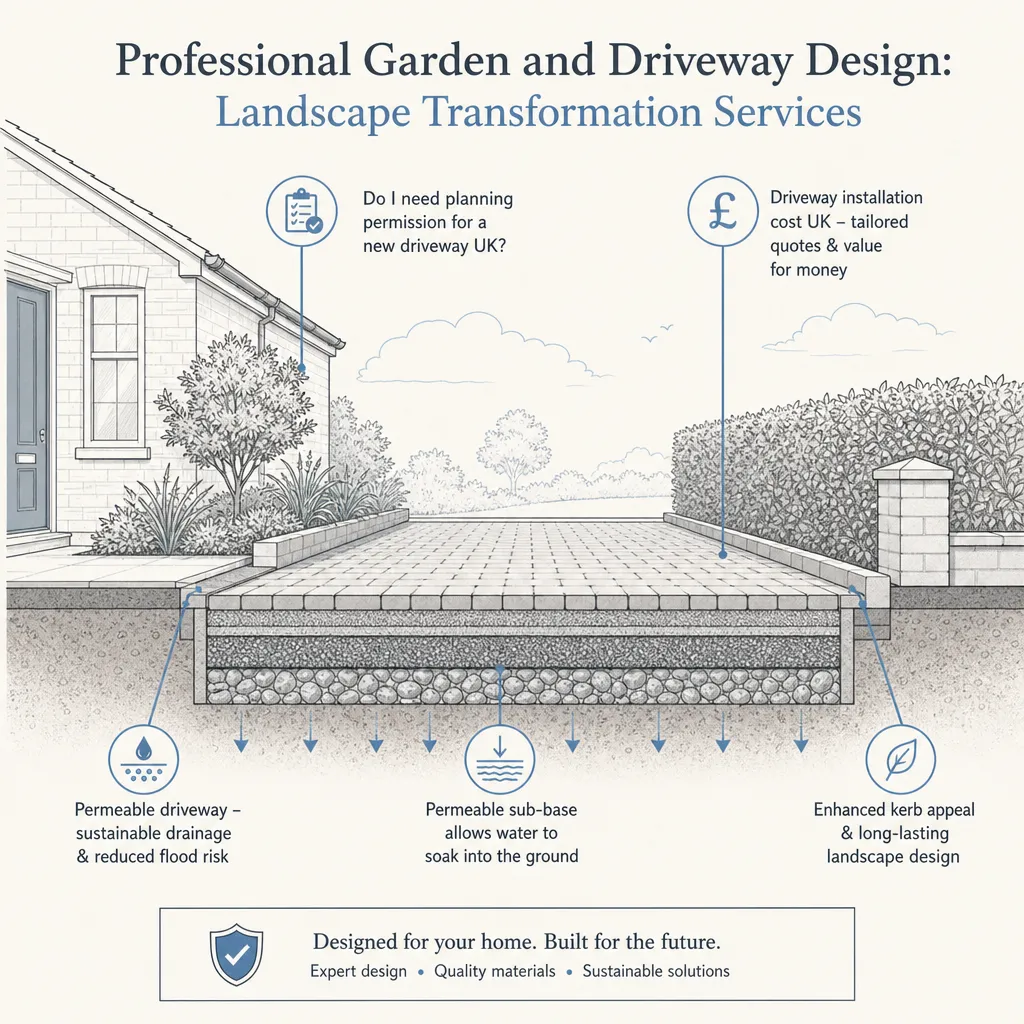
Garden and driveway design combines hard landscaping — paving, block paving, gravel, resin — with planting and layout to improve kerb appeal and functionality.
 Improvement & Build
Asphalt Driveway Installation: Cost and Durability
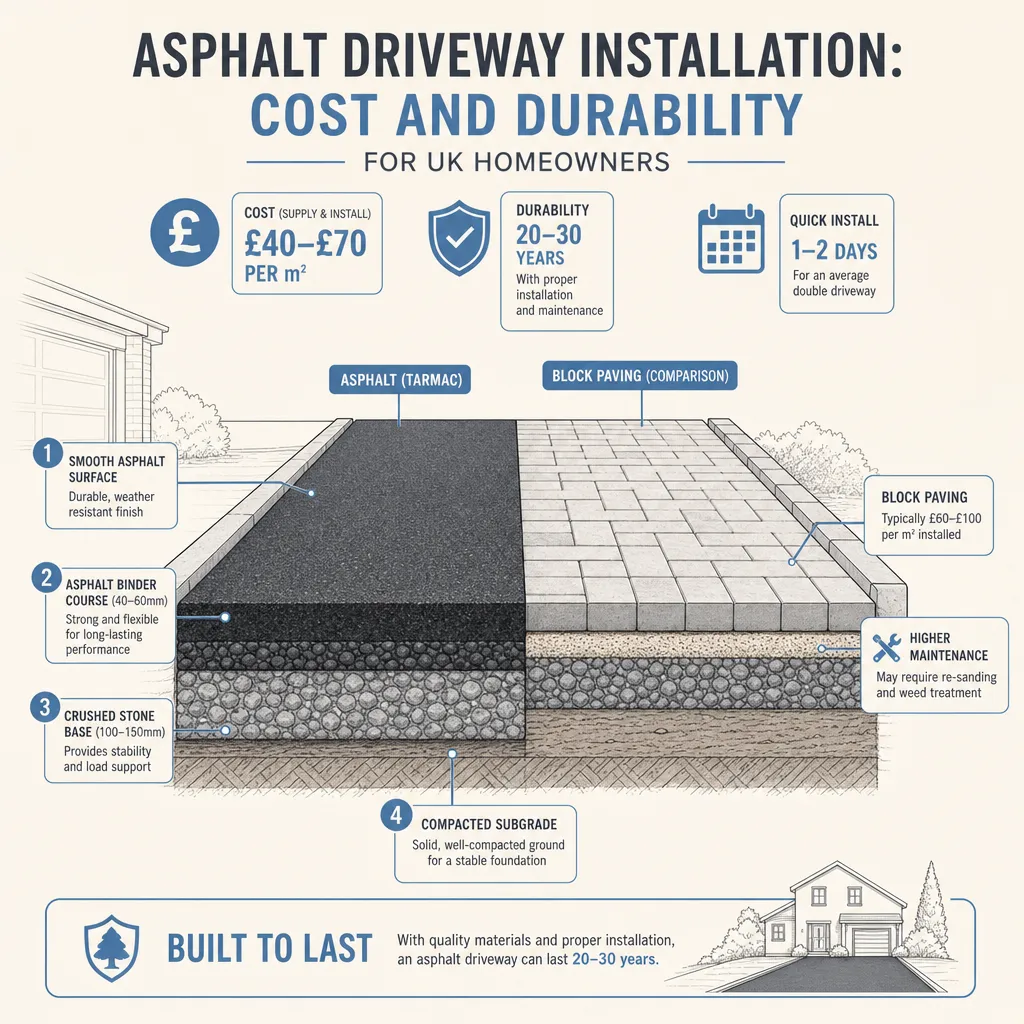
Asphalt driveway installation in the UK typically costs £40–£80 per square metre.