Recycled Asphalt for Driveways: Material Properties and Installation
By Housey · Last reviewed 7th of May 2026
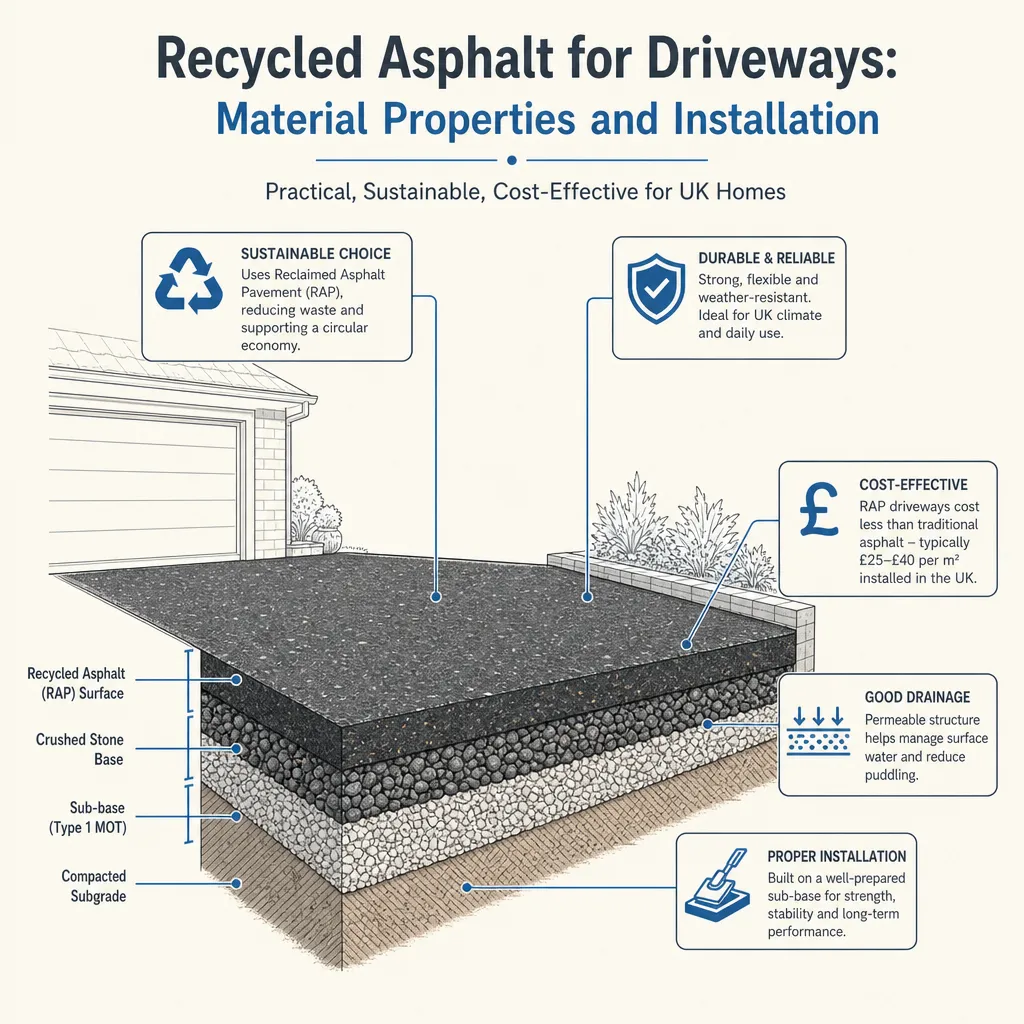
Recycled Asphalt for Driveways: Material Properties and Installation
Homeowners considering a new driveway surface increasingly encounter recycled asphalt — sometimes called RAP (reclaimed asphalt pavement) or blacktop millings — as a lower-cost alternative to virgin asphalt. It uses material reclaimed from road resurfacing projects, costs less to supply, and carries sustainability credentials. But recycled asphalt performs differently to new asphalt and has real limitations that UK homeowners should understand before committing to it.
Key points
- Recycled asphalt pavement (RAP) is reclaimed from road resurfacing and highway maintenance works, reducing landfill and embodied carbon compared to virgin asphalt.
- Under Schedule 2 of the Town and Country Planning (General Permitted Development) (England) Order 2015, new or replacement driveways fronting a highway that exceed 5m² must use permeable surfacing or include drainage to a soakaway; standard asphalt — virgin or recycled — is impermeable and requires planning permission without a drainage solution.
- Recycled asphalt millings typically cost less to supply than virgin asphalt; indicative installed costs for a standard domestic driveway run roughly £25–£50 per m², though ground conditions, sub-base requirements, and site access significantly affect final prices.
- RAP rebinds under heat and compaction but performs less consistently than virgin asphalt in cold, wet UK conditions and may not be suitable for heavily trafficked driveways.
- A competent groundworker should assess sub-base depth and condition before any asphalt surface is laid — inadequate sub-base preparation is the primary cause of driveway failure regardless of the surface material chosen.
What is recycled asphalt and how is it made?
Asphalt is a mixture of aggregates — stones and sand — bound together with bitumen. When old roads are resurfaced, the existing material is milled off and collected. This reclaimed asphalt pavement (RAP) is then crushed or screened and used either as a standalone driveway surface material or blended with virgin asphalt in new-production highway mixes.
In commercial highway applications, RAP is typically blended back into hot-mix asphalt under controlled conditions, with new bitumen and aggregates added to restore consistent performance. For domestic driveways, RAP is often supplied as loose millings — the milled material with its residual bitumen content intact. When laid and compacted, particularly in warmer conditions, the residual bitumen softens slightly and helps the material bind together.
The key distinction for UK homeowners is between hot-mix asphalt containing a specified recycled content (processed and quality-controlled to a specification) and loose recycled millings (variable quality, not processed to a defined standard). These are not the same product and they perform very differently.
Material properties: recycled vs virgin asphalt
Property | Recycled asphalt millings | Virgin/new asphalt | Hot-mix with RAP content |
|---|---|---|---|
Supply cost | Lower | Higher | Mid-range |
Material consistency | Variable | Consistent | Consistent |
UK cold/wet performance | Moderate — can become loose | Good | Good |
Compaction behaviour | Requires heat or multiple passes | Predictable | Predictable |
Surface finish | Rougher, grey-brown tones | Smooth, dark black | Smooth, dark |
Typical domestic lifespan | 5–15 years (variable) | 15–25 years | 15–25 years |
Embodied carbon | Lower | Higher | Moderate — depends on RAP % |
Planning and drainage rules | Same as standard asphalt | Standard rules apply | Standard rules apply |
Indicative UK costs, last reviewed 2026-05-07. Always obtain written quotes from at least three contractors.
Planning permission and drainage rules
This is the most important regulatory point for any UK homeowner laying or replacing a driveway, and it applies equally to recycled and virgin asphalt.
Under permitted development rights for householders in England (Schedule 2, Part 1, Class F of the Town and Country Planning (General Permitted Development) (England) Order 2015), laying or replacing a driveway fronting a highway does not require planning permission if:
- The surface is permeable or porous, or
- Rainwater runs to a lawn or border where it can drain naturally, or
- A drainage system — such as a soakaway — is provided.
Standard asphalt, whether virgin or recycled, is an impermeable surface. Laying it over an area exceeding 5m² that fronts a highway without a drainage solution requires planning permission in England.
In practice this means:
- If your existing driveway is already asphalt and you are resurfacing like for like, your LPA may treat this as maintenance — but you should confirm this before starting.
- If you are creating a new impermeable surface or extending an existing one beyond 5m² fronting a highway, contact your local planning authority first.
- Wales, Scotland, and Northern Ireland operate separate planning frameworks; check with your relevant authority.
The practical solution many homeowners use is to incorporate drainage channels directing runoff to a soakaway or planted border, which can bring an asphalt driveway within permitted development rules. A competent groundworker or drainage contractor can advise on the options for your specific site.
Installation: what to expect
A recycled asphalt driveway installation broadly follows the same stages as any asphalt job, with some differences in how the surface material behaves during laying.
1. Site clearance and excavation Existing surface material is removed. Excavation depth depends on anticipated traffic loading and ground conditions — typically 150–200mm for a standard domestic driveway.
2. Sub-base preparation A compacted sub-base of crushed stone — usually Type 1 MOT limestone — is laid to the required depth and compacted. This stage is critical. A poorly prepared sub-base will cause any surface to crack or sink regardless of the material above it. For recycled asphalt millings, a robust and well-compacted sub-base is especially important.
3. Surface layer: recycled millings Recycled millings are spread evenly and compacted. In warmer conditions the residual bitumen softens and the material begins to bond together. In cooler UK conditions — which apply for much of the year — compaction is more important, and some contractors make multiple passes with a plate compactor or apply a tack coat to improve bonding.
4. Curing and settling Recycled asphalt millings continue to compact with traffic use over the first few months. Some surface movement is normal during this period. Avoid parking heavy vehicles on it until it has fully settled.
5. Edging and drainage Edge restraints — kerb stones, brindle blocks, or treated timber boards — help retain the surface, particularly at edges where unsupported millings can spread. Any drainage channels or soakaways should be installed at this stage if required.
Red flags when getting quotes
Watch for these warning signs when assessing driveway contractors:
- No site survey before quoting. Sub-base depth and ground conditions must be assessed in person. A quote given from a photo or over the phone is unlikely to be reliable.
- Unusually low prices. Recycled asphalt is cheaper than virgin asphalt, but quotes far below market rate often involve inadequate sub-base preparation or the use of unscreened, poor-quality millings.
- No mention of drainage. Any contractor not raising the planning and drainage question for a highway-fronting driveway may not be aware of the rules.
- No written contract or specification. A reputable contractor provides a written scope covering material, sub-base depth, compaction method, edge restraints, and drainage.
- Cash-only payment requests.
What to ask before accepting a quote
- What sub-base depth and material specification are you including?
- Will you carry out a site survey before finalising the price?
- Is the recycled asphalt loose millings or processed hot-mix with a specified RAP content?
- How do you handle drainage — does this driveway front a highway, and have you considered the planning rules?
- What is the expected finish and realistic lifespan for the material you are proposing?
- What edge restraints are included?
- Is disposal of the existing surface included in the price?
- Is VAT included in the quoted figure?
- Do you carry public liability insurance, and what is the cover level?
- What workmanship warranty or guarantee do you provide?
When to get professional help
Recycled asphalt installation is not suitable as a DIY task for most homeowners — adequate sub-base preparation requires excavation equipment, and proper compaction needs a plate compactor. Use a professional contractor if:
- You are uncertain about drainage obligations for a highway-fronting driveway.
- The existing ground is soft, waterlogged, or shows signs of previous subsidence.
- The driveway is on a slope, where surface water management becomes critical.
- You have underground services — drains, gas supply, or electric cables — that need locating before excavation begins.
Ask contractors whether they hold membership of a recognised trade association such as the British Association of Landscape Industries (BALI) or the Association of Professional Landscapers (APL).
How Housey can help
If you are ready to get quotes for a recycled asphalt or other driveway surface, Housey connects you with vetted driveway installers and groundworkers who can assess your site, confirm drainage requirements, and provide written specifications. Compare quotes side by side and move forward with confidence.
Frequently asked questions
Is recycled asphalt as durable as new asphalt for a UK driveway?
Generally, no. Recycled asphalt millings are more variable in quality than new hot-mix asphalt and typically perform less consistently in cold, wet British conditions. They can be a cost-effective option for lighter-use driveways with good sub-base preparation, but for driveways with heavy or frequent traffic, new asphalt or a hot-mix with a specified RAP content usually offers greater longevity.
Do I need planning permission for a recycled asphalt driveway?
Recycled asphalt is an impermeable surface, so the same drainage rules apply as for standard asphalt. In England, if the driveway fronts a highway and exceeds 5m², you need either a permeable surface or a drainage solution such as a soakaway to avoid needing planning permission. Check with your local planning authority if in any doubt.
How long does a recycled asphalt driveway last?
With good sub-base preparation and competent installation, recycled asphalt millings can last 5–15 years for a domestic driveway with light to moderate use. New asphalt typically lasts 15–25 years. Longevity depends heavily on sub-base quality, compaction, drainage provision, and traffic levels.
Can I lay recycled asphalt myself?
It is technically possible to lay loose millings yourself, but compacting them adequately without a plate compactor is very difficult, and sub-base preparation requires excavation equipment. Without proper compaction, the surface will be uneven and short-lived. For most homeowners, professional installation by a competent groundworker or driveway contractor is strongly recommended.
Is recycled asphalt a sustainable choice for a driveway?
Recycled asphalt reuses material that would otherwise go to landfill and requires less energy to produce than virgin asphalt, giving it a lower embodied carbon profile. However, it is still an impermeable surface that contributes to surface water runoff unless drainage provision is included. For a genuinely sustainable driveway, permeable block paving or resin-bound surfacing may be preferable.
Sources and further reading
- Permitted development rights for householders: technical guidance — GOV.UK
- Town and Country Planning (General Permitted Development) (England) Order 2015, Schedule 2 — legislation.gov.uk
- Sustainable drainage systems (SuDS) — GOV.UK
- Recycled and secondary aggregates — GOV.UK / Environment Agency
- British Association of Landscape Industries (BALI) — BALI
Useful next reads
 Improvement & Build
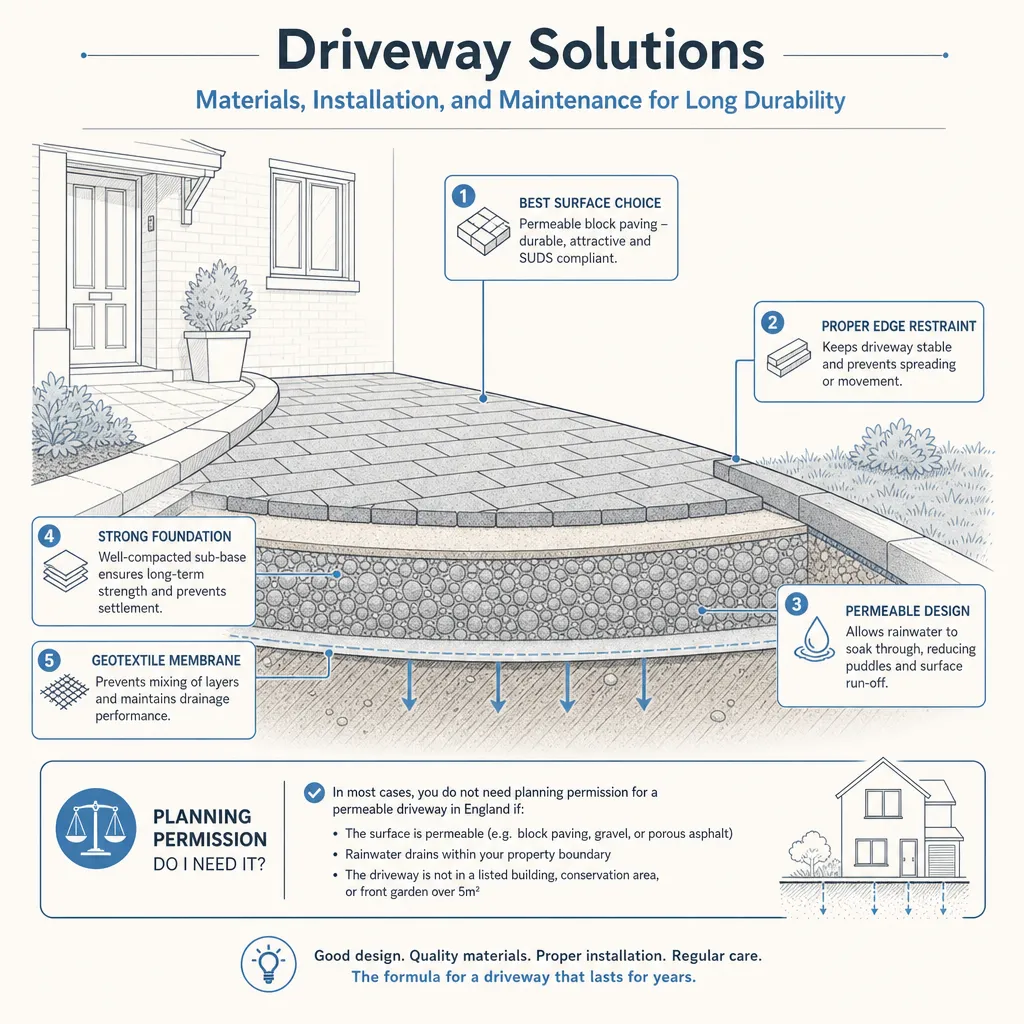
Driveway Solutions: Materials, Installation, and Maintenance for Long Durability
In England, driveways over 5 square metres need planning permission unless they use a permeable surface or drain to a lawn or border.
 Improvement & Build
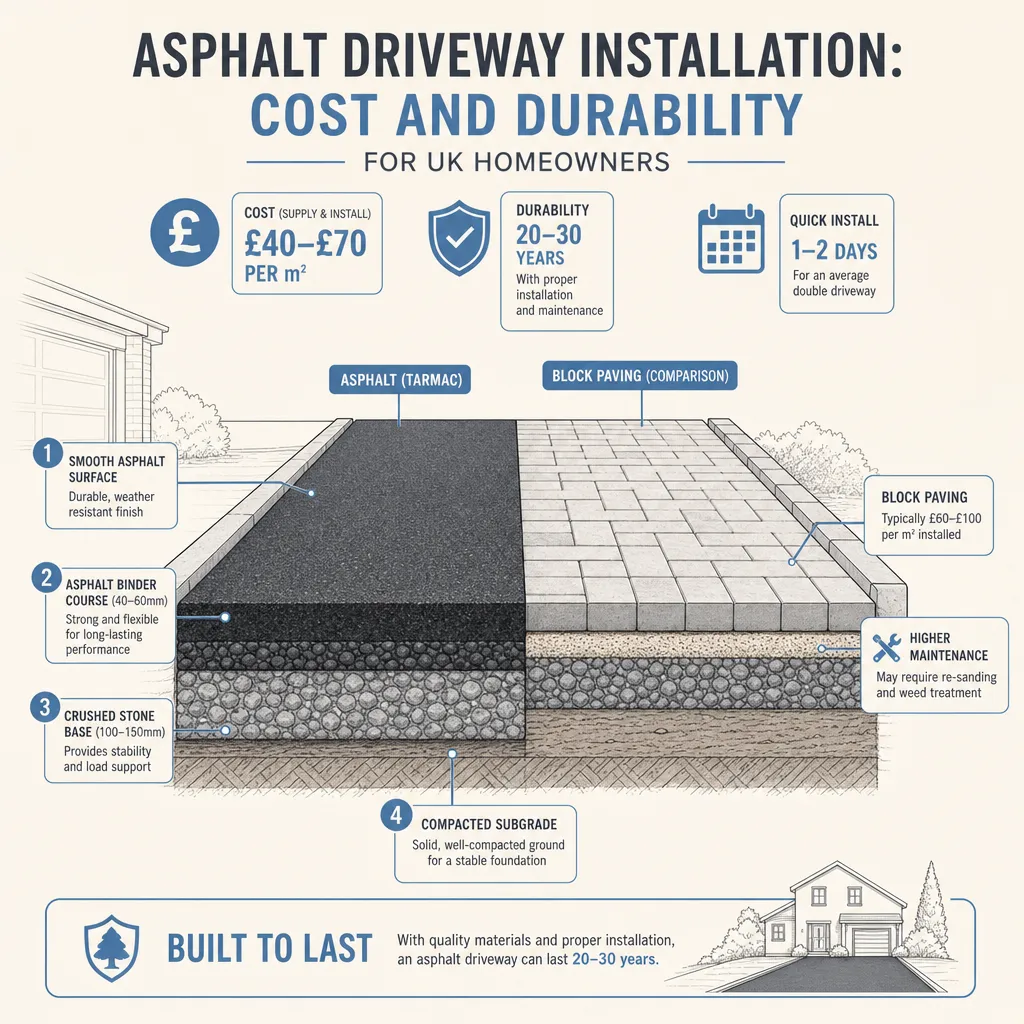
Asphalt Driveway Installation: Cost and Durability
Asphalt driveway installation in the UK typically costs £40–£80 per square metre.
 Improvement & Build
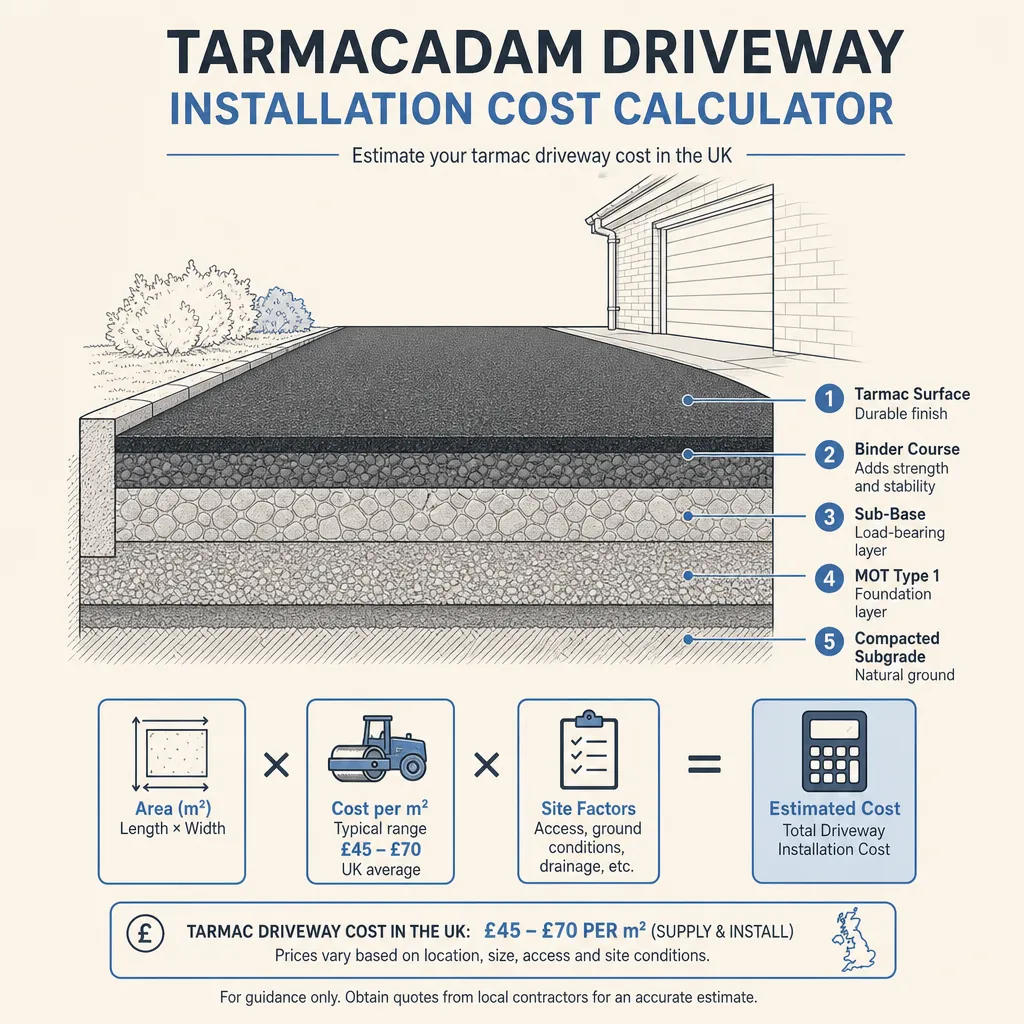
Tarmacadam Driveway Installation Cost Calculator
Tarmacadam driveway installation costs approximately £50–£100 per sq m in the UK for a full new installation, or £20–£50 per sq m for resurfacing over a sound existing base.
 Improvement & Build
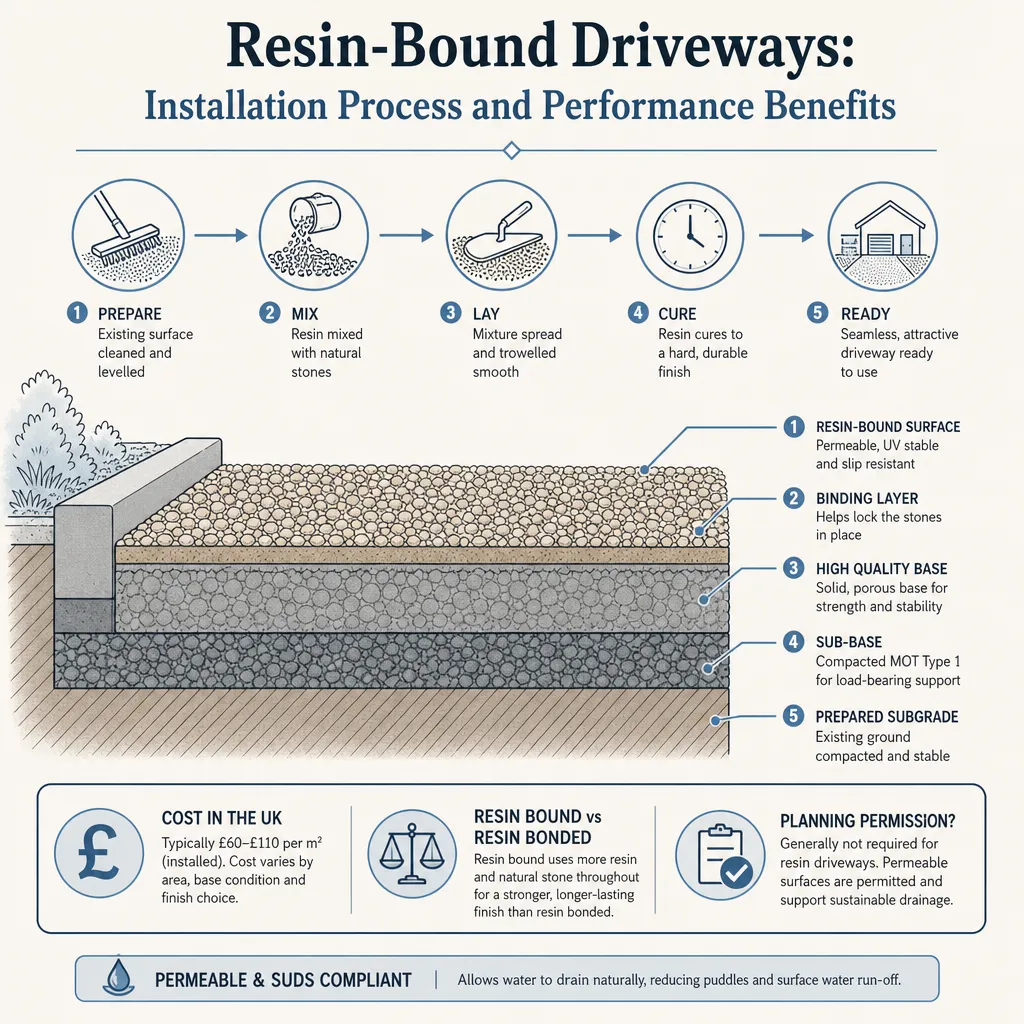
Resin-Bound Driveways: Installation Process and Performance Benefits
Resin-bound surfacing mixes natural aggregate with UV-stable polyurethane resin to create a smooth, porous driveway that drains water through its surface layer.
 Improvement & Build
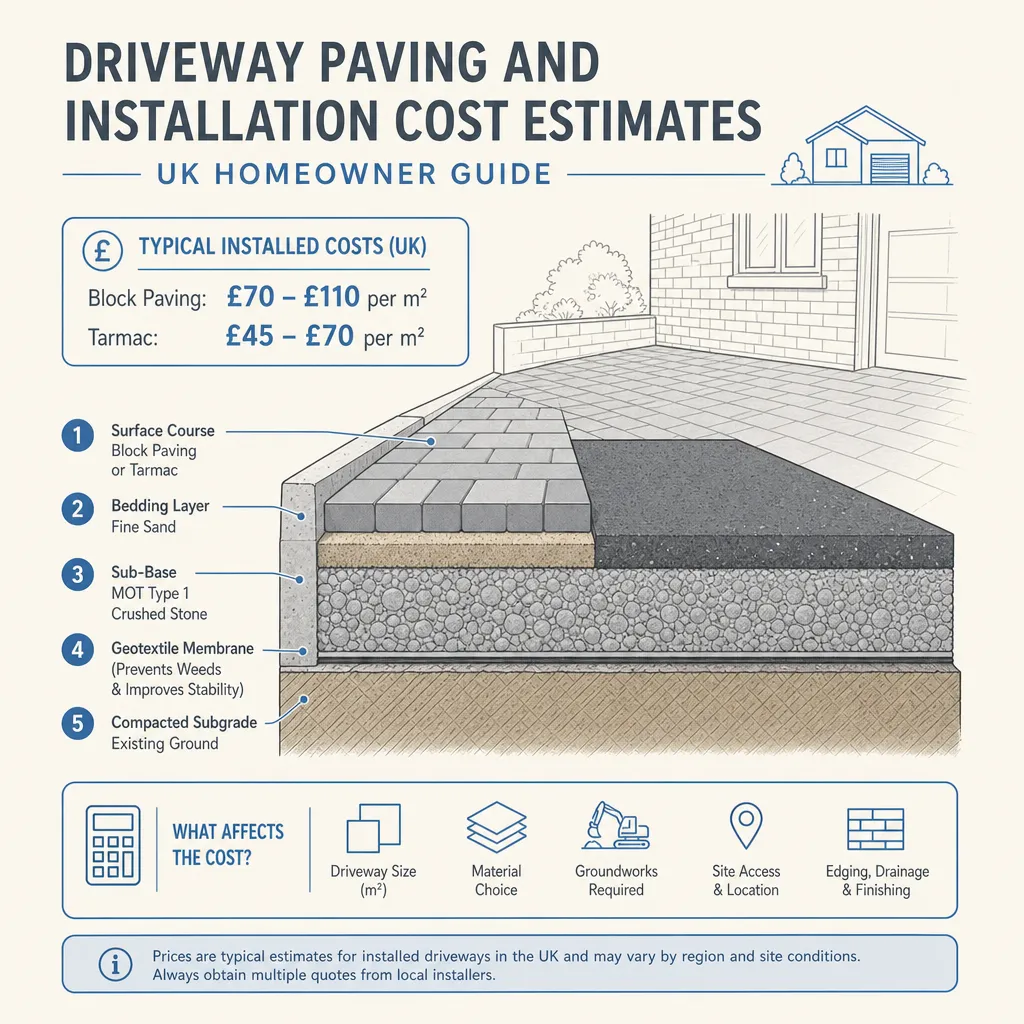
Driveway Paving and Installation Cost Estimates
Installing a new driveway in the UK typically costs £25–£120 per square metre depending on material.