Emergency Roof Protection and Temporary Weather Damage Assessment
By Housey · Last reviewed 1st of June 2026
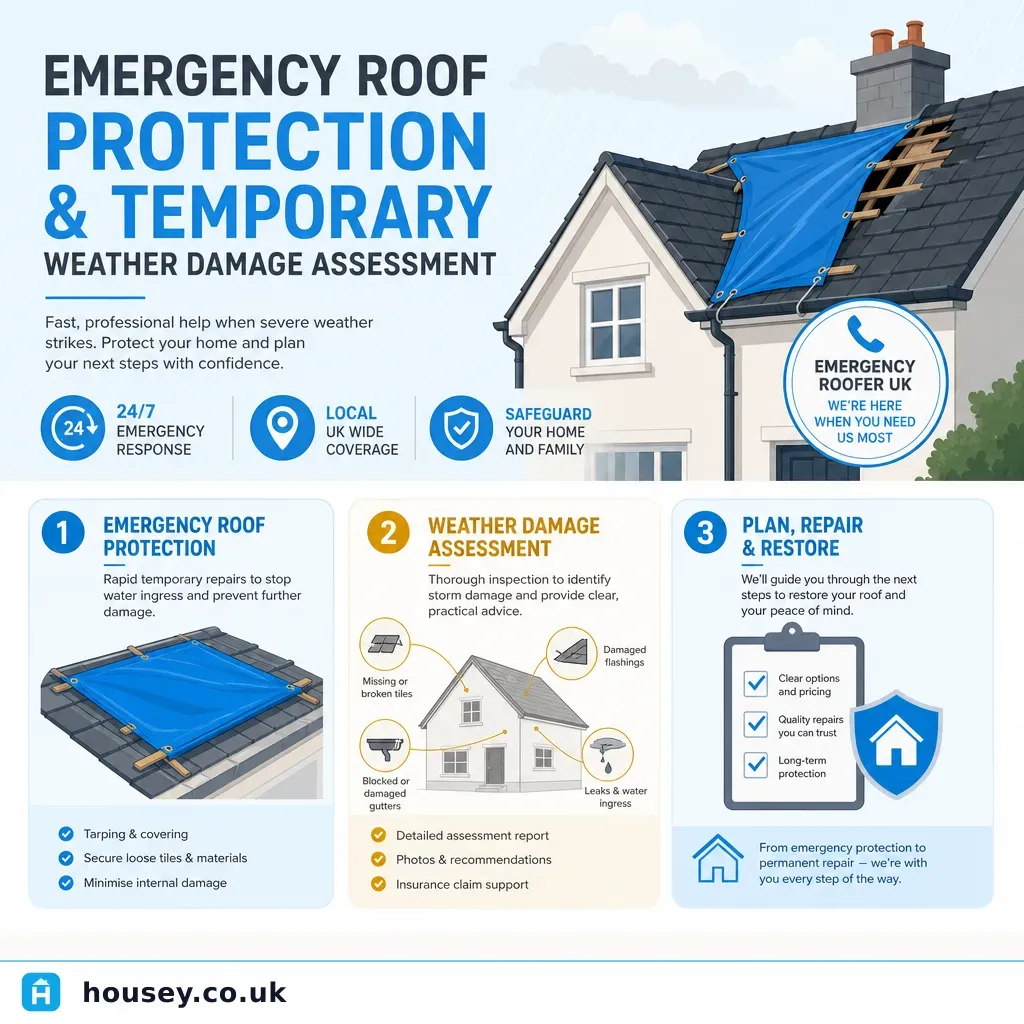
Emergency Roof Protection and Temporary Weather Damage Assessment
When a storm, fallen tree, or sudden leak exposes your roof to the elements, the hours that follow matter. Water ingress can damage ceilings, joists, electrical systems, and insulation surprisingly quickly — and delayed action can complicate insurance claims. This article is for homeowners who have just experienced roof damage and need to understand what temporary protection involves, what a professional damage assessment covers, and how to document everything correctly.
Key points
- Most home insurance policies require prompt notification of damage — commonly within 24 to 48 hours — and reasonable steps to prevent further water ingress; delayed temporary protection can affect a claim.
- Temporary roof protection must be installed by a competent roofer: working at height above 2 m is subject to the Work at Height Regulations 2005 and should not be attempted as a DIY task.
- A specific defect survey or emergency roof inspection assesses not only visible damage but also structural implications — cracked or displaced rafters, compromised ridge, or waterlogged insulation.
- RICS-registered surveyors and specialist roofing contractors can provide a written condition report for your insurer that documents pre-existing defects separately from storm-caused damage.
- Buildings insurance typically covers sudden, unexpected damage (storm, falling tree); gradual deterioration or lack of maintenance is usually excluded.
What counts as emergency roof damage?
Emergency roof damage is any event that leaves the roof covering unable to keep water out — whether from a single dramatic event or a combination of age and storm severity. Common causes in the UK include:
- Storm-force winds stripping or cracking clay or concrete tiles, dislodging ridge tiles, or tearing felt underlays.
- Falling trees or branches puncturing the roof covering, snapping purlins, or crushing fascia boards.
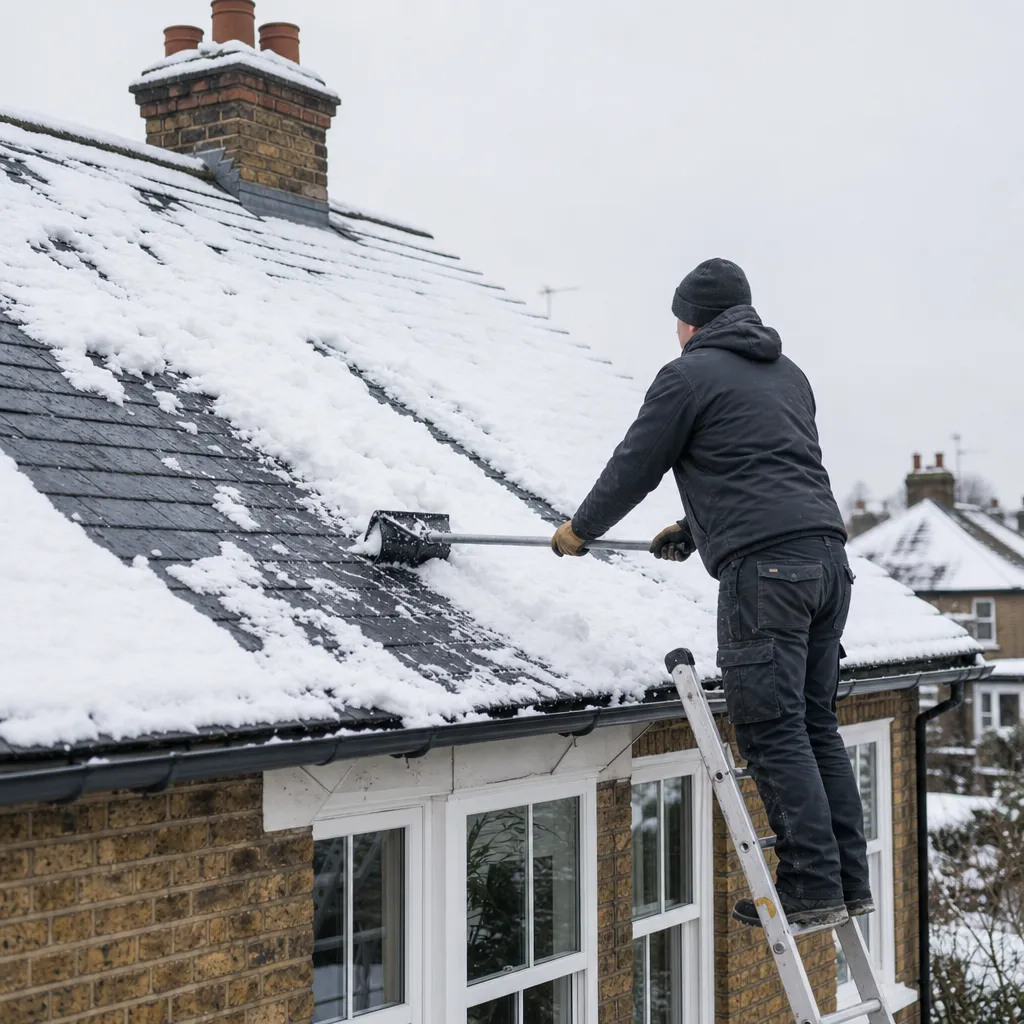
- Hail or snow loading cracking slates or tiles on older roofs, or causing flat roofs to leak at joints and drains.
- Chimney collapse or displacement damaging the surrounding roof covering and potentially the ceiling below.
If water is actively entering the property, treat this as an emergency. Even a slow drip into a ceiling void can saturate insulation, cause mould, and reach electrical wiring in a matter of days.
Temporary protection: what it involves
Temporary roof protection is not a permanent repair — it is an interim measure to stop water entering while a full assessment and specification is prepared. A competent roofer will:
- Assess safe access — scaffolding, a tower platform, or a roof ladder will be used depending on pitch and height. Do not allow anyone to walk a pitched roof without proper equipment.
- Remove loose debris — broken tiles, branches, or displaced ridge sections that could fall or cause further damage are made safe.
- Apply sheeting or tarpaulin — either a reinforced polythene tarpaulin weighted or mechanically fixed, or a proprietary waterproofing system for longer-term cover (particularly on flat roofs).
- Document the damage — a responsible contractor will photograph the area before and after temporary protection, which supports your insurance claim and the subsequent repair specification.
Temporary protection typically lasts two to twelve weeks, depending on the extent of damage, availability of materials, and how quickly a full repair specification can be agreed with your insurer.
Decision tree: which type of temporary protection do you need?
- Single displaced or broken tiles (fewer than 5), no felt damage — an emergency roofer can re-fix or replace tiles the same day; full tarpaulin may not be needed.
- Multiple missing tiles or slates over a large area — a tarpaulin or reinforced sheet is usually necessary pending a full re-roofing specification.
- Structural damage (broken rafters, ridge collapse, chimney fall) — temporary support as well as weatherproofing may be required; a structural engineer should be involved alongside the roofer.
- Flat roof puncture or split — a proprietary liquid membrane or temporary EPDM patch is more effective than a tarpaulin for flat sections.
- Active water entering the ceiling void — call an emergency roofer immediately and turn off electrical circuits in the affected area at the consumer unit.
Damage assessment: what a professional inspection covers
Once temporary protection is in place, a thorough damage assessment determines the full scope of repair work and provides evidence for your insurer. A roof survey or specific defect survey at this stage typically covers:
- Roof covering condition — extent of tile, slate, or flat roof membrane damage; whether the underlayer (felt or breathable membrane) is compromised.
- Structural integrity — rafters, purlins, ridge beam, valley boards; any signs of deflection, cracking, or displacement beyond storm damage.
- Flashings and junctions — lead, mortar, or proprietary flashings at chimney stacks, dormers, abutments, and parapet walls; these are common points of water ingress even after partial damage.
- Ceiling and internal damage — watermarks, staining, sagging plasterboard, or signs that water has reached electrical cables or joists.
- Pre-existing defects — a professional report will distinguish between damage caused by the weather event and deterioration that predates it; this matters significantly to insurers.
The written report should include photographs, a schedule of works, and an estimated cost of permanent repair. This document is the foundation of your insurance claim and the contractor brief.
Red flags that indicate serious structural damage
Seek an urgent structural assessment if you observe any of the following:
- Visible sagging or deflection of the roof plane (not just loose or missing tiles).
- A ridge tile has displaced and the ridge itself appears to have dropped or twisted.
- An interior ceiling is bowing or cracking (not just damp staining).
- Doors or windows in the room below are suddenly sticking or have changed alignment since the damage occurred.
- Smoke or soot visible at mortar joints around a chimney stack, suggesting displacement affecting the flue.
These signs suggest the damage may have affected loadbearing elements, not just the weather-resistant covering.
Insurance and documentation
Most UK buildings insurance policies cover sudden, accidental damage from storms and falling objects. To protect your claim:
- Photograph everything before any temporary work begins — including internal water damage, debris on the roof, and any displaced elements on the ground.
- Report promptly — check your policy document; many require notification within 24 hours of discovery.
- Keep all receipts for emergency call-out fees, temporary protection, and any internal damage containment measures.
- Request a written report from your roofer or surveyor — insurers will usually require a professional scope-of-works and cost estimate before approving repairs.
- Do not instruct permanent repairs until your insurer has confirmed coverage, or you risk paying out of pocket if the claim is later disputed.
Important limitations
This article provides general guidance on emergency roof protection and damage assessment processes in England and Wales. Roof damage, structural implications, insurance policy terms, and the appropriate scope of temporary works vary significantly depending on property age, construction type, local conditions, and individual policy wording. Nothing in this article constitutes structural, legal, or insurance advice. A qualified roofing contractor, RICS surveyor, or structural engineer should assess your specific situation before any work is carried out.
When this becomes urgent
Stop reading and call a professional immediately if:
- Water is actively entering the property and reaching electrical fittings, ceilings, or walls.
- You can see the sky through the roof from inside the loft space.
- Any part of the roof structure, chimney, or parapet wall appears to have partially collapsed.
- You can hear cracking or movement from the roof space.
- A child or vulnerable person occupies a room directly beneath damaged areas.
In any of these cases, vacate the affected room, do not use electrical switches in the area, and call an emergency roofer. If there is immediate danger to life or an imminent collapse risk, contact your local fire and rescue service.
What to ask a qualified professional
Before instructing an emergency roofer or appointing a surveyor for a damage assessment, ask:
- Are you insured for working at height? Request copies of public liability and employers' liability certificates.
- What access equipment will you use, and is that included in the quoted price?
- Will your temporary protection withstand the next forecast period of rain or high winds?
- Will you provide a written report with photographs, or only verbal feedback?
- Does your report distinguish between pre-existing defects and storm damage? This is critical for insurance purposes.
- Are you registered with a trade body such as the National Federation of Roofing Contractors (NFRC)?
- What is your process if structural damage turns out to be more extensive than the initial inspection suggests?
When to get professional help
Roof damage above ground level should always be assessed and remediated by a qualified professional. Do not attempt to:
- Access a pitched roof without proper scaffolding or a purpose-designed roof ladder and safety harness.
- Apply tarpaulins or sheeting on any surface more than 2 m above ground level.
- Assess structural elements from inside the loft without confirming the floor is safe under damaged sections.
In addition to the red flags above, involve a professional if the property is listed or in a conservation area (certain temporary materials may require planning consent), if the roof form is complex (mansard, hipped, curved, or heavily dormered), or if there is any doubt about whether the insurance policy covers the event.
How Housey can help
Housey connects homeowners with vetted professionals who can respond to roof emergencies, carry out independent roof surveys, and produce specific defect surveys for detailed condition reports. If you need emergency roofers to apply temporary protection or a surveyor to document the damage for your insurer, you can compare quotes from qualified local professionals through Housey.
Frequently asked questions
Can I claim emergency roof repairs on my home insurance?
Most UK buildings insurance policies cover sudden storm or impact damage, including emergency temporary protection costs. Gradual wear and tear or damage from poor maintenance is usually excluded. Report the damage promptly, document everything with photographs, and obtain a written professional assessment before instructing permanent repairs. Always confirm coverage with your insurer before committing to full repair costs.
How long can a temporary roof tarpaulin last?
A well-installed reinforced tarpaulin can protect a roof for four to twelve weeks in typical UK weather conditions, though proprietary systems may last longer. Duration depends on wind exposure, roof pitch, and how the sheeting is secured. Your roofer should advise on the realistic lifespan and flag if re-securing is needed before permanent repairs begin.
Do I need a surveyor as well as a roofer after storm damage?
Not always, but an independent surveyor's written report is often valuable for insurance purposes — particularly if the insurer disputes the cause or extent of damage, or if structural elements may be affected. A roofer provides emergency response and repair; a RICS surveyor or structural engineer provides the condition report and scope of works that can support a successful insurance claim.
Is a FENSA certificate needed for emergency roof repairs?
FENSA applies to replacement windows and doors, not roofing. Roof repairs fall under Building Regulations Part A (structure) and Part C (weather resistance) where material change is involved, but many like-for-like emergency repairs may not require formal building control approval. Check with your local authority building control if you are unsure, particularly for large-scale re-roofing projects.
Sources and further reading
- Work at Height Regulations 2005 — legislation.gov.uk
- Working at Height: a brief guide — Health and Safety Executive
- Buildings and contents insurance — GOV.UK
- National Federation of Roofing Contractors — NFRC
- RICS Home Survey Standard — RICS
Useful next reads
 Surveys & Inspections
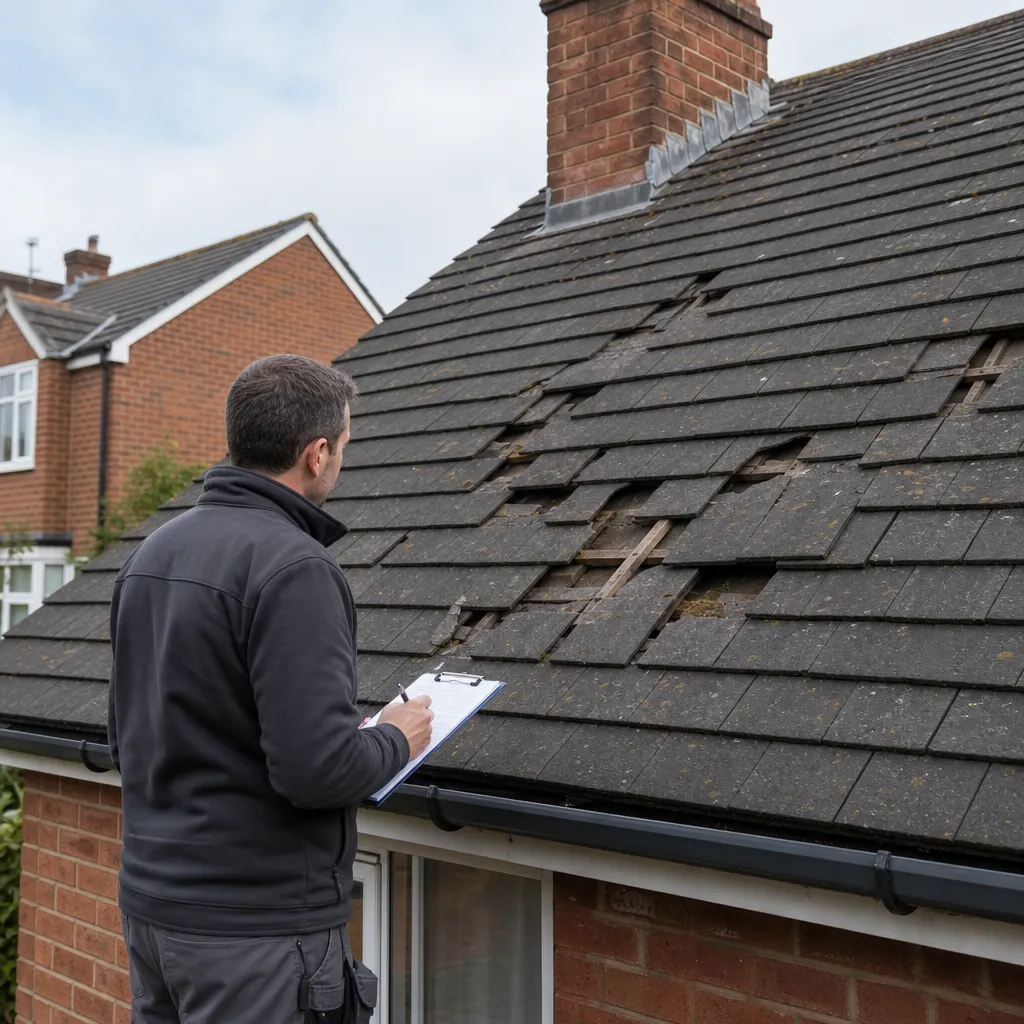
Wind Damage to Roof Tiles and Shingles: Inspection and Repair Guidance
After a storm, inspect your roof from ground level using binoculars before attempting access.
 Surveys & Inspections
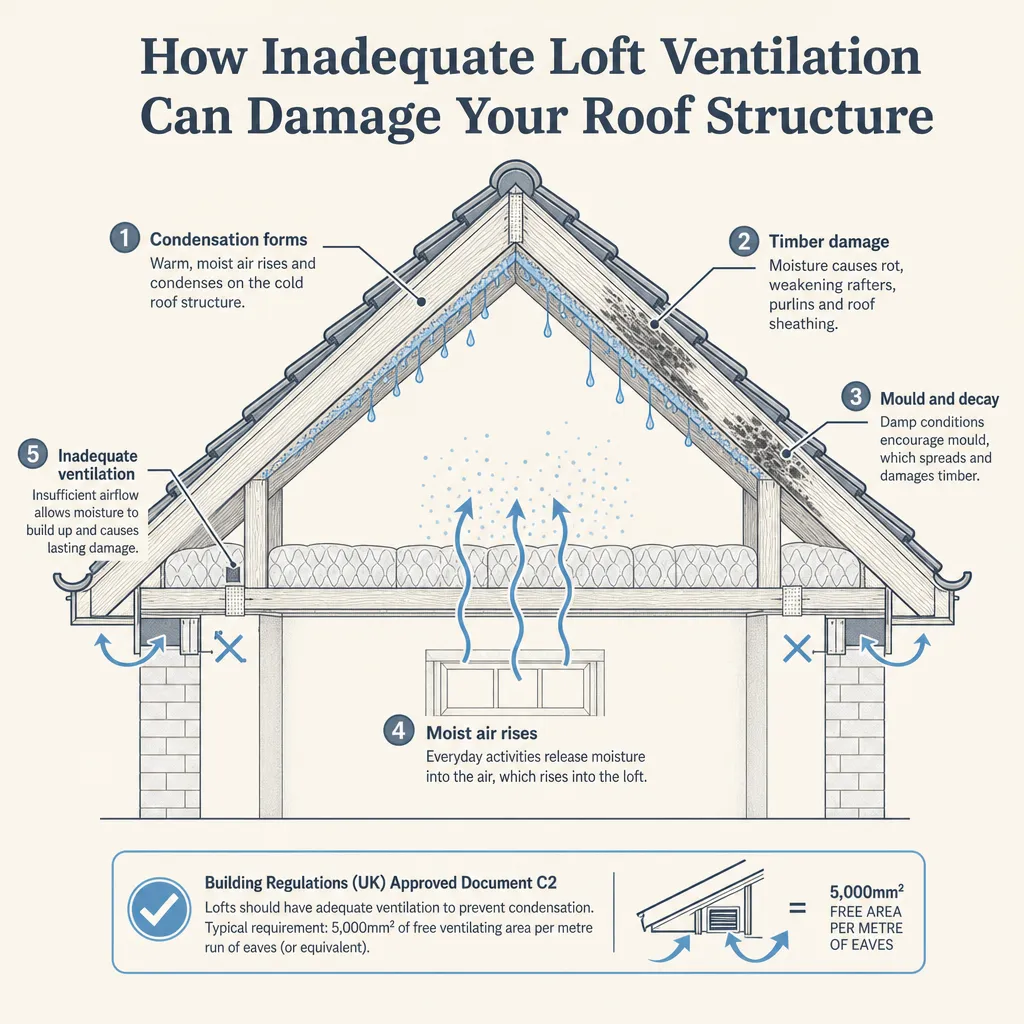
How Inadequate Loft Ventilation Can Damage Your Roof Structure
Inadequate loft ventilation allows warm, moist air to condense on cold roof timbers.
 Surveys & Inspections
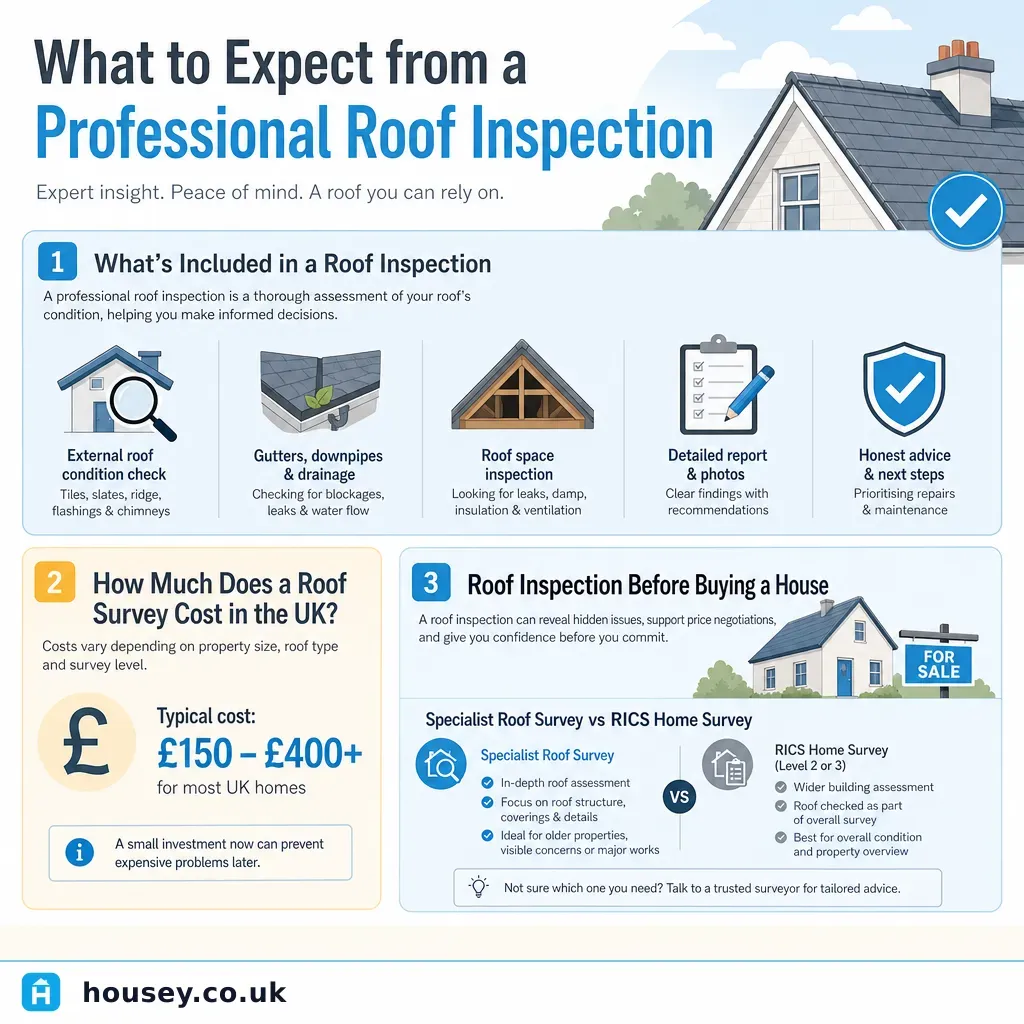
What to Expect from a Professional Roof Inspection
A professional roof inspection involves a qualified specialist examining your roof coverings, flashings, mortar, gutters, and structure.
 Surveys & Inspections
Roof Inspection and Survey Pricing
A professional roof inspection costs £150–£350 for a hands-on roofer survey, rising to £300–£800 for drone or thermal imaging surveys, and £600–£1,500 or more for a RICS Level 3 Building Survey.
 Surveys & Inspections
Roof Snow Removal: Safety and Structural Considerations
In the UK, most pitched roofs in good condition can tolerate typical snowfall without intervention.