Understanding Energy Performance Certificates: EPCs in the UK Property Market
By Housey · Last reviewed 30th of May 2026
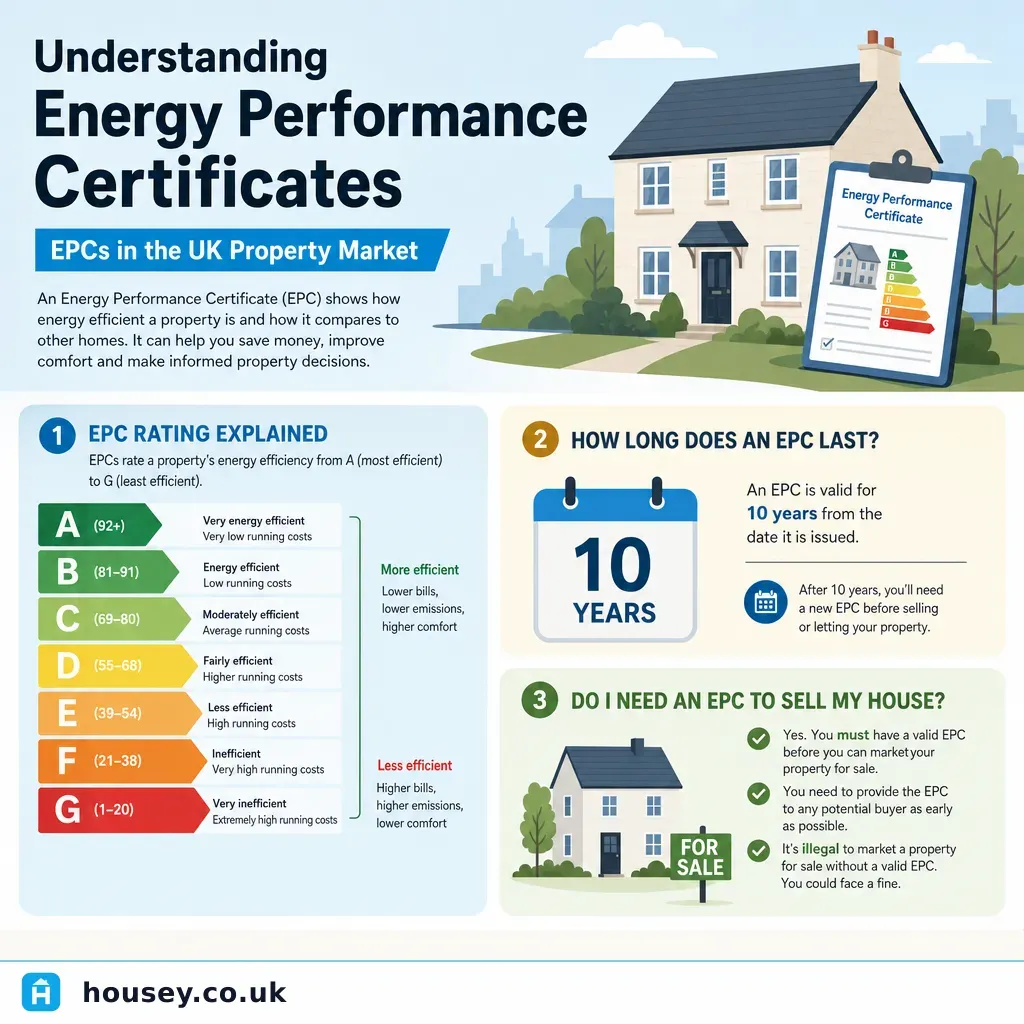
Understanding Energy Performance Certificates: EPCs in the UK Property Market
Most homeowners encounter their first EPC when they list a property for sale or let — often discovering that it has expired or that the rating is lower than expected. Whether you are buying, selling, or renting, the EPC tells you how energy-efficient a property is and what it would cost to run under a standard occupancy model. Getting to grips with what the certificate actually measures, what the letter grades mean, and where the legal obligations sit can help you avoid delays at exchange, negotiate with more confidence, and plan improvements that genuinely move the needle.
Key points
- An EPC is legally required before a property is marketed for sale or let in England, Wales, and Scotland; the certificate must be available to prospective buyers or tenants on request.
- EPC ratings run from A (most efficient) to G (least efficient); the minimum legal rating for most privately rented homes in England and Wales is currently E under the Minimum Energy Efficiency Standards (MEES).
- A valid EPC lasts 10 years; if a current certificate already exists on the GOV.UK EPC register, you are not required to commission a new one for a sale or let during that period.
- Only a qualified, accredited Domestic Energy Assessor (DEA) can issue a valid domestic EPC; find accredited assessors through government-approved schemes including Elmhurst Energy, Stroma, or ECMK.
- The EPC includes a "potential rating" — a second score showing what the property could achieve with recommended improvements, useful for negotiation and retrofit planning but not a guarantee of those savings.
What an EPC measures — and what it does not
An EPC rates a property's energy performance based on a standard occupancy model, not on how the current occupants actually use it. The assessor examines construction type and estimated insulation levels for walls, roof, and floor; the heating system type, age, and controls; the hot water system; glazing type; fixed lighting; and the presence of renewable energy systems such as solar PV, solar thermal, or a heat pump.
What it does not assess: actual energy bills, the working condition of the boiler, the quality of any insulation fitted by previous owners, or whether past upgrade claims are accurate.
What not to assume
- Do not assume a high EPC rating means low bills. The EPC uses a standardised occupancy model. A well-insulated home occupied by a large family may have higher bills than a poorly rated flat with a single occupant.
- Do not assume the potential rating is easily or cheaply achievable. Recommendations on the second page of the EPC are indicative; actual costs depend on property type, construction, and contractor availability.
- Do not assume an EPC from a previous sale is still valid. Check the GOV.UK register — if the certificate is more than 10 years old, a new one is required before marketing.
- Do not assume you always need a new EPC. If a valid certificate exists for the property and no major works have altered its energy characteristics, you can reuse the existing one.
EPC bands explained
Band | SAP score | Typical property type | Indicative running cost |
|---|---|---|---|
A | 92–100 | New-build Passivhaus or highly retrofitted property | Very low |
B | 81–91 | Modern new-build built to Part L 2021 | Low |
C | 69–80 | Well-insulated 1980s–2000s house | Moderate |
D | 55–68 | Typical 1960s–1990s semi-detached | Average |
E | 39–54 | Older solid-wall or poorly insulated property | Above average |
F | 21–38 | Pre-1919 unimproved solid-wall home | High |
G | 1–20 | Unimproved older stock with no central heating | Very high |
SAP = Standard Assessment Procedure. Indicative running costs vary significantly by occupancy, energy tariff, and location.
When is an EPC legally required?
Selling
A valid EPC must be in place before a residential property is marketed for sale in England, Wales, or Scotland. Estate agents are required to attach the EPC rating to all marketing materials. Failure to provide one can attract a fixed-penalty notice of £200 per property.
Renting
Private landlords in England and Wales must hold a valid EPC with a minimum rating of E before granting a new tenancy or renewing one. Letting an F- or G-rated property is unlawful under the Minimum Energy Efficiency Standards (MEES) unless a valid exemption is registered on the PRS Exemptions Register. The Government has proposed raising the minimum to C for new tenancies, but as of May 2026 this has not been legislated — check GOV.UK for the current position.
Exemptions
Certain properties are exempt from needing an EPC, including:
- Listed buildings where compliance with energy-efficiency standards would unacceptably alter the character or appearance (confirm with your local authority or Historic England).
- Temporary structures intended for use for fewer than two years.
- Some holiday lets not rented out for four months or more per year.
Commercial property
Non-domestic buildings require an EPC on sale, let, or new construction. Display Energy Certificates (DECs) are a separate requirement for public buildings with a total useful floor area over 250 m².
How much does an EPC cost?
Indicative UK costs, last reviewed 2026-05-30.
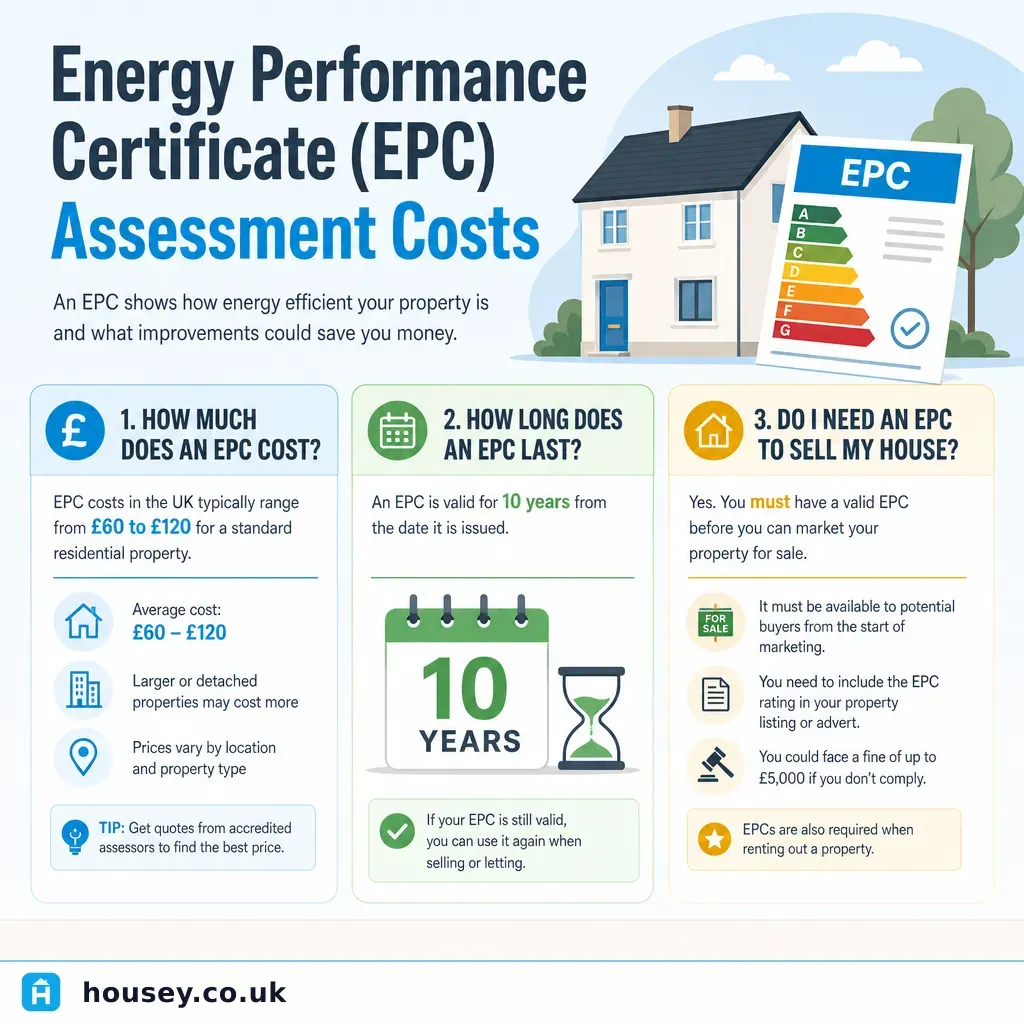
A domestic EPC assessment for a typical property costs approximately £60–£120, depending on property size, location, and assessor. Larger or more complex properties may be higher. Always obtain at least two quotes.
What to ask before accepting a quote
- Is the assessor accredited with a government-approved scheme (Elmhurst Energy, Stroma, ECMK, or Quidos)?
- How quickly will the certificate be lodged on the national register after the assessment?
- What access will be needed — loft hatch, boiler cupboard, meter readings?
- Is the price fixed, or does it depend on property size or access constraints?
- Will you receive the full EPC report including the recommendations page?
How to improve your EPC rating
The second page of an EPC lists recommended measures ranked by cost-effectiveness. Common improvements that typically move the rating upwards include:
- Loft insulation (at least 270 mm of mineral wool) — often the highest-impact, lowest-cost measure for older homes.
- Cavity wall insulation — applicable to most homes built between approximately 1930 and 1995 with unfilled cavities.
- Upgrading to a high-efficiency condensing boiler with a room thermostat, programmer, and thermostatic radiator valves (TRVs).
- Double or secondary glazing to replace single-glazed windows.
- Solar PV panels — can significantly lift a rating, particularly for band D or E homes.
- Heat pump installation — can raise the rating but requires adequate insulation first; seek a retrofit assessment before proceeding.
Note: the SAP methodology weights the carbon intensity of the fuel type, so switching from a gas boiler to an electric heat pump can lift the EPC rating even when the property's heat demand is unchanged, because grid electricity now carries a lower carbon factor than it did a decade ago.
When to get professional help
Contact a qualified professional if:
- Your property is rated F or G and you let or intend to let it — you may be in breach of MEES or at risk of enforcement action.
- A buyer's solicitor has flagged the EPC in pre-contract enquiries — your conveyancer can advise on any legal implications.
- You are planning a significant retrofit and want the EPC to reflect post-works performance — a new assessment will be needed after completion.
- The EPC contains factual errors (wrong wall construction type, missing extensions, or unrecorded improvements) — contact the assessor first, then the accreditation scheme if unresolved.
How Housey can help
Housey connects you with accredited EPC assessors in your area. Submit a request, compare credentials and turnaround times from local professionals, and instruct with confidence.
Frequently asked questions
How long does an EPC last?
An EPC is valid for 10 years from the date of issue. You can check whether a current certificate exists for your property on the GOV.UK EPC register. If a valid one is already in place and no major works have been done, you are not required to commission a new one for a sale or let during that period.
Do I need an EPC before marketing my property for sale?
Yes. In England, Wales, and Scotland, a valid EPC must be available before a residential property is marketed for sale or let. Estate agents are required to attach the EPC rating to all marketing materials. Failure to have one in place can result in a fixed-penalty notice of £200.
What is the minimum EPC rating for a rental property in England?
Under the Minimum Energy Efficiency Standards (MEES), the minimum legal rating for privately rented homes in England and Wales is currently E. Letting an F- or G-rated property is unlawful unless a valid registered exemption applies. The Government has proposed raising this to C for new tenancies, but this has not been legislated as of May 2026.
Can I challenge or correct an inaccurate EPC?
Yes. If the certificate contains factual errors — such as the wrong wall construction type, unrecorded insulation, or a missing extension — contact the assessor directly. If they do not resolve the issue, escalate to their accreditation scheme (Elmhurst Energy, Stroma, ECMK, or Quidos). All accredited assessors must follow the Standard Assessment Procedure methodology.
Sources and further reading
- Find an energy certificate — GOV.UK — GOV.UK
- Domestic private rented property: minimum energy efficiency standard — GOV.UK
- Standard Assessment Procedure (SAP) — GOV.UK / DESNZ
- Energy efficiency and historic buildings — Historic England
- Energy Performance Certificates for your home — GOV.UK
Useful next reads
 Buying & Moving
Energy Performance Certificate (EPC) Assessment Costs
An EPC typically costs between £60 and £120 for a standard UK home, though prices vary by property size and assessor.
 Buying & Moving
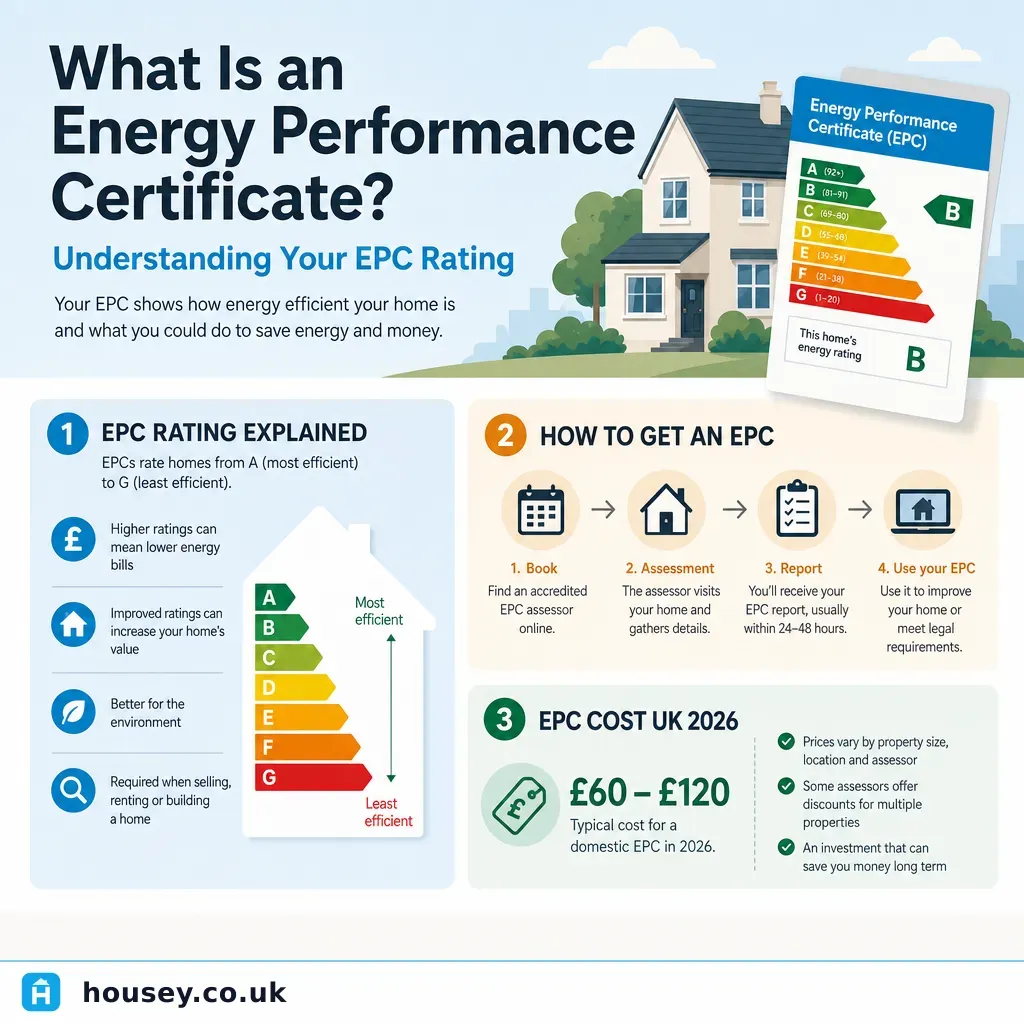
What Is an Energy Performance Certificate: Understanding Your EPC Rating
An Energy Performance Certificate (EPC) rates a property's energy efficiency from A (most efficient) to G (least efficient) using a 1–100 SAP score.
 Buying & Moving
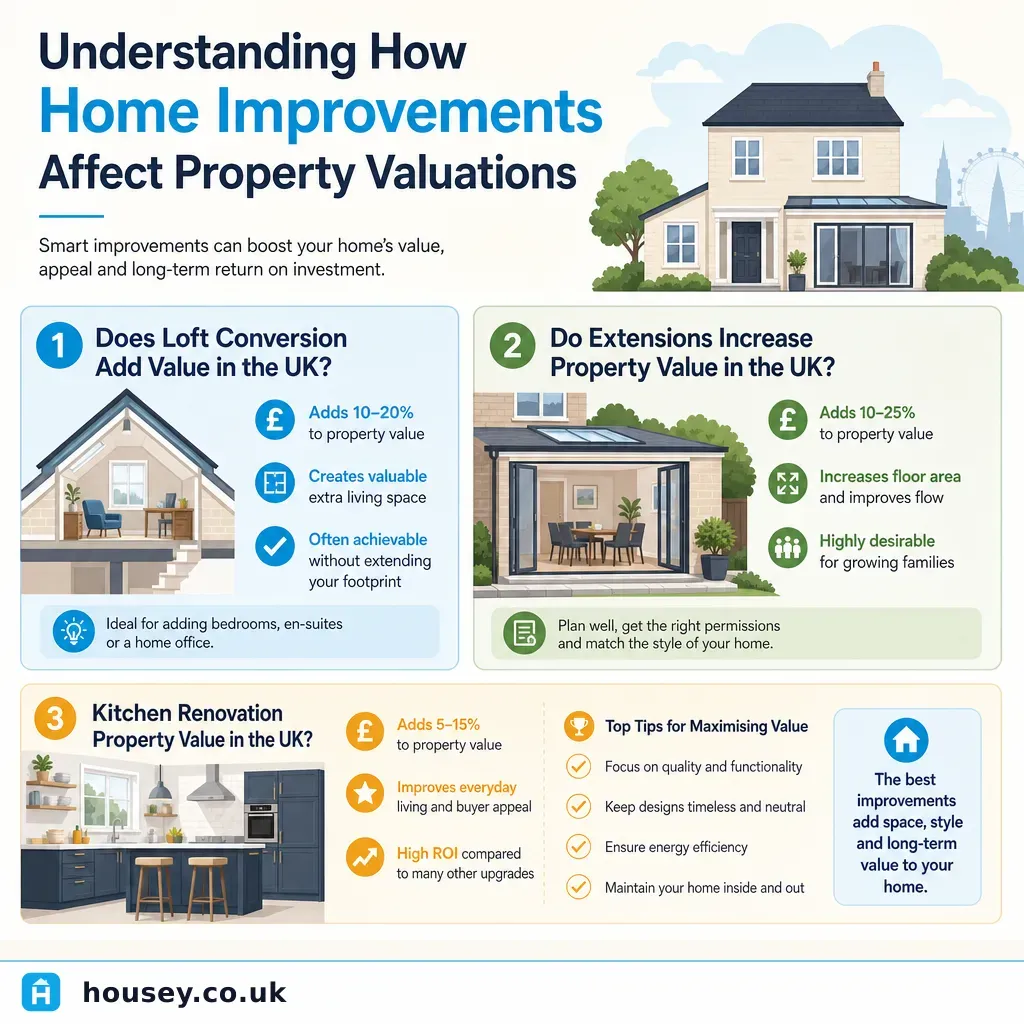
Understanding How Home Improvements Affect Property Valuations
Home improvements can increase a property's market value, but the uplift depends on the type of work, local market conditions, and property type.
 Buying & Moving
Property Enhancement Strategies for a Successful Sale
Enhancing a UK property before listing typically involves improving kerb appeal, decluttering and neutralising décor, addressing minor maintenance issues, and investing in professional photography.
 Buying & Moving
How to Get Your Property Professionally Valued
To get a professional property valuation in the UK, instruct a RICS Registered Valuer for any formal purpose — mortgage, probate, Help to Buy, or legal proceedings.