Understanding How Home Improvements Affect Property Valuations
By Housey · Last reviewed 8th of May 2026
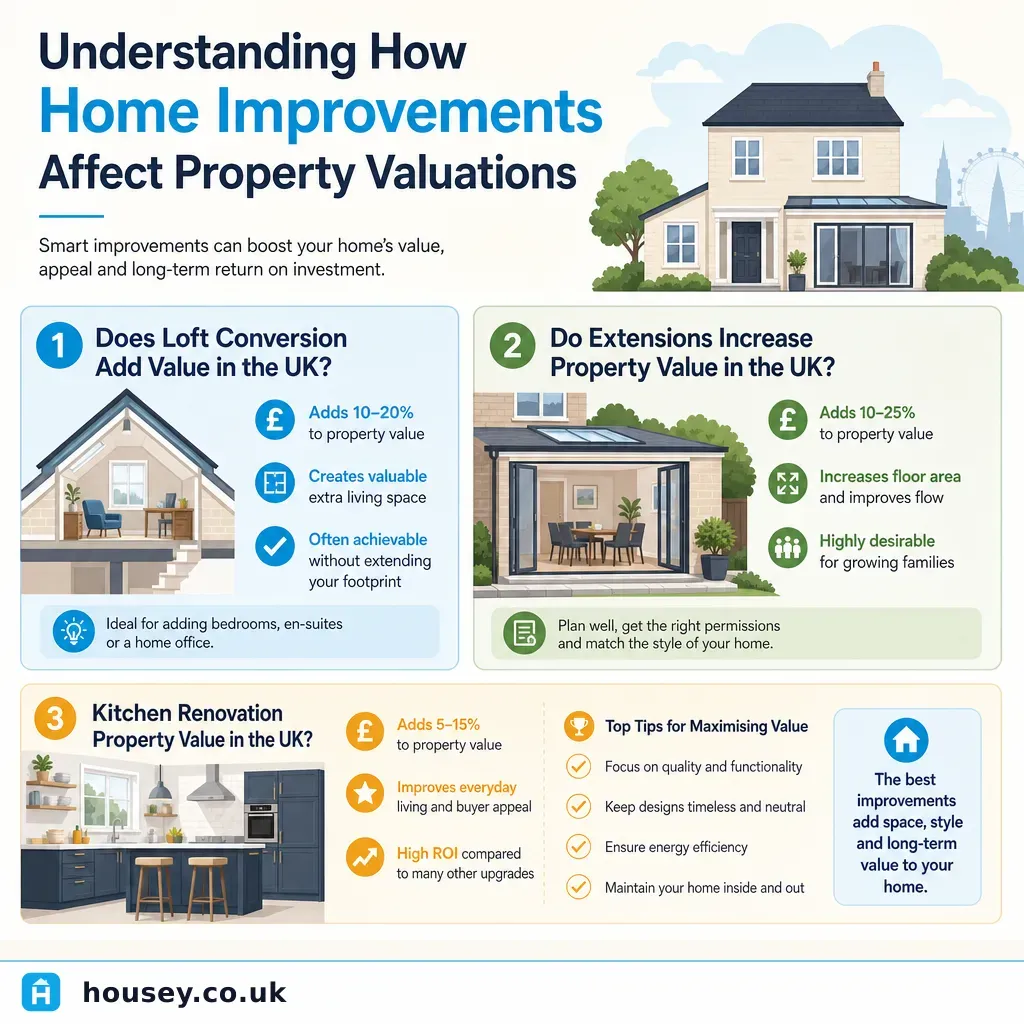
Understanding How Home Improvements Affect Property Valuations
Home improvements are a significant part of the UK housing market, but the relationship between building work and property value is often misunderstood. Whether you are planning a loft conversion before sale, considering a rear extension, or remortgaging after refurbishment, understanding how a valuer views those works helps you make better decisions and set realistic expectations about the return on your investment.
Key points
- A RICS-registered valuer uses the sales comparison approach — your property is assessed against recent comparable sales in the same area, not through a line-item cost/value breakdown of individual improvements.
- Loft conversions adding a bedroom with en suite can add 10–20% to value in many UK markets, though the uplift is directly constrained by what comparable four-bedroom properties have actually sold for nearby.
- Unauthorised works — extensions or conversions completed without required planning permission or Building Regulations approval — can delay or prevent a sale and affect how a valuer treats the improvement.
- EPC-improving measures such as cavity wall insulation, loft insulation, and double glazing to current standards are increasingly relevant to valuers as lender requirements around energy efficiency tighten.
- Over-improvement is a genuine and common risk: every street has a practical price ceiling set by comparable sales, and high-specification finishes cannot push a valuation above that ceiling.
How valuers assess home improvements
A RICS-registered valuer does not produce a room-by-room cost analysis. Instead, they identify properties of similar type, size, and condition that have recently sold in the same locality, then make adjustments for material differences. This process is known as the sales comparison approach and is the foundation of residential valuation practice in the UK.
This has two important implications for homeowners:
- Improvements only add value if buyers in your market are paying more for them. A high-specification kitchen in a modest post-war terrace adds less than the same kitchen in a premium detached home, because local comparable sales set the ceiling.
- The quality and regulatory status of improvements matters. A poorly finished extension, a loft conversion with inadequate headroom, or a bathroom added without Building Regulations sign-off may be treated more cautiously by a valuer than no improvement at all.
For remortgage purposes, lenders instruct their own valuer — often via a panel arrangement — and that valuation is intended to protect the lender's security, not to confirm what you spent on the works.
Which improvements typically add value?
The table below summarises common UK home improvements and their general effect on property valuations. All figures are indicative and vary significantly by property type, location, and local market conditions. Indicative UK context, last reviewed 2026-05-08.
Improvement | Likely valuation impact | Key conditions |
|---|---|---|
Loft conversion (bedroom + en suite) | Often significant (10–20% in many markets) | Building Regs sign-off, adequate headroom, fire escape compliance required |
Rear extension (kitchen/living space) | Moderate to significant | Planning permission or permitted development compliance required |
Side return extension (terraced/semi) | Moderate | Subject to permitted development height and boundary rules |
Kitchen renovation | Variable; modest at best | High-spec finish in a lower-value property constrained by local price ceiling |
Additional bathroom or upgrade | Moderate | Second bathroom generally well received by buyers in most markets |
Garage conversion | Moderate; location-dependent | Loss of off-street parking can reduce value in car-dependent areas |
EPC-improving measures (insulation, DG) | Increasingly positive | EPC Band C and above is a growing lender and buyer priority |
New boiler or heating system | Modest | Reduces buyer concerns; rarely a large standalone uplift |
Garden landscaping | Minor to moderate | Functional outdoor space is prioritised; kerb appeal has some effect |
Swimming pool | Minimal to negative in many areas | Maintenance liability often outweighs appeal outside premium markets |
Worked example: semi-detached in the East Midlands
Consider a 1960s three-bedroom semi-detached in Leicester, purchased for £220,000. The owners invest £35,000 in a loft conversion creating a fourth bedroom with en suite, and £12,000 in a replacement kitchen. Total spend: £47,000.
Similar four-bedroom semis with loft conversions in the same postcodes have recently sold for £265,000–£275,000. The property's post-improvement valuation range is therefore approximately £260,000–£275,000 — an uplift of £40,000–£55,000 on the purchase price, but potentially less than the full £47,000 cost of works depending on comparable evidence available at valuation.
Key factors that determine the outcome in this scenario:
- The loft conversion has a Building Regulations completion certificate and meets fire escape requirements — without these, the valuer would discount or exclude the additional bedroom.
- The kitchen specification is appropriate for the local market rather than over-specified.
- Recent comparable sales in the same postcode area support the upper end of the price range.
This illustrates why checking comparable sales before committing to major works — and securing all required sign-off — is essential to achieving the expected return.
Planning permission and Building Regulations: why they matter for valuations
Unauthorised works are a significant issue in UK property transactions. Where a valuer or buyer's solicitor identifies improvements carried out without required consents, the consequences can include:
- The valuer noting the improvement but flagging the planning risk, potentially discounting or excluding value attributable to those works.
- The buyer's solicitor requiring indemnity insurance before exchange — which can delay completion and reduce buyer confidence.
- In more serious cases, enforcement action by the local planning authority (LPA), though this is subject to statutory time limits.
For extensions and loft conversions, always confirm whether permitted development rights apply or whether a full planning application is needed. Consult your LPA or an RIBA-chartered architect before starting work.
For Building Regulations, completion certificates from your local building control body or a registered approved inspector are essential evidence that structural, fire safety, drainage, and electrical elements meet the required standards. Retain all documentation and pass it on at sale.
Red flags that may affect your valuation
The following issues can reduce the value a valuer attributes to improvements, or complicate a subsequent sale:
- No completion certificate for a loft conversion, extension, or structural alteration.
- Extension built beyond permitted development limits without planning permission having been granted.
- Windows or doors replaced without FENSA or CERTASS certification, which is a Building Regulations Part L requirement.
- Chimney breast removed without a structural engineer's sign-off and adequate support provided for the remaining stack above.
- Electrical works not notified to building control under Part P of the Building Regulations.
- Outbuildings or annexes that may have inadvertently created a separate Council Tax liability.
- Garage converted where the title deeds or planning history restrict such a change of use.
Important limitations
This article provides general information about how home improvements may be considered within a UK property valuation context. Nothing in this article constitutes a professional valuation, financial advice, or legal advice.
Property valuations depend on professional judgement, local market conditions, comparable sales data, lender requirements, and the specific circumstances of each property and transaction. Planning and Building Regulations rules vary by local authority, property location (conservation areas, listed buildings), and the nature of the works carried out.
Always seek advice from a RICS-registered valuer and, where relevant, an RIBA-chartered architect or structural engineer before making significant financial decisions based on an assumed valuation uplift.
What to ask a qualified professional
Before committing to major improvement works, ask:
- What comparable sales exist in my street and postcode, and what price ceiling do they imply for my property type?
- Does this project require planning permission, or does it fall within permitted development rights for my property?
- What Building Regulations applications will be needed, and who will provide the completion certificate?
- Will this improvement be recognised in a mortgage lender's valuation, and are there conditions that need to be met first?
- Is the specification appropriate for the local market, or is there a realistic risk of over-improvement?
- How should I document these works to protect the property's sale or remortgage prospects?
When to get professional help
Seek advice from a RICS-registered valuer or relevant specialist before starting works if:
- The project involves removing or altering load-bearing walls, chimneys, or foundations.
- The property is listed or in a conservation area, where stricter and different rules apply.
- You are uncertain whether planned works require planning permission or fall within permitted development.
- You are considering improvements specifically to increase value for a remortgage — a RICS valuer can provide a realistic indication before you commit to expenditure.
- A buyer's solicitor or lender has raised concerns about previous works at the property.
How Housey can help
If you are preparing to sell or remortgage after carrying out improvements, a professional valuation gives you a clear picture of what the market will actually support. Housey can connect you with RICS-registered valuers through our valuation surveys service.
Frequently asked questions
Does a loft conversion always add value in the UK?
Not automatically. A loft conversion creating a usable additional bedroom — with Building Regulations sign-off, adequate headroom, and compliant fire escape routes — generally supports a higher valuation. However, the uplift is constrained by comparable sales in the same area. Where four-bedroom properties do not command a significant premium over three-bedroom ones locally, the addition will be valued accordingly.
Will my property valuation increase immediately after improvements?
A valuation reflects the market at the time of assessment. If comparable sales in your area do not yet reflect the improvement type you have carried out, a valuer may be conservative. Valuations for remortgage purposes tend to be more cautious than open-market valuations, as lenders are protecting their security rather than maximising price.
Do home improvements affect Council Tax?
Major alterations can in principle trigger a Council Tax reband, but this typically occurs on sale rather than during ownership. Adding a self-contained annexe may create a separate Council Tax liability. The Valuation Office Agency (VOA) manages Council Tax banding in England; contact them if you believe a reband has been incorrectly applied.
Does a new kitchen add significant value?
In most UK markets, a kitchen replacement contributes modest value relative to its cost. It can make a property more attractive and reduce buyer negotiation, but rarely generates a direct return equal to the full cost of works. The exception is where the previous kitchen was in genuinely poor condition or where poor overall presentation was holding back offers.
Should I get a valuation before or after carrying out works?
Both can be useful. A pre-works valuation establishes a baseline; a post-works valuation — obtained once completion certificates are in order — helps confirm any uplift for remortgage or equity release. Always ensure Building Regulations documentation is complete before requesting a post-works valuation, as a valuer will ask about sign-off status.
Sources and further reading
- Planning permission in England and Wales — GOV.UK
- Building regulations approval — GOV.UK
- RICS Valuation — Global Standards (Red Book) — RICS
- Council Tax banding — Valuation Office Agency
- Permitted development rights for householders — Planning Portal
Useful next reads
 Buying & Moving
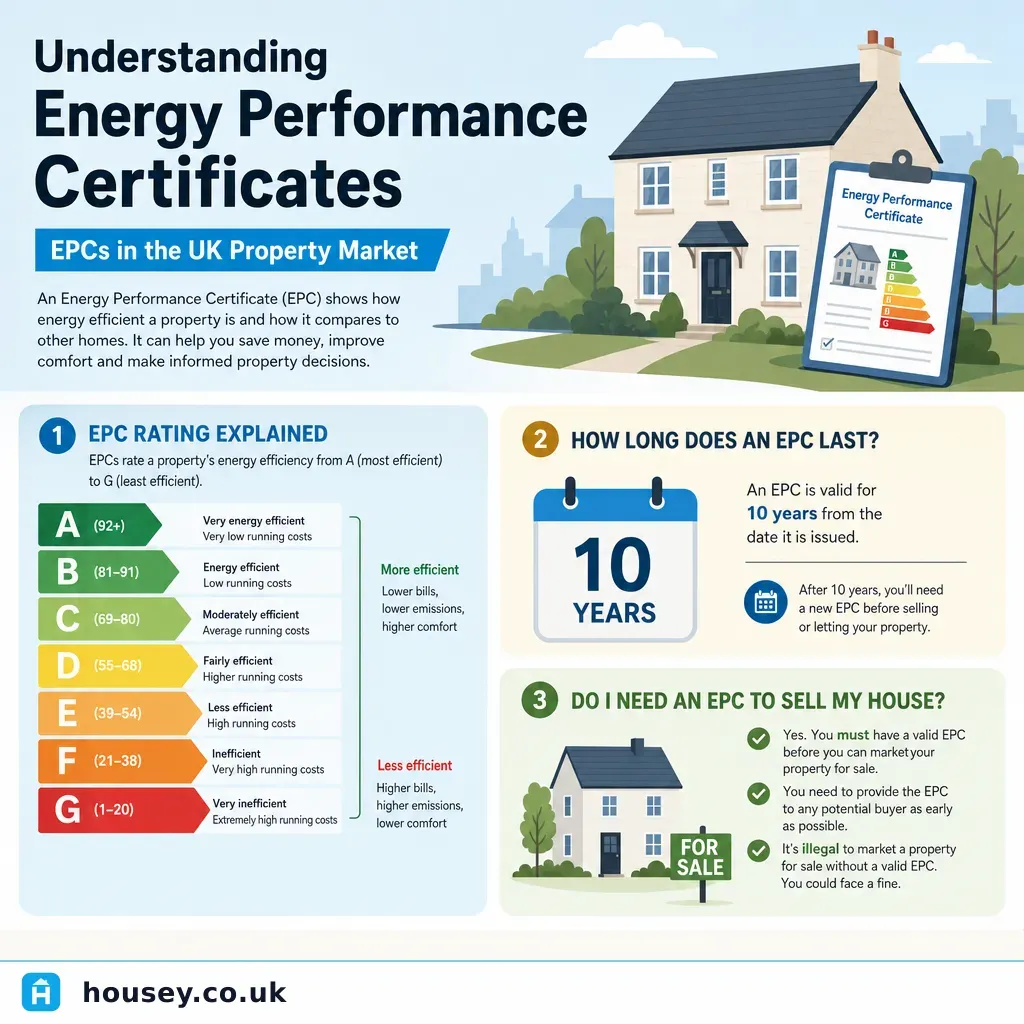
Understanding Energy Performance Certificates: EPCs in the UK Property Market
An Energy Performance Certificate (EPC) rates a property's energy efficiency on a scale from A (most efficient) to G (least efficient).
 Buying & Moving
How to Get Your Property Professionally Valued
To get a professional property valuation in the UK, instruct a RICS Registered Valuer for any formal purpose — mortgage, probate, Help to Buy, or legal proceedings.
 Buying & Moving
Understanding Local Property Values: What Homes Sold For in Your Area
Sold prices for UK properties are publicly recorded by HM Land Registry for England and Wales, Registers of Scotland, and Land and Property Services in Northern Ireland.
 Buying & Moving
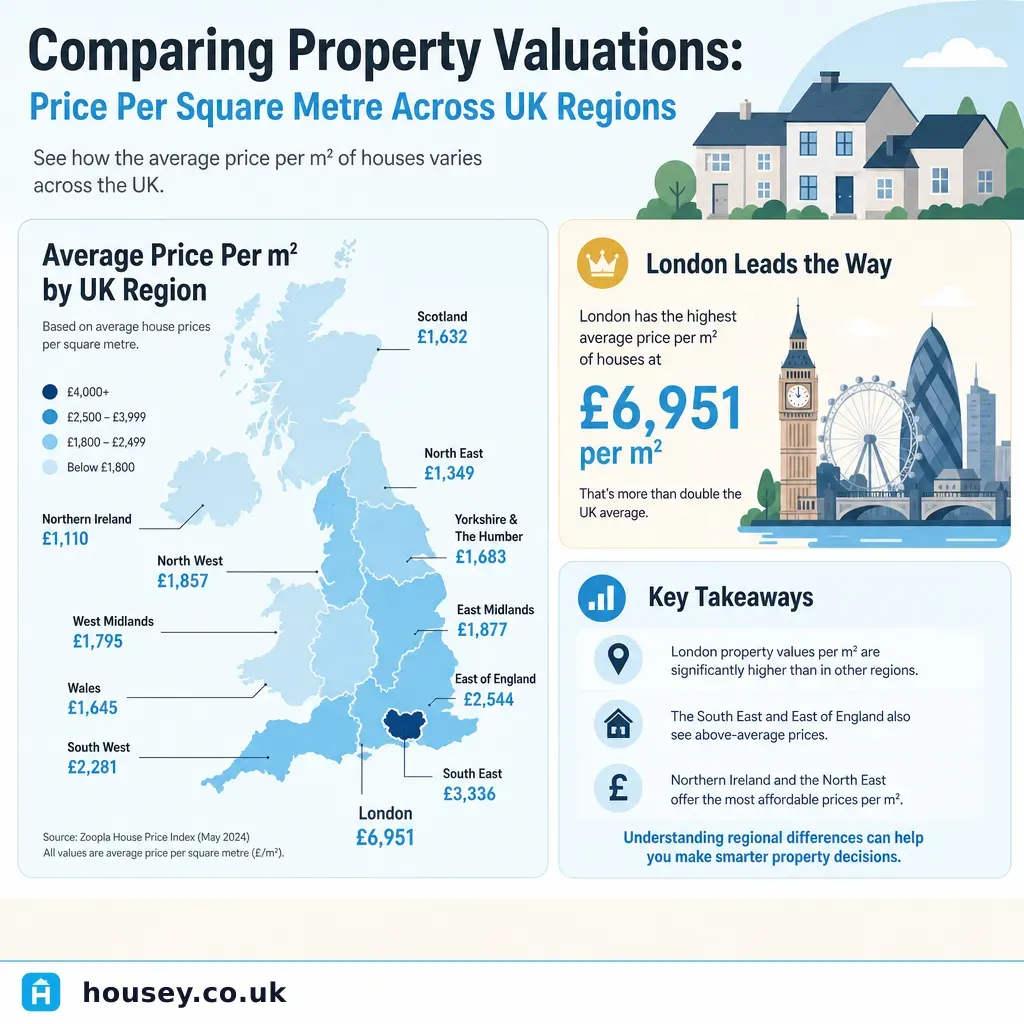
Comparing Property Valuations: Price Per Square Metre Across UK Regions
Property prices per square metre vary dramatically across UK regions.
 Buying & Moving
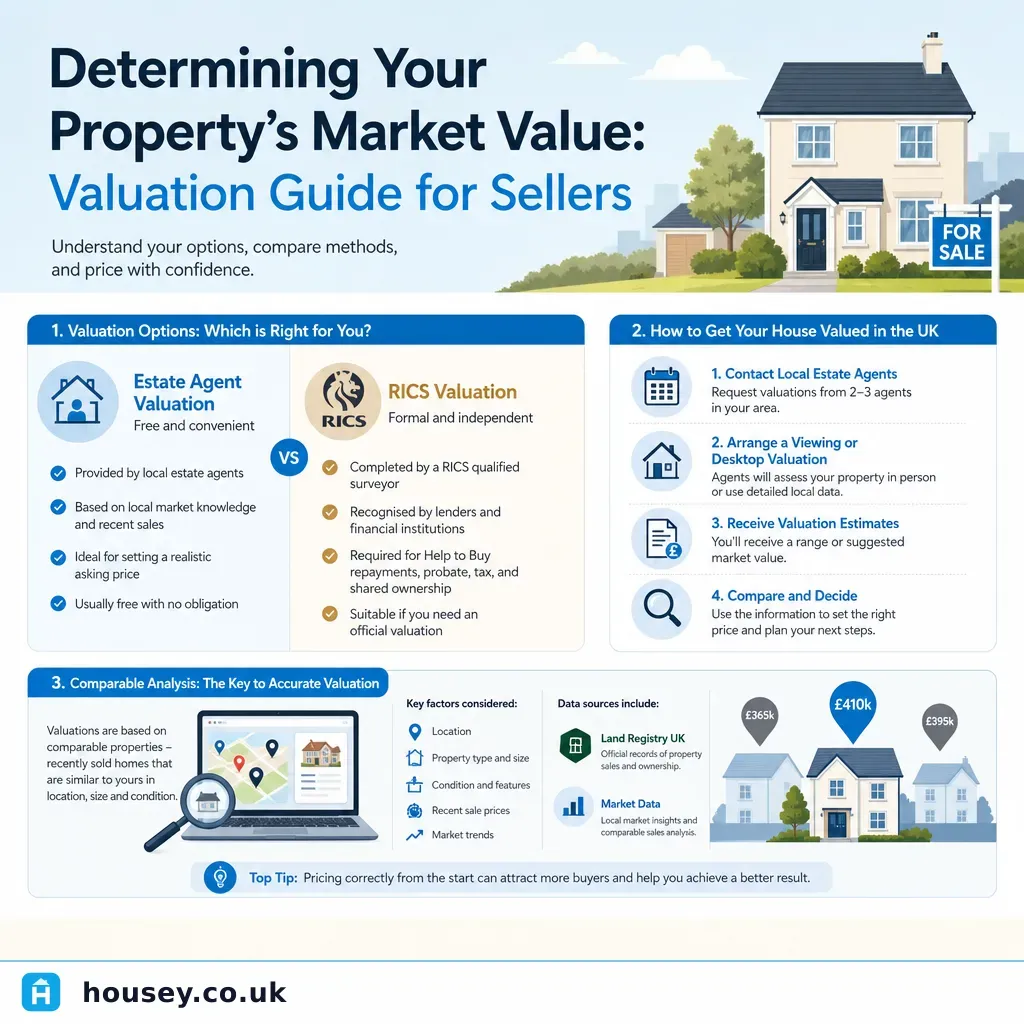
Determining Your Property's Market Value: Valuation Guide for Sellers
Market value in the UK is most reliably established by combining estate agent appraisals with your own analysis of recent sold prices on the HM Land Registry database.