Energy Performance Certificate (EPC) Assessment Costs
By Housey · Last reviewed 7th of May 2026
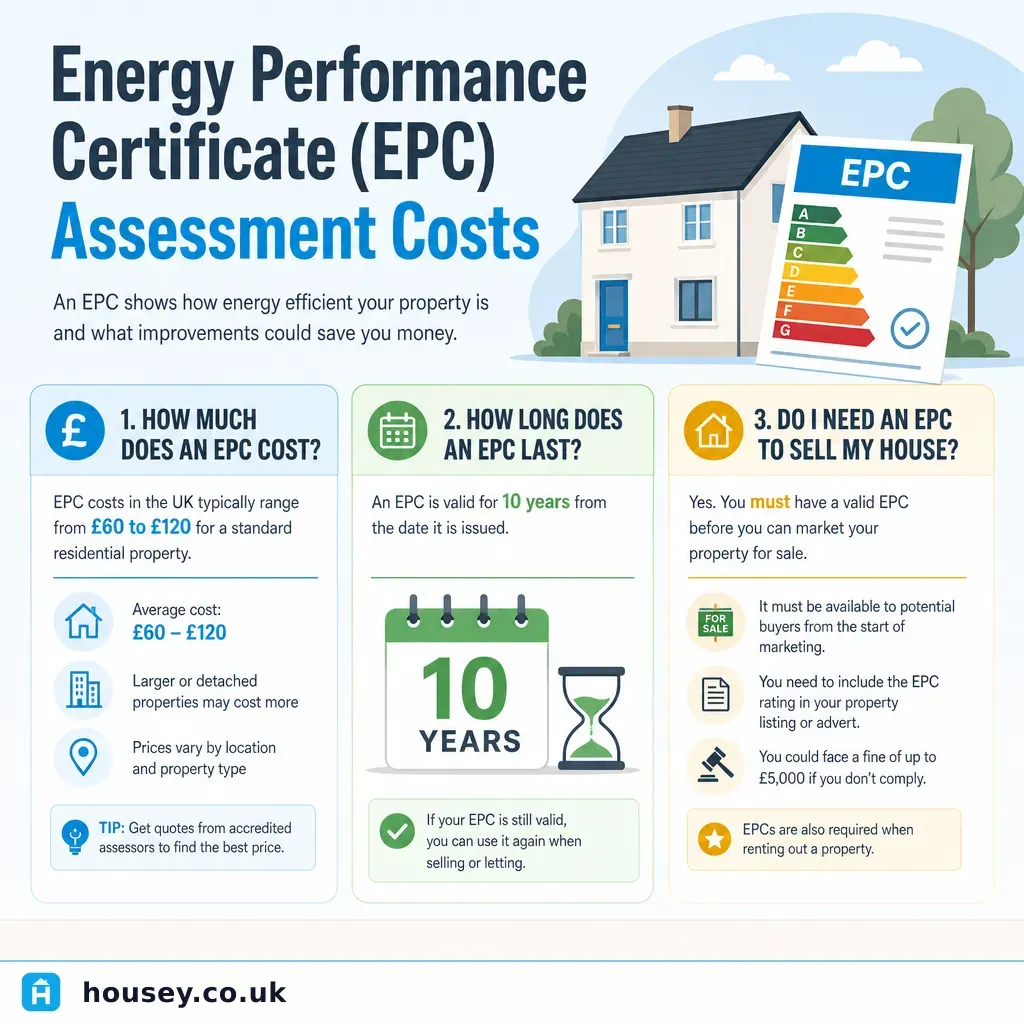
Energy Performance Certificate (EPC) Assessment Costs
Whether you are selling a property, renting it out, or planning energy improvements, an EPC is often the first document you need. The certificate is a legal requirement before marketing most properties in England, Wales, and Scotland, and the rating it assigns can affect your sale prospects, rental compliance, and eligibility for grant funding. Understanding what an assessment involves and what it should cost helps you choose the right assessor and avoid unnecessary expense.
Key points
- An EPC is legally required before marketing a home for sale or rent in England, Wales, and Scotland under the Energy Performance of Buildings (England and Wales) Regulations 2012.
- EPCs are rated A (most efficient) to G (least efficient); landlords in England must ensure rental properties meet at least an E rating under the Minimum Energy Efficiency Standards (MEES).
- A valid EPC lasts 10 years and does not need to be renewed unless it has expired or you want to reflect significant energy improvements.
- Assessments must be carried out by an accredited Domestic Energy Assessor (DEA); verify credentials via the Landmark, Elmhurst, or Stroma register.
- Indicative UK costs range from £60 to £120 for a standard home — larger or more complex properties can cost more. (Indicative UK costs, last reviewed 2026-05-07.)
What does an EPC assessment cost in the UK?
EPC fees are not nationally fixed, so prices vary by assessor, location, and property size. For a typical mid-sized home of two or three bedrooms, most assessors charge between £60 and £120. Smaller flats can be cheaper; larger detached houses or properties with complex heating systems may cost more.
Property type | Typical indicative cost |
|---|---|
One-bedroom flat | £60–£80 |
Two- to three-bedroom semi or terrace | £70–£100 |
Four-bedroom detached | £90–£120+ |
Mixed-use or complex property | Varies — request a bespoke quote |
Indicative UK costs, last reviewed 2026-05-07. Prices vary by assessor and region; always request itemised quotes.
Some estate agents include an EPC in their marketing package. Ask whether the fee is built into the commission or charged separately, and confirm the assessor is independently accredited rather than tied to the agent.
When do you legally need an EPC?
Under the Energy Performance of Buildings (England and Wales) Regulations 2012, you need a valid EPC when:
- Selling a property: the EPC must be commissioned before marketing begins and provided to the buyer.
- Letting a property: a valid EPC must be given to prospective tenants before they sign a tenancy agreement.
- Constructing a new building: an EPC is required on completion.
You do not generally need a new EPC if:
- Your existing EPC is still within its 10-year validity period.
- The property is listed and compliance with minimum energy standards would unacceptably alter its character — though seek specialist advice in this situation.
- The property falls under a specific statutory exemption, such as certain temporary structures.
Scotland has separate regulations under the Energy Performance of Buildings (Scotland) Regulations 2008; the process and certificate format are broadly similar but administered separately.
EPC and MEES for landlords
From April 2020, privately rented homes in England and Wales have been required to achieve at least an E rating under MEES. Properties rated F or G may not legally be let without a registered exemption on the PRS Exemptions Register. The Government has consulted on raising this threshold to C for new tenancies; check GOV.UK for the current position, as policy may have changed since this article was reviewed.
What does an EPC assessor check?
A Domestic Energy Assessor visits the property and collects data on its construction and energy systems using the Reduced Data Standard Assessment Procedure (RdSAP). The assessment typically takes 45–60 minutes. The assessor will record:
- Wall, roof, and floor construction and insulation — type, estimated thickness, and inferred U-values.
- Glazing — single, double, or triple glazed, and approximate installation period.
- Heating system — boiler type, fuel, controls, and secondary heating sources.
- Hot water system — cylinder type, insulation jacket, and controls.
- Lighting — proportion of low-energy fittings throughout the property.
- Renewable energy systems — solar PV, solar thermal, heat pumps, or MVHR if present.
The RdSAP calculation produces a rating from A to G and a recommendation report listing specific improvements and their estimated effect on the rating and running costs.
Homeowner checklist: preparing for your EPC assessment
How long does an EPC last?
An EPC is valid for 10 years from the date of issue. You do not need to renew it simply because it is several years old, provided it has not expired. However, if you have carried out significant energy improvements — such as adding loft or cavity wall insulation, replacing a gas boiler with a heat pump, or installing solar PV — commissioning a new EPC will reflect those changes. An improved rating can support a sale, demonstrate MEES compliance, or unlock better green mortgage terms.
What to ask before accepting a quote from an EPC assessor
- Is the assessor accredited, and which scheme are they registered with — Landmark, Elmhurst, or Stroma?
- How quickly will the EPC be lodged on the national register after the visit?
- Is the fee all-inclusive, or are travel or parking charges added separately?
- Do you provide the full recommendation report alongside the certificate?
- If my rating is lower than expected, can you walk me through the main factors affecting it?
When to get professional help
An EPC is a relatively straightforward assessment, but specialist advice is worth seeking in certain situations:
- Your property is rated F or G and you are a landlord — you need to understand MEES compliance obligations, available exemptions, and the cost of improvements required to reach E.
- Your property is listed or in a conservation area and you are unsure whether the recommended energy improvements can legally be carried out.
- You believe the EPC result is inaccurate — disputes can be raised formally with the assessor's accreditation scheme.
- You want to plan energy improvements strategically before a sale or re-letting and need advice on which measures offer the best rating improvement per pound spent.
How Housey can help
If you need a valid EPC for a sale, rental, or compliance check, Housey can help you request quotes from accredited domestic energy assessors across the UK. Visit our EPC assessment service page to compare assessors in your area and receive quotes directly.
Frequently asked questions
How much does an EPC cost in the UK?
Most domestic EPC assessments cost between £60 and £120 for a standard-sized home, though prices vary by property size, location, and assessor. Estate agents sometimes include an EPC in their marketing package, so check whether it is bundled into their fee. Always request at least two quotes and confirm that the assessor is accredited. (Indicative UK costs, last reviewed 2026-05-07.)
How long does an EPC assessment take?
A typical residential EPC assessment takes 45–60 minutes on site. The assessor then produces the certificate using accredited RdSAP software, and the EPC is usually lodged on the national register within 24–48 hours, though this can vary by assessor and scheme.
Can I check whether my property already has an EPC?
Yes. You can search the free GOV.UK EPC register by postcode or address. If your property has a valid EPC that is less than 10 years old, you may not need to commission a new one. The register is publicly accessible and shows the certificate rating, date of issue, and the recommendation report.
Does an EPC affect my property's value?
A higher EPC rating can positively influence buyer and tenant decisions, and some mortgage lenders offer green mortgage products with preferential rates for properties rated A or B. However, the EPC is not itself a valuation document and does not directly set a property price — that is a matter for a RICS-qualified valuer or estate agent.
Can I improve my EPC rating before sale or re-letting?
Yes. Common improvements include adding loft insulation, cavity wall insulation, upgrading to an efficient boiler or heat pump, and installing low-energy lighting. The recommendation report that accompanies your EPC suggests specific measures and their estimated impact on the rating, which can be useful for prioritising works before marketing.
Sources and further reading
- Energy performance certificates for your home — HM Government
- Minimum Energy Efficiency Standards (MEES) landlord guidance — Department for Energy Security and Net Zero
- Energy Performance of Buildings (England and Wales) Regulations 2012 — legislation.gov.uk
- Find an energy assessor — GOV.UK EPC register — HM Government
- Elmhurst Energy — domestic energy assessor accreditation — Elmhurst Energy
Useful next reads
 Buying & Moving
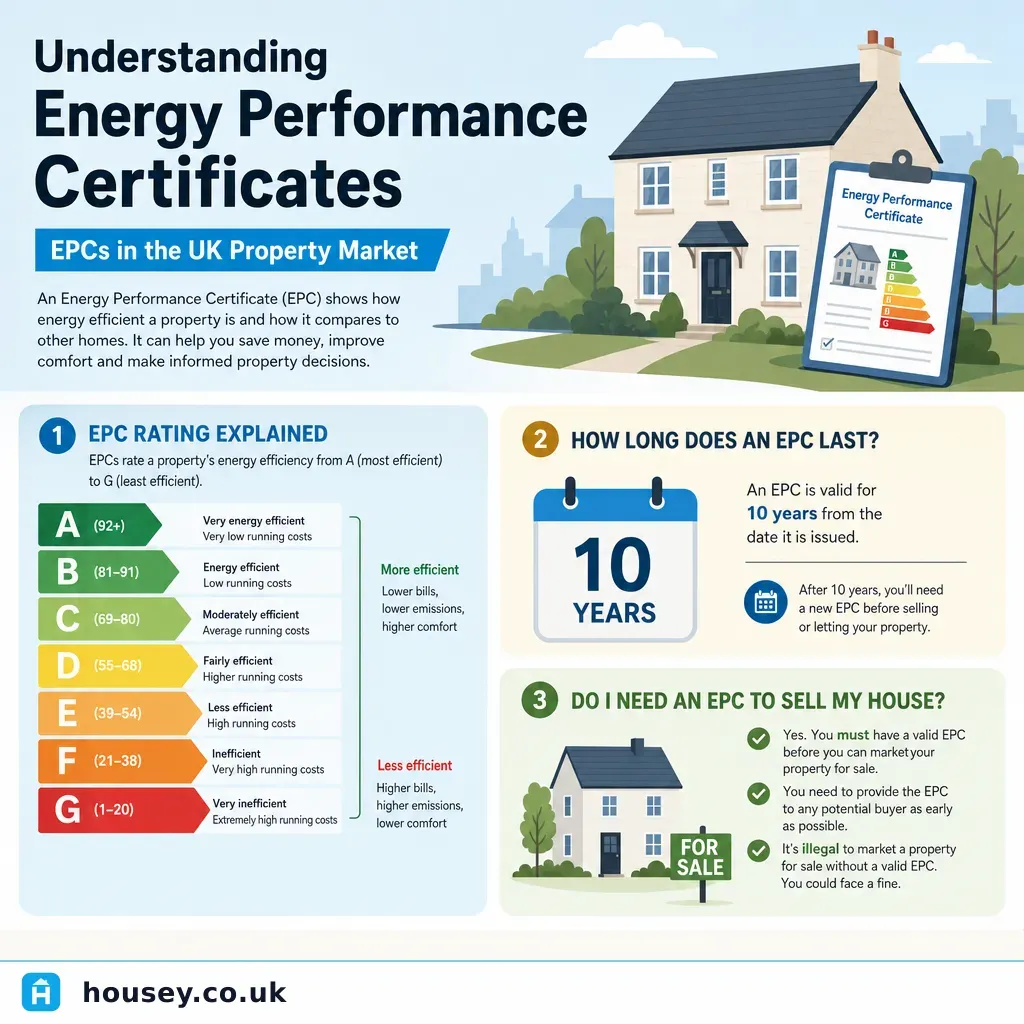
Understanding Energy Performance Certificates: EPCs in the UK Property Market
An Energy Performance Certificate (EPC) rates a property's energy efficiency on a scale from A (most efficient) to G (least efficient).
 Buying & Moving
How to Get Your Property Professionally Valued
To get a professional property valuation in the UK, instruct a RICS Registered Valuer for any formal purpose — mortgage, probate, Help to Buy, or legal proceedings.
 Buying & Moving
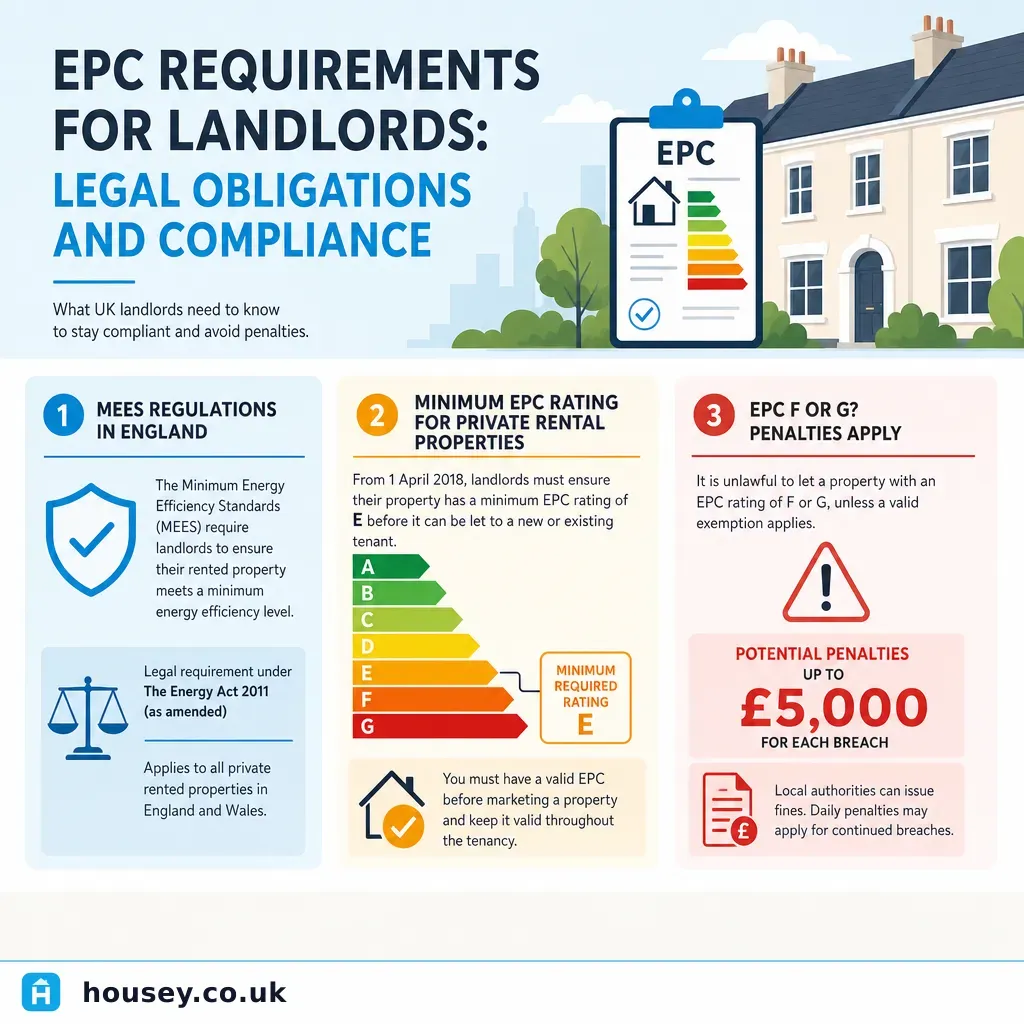
EPC Requirements for Landlords: Legal Obligations and Compliance
Landlords in England and Wales must ensure privately rented properties achieve a minimum EPC rating of E before letting.
 Buying & Moving
Understanding Local Property Values: What Homes Sold For in Your Area
Sold prices for UK properties are publicly recorded by HM Land Registry for England and Wales, Registers of Scotland, and Land and Property Services in Northern Ireland.
 Buying & Moving
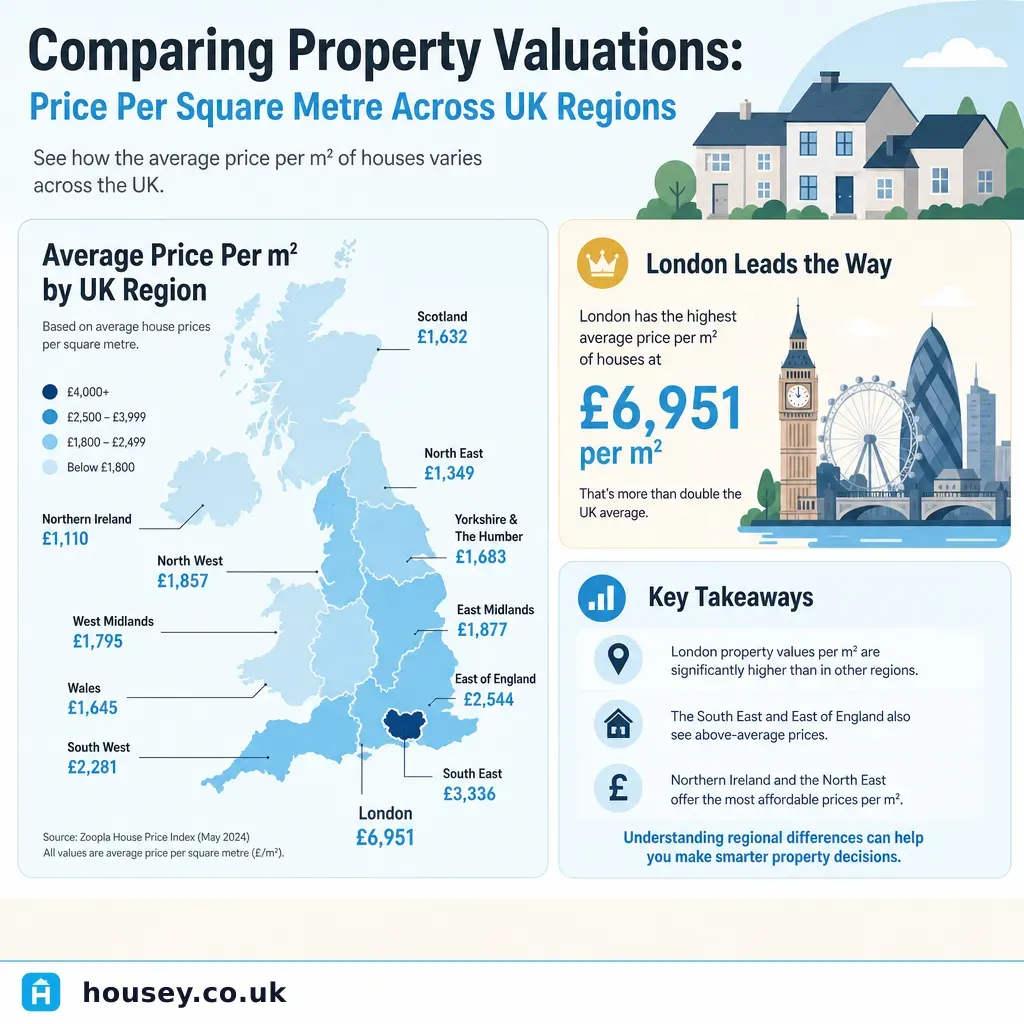
Comparing Property Valuations: Price Per Square Metre Across UK Regions
Property prices per square metre vary dramatically across UK regions.