How to Get Your Property Professionally Valued
By Housey · Last reviewed 19th of May 2026

How to Get Your Property Professionally Valued
Whether you are preparing to sell, remortgaging, or settling an estate, the figure an independent valuer arrives at can have significant financial and legal consequences. In England and Wales, hundreds of thousands of properties are formally valued each year — yet many homeowners only encounter the process through a brief estate-agent appraisal, which serves a different purpose entirely. Understanding the distinction between a formal valuation and an informal market appraisal, and knowing when each is appropriate, can help you avoid costly surprises.
Key points
- A RICS Red Book valuation is the regulated standard for formal purposes including mortgage lending, probate, matrimonial proceedings, Help to Buy equity loan repayment, and shared ownership staircasing — it carries professional liability.
- An estate agent's market appraisal is free and useful for pricing guidance, but it is a commercial estimate, not a regulated report.
- RICS valuers must be RICS Registered Valuers and comply with the RICS Valuation – Global Standards (Red Book); always confirm this before instructing.
- Mortgage valuations are commissioned by the lender for their own protection — they do not represent independent advice to the buyer or homeowner, and the full report is not shared with the purchaser.
- Probate valuations must reflect open market value at the date of death and are required by HMRC for inheritance tax; an inaccurate figure can result in penalties.
Types of property valuation and when you need each
Different situations call for different types of valuation. The table below summarises the most common types, their purposes, and indicative costs.
Valuation type | Purpose | Who commissions it | Formal RICS report? | Indicative cost |
|---|---|---|---|---|
Estate agent market appraisal | Setting an asking price before sale | Homeowner | No | Free |
RICS Red Book valuation | Mortgage, probate, litigation, Help to Buy, tax | Homeowner or lender | Yes — regulated | £150–£600+ |
Mortgage lender valuation | Lender's risk assessment for the loan | Mortgage lender | Brief lender report only | Often included in mortgage fees |
Help to Buy / shared ownership | Staircasing, resale, equity loan redemption | Homeowner | Yes — must be RICS | £150–£300+ |
Probate / HMRC valuation | Estate administration, inheritance tax | Executor or administrator | Yes | £200–£500+ |
Matrimonial / legal dispute | Divorce proceedings or court order | Solicitor or instructing party | Yes — expert witness standard | £500–£1,500+ |
Indicative UK costs, last reviewed 2026-05-19. Fees vary by property size, location, and complexity of the instruction.
RICS Red Book valuation versus a market appraisal
The RICS Valuation – Global Standards (Red Book) sets out mandatory requirements for formal valuation reports. A compliant Red Book valuation:
- Is produced by a RICS Registered Valuer.
- States the purpose of the valuation, the basis of value (usually Market Value as defined by RICS), and the date of valuation.
- Carries professional indemnity insurance, giving you potential recourse if the valuation is found to be negligent.
- Is required by most mortgage lenders, Help to Buy agents, and HMRC for probate purposes.
An estate agent's market appraisal is not regulated in the same way. It is a commercial estimate designed to win your selling instruction and reflects the agent's view of what the property might achieve in the current market. Both have legitimate uses — they must not be confused or substituted for one another.
How to find a qualified valuer
The RICS firm finder at ricsfirms.com lists firms by location and specialism, including residential valuation.
- For mortgage valuations: your lender will instruct a valuer from their approved panel. You generally cannot appoint your own valuer for mortgage purposes.
- For independent valuations: search for RICS Registered Valuers with a residential valuation specialism.
- For probate or matrimonial valuations: check that the firm has experience of HMRC-facing or expert witness work before instructing.
- For Help to Buy or shared ownership: the relevant Help to Buy agent or housing association will specify which valuers they accept for that programme.
Which type of valuation do you need?
- Choose a free estate agent market appraisal if you want to understand current asking-price levels before deciding whether to sell.
- Choose a RICS Red Book valuation if the figure will be used for a mortgage, remortgage, probate, Help to Buy, shared ownership staircasing, matrimonial proceedings, or HMRC purposes.
- Ask a RICS Registered Valuer if you are unsure — they are professionally required to clarify scope and purpose before accepting an instruction.
- Check with your mortgage lender before commissioning a valuation independently — lenders will usually instruct their own, and a separate report is unlikely to be accepted in its place.
What happens during a professional valuation
A RICS Red Book inspection of a typical residential property takes between 30 minutes and 2 hours, depending on size and complexity. The valuer will:
- Inspect the exterior and interior, noting construction, condition, and any visible defects.
- Review tenure details, planning history, and EPC rating where relevant.
- Research comparable transactions using recent HM Land Registry sold-price data.
- Produce a formal written report stating the basis of value and their opinion of Market Value.
The report is usually delivered within a few working days of the inspection. It is addressed to the instructing party and should not be passed to third parties without the valuer's consent, as doing so could affect their professional liability.
Important limitations
This article provides general information about property valuation in England and Wales. Rules and processes differ in Scotland, where the Home Report system applies, and in Northern Ireland. Property valuations involve professional judgement and depend on comparable evidence that varies by location and market conditions. Nothing in this article constitutes professional valuation or financial advice. Always instruct a qualified RICS Registered Valuer for any formal purpose, and seek independent legal or financial advice where a valuation figure has significant consequences.
What to ask a qualified professional
Before instructing a valuer, confirm:
- Are you a RICS Registered Valuer, and will this report comply with the RICS Red Book?
- What basis of value will you use (e.g., Market Value)?
- What is the valuation date, and is that date suitable for my purpose?
- Is your firm on my mortgage lender's approved panel (if a mortgage is involved)?
- What comparable evidence will you use, and how recent is it?
- Will the report carry professional indemnity insurance?
- What could affect the valuation figure or your ability to complete the instruction?
- Is VAT included in your fee?
When to get professional help
Seek professional advice promptly if:
- Your mortgage lender's valuation comes in significantly lower than the agreed purchase price — this 'down-valuation' can affect your mortgage offer and requires swift action.
- HMRC queries a probate valuation — do not respond without professional guidance.
- You are in divorce proceedings and dispute the valuation of jointly held property — a court may require a single joint expert or allow each party's own expert.
- You are dissatisfied with a RICS Red Book valuation — raise concerns in writing with the valuer and, if unresolved, use the RICS formal complaints and professional conduct process.
How Housey can help
Housey connects homeowners with qualified professionals for valuation surveys, whether for remortgaging, probate, or pre-sale purposes. If you are getting ready to sell, professional property photography and floorplans can help your listing stand out once you have agreed your asking price, and a RICS Home Survey can give prospective buyers the confidence to proceed to exchange.
Frequently asked questions
How long does a property valuation take?
A RICS Red Book inspection of a standard residential property typically takes 30 minutes to 2 hours on site, depending on size and complexity. The written report usually follows within a few working days. Larger, listed, or unusual properties may take longer to inspect. A mortgage lender's basic valuation is often quicker — sometimes as brief as 20–30 minutes — as it is less detailed than a full RICS report.
Can I use an estate agent's appraisal for a mortgage?
No. Mortgage lenders require a valuation carried out by a valuer on their approved panel, to their own specification. An estate agent's free market appraisal is a commercial estimate and is not accepted as evidence of value for lending purposes. Your lender will commission their own valuation — you generally cannot substitute a separate independent report.
What is a down-valuation and what can I do?
A down-valuation occurs when a lender's valuer assigns a figure lower than the agreed purchase price, which can reduce the mortgage amount offered. You can challenge it by providing comparable sold-price evidence to the lender, negotiate a reduced purchase price with the seller, or increase your deposit to cover the shortfall. Speak to a mortgage broker or solicitor before deciding how to respond.
Do I need a valuation to sell my home?
You do not legally need a formal valuation to sell in England and Wales. Your estate agent will typically provide a free market appraisal to agree an asking price. A RICS Red Book valuation is not required by law for a straightforward private sale, though your buyer's mortgage lender will commission their own as part of the mortgage process.
How much does a RICS residential valuation cost?
Fees vary by location, property type, complexity, and purpose. Indicative ranges in England: standard residential RICS Red Book valuation £150–£600; probate valuation £200–£500; matrimonial or litigation valuation £500–£1,500 or more. Always request a written quote confirming what is included and whether VAT applies. Indicative UK costs, last reviewed 2026-05-19.
Sources and further reading
- RICS Valuation – Global Standards (Red Book) — Royal Institution of Chartered Surveyors
- RICS Firm Finder — Royal Institution of Chartered Surveyors
- Valuing the estate of someone who has died — GOV.UK / HMRC
- HM Land Registry: search for sold house prices — HM Land Registry
- Help to Buy equity loan: repaying the loan — GOV.UK
Useful next reads
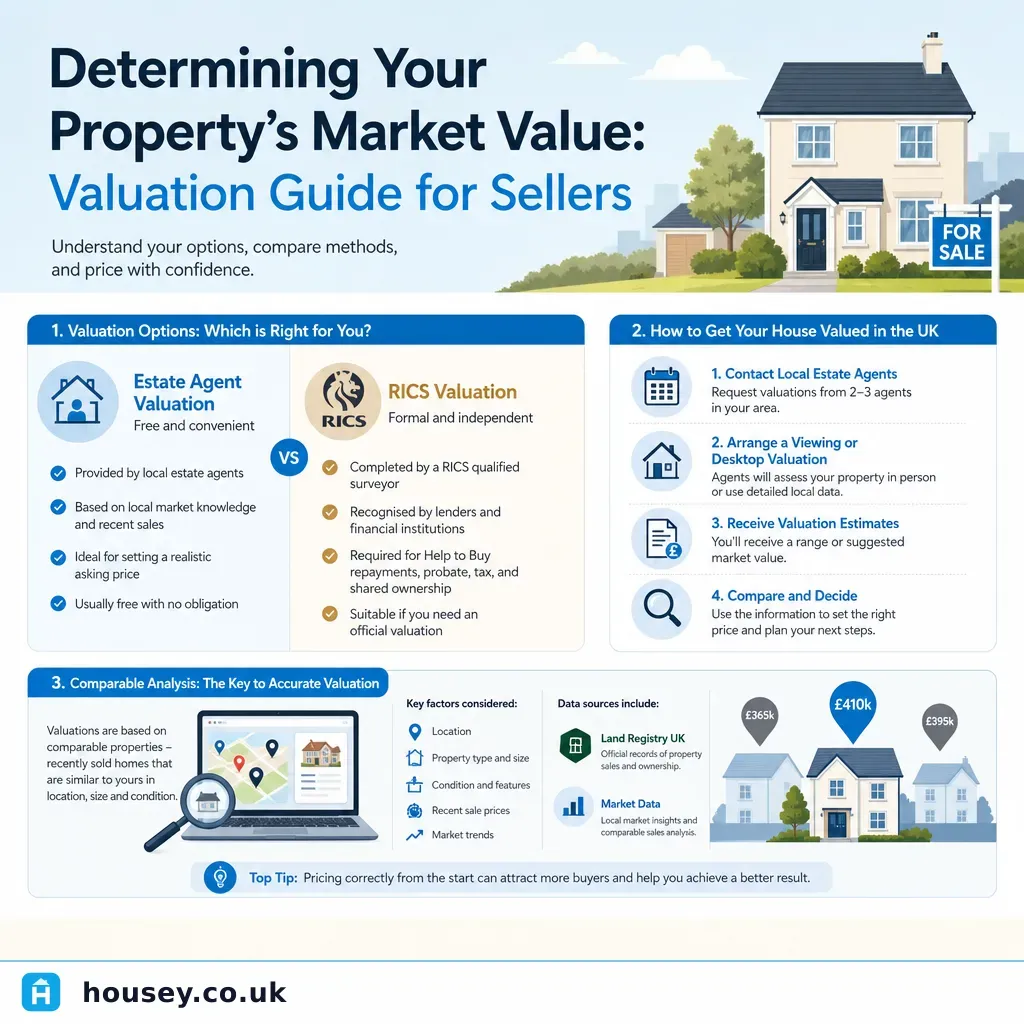 Buying & Moving
Determining Your Property's Market Value: Valuation Guide for Sellers
Market value in the UK is most reliably established by combining estate agent appraisals with your own analysis of recent sold prices on the HM Land Registry database.
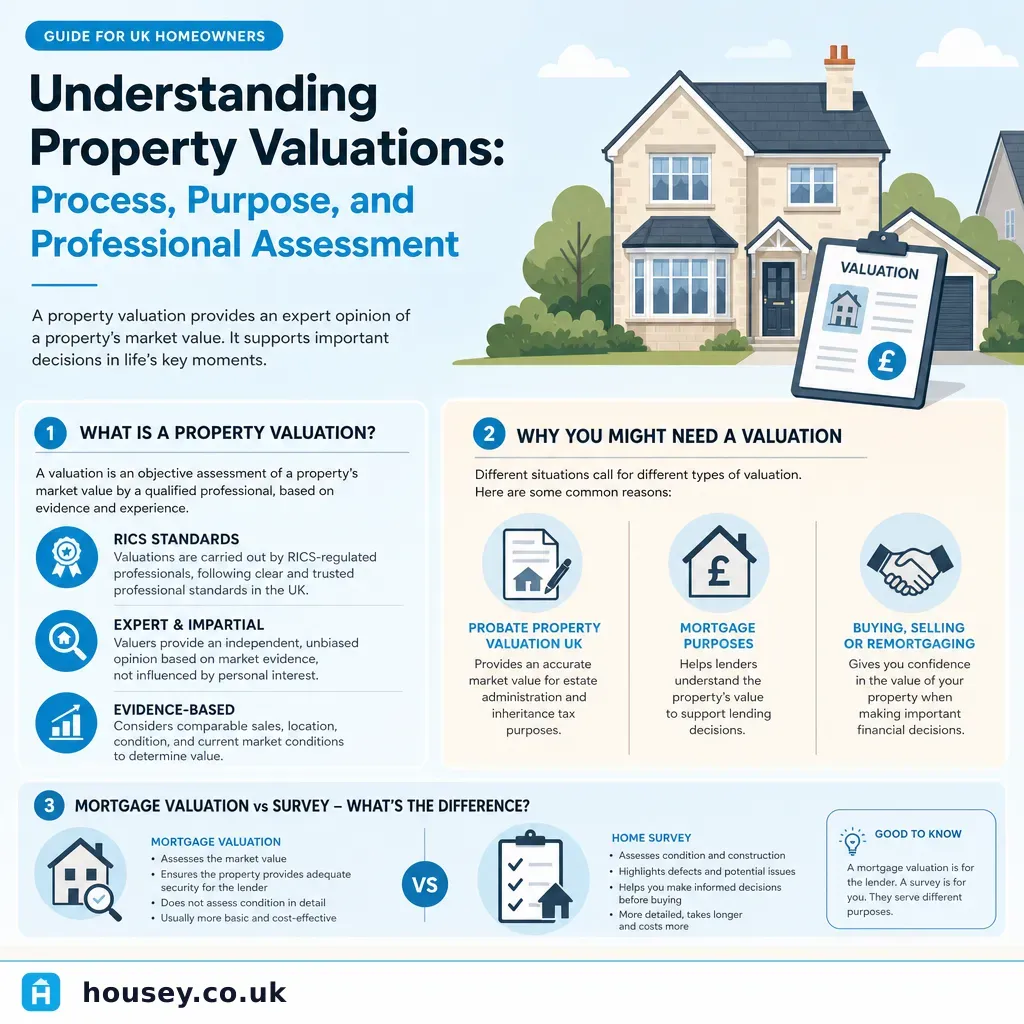 Buying & Moving
Understanding Property Valuations: Process, Purpose, and Professional Assessment
A property valuation is a professional opinion of a property's market value, carried out by a RICS Registered Valuer after a physical inspection and comparable sales analysis.
 Buying & Moving
Factors That Influence Property Valuation and Market Value
Property market value in the UK is shaped by location, floor area, structural condition, EPC rating, tenure, and recent comparable sold prices in the local area.
 Buying & Moving
Valuing Your Property for Rapid Sale: Strategic Pricing Guidance
Pricing a UK home for a quick sale means setting an asking price supported by recent comparable sales evidence — not significantly above it.
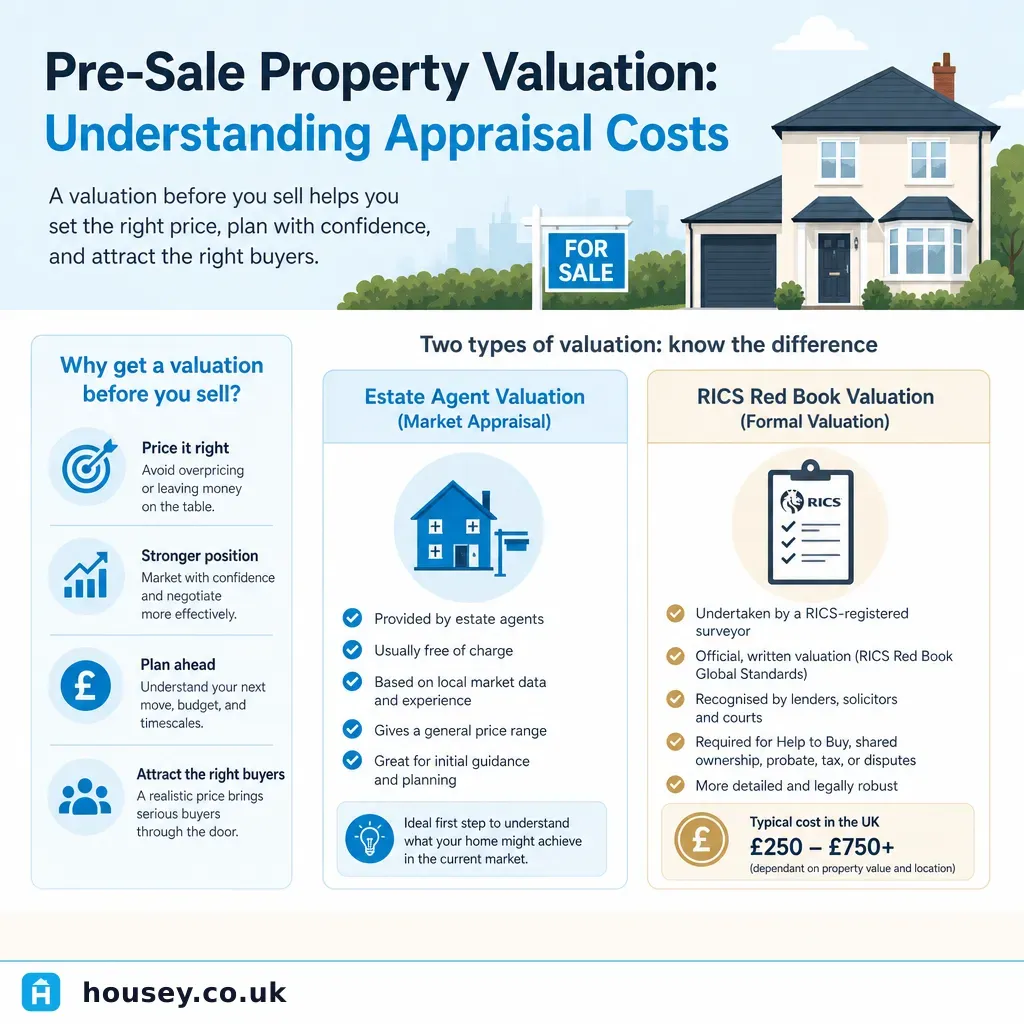 Buying & Moving
Pre-Sale Property Valuation: Understanding Appraisal Costs
Most UK sellers use free estate agent market appraisals to set an asking price.