EPC Requirements for Landlords: Legal Obligations and Compliance
By Housey · Last reviewed 30th of May 2026
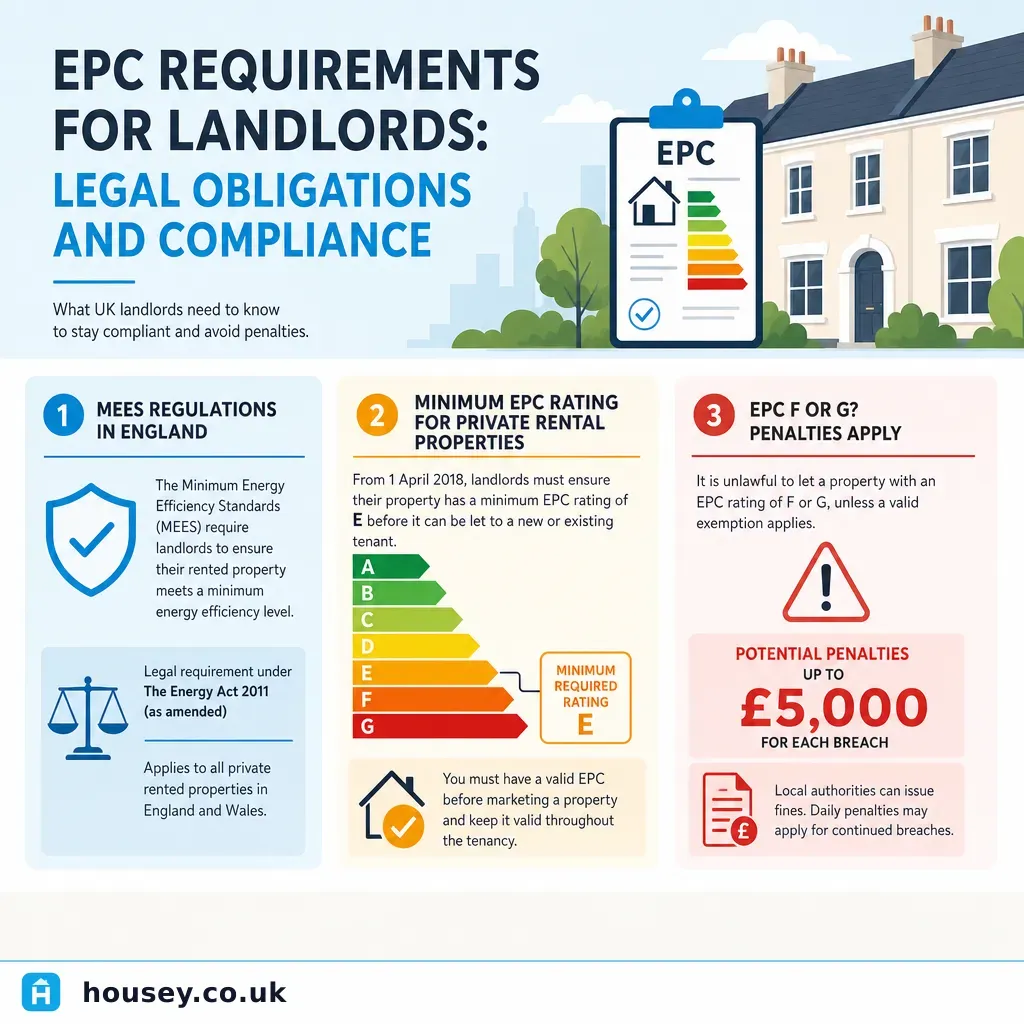
EPC Requirements for Landlords: Legal Obligations and Compliance
Every landlord in England and Wales has a legal duty to ensure their rental property meets minimum energy efficiency standards before it can be let. This requirement, introduced from 2018, sits within a regulatory framework that is widely expected to tighten further in coming years — making it one of the most consequential compliance areas for the private rented sector. Whether you let a single property or manage a portfolio, understanding exactly what is required, when it applies, and what happens if you fall short is essential groundwork.
Key points
- The Minimum Energy Efficiency Standards (MEES) regulations require all privately rented homes in England and Wales to achieve an EPC rating of E or above before they can be legally let.
- Landlords must obtain an EPC before marketing a property and provide a copy to prospective tenants before they sign a tenancy agreement.
- EPCs are valid for ten years and do not need to be renewed automatically during an active tenancy, but must be current before reletting or marketing.
- Registered exemptions on the PRS Exemptions Register can allow sub-standard properties to be let, but each exemption has strict conditions and, in most cases, a five-year limit.
- Penalties for breaching MEES can reach £4,000 per property, and enforcement notices may be published on a public register.
What the Minimum Energy Efficiency Standards (MEES) require
The Energy Efficiency (Private Rented Property) (England and Wales) Regulations 2015 set out the MEES framework. The key rules are:
- Since 1 April 2018: New tenancies (including renewals) cannot be granted for properties with an EPC rating of F or G.
- Since 1 April 2020: Existing tenancies of F or G rated properties also fell within scope, even where the tenancy pre-dated 2018.
- Tenures affected: Assured shorthold tenancies (ASTs), assured tenancies, and regulated tenancies all fall within scope. Take specialist advice if you operate under licence arrangements, as these may be treated differently.
The minimum standard is EPC band E. Properties at F or G are defined as sub-standard under the regulations.
When an EPC must be obtained and shown to tenants
An EPC must be obtained before a property is marketed for rent — there is no grace period after marketing begins. Landlords must provide a copy of the EPC to any prospective tenant when they request it, before a tenancy agreement is signed, and as part of the prescribed information for assured tenancy agreements. The EPC rating must also be included in all property advertisements on a commercial medium, including listings on portals such as Rightmove and Zoopla.
Situation | EPC required? | Notes |
|---|---|---|
New tenancy, valid EPC in place | Provide to tenant | Must be current (within ten years) |
Renewing an existing tenancy, EPC has expired | Yes — before renewal | Obtain new EPC before reletting |
Property with no prior transaction | Yes — before marketing | Obtain before listing on any portal |
Listed building where compliance would unacceptably alter character | Exemption may apply | Register exemption; obtain EPC if feasible |
Short-term holiday let (under four months per year) | No — exempt from MEES | EPC may still be required for longer lets |
Registered exemptions: when they apply and how to claim them
If your property cannot reach EPC E despite all cost-effective improvements being made, or where consent to carry out works has been refused, you may register an exemption on the PRS Exemptions Register, maintained by MHCLG.
Main exemption categories:
- Cost cap exemption: Where all relevant energy efficiency improvements would cost more than £3,500 including VAT per property and the property still cannot reach band E. You must evidence all improvements made within the cap before registering.
- Third-party consent exemption: Where a superior landlord, freeholder, or planning authority has refused consent for the required works.
- Devaluation exemption: Where written evidence from a surveyor confirms that improvements would reduce the property's market value by more than 5%.
- New landlord exemption: A temporary six-month exemption for landlords who have recently acquired a sub-standard property, for example through inheritance or repossession.
All exemptions are property-specific and landlord-specific — they are not transferable on sale. Most last five years; the new landlord exemption lasts six months.
Penalties for non-compliance
Local housing authorities (councils) are responsible for enforcing MEES in England and Wales. The penalty framework includes:
- Letting a sub-standard property: Up to £4,000 per property. The precise amount varies with the duration of the breach and the rateable value of the property — check the full penalty schedule in the MEES regulations at legislation.gov.uk.
- Providing false or misleading information on the exemptions register: Up to £1,000.
- Publication of enforcement notice: A public record of the breach, which can affect a landlord's reputation and future sale or remortgage.
Local authorities must issue a compliance notice before imposing a penalty. The enforcement window is generally 24 months following the breach.
How Scotland and Northern Ireland differ
Scotland and Northern Ireland have separate regulatory frameworks that differ materially from MEES:
- Scotland: The Energy Efficiency (Domestic Private Rented Property) (Scotland) Regulations 2020 introduced a minimum EPC D requirement for new private tenancies from 1 April 2025. A consultation on further tightening the standard is ongoing. Landlords in Scotland should consult Scottish Government guidance directly.
- Northern Ireland: There is no direct equivalent to MEES in Northern Ireland at present. Check with the Northern Ireland Housing Executive for current guidance.
- Wales: Follows the same MEES regulations as England.
Proposed future changes: the EPC C requirement
The UK government has signalled its intention to require privately rented properties in England to reach EPC C — proposed timelines have included 2028 for new tenancies and 2030 for all existing tenancies. As of the last review date of this article (2026-05-30), these requirements had not been enacted into law. Landlords should monitor GOV.UK and the Department for Energy Security and Net Zero for updates, as proposals may change before any legislation is passed.
Red flags: when you need to act now
- Your current EPC is rated F or G and you have an active tenancy — this is likely a current breach of MEES.
- Your EPC expired during an active tenancy and you are marketing the property for reletting without obtaining a new one.
- A local housing authority has issued a compliance or penalty notice.
- You are selling a tenanted property to another landlord and are unclear whether any registered exemption transfers — it does not.
- You received an improvement grant and carried out works but have not yet obtained a new EPC to confirm the updated rating and compliance status.
Important limitations
This article provides general information about EPC and MEES requirements in England and Wales as of 2026-05-30. Regulations vary across England, Wales, Scotland, and Northern Ireland. Exemption eligibility depends on individual property and landlord circumstances. Rules around leasehold properties, houses in multiple occupation (HMOs), listed buildings, and commercial-to-residential conversions can differ significantly. Nothing in this article constitutes legal advice. Take professional advice from a solicitor, licensed property agent, or accredited energy assessor for your specific situation.
When this becomes urgent
Seek professional help promptly if:
- A tenant, local authority, or solicitor has raised concerns about EPC compliance for your property.
- You are planning to let a property with no current EPC or an expired certificate.
- You are considering registering a MEES exemption and are unsure whether your evidence meets the required standard.
- You are in the process of buying or selling a tenanted property and need to understand how MEES obligations transfer between landlords.
What to ask a qualified professional
Before instructing an energy assessor, solicitor, or property compliance adviser, ask:
- Is my current EPC accurate? Do I need a reassessment before committing to improvement works?
- Which improvements are most cost-effective for reaching EPC E — or EPC C, if planning ahead for proposed future requirements?
- Does my situation qualify for any MEES exemptions, and what evidence will I need to submit to the PRS Exemptions Register?
- Are there any leaseholder, freeholder, or planning consent issues I should resolve before starting works?
- Are there ECO4, GBIS, or local authority grant schemes I could access to reduce the cost of improvements?
- How will proposed future changes to the minimum standard affect my portfolio planning?
How Housey can help
If you need a new or updated Energy Performance Certificate, Housey can connect you with accredited local energy assessors. Find and compare specialists through our EPC service.
Frequently asked questions
What EPC rating do I need to legally rent out a property in England?
Your property must achieve an EPC rating of E or above to be legally let under MEES in England and Wales. Properties rated F or G are classified as sub-standard and cannot be let without a valid exemption registered on the PRS Exemptions Register. Letting a sub-standard property without a registered exemption is a breach of the regulations.
How long does an EPC last for a rental property?
An EPC is valid for ten years from the date it was issued. You do not need to renew it automatically during an active tenancy, but you must have a current unexpired certificate before reletting or marketing the property. Carrying out energy improvements and commissioning a new EPC will reflect the updated rating and support compliance evidence.
What happens if I rent out a property with an F or G EPC rating?
Letting an F or G rated property without a registered exemption is a breach of the MEES regulations. The local housing authority can issue a compliance notice and impose a financial penalty of up to £4,000 per property. A record of the enforcement notice may also be published on a public register.
Can I claim an exemption if the required improvements cost too much?
Yes. If all relevant energy efficiency improvements would cost more than £3,500 including VAT and the property still cannot reach EPC E, you may register a cost cap exemption on the PRS Exemptions Register. You must carry out all improvements within the cap first, and submit evidence of costs and works completed.
Do EPC and MEES rules differ in Scotland?
Yes. Scotland operates under the Energy Efficiency (Domestic Private Rented Property) (Scotland) Regulations 2020. From 1 April 2025, new private tenancies in Scotland must meet a minimum EPC D standard. Landlords with Scottish properties should consult Scottish Government guidance directly, as the regulatory framework differs materially from England and Wales.
Sources and further reading
- The Energy Efficiency (Private Rented Property) (England and Wales) Regulations 2015 — legislation.gov.uk
- Domestic private rented property: minimum energy efficiency standard — landlord guidance — GOV.UK
- PRS Exemptions Register — GOV.UK
- Energy Performance of Buildings Register — Department for Energy Security and Net Zero
- Scottish Government: energy efficiency in private rented housing — Scottish Government
Useful next reads
 Buying & Moving
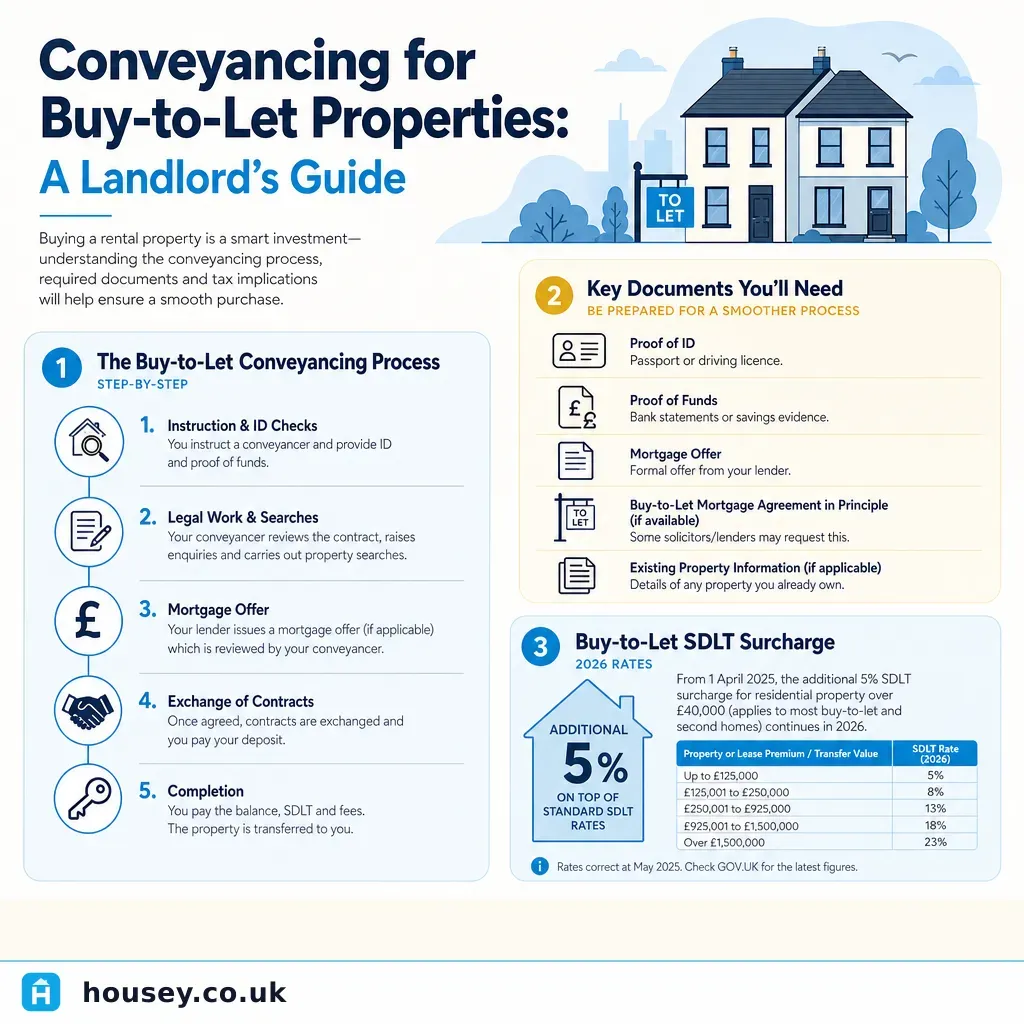
Conveyancing for Buy-to-Let Properties: A Landlord's Guide
Buy-to-let conveyancing follows the same legal process as any residential purchase but adds several layers: a 5% SDLT additional dwelling surcharge in England, review of any existing tenancy agreements, checking local authority licensing requirements, and ensuring buy-to-let mortgage conditions are correctly recorded.
 Buying & Moving
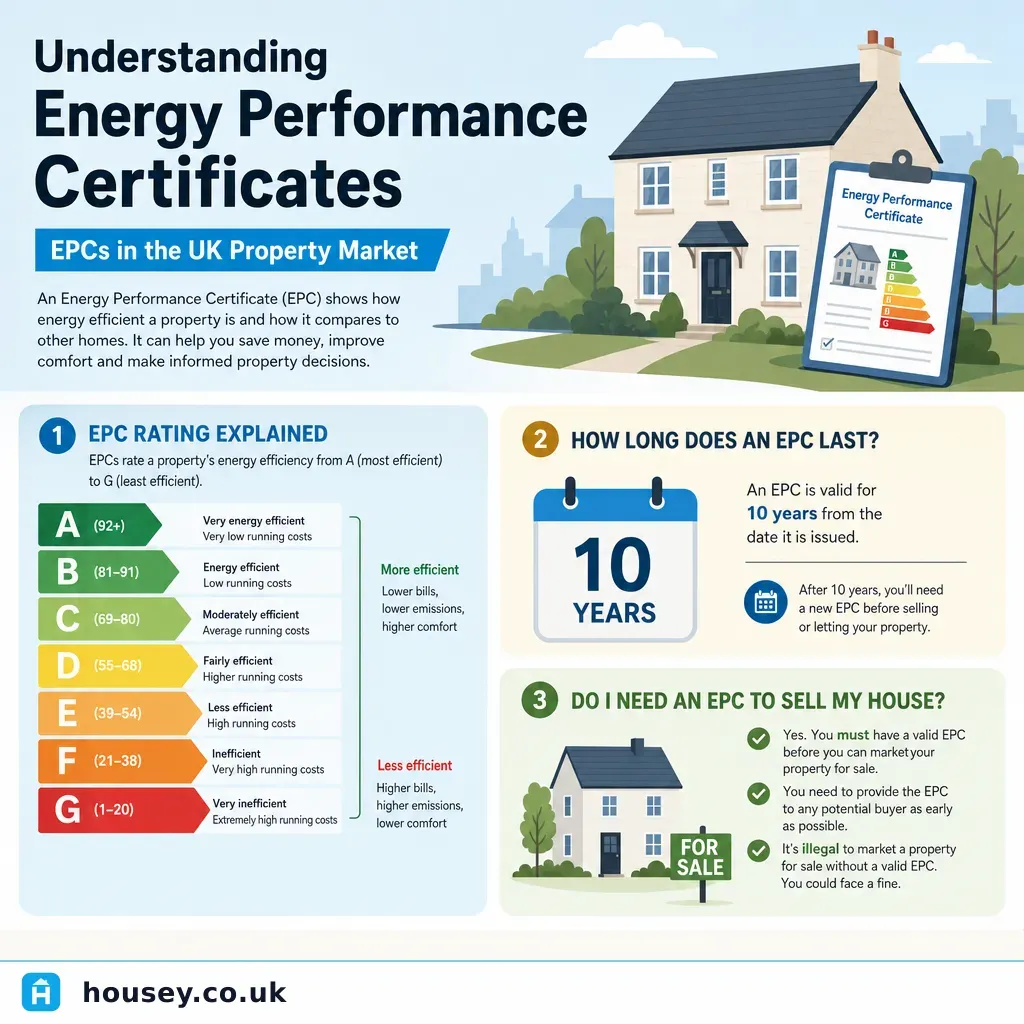
Understanding Energy Performance Certificates: EPCs in the UK Property Market
An Energy Performance Certificate (EPC) rates a property's energy efficiency on a scale from A (most efficient) to G (least efficient).
 Buying & Moving
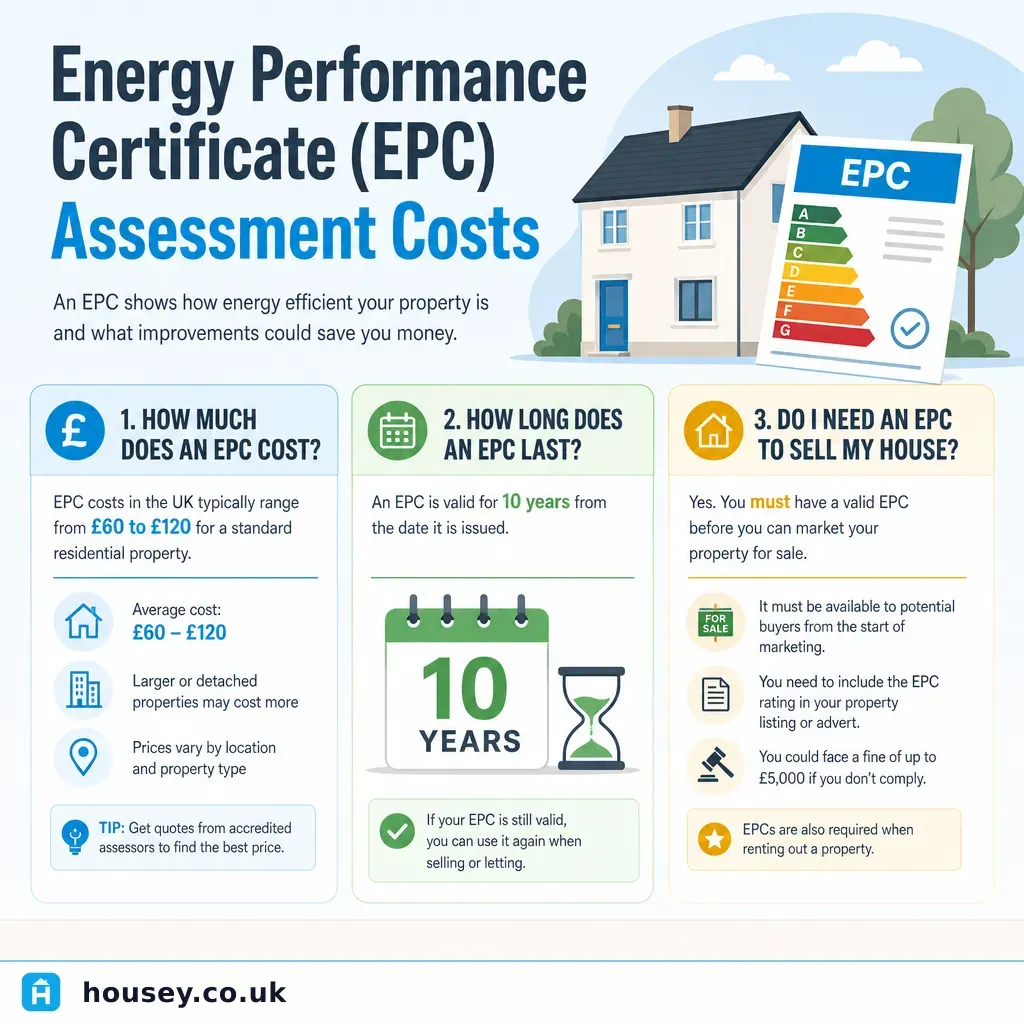
Energy Performance Certificate (EPC) Assessment Costs
An EPC typically costs between £60 and £120 for a standard UK home, though prices vary by property size and assessor.
 Buying & Moving
EPC Exemptions and Circumstances: When Energy Certificates Are Not Required
An EPC is not required for listed buildings where energy measures would unacceptably alter their character, standalone buildings under 50 m², places of worship, certain temporary structures, and holiday lets occupied for less than four months per year.
 Buying & Moving
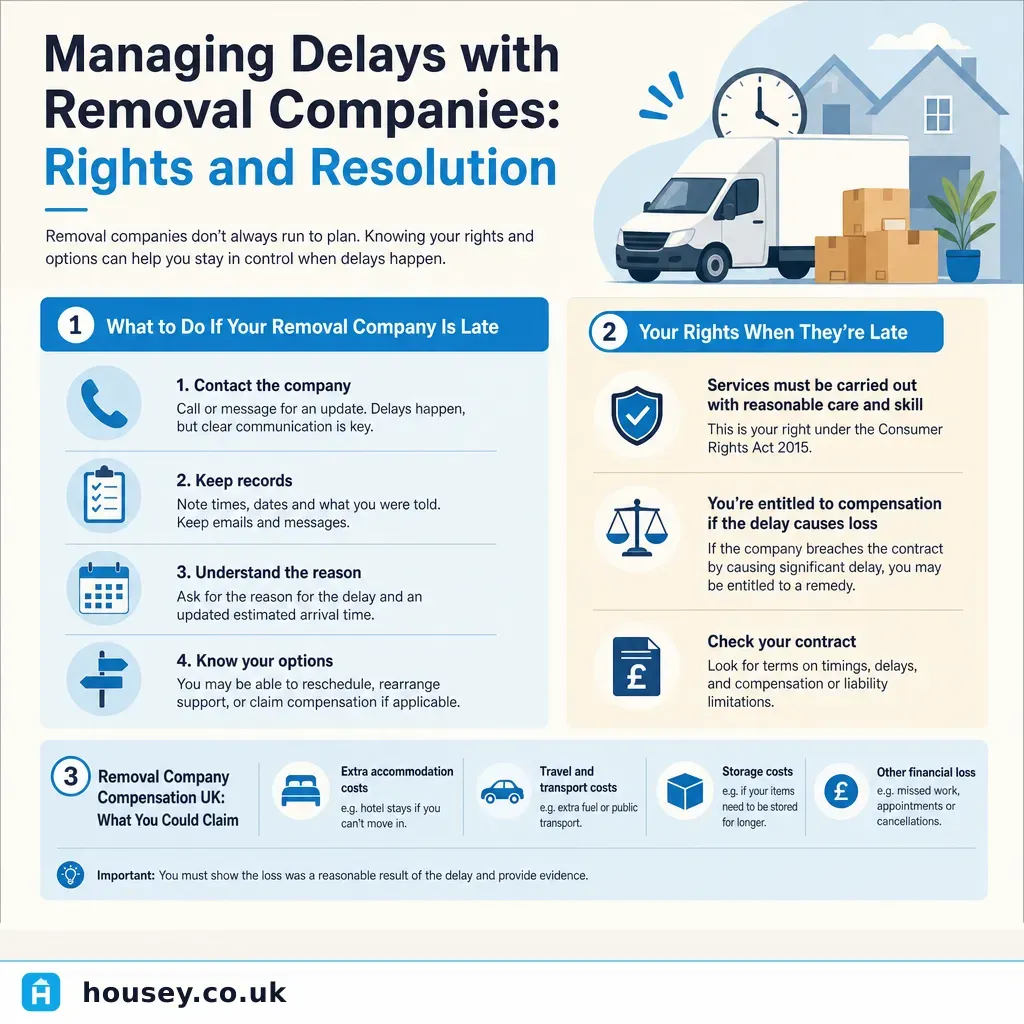
Managing Delays with Removal Companies: Rights and Resolution
If a removal company is late, your rights depend on your contract and whether the company is BAR-registered.