EPC Exemptions and Circumstances: When Energy Certificates Are Not Required
By Housey · Last reviewed 30th of May 2026

EPC Exemptions and Circumstances: When Energy Certificates Are Not Required
Energy Performance Certificates (EPCs) have been a legal requirement in England and Wales since 2008, yet several genuine exemptions exist that are poorly understood by sellers, landlords, and letting agents alike. Knowing whether an exemption legitimately applies to your property can avoid unnecessary cost — a standard domestic EPC typically costs £50–£120 (indicative cost, last reviewed 2026-05-30) — but incorrectly claiming an exemption when one does not apply can expose a landlord or seller to civil penalties and, for rental properties, create complications around tenancy validity.
Key points
- An EPC is required whenever a property is marketed for sale or let in England, Wales, or Scotland; the duty arises at the point of marketing, not at exchange or completion.
- Listed buildings may be exempt from EPC requirements if the energy improvement measures required would unacceptably alter their character or appearance — this is a conditional test, not an automatic exemption.
- Standalone buildings with a total useful floor area of less than 50 m² are exempt from EPC requirements.
- An EPC remains valid for ten years from the date of issue; if a valid certificate already exists on the official EPC register, a new one is not required when selling or letting.
- Failure to have a valid EPC in place when one is required can result in a civil penalty of up to £200 per dwelling in England and Wales.
The legal framework
EPC requirements in England and Wales are set out in the Energy Performance of Buildings (England and Wales) Regulations 2012, as amended. Scotland operates under the Energy Performance of Buildings (Scotland) Regulations 2008. Northern Ireland has separate legislation. The requirement applies to most buildings being sold, let, or constructed. A defined set of exemptions sits alongside the general requirement — understanding which applies, and under what conditions, matters for both sellers and landlords.
EPC exemptions at a glance
Exemption category | When it applies | Key caveat |
|---|---|---|
Listed buildings | The building is listed AND energy measures required would unacceptably alter its character or appearance | Not automatic — the character/appearance test must be applied; seek heritage or conservation advice |
Very small standalone buildings | Total useful floor area below 50 m² | Applies to standalone structures only, not individual rooms within a larger property |
Temporary buildings | Planned use of two years or less | Must be genuinely temporary; construction site offices are the typical example |
Low energy demand premises | Industrial sites, workshops, and non-residential agricultural buildings with low energy demand | Does not apply to farmhouses or any residential accommodation |
Places of worship | Used solely as a place of worship or for religious activities | Does not extend to residential or commercial parts of the same building |
Holiday accommodation (specific conditions) | Occupied for less than four months per year OR expected energy use less than 25% of year-round occupancy | Narrower than most landlords assume — see below |
Valid existing certificate | A certificate is on the EPC register and has not expired | Check the register before commissioning a new assessment |
The listed building exemption in detail
The listed building exemption is the most frequently misunderstood EPC exemption in practice. Many owners assume their listed property is automatically exempt. It is not.
The Energy Performance of Buildings (England and Wales) Regulations 2012 provide that a listed building may be exempt where compliance with minimum energy performance requirements would "unacceptably alter the character or appearance" of the building. This is a conditional test — not a blanket exclusion — applied to the specific property and the specific measures being considered.
If standard measures such as draught-proofing, accessible loft insulation, or modern heating controls can be installed without unacceptably affecting the building's character, the exemption may not apply. Where fitting secondary glazing in original sash windows or applying external insulation to a Georgian terrace would require listed building consent and materially alter the building's appearance, the exemption may be justified.
Historic England's guidance on energy efficiency in traditional buildings is a useful starting point. Your local planning authority's conservation officer can advise on whether the character/appearance test is met for your property.
The holiday let exemption: assumptions vs reality
This exemption is regularly misapplied, particularly by short-term and holiday let landlords.
Common assumption | What the regulations actually say |
|---|---|
Any holiday cottage is automatically exempt | Only if occupied for less than four months per year OR expected energy use is less than 25% of year-round occupancy |
Airbnb listings are automatically exempt | A property available year-round on a short-term platform almost certainly does not qualify |
Furnished Holiday Let tax status means no EPC is needed | FHL status for income tax is entirely separate from EPC exemption — the two are unrelated |
A second home I occasionally rent out is exempt | If marketed for let for more than four months per year, an EPC is very likely required |
If your holiday let does qualify, document the basis clearly — for example, with booking records confirming less than four months' total occupancy per year — in case it is queried by a local authority.
Checking whether a valid EPC already exists
An EPC is valid for ten years from its date of issue. If a valid certificate is already on the official register, you are not required to commission a new one when selling or letting — even if the property has changed hands since the assessment.
How to check the EPC register
MEES exemptions: a separate regime
The Minimum Energy Efficiency Standards (MEES), under the Energy Efficiency (Private Rented Property) (England and Wales) Regulations 2015, require most privately rented dwellings to have an EPC rating of at least E. Properties rated F or G cannot legally be let without a registered MEES exemption on the PRS Exemptions Register.
MEES exemptions are separate from EPC exemptions and include:
- High cost exemption: total cost of improvements to reach band E exceeds £3,500 after available funding
- All improvements made: all recommended measures installed and property still cannot reach band E
- Third-party consent: a freeholder, lender, or tenant has refused consent for improvement works
- Listed building: measures would unacceptably alter character or appearance
- New landlord: temporary six-month exemption following certain property acquisition events
MEES exemptions must be formally registered on the government's PRS Exemptions Register — they are not self-certifying. Penalties for non-compliance can reach £5,000 per property.
What not to assume
- Do not assume a listed building is automatically exempt — the character/appearance test must be applied on a case-by-case basis; assumptions without conservation advice can be incorrect.
- Do not assume a holiday let is exempt — the four-months-per-year threshold is stricter than most owners realise, and availability on short-term rental platforms does not qualify by default.
- Do not assume a previous owner's EPC has expired — check the register; it may still be valid and save the cost of a new assessment.
- Do not confuse MEES exemptions with EPC exemptions — they are separate regimes with separate registers, penalties, and processes.
- Do not assume identical rules apply across England, Wales, Scotland, and Northern Ireland — the legislative frameworks differ in certain respects; check the applicable regulations for your jurisdiction.
When to get professional help
If you are uncertain whether an exemption applies before marketing your property, seek advice rather than assuming:
- Speak to a qualified domestic energy assessor (DEA) who can advise whether an EPC is required and give a preliminary indication of the likely rating
- Contact your local planning authority's conservation officer if you own a listed building and are unsure whether the character/appearance test is met
- For rental properties rated F or G, consult a specialist energy consultant about MEES compliance options before reletting
- Seek legal advice for complex commercial, mixed-use, or unusual buildings where exemption criteria are less clear-cut
Housey connects you with accredited assessors who can advise on EPC requirements and assessments for your property.
How Housey can help
If you need to check whether an EPC is required or commission a new certificate, Housey connects you with accredited domestic energy assessors in your area. Request quotes for an EPC assessment through the platform and compare fees and availability from accredited professionals before marketing your property.
Frequently asked questions
Is a listed building automatically exempt from needing an EPC?
No. Listed buildings may qualify for an EPC exemption, but only where the energy measures required to meet minimum performance standards would unacceptably alter the building's character or appearance. This is a conditional test, not a blanket exclusion. If standard improvements such as draught-proofing can be installed without affecting character, an EPC may still be required. Consult your local planning authority's conservation officer.
My property already has an EPC from the previous owner — do I need a new one?
Not if the existing certificate is within its ten-year validity period. Check the official EPC register at gov.uk/find-energy-certificate. If valid, it can be used when selling or letting without a new assessment. If major works have been carried out since the assessment, a new EPC is not legally required while the original remains valid, but may be worth obtaining to reflect an improved rating.
Are short-term holiday lets on platforms like Airbnb exempt from EPC requirements?
Not automatically. The exemption applies only where the property is occupied for less than four months per year or where expected annual energy consumption is less than 25% of a year-round dwelling. A property listed as available throughout the year on a short-term rental platform is unlikely to qualify. Furnished Holiday Let tax status has no bearing on EPC exemption.
What is the penalty for not having an EPC when one is required?
In England and Wales, a local authority can issue a civil penalty of up to £200 per dwelling for failure to have a valid EPC when marketing for sale or rent. Commercial properties face higher penalties based on rateable value. There is no criminal liability for this specific breach, but it can complicate a sale or create issues in a tenancy.
Sources and further reading
- Energy Performance of Buildings (England and Wales) Regulations 2012 — legislation.gov.uk
- EPC register — find an energy certificate — GOV.UK
- GOV.UK guidance: energy performance certificates — GOV.UK
- MEES and PRS Exemptions Register — landlord guidance — GOV.UK
- Historic England: energy efficiency in traditional buildings — Historic England
- Energy Saving Trust: home energy ratings — Energy Saving Trust
Useful next reads
 Buying & Moving
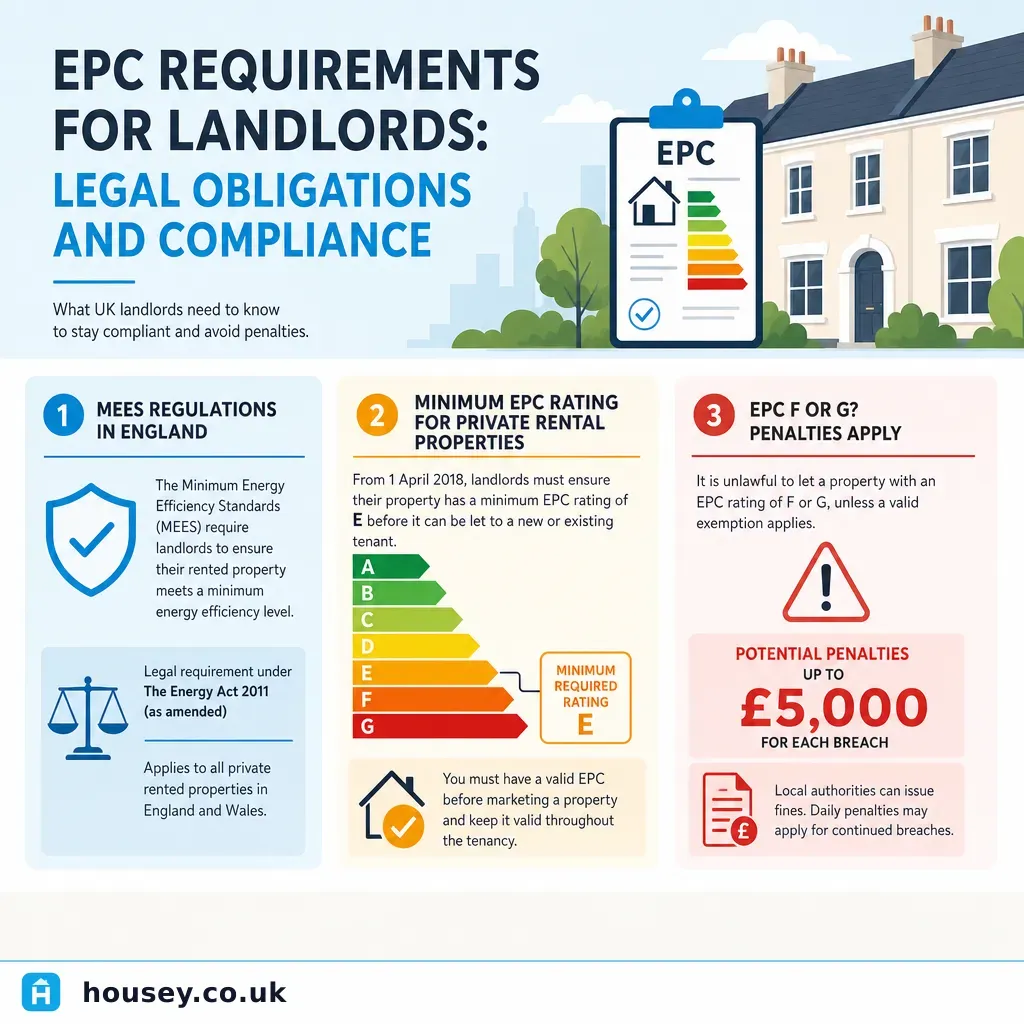
EPC Requirements for Landlords: Legal Obligations and Compliance
Landlords in England and Wales must ensure privately rented properties achieve a minimum EPC rating of E before letting.
 Buying & Moving
What Do EPC Ratings Tell You? Understanding Energy Performance Certificates When Buying Property
An Energy Performance Certificate (EPC) rates a property from A (most efficient) to G (least efficient) using a score out of 100, based on estimated energy costs, insulation, heating systems, and carbon emissions.
 Buying & Moving
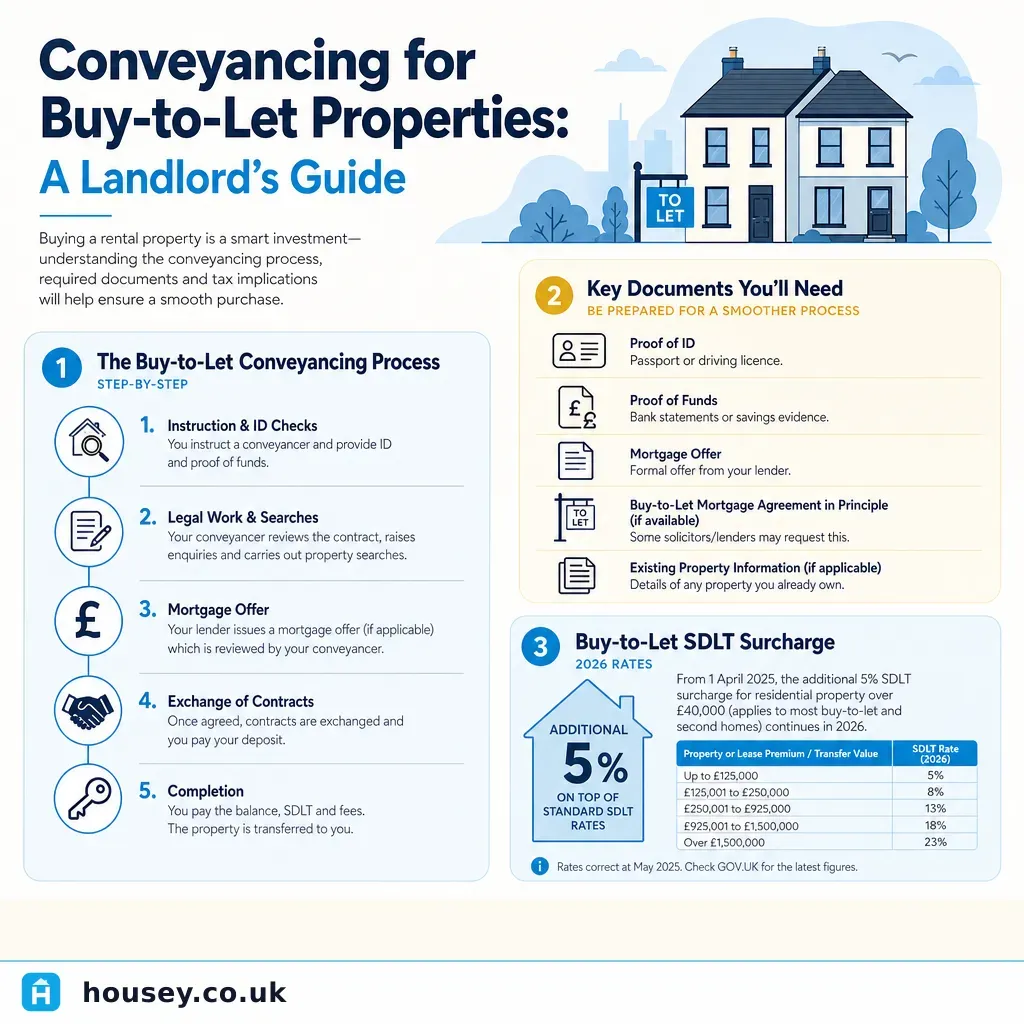
Conveyancing for Buy-to-Let Properties: A Landlord's Guide
Buy-to-let conveyancing follows the same legal process as any residential purchase but adds several layers: a 5% SDLT additional dwelling surcharge in England, review of any existing tenancy agreements, checking local authority licensing requirements, and ensuring buy-to-let mortgage conditions are correctly recorded.
 Buying & Moving
Property Terminology and Listing Definitions: Buyer's Reference Guide
UK property listings and conveyancing documents use specific terms that affect buying decisions.
 Buying & Moving
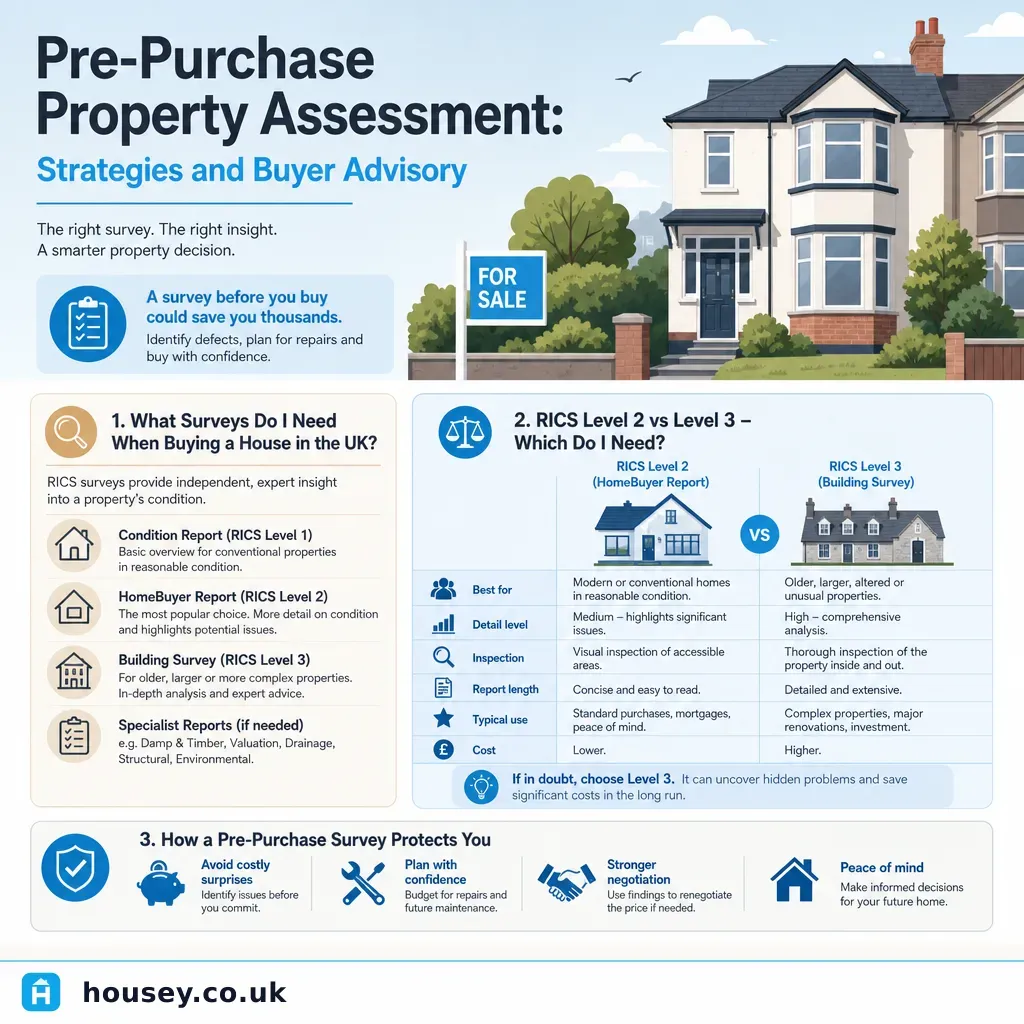
Pre-Purchase Property Assessment: Strategies and Buyer Advisory
A pre-purchase property assessment in the UK typically combines an independent RICS Home Survey, conveyancing searches, and specialist inspections for damp or electrical condition where needed.