Essential Actions for New Homeowners in Their First Year
By Housey · Last reviewed 11th of May 2026

Essential Actions for New Homeowners in Their First Year
The weeks immediately after completing on a property are dominated by removals, paperwork, and the practical chaos of moving in. But the months that follow carry their own obligations and risks that many first-time and repeat buyers underestimate. Whether you have just collected the keys to a 1930s semi-detached, a Victorian terrace, or a modern new-build, the first twelve months are when you learn how the property behaves across seasons, discover what the previous owners may have left undisclosed, and build the maintenance habits that protect your investment over the long term.
Key points
- The Health and Safety Executive strongly advises owner-occupiers to arrange a Gas Safe registered engineer inspection on any property where the installation history is unknown; there is no legal obligation to do this annually as an owner-occupier, but most boiler warranties require annual servicing to remain valid.
- An Electrical Installation Condition Report (EICR) by a NICEIC or NAPIT registered electrician is strongly recommended within the first year for any property more than ten years old, or where no recent test record exists.
- Buildings insurance typically becomes the buyer's liability at exchange of contracts, not completion — confirm your rebuild value is correct and that any unusual construction features (timber frame, non-standard masonry, outbuildings) are declared.
- The Smoke and Carbon Monoxide Alarm (Amendment) Regulations 2022 set minimum standards for rented homes; owner-occupiers should follow the same benchmark: working smoke alarms on every storey and CO alarms in every room with a fixed combustion appliance.
- Completion certificates for previous extensions, FENSA or CERTASS certificates for replacement windows, and NAPIT or NICEIC certificates for electrical installation work are significantly easier to locate or obtain retrospectively in the first few months, before documentation trails go cold.
Immediate priorities: the first four weeks
Gas
Locate the gas meter and the emergency shut-off valve — usually a lever or handle next to the meter. Check the boiler for a service sticker showing the last service date. If no record exists, or the last service was more than twelve months ago, arrange a Gas Safe registered engineer inspection promptly. Fit carbon monoxide alarms in every room containing a gas appliance; these are inexpensive and potentially life-saving. Register the boiler's warranty — many manufacturers require registration within 30 days of installation for the warranty to remain valid.
Electrics
Open the consumer unit and check whether RCD (residual current device) or RCBO protection is present. Older rewirable-fuse boards carry a significantly higher risk profile than modern units. If no recent EICR is available, instruct a NICEIC or NAPIT registered electrician. In Scotland, the Tolerable Standard under the Housing (Scotland) Act 1987 applies broader electrical safety criteria.
Smoke and CO alarms
Test every existing alarm in the property. Replace any that are beyond their ten-year service life (the date is printed on the rear) or have flat batteries. The minimum standard applied to rented homes under the Smoke and Carbon Monoxide Alarm (Amendment) Regulations 2022 — smoke alarms on every floor, CO alarms in every room with a fixed combustion appliance — is a practical benchmark for owner-occupiers.
Security
Change all external door locks and window key locks on day one. Obtain and update any key-safe codes. Ask your solicitor whether spare keys or access arrangements were disclosed by the previous owner in the sale documentation.
Administrative and legal tasks: first three months
Task | Why it matters | Action |
|---|---|---|
Confirm buildings and contents insurance | Exchange creates the obligation; check the rebuild value, not the market value | Contact your insurer or broker |
Register on the electoral roll | Voting rights; also affects your credit file | GOV.UK electoral roll registration or your local council |
Notify DVLA | Driving licence and V5C (vehicle log book) must show your current address | DVLA online service |
Inform HMRC | Ensures tax correspondence and PAYE codes reach you | HMRC online account |
Redirect post | Prevents sensitive mail reaching previous occupants | Royal Mail Redirection service |
Check HM Land Registry title | Confirm registration is complete; check for outstanding charges or restrictions | HM Land Registry search portal |
Review planning history | Understand what works have been approved or refused on the property | Your local planning authority's online planning search |
Gather missing certificates | Building Regulations completion certificates, FENSA or CERTASS window certificates, NAPIT or NICEIC electrical certificates | Previous owner's solicitor, local authority building control |
Register appliance warranties | Many warranties lapse if not registered within 30 days of installation | Each manufacturer directly |
A worked UK property scenario
Situation: A couple buy a 1965 semi-detached in Leicester. The property has no EICR on record, the boiler service sticker shows 2021, and a rear extension built around 2003 has no Building Regulations completion certificate.
Month 1: A Gas Safe registered engineer services the boiler and identifies a minor flue seal deterioration — repaired at low cost. Carbon monoxide alarms are fitted throughout.
Month 2: A NICEIC-registered electrician issues an EICR with a C2 (potentially dangerous) observation for an ageing shower circuit — remediated and retested within the same week.
Month 3: The solicitor contacts the previous owner's solicitor. A search with the local authority building control reveals the extension has only partial sign-off. An independent building surveyor inspects and recommends minor remedial works to the flat-roof junction with the main house.
Outcome: Total cost for safety and documentation work: approximately £1,200–£1,800 (indicative, last reviewed 2026-05-11). The equivalent cost of discovering the same issues during a future sale — through delayed exchange, price renegotiation, or insurance disputes — is typically far higher.
The first year: a seasonal maintenance checklist
Spring (April–June)
- Inspect roof tiles and ridge from ground level using binoculars; arrange a roofer for displaced or cracked tiles before summer conceals slow leaks.
- Clear gutters and downpipes of debris accumulated over winter.
- Check external timber — fascias, soffits, window frames, and garden gates — for peeling paint or soft wood; treat or replace before moisture ingress worsens.
- Inspect the loft for daylight gaps at eaves and verify insulation depth; Building Regulations Part L sets minimum thermal performance standards for new work.
Summer (July–September)
- Monitor clay soil areas close to the property during dry spells for ground shrinkage; note any new cracking in walls or sticking of doors and windows, which can indicate foundation movement.
- Arrange a chimney sweep if you plan to use a solid-fuel stove or open fire in winter; use a HETAS-registered sweep for solid fuel, or Gas Safe for gas fires.
- Obtain quotes for autumn works — roofers, drainage contractors, and decorators typically book up quickly before the wet season.
Autumn (October–November)
- Bleed radiators; check the boiler's pressure gauge (normally 1–1.5 bar cold); arrange the annual boiler service before peak demand season.
- Lag exposed pipework in the garage, loft, and against external walls; locate the internal stopcock so you can isolate the water supply quickly if a pipe bursts.
- Clear gutters again after leaf fall.
Winter (December–March)
- Know how to turn off gas, electricity, and water at the mains before an emergency arises.
- Keep the property above 10°C even when unoccupied to prevent frozen pipes.
- Note persistent condensation on walls rather than cold glass — this may indicate inadequate insulation or ventilation worth investigating before mould develops.
What not to assume as a new homeowner
- Do not assume a new-build is defect-free. New-build properties regularly have snagging issues; instruct a specialist snagging inspector before your NHBC Buildmark first-year inspection stage closes.
- Do not assume completion certificates exist for loft conversions, extensions, or electrical installation work carried out by previous owners. Ask your conveyancer during the purchase process if possible, and resolve gaps promptly after moving in.
- Do not assume your survey identified everything. A RICS Level 2 or Level 3 Home Survey is a visual inspection on a single day; it does not test electrics, gas, drains, or concealed construction.
- Do not assume buildings insurance covers all scenarios. Check policy exclusions for subsidence, flooding, and non-standard construction materials before you need to make a claim.
- Do not wait for a problem to appear before servicing the boiler. Annual servicing is far less expensive than an emergency replacement, and a Gas Safe engineer checks the flue, pressure relief valve, and carbon monoxide output at the same time.
When to get professional help
Call a qualified professional rather than relying on a general checklist if you observe any of the following:
- Gas smell, a yellow or orange boiler flame, or unexplained headaches — call the Gas Emergency Service on 0800 111 999 immediately and do not operate any electrical switches.
- Stepped or diagonal cracking in external brickwork, particularly if widening over weeks or months — ask a chartered building surveyor or structural engineer to inspect.
- Persistent damp or mould that does not resolve with improved heating and ventilation — may indicate rising damp, penetrating damp, or a ventilation deficiency requiring professional diagnosis.
- Tripping circuit breakers or flickering lights — instruct a NICEIC or NAPIT registered electrician before using the affected circuits.
How Housey can help
Housey connects new homeowners with vetted professionals across the safety and inspection services you are most likely to need in year one. You can request a gas safety certificate check, commission an Electrical Installation Condition Report (EICR), book a post-purchase RICS home survey if a condition concern has emerged since completion, or arrange a structural survey where movement or defects have been flagged. Use the Housey quote comparison dashboard to review proposals before instructing.
Frequently asked questions
Do I legally have to get a gas safety check as an owner-occupier?
As an owner-occupier rather than a landlord, the Gas Safety (Installation and Use) Regulations 1998 do not require an annual check. However, the Health and Safety Executive strongly advises one where the installation history is unknown. Many boiler warranties also require annual servicing to remain valid. The cost of a Gas Safe inspection is low relative to the risk of an uninspected appliance.
What is an EICR and how often should I get one as a homeowner?
An Electrical Installation Condition Report (EICR) is a formal inspection and test of a property's fixed electrical installation by a registered electrician. It assesses whether wiring, the consumer unit, and circuits are safe and comply with current standards. For owner-occupiers there is no mandatory frequency, but every five to ten years is commonly recommended — or sooner on moving into a property with no recent test record.
What happens if a defect was not mentioned in my survey?
If a defect was visible at the time of inspection and not reported, you may have grounds to raise it with the surveyor. RICS-registered surveyors are bound by professional standards and complaints can be escalated to RICS. However, surveys are visual inspections and cannot identify concealed defects — review the limitations section of your report carefully before forming a view.
Should I get a snagging survey on a new-build?
Yes, a professional snagging inspection before legal completion — or within the first two years when the builder is typically liable under the NHBC Buildmark warranty — is widely advised. Inspectors can identify hundreds of minor defects, from gaps in sealant to missing insulation, that builders should remedy at no cost to you before the relevant warranty stage closes.
Sources and further reading
- Gas Safety (Installation and Use) Regulations 1998 — legislation.gov.uk
- Smoke and Carbon Monoxide Alarm (Amendment) Regulations 2022 — GOV.UK
- Search the property information register — HM Land Registry
- Gas safety: guidance for homeowners — Health and Safety Executive
- What is an electrical installation condition report? — Electrical Safety First
Useful next reads
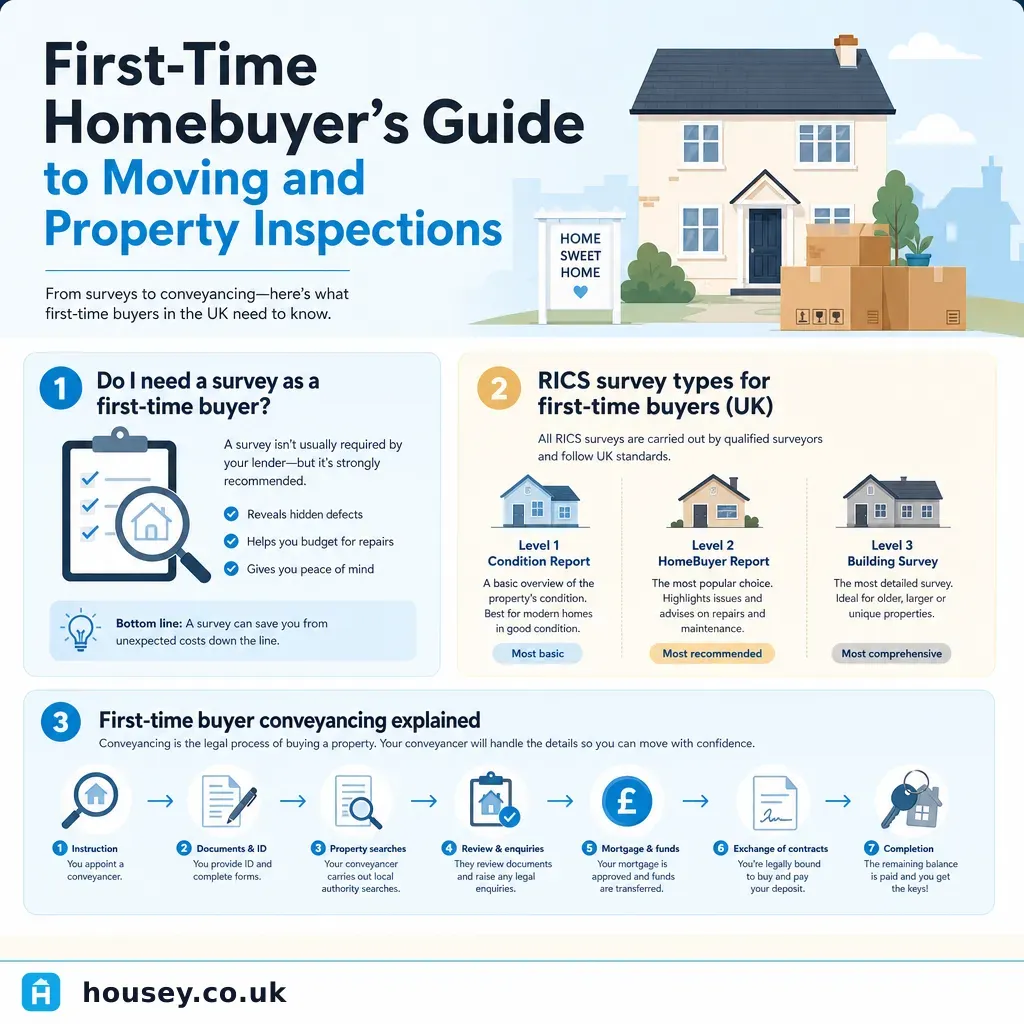 Buying & Moving
First-Time Homebuyer's Guide to Moving and Property Inspections
First-time buyers in the UK should know that a lender's mortgage valuation is not a property survey and does not protect the buyer.
 Buying & Moving
First-Time Homebuyer: Essential Guidance for UK Property Purchase
Buying your first home in the UK involves securing a mortgage in principle, making an offer, instructing a solicitor for conveyancing, commissioning a RICS Home Survey, then exchanging and completing contracts.
 Buying & Moving
Essential guidance for first-time property owners in the UK
As a new UK homeowner, your first responsibilities are buildings insurance from exchange, utility transfers, council tax registration, and gathering key documents including the title register and EPC.
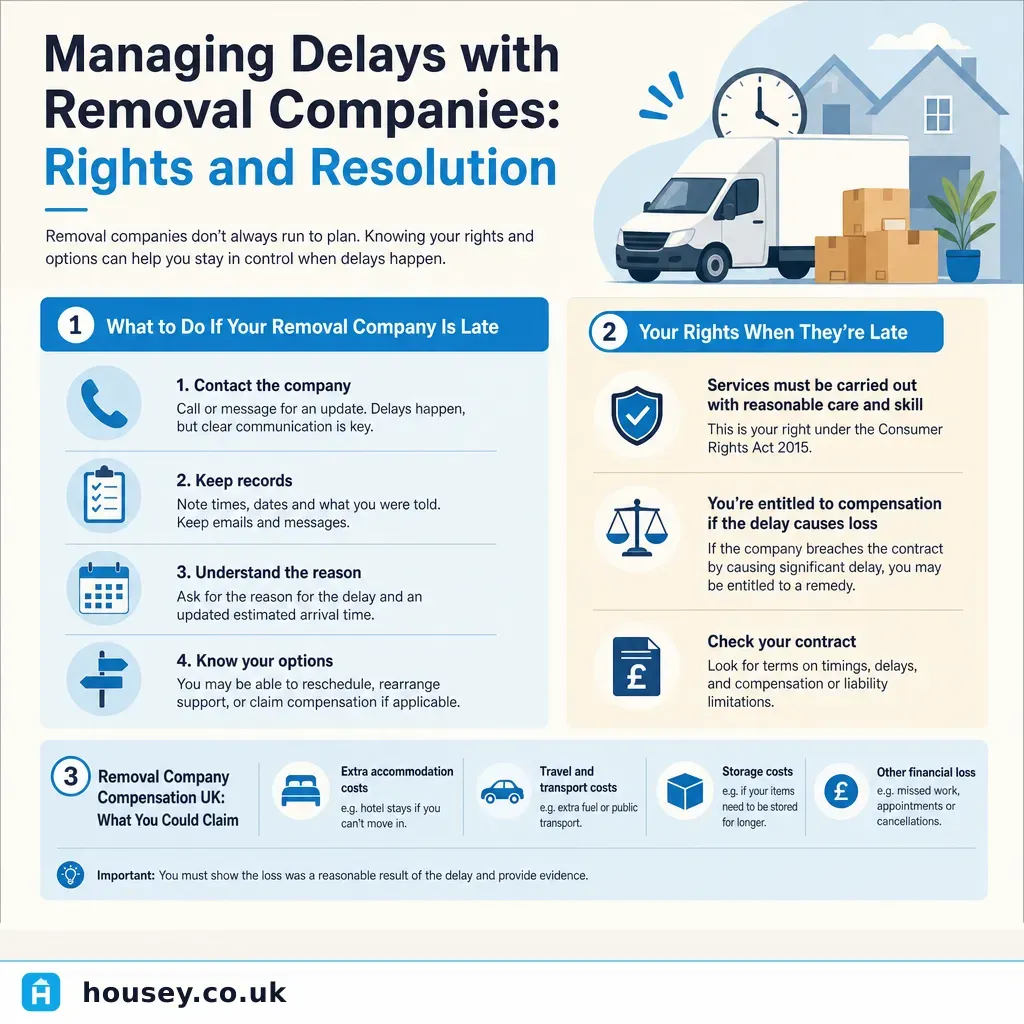 Buying & Moving
Managing Delays with Removal Companies: Rights and Resolution
If a removal company is late, your rights depend on your contract and whether the company is BAR-registered.
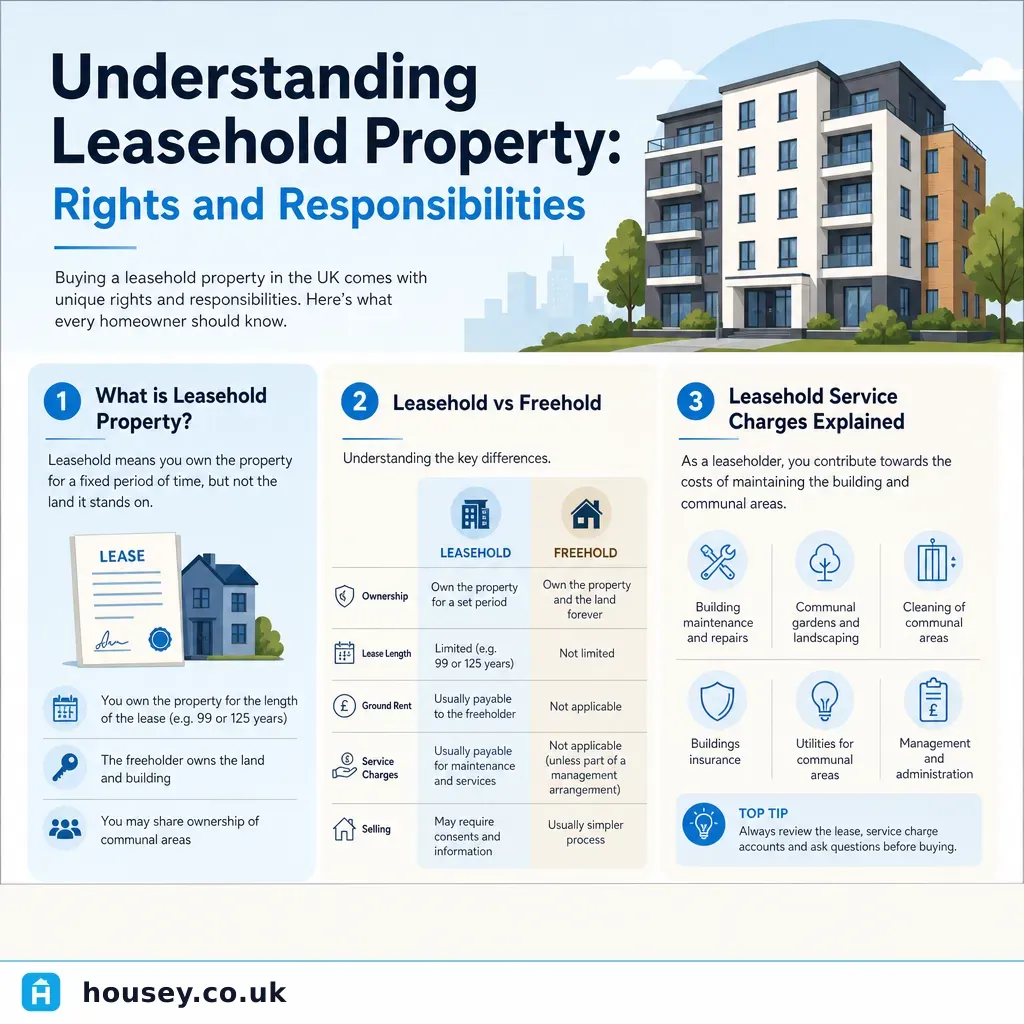 Buying & Moving
Understanding Leasehold Property: Rights and Responsibilities
Leasehold means you own a time-limited interest in a property while the freeholder owns the land and building.