First-Time Homebuyer: Essential Guidance for UK Property Purchase
By Housey · Last reviewed 18th of May 2026
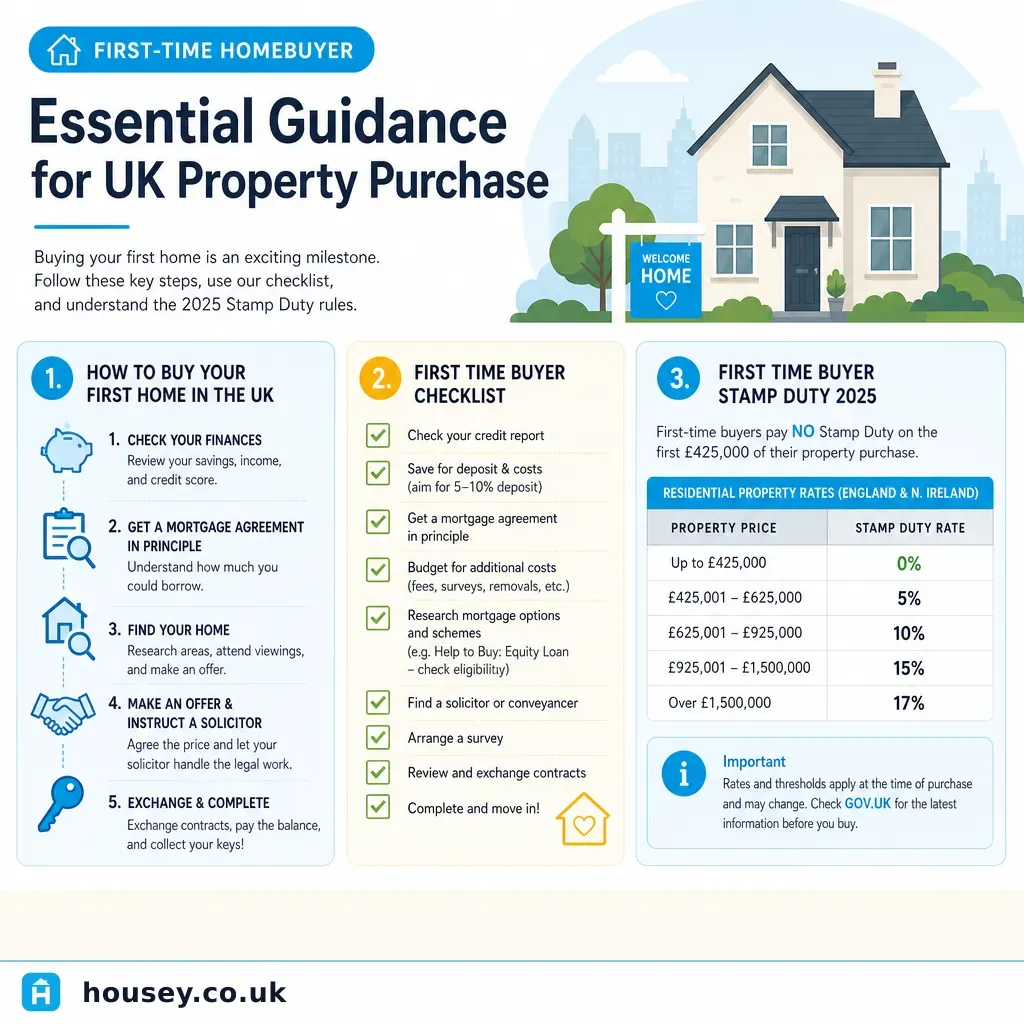
First-Time Homebuyer: Essential Guidance for UK Property Purchase
The purchase of a first home involves a sequence of legal, financial, and practical steps that most buyers have never navigated before. In England and Wales, the process runs from mortgage agreement in principle through to exchange and completion of contracts — a journey that typically takes three to six months and involves solicitors, surveyors, mortgage lenders, and local authorities simultaneously. Getting the sequence right and understanding what each professional does reduces the risk of costly mistakes and prevents delays that can cause a chain to collapse before completion.
Key points
- Stamp Duty Land Tax (SDLT) first-time buyer relief in England applies on purchases up to £500,000: 0% on the first £300,000 and 5% on the portion from £300,001 to £500,000 (rates applicable from April 2025 — check GOV.UK for current thresholds, as SDLT rates are subject to government review).
- A mortgage in principle (also called a decision in principle or agreement in principle) is required by most estate agents before they will formally accept an offer.
- Conveyancing in England and Wales typically takes 8–16 weeks from offer acceptance to completion; the Scottish legal system operates differently, using missives rather than exchange of contracts.
- A mortgage lender's valuation protects the lender's security — it is not a building survey and will not identify structural defects or condition issues. Commission a separate RICS Home Survey to protect your own interests.
- An Energy Performance Certificate (EPC) must be provided by the seller before marketing; a property rated F or G may face restrictions on future mortgage lending and will have higher running costs.
The buying process step by step: England and Wales
Understanding the sequence helps you manage timing and costs at each stage.
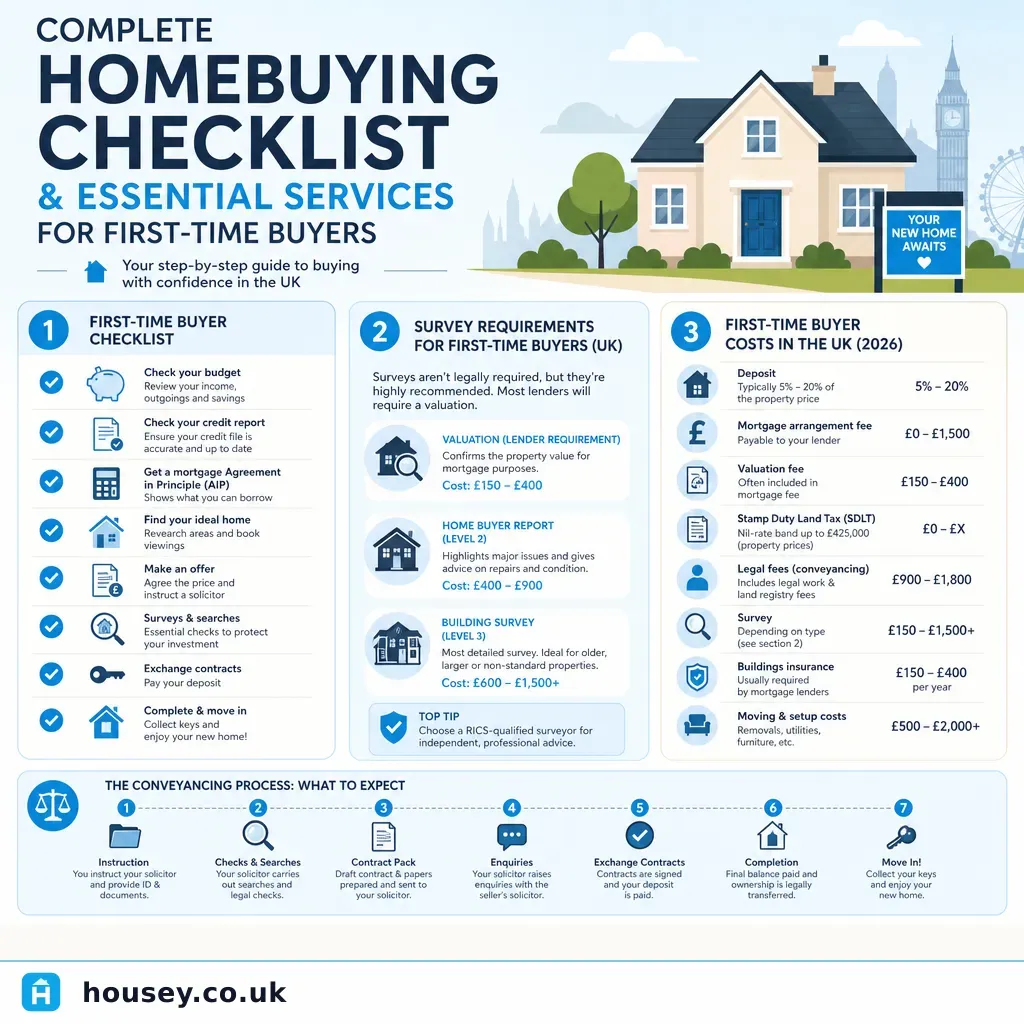
- Assess your finances and obtain a mortgage in principle. A mortgage broker or direct lender can usually issue a decision in principle within 24 hours. This confirms the likely maximum loan, though it is not a guarantee of funds.
- Instruct a solicitor or licensed conveyancer early. Many buyers wait until an offer is accepted, but appointing a conveyancer in advance saves time. Check they are regulated by the SRA or Council for Licensed Conveyancers (CLC) and obtain at least two or three quotes.
- Make an offer through the estate agent. In England and Wales, offers are not legally binding until exchange of contracts. Either party can withdraw before exchange, but this creates risk and cost for both sides.
- Commission a RICS Home Survey. Instruct a surveyor as soon as an offer is accepted and before committing further. The survey result may affect whether you proceed and at what price.
- Conveyancing searches and enquiries. Your solicitor raises local authority, drainage, and environmental searches, and submits enquiries to the vendor's solicitor. This stage often accounts for the longest delays.
- Receive a formal mortgage offer. Once your lender is satisfied with its valuation and your financial checks, it issues a formal mortgage offer. This typically has an expiry date.
- Exchange contracts. At exchange, both parties are legally committed. You pay a deposit — usually 10% of the purchase price. Withdrawing after exchange means losing that deposit.
- Complete. The remaining purchase funds are transferred, keys are released, and you take legal ownership. SDLT must be filed and paid within 14 days of completion; your solicitor normally handles this on your behalf.
Which survey do you need?
A mortgage lender's valuation is instructed by and paid to the lender — it exists to protect the lender's security, not to advise you on condition. Commissioning your own RICS Home Survey is one of the most important steps a first-time buyer can take before exchange.
Survey type | Best for | Not ideal for | Typical output | Main risk if skipped |
|---|---|---|---|---|
RICS Level 1 Condition Report | New-build or recently renovated homes in known good condition | Pre-1900 properties; unusual construction; any visible defects | Traffic-light condition ratings; no repair advice | Limited detail; unsuitable for anything but the most straightforward modern homes |
RICS Level 2 HomeBuyer Report | Conventional post-1900 homes in reasonable condition | Pre-1900 properties; non-standard construction; significant past alterations | Condition ratings, summary of urgent defects, optional market valuation | May miss hidden defects in older or non-standard properties |
RICS Level 3 Building Survey | Pre-1900 properties; listed buildings; unusual construction; visible defects; properties requiring significant work | Standard post-1990 estate homes where cost saving is the priority | Detailed defect assessment, construction description, full repair advice | Most thorough option — not choosing it for an older property increases the risk of costly post-purchase surprises |
Structural engineer's report | Known or suspected structural issues: cracks, subsidence, movement | General-condition survey for a property with unknown history | Specific structural diagnosis and repair specification | Addresses structural concerns only — does not substitute for a general survey |
Which survey should you choose?
- Choose a RICS Level 2 survey if the property was built after 1900, appears in reasonable condition, uses conventional construction (cavity brick, tiled roof), and you want a cost-effective but meaningful inspection.
- Choose a RICS Level 3 survey if the property is pre-1900, has visible cracks or signs of movement, has been significantly extended or altered, uses non-standard construction (solid walls, thatch, concrete frame), or is listed.
- Commission a structural engineer's report alongside a general survey if there are specific signs of structural movement: stepped cracks in brickwork, sloping floors, or doors and windows that stick without obvious cause.
- Arrange a new-build snagging inspection before legal completion if you are buying directly from a developer, so defects can be raised under the warranty.
- Ask your surveyor which level is appropriate if you are unsure — they can advise based on the property's age, construction, and condition.
Documents to prepare before you start searching
Having financial and identity documents ready speeds up both the mortgage application and conveyancing process considerably.
For your mortgage application:
- Proof of identity (passport or driving licence)
- Proof of address (utility bill or bank statement dated within three months)
- Last three months' payslips if employed; last two or three years' SA302s and tax year overviews if self-employed
- Last three months' bank statements
- Evidence of deposit source: savings statements, or a gift letter if any part of the deposit is gifted
- Details of existing debts and regular financial commitments
For your solicitor (once an offer is accepted):
- Signed terms of engagement
- Certified proof of identity and address
- Proof of deposit funds (bank or savings statements)
- Details of any Help to Buy equity loan or Lifetime ISA bonus you intend to use
- Your formal mortgage offer document (forwarded once issued by your lender)
EPC: The vendor must provide an Energy Performance Certificate for the property. Review the rating before making an offer — it affects running costs and may affect future mortgage eligibility for certain lenders.
Costs to budget for beyond the purchase price
First-time buyers commonly underestimate total transaction costs. These are indicative figures only and depend on property price, solicitor, lender, and location (Indicative UK costs, last reviewed 2026-05-18):
- Solicitor or conveyancer fees: typically £1,000–£2,500 including disbursements (searches, Land Registry fees, bank transfer fees). Obtain at least three quotes.
- RICS survey: Level 2 typically £400–£700; Level 3 typically £600–£1,500 depending on property size and location.
- Mortgage arrangement or product fee: £0–£2,000 depending on the mortgage product.
- Mortgage broker fee: £0–£500; many brokers take commission from the lender instead of charging a fee.
- Removal costs: highly variable — from a few hundred pounds for a van hire to £1,500–£3,000+ for a full professional removal on moving day.
- Buildings insurance: required from exchange of contracts; premiums vary significantly by property type and location.
- Stamp Duty Land Tax: use GOV.UK's SDLT calculator for your purchase price and applicable relief.
Important limitations
This article provides general guidance only for England and Wales. Conveyancing law, SDLT rates, mortgage rules, and government scheme terms change regularly — the information here reflects the position as of 2026-05-18. The Scottish and Northern Irish legal systems operate differently and are not covered here. Nothing in this article constitutes legal, financial, or mortgage advice. Always instruct a regulated solicitor or licensed conveyancer for legal work, and consult an FCA-regulated mortgage broker or independent financial adviser (IFA) for personalised financial advice.
What to ask a qualified professional
Questions to ask your conveyancing solicitor or licensed conveyancer:
- Are you regulated by the SRA or CLC, and what is your professional indemnity limit?
- What is included in your quoted fee, and what disbursements are additional?
- Who in your firm will handle my matter day to day, and what is the expected timeline?
- What happens to my fees if the purchase falls through before exchange?
- How will you communicate progress — by phone, email, or an online case-tracking portal?
Questions to ask your RICS surveyor:
- Which survey level do you recommend for this property, and why?
- Will you personally carry out the inspection, or will it be delegated?
- What areas of the property will you not be able to access, and how will you note limitations?
- How long will the report take, and can I discuss the findings with you after it is issued?
- Does the report include a market valuation, and is that covered in the quoted fee?
Questions to ask your mortgage broker:
- Are you whole-of-market, or are you restricted to a lender panel?
- How are you paid — by fee, by lender commission, or both?
- What is the total cost of the recommended mortgage including any product fee?
- What protection products should I consider alongside the mortgage?
When to get professional help
The legal and financial elements of a property purchase always require a regulated professional — these cannot be safely managed without one. Seek urgent professional guidance if:
- A survey reveals structural movement, suspected subsidence, Japanese knotweed, or evidence of past flooding.
- The property is leasehold and the lease has fewer than 85 years remaining, as this affects mortgage eligibility and resale value.
- There are unresolved planning or building control issues identified by your solicitor's searches.
- The vendor cannot provide documentation for past works — extensions, loft conversions, electrical rewiring, or gas installations.
- You are buying a new-build directly from a developer — ensure your solicitor reviews the contract terms, reservation fee conditions, and the warranty (NHBC Buildmark or equivalent) in full.
How Housey can help
Housey connects first-time buyers with trusted professionals at every stage of the purchase. Find a qualified surveyor through our RICS Home Surveys service, choose the right inspection level with a RICS Level 2 survey for post-war homes or a RICS Level 3 survey for older properties, and manage the legal process with access to conveyancing support.
Frequently asked questions
What is the difference between exchange and completion?
Exchange of contracts is the point at which both buyer and seller are legally committed; you pay your deposit and a completion date is agreed. Completion is when the remaining funds are transferred, the mortgage is drawn down, and you receive the keys. The gap between exchange and completion is typically one to four weeks, though same-day exchange and completion is sometimes arranged where circumstances allow.
Do I have to use a solicitor for conveyancing?
You can legally carry out your own conveyancing, but in practice most mortgage lenders require a regulated solicitor or licensed conveyancer to protect the lender's security in the property. Self-conveyancing is complex and errors can have serious legal and financial consequences. Most first-time buyers instruct a solicitor regulated by the SRA or a licensed conveyancer regulated by the Council for Licensed Conveyancers (CLC).
Can I use a Lifetime ISA to buy my first home?
A Lifetime ISA (LISA) can be used towards your first home if the property costs £450,000 or less and you have held the account for at least 12 months. Withdrawing for any other purpose before age 60 incurs a 25% government withdrawal charge, which effectively recovers more than just the bonus received. Check GOV.UK for current contribution limits and any changes to withdrawal terms before relying on a LISA for a purchase.
What is a mortgage in principle and does it affect my credit score?
A mortgage in principle — also called a decision in principle or agreement in principle — is a lender's conditional statement of how much they may be prepared to lend. Some lenders perform a hard credit search when issuing one, leaving a footprint on your credit file; others carry out a soft search, which does not. Ask the lender or broker which type of search they will conduct before you apply.
Should I get a survey on a new-build property?
A new-build property typically comes with a developer warranty such as NHBC Buildmark, but this is not a substitute for an independent inspection. A new-build snagging survey carried out before legal completion identifies defects and unfinished work that the developer should rectify under the warranty. It is generally advisable for any new-build purchase, as defects identified after completion can be considerably harder to get remedied at the developer's cost.
Sources and further reading
- Stamp Duty Land Tax: first-time buyers relief — GOV.UK
- Buying a home: step-by-step — GOV.UK
- RICS Home Survey standards — RICS
- Lifetime ISA: rules and limits — GOV.UK
- Find a regulated conveyancer — Council for Licensed Conveyancers
- Legal Ombudsman: making a complaint — Legal Ombudsman
Useful next reads
 Buying & Moving
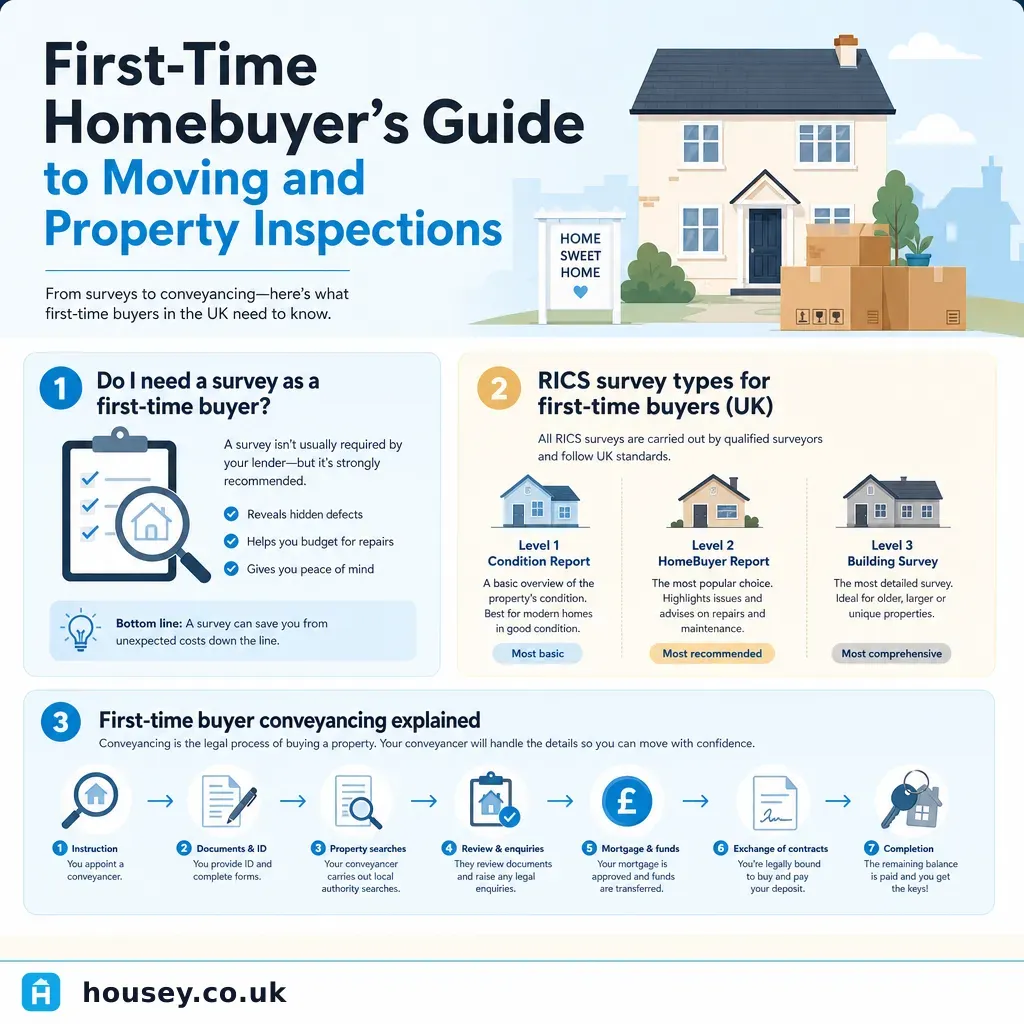
First-Time Homebuyer's Guide to Moving and Property Inspections
First-time buyers in the UK should know that a lender's mortgage valuation is not a property survey and does not protect the buyer.
 Buying & Moving
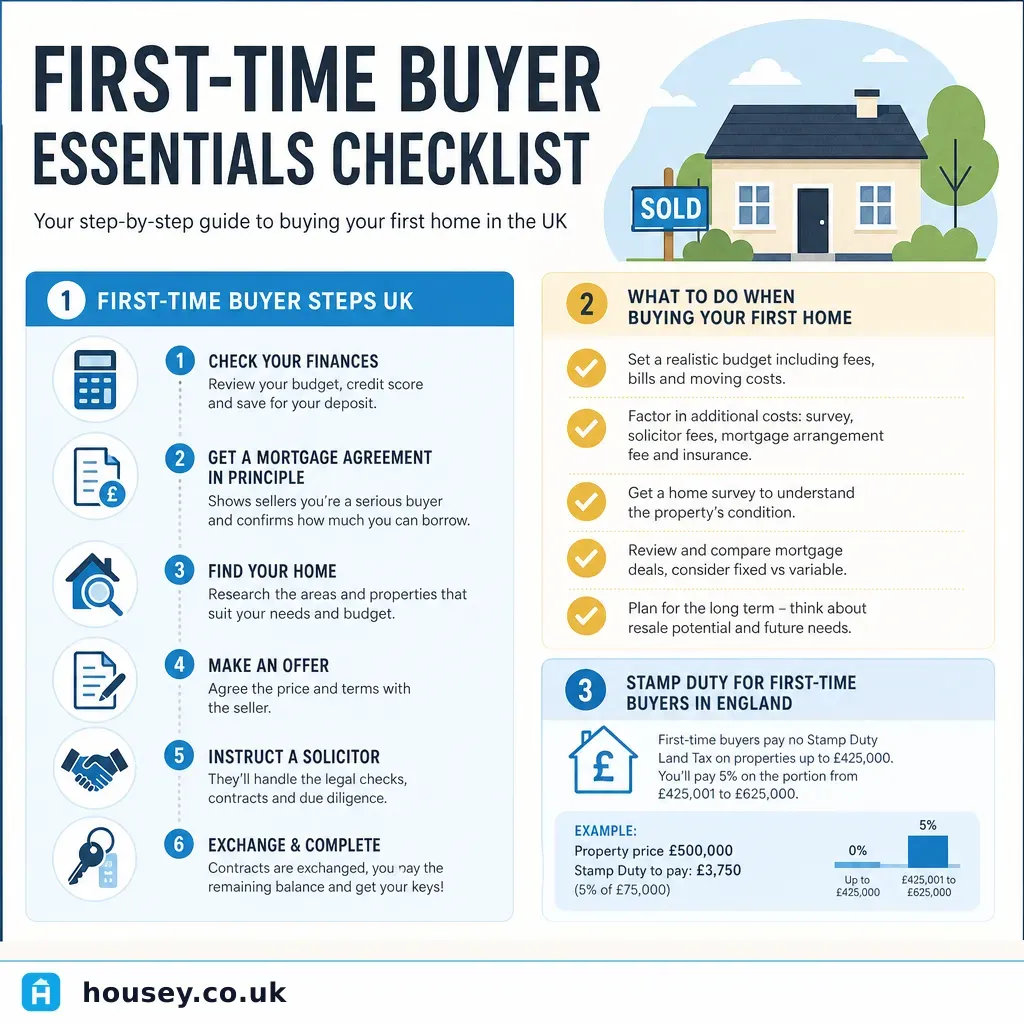
First-Time Buyer Essentials Checklist
Buying your first home involves obtaining a mortgage in principle, making an offer, instructing a solicitor, arranging a survey, and exchanging contracts before completion.
 Buying & Moving
Essential Actions for New Homeowners in Their First Year
In your first year as a UK homeowner, prioritise safety checks covering gas, electrics, and smoke and CO alarms, confirm your buildings insurance reflects the correct rebuild value, and track down any missing completion certificates for previous works.
 Buying & Moving
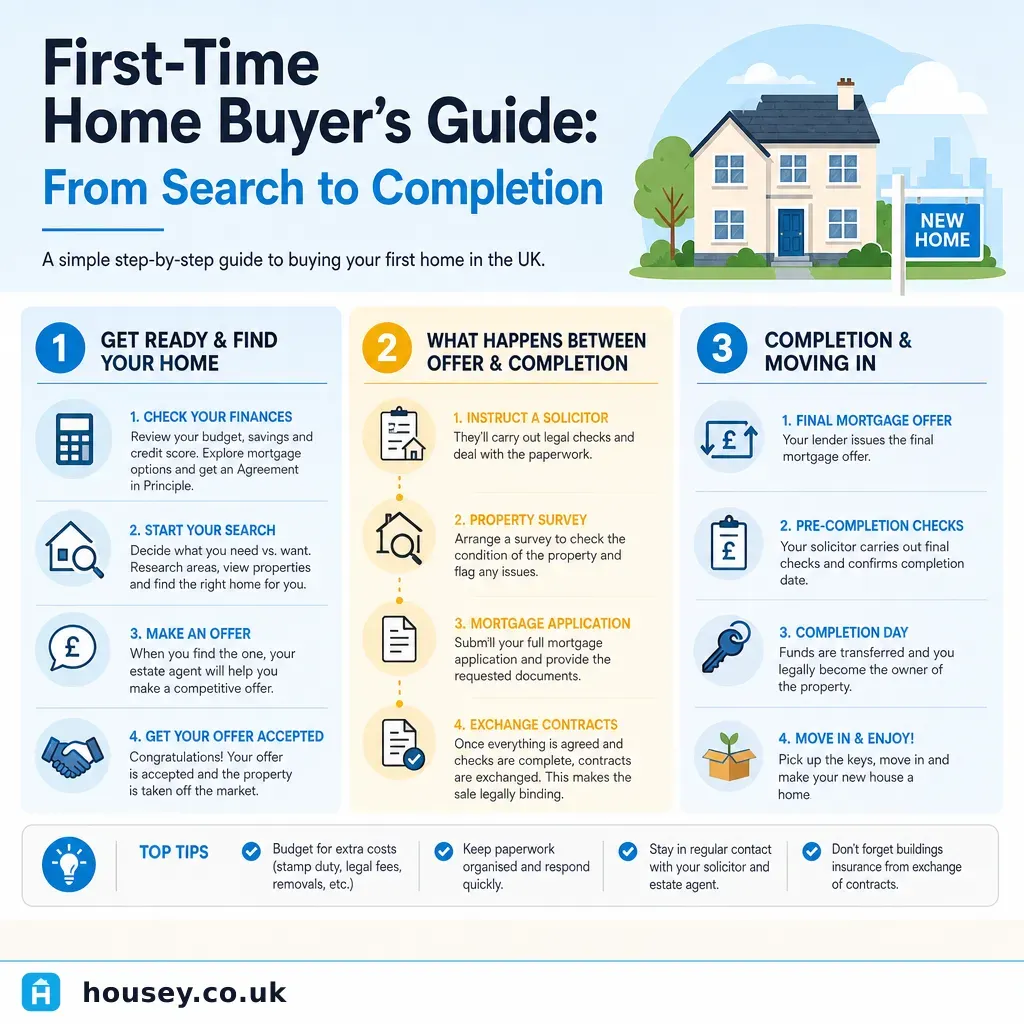
First-Time Home Buyer's Guide: From Search to Completion
Buying your first home in the UK typically takes 3–6 months from offer acceptance to completion.
 Buying & Moving
Complete Homebuying Checklist and Essential Services for First-Time Buyers
First-time buyers in the UK should commission an independent RICS Home Survey before exchange — a mortgage lender's valuation does not protect you.