Essential guidance for first-time property owners in the UK
By Housey · Last reviewed 30th of May 2026

Essential guidance for first-time property owners in the UK
The moment legal completion takes place, a set of financial, legal, and practical responsibilities lands on your shoulders — often before the removal van has arrived. Most new owners focus on decorating and furniture, yet the decisions made in the first weeks of ownership can determine whether a property remains problem-free or accumulates costly deferred maintenance. Whether you have bought a 1930s semi, a Victorian terrace, or a new-build flat, there are universal tasks and some tenure-specific obligations that are worth understanding from day one.
Key points
- Buildings insurance must be in place from exchange of contracts, not completion — legal risk passes to the buyer at exchange.
- The HM Land Registry title register costs £3 to download and confirms your legal boundaries, covenants, and any registered charges.
- An annual boiler service by a Gas Safe registered engineer is required to maintain most boiler manufacturer warranties and is advisable regardless of warranty status.
- Leasehold owners are bound by a lease that may restrict alterations, require landlord consent, and impose service charge obligations — read it before making any changes.
- An Electrical Installation Condition Report (EICR) is valid for up to 10 years in an owner-occupied home; check when the last one was issued and consider commissioning a new one if none is available.
Documents to gather in the first 30 days
The following documents should be located, requested from your solicitor, or applied for as soon as possible after completion:
- Title register and title plan — download from HM Land Registry for £3 each. Confirms boundaries, owners, mortgagees, and any registered easements or covenants.
- Completion statement — from your conveyancer. Shows what you paid, any apportioned ground rent or service charges (leasehold), and stamp duty paid.
- Property Information Form (TA6) and Fittings and Contents Form (TA10) — supplied by the seller's solicitor during conveyancing. Record disputes, past alterations, and what is included in the sale.
- Building Regulations completion certificates — for any works carried out since 1985. Absence of a certificate for an extension or loft conversion can cause problems at resale.
- FENSA or CERTASS certificates — for replacement windows installed since 2002. Confirms compliance with Building Regulations Part L and Part Q.
- Boiler service records and manuals — confirm the service history and any outstanding warranty periods.
- EPC (Energy Performance Certificate) — valid for 10 years; shows the current energy rating and recommended improvements.
- Gas and electrical safety reports — any Gas Safety Record or EICR supplied by the seller.
New homeowner checklist: first year priorities
Use this checklist to track essential tasks in the first 12 months of ownership.
Within the first week:
Within the first month:
Within the first three months:
Within the first year:
What not to assume when you move in
Several common misunderstandings catch new owners off guard.
Do not assume the survey covered everything. A RICS Home Survey is a visual inspection of accessible areas at one point in time. It will not have opened up floors, inspected behind cladding, or identified intermittent problems. If a defect emerges that you suspect was present at purchase, check your survey report carefully — and speak to a solicitor if you believe there was a material misrepresentation.
Do not assume permitted development applies. Permitted development rights allow many alterations without planning permission, but they can be removed by an Article 4 Direction, which is common in conservation areas and some new-build estates. Check with your local planning authority before starting any work.
Do not assume a leasehold flat is low-maintenance. Service charge demands can increase substantially — sometimes following major works to the building fabric — and a landlord's consent may be required for internal alterations, subletting, or keeping pets. Read the lease carefully and budget for service charges accordingly.
Do not assume the boundaries shown on estate agent particulars are legally definitive. Only the title register and title plan from HM Land Registry carry legal weight. Fence lines on the ground do not necessarily match legal ownership.
Do not assume all alterations were properly certified. If the previous owner installed a flue, solid fuel stove, or added a room, commissioning certificates may not have been obtained. Missing documentation can affect insurance cover and resale value.
When to get professional help
Contact a qualified professional in these situations:
- Any smell of gas — call the National Gas Emergency Service on 0800 111 999 immediately and leave the property.
- Visible cracks wider than 5 mm in external brickwork, or cracks stepping through mortar joints in a stair-step pattern.
- Evidence of water ingress, rising damp, or persistent condensation that does not clear with improved ventilation.
- Electrics that trip repeatedly, show scorch marks, or behave unexpectedly.
- Any query about altering a leasehold property — speak to a solicitor before proceeding.
- Any planned works likely to affect a party wall, boundary structure, or neighbouring drainage.
How Housey can help
Whether you need a second opinion on the condition of your new home or want to commission formal property documentation, Housey connects you with vetted professionals. You can request a RICS Home Survey to get a detailed condition assessment and list of maintenance priorities, or arrange conveyancing support if you have outstanding legal questions about your title, lease, or boundary.
Frequently asked questions
Do I need a solicitor after completion?
Most owners do not need ongoing legal advice after completion, but a solicitor is advisable if you discover undisclosed defects that may constitute misrepresentation, if you have leasehold queries, or if you plan alterations requiring a deed of variation or licence to alter. Always use a solicitor regulated by the Solicitors Regulation Authority (SRA).
How do I find out whether my property is leasehold or freehold?
Your title register from HM Land Registry will confirm the tenure. The estate agent particulars and your conveyancer's report on title will also state this clearly. If in doubt, download the register for £3 from the HM Land Registry portal at gov.uk. The information is publicly accessible.
What is the difference between buildings insurance and contents insurance?
Buildings insurance covers the structure of the property — walls, roof, floors, fitted kitchens, and permanent fixtures. Contents insurance covers your personal possessions. Most mortgage lenders require buildings insurance to be in place from exchange of contracts as a condition of the loan, so arrange it before or at exchange.
Is an EICR a legal requirement for owner-occupiers?
An EICR is a legal requirement for private landlords in England and Wales, who must have one every 5 years. For owner-occupiers there is no statutory requirement, but commissioning one is strongly advisable when buying a property with no recent electrical record, particularly in older homes, and some insurers require it.
Sources and further reading
- Search for property information — HM Land Registry / GOV.UK
- Leasehold homes: your rights and responsibilities — GOV.UK
- Building Regulations: when you need them — GOV.UK
- Find a Gas Safe registered engineer — Gas Safe Register
- Electrical Installation Condition Reports: homeowner guidance — Electrical Safety First
Useful next reads
 Buying & Moving
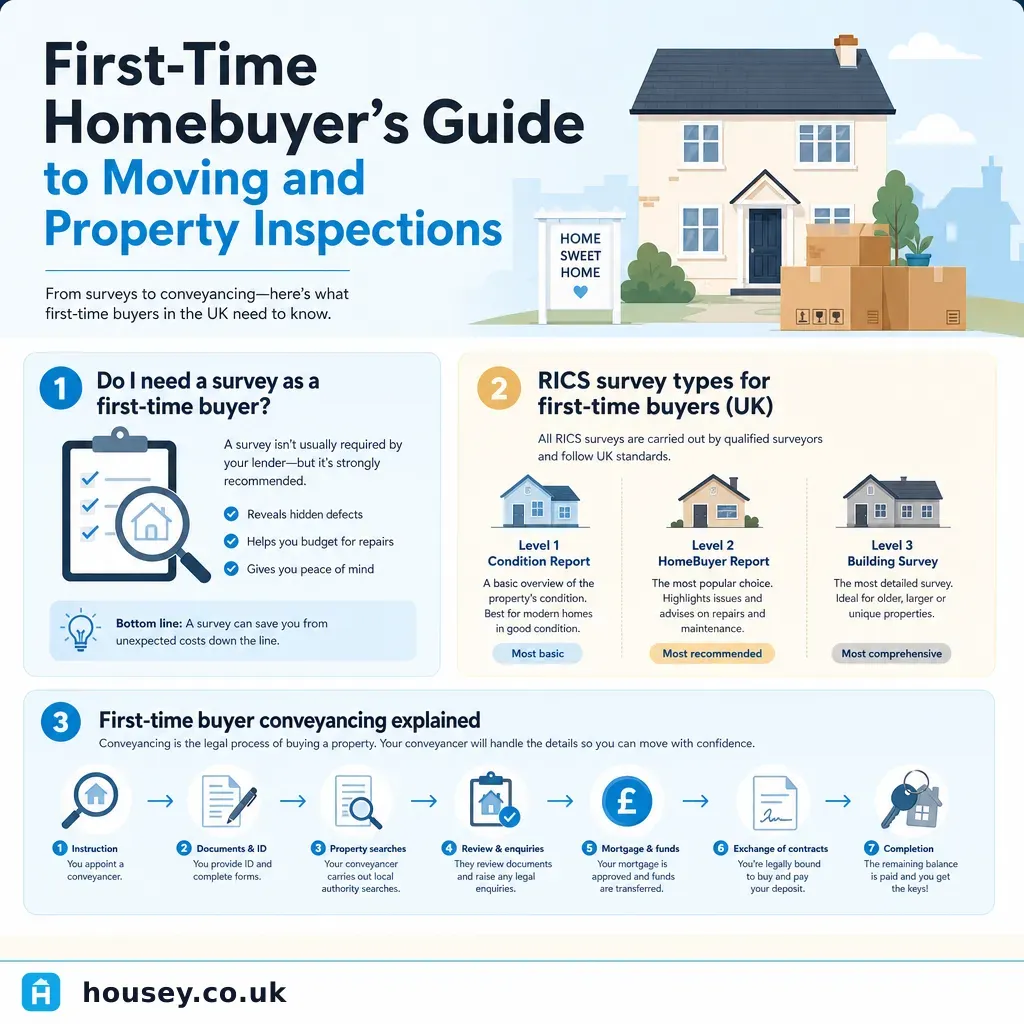
First-Time Homebuyer's Guide to Moving and Property Inspections
First-time buyers in the UK should know that a lender's mortgage valuation is not a property survey and does not protect the buyer.
 Buying & Moving
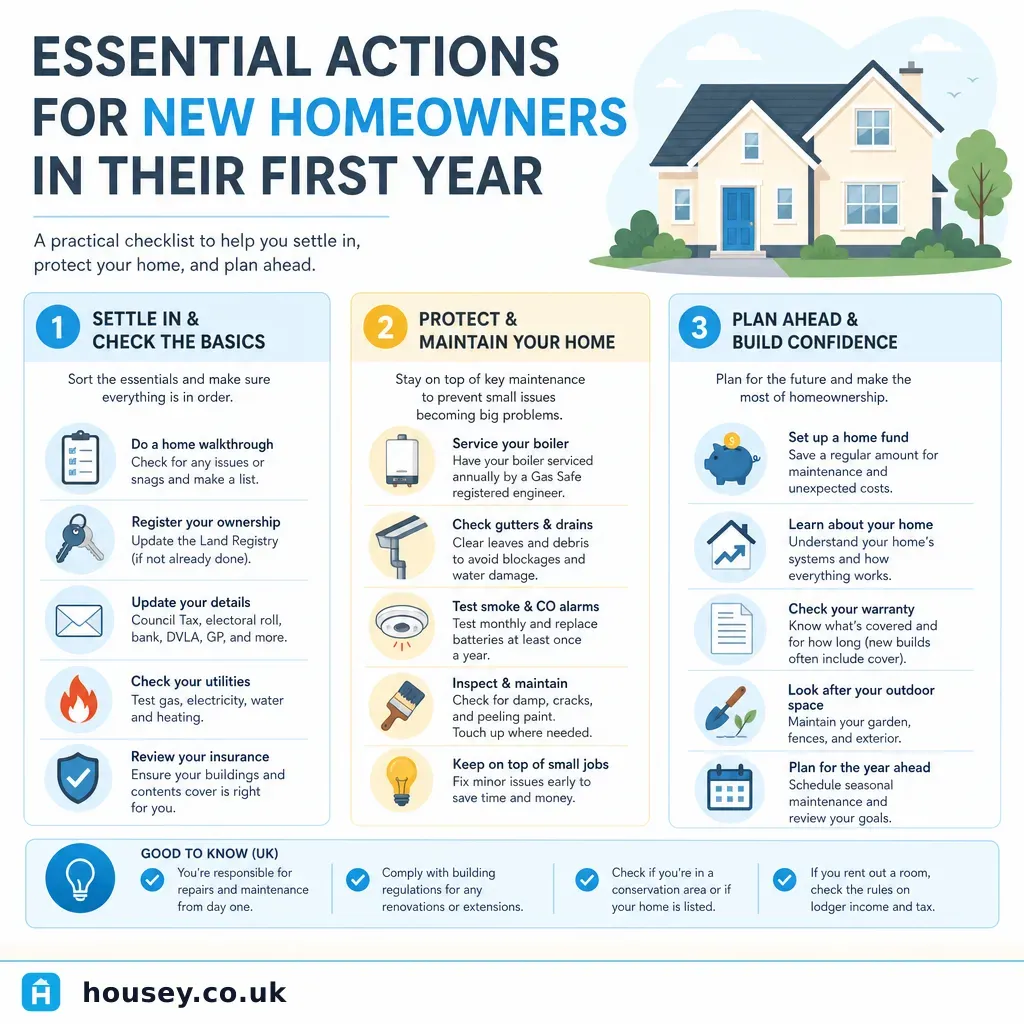
Essential Actions for New Homeowners in Their First Year
In your first year as a UK homeowner, prioritise safety checks covering gas, electrics, and smoke and CO alarms, confirm your buildings insurance reflects the correct rebuild value, and track down any missing completion certificates for previous works.
 Buying & Moving
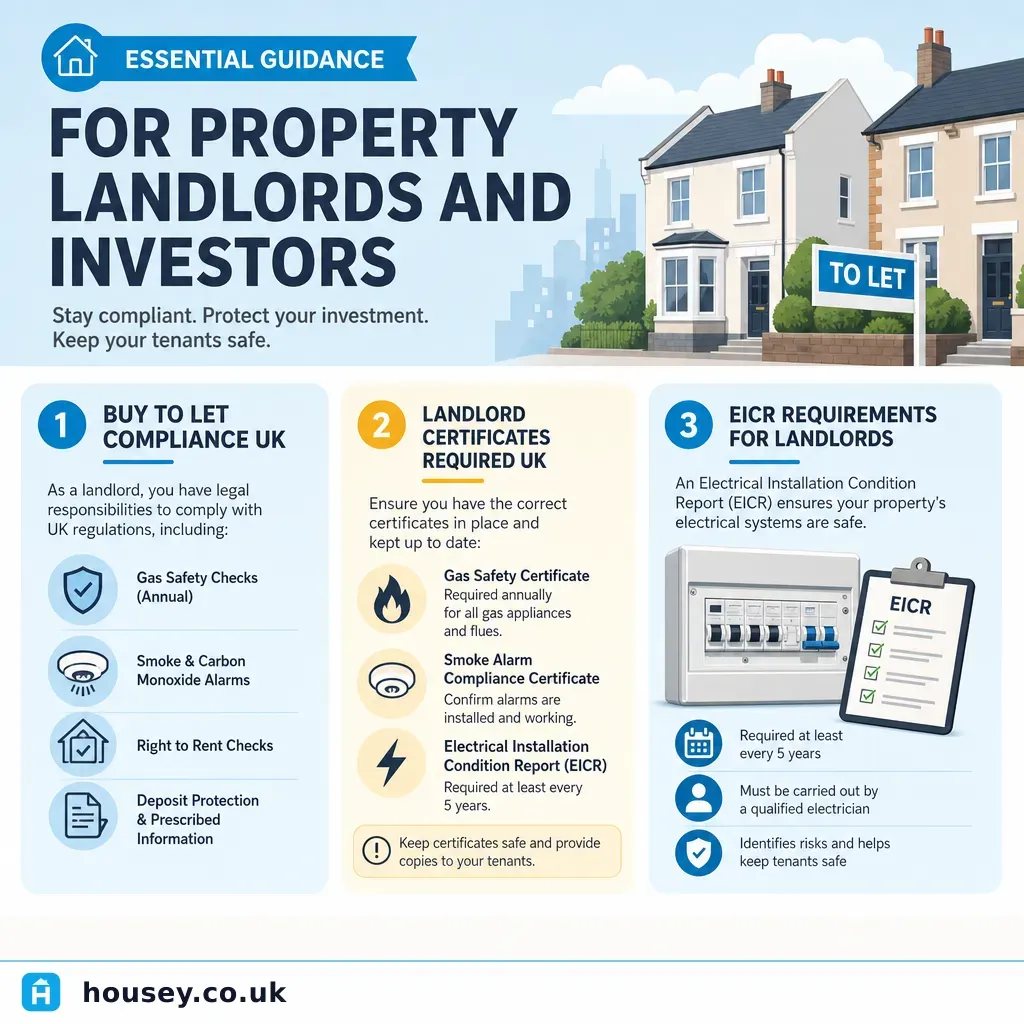
Essential Guidance for Property Landlords and Investors
UK landlords must hold valid gas safety records, electrical installation condition reports, and energy performance certificates before letting a property.
 Buying & Moving
Government Property Support Schemes: Help to Buy Eligibility and Benefits
Help to Buy: Equity Loan in England closed in March 2023 and is no longer available to new buyers.
 Buying & Moving
First-Time Buyer Essentials: Your Complete Guide to Purchasing Property
Buying your first UK home involves six key stages: securing a mortgage Agreement in Principle, making an offer, instructing a solicitor, commissioning an independent RICS survey, exchanging contracts (the legally binding point), and completing.