Essential Checklist for Your House Move
By Housey · Last reviewed 18th of May 2026
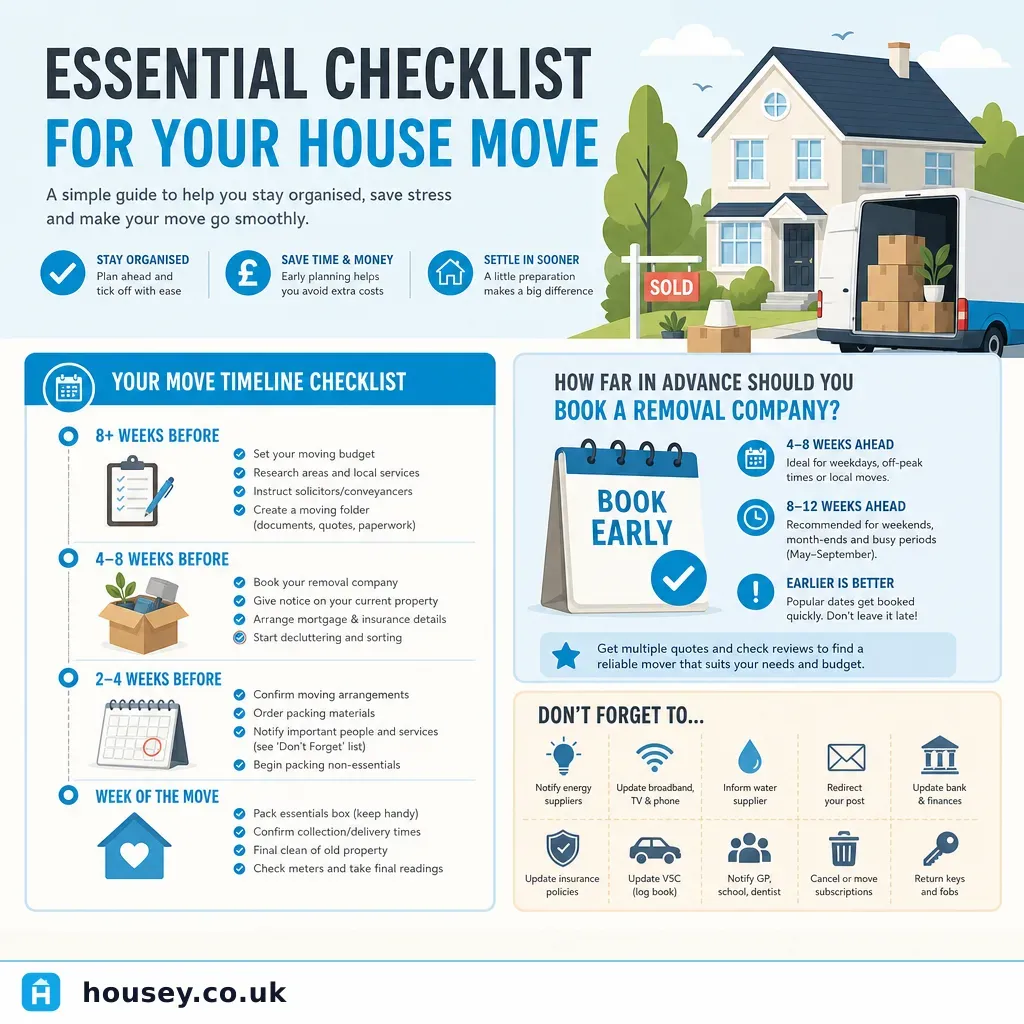
Essential Checklist for Your House Move
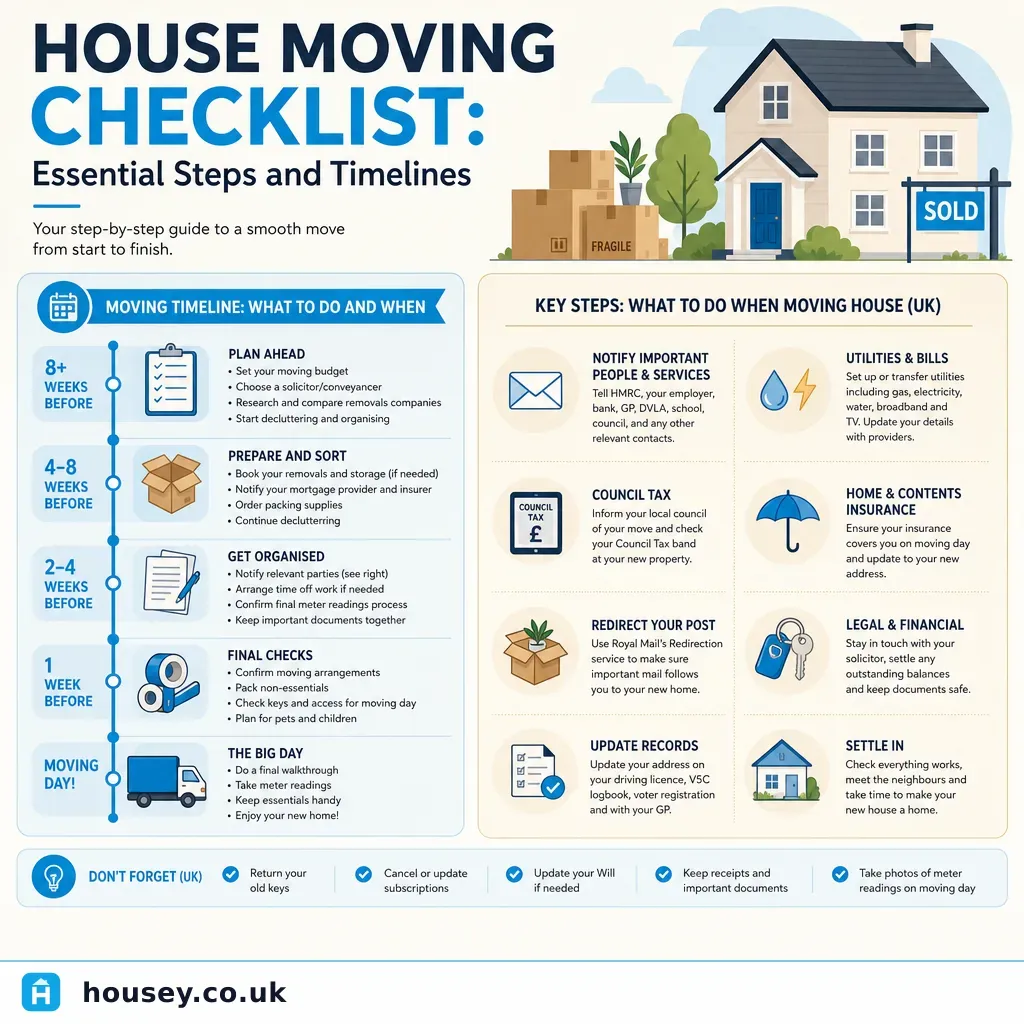
A UK house move involves dozens of parallel tasks spread across several weeks, and it is surprisingly easy for something critical — redirecting your post, noting meter readings, or confirming a removal booking — to slip through the gaps at the worst possible moment. Whether you are moving across town or across the country, having a staged plan organised by timeline turns an overwhelming list into a manageable sequence of steps.
Key points
- Royal Mail Redirection takes at least five working days to activate and should be set up at least two weeks before moving day; standard one-month redirection starts from £33.99 (check Royal Mail for current prices).
- Utility suppliers need a meter reading on the actual day you leave your current property and the day you arrive at your new one — not just a phone call in the weeks before.
- Standard contents insurance policies may not automatically cover belongings during transit; confirm coverage with your insurer or check the removal company's goods-in-transit insurance limit before moving day.
- The DVLA requires you to update your driving licence address after moving; driving with an incorrect licence address is technically an offence under section 99 of the Road Traffic Act 1988.
- Completion day in a chain is rarely on a fixed schedule — keys are typically not released until solicitors confirm funds have cleared, often in the early-to-mid afternoon, so plan removal access accordingly.
The master moving checklist
8–12 weeks before moving day
4–6 weeks before moving day
1–2 weeks before moving day
On moving day
Within 2 weeks of moving in
What to ask a removal company before booking
Use these questions to compare quotes on a like-for-like basis:
- What is included in the quoted price: packing, unpacking, disassembly, and reassembly of furniture?
- What is explicitly excluded — pianos, large gym equipment, garden machinery, or hazardous materials?
- What goods-in-transit insurance does the company carry, and what is the per-item limit and claims process?
- Is the price calculated by hourly rate, fixed quote, or volume?
- What happens if completion is delayed and the removal team cannot gain access on the agreed day?
- Is the company a member of BAR or NGRS, both of which offer independent dispute resolution?
- Will a surveyor visit to assess volume, or is the quote produced from an online form only?
- Is VAT included in the quoted price?
When to get professional help
For most moves, the key professional decision is choosing the right removal company. However, a few situations warrant additional specialist input:
- Valuable or fragile items — antiques, artwork, pianos, or specialist equipment require explicit confirmation that the removal company has the experience and appropriate insurance coverage
- Large properties — insist on a pre-move survey visit rather than accepting a volume estimate from an online form; reputable companies will offer this as standard for larger moves
- Landlords and tenants — an independent inventory clerk provides a neutral, timestamped record of a property's condition at check-in and check-out, protecting both parties from deposit disputes
How Housey can help
Housey connects homeowners with vetted removal companies, storage providers, and inventory clerks for every stage of a move. You can compare quotes and check credentials in one place — particularly useful when coordinating multiple services around a tight completion timeline.
Frequently asked questions
How far in advance should I book a removal company?
For a standard move, aim to book at least four to six weeks ahead. Peak moving periods — school summer holidays, the end of March, and school half-terms — fill up quickly. For a complex, long-distance, or large-volume move, eight weeks or more gives greater flexibility to compare quotes from BAR or NGRS-member companies and negotiate terms.
What happens if my completion date changes after I have already booked removals?
Most reputable removal companies will attempt to accommodate a date change, but this is not guaranteed during peak periods. Always check the amendment and cancellation policy before confirming a booking. Some BAR-member firms include a degree of date flexibility as standard; others charge a fee for late changes. Ask specifically about this before you commit.
Do I need to tip my removal team?
There is no obligation to tip, but it is common practice when the team has done a good job — especially on a long or physically demanding move. A small gesture such as cash, food, or drinks is usually appreciated but never expected. Tips are entirely at your discretion.
Should I pack myself or pay the removal company to pack?
Self-packing reduces cost but means you carry liability for breakages in boxes you packed yourself. Removal-company packing is more expensive but typically covered by their insurance policy. Many homeowners take a hybrid approach: the removal company packs fragile and high-value items while the homeowner handles the rest to manage cost.
Sources and further reading
- Royal Mail Redirection service — Royal Mail
- Change the address on your driving licence — GOV.UK
- Register to vote — GOV.UK
- Council Tax: moving to a new address — GOV.UK
- British Association of Removers — British Association of Removers
Useful next reads
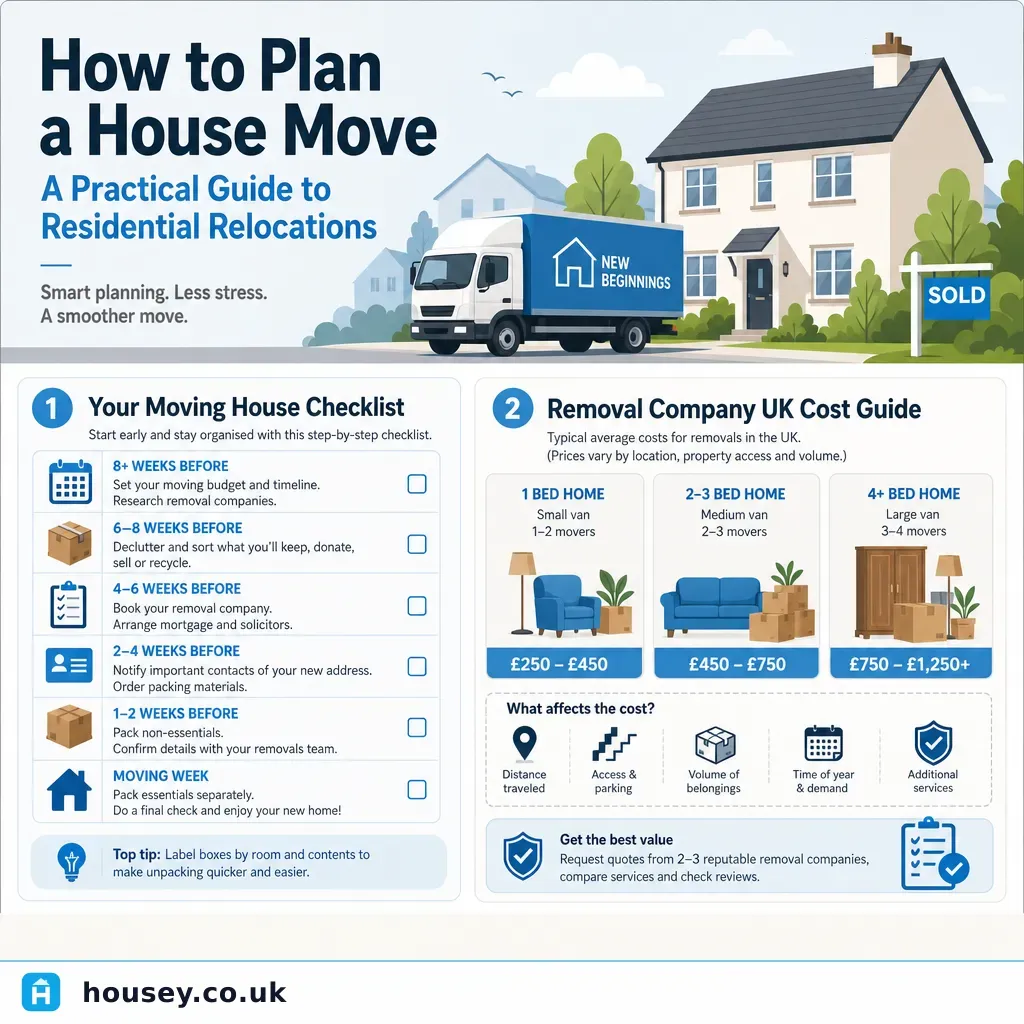 Buying & Moving
How to Plan a House Move: A Practical Guide to Residential Relocations
A UK house move goes more smoothly with planning that starts 6–8 weeks before moving day.
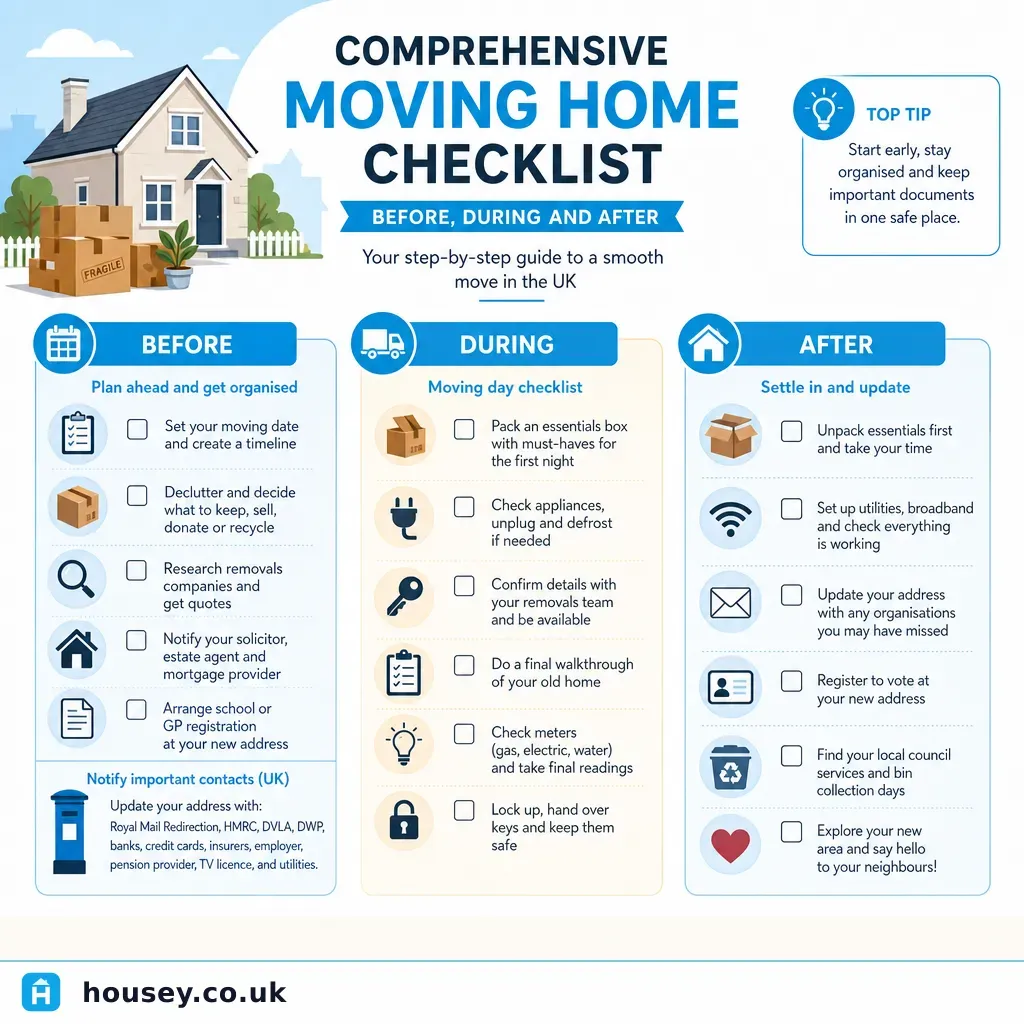 Buying & Moving
Comprehensive Moving Home Checklist: Before, During and After
Moving house in the UK involves tasks across roughly eight weeks: instructing a conveyancer and removal firm early, systematically notifying organisations of your new address, confirming buildings insurance from exchange, taking meter readings on completion day, and registering with the new council and utilities promptly.
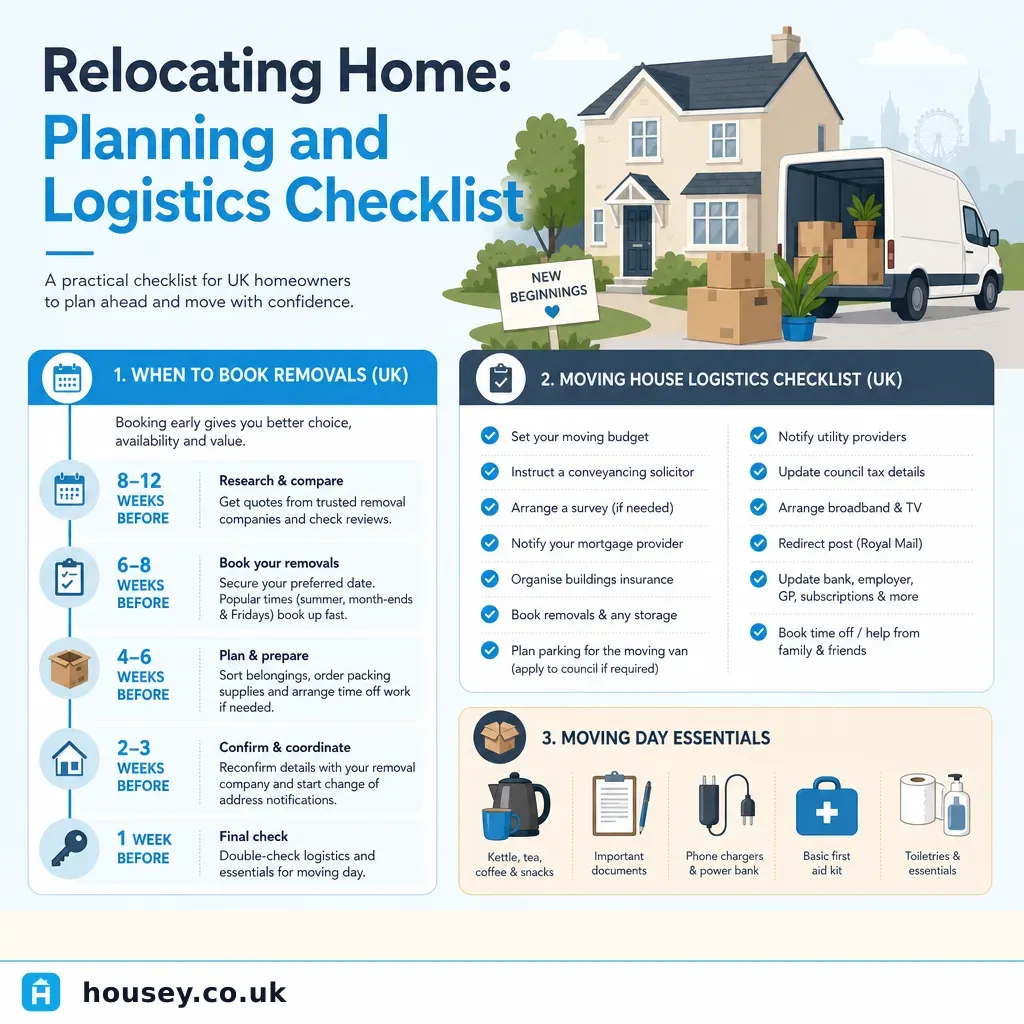 Buying & Moving
Relocating Home: Planning and Logistics Checklist
Successful home relocation in the UK typically requires 8–12 weeks of advance planning.
 Buying & Moving
House Moving Checklist: Essential Steps and Timelines
A UK house move typically spans 8–12 weeks of preparation: book removals 4–6 weeks out, notify the DVLA, HMRC, and utilities as exchange approaches, take meter readings on moving day, and update Council Tax and the electoral register on arrival.
 Buying & Moving
Managing Residential Moves During Major Urban Events
Moving house during a major urban event — a marathon, carnival, street festival, or large sporting occasion — requires advance planning around road closures, parking suspensions, and access restrictions.