House Moving Checklist: Essential Steps and Timelines
By Housey · Last reviewed 30th of May 2026
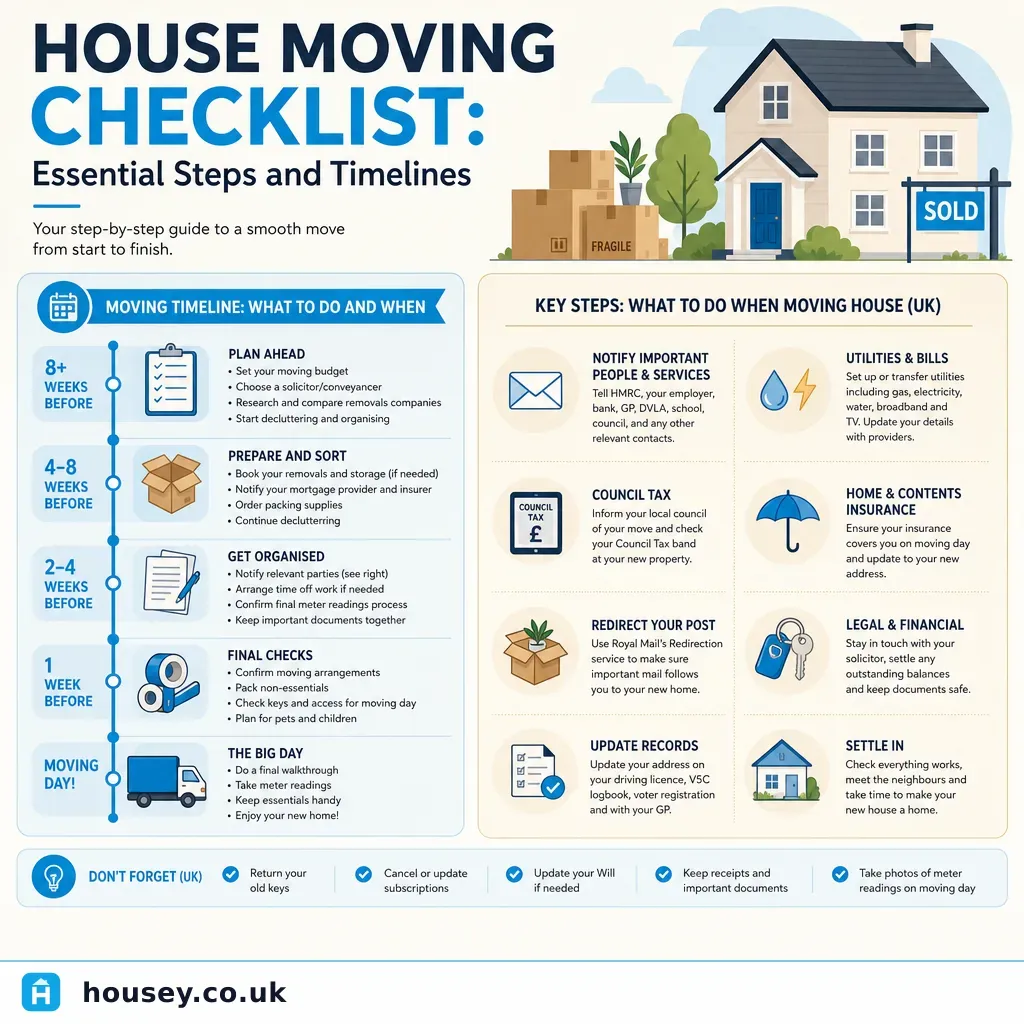
House Moving Checklist: Essential Steps and Timelines
Moving house in the UK typically involves coordinating solicitors, removal companies, utility providers, and multiple public-sector organisations — often simultaneously over an uncertain timeline. Whether you're completing on a Victorian terrace or handing back keys on a rented flat, the same core sequence applies: starting tasks at the right time is what separates a smooth move from a stressful one.
Key points
- Book a removal company at least 4–6 weeks before your target move date; Friday completions and end-of-month dates are the busiest periods and often command a premium.
- Buildings insurance on a property you are purchasing must be in place from exchange of contracts — not completion day.
- You are legally required to update your driving licence address with the DVLA; failure to do so can result in a fine of up to £1,000.
- Royal Mail Redirection requires at least 5 working days' notice to activate and is available for periods of 3, 6, or 12 months.
- Meter readings taken and photographed on both move-out and move-in day are your principal defence against a disputed energy bill.
8 weeks before: legal, financial, and removals
The period before exchange is when most people underestimate the planning needed. Use this window to make decisions that are harder to reverse later.
Legal and financial
- Instruct a solicitor or licensed conveyancer if you haven't already done so.
- Commission a survey — a RICS Level 2 Home Survey suits most conventional modern properties; a RICS Level 3 Building Survey is more appropriate for older, altered, or visibly defective homes.
- Confirm your buildings insurance arrangements and clarify from which date cover needs to start (exchange, not completion).
Removals
- Request at least three quotes from removal companies. Give each one the same brief: approximate volume of items, access at both ends (stairs, lift, parking restrictions), and any specialist items such as a piano or garden statuary.
- Ask whether each company is a member of the British Association of Removers (BAR) — BAR membership includes access to a deposit protection scheme and a disputes resolution process.
- If you're leaving a rented property, check your tenancy agreement for the required notice period and serve notice in writing.
Which removal service do you need?
- Choose a full-service removal company if you have a large volume of furniture, require professional packing, or are moving long-distance.
- Choose a man-and-van service if you're moving a modest volume of items locally and are comfortable packing yourself.
- Choose self-drive van hire if you're on a tight budget, have friends to help load, and are confident driving a large vehicle.
- Book an inventory clerk if you're vacating a rented property — an independent check-out report carries more weight in deposit disputes than a landlord's own assessment.
- Ask about storage if there may be a gap between your move-out and move-in dates; many removal companies offer short-term storage as part of their service.
4 weeks before: notifications and packing
With exchange approaching or recently completed, turn your attention to the administrative tasks that need a lead time.
Address changes to notify:
Packing checklist:
Moving week: utilities and final preparations
- Notify your current energy supplier of your move-out date; take meter readings on the morning of departure and photograph them.
- Contact the energy supplier at your new property to register in your name from move-in day, or arrange a switch before you arrive.
- Notify your broadband provider — activation at a new address can take 2–4 weeks with many providers; arrange a 4G/5G mobile router as a backup if needed.
- Set up Royal Mail Redirection — allow at least 5 working days from application to activation.
Completion day and arrival
Keys are typically released once your solicitor confirms funds have cleared — often mid-morning to early afternoon in a chain. On arrival, work through the following immediately:
Task | Why it matters |
|---|---|
Photograph meter readings | Establishes your energy liability start date |
Locate the stopcock | Essential for shutting off the water supply quickly |
Locate the fuse board and test RCDs | Identify any tripped circuits before unloading |
Check smoke and CO alarms | Replace batteries or units if absent or defective |
Check fixtures match the contract | Notify your solicitor the same day if anything listed is missing |
Confirm keys work in all locks | Re-key if previous occupants' key count is uncertain |
After you move in
- Register for Council Tax with your new local authority on or before your move-in date; contact your old council to cancel your previous liability from move-out day.
- Re-register to vote — this affects your credit file as well as your voting rights.
- Update your car insurance address promptly; an incorrect address can void a policy at the point of a claim.
- Register with a local GP practice — this cannot be transferred automatically and may take a few weeks to be fully processed.
When to get professional help
Most moving logistics are self-manageable, but seek professional input when:
- Items are damaged in transit — notify your removal company in writing the same day and check your insurance. BAR members operate a disputes resolution scheme.
- Your deposit is disputed after leaving a rented property — an independent inventory clerk can provide a check-out report that may be decisive in a Tenancy Deposit Scheme adjudication.
- There is a gap between exchange and completion and you're unsure who holds buildings insurance liability — ask your solicitor to clarify in writing before the gap arises.
- You discover unexpected defects on completion day — document everything photographically and contact your solicitor immediately.
How Housey can help
Housey connects you with vetted house removals companies who quote based on your specific volume, distance, and access conditions. If you're vacating a rented property, you can also find professional inventory clerks through Housey to produce an independent check-out report that protects your deposit.
Frequently asked questions
How far in advance should I book a removal company in the UK?
Most UK removal companies recommend booking 4–6 weeks before your planned move date as a minimum. Friday moves and end-of-month completions fill quickly and may cost more. If your solicitor hasn't confirmed a completion date yet, book provisionally with a company that allows rescheduling without a penalty.
Do I need to tell my council when I move house?
Yes — notify both your old and new local authority. Contact your current council to end your Council Tax liability from your move-out date, and register with your new council from move-in day. Re-register for the electoral roll via GOV.UK, which takes a few minutes online.
What happens if my completion is delayed on moving day?
Delays in a chain occur when funds take longer to transfer between solicitors. Your removal company may charge a waiting fee — ask about their policy in advance. Your solicitor should update you in real time on completion day; keep your phone charged and accessible.
When should I set up Royal Mail redirection?
Royal Mail recommends applying at least 5 working days before your move date, though you can arrange it up to 3 months in advance. Redirection is available for 3, 6, or 12 months and can be extended. Not all mail types are covered, so inform senders directly where possible.
Sources and further reading
- Royal Mail Redirection service — Royal Mail
- Tell DVLA you've changed address — GOV.UK
- Council Tax: moving home — GOV.UK
- Register to vote — GOV.UK
- British Association of Removers: choosing a remover — British Association of Removers
- Tenancy Deposit Scheme: dispute resolution — Tenancy Deposit Scheme
Useful next reads
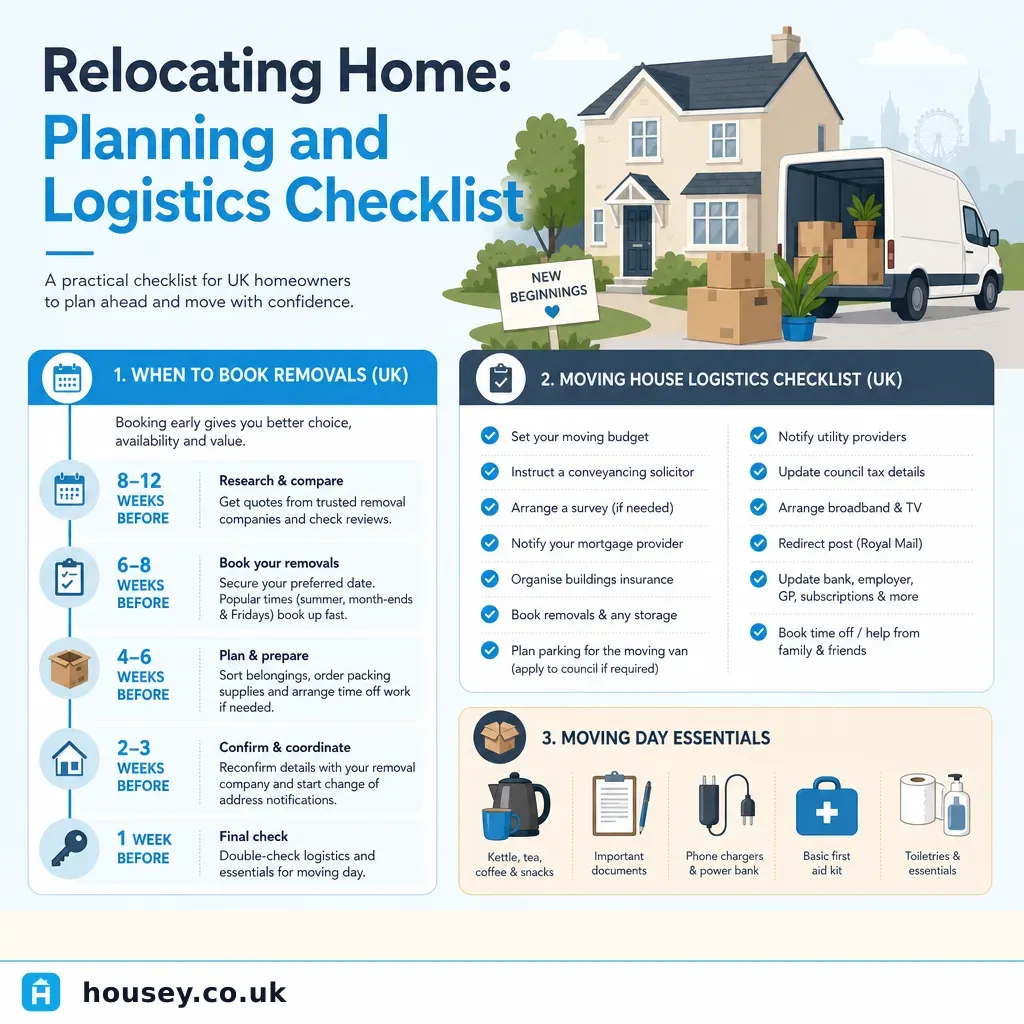 Buying & Moving
Relocating Home: Planning and Logistics Checklist
Successful home relocation in the UK typically requires 8–12 weeks of advance planning.
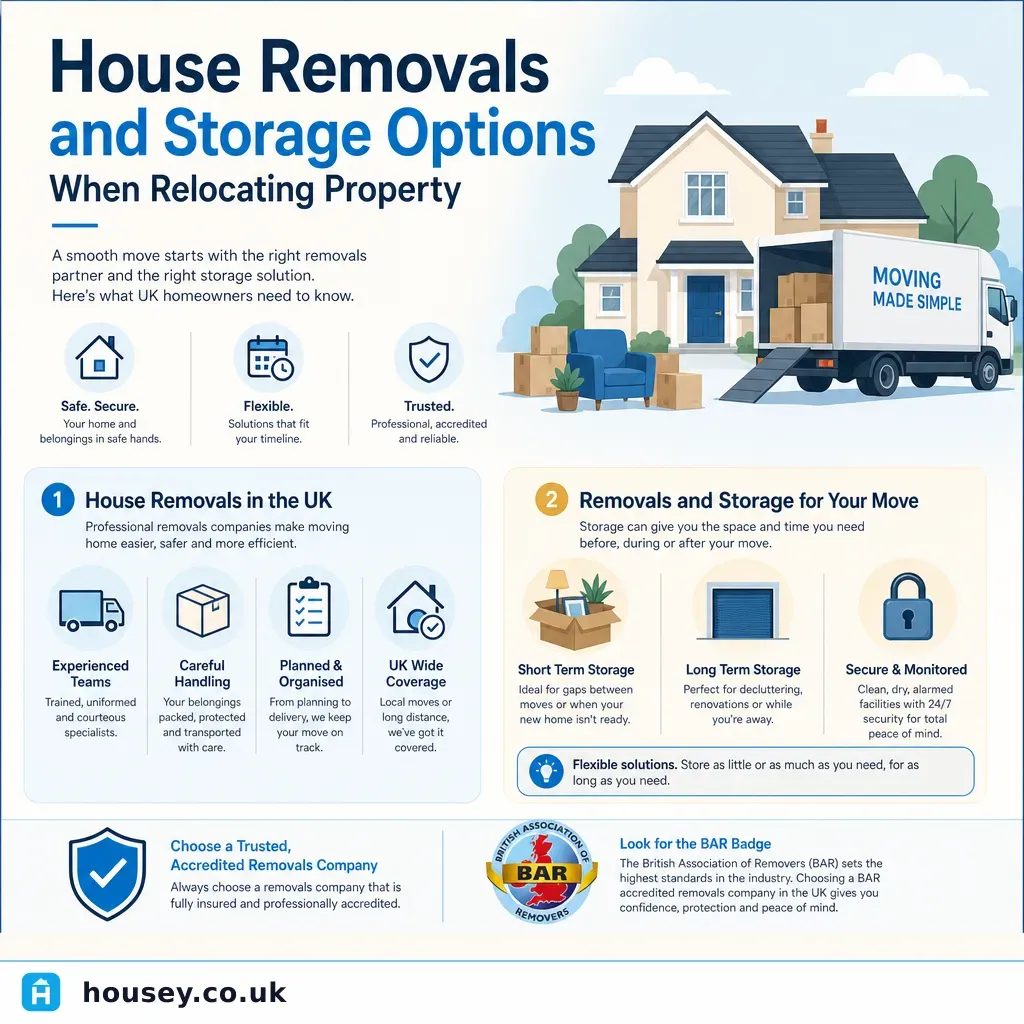 Buying & Moving
House Removals and Storage Options When Relocating Property
Choosing the right combination of removals service and storage depends on move size, timeline, and budget.
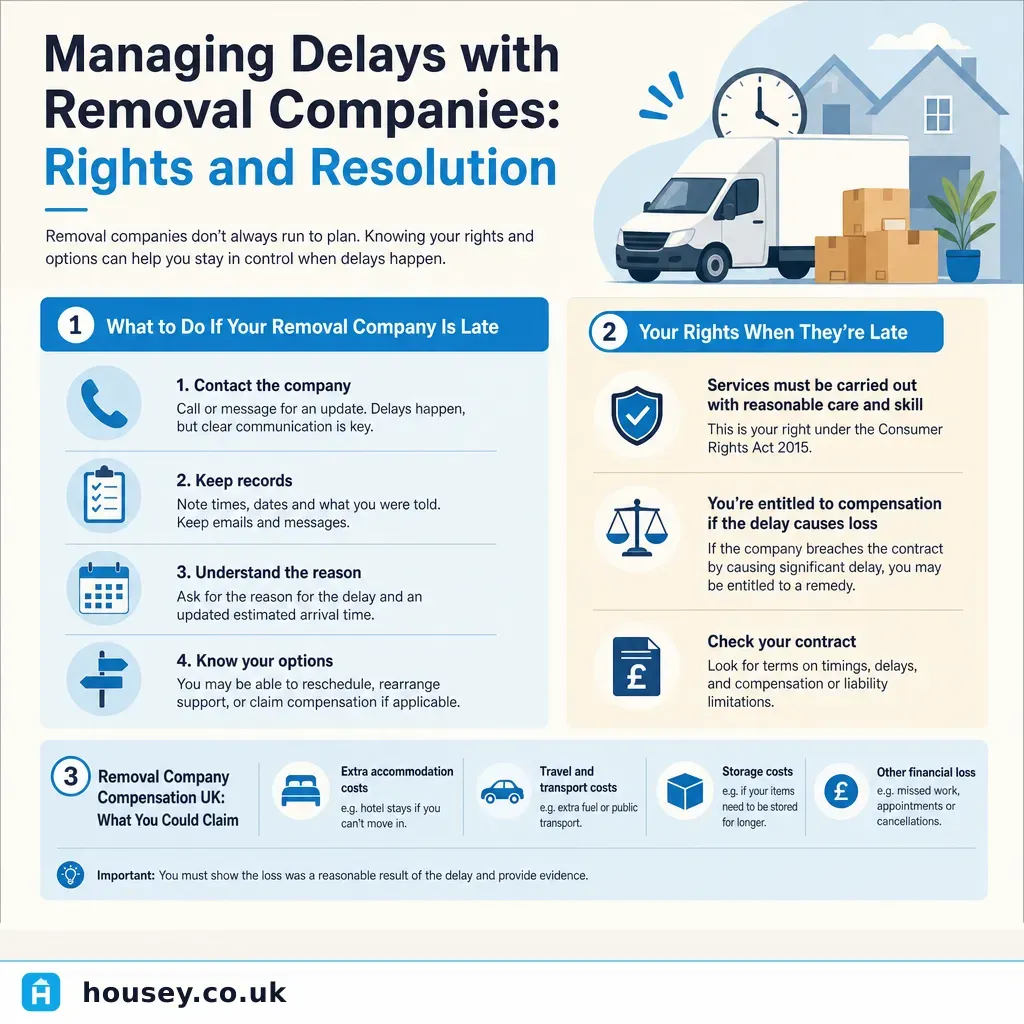 Buying & Moving
Managing Delays with Removal Companies: Rights and Resolution
If a removal company is late, your rights depend on your contract and whether the company is BAR-registered.
 Buying & Moving
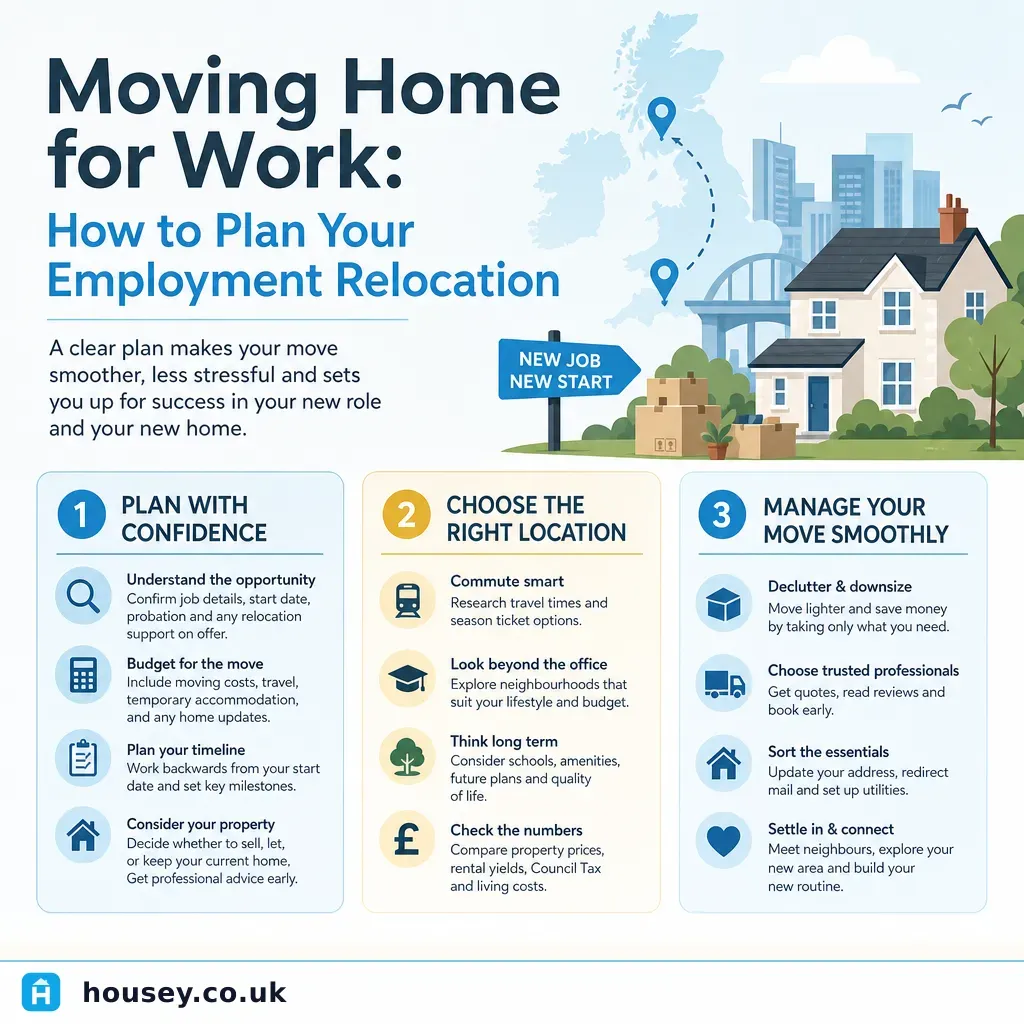
Moving Home for Work: How to Plan Your Employment Relocation
Moving home for a new job requires coordinating property timelines, removal logistics, and employer reimbursement simultaneously.
 Buying & Moving
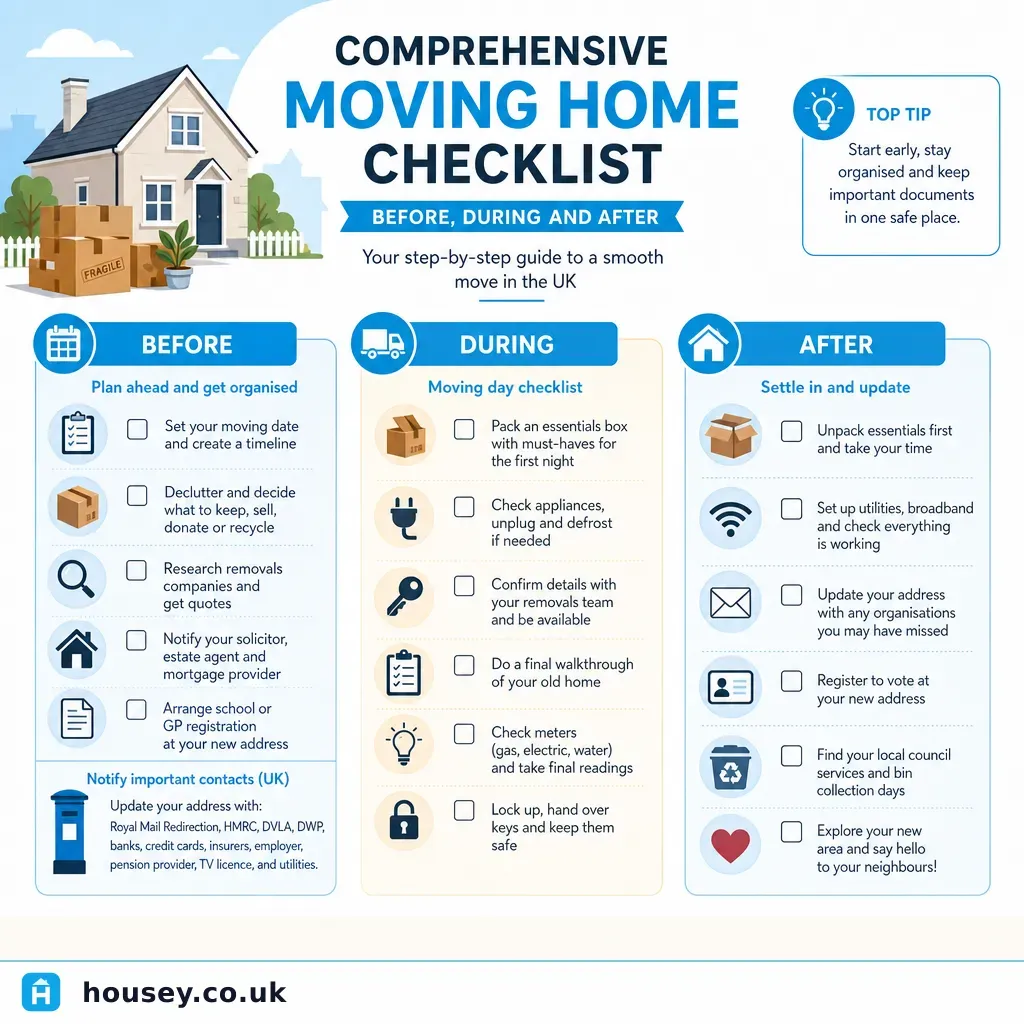
Comprehensive Moving Home Checklist: Before, During and After
Moving house in the UK involves tasks across roughly eight weeks: instructing a conveyancer and removal firm early, systematically notifying organisations of your new address, confirming buildings insurance from exchange, taking meter readings on completion day, and registering with the new council and utilities promptly.