Essential Considerations For Planning A Property Relocation
By Housey · Last reviewed 30th of May 2026
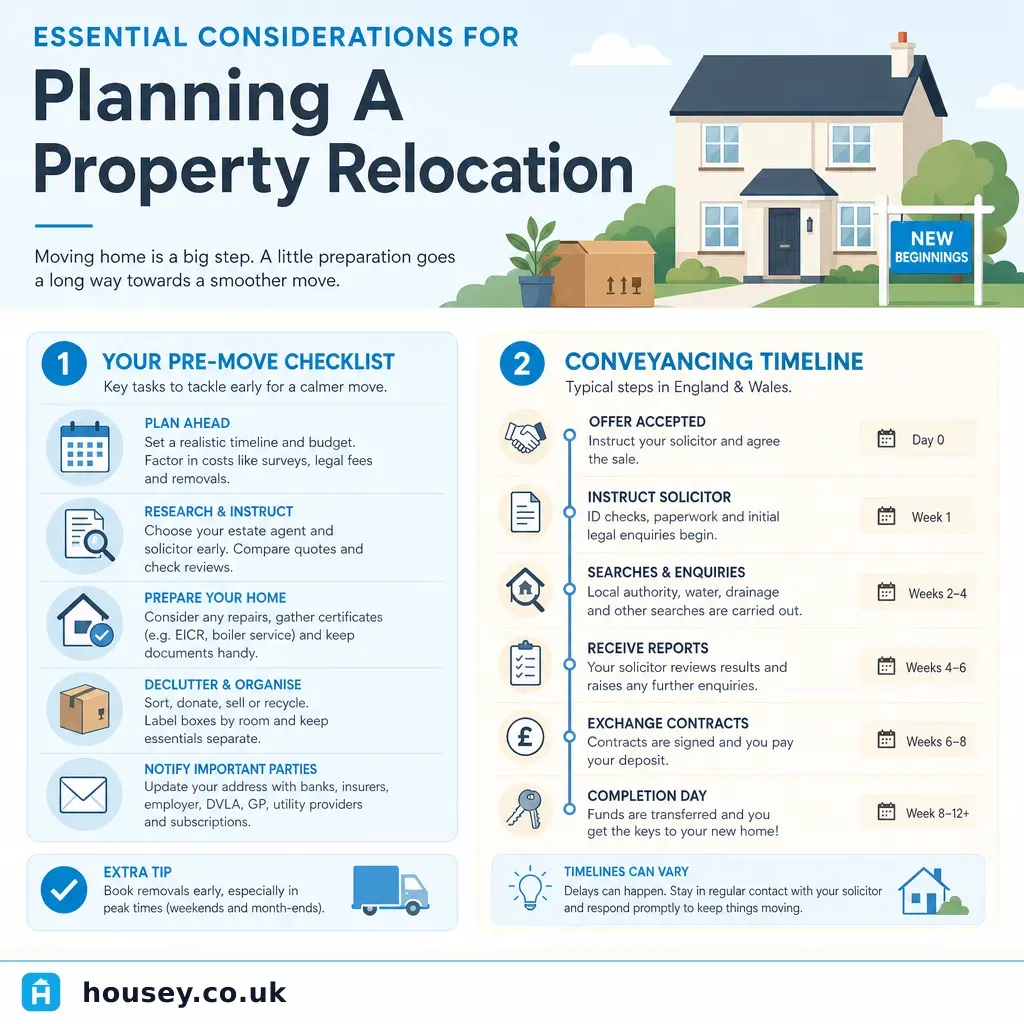
Essential Considerations For Planning A Property Relocation
Property relocation in the UK joins together legal, financial, and practical processes that rarely proceed in a neat sequence. Whether you are a first-time buyer, moving up the chain, or downsizing, the dependencies between conveyancing, surveys, mortgage offers, and removal logistics mean that a delay in any one area can compress your entire timeline. Understanding what needs to happen — and roughly when — is the most effective way to avoid scrambling at completion.
Key points
- Conveyancing in England and Wales typically takes 8–12 weeks from offer acceptance to exchange of contracts, with leasehold properties, complex titles, or lengthy chains frequently taking longer.
- A RICS Level 2 or Level 3 Home Survey should be commissioned before exchange of contracts so findings can inform negotiation or the decision to proceed.
- Buildings insurance is usually required from exchange of contracts — not from completion — and your mortgage lender may specify minimum cover requirements.
- Stamp Duty Land Tax (SDLT) is payable within 14 days of completion; first-time buyer relief and additional-dwelling surcharges should be confirmed with your solicitor before exchange.
- Removal firms in high-demand periods — late-spring Fridays, end-of-month dates, and school holiday starts — can be booked out 4–6 weeks in advance.
The conveyancing process and what affects timelines
Conveyancing is the legal transfer of property ownership. In England and Wales, a solicitor or licensed conveyancer manages this on your behalf, taking the transaction from offer acceptance through to completion. Scotland uses a different legal system — offers are made through a solicitor and completion is managed via a disposition deed — so check timelines with a Scottish solicitor if buying north of the border.
For most freehold transactions in England and Wales, the key stages run in this order: solicitors instructed → local authority, drainage, and environmental searches ordered → survey commissioned → mortgage offer confirmed → draft contract reviewed → enquiries raised and answered → exchange of contracts → completion.
Common causes of delay include:
- Local authority search returns in some areas taking 4–8 weeks rather than the typical 1–3 weeks
- Leasehold management packs arriving late from the freeholder or managing agent
- Mortgage lenders requesting additional evidence or a revised valuation
- Chain collapses requiring one property to be remarketed before the transaction can proceed
- Missing building regulations certificates or planning consents for past works requiring indemnity insurance
Instructing your conveyancing solicitor promptly after offer acceptance — and maintaining regular contact throughout — is one of the most effective ways to reduce avoidable delays.
Which survey do you need?
Commissioning the right survey is one of the most consequential decisions in the relocation process. A mortgage lender's valuation survey is conducted for the lender's benefit to confirm the property provides adequate security for the loan — it is not a substitute for a buyer's independent survey.
Survey type | Best for | Not ideal for | Typical output |
|---|---|---|---|
RICS Level 2 Home Survey | Modern, conventional homes in reasonable condition | Older, altered, or defective properties | Condition ratings, key issues, recommended actions |
RICS Level 3 Building Survey | Pre-1900 homes, unusual construction, visible defects, major alterations | Standard modern homes where it may be unnecessary spend | Detailed defect analysis, maintenance advice, cost indicators |
Structural engineer inspection | Suspected structural movement, subsidence, or significant cracking | General condition assessment | Engineering diagnosis, remedial options, cost estimate |
Decision tree: which survey do you need?
- Choose a RICS Level 2 Home Survey if the property is post-1980s, conventional in construction, and has no visible defects.
- Choose a RICS Level 3 Building Survey if the property is Victorian, Edwardian, or 1930s; has visible damp, cracking, or past alterations; or is of non-standard construction.
- Commission a structural engineer's report if a specific structural concern — stepped cracking, suspected subsidence, or leaning walls — needs diagnosis beyond a general survey.
- Check with your mortgage lender whether they require a particular form of valuation or inspection as a condition of their mortgage offer.
Organising removal logistics
Booking a removal firm is frequently left too late, particularly in urban areas where Friday and end-of-month slots fill quickly. For a target completion date, aim to:
- Request quotes from at least three house removal firms as soon as a completion date looks likely — even a provisional one.
- Ask each firm whether they offer packing services, furniture disassembly, storage cover, and what their policy is if your completion date changes.
- Clarify what counts as a specialist or large item — pianos, built-in wardrobes, garden outbuildings — as these can significantly affect the final price.
- Confirm the deposit, cancellation, and rescheduling terms in writing before you commit.
Moving house preparation checklist
Use this checklist to track key tasks across the relocation process.
8 or more weeks before completion
4–8 weeks before completion
2–4 weeks before completion
Exchange to completion
When to get professional help
Most residential moves proceed smoothly with a solicitor and removal firm in place. Seek additional professional input if:
- Your survey raises significant structural concerns — a structural engineer may need to assess the property before you decide whether to proceed or renegotiate.
- Search results reveal a planning enforcement notice, flood risk entry, or contaminated land designation — these can affect insurability and long-term value.
- The title shows restrictive covenants, rights of way, or chancel repair liability — your solicitor should advise, but independent legal guidance may also help.
- You are buying a leasehold property with fewer than 85 years remaining on the lease — extension rights and costs should be understood before exchange.
How Housey can help
Housey connects you with local professionals across every stage of your relocation. Compare quotes from conveyancing solicitors, find the right property survey for your purchase, and book a reliable house removal firm — all in one place, with verified reviews.
Frequently asked questions
How long does conveyancing typically take in England and Wales?
Most freehold transactions complete in 8–12 weeks from offer acceptance to exchange of contracts. Leasehold properties, longer chains, and complex titles often take 14–20 weeks. The key variables are how quickly local searches are returned, how promptly solicitors answer enquiries, and whether title issues arise requiring indemnity insurance or additional documentation.
Do I need my own survey if the lender arranges a valuation?
Yes, for most buyers. A mortgage lender's valuation confirms the property is adequate security for the loan — it is conducted for the lender's benefit, not yours. A separate RICS Level 2 or Level 3 survey gives you independent information about the property's condition before you are legally committed at exchange.
Can I change my removal booking if the completion date moves?
Most removal firms allow rescheduling, but availability is not guaranteed — particularly at busy periods. Check the rescheduling and cancellation terms before paying your deposit. Some firms offer a flexible completion booking at a premium that accommodates date changes more readily. Always confirm the rescheduling policy in writing.
What address changes do I need to notify when moving house?
Key notifications include HMRC, DVLA (driving licence and vehicle registration), your bank and building society, pension providers, the electoral roll (via GOV.UK), TV Licensing, and your GP and dentist. A Royal Mail post redirection for 12 months provides a useful safety net while you update individual accounts.
Sources and further reading
- Buying a home: steps to buying a new home — GOV.UK
- RICS Home Survey Standard — RICS
- Stamp Duty Land Tax: overview — GOV.UK
- Conveyancing when buying a home — Citizens Advice
Useful next reads
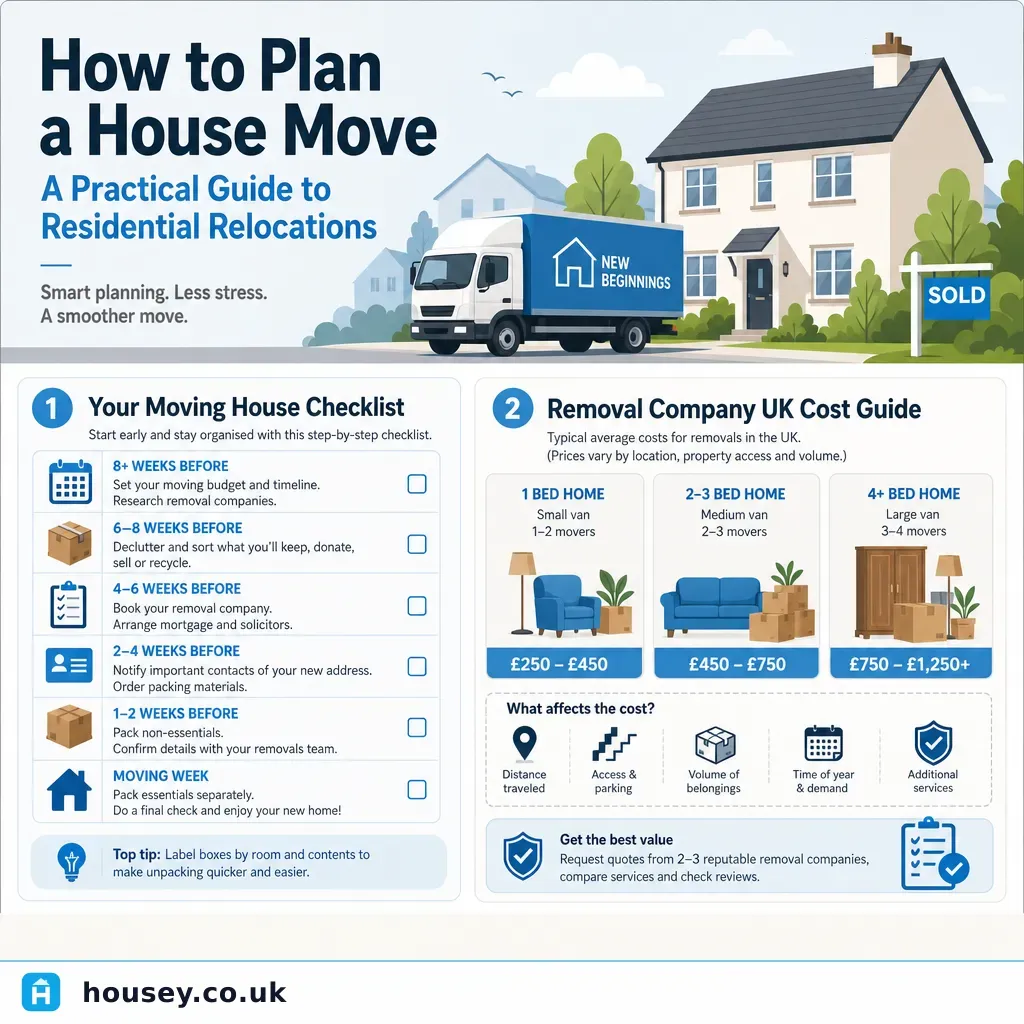 Buying & Moving
How to Plan a House Move: A Practical Guide to Residential Relocations
A UK house move goes more smoothly with planning that starts 6–8 weeks before moving day.
 Buying & Moving
Managing Residential Moves During Major Urban Events
Moving house during a major urban event — a marathon, carnival, street festival, or large sporting occasion — requires advance planning around road closures, parking suspensions, and access restrictions.
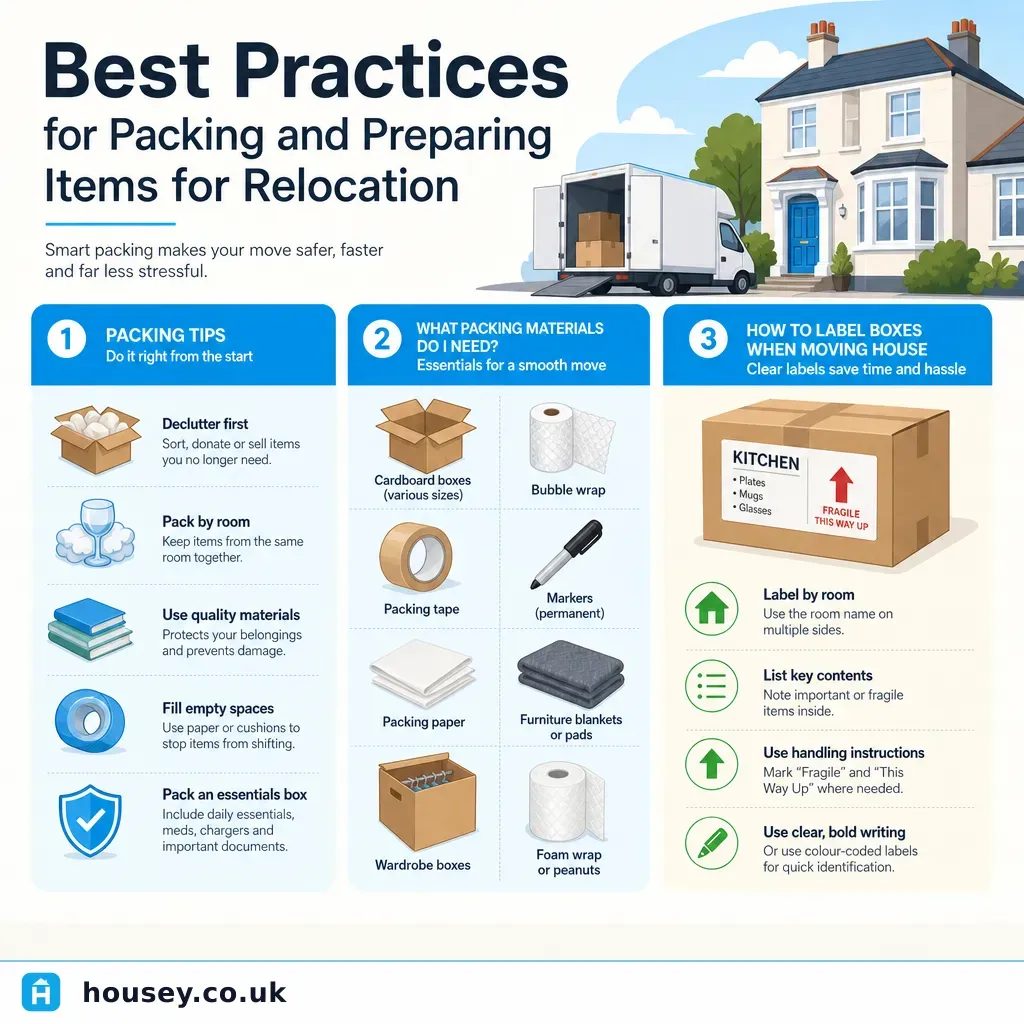 Buying & Moving
Best Practices for Packing and Preparing Items for Relocation
Good packing starts four to six weeks before moving day, following a room-by-room sequence from loft and rarely used spaces first.
 Buying & Moving
Moving Home During the Festive Season: Planning and Logistics Guide
Moving home during the festive season is achievable but requires extra planning.
 Buying & Moving
Managing Property Relocation in Major Urban Centres
Urban house moves require planning beyond a standard removal, particularly around vehicle emission zone compliance, parking bay suspensions, and lift access in purpose-built flats.