Moving Home During the Festive Season: Planning and Logistics Guide
By Housey · Last reviewed 31st of May 2026

Moving Home During the Festive Season: Planning and Logistics Guide
The weeks between late November and early January sit at the intersection of two major life events for many UK homeowners: property completions and the Christmas break. Whether your chain has pushed a completion into December or you have planned your move around a lease end, understanding how the festive period affects removals, legal timelines, and service availability can make the difference between a smooth handover and a last-minute scramble.
Key points
- HM Land Registry and most solicitors' offices close for at least 3–4 working days over Christmas, making completion legally impossible on those dates.
- Stamp Duty Land Tax (SDLT) returns must be filed and paid within 14 days of completion in England — this deadline does not pause for bank holidays or the festive break.
- Most removal companies report late November to mid-December as their peak booking period; lead times can stretch to 6–8 weeks for December slots.
- Storage-in-transit is available from most national removals firms and can bridge the gap when completion and property access do not fall on the same day.
- Royal Mail redirection typically takes 5–7 working days to activate — set this up at least 2 weeks before your intended move date to avoid festive backlogs.
How the festive period affects property completions
Completion requires several parties to be simultaneously available: your conveyancer, your buyer's conveyancer, mortgage lenders, and HM Land Registry. During the Christmas period, most solicitors' practices operate reduced hours from around 23 December, and many close entirely from Christmas Eve until 2 or 3 January.
HM Land Registry publishes its annual office closure dates on GOV.UK. While many registration tasks can proceed electronically, your conveyancer still needs to be available to authorise transfers. If a completion date falls on a bank holiday, it typically rolls to the next working day — which can have knock-on consequences for an entire chain.
Mortgage lenders also reduce processing capacity in late December, which can delay the drawdown of funds. If your completion relies on a mortgage, confirm with your lender that funds can be released on the proposed date before you commit to a festive completion.
Removal company availability over Christmas
Period | Typical availability | Booking lead time | Notes |
|---|---|---|---|
Late November | Good | 3–4 weeks | Pre-Christmas rush begins |
1–20 December | Reduced | 6–8 weeks | Peak demand; prices may be higher |
21–27 December | Very limited | Fully booked for most firms | Most companies do not operate 24–27 Dec |
28–31 December | Patchy | Short notice often impossible | Some firms operate; confirm directly |
2–7 January | Recovering | 2–3 weeks | New year demand spike |
Book your house removals company as soon as your completion date is confirmed — do not wait until contracts are exchanged if you are moving in December or early January. Many firms require a deposit at booking; check their cancellation policy carefully in case your completion date shifts by even one day.
What to do if completion and access do not align
It is not uncommon for a chain completion to proceed on 23 December while the new property needs cleaning, key collection, or access arrangements that make same-day moving impractical. Storage-in-transit provides a practical bridge: your contents are collected when your old property is vacated and held securely until you are ready to move in.
Storage-in-transit is typically charged per week or part-week. Get costs confirmed in writing before your move, including the level of insurance cover during storage and the process for accessing your belongings should your completion date change.
Practical checklist for a festive-period move
- 8 weeks before: Confirm your target completion date with your conveyancer and ask for a candid risk assessment given the festive schedule.
- 6–8 weeks before: Obtain at least three quotes from removal companies and book your preferred firm with written confirmation.
- 4 weeks before: Set up Royal Mail redirection (allow 5–7 working days to activate).
- 3 weeks before: Notify HMRC, DVLA, your bank, and utility providers of your new address.
- 2 weeks before: Confirm the removals booking; ask about their policy if completion slips by one day.
- 1 week before: Pack non-essential items; arrange care for children or pets on moving day.
- Moving day: Take meter readings at both properties and photograph the condition of each home.
- After moving: Confirm with your conveyancer that the SDLT return has been filed within 14 days of completion.
What not to assume about a festive move
Many buyers and sellers assume their conveyancer will proactively flag problems with a festive completion date. In practice, it is your responsibility to ask. Confirm in writing:
- The proposed completion date is achievable given the festive closure schedule.
- Your conveyancer will be personally available — not on annual leave — on completion day itself.
- Your mortgage lender has confirmed it can release funds on that specific date.
- Your removal company's booking is protected if the completion date slips by one day.
Assuming these details will resolve themselves is one of the most common causes of last-minute festive moving crises in UK property chains.
When to get professional help
If you are in a chain of three or more properties, a festive completion introduces meaningful coordination risk. A single party closing early — a solicitor, a lender, or an estate agent — can stall the entire chain. Ask your estate agent to arrange a chain coordination call between all conveyancers before the Christmas break begins.
Seek advice promptly if:
- Your conveyancer stops responding in late November and you have a December completion date.
- Your mortgage lender cannot confirm fund release before their festive closure.
- A new issue arises after exchange that triggers renegotiation in the weeks immediately before Christmas.
How Housey can help
Housey connects you with vetted house removals companies and storage providers experienced in festive-period moves. If you need a solicitor who will confirm their Christmas availability in writing before you instruct, our conveyancing service can help you find one.
Frequently asked questions
Can I exchange and complete on the same day over Christmas?
Same-day exchange and completion is unusual at any time of year and becomes harder in December when solicitors operate reduced schedules. Most conveyancers recommend leaving at least five to ten working days between exchange and completion to allow mortgage funds to be arranged. Over Christmas, this window often needs to extend further to account for closures at solicitors' firms, lenders, and HM Land Registry.
What happens to my SDLT deadline if completion falls on 23 December?
Stamp Duty Land Tax must be filed and paid within 14 days of completion in England — bank holidays and the festive break do not pause this clock. Completing on 23 December means the deadline falls on 6 January. Your conveyancer typically handles the submission, but confirm it will be filed before their festive closure to avoid a late-filing penalty from HMRC.
Do removal companies charge more at Christmas?
Many removal firms apply a seasonal surcharge in December, particularly in the weeks running up to Christmas Day. Surcharges of 10–20% above standard rates are common among national and London-based operators. Always obtain a written quote specifying whether the price is fixed or subject to adjustment for date changes or fuel costs, and compare at least three firms before committing.
Is it worth delaying my completion until January to avoid the festive rush?
Delaying until January can ease removal logistics and solicitor availability, but it extends your chain's exposure time and may affect your mortgage offer's validity. Check with your lender how long the current offer remains valid. If it expires in December, a January completion could require a fresh application, adding cost and uncertainty. Weigh the practical advantage carefully against the financial risk before deciding.
Sources and further reading
- HM Land Registry office closures — GOV.UK
- Stamp Duty Land Tax: pay and file — GOV.UK
- Moving home — Citizens Advice
- Royal Mail redirection service — Royal Mail
Useful next reads
 Buying & Moving
How to Plan a House Move: A Practical Guide to Residential Relocations
A UK house move goes more smoothly with planning that starts 6–8 weeks before moving day.
 Buying & Moving
Managing Residential Moves During Major Urban Events
Moving house during a major urban event — a marathon, carnival, street festival, or large sporting occasion — requires advance planning around road closures, parking suspensions, and access restrictions.
 Buying & Moving
Essential Considerations For Planning A Property Relocation
Planning a UK property relocation means coordinating legal, financial, and practical steps across several months.
 Buying & Moving
Managing Property Relocation in Major Urban Centres
Urban house moves require planning beyond a standard removal, particularly around vehicle emission zone compliance, parking bay suspensions, and lift access in purpose-built flats.
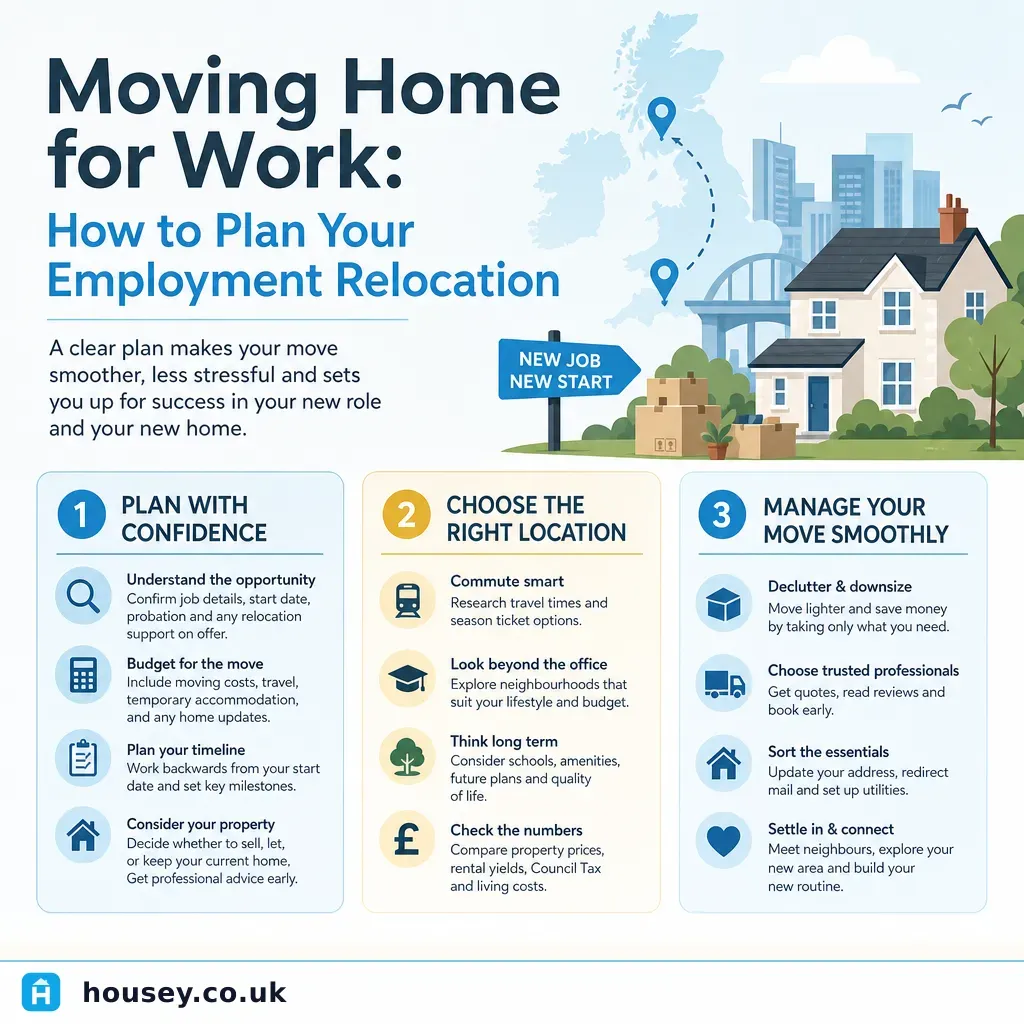 Buying & Moving
Moving Home for Work: How to Plan Your Employment Relocation
Moving home for a new job requires coordinating property timelines, removal logistics, and employer reimbursement simultaneously.