Essential Guidance for Property Landlords and Investors
By Housey · Last reviewed 18th of May 2026

Essential Guidance for Property Landlords and Investors
UK residential property remains one of the most actively managed asset classes, yet landlords face an increasingly complex framework of legal duties, tax obligations, and tenant-protection rules. Whether you own a single buy-to-let flat or a growing portfolio, understanding what is required of you — before tenants move in and throughout the tenancy — is central to protecting your investment and staying on the right side of the law.
Key points
- Landlords must provide an Energy Performance Certificate (EPC) rated E or above to new tenants; proposed reforms may raise this threshold to C for new tenancies from 2028 (check GOV.UK for confirmed dates and any transitional arrangements).
- A Gas Safety Record (CP12) must be issued annually by a Gas Safe Register-registered engineer and provided to tenants within 28 days of the check.
- An Electrical Installation Condition Report (EICR) is required every five years for all private rented homes in England, issued by a qualified electrician registered with NICEIC or NAPIT.
- The Renters' Rights Bill (proceeding through Parliament as of May 2026) proposes to abolish Section 21 no-fault evictions and introduce a new periodic tenancy regime — landlords should monitor its progress on GOV.UK.
- Since April 2020, mortgage interest relief for residential landlords has been replaced by a 20% tax credit under Section 24 of the Finance (No. 2) Act 2015, significantly affecting higher-rate and additional-rate taxpayers.
What landlord and investor status means in practice
Owning rental property in the UK is legally distinct from living in your own home. You become responsible for maintaining the property to the Decent Homes Standard, complying with fire safety requirements under the Regulatory Reform (Fire Safety) Order 2005, and meeting a growing list of prescribed documentation duties from the outset of each tenancy.
Investment buyers — those purchasing with a buy-to-let mortgage — are subject to an additional stamp duty land tax (SDLT) surcharge of 5% on top of standard rates for additional dwellings in England (as of October 2024; check GOV.UK for current figures). Scottish buyers pay Land and Buildings Transaction Tax (LBTT) with an Additional Dwelling Supplement (ADS); Welsh buyers pay Land Transaction Tax (LTT) with a higher residential rate. Professional advice from a chartered accountant and a regulated solicitor is strongly advisable before any purchase.
Certificates and compliance: what you must provide
Every private rented home in England must be backed by a documented compliance trail from day one of a tenancy. The table below summarises the key certificates and their renewal requirements.
Certificate or document | Frequency | Who can issue | Must be given to tenant? |
|---|---|---|---|
Gas Safety Record (CP12) | Annually | Gas Safe Register engineer | Yes — within 28 days of check |
EICR | Every 5 years | NICEIC or NAPIT registered electrician | Yes — within 28 days or before move-in |
Energy Performance Certificate (EPC) | Every 10 years (or sooner if rating changes) | Accredited energy assessor | Yes — before marketing |
Smoke and CO alarm compliance | Verify at start of tenancy; CO alarms required in rooms with fixed combustion appliances | Landlord responsible | No formal certificate, but written records recommended |
How to Rent guide | At start of each tenancy | Current GOV.UK PDF | Yes — must be the current edition |
Failure to provide required documents can prevent a landlord from serving a valid Section 21 notice (where still available) and may attract civil penalties of up to £30,000 under the Housing and Planning Act 2016.
Landlord obligations: a pre-tenancy checklist
Use the following checklist before allowing a new tenant to move in.
Knowing the value of your investment property
Accurate valuation underpins sound investment decisions — whether you are purchasing, remortgaging, extending a portfolio, or considering a sale. A professional valuation survey provides an independent assessment of current market value, which differs meaningfully from an estate agent's marketing appraisal. RICS-registered valuers produce reports compliant with the RICS Red Book (RICS Valuation — Global Standards), which most mortgage lenders require for buy-to-let purposes.
Rental yield depends on the gross rent achieved relative to purchase price or current market value. Indicative gross yields across UK regions vary — from approximately 3–4% in prime London postcodes to 7–9% in some northern cities — but net yield after tax, voids, maintenance, and management fees is the more meaningful figure. Any yield calculation should be stress-tested against an interest rate change and a void period of at least two months.
When marketing a property to let, professional property photography and floorplans consistently improve listing performance on Rightmove and Zoopla, reducing void periods and supporting a higher achievable rent.
Red flags: when your investment may be at risk
Certain situations warrant immediate professional advice rather than self-managed responses:
- A tenant reports damp, mould, or condensation — this may engage the Housing Health and Safety Rating System (HHSRS), which local councils can use to issue improvement notices.
- The property falls within a selective or additional licensing area and you are not licensed — operating without the required licence carries fines of up to £30,000 and may enable a Rent Repayment Order.
- You receive any notice from the local authority following a tenant complaint.
- Structural cracking, roof failure, or subsidence is identified at the property — these may constitute Category 1 hazards under HHSRS.
- A tenancy dispute progresses to the First-tier Tribunal (Property Chamber).
Important limitations
This article provides general information about landlord obligations and residential investment property in England. Rules differ materially in Scotland, Wales, and Northern Ireland. Tax treatment, licensing requirements, and tenancy law are subject to change. Nothing in this article constitutes legal, financial, or tax advice. Consult a regulated solicitor, RICS-accredited valuer, or chartered accountant before making any investment or compliance decision.
What to ask a qualified professional
Before purchasing an investment property, or at the start of each new tenancy, consider asking:
- What is the current market rent and achievable net yield for this property in this postcode area?
- Does this property fall within a selective or additional licensing area?
- Is the EPC rating compliant with current minimum standards, and is it likely to remain compliant under proposed 2028 reforms?
- What is the condition of the electrical installation, and when is the EICR next due for renewal?
- What are the likely tax implications as a higher-rate or additional-rate taxpayer, including the Section 24 mortgage interest restriction?
When to get professional help
Landlord compliance is an ongoing responsibility, not a one-off exercise. Seek professional help:
- When purchasing any buy-to-let property — instruct a solicitor, accountant, and RICS-registered valuer.
- Before marketing a property to let — verify local licensing requirements with your council.
- When a tenant raises a repair or hazard complaint in writing.
- When considering a rent increase, eviction, or change to tenancy terms.
- If you receive any local authority enforcement notice or improvement notice.
How Housey can help
Housey connects landlords and investors with trusted professionals across the UK. Whether you need a valuation survey to inform a purchase or remortgage decision, or professional property photography and floorplans to reduce void periods and attract quality tenants, Housey can match you with qualified local providers quickly.
Frequently asked questions
Do I need a licence to rent out a property in England?
Not always. Houses in multiple occupation (HMOs) housing five or more people forming two or more households require a mandatory HMO licence. Many councils also run selective or additional licensing schemes in specific local areas. Check your local authority's website before letting any property, as operating without a required licence can result in fines of up to £30,000 and may prevent rent recovery.
What happens if I don't have a valid EICR?
Landlords who fail to provide a valid Electrical Installation Condition Report within 28 days of a new tenancy, or by the renewal date, can be fined up to £30,000 by the local authority. You may also be unable to serve a valid Section 21 notice until any remedial works are completed and written evidence is provided to the tenant.
Can I manage a rental property myself without an agent?
Yes. Self-management is permitted, but you remain fully responsible for all legal compliance, maintenance, and tenancy obligations. Many landlords use a letting agent regulated by Propertymark or ARLA for day-to-day management. Agents must hold client money protection, which provides important consumer safeguards if the agency business fails.
How does the proposed abolition of Section 21 affect landlords?
The Renters' Rights Bill, if enacted as drafted, would remove Section 21 no-fault evictions and replace all assured shorthold tenancies with periodic tenancies. Landlords would need to rely on specified Section 8 grounds for possession. Monitor GOV.UK for confirmed enactment dates and seek legal advice once the legislation is confirmed.
Sources and further reading
- Private renting: your rights and responsibilities — GOV.UK
- Landlord duties: gas safety — Gas Safe Register
- EICR for landlords — NICEIC
- Renters' Rights Bill — GOV.UK
- Stamp Duty Land Tax: residential property rates — GOV.UK
- RICS Valuation Standards (Red Book) — RICS
Useful next reads
 Buying & Moving
Buy-to-Let Property Investment: Essential Guidance for Landlords
Buy-to-let investment in the UK requires careful financial planning.
 Buying & Moving
What Property Covenants Are and How They Affect Your Home
A property covenant is a legally binding promise attached to land rather than to a specific owner, recorded in the title deeds and registered at HM Land Registry.
 Buying & Moving
Essential guidance for first-time property owners in the UK
As a new UK homeowner, your first responsibilities are buildings insurance from exchange, utility transfers, council tax registration, and gathering key documents including the title register and EPC.
 Buying & Moving
Leasehold Explained: Ownership Rights and Long-Term Implications
Leasehold means you own the right to occupy a property for a fixed term — you do not own the land or building.
 Buying & Moving
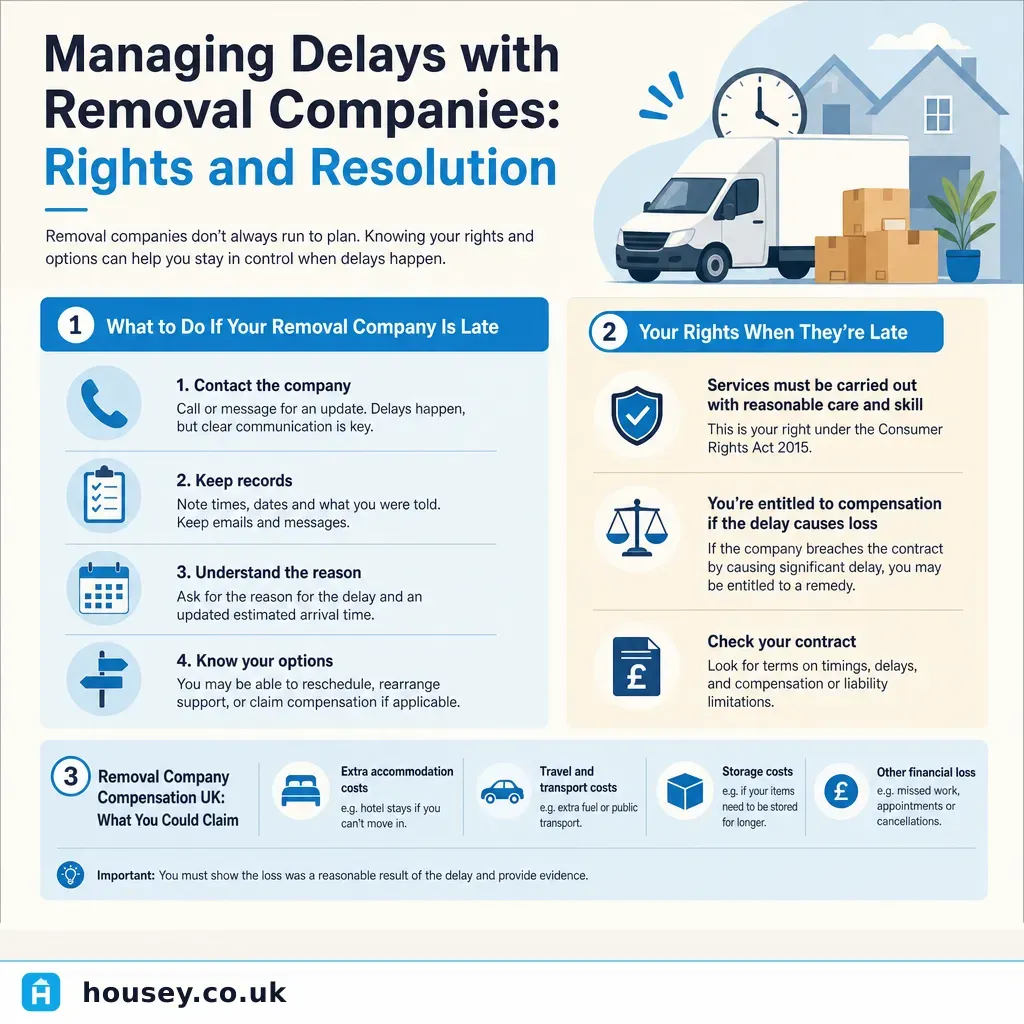
Managing Delays with Removal Companies: Rights and Resolution
If a removal company is late, your rights depend on your contract and whether the company is BAR-registered.