What Property Covenants Are and How They Affect Your Home
By Housey · Last reviewed 24th of May 2026

What Property Covenants Are and How They Affect Your Home
Property covenants are one of those legal features that can surprise homeowners long after completion. They do not appear on a title plan, they do not come up in an estate agent's valuation, and they are not always mentioned until a solicitor finds them in the title deeds during a purchase or remortgage. Yet their effects can be long-lasting: a covenant can determine whether you are permitted to build an extension, run a business from home, subdivide a property, or even keep certain animals on the premises.
Key points
- A covenant is a legally binding promise relating to land, recorded in a deed and usually registrable at HM Land Registry under the Law of Property Act 1925 and the Land Registration Act 2002.
- Restrictive covenants "run with the land" — they bind every future owner of the burdened property automatically, not just the party who originally agreed to them.
- The benefit of a covenant (the right to enforce it) belongs to another parcel of land — usually a neighbouring plot, an estate developer's retained land, or a housing association.
- Positive covenants (requiring the owner to do something) do not technically run with the land under English and Welsh law, but are routinely passed forward via a deed of covenant at each point of sale.
- Breach of a restrictive covenant can result in an injunction requiring works to be undone and/or a claim for damages — though enforcement depends on who holds the benefit and their willingness to act.
The difference between restrictive and positive covenants
The most important distinction in UK residential property law is between what you are prevented from doing and what you are required to do.
A restrictive covenant is a negative obligation — it limits your use of the land. Restrictive covenants are common in both freehold and leasehold properties. In new-build developments, they are routinely used by developers to preserve the character and value of an estate long after all plots have been sold.
A positive covenant is an active obligation — to maintain a shared access road, contribute to the upkeep of an estate communal area, or keep a boundary wall in repair. Positive covenants are harder to enforce against successors in title because English and Welsh law does not allow the burden of a positive covenant to pass automatically to a new owner. Developers address this by requiring each buyer to enter into a deed of covenant at the point of sale, making the obligation contractual as well as proprietary.
Covenant type | Obligation | Enforceable against future owners? | Who can enforce? |
|---|---|---|---|
Restrictive | Negative — do not do something | Yes — automatically runs with the land | Owner of the benefiting land |
Positive | Active — do something | Not automatically — usually via deed of covenant | Housing association, developer, or neighbouring owner |
Leasehold covenant | Either — as set out in the lease | Yes — via the terms of the lease | Landlord or freeholder |
Building scheme covenant | Restrictive — mutual obligations across an estate | Yes — each plot owner can enforce against others | Any owner of a plot within the scheme |
How covenants run with the land
The legal phrase "runs with the land" means that a covenant attaches to the land itself rather than to the specific person who agreed to it. When you buy a property subject to a restrictive covenant, you take on the burden of that covenant whether or not it was drawn to your attention before exchange of contracts.
This is why a thorough title investigation by a conveyancing solicitor is important. The burden passes automatically to the new registered owner; ignorance of the covenant is not a defence against enforcement.
The benefit — the right to enforce the covenant — also runs with the land in most circumstances. This means a neighbour whose land benefits from a covenant can enforce it against you even if you had no direct dealings with them at the time of purchase, and even if you were unaware the covenant existed.
Common covenants found in UK residential property
The covenants most frequently encountered on freehold residential properties in England and Wales include:
- No further building: restrictions on erecting outbuildings, garages, extensions, or garden structures without consent from a named beneficiary (often an historic estate or the original developer).
- Residential use only: prohibiting commercial activity, holiday letting, conversion to flats, or any use other than a single private dwelling house.
- No external alterations: common on 1930s, post-war, and later estate developments to preserve a uniform appearance — often covering roof changes, window replacements, and satellite dishes.
- Boundary maintenance obligations: positive covenants requiring the upkeep of a fence, wall, hedge, or gate on a specified boundary, often indicated by a "T" mark on the title plan.
- Estate charge contributions: obligations to contribute to shared roads, drainage, lighting, or landscaping on private or managed developments — increasingly common on new-build estates built since the 1990s.
What not to assume about covenants
Several common misunderstandings can lead homeowners into difficulty.
Do not assume an old covenant is automatically unenforceable. While courts have discretion in weighing equitable remedies, a restrictive covenant does not expire due to age alone. Victorian covenants have been enforced in the twenty-first century, particularly where an identifiable beneficiary still holds land nearby.
Do not assume planning permission overrides a covenant. Planning permission from your local planning authority is entirely separate from private land law obligations. Obtaining planning permission for an extension does not mean a restrictive covenant no longer applies — you need both, and the covenant remains a private matter between you and the beneficiary.
Do not assume a covenant is visible on the title plan. The title plan shows boundaries and the extent of the registered title, not the obligations attached to it. Covenants are in the Charges Register section of the title register and in any filed deed documents.
Do not assume your conveyancer will automatically flag every practical implication. Conveyancers are trained to identify covenants, but you should read the title report they send you and ask questions if any restriction could affect your intended use of the property — particularly if you plan alterations, a home office, or a change in use.
Red flags when reviewing covenants
These situations warrant additional investigation or specialist advice before proceeding:
- A covenant granted to a named developer whose successor company you cannot trace — the benefit may still be identifiable and enforceable.
- Recent correspondence between the seller and a third party about a covenant, disclosed in the TA6 property information form or via solicitor's enquiries.
- A covenant that restricts exactly the kind of development or use you are planning — do not exchange contracts assuming you can resolve this later.
- A covenant granted within the past 20 years, particularly on a new-build or regeneration site, where the developer's retained land may still benefit from it.
- Any property within a building scheme, where mutual covenants exist and any plot owner on the estate may have the right to enforce against you.
- A positive covenant on a property with no management company or residents' association — it may be unclear who is responsible or who you should be paying.
Important limitations
This article provides a general explanation of how property covenants work in England and Wales. It is not legal advice. The enforceability of any specific covenant depends on its precise wording, the history of the title, whether the beneficiary can be identified, whether a building scheme exists, and judicial interpretation. Scotland operates under a distinct legal framework (the Title Conditions (Scotland) Act 2003 governs real burdens). Always instruct a qualified conveyancing solicitor to review the title before exchange of contracts.
What to ask a qualified professional
- Is there a building scheme in place, and which properties share the benefit of these covenants?
- Does any covenant restrict something I currently intend to do with the property?
- Is the wording of the covenant broad enough to cover alterations I may not yet have anticipated?
- Has the seller ever sought consent from the beneficiary, and what was the outcome?
- Are there any covenants in the title that might affect my ability to remortgage or sell in the future?
- What options are available to vary or discharge a covenant, and what are the realistic costs and timescales?
When to get professional help
Instruct a conveyancing solicitor before exchange on any property. Specialist advice from a solicitor or barrister with expertise in land law may be needed if:
- You intend to develop or alter the property and a covenant may restrict that work.
- You discover that a covenant was breached before you purchased the property and indemnity insurance is not available or acceptable to your lender.
- You wish to apply to the Upper Tribunal (Lands Chamber) to discharge or modify a covenant under section 84 of the Law of Property Act 1925.
- You are buying into a building scheme with mutual covenants across a development where multiple neighbouring owners could enforce against you.
How Housey can help
Understanding covenants starts with having the right professional examine the title. Housey's conveyancing solicitor service connects you with qualified solicitors and licensed conveyancers who can report on any restrictions in the title deeds clearly and in good time before you commit to a purchase.
Frequently asked questions
Does a covenant show up on a local authority search?
No. Local authority searches reveal planning history, building control, and other public law matters. Covenants are private law obligations revealed through the title register at HM Land Registry, which your conveyancer obtains as part of the title investigation. You can also purchase a copy of the title register yourself from HM Land Registry for £3.00 via GOV.UK.
What is a deed of covenant in a leasehold flat purchase?
When you buy a leasehold flat, you typically sign a deed of covenant with the freeholder, formally agreeing to observe the terms of the lease. This is standard practice and ensures that the freeholder and other leaseholders can hold you to the lease obligations — including restrictive and positive covenants — even though you were not a party to the original lease.
Can I find out if my property has a covenant before instructing a solicitor?
Yes. You can purchase a copy of the title register from HM Land Registry for £3.00 via GOV.UK. The Charges Register will show whether any covenants are noted. However, the full wording usually requires a separate application for the underlying filed deed. A conveyancing solicitor interprets the practical implications — the raw document alone may not reveal the full picture.
What happens if I breach a covenant without realising?
The consequence depends on whether the beneficiary chooses to enforce. They may apply for an injunction requiring you to undo works, or claim damages. In practice, many breaches are resolved through retrospective consent or indemnity insurance. However, a breach discovered during a future sale can delay or complicate the transaction and may require insurance before any buyer's mortgage lender will proceed.
Sources and further reading
- HM Land Registry: Search for land and property information — GOV.UK
- Law of Property Act 1925 — legislation.gov.uk
- Land Registration Act 2002 — legislation.gov.uk
- Upper Tribunal (Lands Chamber) guidance — GOV.UK
- Citizens Advice: Restrictions on property — Citizens Advice
Useful next reads
 Buying & Moving
Property Covenants: Legal Restrictions You May Encounter When Buying
Property covenants are legally binding obligations tied to land and registered at HM Land Registry.
 Buying & Moving
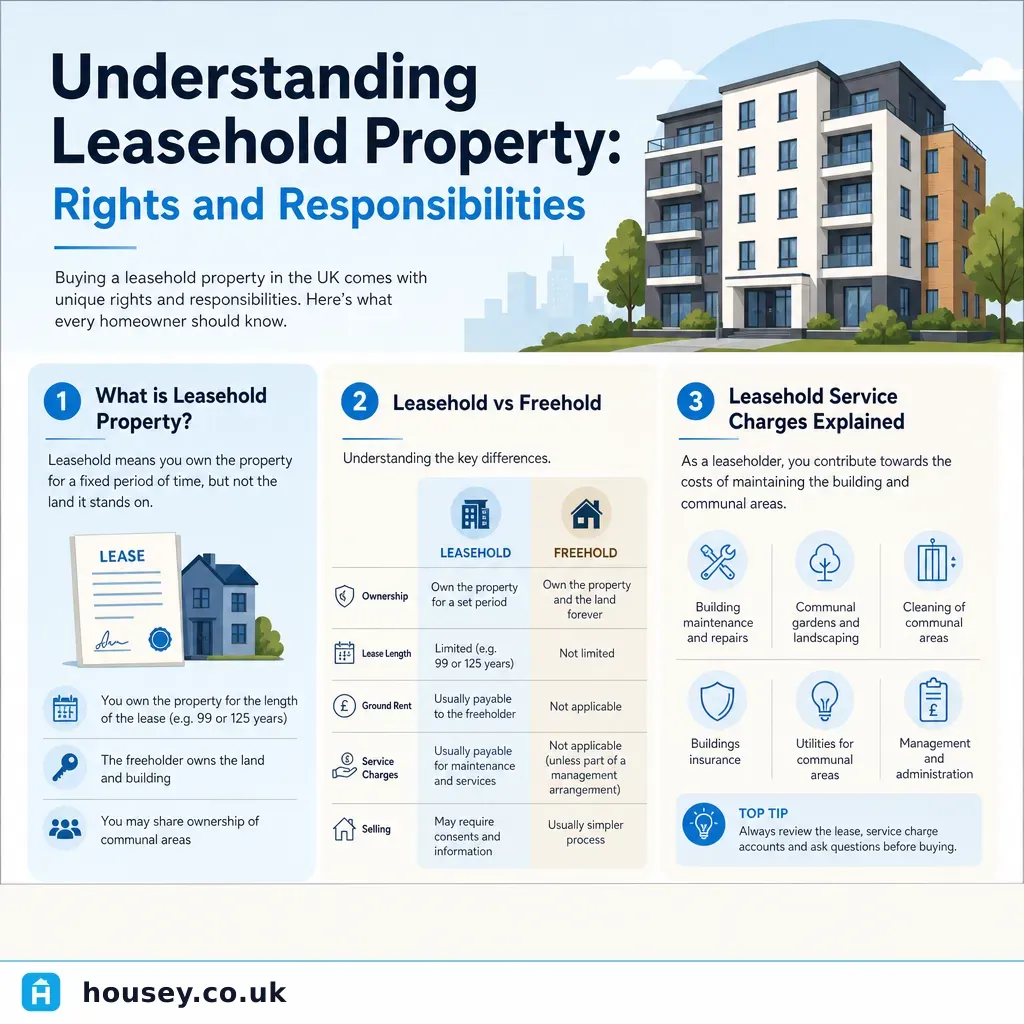
Understanding Leasehold Property: Rights and Responsibilities
Leasehold means you own a time-limited interest in a property while the freeholder owns the land and building.
 Buying & Moving
Navigating Simultaneous Purchase and Sale of Property
When buying and selling simultaneously in England and Wales, both sets of contracts are exchanged on the same day — this is called simultaneous exchange.
 Buying & Moving
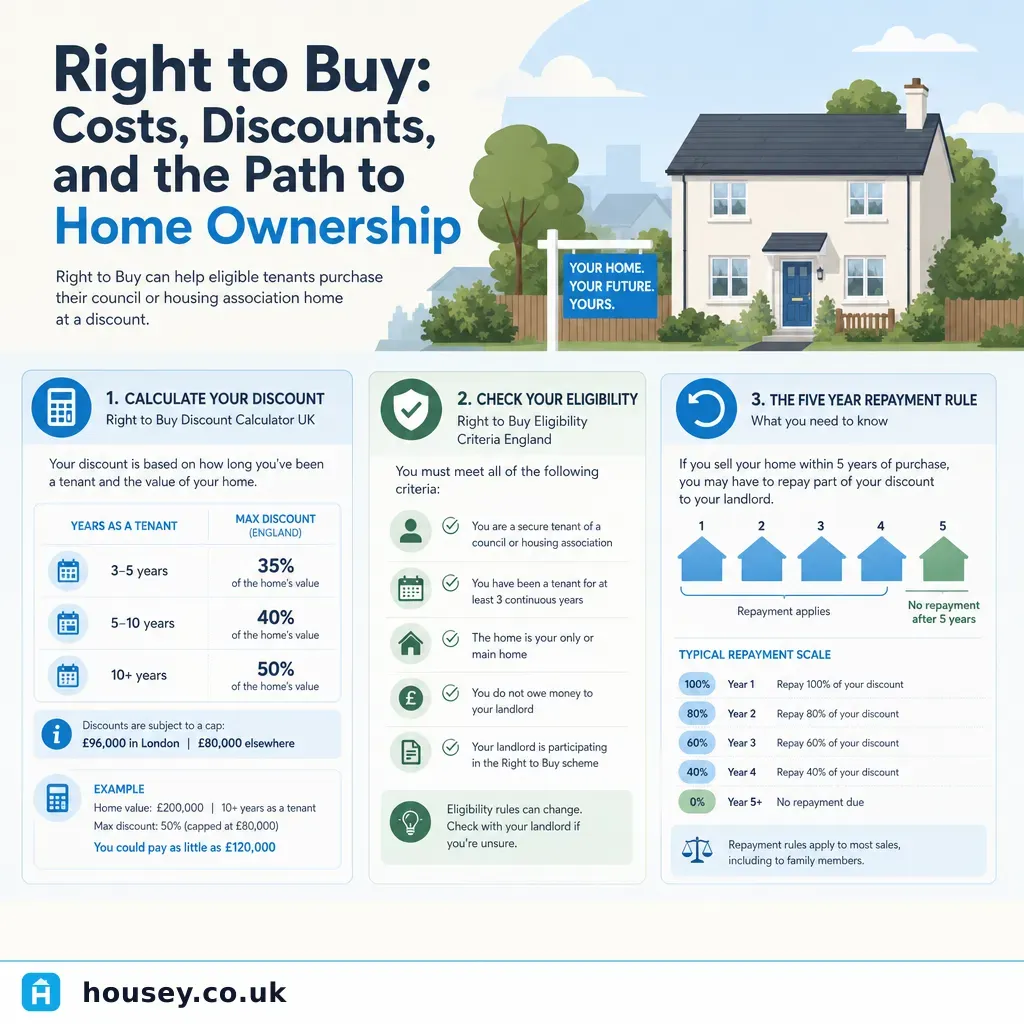
Right to Buy: Costs, Discounts, and the Path to Home Ownership
Right to Buy lets eligible council tenants in England buy their home at a government-funded discount — between 35% and 70% of its value, depending on tenancy length and property type.
 Buying & Moving
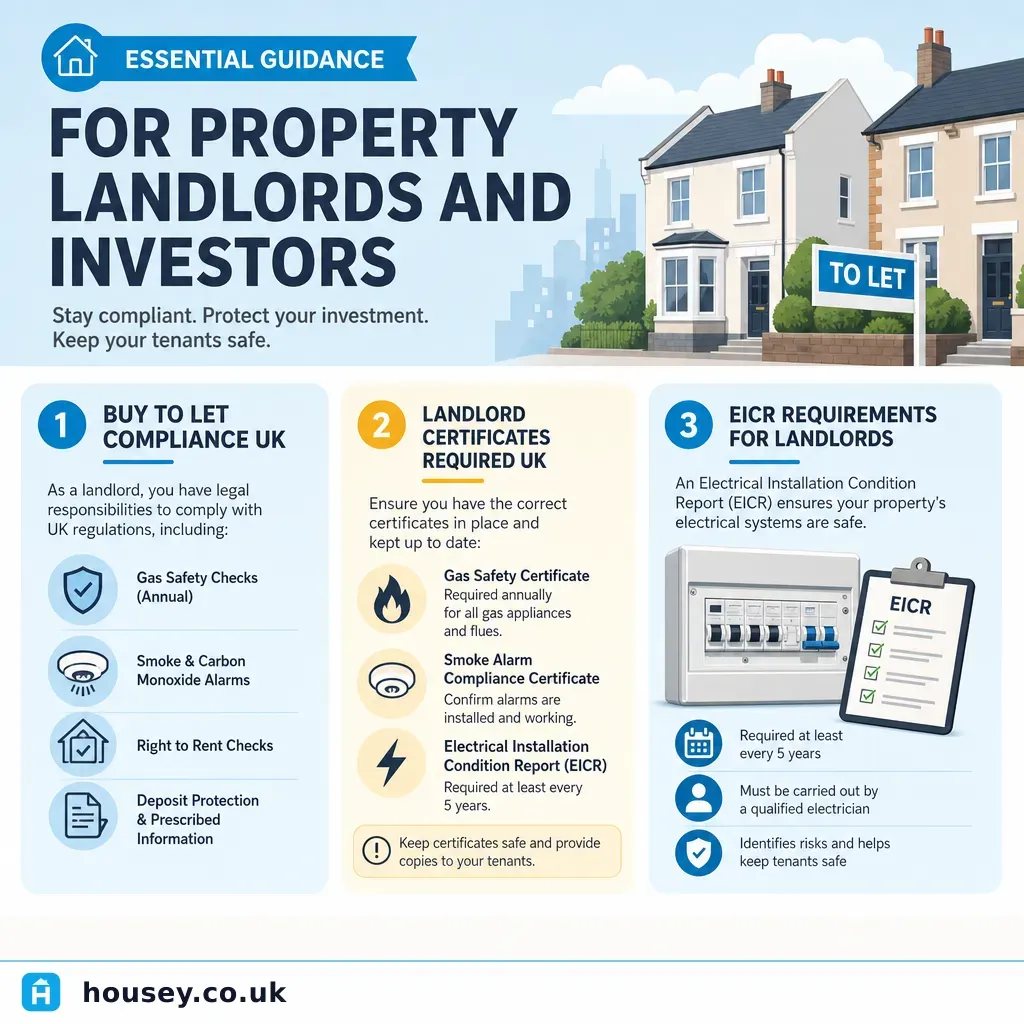
Essential Guidance for Property Landlords and Investors
UK landlords must hold valid gas safety records, electrical installation condition reports, and energy performance certificates before letting a property.